
Steel Fiber Market Size and Share
Market Overview
| Study Period | 2022 - 2032 |
|---|---|
| Market Size (2027) | USD 2.60 Billion |
| Market Size (2032) | USD 3.38 Billion |
| Growth Rate (2027 - 2032) | 5.37 % |
| Fastest Growing Market | Asia-Pacific |
| Largest Market | Asia-Pacific |
| Market Concentration | Medium |
Major Players *Disclaimer: Major Players sorted in no particular order Image © Mordor Intelligence. Reuse requires attribution under CC BY 4.0. | |
Steel Fiber Market Analysis by Mordor Intelligence
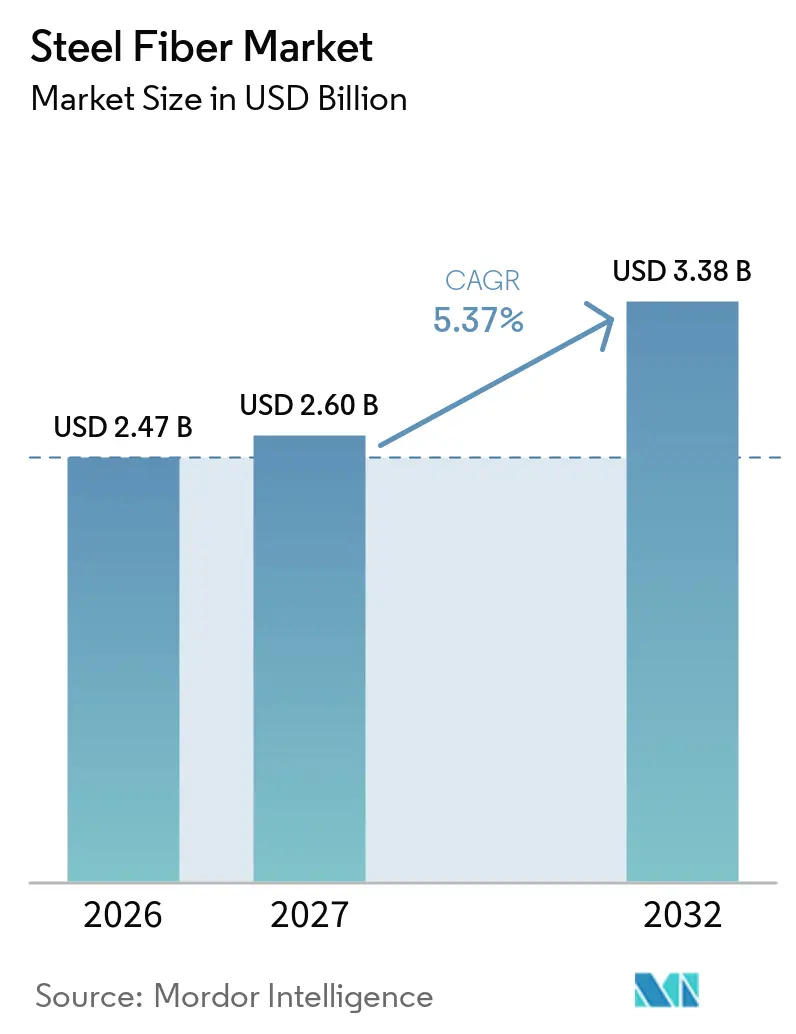
The Steel Fiber Market size was valued at USD 2.47 billion in 2026 and is estimated to grow from USD 2.60 billion in 2027 to USD 3.38 billion by 2032, at a CAGR of 5.37% during the forecast period (2027-2032). Demand is supported by rehabilitation work on aging transport assets, wider use of tunnel-boring-machine precast segments, and warehouse construction serving automated logistics operations. Steel fibers can reduce reliance on conventional mesh and rebar where contractors require faster placement, lower labor input, and durable structural performance. The steel fiber market is also gaining support from public buyers who now assess material intensity and carbon documentation alongside conventional technical criteria. Competition remains active, as macro-synthetic and glass fibers are better suited to some corrosive environments, while steel fibers retain an advantage in heavy infrastructure and industrial flooring. Producers are responding through product design, application engineering, drawing-line automation, and fiber lines that use recycled steel.
Key Report Takeaways
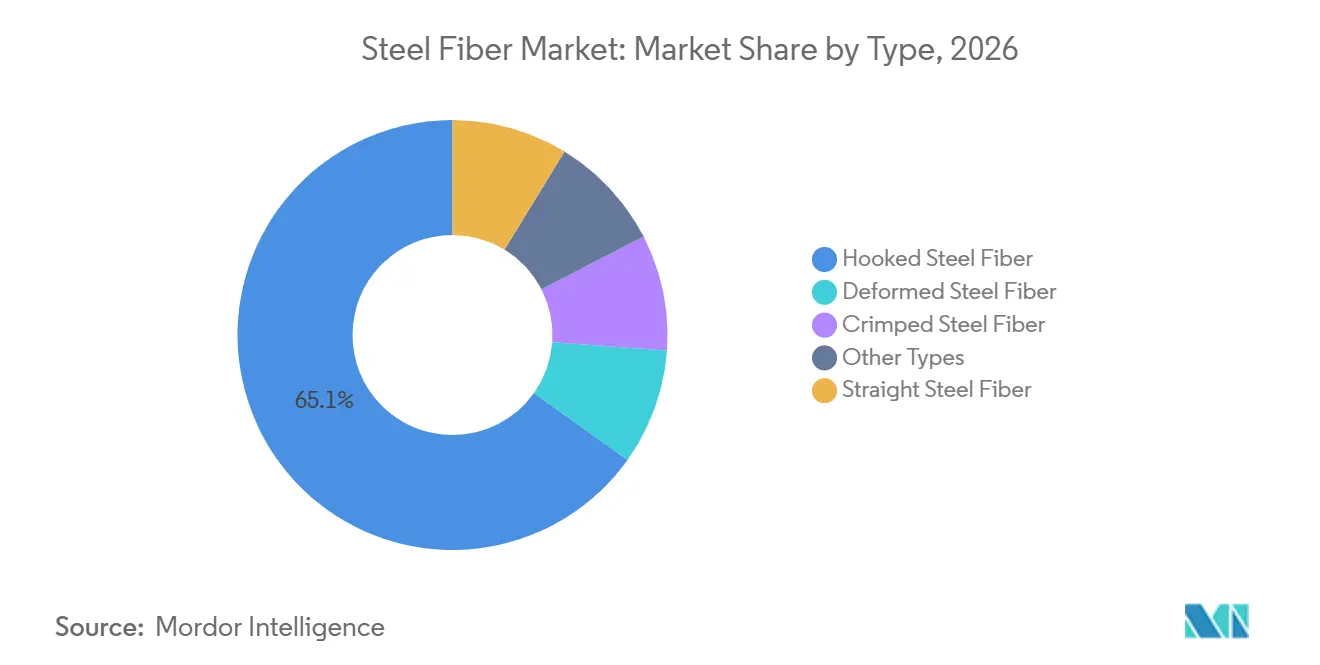
- By type, hooked steel fiber held 65.13% of the steel fiber market share in 2026, while deformed steel fiber is projected to grow at a 5.62% CAGR through 2032.
- By manufacturing process, cold drawn wire held 40.45% of the steel fiber market share in 2026 and is projected to grow at a 5.91% CAGR through 2032.
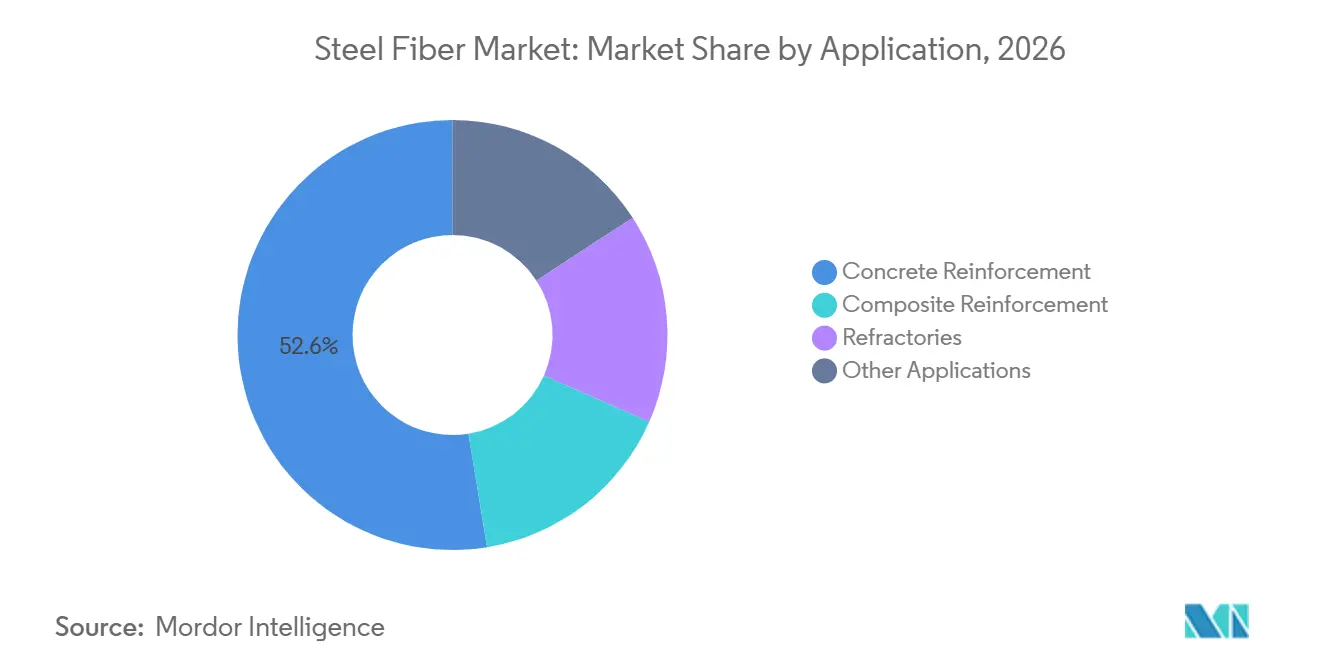
- By application, concrete reinforcement accounted for 52.56% of the steel fiber market size in 2026, while composite reinforcement is projected to grow at a 6.05% CAGR through 2032.
- By geography, Asia-Pacific held 33.72% of the steel fiber market share in 2026 and is projected to grow at a 5.78% CAGR through 2032.
Note: Market numbers in this report are based on Mordor Intelligence's proprietary estimation framework, which combines nine months of actuals with Q4 projections for base year 2026.
Market Trends and Insights
Drivers Impact Analysis of Steel Fiber Market*
| Drivers | (~) % Impact on CAGR Forecast | Geographic Relevance | Impact Timeline |
|---|---|---|---|
| Infrastructure Rehabilitation and Durable Transport Projects | +1.2% | Global, with concentration in North America, Europe, and Asia-Pacific | Medium term (2-4 years) |
| Labor-Saving Replacement of Mesh and Rebar | +1.0% | Global, with early traction in North America, Western Europe, and India | Short term (≤ 2 years) |
| Sustainable Construction and Lower Material Intensity | +0.7% | North America and Europe, with growing adoption in Gulf Cooperation Council (GCC) and Asia-Pacific | Medium term (2-4 years) |
| Industrial Flooring and Warehouse Automation | +0.9% | Global, with the fastest adoption in North America, Western Europe, and East Asia | Short term (≤ 2 years) |
| Tunnel, Shotcrete, and Precast Expansion in Asia-Pacific | +0.8% | Asia-Pacific, with expansion into the Middle East and Africa | Long term (≥ 4 years) |
| Source: Mordor Intelligence | |||
Infrastructure Rehabilitation and Durable Transport Projects
Aging transport systems in North America and Europe are generating steady demand for reinforcement materials used in bridge deck and road renewal projects. A 2025 peer-reviewed study found that ultra-high-performance fiber-reinforced concrete with up to 3% micro steel fibers could be produced at conventional ready-mix plants. The study also reported chloride-migration resistance and flexural strength suitable for bridge deck rehabilitation. This production approach reduces the need for specialized equipment that was previously limited to rehabilitation work. As a result, the steel fiber market can access projects where plant capacity and logistics are no longer the primary constraints. Familiarity with fiber specifications remains the main practical barrier as public authorities renew bridges and road decks.
Labor-Saving Replacement of Mesh and Rebar
Steel fiber systems are increasingly evaluated on project economics as well as structural performance. A 2025 review reported improvements in flexural strength of up to 51.7% and splitting tensile strength of 14-24% in concrete slab systems using steel fibers. The review also noted that fiber use can reduce positioning errors associated with fabric reinforcement. Fiber placement shifts the work from cutting, tying, and positioning reinforcement to a concrete-mixing operation. This is relevant to projects with short delivery schedules and limited access to skilled construction labor. The steel fiber market has an opportunity where flooring contractors and engineers update specifications to address labor constraints.
Sustainable Construction and Lower Material Intensity
Carbon reporting is influencing procurement decisions for reinforcement systems that reduce total steel and concrete use per structural element. ArcelorMittal Wire Solutions has promoted XCarb steel fibers, made from recycled and renewably produced steel, for construction applications. This product approach links fiber supply with carbon documentation, which is relevant to public tenders with material reporting requirements. Bekaert reported its acquisition of Twincon and Flexofibers, two companies focused on second-life fiber solutions. The company also introduced Dramix Loop, which uses steel recovered from end-of-life tires. These developments bring circular material content closer to a procurement requirement in Western Europe and selected North American projects[1].
Industrial Flooring and Warehouse Automation
Automated warehouses require floors that can maintain flatness under repeated traffic from guided vehicles, mobile robots, and narrow-aisle lift trucks. Steel fiber-reinforced self-stressing concrete can eliminate saw-cut joints in suitable designs. A continuous floor surface reduces operational issues associated with joint deterioration in automated facilities. Bekaert documented the use of Dramix 3D fibers in a 90,000 m² jointless warehouse floor for Flipkart in Kolkata. This project demonstrates how steel fiber solutions are being applied in large logistics buildings in India. International flatness standards are also making floor requirements more explicit for contractors and facility operators.
Restraints Impact Analysis of Steel Fiber Market*
| Restraints | (~) % Impact on CAGR Forecast | Geographic Relevance | Impact Timeline |
|---|---|---|---|
| Steel Wire Rod Price Volatility | -0.8% | Global, most acute in North America and Europe due to tariff exposure | Short term (≤ 2 years) |
| Competition from Synthetic, Glass, and Carbon Fibers | -0.6% | Global, strongest in markets with corrosion exposure in the Middle East and Africa, and coastal Asia-Pacific | Medium term (2-4 years) |
| Corrosion and Durability Risk in Aggressive Environments | -0.4% | Coastal Asia-Pacific, the Middle East and Africa, and North American deicing-salt regions | Long term (≥ 4 years) |
| Source: Mordor Intelligence | |||
Steel Wire Rod Price Volatility
Wire rod costs remain an immediate pressure point for steel fiber producers, as raw materials represent a significant share of production costs. In 2025, Insteel Industries reported that higher Section 232 tariffs increased wire rod costs and necessitated multiple price increases. These cost increases can be difficult to pass through to fiber customers immediately. The time gap between rising input costs and selling-price adjustments can compress margins. Smaller regional producers face greater exposure when they have limited hedging capacity or less purchasing scale. This operating pressure may support consolidation toward larger, more vertically integrated manufacturers[2].
Competition From Synthetic, Glass, and Carbon Fibers
Macro-polypropylene, glass, and carbon fibers compete with steel fiber systems in applications where corrosion exposure drives material selection. A 2025 study found that macro-polypropylene fibers improved crack control in ultra-high-performance concrete, reporting increases of up to 2.8 times in residual flexural tensile strength and 2.5 times in fracture energy compared with unfibered material. Bekaert's Synmix offering and its agreement with IKK Mateenbar indicate that suppliers are developing portfolios that combine steel and synthetic reinforcement solutions. The competitive impact is not uniform across all applications. Marine structures, wastewater infrastructure, and lower-load uses are more exposed, as lifecycle corrosion costs can outweigh short-term tensile advantages.
*Our forecasts treat driver/restraint impacts as directional, not additive. The impact forecasts reflect baseline growth, mix effects, and variable interactions.
Steel Fiber Market Segment Analysis
By Type:
Hooked Geometry Leads While Deformed Fiber Gains Use in Demanding StructuresHooked steel fiber held 65.13% of the steel fiber market share in 2026, making it the dominant type by revenue. Its bent ends create mechanical anchorage in cementitious matrices and support pullout resistance. This characteristic supports use in industrial slabs, airport pavements, and residential construction. Hooked fiber remains suitable for high-output concrete applications that require established placement methods. Straight fibers retain a role in refractory castables because their simple geometry facilitates mixing and the management of thermal expansion. Crimped fibers are used in more targeted composite applications that require a larger surface area. The steel fiber market continues to rely on hooked products where contractors favor a familiar geometry and predictable installation performance.
Deformed steel fiber is projected to advance at a 5.62% CAGR through 2032. Its geometry supports mechanical interlock in shotcrete, tunnel construction, and ultra-high-performance concrete precast elements. A 2025 Scientific Reports study found that steel fiber shotcrete tunnel linings reduced maximum deformation at key structural nodes by 33% compared with ordinary concrete. The study also found that a 450 mm steel fiber-reinforced concrete (SFRC) lining could provide performance comparable to that of a 600 mm conventional reinforced concrete lining. The Świnoujście road tunnel in Poland used 1,325 tons of ArcelorMittal HE++ 90/60 fibers in 500 mm precast segments. Revised Eurocode 2 provisions addressing SFRC compression ductility may also support the broader use of SFRC in composite beams.

By Manufacturing Process:
Cold Drawing Holds a Leading Position as Other Processes Serve Specialized NeedsCold drawn wire accounted for 40.45% of the steel fiber market share in 2026 and is forecast to grow at a 5.91% CAGR through 2032. The process provides dimensional consistency and high tensile-strength output. It supports hooked, straight, and deformed fiber geometries from the same wire input. Automated drawing lines can reduce production costs and help producers maintain tighter aspect-ratio tolerances, thereby improving fiber dispersion in fresh concrete. Cold drawing, therefore, serves both large-output supply and performance-driven product grades.
Melt extract processes have a narrower role but remain relevant in refractory applications. Molten steel is spun or cast into fibers, eliminating the need for wire-rod drawing. The resulting rough and irregular surface can improve adhesion in high-alumina castables used in furnaces and cement kilns. Cut-wire products are used where precise dosage control is required. Slit-sheet fibers are used in large-diameter industrial flooring applications where a wide-flange geometry is specified. ISO 13270 and equivalent national standards continue to shape product selection as public specifications increasingly include certification requirements.
By Application:
Concrete Reinforcement Provides the Main Demand Base While Composites Grow FasterConcrete reinforcement accounted for 52.56% of the steel fiber market in 2026, supported by construction activity across residential, commercial, and infrastructure projects. Steel fibers are used where designers seek crack control, toughness, and reduced dependence on conventional mesh or rebar. Industrial floors and pavements are important applications because they require durable surfaces that can withstand repeated loads. Infrastructure rehabilitation also supports use in bridge decks and road-related structures. Established product standards give contractors and engineers a basis for evaluating material performance. The steel fiber market remains most closely tied to concrete reinforcement, which provides the broadest base of end-use demand.
Composite reinforcement is forecast to expand at a 6.05% CAGR through 2032, the highest application growth rate in the data. Stainless and specialty alloy fibers are used in industrial composites, friction materials, and ceramic-matrix applications. These grades can withstand higher-temperature processing and oxidizing conditions. Refractories provide another demand base for steel, cement, and petrochemical facilities. Electric arc furnace operations impose thermal cycling that can favor monolithic steel-fiber castables over conventional brick linings, as castable linings can offer better crack resistance under rapid heating and cooling cycles. The combination of composite and refractory uses expands demand beyond conventional construction.
Geography Analysis
APAC Steel Fiber Market
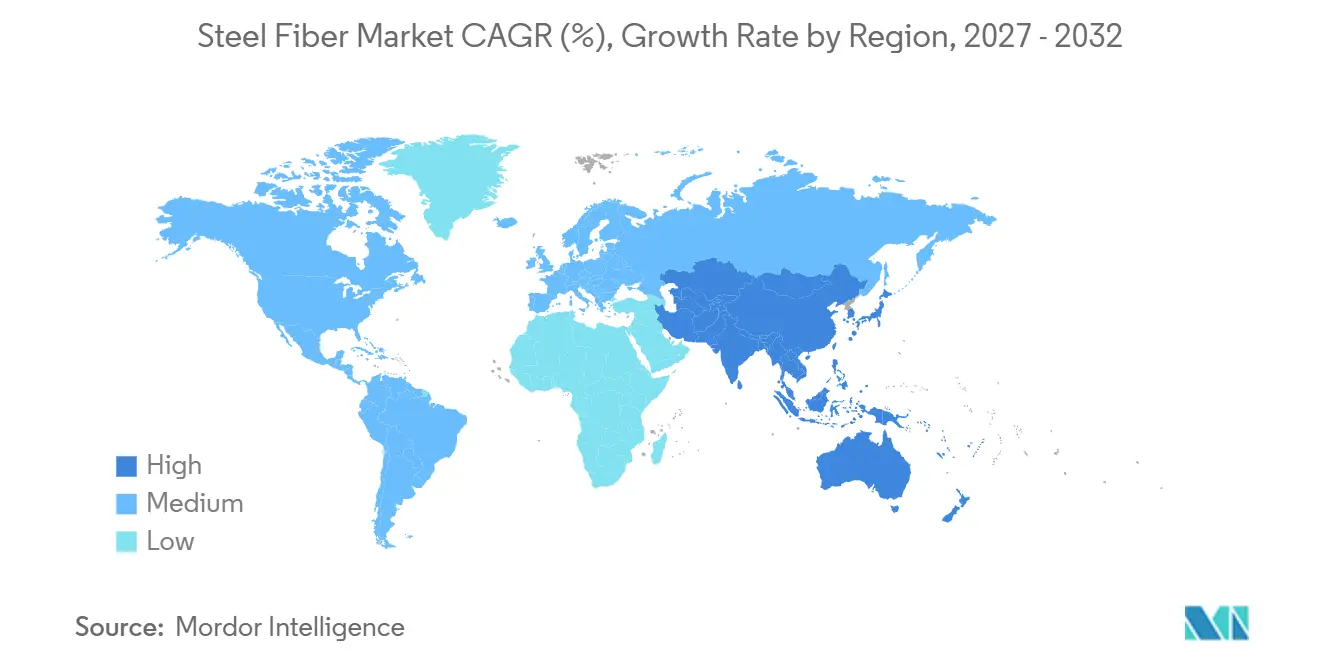
Asia-Pacific accounted for 33.72% of global revenue in 2026, representing the largest regional share in the supplied data. The region is also expected to record a 5.78% CAGR through 2032. China, India, and ASEAN drive demand through metro rail, road, tunnel, and industrial construction projects. India's logistics expansion adds further demand for jointless industrial floors. Regional and international producers are expanding their technical support activities, helping users evaluate fiber dosage, mix design, and application performance before project specifications are finalized. A combination of public infrastructure investment and private logistics development supports the Asia-Pacific steel fiber market.
North America and Europe Steel Fiber Market
North America and Europe have mature demand patterns, with high per-unit material use in established construction systems. Growth opportunities in these regions are linked to infrastructure renewal and increasing requirements for carbon documentation. New Eurocode 2 provisions, through Annex L, recognize the contribution of steel fiber-reinforced concrete (SFRC) ductility to structural design. This change can expand the range of composite structures in which engineers can formally account for the fiber contribution. Bekaert reported delays in the US flooring market in 2025, while tunneling and demand in the Middle East showed stronger order intake. These conditions create uneven demand by application, even within established regions.
MEA and South America Steel Fiber Market
In South America, demand is concentrated in Brazil and Argentina, where road pavement and industrial-zone projects provide a base for consumption. Irregular infrastructure investment cycles can create volatility in project output. The Middle East and Africa are emerging as a regional opportunity for supply and application. In November 2025, Bekaert and EMSTEEL agreed to collaborate on steel fiber solutions using UAE-made steel for GCC markets. Local production could reduce delivered-cost barriers in Saudi Arabia, the United Arab Emirates, and nearby markets. The agreement also connects fiber supply to broader sustainable construction priorities in the region.
Competitive Landscape
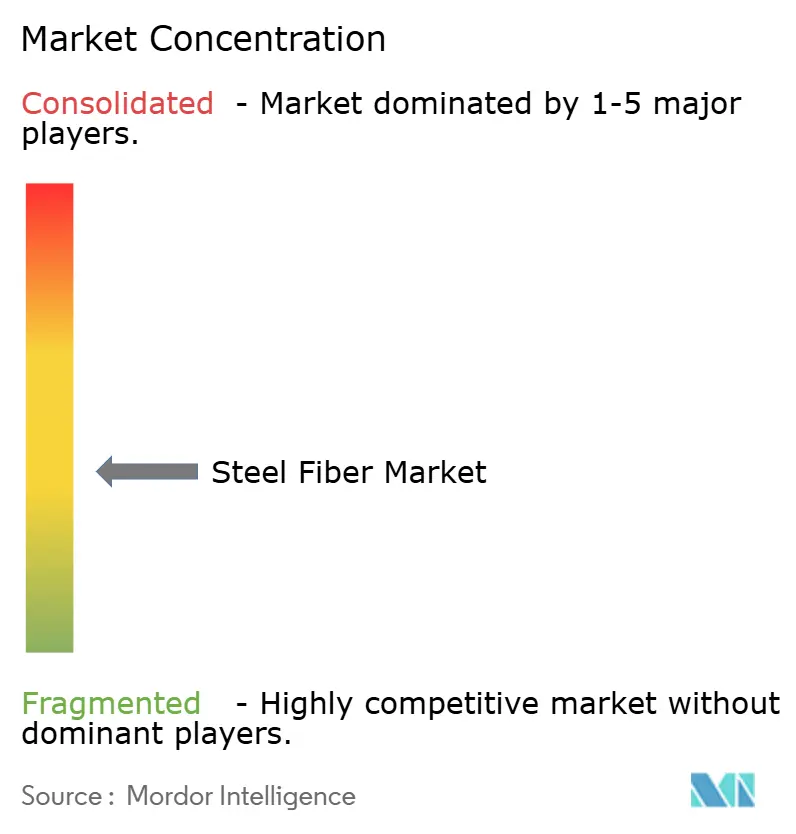
The steel fiber market is moderately fragmented. Bekaert, ArcelorMittal Wire Solutions, and regional Chinese producers are the principal players identified in the competitive assessment. Larger producers compete through product consistency, technical services, and access to established construction specifications. Local manufacturers compete primarily on price in commodity concrete-reinforcement applications. This creates distinct competitive conditions for premium performance grades versus standard hooked-fiber products. The absence of a reported combined market share among the top players limits any estimate of numerical concentration. Product capability and application support therefore provide a more useful basis for assessing competitive positioning than unverified share figures.
Bekaert has developed its position in sustainable construction through acquisitions and recycled-content products. Its 2025 acquisition of Twincon and Flexofibers added second-life fiber capabilities. The company also introduced Dramix Loop, a fiber made from steel recovered from end-of-life tires. These actions set it apart for buyers who need circularity documentation. ArcelorMittal Wire Solutions uses vertical integration from wire rod through finished fiber to support traceability and carbon-related product documentation. Both companies also participate in technical communities that influence early-stage tunneling and structural design specifications.
Regional firms in India and China compete through domestic distribution reach and cost-based offerings. Precision Drawell and Stewols India operate in India, while Hunan Sunshine, Yutian Zhitai, and Zhejiang Boen operate in China. Specialized suppliers also serve selected applications, including refractory-grade stainless fibers and high-end structural fibers. In October 2025, Bekaert and IKK Mateenbar signed an agreement to develop hybrid Glass Fiber Reinforced Polymer (GFRP) and fiber-reinforced-concrete solutions for the Middle East and North Africa. The agreement covers industrial floors, port pavements, and precast applications. Suppliers that combine fiber supply with design support, mix optimization, and carbon documentation can address buyer needs beyond the sale of fiber alone.
Steel Fiber Industry Leaders
-
ARCELORMITTAL
-
Bekaert
-
Nippon Seisen Co., Ltd.
-
Fibrometals
-
Green Steel Group
- *Disclaimer: Major Players sorted in no particular order
Steel Fiber Market Companies Covered in this Report
- ARCELORMITTAL
- Bekaert
- Fibrometals
- Green Steel Group
- Hunan Sunshine Steel Fiber Co., Ltd.
- Jiangsu Shagang Group Co., Ltd.
- Kerakoll Spa
- Nippon Seisen Co., Ltd.
- Precision Drawell Pvt Ltd.
- R.STAT SAS
- Severstal
- SPAJIC DOO
- Stewols India Pvt. Ltd.
- Yutian Zhitai Steel Fiber Manufacturing Co., Ltd.
- Zhejiang Boen Metal Products Co., Ltd.
Recent Industry Developments in Steel Fiber Market
- January 2026: Bekaert unveiled Dramix Loop at World of Concrete 2026 in Las Vegas. Dramix Loop is a concrete reinforcement steel fiber manufactured entirely from steel recovered from end-of-life tires. The product addresses tire waste through a circular economy approach while meeting performance requirements for structural concrete applications.
- November 2025: Bekaert and EMSTEEL Building Materials PJSC signed a partnership at the Middle East Iron and Steel Conference in Dubai. The agreement covered technical collaboration, an offtake intention for Bekaert, and an assessment of downstream investment to manufacture Dramix steel fiber solutions using UAE-made steel for GCC markets.
Global Steel Fiber Market Report Scope
Steel fiber consists of short, discrete metal reinforcement elements mixed directly into concrete to enhance its tensile strength, ductility, and crack resistance. These fibers are distributed uniformly throughout the concrete mix, providing multidirectional reinforcement that improves the material's ability to withstand mechanical stress, resist crack propagation, and maintain structural integrity under load.
The steel fiber market is segmented by type, manufacturing process, application, and geography. By type, the market is segmented into hooked steel fiber, straight steel fiber, deformed steel fiber, crimped steel fiber, and other types. By manufacturing process, the market is segmented into cold drawn, cut wire, melt extract, slit sheet, and other manufacturing processes. By application, the market is segmented into concrete reinforcement, composite reinforcement, refractories, and other applications. The report also covers market sizes and forecasts for the global steel fiber across 15 countries in major regions. The market sizes and forecasts are provided in terms of value (USD).
Segmentation Overview
| Hooked Steel Fiber |
| Straight Steel Fiber |
| Deformed Steel Fiber |
| Crimped Steel Fiber |
| Other Types |
| Cold Drawn |
| Cut Wire |
| Melt Extract |
| Slit Sheet |
| Other Manufacturing Processes |
| Concrete Reinforcement |
| Composite Reinforcement |
| Refractories |
| Other Applications |
| Asia-Pacific | China |
| India | |
| Japan | |
| South Korea | |
| ASEAN Countries | |
| Rest of Asia-Pacific | |
| North America | United States |
| Canada | |
| Mexico | |
| Europe | Germany |
| United Kingdom | |
| France | |
| Italy | |
| NORDIC Countries | |
| Rest of Europe | |
| South America | Brazil |
| Argentina | |
| Rest of South America | |
| Middle East and Africa | Saudi Arabia |
| South Africa | |
| Rest of Middle East and Africa |
| By Type | Hooked Steel Fiber | |
| Straight Steel Fiber | ||
| Deformed Steel Fiber | ||
| Crimped Steel Fiber | ||
| Other Types | ||
| By Manufacturing Process | Cold Drawn | |
| Cut Wire | ||
| Melt Extract | ||
| Slit Sheet | ||
| Other Manufacturing Processes | ||
| By Application | Concrete Reinforcement | |
| Composite Reinforcement | ||
| Refractories | ||
| Other Applications | ||
| By Geography | Asia-Pacific | China |
| India | ||
| Japan | ||
| South Korea | ||
| ASEAN Countries | ||
| Rest of Asia-Pacific | ||
| North America | United States | |
| Canada | ||
| Mexico | ||
| Europe | Germany | |
| United Kingdom | ||
| France | ||
| Italy | ||
| NORDIC Countries | ||
| Rest of Europe | ||
| South America | Brazil | |
| Argentina | ||
| Rest of South America | ||
| Middle East and Africa | Saudi Arabia | |
| South Africa | ||
| Rest of Middle East and Africa | ||
Key Questions Answered in the Report
What is current market size of Steel Fiber Market?
The Steel Fiber Market size was valued at USD 2.47 billion in 2026 and is estimated to grow from USD 2.60 billion in 2027 to USD 3.38 billion by 2032, at a CAGR of 5.37% during the forecast period (2027-2032).
Which manufacturing process is growing fastest?
Cold drawn wire is the fastest-growing reported process, with a projected 5.91% CAGR through 2032.
What application accounts for the largest demand for steel fibers?
Concrete reinforcement is the largest application, accounting for 52.56% of revenue in 2026.
Which region leads demand for steel fibers?
Asia-Pacific leads with 33.72% of revenue in 2026 and is also the fastest-growing region at a projected 5.78% CAGR through 2032.