
Steel Casting Market Size and Share
Market Overview
| Study Period | 2022 - 2032 |
|---|---|
| Market Size (2027) | USD 24.85 Billion |
| Market Size (2032) | USD 32.13 Billion |
| Growth Rate (2027 - 2032) | 5.27 % |
| Fastest Growing Market | Asia-Pacific |
| Largest Market | Asia-Pacific |
| Market Concentration | Low |
Major Players *Disclaimer: Major Players sorted in no particular order Image © Mordor Intelligence. Reuse requires attribution under CC BY 4.0. | |
Steel Casting Market Analysis by Mordor Intelligence
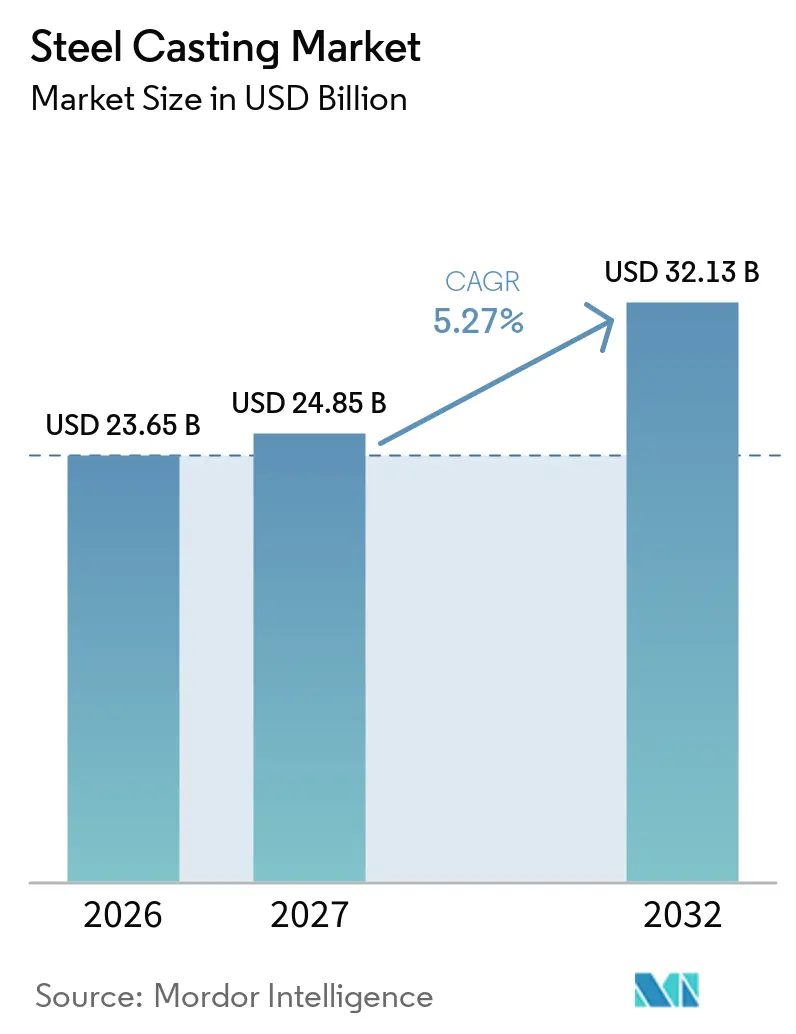
The Steel Casting Market size was valued at USD 23.65 billion in 2026 and is estimated to grow from USD 24.85 billion in 2027 to reach USD 32.13 billion by 2032, at a CAGR of 5.27% during the forecast period (2027-2032). The steel casting market is supported by capital spending in power generation, rail infrastructure, mining, and other heavy equipment activities that require durable components with complex shapes. Many of these applications need poured steel because lighter materials, composites, and fabricated parts cannot consistently meet their load, heat, or pressure requirements at a comparable cost. Large castings above 100 metric tons remain a constrained part of supply because fewer than 20 foundries can complete single-pour work at this scale. This gives qualified producers more visibility over order books and greater scope to reserve capacity for long-cycle projects. The steel casting market also faces pressure from energy costs, substitute materials in lighter vehicle applications, and shortages of experienced patternmakers and metallurgists.
Key Report Takeaways
- By type, carbon steel casting held 33.51% of the steel casting market share in 2026, while high-alloy steel casting is forecast to advance at a 5.83% CAGR through 2032.
- By process, sand casting held 46.55% of the steel casting market share in 2026, while investment casting is forecast to advance at a 5.98% CAGR through 2032.
- By application, power generation held 37.83% of the steel casting market share in 2026, while oil and gas is forecast to advance at a 6.16% CAGR through 2032.
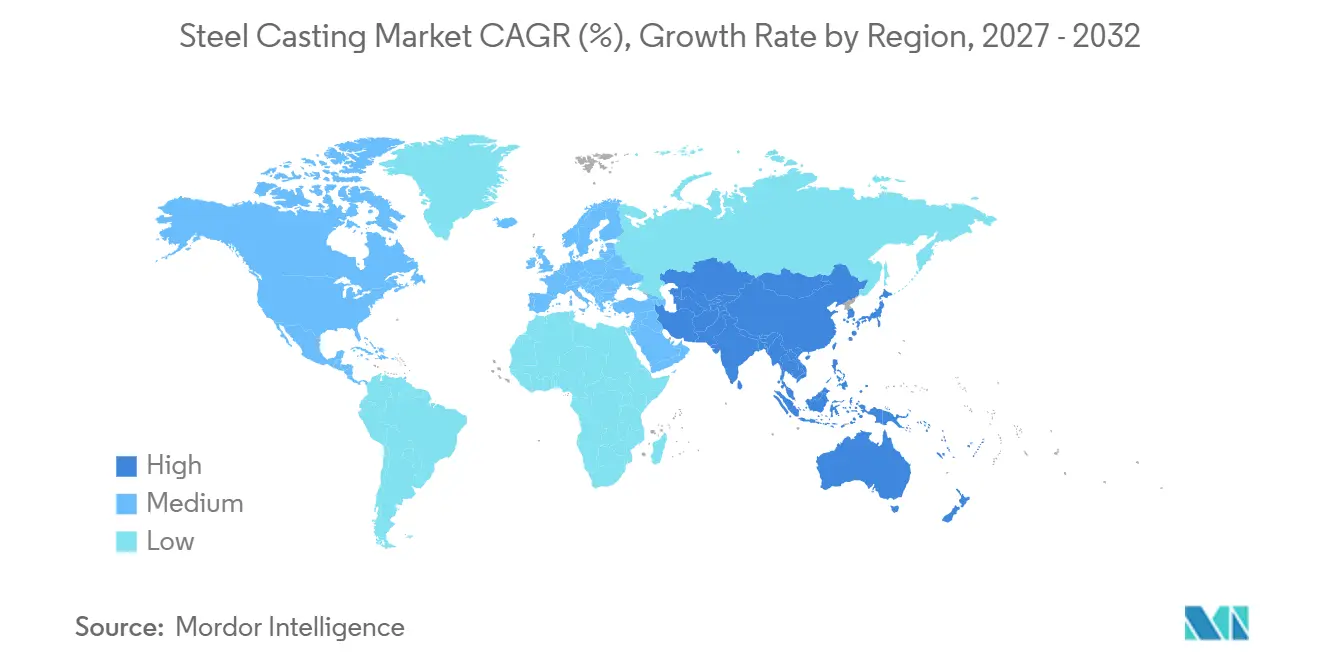
- By geography, Asia-Pacific held 54.62% of the steel casting market share in 2026 and is forecast to advance at a 6.07% CAGR through 2032.
Note: Market numbers in this report are based on Mordor Intelligence's proprietary estimation framework, which combines nine months of actuals with Q4 projections for base year 2026.
Market Trends and Insights
Drivers Impact Analysis of Steel Casting Market*
| Driver | (~) % Impact on CAGR Forecast | Geographic Relevance | Impact Timeline |
|---|---|---|---|
| Industrialization and Infrastructure Investment in Asia-Pacific | +1.3% | APAC core, spillover to South America and MEA | Medium term (2–4 years) |
| Railway Network Expansion and Rail-Freight Modernization | +1.1% | Global, with largest gains in India, ASEAN, and Eastern Europe | Long term (≥ 4 years) |
| Renewable-Power and Grid-Equipment Buildout | +0.9% | North America, Europe, and APAC | Medium term (2–4 years) |
| Electric Vehicle and Heavy Vehicle Component Reconfiguration | +0.7% | North America, Europe, and China | Short term (≤ 2 years) |
| Digital Casting, Simulation, and Automated Quality Control | +0.4% | Global | Short term (≤ 2 years) |
| Source: Mordor Intelligence | |||
Industrialization and Infrastructure Investment in Asia-Pacific
The steel casting market in Asia-Pacific benefits from public and private investment in transport, urban infrastructure, manufacturing, and power systems. India’s steel demand grew 8.5% in 2025, compared with a global average of 1.2%, as spending on transportation, urban projects, and manufacturing remained strong[1]. The region’s demand base is changing as India, Vietnam, Thailand, and Indonesia add industrial capacity and expand casting-intensive sectors such as railways, mining equipment, and construction machinery. China remains an important consumer, but lower real estate investment has reduced the role of construction as the region’s principal growth engine. This shifts supplier attention toward countries where industrial development is at an earlier stage and equipment procurement is rising. The steel casting market can benefit when foundries build certified relationships with local buyers before supply networks become established.
Railway Network Expansion and Rail-Freight Modernization
Rail systems require cast components for bogie frames, coupler systems, wheelsets, and track infrastructure because these parts work under repeated heavy loads. The steel casting market, therefore, has a durable connection to rail freight and passenger rail investment. India’s Union Budget for fiscal year 2026 allocated INR 2.93 lakh crore (approximately USD 35.2 billion) for railway capacity growth, while Indian Railways planned procurement of 300,000 freight cars under its multi-year expansion program. The Steel Founders’ Society of America projected North American railroad steel casting tonnage to rise 3% in 2026 after a 4% decline in 2025. Buyers are increasingly requiring longer fatigue life and closer dimensional control in rail parts.
Renewable-Power and Grid-Equipment Buildout
The steel casting market gains demand from wind equipment and from the grid assets that connect generation to users. Cast housings, tank components, nacelle frames, main bearing housings, and monopile connectors are needed across power equipment supply chains. The Offshore Wind Growth Partnership estimated that the United Kingdom could need more than 2 million metric tons of castings and forgings between 2026 and 2050. For the steel casting market, this indicates a long-term opportunity for specialist producers that can meet demanding size and quality requirements. Large power castings are often made by the same facilities that serve defense and nuclear customers. Renewable energy orders can therefore compete for constrained capacity, which encourages selective qualification and advanced capacity reservation.
Electric Vehicle and Heavy Vehicle Component Reconfiguration
Electrification affects the steel casting market differently in passenger vehicles and heavy trucks. In some passenger vehicles, large aluminum castings can replace fabricated steel assemblies, although steel remains relevant for powertrain mounts, steering knuckles, and structural nodes that carry high loads. Battery mass increases vehicle weight and changes the load paths for suspension, axle, and frame components. This can increase the need for redesigned steel castings in heavy vehicles. Aluminum metal matrix nanocomposites demonstrated up to 47% weight reduction versus steel and more than 91% recyclability in the European Commission-funded FLAMINGo project, showing substitution pressure in lighter structural applications.
Restraints Impact Analysis of Steel Casting Market*
| Restraint | (~) % Impact on CAGR Forecast | Geographic Relevance | Impact Timeline |
|---|---|---|---|
| Energy-Intensive Melting and Electricity-Price Volatility | -1.1% | Global, particularly severe in Europe and North America | Medium term (2–4 years) |
| Competition from Aluminum, Composites, Forgings, and Fabrications | -0.9% | North America, Europe, and China | Short term (≤ 2 years) |
| Scarcity of Patternmakers, Metallurgists, and Skilled Foundry Labor | -0.5% | North America, Europe, and Australia | Long term (≥ 4 years) |
| Source: Mordor Intelligence | |||
Energy-Intensive Melting and Electricity-Price Volatility
Electric arc furnace melting is energy-intensive, and energy costs can account for 20%-40% of total production costs, depending on the operating configuration. The steel casting market is sensitive to electricity and gas price changes because melting is essential to every production cycle. The U.S. Energy Information Administration stated that natural gas delivered to power generators at USD 3.37 per million British thermal units in 2025, 24% above 2024 levels[2]. Industrial electricity rates also face pressure from grid modernization, data center demand, and transport electrification. Smaller foundries have less ability to secure long-term energy contracts or operate co-located power assets. This can favor larger producers and lower-cost regions, while increasing cost pressure on independent operators in Europe and North America.
Competition from Aluminum, Composites, Forgings, and Fabrications
The steel casting market faces different forms of substitution depending on the application. Aluminum and composites are more credible alternatives where low weight matters most, especially in lighter vehicle structures. Precision forgings can compete in pump bodies, valve housings, and industrial frames when thinner sections can meet fatigue requirements. Steel castings retain a stronger position in high-temperature, high-pressure, and corrosive settings, including oil and gas, nuclear, and heavy mining equipment. Compliance with American Society of Mechanical Engineers requirements for nuclear pressure-retaining parts and American Petroleum Institute requirements for wellhead equipment can extend material qualification cycles. These long approval periods protect qualified cast steel suppliers in applications where a substitute would need extensive technical validation.
*Our forecasts treat driver/restraint impacts as directional, not additive. The impact forecasts reflect baseline growth, mix effects, and variable interactions.
Steel Casting Market Segment Analysis
By Type:
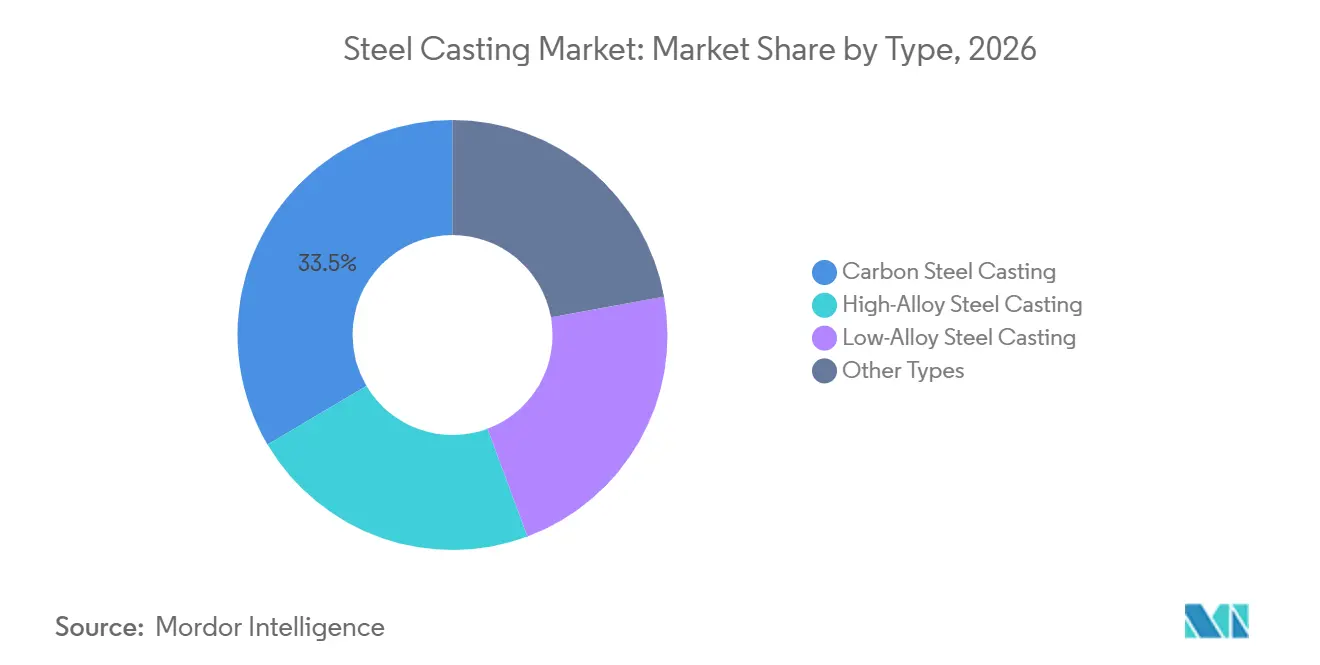
Carbon Steel Casting Leads, While High-Alloy Steel Casting ExpandsCarbon steel casting held 33.51% of the market share in 2026, supported by a favorable cost-to-strength balance and broad use in rail, construction machinery, and general engineering. Its established position reflects existing processing infrastructure and long-running customer specifications. Standard carbon grades face price competition from foundries in China and India that serve commodity requirements. Low-alloy steel casting serves heavy machinery frames, pressure vessel shells, and pump housings where service conditions justify improved tensile and impact properties. These grades provide an intermediate option for buyers who do not require the cost and performance profile of high-alloy materials.
High-alloy steel casting is projected to advance at a 5.83% CAGR through 2032. It serves gas turbines, nuclear reactor internals, and subsea oil and gas equipment that operate in high-temperature, corrosive, or high-pressure conditions. The steel casting market benefits when these applications require duplex stainless steel or nickel-based compositions. A 2025 review identified integrated computational materials engineering as a tool for designing and optimizing complex metal casting geometries more efficiently. Standards including (American Society for Testing and Materials) A743/A744 and ASME SA-351 require material traceability for corrosion-resistant and pressure-retaining castings.

By Process:
Sand Casting Leads Demand, While Investment Casting Supports Higher Precision RequirementsSand casting held 46.55% of the steel casting market size in 2026 because it can produce large, complex components and relies on established foundry infrastructure. It remains useful for power generation and heavy equipment applications where individual castings can exceed 100 metric tons. Sheffield Forgemasters International Ltd completed 11 ultra-large steel castings in February 2026, including a finished 325-metric-ton component made from more than 600 metric tons of molten steel in one pour. This example shows the continued need for large-format sand casting in heavy industrial and defense work. Die casting has a narrower role in steel due to high melting temperatures, shorter tooling life, and less favorable economics.
Investment casting is projected to advance at a 5.98% CAGR through 2032 as turbine blades, aerospace structures, and high-pressure valve bodies require near-net-shape precision. The process can reduce machining needs and support closer dimensional tolerances than many sand-based methods. The steel casting market can gain from investment casting where customers need accurate geometry and a controlled surface finish. An artificial intelligence-based digital twin at an investment casting plant demonstrated a method for identifying and correcting risks related to porosity and mechanical properties before physical production. The higher capital requirement slows rapid conversion from existing sand-casting capacity, especially in price-sensitive heavy equipment work.
By Application:
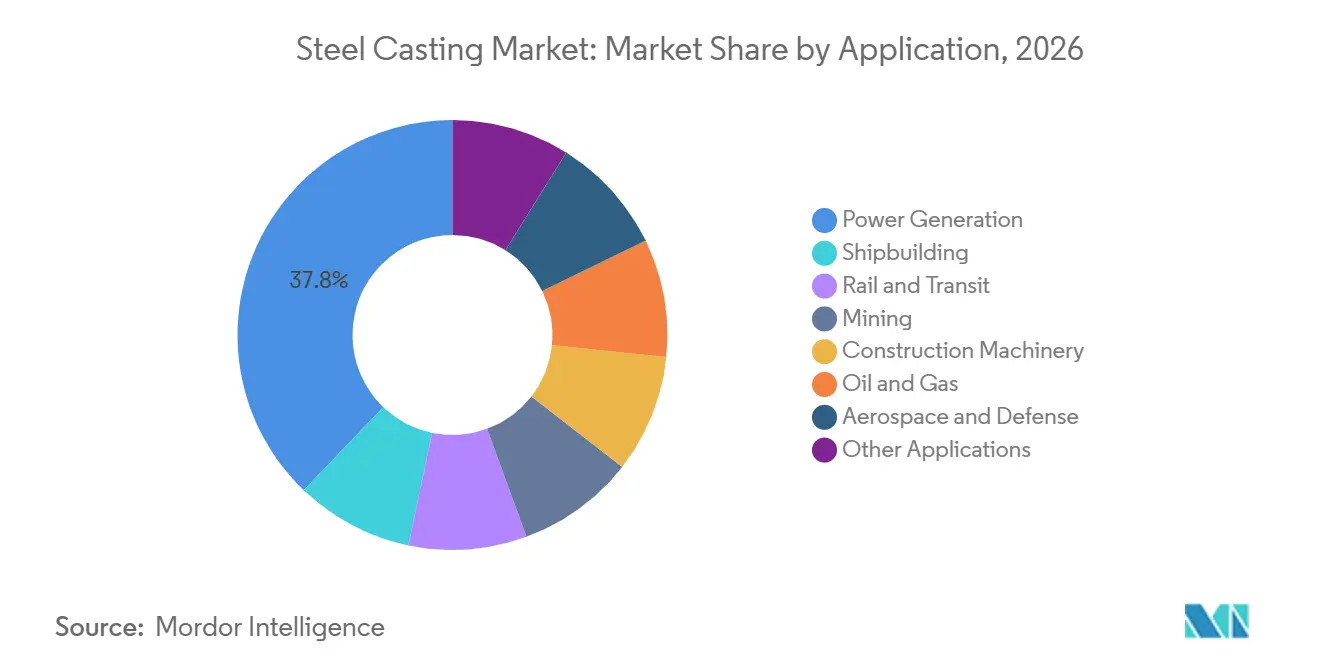
Power Generation Holds the Largest Role While Oil and Gas Grow FasterPower generation held 37.83% of the market share in 2026, supported by gas-fired combined-cycle plants, advanced nuclear programs, renewable power equipment, and related grid assets. These systems use large cast housings, structural supports, turbine parts, and other components that must perform under demanding conditions. Doosan Enerbility secured 5 gas turbine orders from a U.S. technology company in late 2025, supporting demand for large power equipment components. Rail and transit, mining, and construction machinery continue to provide an important demand base for foundries. Mining applications generate recurring demand for wear-resistant parts linked to extraction activity.
Oil and gas are projected to advance at a 6.16% CAGR through 2032. The segment requires high-alloy castings for subsea valves, blowout preventers, and deepwater compressor casings. These components often use duplex stainless steel and nickel-based materials because corrosion resistance and pressure performance are essential. The steel casting market has an opportunity where upstream investment in the Middle East and liquefied natural gas infrastructure in South and Southeast Asia requires certified components. Aerospace, defense, and shipbuilding are specialized application areas with long qualification cycles and strict procurement conditions.
Geography Analysis
APAC Steel Casting Market
Asia-Pacific held 54.62% of the steel casting market share in 2026 and is projected to advance at a 6.07% CAGR through 2032. The region has a large foundry base and receives substantial investment in power, transport, mining, and manufacturing equipment. India’s steel demand grew 8.5% in 2025, compared with the global average of 1.2%, supported by spending on transportation, railways, and renewable energy. China remains a major steel consumer, although declining real estate investment is changing the composition of regional demand. India, Vietnam, Thailand, and Indonesia offer growing demand for rail, construction machinery, and mining equipment.
North America and Europe Steel Casting Market
North America is a major regional buyer of cast steel for infrastructure, defense, energy, and critical supply chains. The Steel Founders’ Society of America projected the North American steel castings market to grow 4% in 2026 after 2% growth in 2025. It also projected military segment tonnage to increase 8% in 2026, supported by ground vehicle and naval system demand. Europe has higher industrial electricity costs, which limits cost competitiveness in energy-intensive production. However, Europe retains technical strength in ultra-large and complex castings for defense, offshore energy, and nuclear applications.
MEA and South America Steel Casting Market
South America is developing as a production base for mining wear castings, especially for copper and gold extraction. Bradken opened its Chilca, Peru, foundry in July 2026 with annual capacity of up to 20,000 metric tons and an investment exceeding USD 100 million. More than 99% of the facility’s electricity comes from renewable sources. Middle East and Africa has favorable demand conditions from industrial diversification, oil and gas, and petrochemical projects.
Competitive Landscape
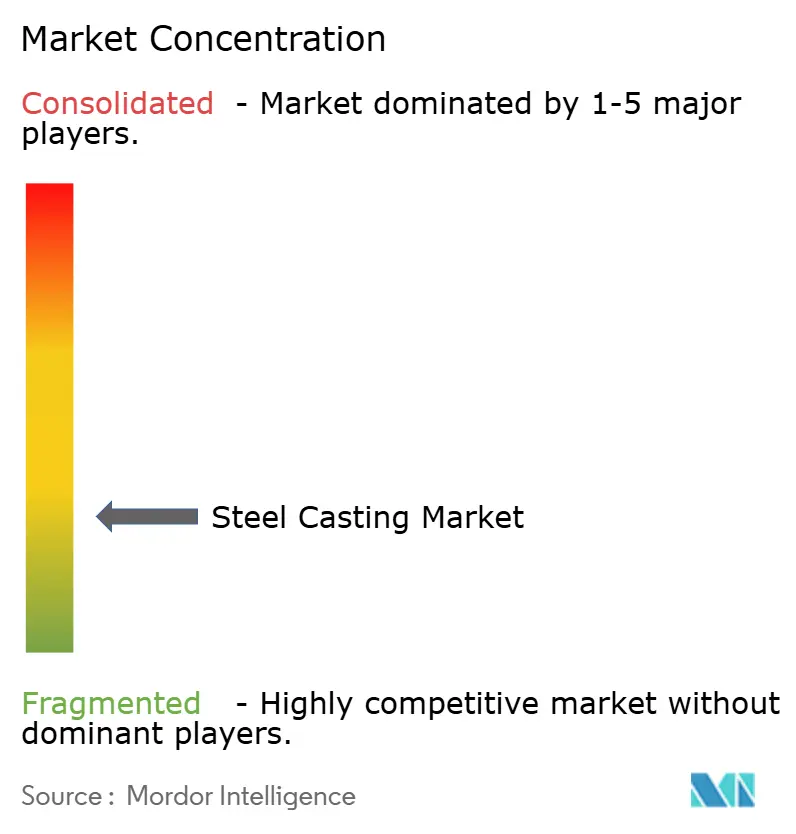
The steel casting market is highly fragmented, with the top five players including ArcelorMittal, Doosan Enerbility, KOBE STEEL, LTD., Nucor Corporation, and Georg Fischer Ltd. Competition is more intense for castings below 10 metric tons, where suppliers in India, China, and Southeast Asia can compete strongly on cost. The field becomes narrower for castings above 50 metric tons because fewer facilities can produce complex single-pour parts with the required metallurgical and quality controls. The steel casting market rewards companies that combine vacuum degassing, heat treatment, non-destructive testing, and machining at the same site. This integrated model reduces coordination risk for customers buying critical components.
Doosan Enerbility operates as an integrated specialist for nuclear reactor pressure vessels, gas turbine casings, and marine crankshafts. In December 2025, X-energy and Doosan Enerbility signed a binding reservation agreement for steel components for 16 Xe-100 small modular reactors. Doosan Enerbility committed to a new facility in Changwon, South Korea, intended to support production for 20 Xe-100 reactors each year at full output. This capacity commitment can build a long-running backlog in a field with few qualified manufacturers. Certified supply for small modular reactors and for subsea and liquefied natural gas infrastructure remains difficult to enter because customer approvals and material qualifications take time.
Strategic activity is also reshaping the steel casting market through portfolio changes and process upgrades. Georg Fischer Ltd. closed the sale of the automotive casting business of GF Casting Solutions to Nemak in February 2026 in a USD 336 million transaction covering 8 manufacturing sites. Magotteaux reported USD 1,031 million in sales in 2025, up 7.1%, and reported an 11.9% volume increase supported by digital process controls. These actions show that competition increasingly depends on application focus, qualified capacity, and production control rather than scale alone.
Steel Casting Industry Leaders
-
ArcelorMittal
-
Doosan Enerbility
-
KOBE STEEL, LTD.
-
Nucor Corporation
-
Georg Fischer Ltd.
- *Disclaimer: Major Players sorted in no particular order
Steel Casting Market Companies Covered in this Report
- ArcelorMittal
- Bradken
- Doosan Enerbility
- Ferralloy Inc.
- Georg Fischer Ltd.
- Isgec Heavy Engineering Ltd.
- KOBE STEEL, LTD.
- Magotteaux
- Nelcast Limited
- Nucor Corporation
- POSCO
- Precision Castparts Corp.
- Sheffield Forgemasters
- The Japan Steel Works, Ltd.
- voestalpine Stahl GmbH
Recent Industry Developments in Steel Casting Market
- October 2026: WIRCO Inc. agreed to acquire selected manufacturing assets from Alcon Industries Inc., including melting furnaces, casting machines, tooling and manufacturing processes, to expand its fabrication, centrifugal casting and static casting capabilities. The acquisition supports the steel casting market by increasing manufacturing capabilities for high-temperature tooling and high-alloy cast components used in industrial applications.
- July 2026: Steelcast Limited approved an investment to establish a greenfield foundry with an additional annual capacity of 8,500 metric tons, expanding its existing installed capacity of 29,000 metric tons. The expansion supports the steel casting market by increasing production capacity to meet rising customer demand for cast components used in industrial equipment and heavy machinery.
Global Steel Casting Market Report Scope
Steel casting is a manufacturing process in which molten steel is poured into molds and solidified to produce components with specific shapes, dimensions, and mechanical properties. It enables the production of complex, durable parts designed to withstand demanding operating conditions across industrial applications.
The Steel Casting Market is segmented by type, process, application, and geography. By type, the market is segmented into carbon steel casting, low-alloy steel casting, high-alloy steel casting, and other types. By process, the market is segmented into sand casting, investment casting, die casting, and other processes. By application, the market is segmented into power generation, rail and transit, mining, construction machinery, oil and gas, aerospace and defense, shipbuilding, and other applications. The report also covers the market size and forecasts for steel casting across 15 countries. For each segment, the market sizing and forecasts have been done on the basis of value (USD).
Segmentation Overview
| Carbon Steel Casting |
| Low-Alloy Steel Casting |
| High-Alloy Steel Casting |
| Other Types |
| Sand Casting |
| Investment Casting |
| Die Casting |
| Other Processes |
| Power Generation |
| Rail and Transit |
| Mining |
| Construction Machinery |
| Oil and Gas |
| Aerospace and Defense |
| Shipbuilding |
| Other Applications |
| Asia-Pacific | China |
| India | |
| Japan | |
| South Korea | |
| ASEAN Countries | |
| Rest of Asia-Pacific | |
| North America | United States |
| Canada | |
| Mexico | |
| Europe | Germany |
| United Kingdom | |
| France | |
| Italy | |
| NORDIC Countries | |
| Rest of Europe | |
| South America | Brazil |
| Argentina | |
| Rest of South America | |
| Middle East and Africa | Saudi Arabia |
| South Africa | |
| Rest of Middle East and Africa |
| By Type | Carbon Steel Casting | |
| Low-Alloy Steel Casting | ||
| High-Alloy Steel Casting | ||
| Other Types | ||
| By Process | Sand Casting | |
| Investment Casting | ||
| Die Casting | ||
| Other Processes | ||
| By Application | Power Generation | |
| Rail and Transit | ||
| Mining | ||
| Construction Machinery | ||
| Oil and Gas | ||
| Aerospace and Defense | ||
| Shipbuilding | ||
| Other Applications | ||
| By Geography | Asia-Pacific | China |
| India | ||
| Japan | ||
| South Korea | ||
| ASEAN Countries | ||
| Rest of Asia-Pacific | ||
| North America | United States | |
| Canada | ||
| Mexico | ||
| Europe | Germany | |
| United Kingdom | ||
| France | ||
| Italy | ||
| NORDIC Countries | ||
| Rest of Europe | ||
| South America | Brazil | |
| Argentina | ||
| Rest of South America | ||
| Middle East and Africa | Saudi Arabia | |
| South Africa | ||
| Rest of Middle East and Africa | ||
Key Questions Answered in the Report
What is the size of the steel casting market?
The steel casting market size was valued at USD 23.65 billion in 2026 and is estimated to grow from USD 24.85 billion in 2027 to reach USD 32.13 billion by 2032, at a CAGR of 5.27% during the forecast period (2027-2032).
What is driving demand for steel castings?
Power generation, rail expansion, industrial infrastructure, mining equipment, and oil and gas projects support demand for durable and complex steel components.
Which is projected to advance fastest through 2032?
High-alloy steel casting is projected to advance at a 5.83% CAGR through 2032 as gas turbine, nuclear, and subsea equipment require corrosion-resistant and high-temperature materials.
Which process held the largest share in 2026?
Sand casting held 46.55% in 2026 because it supports large, complex castings for power generation and heavy equipment.