
Stationary Fuel Cells Market Size and Share
Market Overview
| Study Period | 2022 - 2032 |
|---|---|
| Market Size (2027) | USD 4.09 Billion |
| Market Size (2032) | USD 8.02 Billion |
| Growth Rate (2027 - 2032) | 14.45 % |
| Fastest Growing Market | Asia-Pacific |
| Largest Market | North America |
| Market Concentration | Medium |
Major Players *Disclaimer: Major Players sorted in no particular order Image © Mordor Intelligence. Reuse requires attribution under CC BY 4.0. | |
Stationary Fuel Cells Market Analysis by Mordor Intelligence
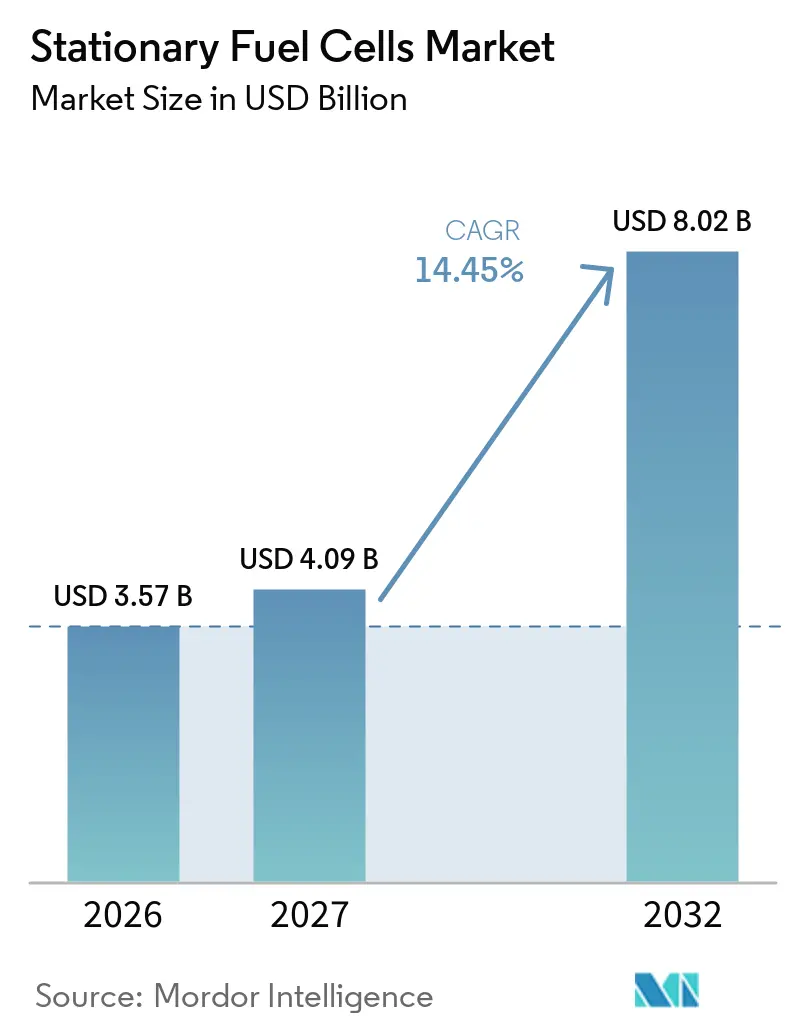
The Stationary Fuel Cells Market size was valued at USD 3.57 billion in 2026 and is estimated to grow from USD 4.09 billion in 2027 to reach USD 8.02 billion by 2032, at a CAGR of 14.45% during the forecast period (2027-2032). Grid connection delays are increasing the value of on-site generation for data centers and other facilities with continuous power needs. Lawrence Berkeley National Laboratory reported that projects reaching commercial operation between 2018 and 2024 had a median interconnection timeline exceeding 4 years, which supports interest in alternatives that can be installed at the customer site. High-temperature systems can use several fuels and provide electricity with useful heat, giving operators flexibility as fuel supply changes. The stationary fuel cells market is therefore gaining attention in locations where grid capacity, resilience requirements, and emissions targets overlap. Larger framework agreements also show that purchasers are seeking production access before projects are fully built. Cost and hydrogen availability remain limits outside well-financed data center, utility, and industrial projects.
Key Report Takeaways
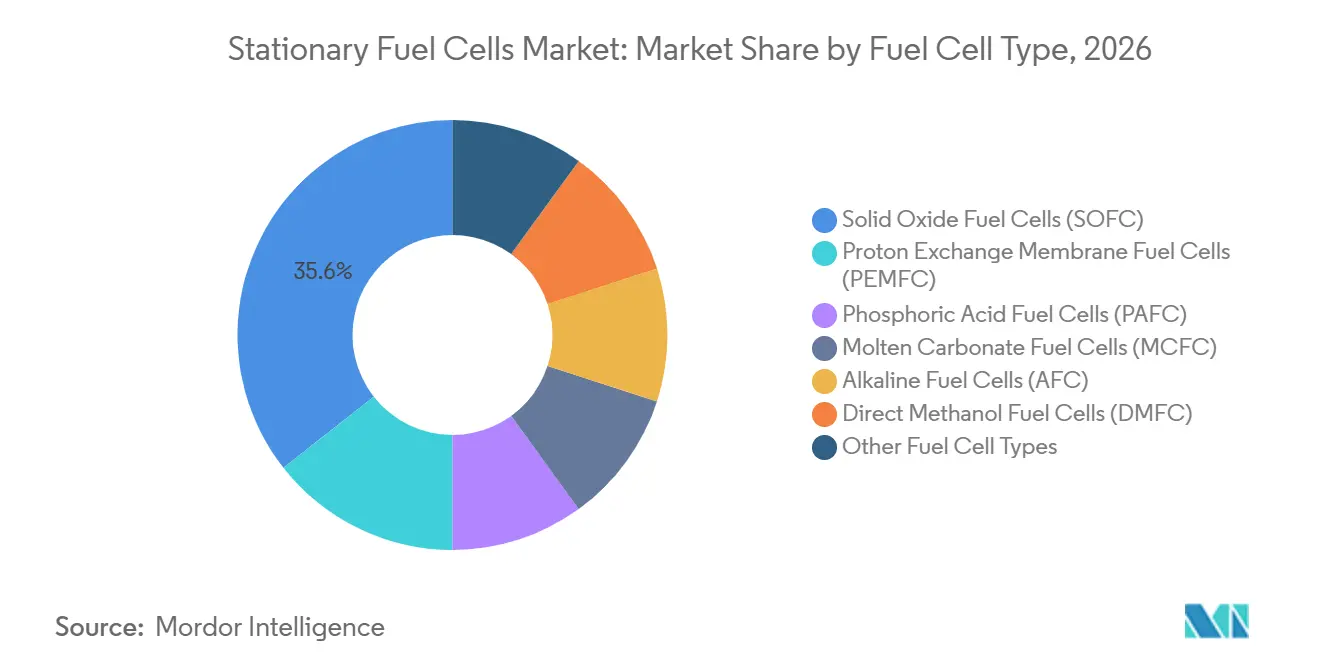
- By fuel cell type, solid oxide fuel cells led with 35.6% revenue share in 2026, and are forecasted to growth rate at 15.1% CAGR through 2032.
- By capacity, the 5–250 kW category held 41.8% revenue share in 2026, while systems above 1 MW are forecast to grow at a 15.6% CAGR through 2032.
- By application, combined heat and power accounted for 39.4% revenue share in 2026, while distributed power generation is forecast to expand at a 16.3% CAGR through 2032.
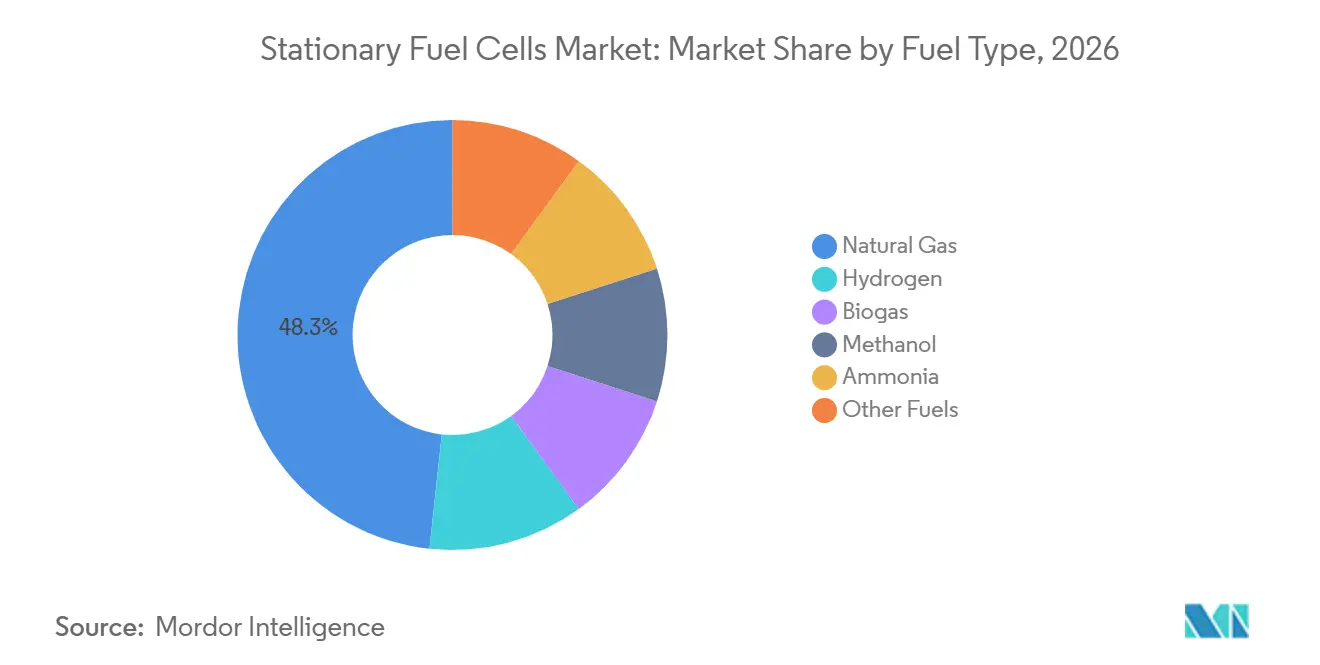
- By fuel type, natural gas held 48.3% revenue share in 2026, while hydrogen is forecast to grow at a 17.5% CAGR through 2032.
- By end user, utilities accounted for 29.1% revenue share in 2026, while commercial buildings are forecast to grow at a 15.5% CAGR through 2032.
- By geography, North America held 33.2% revenue share in 2026, while Asia-Pacific is forecast to expand at a 16.1% CAGR through 2032.
Note: Market numbers in this report are based on Mordor Intelligence's proprietary estimation framework, which combines nine months of actuals with Q4 projections for base year 2026.
Market Trends and Insights
Drivers Impact Analysis of Stationary Fuel Cells Market*
| Driver | (~) % Impact on CAGR Forecast | Geographic Relevance | Impact Timeline |
|---|---|---|---|
| Decarbonization And Clean-Energy Targets | +3.2% | Global, with early gains in North America, EU, Japan, South Korea | Medium term (2-4 years) |
| Demand For Grid-Resilient Distributed Power | +2.8% | North America core, spill-over to EU and APAC | Short term (≤ 2 years) |
| Hydrogen Production And Distribution Expansion | +2.1% | North America, EU, Japan, South Korea | Long term (≥ 4 years) |
| Data Center And Critical Infrastructure Power Demand | +2.5% | North America, APAC, EU | Short term (≤ 2 years) |
| Waste-Heat Monetization Through Combined Heat And Power | +1.8% | EU industrial corridors, North America, Japan | Medium term (2-4 years) |
| Renewable Microgrid And Energy-As-A-Service Integration | +1.2% | North America, APAC emerging markets | Long term (≥ 4 years) |
| Source: Mordor Intelligence | |||
Decarbonization And Clean-Energy Targets
National energy policies are creating more defined demand for stationary fuel cell systems. South Korea’s clean hydrogen procurement structure gives large generators a route to procure fuel-cell output, including a 2025 general hydrogen tender of 1,300 GWh. Japan’s Green Transformation program committed JPY 20 trillion to clean-energy support and extended ENE-FARM residential subsidies through fiscal year 2027. These measures support systems rated from 0.7 kW to 1.0 kW in the residential micro-CHP segment. Policy support can improve project financing because it gives manufacturers and buyers a clearer planning horizon. The stationary fuel cells market benefits where procurement rules translate emissions objectives into recurring electricity demand.
Rising Power Demand From Data Centers And Critical Infrastructure
Data centers need power capacity that can be delivered before grid upgrades are complete. This need supports interest in utility-scale SOFC systems that can operate as a primary on-site supply. In April 2026, Bloom Energy and Oracle expanded their agreement to cover up to 2.8 GW, with an initial 1.2 GW contracted and deployment underway. The contracted pipeline makes manufacturing availability an important procurement issue for the stationary fuel cells market. Buyers are using longer framework arrangements to secure equipment production for large sites. This pattern favors suppliers that can manufacture standardized systems at scale.
Hydrogen Production And Distribution Expansion
Hydrogen supply remains uneven, but public investment is building a wider physical base for future demand. Germany issued a EUR 220 million funding call in January 2026 for hydrogen refueling stations linked to truck procurement. The US Department of Transportation committed USD 635 million in January 2025 for electric vehicle and hydrogen refueling infrastructure. India allocated INR 410.8 crore, equivalent to USD 49 million, for 12 pilots involving 70 hydrogen-powered vehicles and 16 stations across 21 routes. Mobility infrastructure may also create local supply options for stationary users in industrial clusters and data center parks. The stationary fuel cells market can benefit as these supply networks develop beyond their original transport use.
Waste-Heat Monetization Through Combined Heat And Power
Combined heat and power improves system economics when both electricity and heat have local value. FuelCell Energy stated that its improved carbonate fuel cell product achieved 50% electrical efficiency and more than 80% total efficiency in a CHP configuration. Bloom Energy states that its combined cooling, heat, and power configuration can improve data center power usage effectiveness by 10% to 20% through heat recovery. CHP is most attractive where the host facility has stable thermal demand and electricity prices are high. This supports commercial and industrial adoption in the stationary fuel cells market. It also gives operators a way to use thermal output that would otherwise be lost.
Restraints Impact Analysis of Stationary Fuel Cells Market*
| Restraint | (~) % Impact on CAGR Forecast | Geographic Relevance | Impact Timelin |
|---|---|---|---|
| High Upfront System And Installation Costs | -2.4% | Global, most acute in South America and MEA | Medium term (2-4 years) |
| Limited Hydrogen Availability And Fuel-Supply Infrastructure | -1.8% | Global outside North America and East Asia industrial corridors | Long term (≥ 4 years) |
| Fuel-Quality Sensitivity And Stack Degradation | -0.9% | Global | Long term (≥ 4 years) |
| Interconnection, Permitting And Ownership-Model Complexity | -0.8% | North America, EU | Medium term (2-4 years) |
| Source: Mordor Intelligence | |||
High Upfront System And Installation Costs
High capital costs still limit adoption in the stationary fuel cells market where power prices and resilience needs cannot support a premium solution. The US Department of Energy reported an industrial manufacturing baseline of USD 282 per kW for 275 kW PEM fuel cell systems at volumes below 1,000 units annually.[1] Its target is USD 155 per kW at 50,000 units per year, showing the importance of scale. A National Renewable Energy Laboratory study placed the 2022 total overnight cost for heavy-duty PEM stationary plants at USD 1,352 per kW and projected USD 1,001 per kW in a mid-case 2050 scenario.[2] Energy-as-a-service arrangements can reduce the barrier by shifting the initial expense from the customer to a provider. The stationary fuel cells market remains more accessible to organizations able to finance multi-year energy contracts.
Limited Hydrogen Availability And Fuel-Supply Infrastructure
The stationary fuel cells market depends on delivered hydrogen costs that can compete with natural gas on a power-output basis. A 2025 peer-reviewed study cited dispensed hydrogen at USD 5.8 per kilogram, compared with the US Department of Energy’s USD 2 per kilogram 2026 target. The gap restricts the near-term addressable base for hydrogen systems even when end users have decarbonization goals. Natural gas and biogas systems can use existing fuel networks while operators plan for gradual fuel switching. The stationary fuel cells market, therefore, has a near-term advantage in fuel-flexible technologies. Certification, fuel quality, and permitting requirements can also extend deployment schedules for first-of-kind projects.
*Our forecasts treat driver/restraint impacts as directional, not additive. The impact forecasts reflect baseline growth, mix effects, and variable interactions.
Stationary Fuel Cells Market Segment Analysis
By Fuel Cell Type:
SOFC Leads Across Commercial And Utility UsesSolid oxide fuel cells held 35.6% of the stationary fuel cells market share in 2026, and are forecasted to growth rate at 15.1% CAGR through 2032. Their position reflects their capacity to operate on natural gas, biogas, hydrogen, carbon-neutral methane, and blended fuels. Japan’s technology roadmap identifies SOFC electrical efficiency above 60%. This fuel flexibility supports commercial and utility users who need to manage supply and price uncertainty. PEMFC systems remain relevant for prime and backup power, especially where hydrogen is the selected fuel.
SOFC production in the stationary fuel cells market is moving toward a model in which stack manufacturing and system integration can be separated. Doosan Fuel Cell commissioned a Gunsan facility with an annual capacity of 50 MW for Ceres Power’s metal-supported SOFC technology. This model can allow technology owners to expand output without owning every manufacturing asset. Aisin introduced a solar-priority ENE-FARM type S system in April 2026 that aligns fuel cell output with real-time solar generation. The stationary fuel cells industry is therefore shaped by different technology choices across power size, fuel access, and reliability requirements.

By Capacity:
Large Systems Support Data Center DemandThe 5–250 kW category accounted for 41.8% of the stationary fuel cells market size in 2026. This installed base serves commercial buildings, CHP projects, industrial backup systems, and smaller microgrids. Systems in this range are relevant to the 5–25 kW ENE-FARM residential class in Japan and the 50–200 kW commercial building base in Europe and North America. The category has established use cases where electrical and thermal demand can be matched on one site. These applications provide a broad operational base for the stationary fuel cells market.
Systems above 1 MW are forecast to expand at a 15.6% CAGR through 2032. Data centers are a central source of this growth because they need firm power in increments of tens of megawatts. FuelCell Energy introduced a standardized 12.5 MW power block in March 2026, built from five independently operating 2.5 MW modules. The 250 kW–1 MW band serves healthcare, hospitality, and food-processing sites with meaningful thermal loads. Capacity below 5 kW remains centered on residential, remote monitoring, and small community applications.
By Application:
CHP Holds The Largest PositionCombined heat and power accounted for 39.4% of the stationary fuel cells market size in 2026. It can reach 80% to 85% total efficiency, where customers use both electrical and thermal output. CHP has a longstanding role in industrial and commercial buildings where heat demand can be managed locally. Scale Microgrids financed a 9.6 MW fuel cell CHP project in Bridgeport, Connecticut, including a 1.6-mile district-heating loop. This type of project shows how CHP can operate as community energy infrastructure rather than only as building equipment.
Distributed power generation is forecast to grow at a 16.3% CAGR through 2032. Data centers are increasing demand for systems that supply primary power rather than standby capacity. Backup power and UPS applications continue to serve telecommunications and critical facilities in areas with less reliable grids. Microgrid projects can use service contracts to avoid a large upfront purchase. Application choice is increasingly linked to whether customers prioritize resilience, heat recovery, or independent baseload power.
By Fuel Type:
Natural Gas Remains The Main Near-Term FuelNatural gas held 48.3% of the stationary fuel cells market share in 2026. Existing pipeline infrastructure gives commercial and utility users a practical fuel supply route. FuelCell Energy’s 2.5 MW system can use natural gas, biogas, and blends containing up to 50% hydrogen without hardware modification. This flexibility lets users reduce carbon intensity as available fuels change. It also reduces the need to wait for dedicated hydrogen distribution.
Hydrogen is forecast to be the fastest-growing fuel type at a 17.5% CAGR through 2032. The IEA Advanced Fuel Cells Technology Collaboration Programme identified potential for stationary applications where electrolysis and fuel cells can be colocated. Biogas can support agricultural repowering projects and give operators a route to use local feedstocks. Ammonia is an emerging option for remote industrial and maritime power applications. A 2026 review reported 61% to 67% electrical efficiency for pressurized direct-ammonia SOFC configurations.
By End User:
Utilities Lead While Commercial Buildings Gain MomentumUtilities held the largest end-user share at 29.1% in 2026. South Korea’s 2025 CHPS auction offered 1,300 GWh annually, while a separate clean hydrogen generation auction covered 6,500 GWh annually. These structures position utilities as primary counterparties for new capacity. They can support large project financing, but also concentrate demand among a limited number of buyers. Utility procurement is especially relevant for large systems serving data center campuses.
Commercial buildings are forecast to grow at a 15.5% CAGR through 2032. Corporate emissions commitments, building energy codes, and efficiency certification can support on-site power and heat projects. Japan extended ENE-FARM support for commercial systems achieving at least 80% total efficiency through fiscal year 2027. Industrial users deploy fuel cells for process heat integration and backup power in semiconductor, petrochemical, and food-processing facilities. Defense users remain a specialized but resilient customer group for direct methanol systems.
Geography Analysis
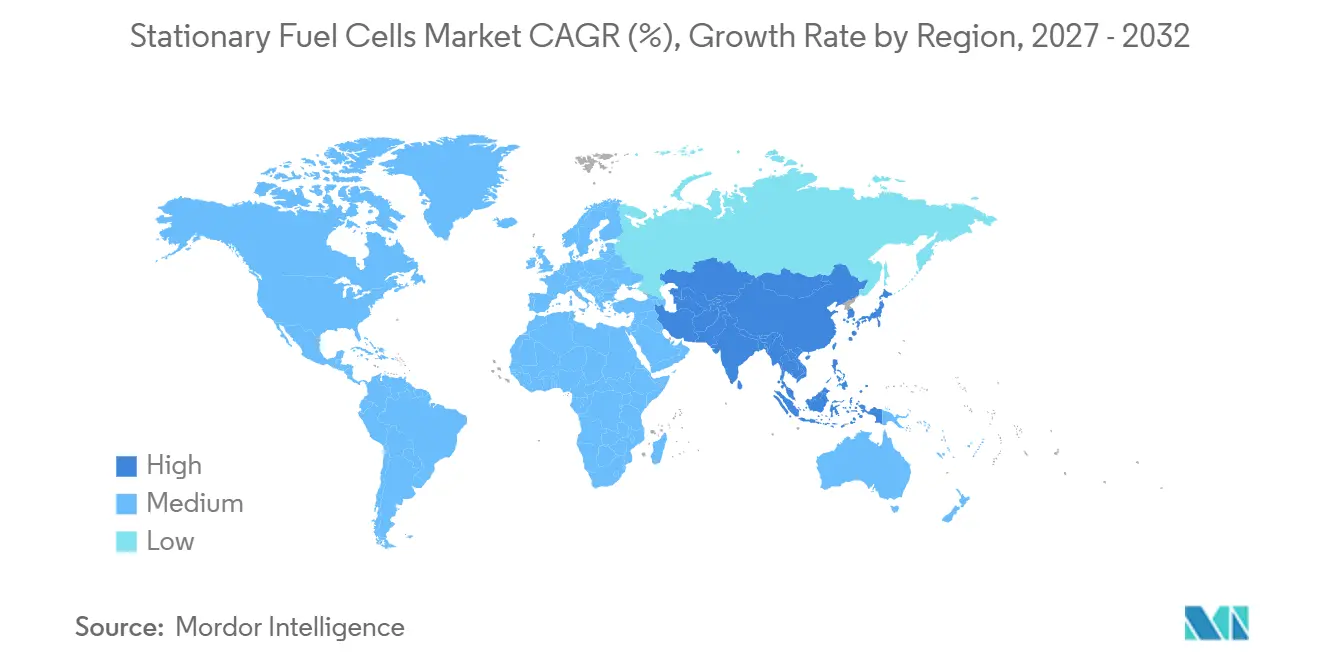
North America held 33.2% revenue share in 2026. Hyperscale data center operators are driving demand because the available grid connection timeline may not match their planned construction schedule. Bloom Energy’s 2024 agreement with American Electric Power covered up to 1 GW of SOFC systems, with an initial 100 MW order. In August 2026, Bloom Energy and Brookfield expanded their AI infrastructure financing partnership from USD 5 billion to USD 25 billion.
Asia-Pacific is forecast to grow at a 16.1% CAGR through 2032. Japan has installed more than 490,000 ENE-FARM residential SOFC and PEMFC units since 2009. Japan’s long-term GX program continues to support clean-energy investment, while Aisin’s 2026 solar-priority system fits behind-the-meter solar use. South Korea had more than 800 MW of installed utility-scale fuel cell capacity in 2025 and is projected to exceed 2.5 GW by 2035. The stationary fuel cells market in the region has mature domestic demand and manufacturing potential.
Europe has a more varied profile because policy support and hydrogen infrastructure are developing at different speeds. Germany’s planned 9,700 km hydrogen backbone had 540 km under construction and 1,250 km in final engineering during Q2 2026. South America and the Middle East and Africa remain earlier-stage markets, where backup power needs are evident but high costs and limited hydrogen infrastructure restrict market depth. The stationary fuel cells market in Europe depends on wider access to fuel supply.
Competitive Landscape
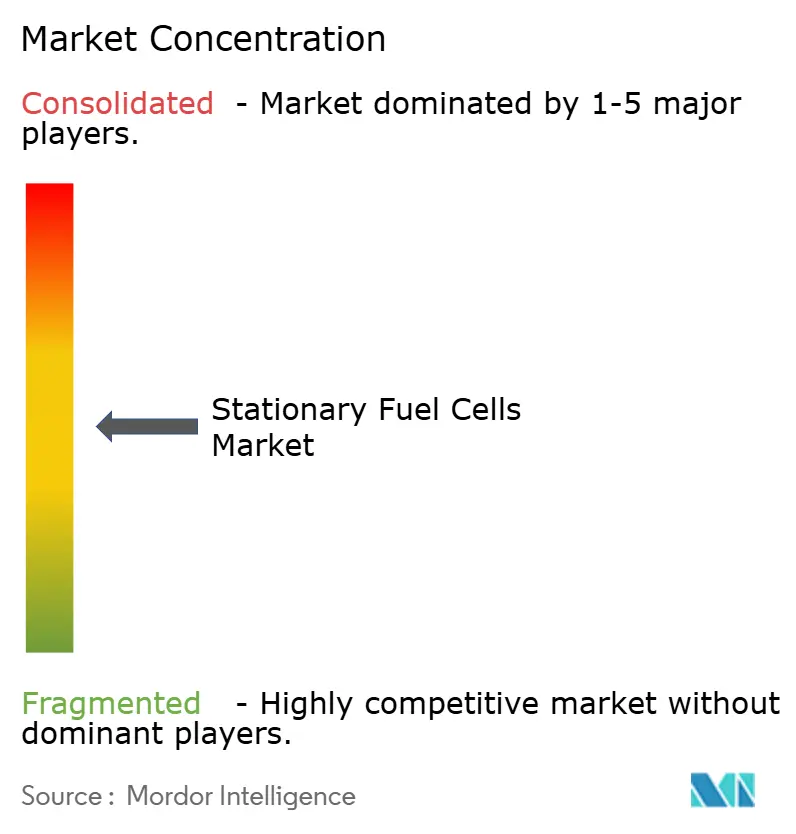
The stationary fuel cells market has moderate concentration across technology and deployment tiers. Bloom Energy has a leading position in large-scale SOFC systems for continuous on-site power in North America. Its Oracle agreement now covers up to 2.8 GW, demonstrating the scale of the company’s data center activity. FuelCell Energy differentiates with carbonate technology, fuel flexibility, and CHP integration. Ceres Power operates as a technology licensor with partners including Doosan, Delta, and Weichai.
FuelCell Energy introduced its 12.5 MW modular power block in March 2026 for data center projects. Ceres Power launched its Endura SOFC platform in April 2026 for data center and energy-intensive applications, with 800V DC compatibility and steel-supported cells. Ballard Power Systems received a 15 MW order in June 2026 for stationary modules, with deliveries starting in the second half of 2026. These steps show different approaches to larger-scale demand, including modular carbonate systems, technology platforms, and PEM modules.
Opportunities remain in smaller residential and light-commercial installations without mature incentive programs, as well as in large data center campuses that exceed current supply capacity. WATT Fuel Cell and Hope Gas introduced a 2025 SOFC leasing program for 7,250 residential backup units, removing the customer’s upfront purchase requirement. IEC 62282-3-100 compliance can help suppliers pursue deployment across regulated markets, although certification can extend first-of-kind schedules. Standards alignment also matters for data center power architecture. Competition in the stationary fuel cells market, therefore, turns on technology performance, fuel flexibility, financing, manufacturing capacity, and certification readiness.
Stationary Fuel Cells Industry Leaders
-
Bloom Energy Corporation
-
FuelCell Energy, Inc.
-
Doosan Fuel Cell Co., Ltd.
-
Panasonic Holdings Corporation
-
Toshiba Energy Systems & Solutions Corporation
- *Disclaimer: Major Players sorted in no particular order
Stationary Fuel Cells Market Companies Covered in this Report
- Advent Technologies Holdings, Inc.
- AFC Energy PLC
- Aisin Corporation
- Altergy Systems
- Ballard Power Systems Inc.
- Bloom Energy Corporation
- Ceres Power Holdings plc
- Cummins Inc.
- Doosan Fuel Cell Co., Ltd.
- FuelCell Energy, Inc.
- Fuji Electric Co., Ltd.
- GenCell Ltd.
- Horizon Fuel Cell Technologies Pte. Ltd.
- Intelligent Energy Limited
- Mitsubishi Heavy Industries, Ltd.
- Panasonic Holdings Corporation
- Plug Power Inc.
- POSCO Energy Co., Ltd.
- SFC Energy AG
- Toshiba Energy Systems & Solutions Corporation
Recent Industry Developments in Stationary Fuel Cells Market
- September 2026: FuelCell Energy reported second fiscal quarter 2026 results confirming progress toward 500 MW per year manufacturing capacity at its Torrington facility, with expansion now scheduled for completion by June 2028. The announcement confirmed that the 380 MW Fit Energy agreement’s Phase 0, 30 MW, is on track for delivery in Q4 fiscal 2026, validating the company’s data center power strategy at commercial scale.
- August 2026: Bloom Energy and Brookfield expanded their AI infrastructure partnership from USD 5 billion to USD 25 billion, a fivefold increase in the financing framework since October 2025, to accelerate deployment of fuel cell power for AI infrastructure globally.
- June 2026: FuelCell Energy and Fit Energy signed a strategic agreement for up to 380 MW of carbonate fuel cell baseload power for data centers, with Phase 0 covering 30 MW.
Global Stationary Fuel Cells Market Report Scope
A stationary fuel cell is an electrochemical device installed at a fixed location that converts the chemical energy of a fuel, typically hydrogen, and an oxidant directly into electricity and heat through a combustion-free chemical reaction. Unlike batteries, which store a finite amount of energy, stationary fuel cells generate continuous power as long as they receive an external supply of fuel and air.
The global stationary fuel cell market is segmented by fuel cell type, capacity, application, fuel type, end user, and geography. By fuel cell type, the market is segmented into proton exchange membrane fuel cells (PEMFC), solid oxide fuel cells (SOFC), phosphoric acid fuel cells (PAFC), molten carbonate fuel cells (MCFC), alkaline fuel cells (AFC), direct methanol fuel cells (DMFC), and other fuel cell types. By capacity, the market is segmented into less than 1 kW, 1–5 kW, 5–250 kW, 250 kW–1 MW, and more than 1 MW. By application, the market is segmented into combined heat and power (CHP), prime power, backup power, uninterruptible power supply (UPS), distributed power generation, microgrid power, and other applications. By fuel type, the market is segmented into hydrogen, natural gas, biogas, methanol, ammonia, and other fuels. By end-user, the market is segmented into residential, commercial buildings, industrial, utilities, defense and military, other end users. The report also covers the market size and forecasts for the global stationary fuel cell market across 26 countries in the key regions. For each segment, market sizing and forecasts are provided in terms of value (USD).
.
Segmentation Overview
| Proton Exchange Membrane Fuel Cells (PEMFC) |
| Solid Oxide Fuel Cells (SOFC) |
| Phosphoric Acid Fuel Cells (PAFC) |
| Molten Carbonate Fuel Cells (MCFC) |
| Alkaline Fuel Cells (AFC) |
| Direct Methanol Fuel Cells (DMFC) |
| Other Fuel Cell Types |
| Less than 1 kW |
| 1-5 kW |
| 5-250 kW |
| 250 kW-1 MW |
| More than 1 MW |
| Combined Heat and Power (CHP) |
| Prime Power |
| Backup Power |
| Uninterruptible Power Supply (UPS) |
| Distributed Power Generation |
| Microgrid Power |
| Other Applications |
| Hydrogen |
| Natural Gas |
| Biogas |
| Methanol |
| Ammonia |
| Other Fuels |
| Residential |
| Commercial Buildings |
| Industrial |
| Utilities |
| Defense and Military |
| Other End Users |
| North America | United States |
| Canada | |
| Mexico | |
| Europe | Germany |
| France | |
| Italy | |
| Spain | |
| United Kingdom | |
| Poland | |
| Russia | |
| Rest of Europe | |
| Asia-Pacific | China |
| India | |
| Japan | |
| South Korea | |
| Australia | |
| Indonesia | |
| Vietnam | |
| Thailand | |
| Rest of Asia-Pacific | |
| South America | Brazil |
| Argentina | |
| Chile | |
| Rest of South America | |
| Middle East and Africa | Saudi Arabia |
| United Arab Emirates | |
| Egypt | |
| South Africa | |
| Morocco | |
| Rest of Middle East and Africa |
| By Fuel Cell Type | Proton Exchange Membrane Fuel Cells (PEMFC) | |
| Solid Oxide Fuel Cells (SOFC) | ||
| Phosphoric Acid Fuel Cells (PAFC) | ||
| Molten Carbonate Fuel Cells (MCFC) | ||
| Alkaline Fuel Cells (AFC) | ||
| Direct Methanol Fuel Cells (DMFC) | ||
| Other Fuel Cell Types | ||
| By Capacity | Less than 1 kW | |
| 1-5 kW | ||
| 5-250 kW | ||
| 250 kW-1 MW | ||
| More than 1 MW | ||
| By Application | Combined Heat and Power (CHP) | |
| Prime Power | ||
| Backup Power | ||
| Uninterruptible Power Supply (UPS) | ||
| Distributed Power Generation | ||
| Microgrid Power | ||
| Other Applications | ||
| By Fuel Type | Hydrogen | |
| Natural Gas | ||
| Biogas | ||
| Methanol | ||
| Ammonia | ||
| Other Fuels | ||
| By End User | Residential | |
| Commercial Buildings | ||
| Industrial | ||
| Utilities | ||
| Defense and Military | ||
| Other End Users | ||
| By Geography | North America | United States |
| Canada | ||
| Mexico | ||
| Europe | Germany | |
| France | ||
| Italy | ||
| Spain | ||
| United Kingdom | ||
| Poland | ||
| Russia | ||
| Rest of Europe | ||
| Asia-Pacific | China | |
| India | ||
| Japan | ||
| South Korea | ||
| Australia | ||
| Indonesia | ||
| Vietnam | ||
| Thailand | ||
| Rest of Asia-Pacific | ||
| South America | Brazil | |
| Argentina | ||
| Chile | ||
| Rest of South America | ||
| Middle East and Africa | Saudi Arabia | |
| United Arab Emirates | ||
| Egypt | ||
| South Africa | ||
| Morocco | ||
| Rest of Middle East and Africa | ||
Key Questions Answered in the Report
What is the projected size of the global stationary fuel cells market by 2032?
The Stationary Fuel Cells Market size was valued at USD 3.57 billion in 2026 and is estimated to grow from USD 4.09 billion in 2027 to reach USD 8.02 billion by 2032, at a CAGR of 14.45% during the forecast period (2027-2032).
Which fuel cell technology led stationary installations in 2026?
Solid oxide fuel cells led with 35.6% revenue share in 2026, supported by fuel flexibility and electrical efficiency above 60%.
Why are data centers adopting stationary fuel cells?
Data centers need firm on-site power where grid connections are delayed, and agreements such as Bloom Energy's up to 2.8 GW Oracle arrangement show the scale of demand.
Which application held the largest share in 2026?
Combined heat and power held 39.4% revenue share because it can capture both electricity and thermal value at the customer site.
What is the fastest-growing fuel type through 2032?
Hydrogen is forecast to grow at a 17.5% CAGR, although fuel cost and distribution availability remain constraints.
Which region is forecast to grow fastest through 2032?
Asia-Pacific is forecast to grow at a 16.1% CAGR through 2032, supported by Japanese residential deployments and South Korean utility-scale procurement.