
Stationary Energy Storage Market Size and Share
Market Overview
| Study Period | 2022 - 2032 |
|---|---|
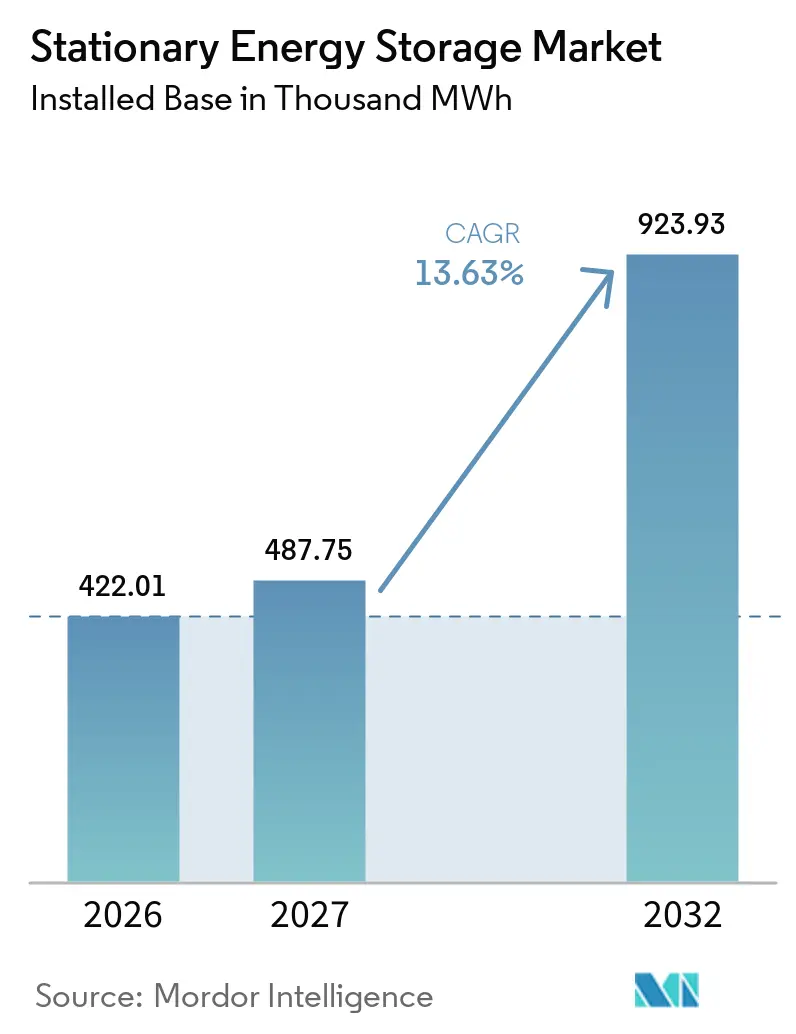
| Market Volume (2027) | 487.75 Thousand MWh |
| Market Volume (2032) | 923.93 Thousand MWh |
| Growth Rate (2027 - 2032) | 13.63 % |
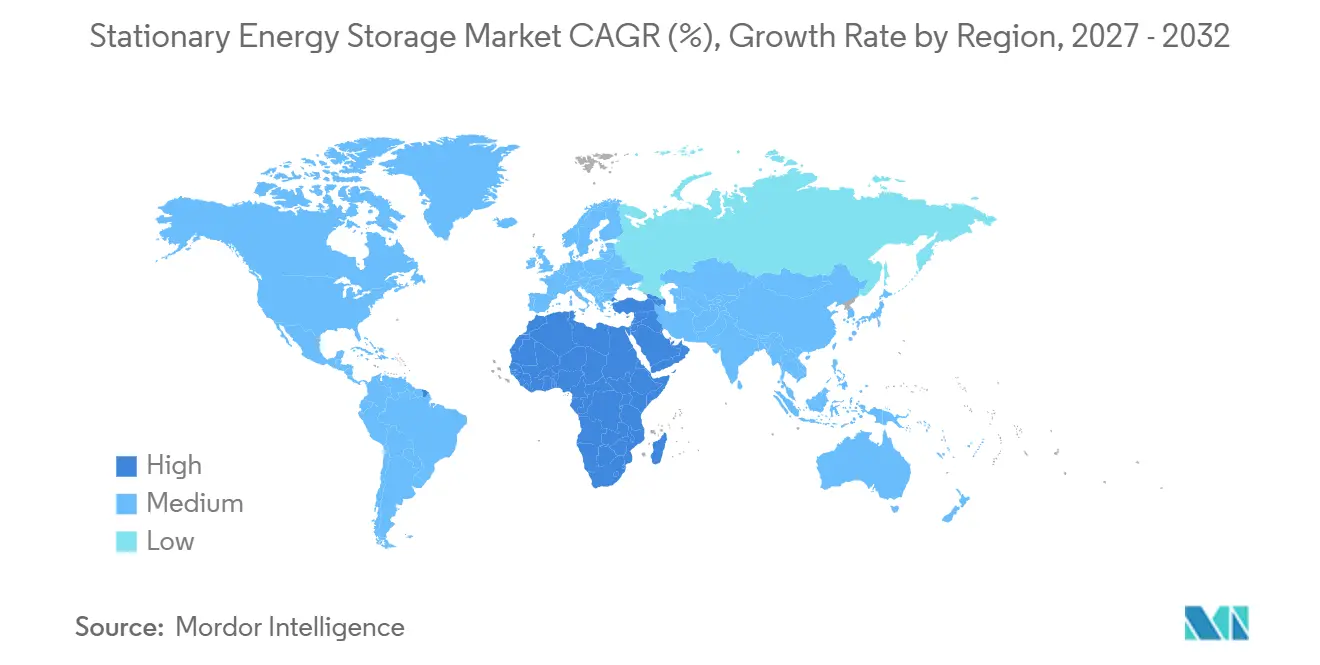
| Fastest Growing Market | Middle East and Africa |
| Largest Market | Asia-Pacific |
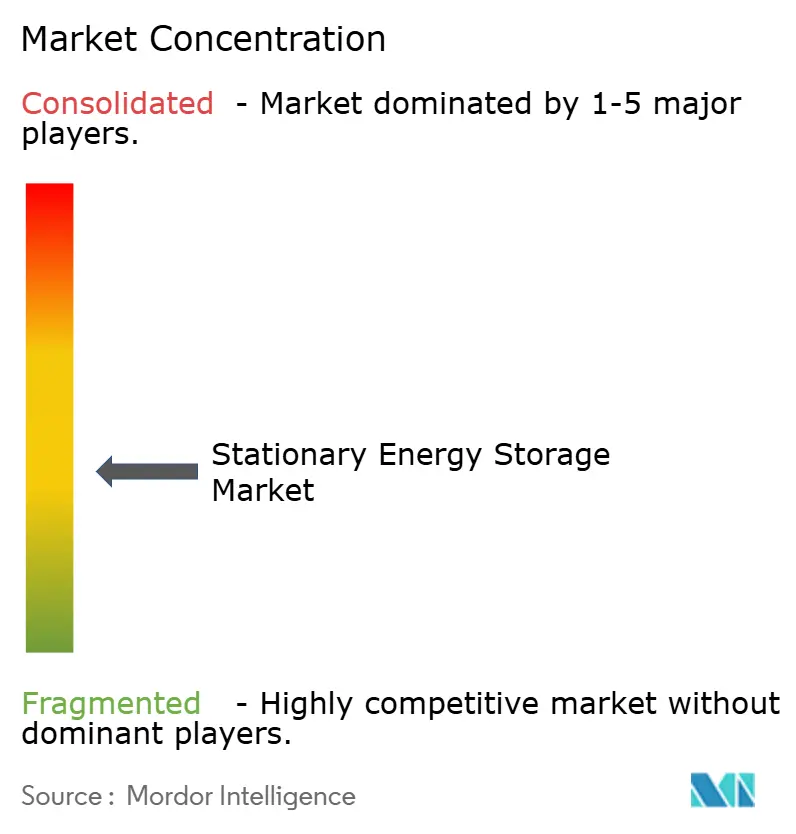
| Market Concentration | Medium |
Major Players *Disclaimer: Major Players sorted in no particular order Image © Mordor Intelligence. Reuse requires attribution under CC BY 4.0. | |
Stationary Energy Storage Market Analysis by Mordor Intelligence
The stationary energy storage market size is projected to expand from 422,011.42 MWh in 2026 to 923,932.67 MWh by 2032, registering a CAGR of 13.6% between 2027 and 2032. The stationary energy storage market is expanding as grids need assets that can move electricity from periods of high renewable output to periods of higher demand, particularly when solar generation declines after the evening peak begins. Battery systems are becoming more central to daily grid operations as their duration increases and developers use them for energy shifting rather than only ancillary services, which changes both dispatch requirements and financing expectations. Lower installed costs, larger containers, and standardized equipment favor larger projects, while data centers and industrial electrification are widening demand beyond traditional utility procurement, including customer-owned systems that address reliability and connection constraints. Grid access, permitting, and concentrated battery-material supply remain important limits on how quickly projects can move from development to operation. Competition is also moving beyond equipment price because dispatch software, long-term service, and supply-chain localization can influence project revenue and delivery risk.
Key Report Takeaways
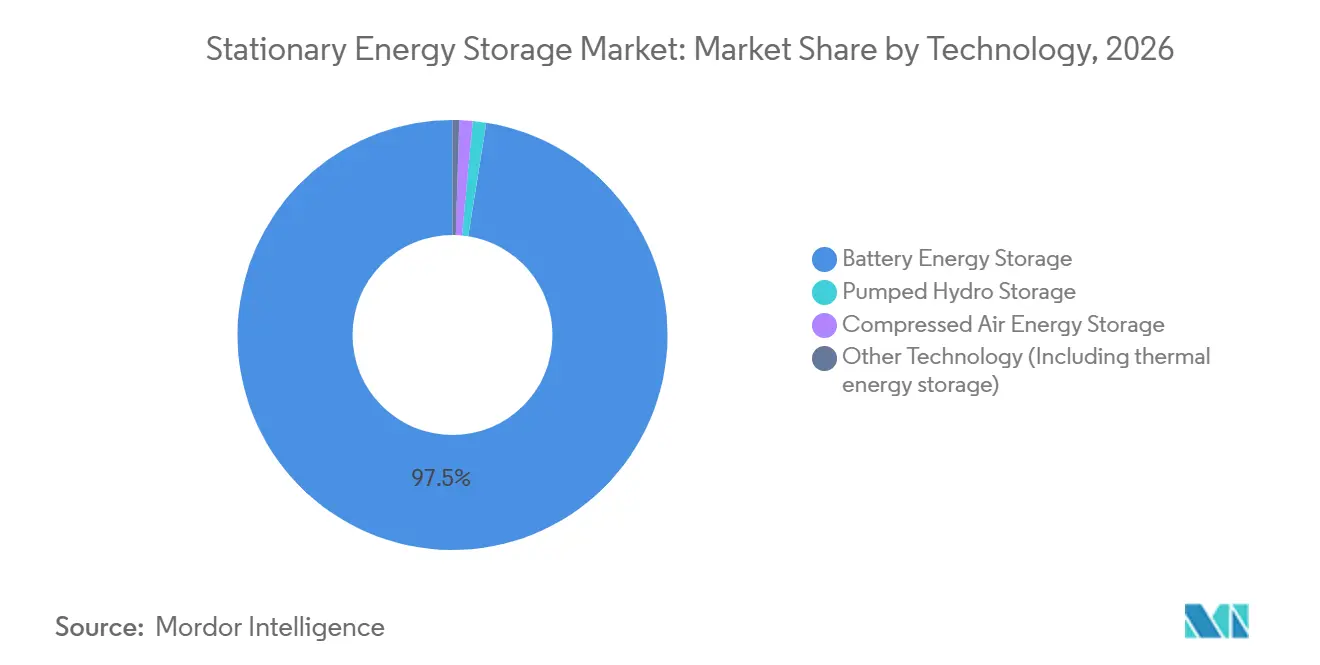
- By technology, battery energy storage systems held 97.5% of the stationary energy storage market share in 2026, while compressed air energy storage is forecast to expand at a 23.5% CAGR through 2032.
- By connectivity, on-grid systems held 75.7% of the stationary energy storage market share in 2026 and are forecast to expand at a 15.1% CAGR through 2032.
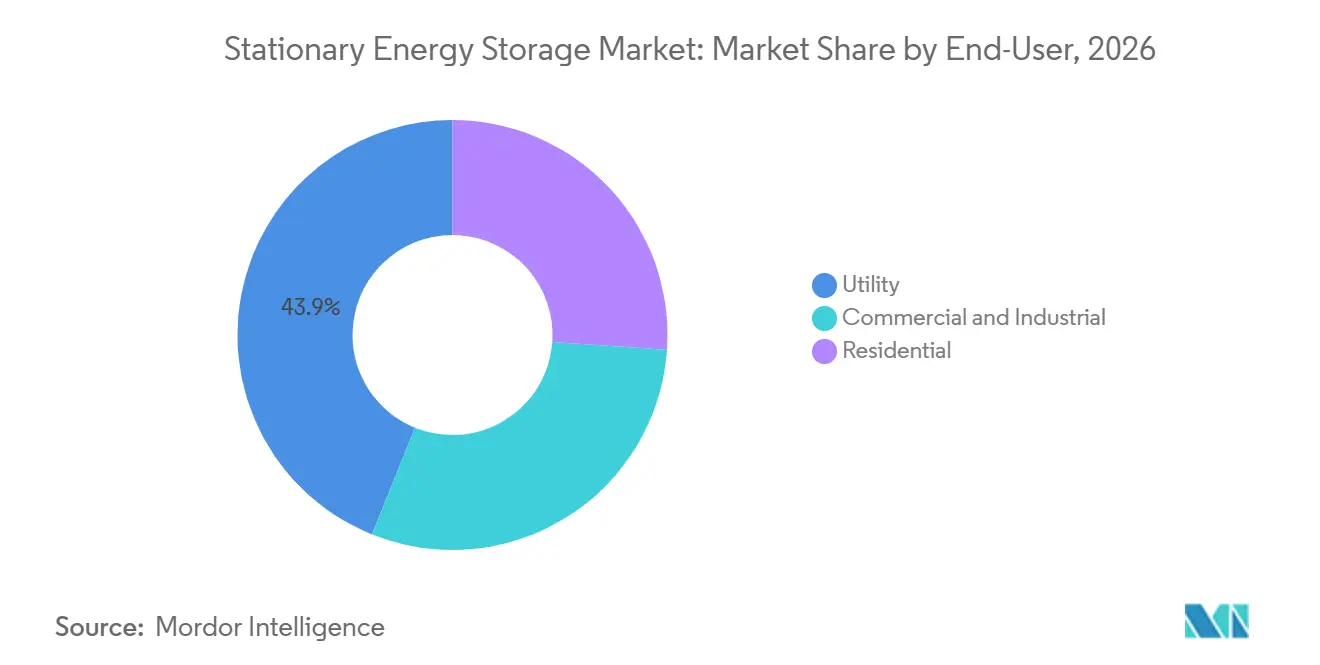
- By end-user, the utility segment held 43.9% of 2026 volume, while commercial and industrial are forecast to expand at a 16.9% CAGR through 2032.
- By geography, Asia-Pacific held 57.1% of 2026 volume, while the Middle East and Africa is forecast to expand at a 17.1% CAGR through 2032.
Note: Market numbers in this report are based on Mordor Intelligence's proprietary estimation framework, which combines nine months of actuals with Q4 projections for base year 2026.
Market Trends and Insights
Drivers Impact Analysis of Stationary Energy Storage Market*
| Driver | (~) % Impact on CAGR Forecast | Geographic Relevance | Impact Timeline |
|---|---|---|---|
| Renewable Integration and Energy Shifting Demand | +3.5% | Global, with highest intensity in Asia-Pacific and North America | Short term (≤ 2 years) |
| Utility-Scale Grid Flexibility Procurement | +2.5% | North America, Europe, Asia-Pacific | Short term (≤ 2 years) |
| Falling Battery Costs and Longer-Duration Systems | +3.0% | Global | Short term (≤ 2 years) |
| Rising Data-Center and Electrification Loads | +1.8% | North America, Europe, Asia-Pacific core | Medium term (2-4 years) |
| Battery Energy Storage System (BESS) Revenue-Stacking and Software Optimization | +1.2% | North America, Europe, Australia | Medium term (2-4 years) |
| Underutilized Interconnection Capacity Creating Storage Opportunities | +0.8% | North America, Europe | Long term (≥ 4 years) |
| Source: Mordor Intelligence | |||
Renewable Integration and Energy Shifting Demand
Solar and wind curtailment has become a central reason for utility-scale storage procurement in the stationary energy storage market. The International Energy Agency reported 108 GW of new battery storage deployment globally in 2025, exceeding peak annual additions from conventional gas-fired generation and confirming that storage is now being developed at a scale that matters to system planning. The average duration of commissioned utility-scale systems rose to 3 hours from 2 hours in 2023, which supported energy shifting, peak shaving, and renewable firming instead of only short dispatch windows. Energy shifting represented more than 90% of new battery storage project applications in 2025, compared with 40% in 2015, showing a clear move away from ancillary-service-only projects and toward assets designed around daily power-system needs. In California, batteries provided more than 60% of hour-to-hour net-load ramping by the first quarter of 2026, which demonstrates their growing role in short-duration balancing at times when the grid must rapidly adjust between changing renewable production and customer demand. Co-location requirements in several countries are also creating secured project demand and can reduce merchant revenue exposure for developers, helping projects attract capital that may otherwise avoid uncertain market-based revenue.
Falling Battery Costs and Longer-Duration Systems
Cost declines are improving the economics of the stationary energy storage market, especially for larger installations. The International Renewable Energy Agency (IRENA) reported that installed battery energy storage system costs declined 93% from USD 2,571/kWh in 2010 to USD 192/kWh in 2024, improving the basis for storage investment across a wider set of grid and customer uses[1]. Lithium iron phosphate batteries have supported this change through cost, cycle-life, and safety advantages in many stationary applications, especially where developers prioritize standardized equipment and dependable operating performance. The move to containers with 5 MWh or more of capacity reduces the number of system components and lowers installation labor requirements, which can simplify site construction and reduce the equipment footprint needed for a project. This configuration supports utility-scale projects, where balance-of-plant savings can be meaningful and a smaller number of containers can reduce the complexity of construction, commissioning, and ongoing site management. Persistent losses among some lithium iron phosphate cathode producers also indicate that supply consolidation could affect material availability before 2030, even if near-term oversupply continues to support low cell prices for project buyers.
Rising Data-Center and Electrification Loads
Data centers are becoming a major new demand source for the stationary energy storage market because their electricity needs require both dependable supply and clearer paths through constrained grid-connection processes. Commercial and industrial storage deployments in the United States rose 55% in the first quarter of 2026 compared with the same quarter in 2025, with data-center demand linked to behind-the-meter storage needs[3]. Storage can help large customers manage interconnection delays and maintain power quality, while allowing operations to respond to changing load requirements with more control over on-site capacity. Industrial electrification creates a related need because additional electricity demand can reduce available grid headroom in key areas, especially where existing networks were not designed for rapid increases in high-load commercial activity. This demand is driven by operating requirements rather than only solar self-consumption or demand-response programs, which gives the segment a different basis for investment approval and capacity planning. The result is a broader set of customers for systems that can provide resilience, peak management, and flexible load support, including businesses that need predictable power quality as part of their core operations.
Battery Energy Storage System (BESS) Revenue-Stacking and Software Optimization
Software is becoming more important in the stationary energy storage market because a single asset can participate in several power-system services, subject to local market rules and the technical conditions of the network. Operators can combine energy arbitrage, ancillary services, capacity products, and intraday trading when market rules permit, making the quality of dispatch decisions more relevant to returns from the same installed hardware. Fluence reported that assets using its Mosaic bidding software outperformed the California Independent System Operator market average by 50% during the summer of 2025. The same company reported a 204% improvement over the average for assets using a day-ahead and real-time co-optimization framework[2]. These results show why developers increasingly evaluate software and asset-performance tools alongside battery hardware, rather than treating the battery container as the only source of a project’s commercial value. Companies that provide bidding intelligence and long-term optimization services can develop recurring revenue streams that component suppliers do not have, particularly as operational storage fleets become larger and require continuous performance monitoring.
Restraints Impact Analysis of Stationary Energy Storage Market*
| Restraint | (~) % Impact on CAGR Forecast | Geographic Relevance | Impact Timeline |
|---|---|---|---|
| Grid-Connection and Permitting Delays | -1.5% | North America, Europe | Short term (≤ 2 years) |
| Revenue-Stack Uncertainty and Limited Market Access | -0.8% | Global | Medium term (2-4 years) |
| Critical-Mineral Supply and Trade Exposure | -1.0% | Global, with focus on non-China markets | Long term (≥ 4 years) |
| Fire-Safety, Siting, and Community-Approval Friction | -0.5% | North America, Europe, Asia-Pacific urban markets | Medium term (2-4 years) |
| Source: Mordor Intelligence | |||
Grid-Connection and Permitting Delays
Grid interconnection backlogs remain the most immediate constraint on the stationary energy storage market in developed project pipelines. Lawrence Berkeley National Laboratory reported that 749 GW of storage capacity was seeking grid connection in the United States at the end of 2025, a volume that creates long waits even for projects with viable technology and financing. The median time from an interconnection request to commercial operation exceeded 5 years for projects commissioned in 2025. Only 13% of the capacity that submitted interconnection requests from 2000 to 2020 had reached commercial operation by the end of 2025, while 75% had been withdrawn.[4] Regional reforms can improve queue administration, but they do not eliminate high transmission-upgrade costs, which can change a project’s economics after an initial development decision has already been made. Local siting decisions can add another delay when safety and land-use concerns are unresolved, making early engagement with communities, local authorities, and emergency-response stakeholders an important part of project development.
Critical-Mineral Supply and Trade Exposure
Battery-material concentration creates procurement risk for the stationary energy storage market because changes in trade conditions can affect delivery schedules and developers’ ability to plan equipment sourcing with confidence. China manufactured more than 80% of batteries in 2025 and supplies almost all global lithium iron phosphate manufacturing capacity. The IEA identifies lithium iron phosphate cathode materials and graphite anode feedstock as highly concentrated supply risks in the storage value chain. Export-control actions announced in October 2025 introduced uncertainty for battery-component procurement even when specific measures were later suspended. Building alternative processing capacity requires sustained demand signals and significant capital investment, so new facilities cannot fully resolve the issue in the near term simply because demand has increased. This means that diversification outside China is likely to take several years, even as developers seek regional supply options and attempt to balance cost, technical qualification, and availability across their procurement plans.
*Our forecasts treat driver/restraint impacts as directional, not additive. The impact forecasts reflect baseline growth, mix effects, and variable interactions.
Stationary Energy Storage Market Segment Analysis
By Technology:
Battery Systems Lead While Compressed Air Storage ExpandsBattery energy storage systems accounted for 97.5% of the stationary energy storage market size in 2026. Their position reflects the cost, cycle-life, and safety characteristics of lithium iron phosphate systems across utility and commercial applications, where standardization also helps buyers assess suppliers, warranties, and expected operating performance. Utility-scale batteries represented 80% of global annual battery additions in 2025. The average commissioned project duration reached 3 hours, which widened use cases beyond frequency response. Pumped hydro remains an established technology, but siting limits and long development timelines restrict its incremental additions, while thermal storage serves specific industrial and district-heating needs where heat integration has local value.
Compressed air energy storage is forecast to record a 23.5% CAGR through 2032 within the stationary energy storage market. It can offer long-duration services without electrochemical degradation, which is relevant for projects requiring 8 hours or more of storage. The U.S. Department of Energy issued a conditional commitment for a loan guarantee of up to USD 1.76 billion in January 2025 for the 500 MW/4,000 MWh Willow Rock advanced compressed air energy storage facility in California. This federal backing supports the role of advanced compressed air storage as a long-duration option in the stationary energy storage market alongside pumped hydro, particularly for systems that need to deliver energy over extended periods rather than short daily cycles. China also commissioned a 600 MW/2.4 GWh compressed air facility in March 2026, showing that public institutions and state-linked entities can support larger commercial projects without relying solely on merchant battery returns.

By Connectivity:
On-Grid Systems Lead ProcurementOn-grid systems held 75.7% of the stationary energy storage market size in 2026 and are forecast to expand at a 15.1% CAGR through 2032. The combined scale and growth rate indicate that grid-connected procurement in the stationary energy storage market remains in an expansion phase rather than a mature phase. Grid-connected battery projects commissioned in 2025 averaged 3 hours of duration globally. A growing share of projects provides 4 hours or more, matching the move toward energy shifting. California battery capacity rose from less than 1 GW in 2019 to more than 17 GW by 2026, providing a visible example of how quickly a large storage fleet can become important to a renewable-heavy power system. Batteries supplied more than 40% of the state grid load on the evening of March 29, 2026, demonstrating the operational value of on-grid systems in a high-renewable system.
Off-grid systems have lower volumes but serve distinct applications in island grids, remote mines, and rural electrification. In these settings, storage replaces diesel generation rather than competing only with grid electricity, which can make the project case more resilient when fuel delivery is expensive or unreliable. The stationary energy storage industry uses off-grid systems in hybrid projects that combine solar, storage, and existing generation to improve supply reliability and reduce fuel exposure for isolated customers. Developers that build behind-the-meter commercial systems can apply similar experience in microgrid and remote-project pipelines, where the design must account for local load patterns, fuel alternatives, and the availability of renewable generation.
By End-User:
Utility Projects Lead Volume and Commercial Demand GrowsThe utility segment held 43.9% of the stationary energy storage market size in 2026. It remained the main source of volume because utilities procured capacity in the stationary energy storage market for renewable firming, ancillary services, and resource adequacy. Utility-scale projects accounted for 80% of new battery storage additions globally in 2025. Existing fossil-plant connection points can also create utility-scale opportunities. A 2026 study in the Proceedings of the National Academy of Sciences estimated 597 GW of storage opportunity at existing fossil-plant grid connection points in the United States by 2030 through surplus interconnection sharing. This approach can enable storage projects without constructing entirely new transmission connections, which may be particularly valuable where a new connection would otherwise involve a long study process and high network-upgrade costs.
Commercial and industrial systems are forecast to expand at a 16.9% CAGR through 2032. Data centers, corporate power strategies, and industrial electrification are increasing the demand for reliable on-site capacity. U.S. commercial and industrial behind-the-meter deployments rose 55% in the first quarter of 2026 from the same period in 2025. These systems can address power-quality requirements and help customers manage long connection timelines, while residential systems remain smaller despite time-of-use rates and solar self-consumption programs in Germany, Australia, and Japan. The different demand profile means that commercial and industrial growth is less dependent on household purchase decisions, because project economics are more closely tied to business continuity, power quality, and the timing of new electrical loads.
Geography Analysis
Asia-Pacific accounted for 57.1% of the stationary energy storage market in 2026. China added more than 63 GW of battery storage in 2025 and has a 300 GW target for 2030 under firming requirements for standalone solar and wind projects. India is accelerating through tender-led procurement, while Australia is adding systems across utility and behind-the-meter applications, reaching nearly 8 GW of battery additions in 2025 and 18% of installed dispatchable capacity. Japan, South Korea, and Taiwan add diversity through their power-market structures and utility procurement programs, reducing the region’s dependence on any single national deployment pattern even as China remains the largest contributor.
North America and Europe are important parts of the stationary energy storage market for software-led services and localized supply chains. The United States deployed 19 GW of battery storage in 2025, with utility-scale additions accounting for more than 16 GW. U.S. deployments reached 9.7 GWh in the first quarter of 2026, 32% higher than the year-earlier quarter. Europe deployed 6.2 GW in 2025, including 4.6 GW of utility-scale additions. Development is extending beyond the United Kingdom, Germany, and Italy into Poland, Romania, Bulgaria, France, and the Netherlands, where capacity-market structures and changing renewable portfolios are supporting a broader set of project pipelines. European battery rules on lifecycle carbon declarations and supply-chain due diligence are also raising compliance requirements for suppliers.
The Middle East and Africa is forecast to expand at a 17.1% CAGR through 2032, the fastest regional rate in the stationary energy storage market. Regional battery energy storage additions exceeded 3 GW in 2025 and were more than 3 times the 2024 level, led by Saudi Arabia's project pipeline. Egypt reached financial close for a 1.1 GW solar project with a 200 MWh battery system at Nagaa Hammadi in June 2025. The project had USD 479.1 million in blended finance from the European Bank for Reconstruction and Development (EBRD), African Development Bank, and British International Investment, a structure that can support further hybrid solar and storage projects across the region. South America is also emerging, led by Chile, Argentina, and Brazil, where storage can absorb surplus solar output and manage peak demand, giving developers a practical response to the timing mismatch between solar production and evening consumption.
Competitive Landscape
The stationary energy storage market is moderately concentrated among system integrators and more fragmented across cells, software, and services. BYD, Tesla, and Sungrow together represented roughly one-third of 460 GWh of global system shipments, supported by large manufacturing capacity, established product platforms, and global project experience. The share of companies outside the top 10 increased from 18% in 2024 to 32% in 2025, pointing to greater price competition and a wider group of capable suppliers.
Supply-chain localization is changing the choices available to major competitors as developers consider tariff exposure, component availability, manufacturing location, and the value of having a qualified supplier base closer to project markets. Fluence began manufacturing its Smartstack platform at a 35 GWh annual-capacity facility in Vietnam in September 2025, creating a large production base for a platform intended for utility-scale use. The company stated that the platform offered 30% higher energy density than leading peers, which shows how suppliers are seeking to reduce site footprint and make larger projects easier to build, operate, and service over their working lives. These moves show how companies are pursuing domestic supply, higher site energy density, and stronger system capabilities, because buyers increasingly evaluate whether suppliers can support projects throughout construction, commissioning, and operation, not merely whether the initial equipment price is competitive.
Long-duration storage, software optimization, and project development in newer regions remain important areas of competition because these activities allow suppliers to address needs that extend beyond the standard delivery of battery containers. Compressed air and flow technologies can serve projects that require longer storage duration than typical battery systems provide, while software providers can aggregate fleets from multiple owners and optimize dispatch across market products. This model allows companies to pursue revenue without owning all of the hardware assets, while giving asset owners access to coordination tools that may be difficult to build and operate independently. Fluence's bidding performance results illustrate how software can become part of a project's commercial offer. The stationary energy storage market therefore rewards companies that can combine equipment delivery with service, operating data, and local execution.
Stationary Energy Storage Industry Leaders
-
BYD Company Limited
-
Sungrow Power Supply Co., Ltd.
-
Contemporary Amperex Technology Co., Limited (CATL)
-
Tesla, Inc.
-
Beijing HyperStrong Technology Co., Ltd.
- *Disclaimer: Major Players sorted in no particular order
Stationary Energy Storage Market Companies Covered in this Report
- ABB Ltd.
- Beijing HyperStrong Technology Co., Ltd.
- BYD Company Limited
- Canadian Solar Inc.
- Contemporary Amperex Technology Co., Limited (CATL)
- Delta Electronics, Inc.
- Exide Industries Limited
- Fluence Energy, Inc.
- GE Vernova Inc.
- Huawei Technologies Co., Ltd.
- LG Energy Solution, Ltd.
- Panasonic Holdings Corporation
- Powin, LLC
- Saft Groupe S.A.
- Samsung SDI Co., Ltd.
- Siemens Energy AG
- Sungrow Power Supply Co., Ltd.
- Tesla, Inc.
- Trina Solar Co., Ltd.
- Wärtsilä Corporation
Recent Industry Developments in Stationary Energy Storage Market
- October 2026: Vattenfall awarded Fluence a supply and long-term service contract for a 254 MW/1,000+ MWh Battery Energy Storage System (BESS) in Brunsbüttel, Germany, expected to be among the country's largest battery projects and scheduled for commissioning by end-2028. The project will utilize Fluence's Gridstack Pro 5000 platform connected to the 50Hertz 380 kV transmission network, strengthening German grid flexibility at a critical phase of the coal phase-out
- July 2025: Fluence was selected for the 300 MW/600 MWh Wellington Stage 1 Battery Energy Storage System (BESS) in New South Wales, Australia, AMPYR's first grid-scale project at financial close, including a 20-year service contract, Mosaic AI bidding software, and Nispera asset performance management.
- January 2025: The U.S. Department of Energy's Loan Programs Office announced a conditional commitment for a loan guarantee of up to USD 1.76 billion for the Willow Rock 500 MW/4,000 MWh advanced CAES project in Kern County, California, supporting the first commercial-scale A-CAES project in the United States.
Global Stationary Energy Storage Market Report Scope
The Global Stationary Energy Storage Market refers to the market for systems designed to store energy for later use in fixed installations across residential, commercial, industrial, and utility applications. These systems include battery energy storage, pumped hydro storage, compressed air energy storage, and other technologies such as thermal energy storage. They support renewable energy integration, grid stability, peak-load management, backup power, and improved electricity supply reliability in both grid-connected and off-grid environments.
The global stationary energy storage market is segmented by technology, connectivity, end-user, and geography. By technology, the market is segmented into battery energy storage, pumped hydro storage, compressed air energy storage, and other technologies, including thermal energy storage. By connectivity, the market is segmented into on-grid and off-grid systems. By end-user, the market is segmented into residential, commercial, industrial, and utility applications. The report also covers the market size and forecasts for the global stationary energy storage market across 20 countries in key regions. For each segment, the market sizing and forecasts are provided on the basis of value (USD).
Segmentation Overview
| Battery Energy Storage |
| Pumped Hydro Storage |
| Compressed Air Energy Storage |
| Other Technology (Including thermal energy storage) |
| On-Grid |
| Off-Grid |
| Residential |
| Commercial and Industrial |
| Utility |
| North America | United States |
| Canada | |
| Rest of North America | |
| Europe | Germany |
| United Kingdom | |
| France | |
| Spain | |
| Nordic Countries | |
| Russia | |
| Rest of Europe | |
| Asia-Pacific | China |
| India | |
| Japan | |
| Taiwan | |
| South Korea | |
| ASEAN Countries | |
| Rest of Asia Pacific | |
| South America | Brazil |
| Argentina | |
| Colombia | |
| Rest of South America | |
| Middle East and Africa | Saudi Arabia |
| United Arab Emirates | |
| Egypt | |
| South Africa | |
| Rest of Middle East and Africa |
| By Technology | Battery Energy Storage | |
| Pumped Hydro Storage | ||
| Compressed Air Energy Storage | ||
| Other Technology (Including thermal energy storage) | ||
| By Connectivity | On-Grid | |
| Off-Grid | ||
| By End-User | Residential | |
| Commercial and Industrial | ||
| Utility | ||
| By Geography | North America | United States |
| Canada | ||
| Rest of North America | ||
| Europe | Germany | |
| United Kingdom | ||
| France | ||
| Spain | ||
| Nordic Countries | ||
| Russia | ||
| Rest of Europe | ||
| Asia-Pacific | China | |
| India | ||
| Japan | ||
| Taiwan | ||
| South Korea | ||
| ASEAN Countries | ||
| Rest of Asia Pacific | ||
| South America | Brazil | |
| Argentina | ||
| Colombia | ||
| Rest of South America | ||
| Middle East and Africa | Saudi Arabia | |
| United Arab Emirates | ||
| Egypt | ||
| South Africa | ||
| Rest of Middle East and Africa | ||
Key Questions Answered in the Report
What is the stationary energy storage market forecast through 2032?
Global volume is projected to reach 923,932.67 MWh by 2032, growing at a 13.63% CAGR from 2027 as renewable integration, lower system costs, and higher electricity demand support new capacity.
Which stationary energy storage technology leads deployment?
Battery energy storage systems lead with 97.5% of 2026 volume, while compressed air energy storage has the fastest projected growth at 23.5% CAGR because it can serve longer-duration applications. Battery systems remain the preferred choice for most new installations because their supply base, container formats, and operating history are more established across utility, commercial, and industrial uses.
Why are utilities investing in stationary energy storage?
Utilities use storage for renewable firming, energy shifting, ancillary services, and resource adequacy. Utility-scale systems accounted for 80% of new battery additions in 2025, reflecting their role in meeting system-wide power needs.
Which region leads global stationary energy storage deployment?
Asia-Pacific leads with 57.1% of 2026 volume, supported by China, India, and Australia. China’s large deployment program, Indian tenders, and Australian utility and customer systems give the region a broad base of demand.
What is slowing battery storage project development?
Long grid-connection queues, permitting delays, transmission-upgrade costs, and concentrated material supply can delay projects, even when demand, funding, and the technology case for deployment are established.
How are data centers affecting energy storage demand?
Data centers are increasing in demand for behind-the-meter systems that support power quality and help manage grid-interconnection timelines. These customers need dependable electricity for high-load operations and can use storage alongside wider power-procurement strategies. This need is likely to persist as computing loads grow.