
SSL/TLS Certificate Market Size and Share
Market Overview
| Study Period | 2021 - 2032 |
|---|---|
| Market Size (2027) | USD 5.43 Billion |
| Market Size (2032) | USD 8.12 Billion |
| Growth Rate (2027 - 2032) | 8.38 % |
| Fastest Growing Market | Asia-Pacific |
| Largest Market | North America |
| Market Concentration | Medium |
Major Players *Disclaimer: Major Players sorted in no particular order Image © Mordor Intelligence. Reuse requires attribution under CC BY 4.0. | |
SSL/TLS Certificate Market Analysis by Mordor Intelligence
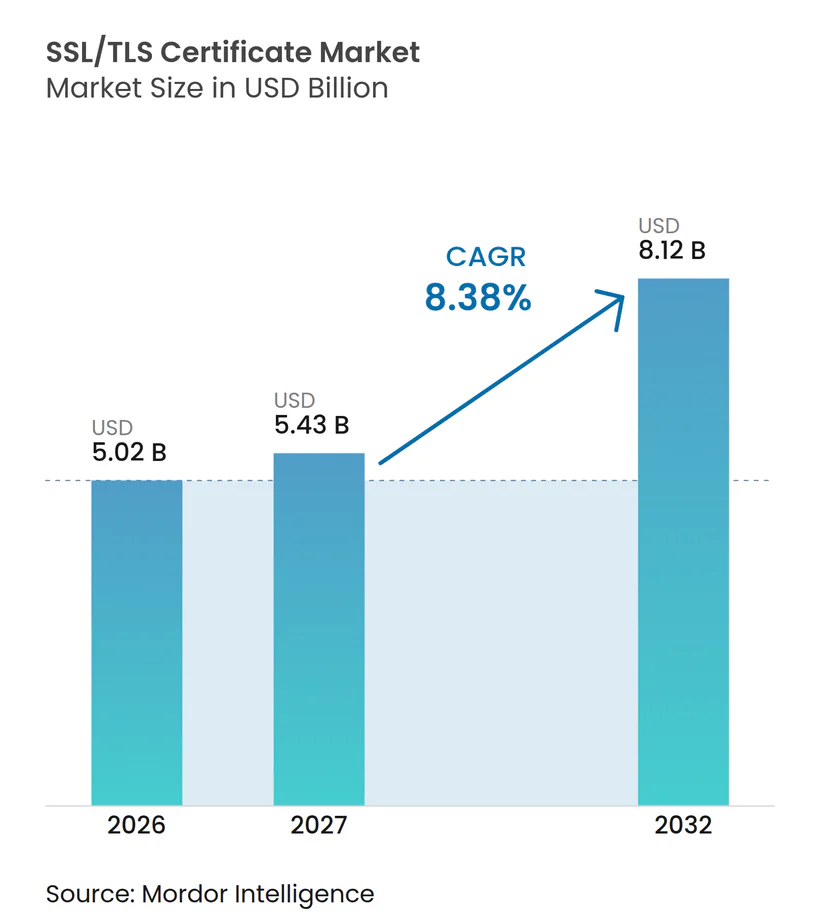
The SSL/TLS certificate market stands at USD 5.02 billion in 2026 and is forecast to reach USD 8.12 billion by 2032, expanding at a CAGR of 8.38% during 2027–2032. Near-universal HTTPS use has moved demand away from basic website encryption and toward reliable certificate discovery, renewal, and policy control. Shorter certificate validity periods are making manual renewal practices less viable, particularly for organizations with large and distributed certificate estates. This change favors providers that combine public certificate issuance with certificate lifecycle management, automation interfaces, and cloud integrations. Private PKI is also becoming more important as enterprises protect internal APIs, containers, service meshes, and device identities. Competition is therefore shifting from the sale of individual certificates to long-term software and managed-service relationships.
Key Report Takeaways
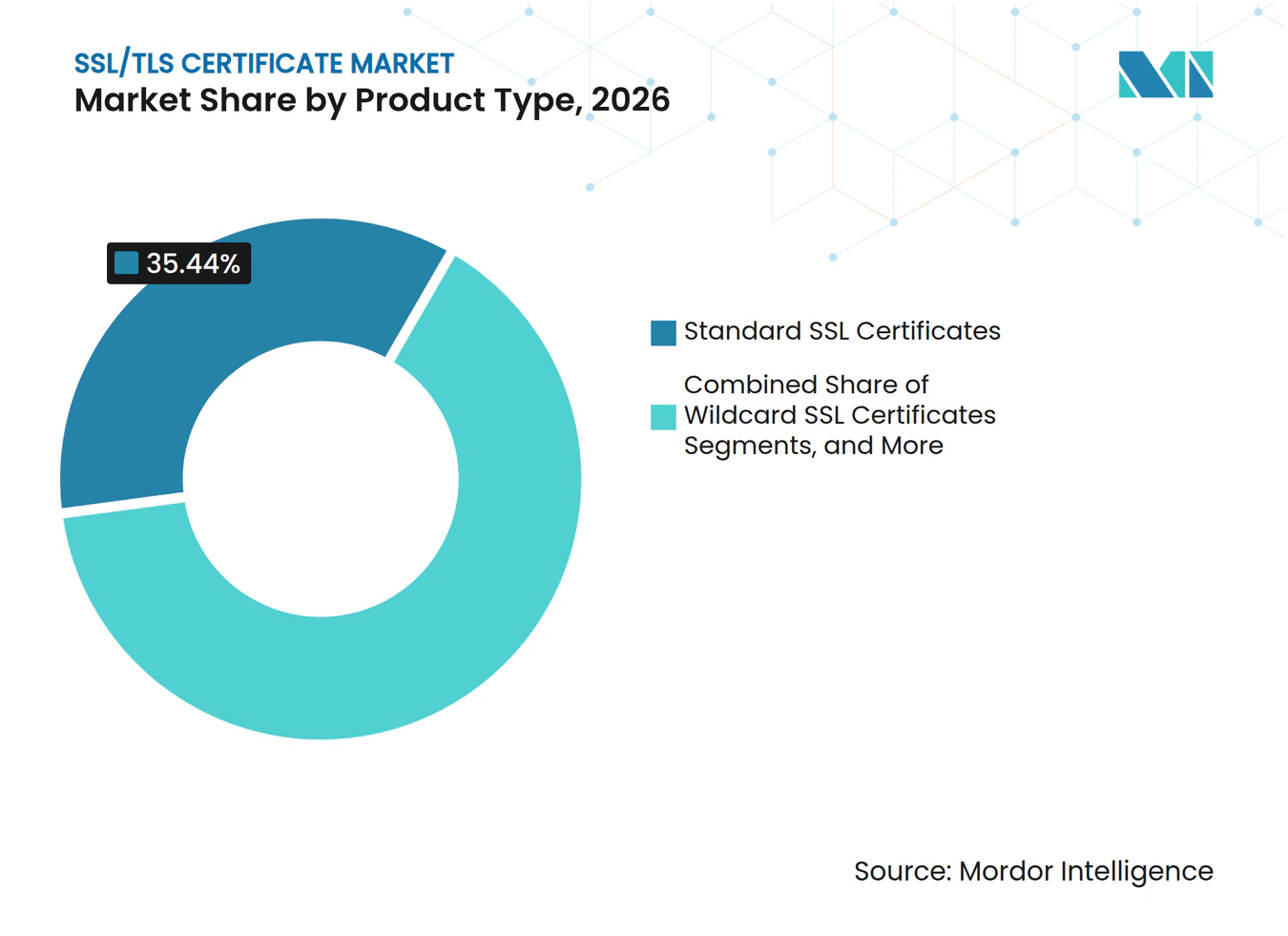
- By product type, Standard SSL certificates held 35.44% of the market share in 2026, while SAN certificates are projected to expand at an 8.66% CAGR through 2032.
- By validation level, Organization Validation certificates held 43.99% share in 2026, while Domain Validation certificates are expected to expand at an 8.72% CAGR through 2032.
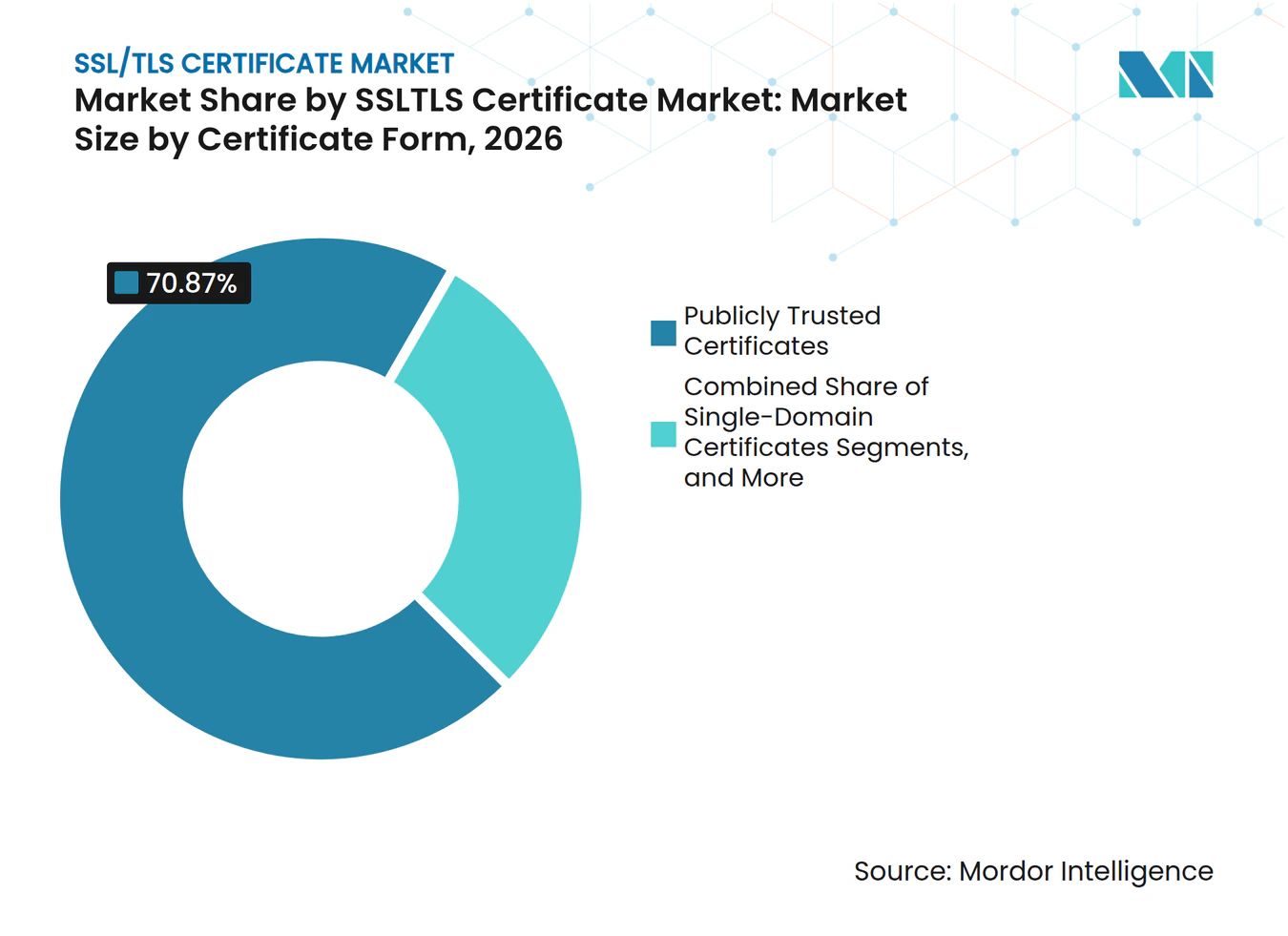
- By certificate form, publicly trusted certificates accounted for 70.87% share in 2026, while privately trusted certificates are projected to expand at an 8.63% CAGR through 2032.
- By deployment model, cloud-based deployment held 53.97% share in 2026, while hybrid deployment is expected to expand at an 8.94% CAGR through 2032.
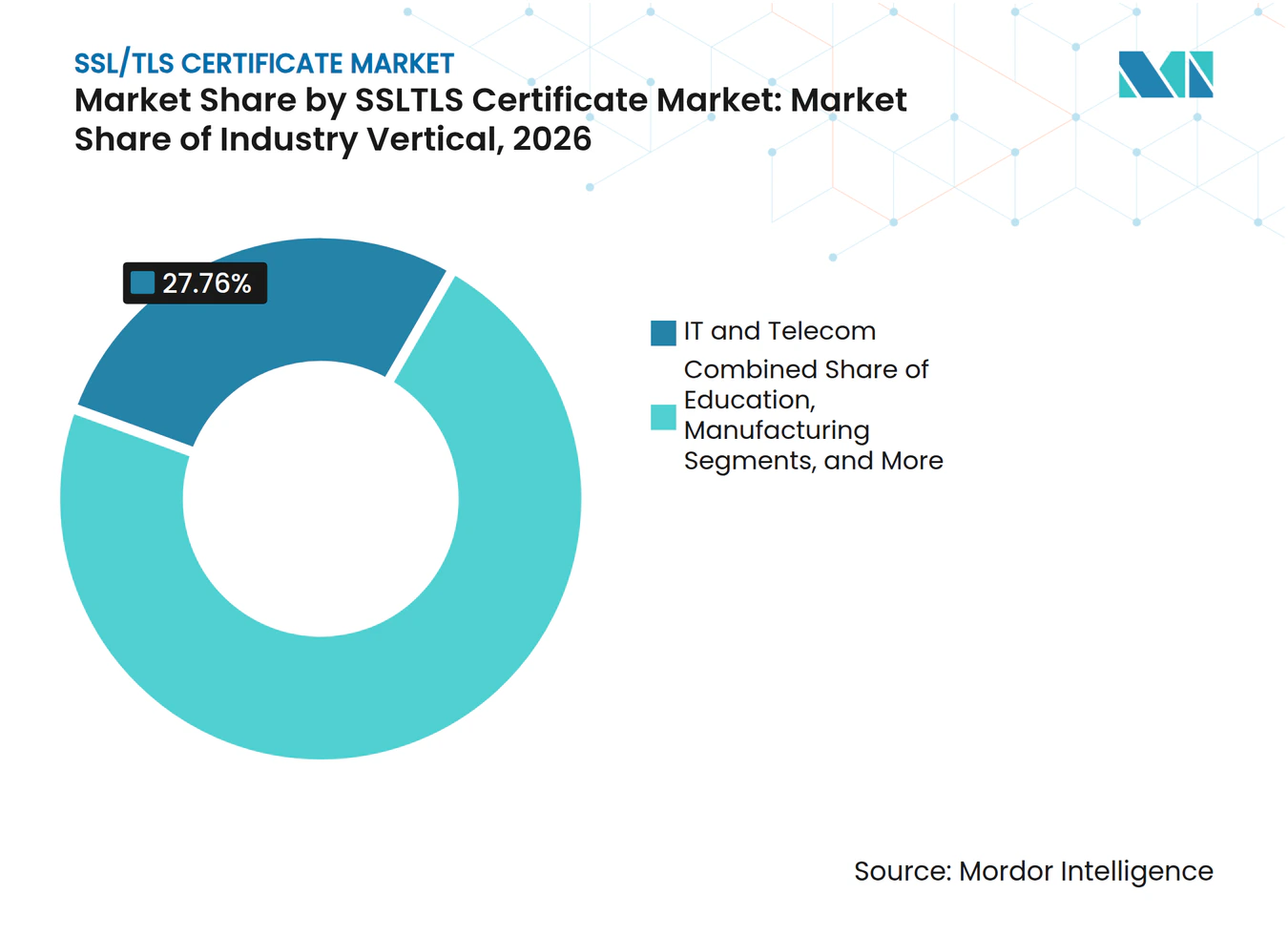
- By industry vertical, IT and Telecom held 27.76% share in 2026, while Healthcare and Life Sciences are projected to expand at a 9.12% CAGR through 2032.
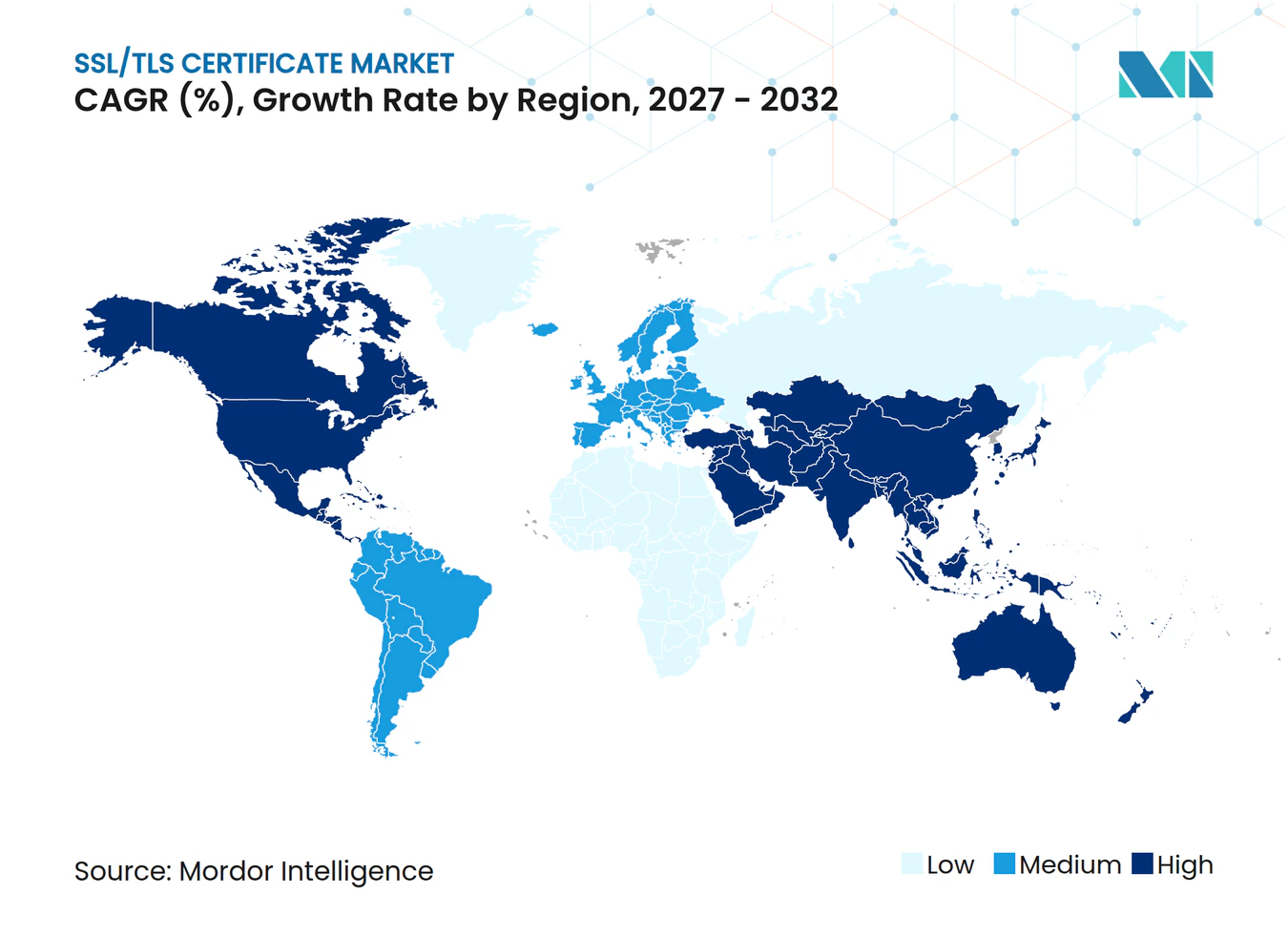
- By geography, North America held 36.68% share in 2026, while Asia-Pacific is expected to expand at a 9.23% CAGR through 2032.
Note: Market numbers in this report are based on Mordor Intelligence's proprietary estimation framework, which combines nine months of actuals with Q4 projections for base year 2026.
Market Trends and Insights
Drivers Impact Analysis of SSL/TLS Certificate Market*
| Driver | (~) % Impact on CAGR Forecast | Geographic Relevance | Impact Timeline |
|---|---|---|---|
| Rising HTTPS Adoption Across Digital Services | +2.5% | Global | Short term (≤ 2 years) |
| Shortening TLS Certificate Lifecycles | +2.0% | Global | Short term (≤ 2 years) |
| Cloud-Native and Machine-Identity Expansion | +1.3% | North America, Europe, Asia-Pacific core, spill-over to Middle East | Medium term (2-4 years) |
| Regulatory and Digital-Trust Requirements | +1.0% | Europe, North America | Medium term (2-4 years) |
| Automated Issuance Through ACME and DevSecOps | +0.7% | Global, early gains in North America and Western Europe | Medium term (2-4 years) |
| Certificate Transparency and Continuous Monitoring | +0.4% | Global | Long term (≥ 4 years) |
| Source: Mordor Intelligence | |||
Rising HTTPS Adoption Across Digital Services
HTTPS is now the default security layer for most internet communication. The 2025 Web Almanac reported that 97.5% of desktop homepages and 97.3% of mobile homepages were served through HTTPS in its July 2025 crawl. It also found that 98.8% of mobile requests were encrypted.[1] Large enterprises have largely completed their initial HTTPS transition, but smaller businesses, regional publishers, and public portals still need simpler ways to provision and renew certificates. Browser warnings and HTTPS-first approaches make the absence of encryption more visible to these users. The SSL/TLS certificate market benefits when managed services remove the operational burden that has historically slowed adoption in smaller organizations.
Shortening TLS Certificate Lifecycles
The CA/Browser Forum approved Ballot SC-081v3 in April 2025, setting a staged reduction in the maximum validity of TLS certificates. The maximum period falls to 200 days in March 2026, 100 days in March 2027, and 47 days in March 2029. Organizations managing thousands of certificates will have to renew credentials much more often than under the former 398-day period. Manual tracking becomes especially risky when certificates support customer applications, payment systems, or healthcare information exchanges. The SSL/TLS certificate market is therefore moving toward automated discovery, approval, issuance, renewal, and revocation tools. This shift also supports recurring lifecycle-management contracts rather than isolated certificate purchases.
Cloud-Native and Machine-Identity Expansion
Cloud-native applications use certificates across APIs, containers, service meshes, and device connections. CyberArk reported that machine identities outnumbered human identities by 82:1 in enterprise environments in 2025. AWS increased AWS Private CA capacity to 100 million certificates per CA in July 2025 for eligible partitioned CRL configurations.[2] These volumes show why basic issuance alone does not give organizations sufficient control over machine identities. Discovery and inventory tools are becoming important because a missed certificate can interrupt an application even when a company has adequate encryption policies. The SSL/TLS certificate market has an opportunity to support this broader identity-management need across hybrid environments.
Regulatory and Digital-Trust Requirements
European digital identity rules are increasing the importance of qualified certificates and trusted identity services. Regulation EU 2024/1183 created the European Digital Identity Framework and requires member states to make digital identity wallets available by the end of 2026. These requirements place technical and operational demands on organizations that issue, validate, or rely on digital credentials. NIST has also finalized FIPS 203, FIPS 204, and FIPS 205 as its first post-quantum cryptography standards. Certificate inventories are a necessary starting point for any transition to new cryptographic methods. The SSL/TLS certificate market can benefit when compliance programs require centralized visibility over certificate ownership, expiry, and key type.
Restraints Impact Analysis of SSL/TLS Certificate Market*
| Restraint | (~) % Impact on CAGR Forecast | Geographic Relevance | Impact Timeline |
|---|---|---|---|
| Low Awareness and Weak Certificate Governance Among SMBs | -1.2% | Global, most acute in South America, Africa, and Southeast Asia | Short term (≤ 2 years) |
| Self-Signed and Private-CA Substitution for Internal Workloads | -0.8% | North America and Europe, high cloud-native adoption | Medium term (2-4 years) |
| Legacy-System Integration and Skills Constraints | -0.5% | Asia-Pacific, South America, Africa | Medium term (2-4 years) |
| Multi-Provider Fragmentation and Ownership Blind Spots | -0.4% | Global, large enterprises with decentralized IT | Long term (≥ 4 years) |
| Source: Mordor Intelligence | |||
Low Awareness and Weak Certificate Governance Among SMBs
Smaller organizations often lack a formal policy for certificate ownership and renewal. CSC research published in October 2025 found that nearly 60% of enterprises use 3 or more SSL providers.[3] Multiple providers can leave teams with separate inventories and uncertain responsibility for expiring certificates. The problem is more difficult for businesses that cannot justify specialist PKI staff or higher-cost automation platforms. Sectigo and Omdia reported that 95% of surveyed organizations remained at least partly dependent on manual processes. This dependence can delay adoption in the near term while creating future demand for lower-cost, managed automation.
Self-Signed and Private-CA Substitution for Internal Workloads
Internal services do not always require publicly trusted certificates. Self-signed certificates and private CA hierarchies can secure internal APIs, container traffic, and service-mesh connections without purchasing public certificates. AWS Private CA, Google Certificate Authority Service, and Microsoft Intune Cloud PKI support this approach in cloud environments. AWS also introduced exportable public certificates in June 2025, priced at USD 15 per fully qualified domain name and USD 149 per wildcard certificate. This substitution can limit demand for commercial public certificates in fast-expanding internal workloads. Commercial providers are responding by offering unified platforms that manage both private PKI and public issuance.
*Our forecasts treat driver/restraint impacts as directional, not additive. The impact forecasts reflect baseline growth, mix effects, and variable interactions.
SSL/TLS Certificate Market Segment Analysis
By Product Type:
SAN Certificates Support Multi-Cloud DeploymentsStandard SSL certificates held 35.44% of the market share in 2026. Their position reflects high volumes of single-domain requirements among smaller businesses and content publishers. SAN certificates are projected to expand at an 8.66% CAGR through 2032. They allow enterprises to secure multiple hostnames through a single certificate, which is useful where applications operate across several cloud regions and subdomains. The market size for SAN certificates benefits from infrastructure teams that want programmatic issuance within their established deployment workflows.
NGINX introduced native support for the ACME protocol in 2025, bringing automated certificate workflows closer to common infrastructure tooling. This integration supports the use of SAN certificates where requests and renewals are handled through DevSecOps processes. Wildcard and multi-domain certificates continue to serve users that manage broader subdomain structures. Their value is changing because 47-day lifecycles reduce the benefit of any credential designed around long renewal intervals. ECDSA certificates represented 50.11% of CT records in Q3 2026, according to the supplied source material, which points to an ongoing change in cryptographic choices. SAN certificates fit the faster re-keying and reissuance practices that shorter validity periods encourage.



By Validation Level:
OV Retains Enterprise Preference While DV AutomatesOrganization Validation certificates held 43.99% of the market share in 2026. They verify the legal existence of the requesting organization without the extensive review associated with Extended Validation. This level of assurance remains suitable for B2B portals, API gateways, and employee-facing applications. Domain Validation certificates are projected to expand at an 8.72% CAGR through 2032. Their growth is linked to ACME-enabled issuance for machine-to-machine connections that do not require human validation steps.
Extended Validation certificates retain a compliance-based role in financial services and e-commerce. Their price premium has become less distinct after browser interfaces reduced the visual differentiation of higher-assurance certificates. Let’s Encrypt announced the retirement plan for its RFC 6962 certificate transparency logs in August 2025 and moved toward the Static CT API implementation. This transition supports the technical scaling of high-volume certificate ecosystems. Commercially issued DV certificates can still support organizations that need auditable validation records within their certificate policies. That requirement can distinguish them from self-signed credentials in regulated operating environments.
By Certificate Form:
Public Trust Remains Central While Private Trust ExpandsPublicly trusted certificates accounted for 70.87% of the market share in 2026. Public-facing websites and services need a trust chain that is recognized by major browser root stores. This requirement preserves the central role of public WebPKI for consumer, partner, and external business applications. Privately trusted certificates are projected to expand at an 8.63% CAGR through 2032. Their use is increasing in internal services that need mutual TLS authentication, controlled trust boundaries, and local handling of sensitive data.
Private root CAs allow regulated organizations to tailor identity and policy rules for internal systems. They are relevant when services do not need browser recognition but must authenticate devices, applications, or users. AWS Certificate Manager made exportable public certificates available in June 2025 for workloads inside or outside AWS. This offering helps organizations use cloud-managed public certificates in hybrid environments. The sockets layer / transport layer security certificate market includes both public and private trust needs because large enterprises often operate external and internal services at the same time. Providers with lifecycle management across both forms can reduce the operational divide between them.

By Deployment Model:
Cloud-Based Services Lead While Hybrid Environments ExpandCloud-based deployment held 53.97% share of the market size in 2026. The lead reflects the integration of certificate services into cloud toolchains and the avoidance of on-premise CA infrastructure costs. Cloud delivery can simplify provisioning for teams that already manage applications through hyperscale platforms. Hybrid deployment is expected to expand at an 8.94% CAGR through 2032. It reflects the fact that many large organizations operate legacy systems, several public clouds, and edge workloads at the same time.
On-premise deployment remains relevant in air-gapped environments, critical infrastructure, and locations with strict data-residency rules. Entrust launched PKI Hub in January 2025 as a container-based virtual appliance for private PKI and certificate lifecycle management. Hybrid environments require a consistent policy across AWS, Azure, Google Cloud, and local systems. Each environment can have different certificate services, APIs, and rules. The SSL/TLS certificate market responds to this fragmentation through CA-agnostic platforms that centralize inventory, policy enforcement, and renewal automation. CSC’s finding that nearly 60% of enterprises use 3 or more SSL providers underscores this need.
By Industry Vertical:
IT and Telecom Leads While Healthcare AdvancesIT and Telecom held 27.76% of the market share in 2026. The sector operates much of the certificate-secured infrastructure used by other industries. Cloud-native 5G core networks also require secured communication among internal components. Banking and Financial Services remains another important user because payment and security rules establish a baseline for encryption hygiene. Government and Defense, Retail and E-Commerce, Education, Manufacturing, and Travel and Hospitality are also increasing their use of certificates as digital services expand.
Healthcare and Life Sciences are projected to expand at a 9.12% CAGR through 2032. Health systems need secure data transfers across clinical applications, patient portals, and connected partners. The proposed HIPAA Security Rule update published in January 2025 would make encryption of protected health information a required safeguard rather than an addressable one, according to the supplied source material. Google Chrome’s client authentication policy also requires organizations using mTLS health information exchange systems to consider private CA trust chains. These changes support demand for discovery and lifecycle management across hospital systems and health IT vendors. The SSL/TLS certificate industry is increasingly relevant to healthcare operations because secure connections depend on both encryption and certificate continuity.
Geography Analysis
North America SSL/TLS Certificate Market
North America held 36.68% of the market share in 2026. The United States accounts for much of this position because it has a large concentration of enterprise users, cloud providers, SaaS vendors, and public PKI services. NIST published SP 1800-37 in September 2025 to help enterprises address visibility challenges while migrating from TLS 1.2 to TLS 1.3. This guidance is relevant to financial services, healthcare, and government organizations that need to maintain network visibility during encryption upgrades. DigiCert’s September 2026 partnership with Newfold Digital shows how large North American platforms are standardizing certificate infrastructure for smaller customers.
Europe SSL/TLS Certificate Market
Europe is the second-largest regional sockets layer / transport layer security certificate market. Regulation EU 2024/1183 is driving a compliance-focused environment for digital identity wallets, qualified certificates, and trust services. The United Kingdom, Germany, and France remain core sources of enterprise demand. The SwissSign and Evertrust partnership announced in November 2025 combined a lifecycle-management platform with Swiss-made certificates under a European-sovereign positioning. This type of regional offering addresses overlapping requirements related to eIDAS 2.0, GDPR, and NIS2.
APAC, MEA and South America SSL/TLS Certificate Market
Asia-Pacific is expected to expand at a 9.23% CAGR through 2032, the fastest regional rate in the SSL/TLS certificate market. China’s 59 CA institutions issued 12.51 billion digital authentication certificates in 2025, a 31.0% increase from the prior year, according to the supplied government-source material. Financial-sector issuance represented 73.3% of China’s total, and business income reached CNY 3.77 billion, equivalent to USD 520 million. India’s digital economy supports certificate demand in banking, insurance, and government portals. South America is advancing through e-government and e-commerce adoption, although weaker SMB governance can slow deployment. The Middle East is supported by digital transformation programs in the UAE and Saudi Arabia, while early adoption in South Africa and Egypt is tied to fintech and mobile internet use.
Competitive Landscape
Market Concentration
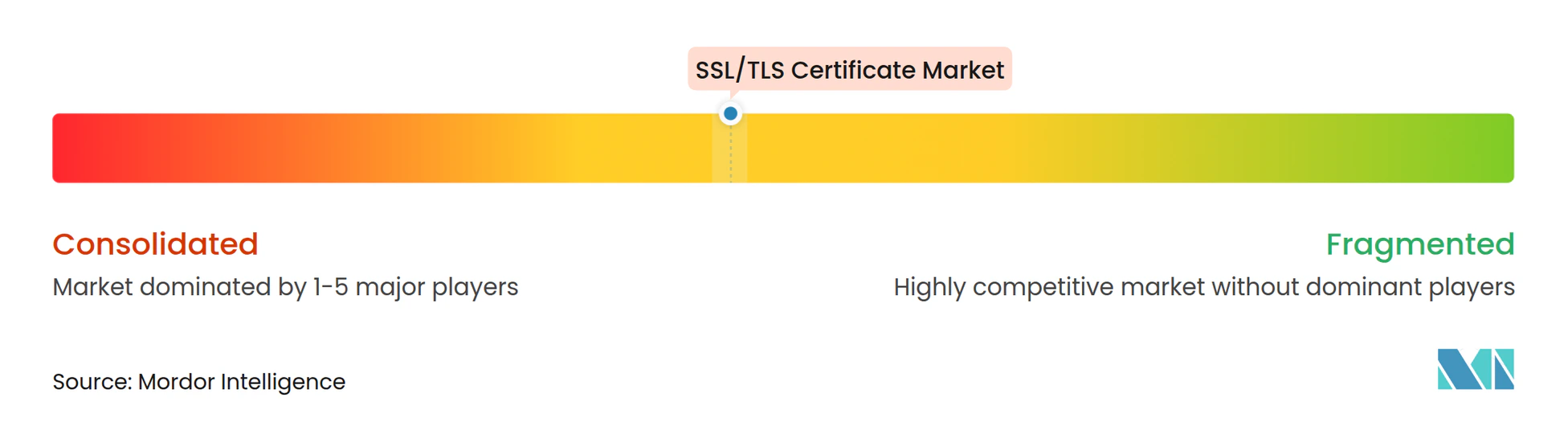
The sockets layer / transport layer security certificate market is moderately concentrated among public certificate authorities, with DigiCert, Sectigo, GlobalSign, and Amazon Trust Services playing important roles. Competitive advantage increasingly depends on lifecycle automation, API coverage, cloud support, and integration with development processes. Public issuance remains essential, but it no longer defines the whole customer relationship. Vendors are seeking recurring revenue through discovery, governance, automated renewal, private PKI, and policy management. This broadening of the offer raises the barrier for providers that only sell individual certificates.
Sectigo completed the migration of more than 500,000 certificates after acquiring Entrust’s public certificate business in September 2025. The move combined a large public certificate base with Sectigo Certificate Manager and its focus on short certificate lifecycles. DigiCert acquired Valimail in September 2025, adding zero-trust email authentication capabilities to its platform. GlobalSign introduced LifeCycleX as an end-to-end certificate management and lifecycle-control platform that works with Microsoft CAs, EJBCA, Kubernetes, and F5 environments. These actions show how leading providers are positioning themselves as multi-CA orchestration platforms.
Post-quantum readiness is becoming another competitive requirement. Microsoft launched its PQC TLS Pilot Program on August 27, 2026, allowing eligible certificate authorities to test post-quantum authentication readiness. Providers without credible migration plans may find it harder to meet future technical expectations. Regional specialists, including Actalis, SSL.com, Certum, and D-TRUST, retain a role where local regulatory expertise matters. Buypass ended TLS and SSL certificate issuance in October 2025, showing the pressure on standalone issuance businesses without broader platform services. The competitive field is likely to favor firms that combine trusted issuance with flexible automation and regional compliance support.
SSL/TLS Certificate Industry Leaders
-
Internet Security Research Group
-
GlobalSign nv-sa
-
Sectigo Limited
-
GoDaddy Operating Company, LLC
-
DigiCert, Inc.
- *Disclaimer: Major Players sorted in no particular order
SSL/TLS Certificate Market Companies Covered in this Report
- DigiCert, Inc.
- Sectigo Limited
- GlobalSign nv-sa
- GoDaddy Operating Company, LLC
- Internet Security Research Group
- Google Trust Services LLC
- Amazon Web Services, Inc.
- Microsoft Corporation
- Entrust Corporation
- SSL.com LLC
- Actalis S.p.A.
- Asseco Data Systems S.A.
- IdenTrust, Inc.
- Network Solutions, LLC
- WISeKey International Holding Ltd
- SwissSign AG
- OneSpan Inc.
- Trustwave Holdings, Inc.
- Buypass AS
- Certum sp. z o.o.
Recent Industry Developments in SSL/TLS Certificate Market
- September 2026: Newfold Digital, approximately 6 million customers globally, including Network Solutions and Bluehost brands, selected DigiCert as its digital trust technology partner to modernize SSL/TLS certificate infrastructure, enabling enterprise-grade certificate management at scale for millions of small-business customers.
- August 2026: Microsoft launched the PQC TLS Pilot Program on August 27, 2026, inviting eligible CAs in the Microsoft Trusted Root Program to test post-quantum authentication readiness with rolling admissions through end of 2026, the first formal hyperscaler-led validation of post-quantum certificate issuance workflows at production scale.
- July 2026: Sectigo announced a strategic partnership with eCAPS Computers India to accelerate automated CLM adoption among Indian enterprises preparing for 47-day TLS certificate lifecycles, targeting the Asia-Pacific growth corridor.
- April 2026: Sectigo partnered with F5 to deliver automated certificate lifecycle management across F5's Application Delivery and Security Platform, enabling enterprise-scale automated certificate renewal and revocation within application delivery infrastructure.
Global SSL/TLS Certificate Market Report Scope
The secure sockets layer / transport layer security certificate market refers to the market for digital certificates that authenticate the identity of websites, servers, devices, and users, and enable encrypted communication over networks using the SSL/TLS protocols. These certificates are issued by trusted Certificate Authorities (CAs), which verify domain ownership and/or organization details before issuance, and are foundational to HTTPS, secure email, API security, and machine-to-machine communication.
The SSL/TLS Certificate Market Report is Segmented by Product Type (Standard SSL Certificates, Wildcard SSL Certificates, Multi-Domain SSL Certificates, Subject Alternative Name Certificates), Validation Level (Domain Validation Certificates, Organization Validation Certificates, Extended Validation Certificates), Certificate Form (Single-Domain Certificates, Multi-Domain Certificates, Wildcard Certificates, Publicly Trusted Certificates, Privately Trusted Certificates), Deployment Model (Cloud-Based, On-Premise, Hybrid), Industry Vertical (Banking and Financial Services, IT and Telecom, Retail and E-Commerce, Healthcare and Life Sciences, Government and Defense, Travel and Hospitality, Education, Manufacturing, and Other Industry Verticals), and Geography (North America, South America, Europe, Asia-Pacific, Middle East, Africa). The Market Forecasts are Provided in Value (USD).
Segmentation Overview
| Standard SSL Certificates |
| Wildcard SSL Certificates |
| Multi-Domain SSL Certificates |
| Subject Alternative Name Certificates |
| Domain Validation Certificates |
| Organization Validation Certificates |
| Extended Validation Certificates |
| Single-Domain Certificates |
| Multi-Domain Certificates |
| Wildcard Certificates |
| Publicly Trusted Certificates |
| Privately Trusted Certificates |
| Cloud-Based |
| On-Premise |
| Hybrid |
| Banking and Financial Services |
| IT and Telecom |
| Retail and E-Commerce |
| Healthcare and Life Sciences |
| Government and Defense |
| Travel and Hospitality |
| Education |
| Manufacturing |
| Other Industry Verticals |
| North America | United States |
| Canada | |
| Mexico | |
| Rest of North America | |
| South America | Brazil |
| Argentina | |
| Rest of South America | |
| Europe | United Kingdom |
| Germany | |
| France | |
| Italy | |
| Russia | |
| Rest of Europe | |
| Asia-Pacific | China |
| Japan | |
| India | |
| South Korea | |
| Australia | |
| Rest of Asia-Pacific | |
| Middle East and Africa | Saudi Arabia |
| United Arab Emirates | |
| South Africa | |
| Egypt | |
| Rest of Middle East and Africa |
| By Product Type | Standard SSL Certificates | |
| Wildcard SSL Certificates | ||
| Multi-Domain SSL Certificates | ||
| Subject Alternative Name Certificates | ||
| By Validation Level | Domain Validation Certificates | |
| Organization Validation Certificates | ||
| Extended Validation Certificates | ||
| By Certificate Form | Single-Domain Certificates | |
| Multi-Domain Certificates | ||
| Wildcard Certificates | ||
| Publicly Trusted Certificates | ||
| Privately Trusted Certificates | ||
| By Deployment Model | Cloud-Based | |
| On-Premise | ||
| Hybrid | ||
| By Industry Vertical | Banking and Financial Services | |
| IT and Telecom | ||
| Retail and E-Commerce | ||
| Healthcare and Life Sciences | ||
| Government and Defense | ||
| Travel and Hospitality | ||
| Education | ||
| Manufacturing | ||
| Other Industry Verticals | ||
| By Geography | North America | United States |
| Canada | ||
| Mexico | ||
| Rest of North America | ||
| South America | Brazil | |
| Argentina | ||
| Rest of South America | ||
| Europe | United Kingdom | |
| Germany | ||
| France | ||
| Italy | ||
| Russia | ||
| Rest of Europe | ||
| Asia-Pacific | China | |
| Japan | ||
| India | ||
| South Korea | ||
| Australia | ||
| Rest of Asia-Pacific | ||
| Middle East and Africa | Saudi Arabia | |
| United Arab Emirates | ||
| South Africa | ||
| Egypt | ||
| Rest of Middle East and Africa | ||
Key Questions Answered in the Report
What is the market size?
The market size was USD 5.02 billion in 2026 and is forecast to reach USD 8.12 billion by 2032 at an 8.38% CAGR during 2027-2032.
Why are SSL/TLS certificate lifecycles becoming shorter?
CA/Browser Forum Ballot SC-081v3 reduces maximum certificate validity to 200 days in 2026, 100 days in 2027, and 47 days in 2029.
Which certificate product type is expanding fastest?
SAN certificates are projected to expand at an 8.66% CAGR through 2032 because they can protect multiple hostnames in multi-cloud environments.
Which deployment approach leads certificate management?
Cloud-based deployment held 53.97% share in 2026, while hybrid deployment is expected to expand at an 8.94% CAGR through 2032.
Which end-user sector has the highest forecast rate?
Healthcare and Life Sciences are projected to expand at a 9.12% CAGR through 2032, supported by secure data-transfer requirements.
Which region is expected to advance fastest?
Asia-Pacific is expected to expand at a 9.23% CAGR through 2032, supported by broad digitalization and certificate issuance activity.