
Speech Generating Devices Market Size and Share
Market Overview
| Study Period | 2021 - 2032 |
|---|---|
| Market Size (2027) | USD 430.22 Million |
| Market Size (2032) | USD 747.09 Million |
| Growth Rate (2027 - 2032) | 11.67 % |
| Fastest Growing Market | Asia-Pacific |
| Largest Market | North America |
| Market Concentration | Medium |
Major Players *Disclaimer: Major Players sorted in no particular order Image © Mordor Intelligence. Reuse requires attribution under CC BY 4.0. | |
Speech Generating Devices Market Analysis by Mordor Intelligence
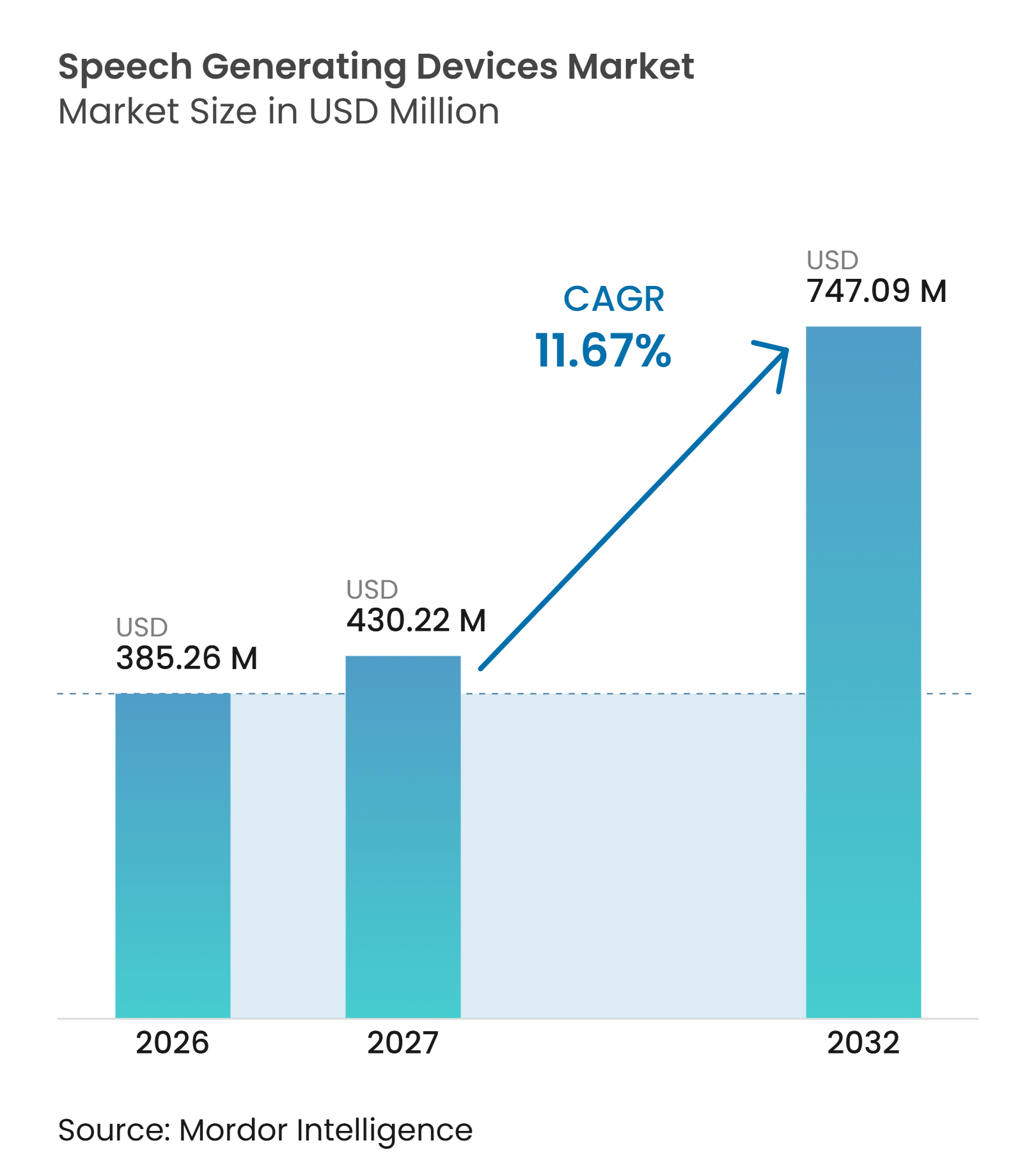
The Speech Generating Devices Market size is expected to increase from USD 385.26 million in 2026 to USD 430.22 million in 2027 and reach USD 747.09 million by 2032, growing at a CAGR of 11.67% over 2027-2032.
The speech-generating devices market is supported by a growing need for augmentative and alternative communication among people with autism, stroke-related aphasia, cerebral palsy, ALS, and other conditions that limit speech. The World Stroke Organization reported 11.9 million new strokes and 93.8 million people living with stroke globally in 2025, creating a substantial adult need for communication support. The speech generating devices market also benefits from school assistive-technology requirements, wider outpatient care, and product development in voice banking, eye tracking, and multilingual content. Companies are increasingly linking hardware, software, clinical training, and distribution, which makes service quality as important as device specifications. Reimbursement limits, medical-device compliance requirements, and shortages of speech-language pathologists continue to restrict access, particularly for lower-cost software tools and lower-income settings.
Key Report Takeaways
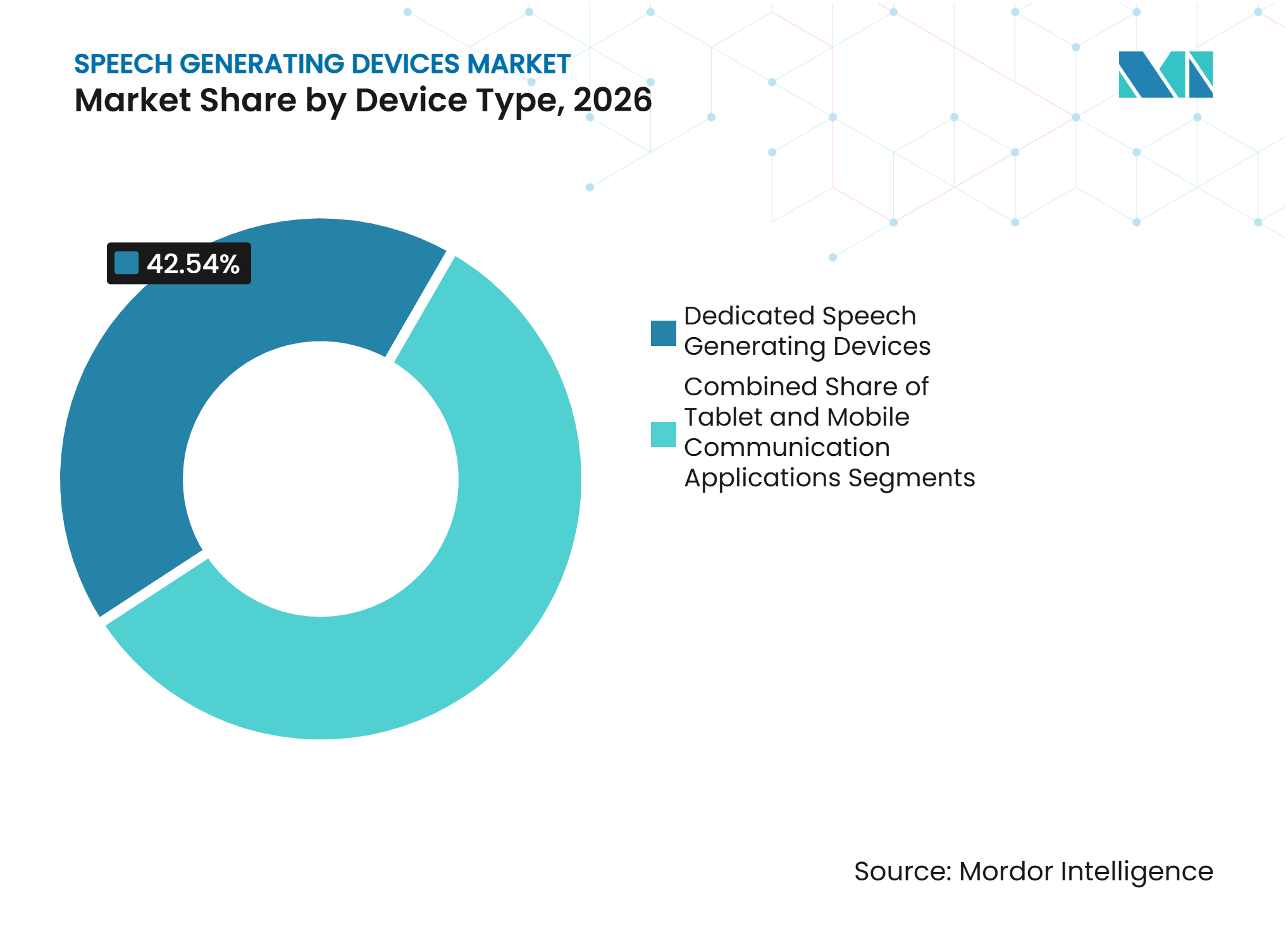
- By device type, dedicated SGDs held 42.54% of the speech generating devices market share in 2026, while mobile communication applications are forecast to expand at a 13.65% CAGR through 2032.
- By display type, dynamic display devices held 66.54% of global category revenue in 2026 and are forecast to expand at a 13.98% CAGR through 2032.
- By application, pediatric communication needs accounted for 53.76% of the speech generating devices market size in 2026, while adult acquired communication disorders are forecast to grow at a 14.76% CAGR through 2032.
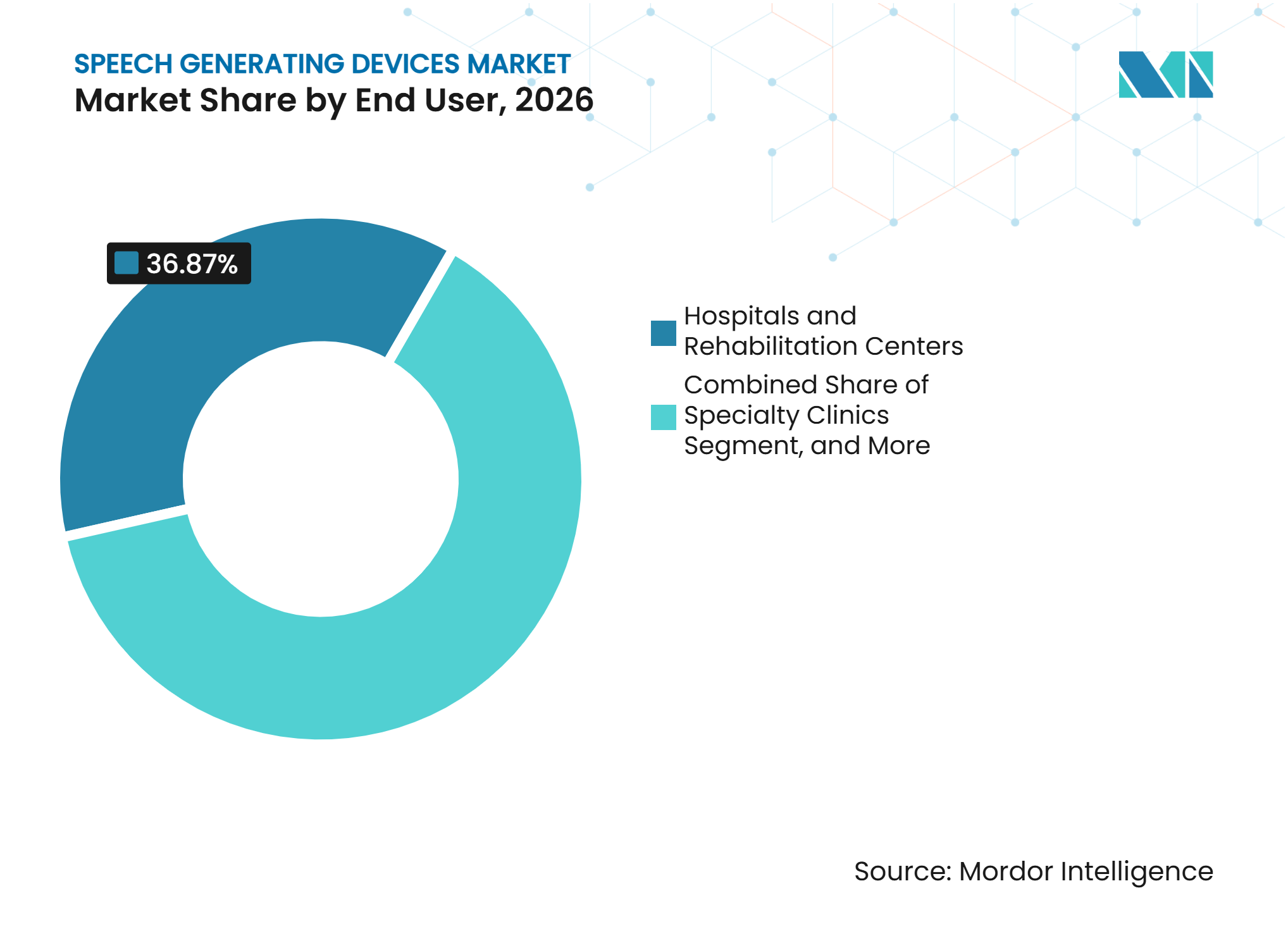
- By end user, hospitals and rehabilitation centers held 36.87% of the speech generating devices market size in 2026, while specialty clinics and speech-language pathology practices are forecast to grow at a 14.87% CAGR through 2032.
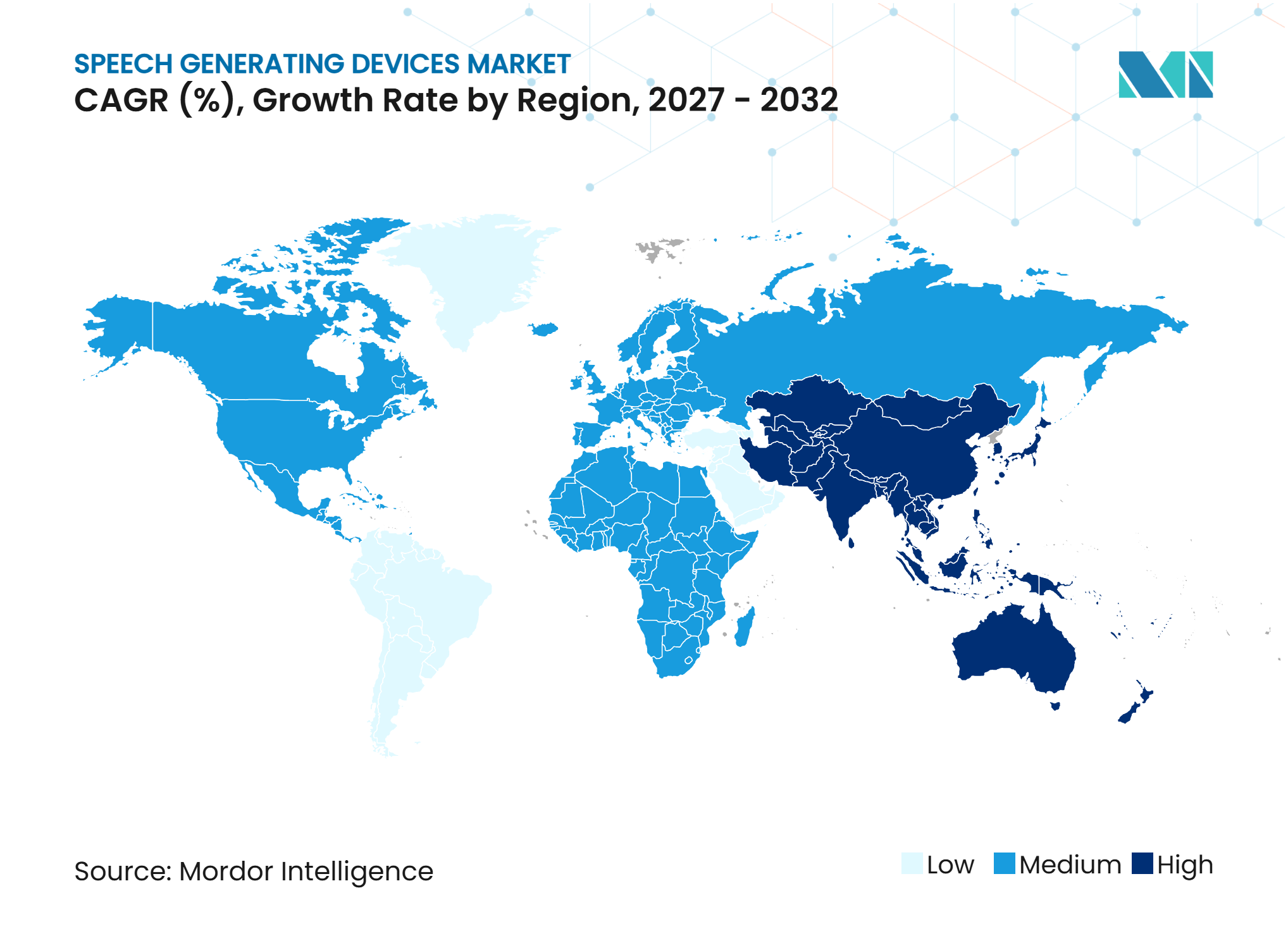
- By geography, North America held 41.67% of the speech generating devices market share in 2026, while Asia-Pacific is forecast to expand at a 12.65% CAGR through 2032.
Note: Market numbers in this report are based on Mordor Intelligence's proprietary estimation framework, which combines nine months of actuals with Q4 projections for base year 2026.
Market Trends and Insights
Drivers Impact Analysis of Speech Generating Devices Market*
| Driver | (~) % Impact on CAGR Forecast | Geographic Relevance | Impact Timeline |
|---|---|---|---|
| Rising Prevalence of Autism, ALS, Stroke Aphasia, and Cerebral Palsy | +3.20% | Global | Short term (≤ 2 years) |
| Expansion of School-Based and Public Assistive-Technology Provision | +1.90% | North America and Europe | Medium term (2-4 years) |
| Shift Toward Personalized Synthetic and Banked Voices | +1.80% | Global | Medium term (2-4 years) |
| Adoption of Eye-Gaze and Multimodal Access for Severe Motor Impairment | +1.40% | North America, Europe, and Asia-Pacific | Long term (≥ 4 years) |
| Integration of SGDs Into Tele-Rehabilitation and Connected Care | +1.20% | North America and Europe | Medium term (2-4 years) |
| Localization of AAC Content for Multilingual and Culturally Diverse Users | +1.00% | Asia-Pacific, Middle East and Africa, and South America | Long term (≥ 4 years) |
| Source: Mordor Intelligence | |||
Rising Disease Burden Across Core Diagnostic Categories
The speech generating devices market is tied to conditions that create lasting expressive-language needs across the life course. The World Stroke Organization recorded 11.9 million new stroke events and 93.8 million prevalent cases worldwide in 2025, creating a large population that may need support during recovery and longer-term care. Post-stroke aphasia creates an important referral pathway for adult AAC assessment, therapy, and later device adjustment as a person’s abilities change. A 2025 Lancet review reported cerebral palsy birth prevalence of 1.5 to 1.7 per 1,000 live births in high-income countries and 3.0 to 3.9 per 1,000 in low- and middle-income countries. These populations need different access methods, from simple symbol-based systems and predictable page layouts to eye-controlled devices for people with severe motor limitations. Demand therefore spans pediatric, adult acquired, and older-user care settings, with different clinical priorities for language development, independent access, caregiver involvement, vocabulary depth, and the pace of functional change.
School-Based Provision and Localized Content Expand Access
School policy turns clinical need into funded device evaluation, training, and everyday use during the school day. The U.S. Government Accountability Office stated that IDEA requires individualized education program teams to consider assistive technology for each child with a disability, although staffing, funding, and staff knowledge remain barriers. Virginia legislation that took effect in July 2025 requires AAC-device training for school staff supporting students who use these systems, which places attention on implementation rather than device purchase alone. The United Kingdom also launched a GBP 1.7 million assistive-technology lending-library pilot that allows schools to trial equipment before purchase, helping staff test whether a system fits the student and classroom routine. The speech generating devices market gains when suppliers provide usable vocabulary, practical training, and localized content alongside the device, because schools need tools that staff can use consistently. This model can lower the burden on specialist staff, improve day-to-day adoption in classrooms, and make equipment more likely to remain part of a student’s learning plan when teachers, therapists, and families use consistent language and routines.
Personalized Synthetic and Banked Voices Strengthen Product Value
Voice banking is gaining relevance for people with progressive conditions, especially ALS, who may lose natural speech over time and want to retain a recognizable voice. A 2025 Scientific Reports study found that AI voice-generation methods using banked speech could produce personalized utterances that retained characteristics of a patient’s own voice, including qualities associated with individual speech. Tobii Dynavox added My-Own-Voice licensing for eligible dedicated-device users and expanded its voice options in 2026, bringing this function closer to the core device offering. Personalized speech can improve acceptance because communication feels more familiar to the user, family members, and regular communication partners. It also increases the value of platforms that combine device access, voice services, vocabulary software, and support after the initial setup. In the speech generating devices market, this can make long-term software support more important than a one-time hardware sale and may favor providers that can maintain a user’s voice, settings, language choices, and communication history over time.
Eye-Gaze, Multimodal Access, and Connected Care Reach Complex Needs
Eye-gaze and multimodal controls extend communication options for users who cannot reliably use touch screens or switches because of severe motor impairment. A 2026 Human Factors study found that a hybrid interface using steady-state visual evoked potential signals and eye tracking improved selection speed and reduced accidental selections in demanding communication tasks. Smartbox introduced its Evo eye tracker in 2025, using on-device processing to improve real-world calibration for Grid Pad users and support use beyond highly controlled settings. Telepractice can support device setup, follow-up training, vocabulary changes, and problem resolution when specialist care is not available locally or regular travel is difficult. A 2025 systematic review found that telepractice AAC intervention showed feasibility and early effectiveness for children with autism or intellectual disabilities. These services make advanced access technology more usable beyond hospital visits and support the speech generating devices market in home, school, and community settings where regular practice, family confidence, and timely technical help determine whether a device is used effectively.
Restraints Impact Analysis of Speech Generating Devices Market*
| Restraint | (~) % Impact on CAGR Forecast | Geographic Relevance | Impact Timeline |
|---|---|---|---|
| Reimbursement and Funding Delays for High-Cost Dedicated Devices | -1.30% | North America and Europe | Medium term (2-4 years) |
| Shortage of Speech-Language Pathologists and AAC Specialists | -0.90% | Global | Long term (≥ 4 years) |
| Interoperability and Workflow Friction Across AAC Software Ecosystems | -0.70% | Global | Medium term (2-4 years) |
| Battery, Durability, and Device-Down-Time Constraints in Daily Use | -0.40% | Global | Medium term (2-4 years) |
| Source: Mordor Intelligence | |||
Reimbursement Complexity and Daily-Use Barriers Limit High-Cost Device Uptake
Public coverage can make dedicated systems accessible, but the approval process remains demanding for users, families, and prescribing teams. CMS covers qualifying speech-generating devices as durable medical equipment when users meet medical and documentation requirements[1]. The process may require physician input, speech-language pathology assessment, evidence from a device trial, and an individualized care plan, which can delay provision after a communication need is identified. Medicare policy also distinguishes dedicated systems from general-purpose tablets, which can limit reimbursement for app-based communication tools even when the software is clinically useful. Noridian’s 2025 policy updates show that coding and coverage administration continue to shape the device categories available through the U.S. durable-medical-equipment system[2]. Battery life, maintenance, durability, and time without a device can create further daily-use barriers for people who depend on the system for essential communication at home, in school, during travel, and when moving between hospital, rehabilitation, and community care.
Specialist Workforce and Software Fragmentation Constrain Adoption
Speech-language pathologists are central to assessment, device selection, prescription, training, reimbursement documentation, and the adjustments that follow changes in a user’s abilities. Texas reported 392,363 students receiving speech-language services in the 2025-2026 school year, supported by 5,556 full-time-equivalent speech-language pathologists, illustrating heavy service demand within a large education system. The Philippines Department of Health reported that 79% of authorized speech-therapist posts were vacant in September 2026, which limits access where specialist input is already scarce. A 2026 study from Georgia identified limited practitioner knowledge, weak coordination, funding gaps, and workforce shortages as major obstacles to AAC access. Proprietary vocabulary, access tools, and file formats can also create friction when a user changes devices or access methods during a long care journey. The speech generating devices market will need simpler setup, better support tools, and more interoperable workflows to serve people outside specialist centers without reducing the clinical quality of assessment, user training, caregiver involvement, and ongoing adjustment.
*Our forecasts treat driver/restraint impacts as directional, not additive. The impact forecasts reflect baseline growth, mix effects, and variable interactions.
Speech Generating Devices Market Segment Analysis
By Device Type:
Dedicated Systems Retain Clinical Strength While Apps Expand AccessDedicated SGDs held 42.54% of category revenue in 2026. Their position reflects use in complex clinical cases that require durable hardware, specialist configuration, and established reimbursement routes. CMS coverage rules continue to support purpose-built devices for qualifying users with severe speech impairment. Dedicated systems can integrate eye-gaze control, mounting options, speakers, battery support, and fixed clinical vocabulary packages. These features matter when a person relies on the device throughout the day. They also allow clinicians and caregivers to work within a known product environment during training and follow-up.
Mobile communication applications are forecast to grow at a 13.65% CAGR through 2032. Lower entry cost and wide availability on iOS and Android support interest from families, schools, and new users. PRC-Saltillo expanded its software offerings in 2025 with Unity AAC for iOS and LAMP Words for Life on its Discover platform. Apps can add multilingual vocabulary and AI-enabled features without replacing hardware. Their main limitation is that reimbursement does not consistently extend to general-purpose tablet systems. The speech-generating devices market therefore has two connected paths: clinically funded dedicated equipment and more accessible software-led communication tools.



By Display Type:
Dynamic Displays Lead Through Flexible Communication DesignDynamic display devices commanded 66.54% of category revenue in 2026. They allow users and clinicians to organize, expand, and adapt vocabulary as communication needs change. This flexibility is useful for children who are building language and for people with progressive motor conditions. A 2025 review found that mobile applications, which generally use dynamic display architectures, represented 37.7% of AAC technology studies included in the review[3]. Dynamic systems can also support several page sets, symbol sizes, and input options within one device. These capabilities help clinicians tailor communication without changing the overall platform.
Dynamic display devices are forecast to grow at a 13.98% CAGR through 2032. PRC-Saltillo introduced Genesis 13 and Genesis 16 in 2026 with larger displays and a partner display for shared interaction. Fixed displays still serve users who need stable vocabulary locations, limited symbol sets, or simpler motor patterns. Their value is strongest when predictability is more useful than changing content. Dedicated fixed hardware may also face fewer software-related regulatory questions than tablet-native communication apps in some European settings. The speech generating devices market will continue to use both formats, but adaptive displays are likely to receive more product investment.
By Application:
Pediatric Demand Leads While Adult Acquired Needs AcceleratePediatric communication needs accounted for 53.76% of application revenue in 2026. Early intervention, school support, and long device-use periods sustain this position. U.S. education policy requires teams to consider assistive technology, giving children with complex communication needs a formal route to assessment and support. Pediatric users often need ongoing vocabulary changes, access-method adjustments, and caregiver training as they develop. This makes long-term service quality important for suppliers. Familiar vocabulary systems can also create continuity from school to home and community care.
Adult acquired communication disorders are forecast to grow at a 14.76% CAGR through 2032. Stroke, ALS, and aphasia care bring different communication needs, including faster message creation, natural conversational flow, and voice identity. A 2025 telerehabilitation pilot for people with chronic aphasia reported 94% therapy integrity and high user acceptance across 9 participants[3]. Lingraphica introduced the Conversations feature for adult users in 2026 to support spontaneous communication within its Hub suite. Older users remain an emerging group, but caregiver training and interface complexity continue to limit uptake. These needs encourage suppliers to design simpler workflows that complement clinical therapy rather than replace it.
By End User:
Hospitals Remain Important While Specialty Clinics Expand FasterHospitals and rehabilitation centers held 36.87% of end-user revenue in 2026. Acute neurological admissions, inpatient assessment, and established durable medical equipment processes support this role. Hospitals can bring together rehabilitation physicians, speech-language pathologists, occupational therapists, and caregivers during a device evaluation. They are an important first point of referral after stroke or serious neurological injury. Their procurement processes also support the use of dedicated equipment in medically complex cases. In many cases, however, the hospital begins the communication plan rather than managing every later adjustment.
Specialty clinics and speech-language pathology practices are forecast to grow at a 14.87% CAGR through 2032. These settings can provide repeated programming, training, and review after discharge. ASHA highlighted classroom inclusion practices for AAC in 2026, reinforcing the need for specialist support that connects school routines with clinical goals. Homecare is also gaining relevance as telepractice makes remote support more practical. Schools remain a high-volume end-user setting because staff must help students use documented tools during everyday learning. The speech-generating devices market benefits when clinical and educational users can coordinate vocabulary, access methods, and training plans.

By Distribution Channel:
Direct Service Becomes a Competitive AdvantageDirect institutional procurement is important for high-value dedicated systems sold to hospitals, schools, and rehabilitation networks. These buyers often need device trials, documentation support, staff training, and ongoing technical service. Dynavox Group acquired reseller partners in France, Germany, and Italy between 2025 and 2026, extending its direct service footprint across key European markets. Direct control can improve response times and give manufacturers closer contact with clinicians and users. It also brings distribution and service revenue inside the company. This approach is difficult for smaller vendors to reproduce across several countries.
Medical-device distributors and assistive-technology specialists remain necessary where suppliers do not operate direct networks. They support community care, home use, and smaller institutions that may not have direct contracts with device makers. Online and retail channels are becoming more relevant for lower-cost apps and tablet bundles. They can help caregivers and schools find entry-level tools, although they may provide less clinical guidance than specialist channels. In the speech generating devices market, a supplier’s route to market increasingly affects its ability to help users with funding, setup, software updates, and repairs. Channel strategy is therefore closely linked to product adoption and long-term retention.
Geography Analysis
North America
North America held 41.67% of global revenue in 2026. CMS classifies qualifying dedicated systems as durable medical equipment under National Coverage Determination 274, supporting a structured reimbursement route for eligible users. School-based assistive-technology obligations extend demand beyond health care into public education. Virginia’s 2025 AAC training requirement illustrates how state policy can strengthen implementation after a device is supplied. Dynavox Group also expanded its North American operating capacity in 2025 through a new Pittsburgh facility and systems investment. The region’s established reimbursement and specialist base support premium hardware, but they also reinforce the importance of clinical documentation. The GAO reported that school districts continue to face staff knowledge, funding, and workforce constraints, showing that eligibility does not always translate into use.
Asia-Pacific
Asia-Pacific is forecast to expand at a 12.65% CAGR through 2032. Demand is supported by health-care investment, disability inclusion efforts, and the need for localized language content across diverse health systems. In South Korea, the Ministry of Food and Drug Safety designated Hi’s Repeech as an innovative medical device in August 2026, creating a route for consideration in health-insurance coverage and institutional use. India’s disability support programs and special-education procurement requirements support access, while affordability remains important for wider adoption. China’s digital health capacity and AI voice capabilities create scope for local software development. Tobii Dynavox added Korean and Traditional Chinese support to TD Snap in 2026, including localized symbols, voices, interfaces, and input methods. This localization is important because communication tools must reflect the language and cultural context of the user.
Europe, Middle East and Africa, and South America
Europe has established reimbursement pathways in countries such as Germany, while medical-device compliance requirements shape the pace of software adoption. Smartbox’s platform supports users across 37 languages, and Verdane’s 2026 investment gives the company resources to extend its international reach. The region’s regulatory influence can favor products with established clinical and compliance documentation. In the Middle East and Africa, high cerebral palsy burden and limited specialist availability create need, but funding, language support, and workforce capacity remain key constraints. Research from Georgia also identified policy, funding, and practitioner knowledge gaps that limit AAC access. South America remains early in adoption, with Brazil and Argentina serving as commercial anchors. Multilingual vocabulary and culturally relevant symbols offer a practical route for suppliers to expand access in these mixed geographies.
Competitive Landscape
Market Concentration
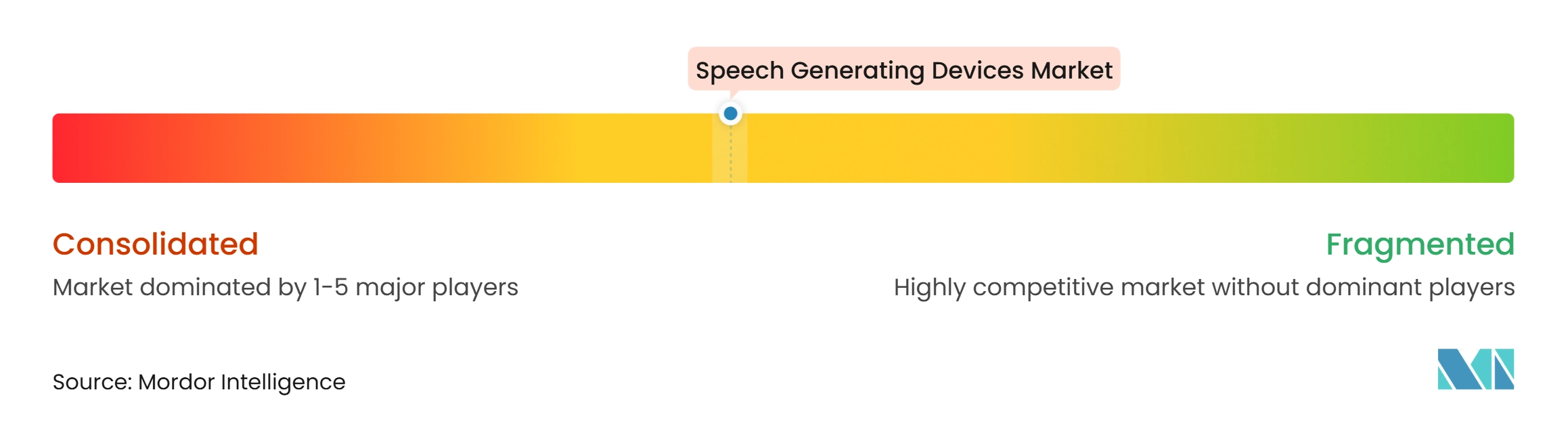
The speech generating devices market has a clear leader in premium dedicated hardware, while software, tablet accessories, and specialized access tools remain more fragmented. Dynavox Group has expanded from product supply into a more direct service model in Europe through acquisitions of Cenomy, RehaMedia, and SR Labs Healthcare. This strategy brings local distribution, clinician support, implementation training, and service coordination under closer company control. It also reduces dependence on independent resellers in markets where funding and technical support can determine whether a user receives and retains a device. The model creates an advantage in countries where device funding and implementation require extensive local support.
Smartbox is building its position through international software and access technology. Verdane took a majority stake in Smartbox in 2026 with a target to triple the number of users served by 2030. Smartbox also launched Evo in 2025 after integrating technology from GazeFirst, improving its eye-gaze offering for Grid Pad systems. PRC-Saltillo expanded its software portfolio by acquiring Therapy Box applications in 2026. These moves reflect competition based on vocabulary systems, multilingual support, and access technology rather than device hardware alone. The speech generating devices market increasingly rewards suppliers that can support users across clinical, educational, and home settings.
New products also show continued movement toward iOS-based devices, eye tracking, and AI-supported communication. IRISBOND and Control Bionics introduced Oskol 2 in 2025 as an iPad-based eye-gaze communication product. Lingraphica has focused on software features for adult users, including tools that support phrase building and more spontaneous communication. Interoperability remains a weak point because people may need to change devices, vocabulary systems, or access methods over their lives. Open and adaptable software could therefore become more important, especially in price-sensitive countries.
Speech Generating Devices Industry Leaders
-
Tobii Dynavox AB
-
PRC-Saltillo
-
Smartbox Assistive Technology Limited
-
Lingraphica, Inc.
-
Forbes AAC, Inc
- *Disclaimer: Major Players sorted in no particular order
Speech Generating Devices Market Companies Covered in this Report
- Tobii Dynavox AB
- PRC-Saltillo
- Smartbox Assistive Technology Limited
- Lingraphica, Inc.
- Forbes AAC, Inc.
- Jabbla BVBA
- AssistiveWare B.V.
- Control Bionics Inc.
- AbleNet, Inc.
- Attainment Company, Inc.
- EyeTech Digital Systems, Inc.
- Talk To Me Technologies, LLC
- Cognixion, Inc.
- Inclusive Technology Ltd.
- Enabling Devices, Inc.
- Zygo Corporation
- Textspeak Corporation
- Adaptivation, Inc.
Recent Industry Developments in Speech Generating Devices Market
- September 2026: PRC-Saltillo launched the Genesis 13 and Genesis 16, its first all-new Windows-based AAC device line targeting adults, teens, and children with acquired or long-term complex communication needs, including ALS and cerebral palsy. Features include the company’s largest-ever screens, an integrated Genesis eye tracker with improved outdoor performance, dual battery configuration, a 3-inch angled partner display, and a 5-year High Five Warranty.
- April 2026: Dynavox Group completed the acquisition of SR Labs Healthcare in Italy, extending its direct-service presence in southern Europe and completing a direct-distribution network across France, Germany, and Italy.
- January 2026: Verdane acquired a majority stake in Smartbox Assistive Technology Group and targeted a 3-fold increase in users served by 2030. Smartbox technology serves more than 100,000 people globally across 37 languages.
- January 2026: PRC-Saltillo acquired the Therapy Box suite of apps, including Predictable, Scene & Heard Pro, Colourful Semantics, and Voca Quest. The transaction expanded the company’s European and global AAC portfolio.
Global Speech Generating Devices Market Report Scope
According to the report’s scope, speech-generating devices are assistive communication tools that convert text, symbols, or selected messages into spoken words. They help people with speech or communication disabilities express needs, thoughts, and participate in conversations.
The speech generating devices market is segmented into device type, display type, application, end user, and geography. By device type, the market is segmented into dedicated speech generating devices, tablet-based speech generating devices, and mobile communication applications. By display type, the market is segmented into dynamic display devices and fixed display devices. By application, the market is segmented into pediatric communication needs, adult acquired communication disorders, and geriatric communication needs. By end user, the market is segmented into hospitals and rehabilitation centers, specialty clinics and speech-language pathology practices, schools and educational institutions, and homecare settings. By distribution channel, the market is segmented into direct institutional procurement, medical device distributors and assistive-technology specialists, and online and retail channels. By geography, the market is segmented into North America, Europe, Asia-Pacific, the Middle East and Africa, and South America. The report also covers the estimated market sizes and trends for 17 countries across major regions globally. The report offers values (USD) for all the above segments.
Segmentation Overview
| Dedicated Speech Generating Devices |
| Tablet-Based Speech Generating Devices |
| Mobile Communication Applications |
| Dynamic Display Devices |
| Fixed Display Devices |
| Pediatric Communication Needs |
| Adult Acquired Communication Disorders |
| Geriatric Communication Needs |
| Hospitals and Rehabilitation Centers |
| Specialty Clinics and Speech-Language Pathology Practices |
| Schools and Educational Institutions |
| Homecare Settings |
| Direct Institutional Procurement |
| Medical Device Distributors and Assistive-Technology Specialists |
| Online and Retail Channels |
| North America | United States |
| Canada | |
| Mexico | |
| Europe | Germany |
| United Kingdom | |
| France | |
| Italy | |
| Spain | |
| Rest of Europe | |
| Asia-Pacific | China |
| Japan | |
| India | |
| Australia | |
| South Korea | |
| Rest of Asia-Pacific | |
| Middle East and Africa | GCC |
| South Africa | |
| Rest of Middle East and Africa | |
| South America | Brazil |
| Argentina | |
| Rest of South America |
| By Device Type | Dedicated Speech Generating Devices | |
| Tablet-Based Speech Generating Devices | ||
| Mobile Communication Applications | ||
| By Display Type | Dynamic Display Devices | |
| Fixed Display Devices | ||
| By Application | Pediatric Communication Needs | |
| Adult Acquired Communication Disorders | ||
| Geriatric Communication Needs | ||
| By End User | Hospitals and Rehabilitation Centers | |
| Specialty Clinics and Speech-Language Pathology Practices | ||
| Schools and Educational Institutions | ||
| Homecare Settings | ||
| By Distribution Channel | Direct Institutional Procurement | |
| Medical Device Distributors and Assistive-Technology Specialists | ||
| Online and Retail Channels | ||
| Geography | North America | United States |
| Canada | ||
| Mexico | ||
| Europe | Germany | |
| United Kingdom | ||
| France | ||
| Italy | ||
| Spain | ||
| Rest of Europe | ||
| Asia-Pacific | China | |
| Japan | ||
| India | ||
| Australia | ||
| South Korea | ||
| Rest of Asia-Pacific | ||
| Middle East and Africa | GCC | |
| South Africa | ||
| Rest of Middle East and Africa | ||
| South America | Brazil | |
| Argentina | ||
| Rest of South America | ||
Key Questions Answered in the Report
What is driving demand for speech generating devices?
Demand is supported by communication needs linked to stroke, cerebral palsy, autism, ALS, and other conditions. The Speech generating devices market also benefits when schools, caregivers, and clinicians can obtain training, practical vocabulary systems, and continuing support after a device is selected.
How large is the Speech generating devices market?
The Speech generating devices market is expected to increase from USD 430.22 million in 2027 to USD 747.09 million by 2032, at an 11.67% CAGR. Growth reflects wider need across pediatric and adult care, alongside product development in voice personalization, eye-gaze access, and software.
Which speech-generating device type leads sales?
Dedicated SGDs led with 42.54% share in 2026 because they are widely used in complex clinical cases and have established reimbursement pathways. They can also combine durable hardware, integrated speakers, access tools, and structured support for users who rely on communication technology throughout the day.
Which user group is growing fastest for speech-generating devices?
Adult acquired communication disorders are projected to grow at a 14.76% CAGR through 2032, supported by demand following stroke and for progressive neurological conditions. These users often need fast message access, conversational ease, and tools that preserve personal voice and identity.
Why are dynamic display devices widely used?
Dynamic displays held 66.54% share in 2026 because users can adapt vocabulary, page layouts, and access methods as their communication needs change. This flexibility supports language development for children and ongoing adjustment for people with progressive conditions.
What limits access to speech-generating devices?
Reimbursement documentation, device cost, specialist shortages, software fragmentation, and maintenance needs can delay or prevent adoption. Access can also depend on whether a school, clinic, or family has the time and training needed to integrate the device into daily communication.