
Special Graphite Market Size and Share
Market Overview
| Study Period | 2021 - 2031 |
|---|---|
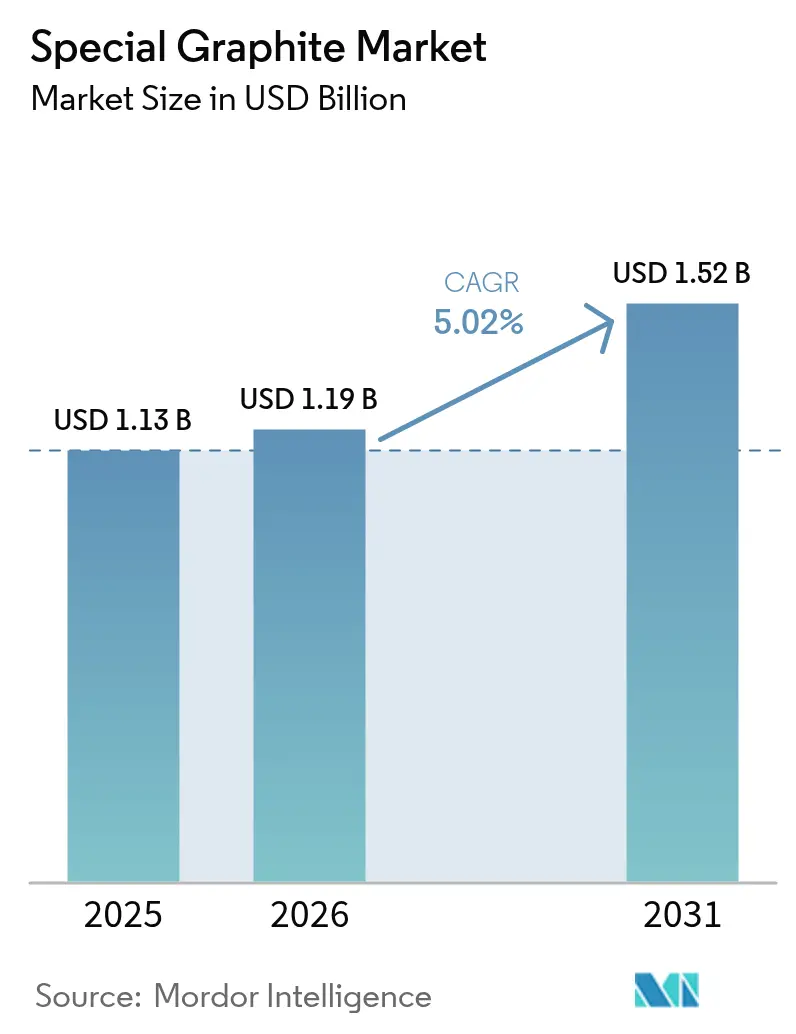
| Market Size (2026) | USD 1.19 Billion |
| Market Size (2031) | USD 1.52 Billion |
| Growth Rate (2026 - 2031) | 5.02 % |
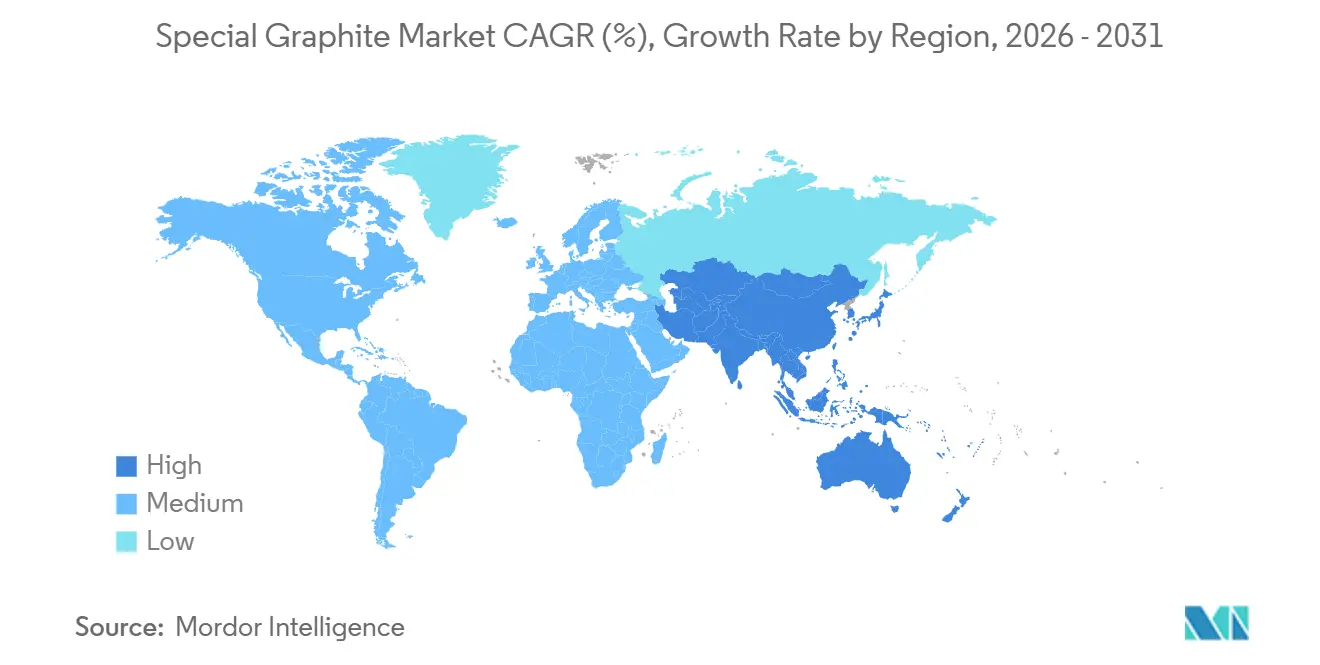
| Fastest Growing Market | Asia Pacific |
| Largest Market | Asia Pacific |
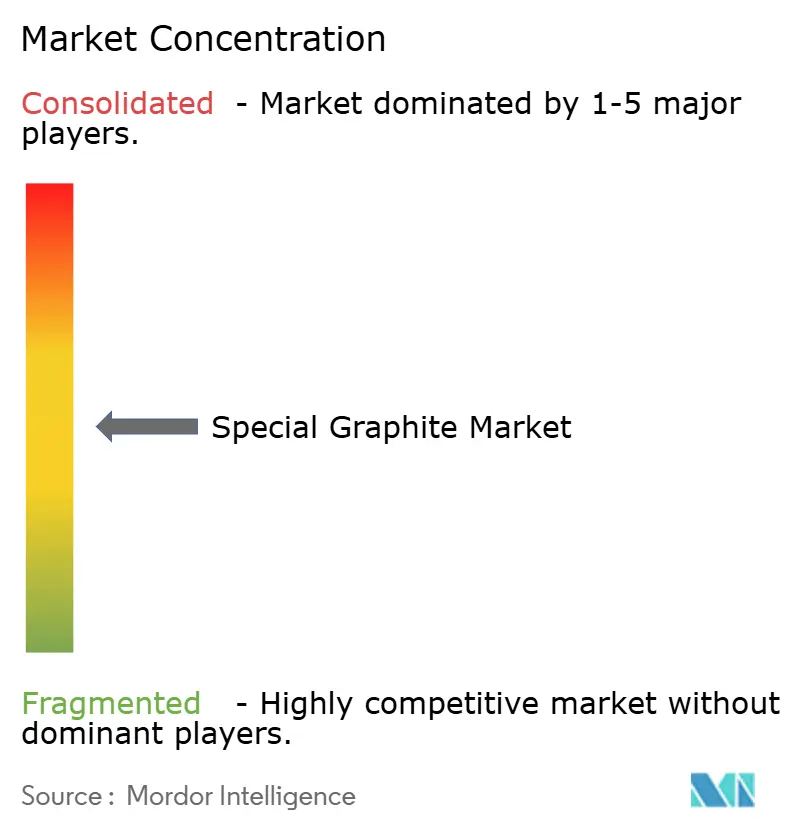
| Market Concentration | Medium |
Major Players *Disclaimer: Major Players sorted in no particular order Image © Mordor Intelligence. Reuse requires attribution under CC BY 4.0. | |
Special Graphite Market Analysis by Mordor Intelligence
The Special Graphite Market size is projected to be USD 1.13 billion in 2025, USD 1.19 billion in 2026, and reach USD 1.52 billion by 2031, growing at a CAGR of 5.02% from 2026 to 2031. Sovereign battery-content rules in the United States and European Union are splitting the global supply chain into a high-volume Chinese sphere and a premium-priced Western sphere, pushing Western automakers to pay 15-20% premiums for non-Chinese, fully traceable material. At the same time, Chinese refiners still control more than 95% of battery-grade processing capacity, giving them the ability to move spot prices by double-digit percentages within a single quarter. Midstream volatility therefore rewards vertically integrated companies that own both needle-coke feedstock and graphitization furnaces, while pure-play refiners remain exposed to feedstock spikes that reached USD 750 per tonne in early 2025 after a fire at a major Japanese calciner. Demand also benefits from the accelerating deployment of green-hydrogen electrolysers and 400 GW of new solar-wafer capacity in China, both of which require high-purity isotropic graphite parts capable of operating beyond 1,400 °C.
Key Report Takeaways
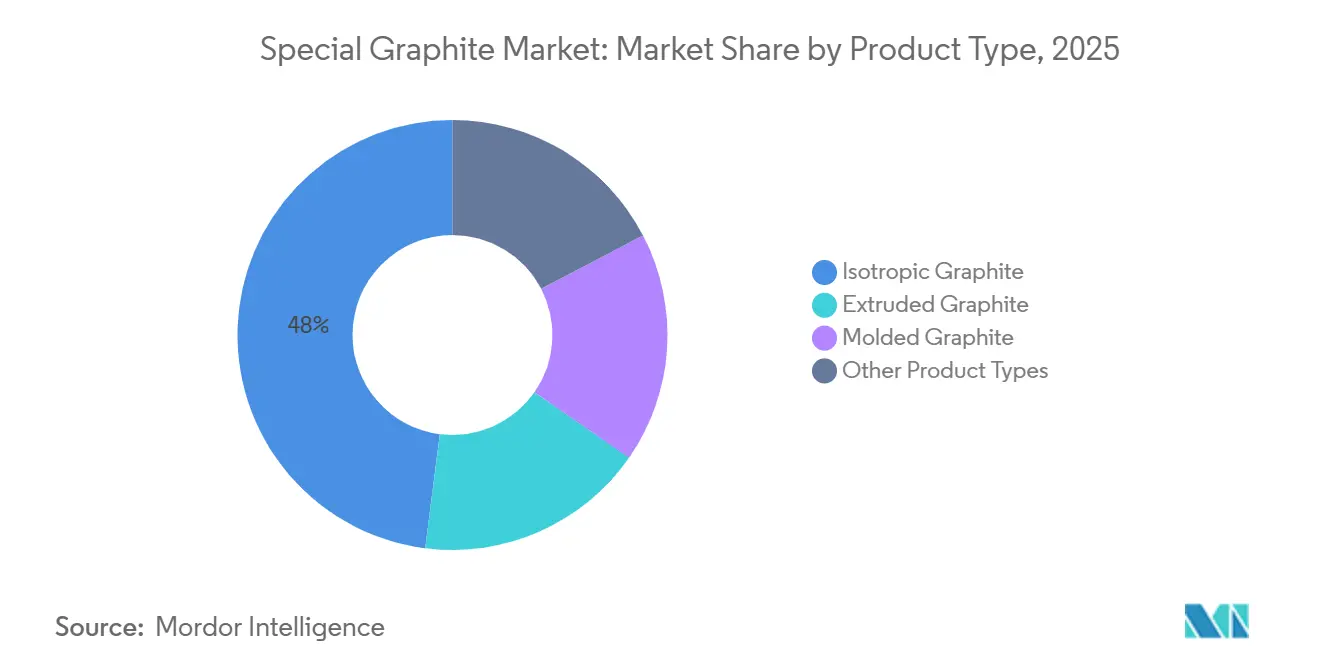
- By product type, isotropic graphite led with 47.98% of the special graphite market share in 2025 and is projected to expand at a 5.51% CAGR through 2031.
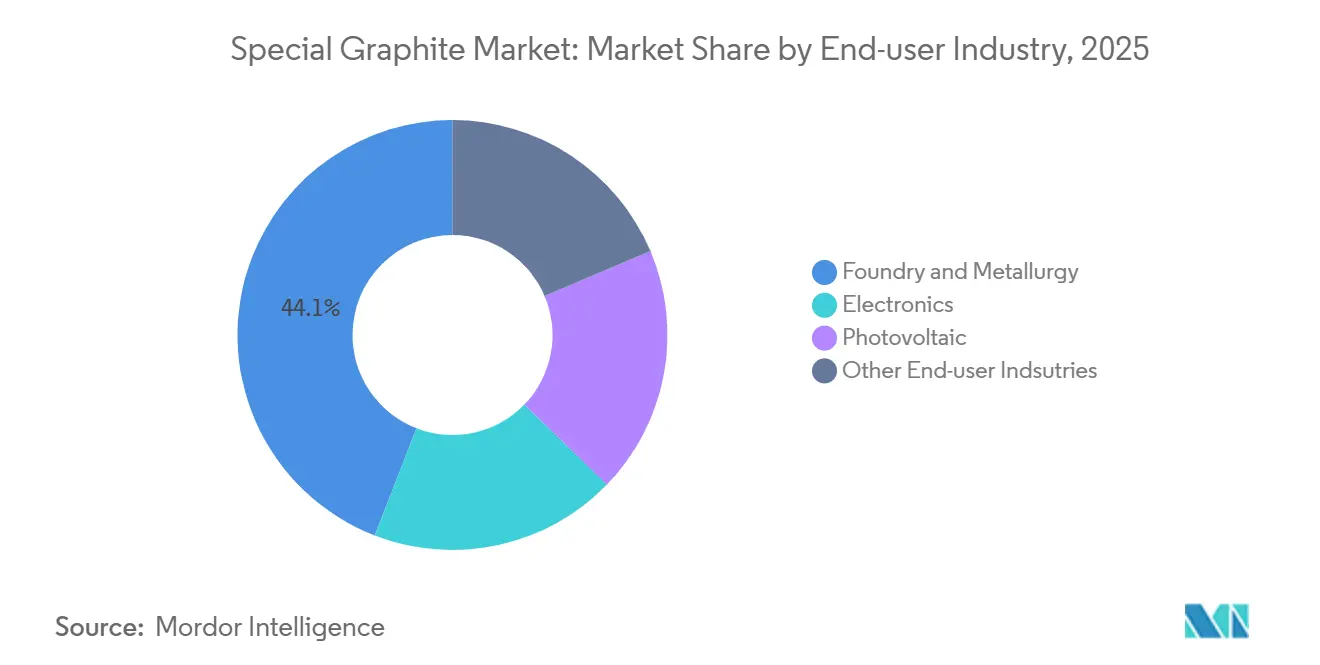
- By end-user industry, foundry and metallurgy commanded 44.12% of the special graphite market share in 2025 and is advancing at a 5.32% CAGR through 2031.
- By geography, Asia-Pacific captured 45.78% of the special graphite market share in 2025 and is advancing at a 6.57% CAGR through 2031.
Note: Market size and forecast figures in this report are generated using Mordor Intelligence’s proprietary estimation framework, updated with the latest available data and insights as of 2026.
Market Trends and Insights
Drivers Impact Analysis of Special Graphite Market*
| Driver | (~) % Impact on CAGR Forecast | Geographic Relevance | Impact Timeline |
|---|---|---|---|
| Government decarbonization policies boosting solar-wafer demand | +1.2% | APAC core (China, India), spill-over to EU and North America | Medium term (2-4 years) |
| EV-battery supply-chain localization in United States and European Union spurring special graphite offtake | +1.5% | North America and EU, with sourcing pressure on APAC | Long term (≥ 4 years) |
| Shift to large-format Si-rich anodes needing higher-purity graphite | +0.9% | Global, led by China, South Korea, United States | Medium term (2-4 years) |
| Foundry migration from metal to graphite molds for complex alloys | +0.7% | North America, EU (Germany, France), APAC (Japan) | Short term (≤ 2 years) |
| Rapid expansion of green-hydrogen electrolyser plates using isostatic graphite | +0.6% | EU (Germany, Netherlands), North America, early gains in Middle-East (Saudi Arabia, UAE) | Long term (≥ 4 years) |
| Source: Mordor Intelligence | |||
Government Decarbonization Policies Boosting Solar-Wafer Demand
National climate mandates are translating directly into polysilicon and wafer capacity that sharply lifts special graphite market demand. China added 400 GW of solar manufacturing lines in 2024, which required an estimated 120,000 tonnes of crucible-grade graphite for Czochralski and directional-solidification processes. The U.S. Inflation Reduction Act pushed First Solar and Qcells to commit USD 4 billion to domestic wafer plants that each need isotropic susceptors able to survive 1,450 °C without warping[1]U.S. Department of Energy, “Solar Manufacturing Commitments under IRA,” energy.gov . India’s Production-Linked Incentive program set aside INR 240 billion for solar components, yet the country still imports more than 90% of specialty grades, creating commissioning delays of three to six months. Europe’s rose eight to ten percentage points between 2024 and 2026. Falling wafer thickness from 180 µm to 130 µm paradoxically raises graphite intensity per gigawatt because thinner wafers need tighter thermal-profile control and more rapid crucible replacement.
EV-Battery Supply-Chain Localization in United States and European Union Spurring Special Graphite Offtake
Foreign Entity of Concern rules in the United States and the EU Critical Raw Materials Act obligate automakers to secure non-Chinese graphite after 2027, even though China refined 1.5 million tonnes of spherical graphite in 2024. General Motors and Stellantis signed multi-year offtakes with Syrah’s Vidalia plant in Louisiana and Novonix’s Tennessee facility, paying 15-20% price premiums to lock in IRA eligibility. BMW and Volkswagen earmarked EUR 1.2 billion for a synthetic-graphite venture in Poland, but the plant’s dependence on petroleum needle coke makes it vulnerable to feedstock spikes such as the USD 750-per-tonne price seen in early 2025. The FEOC exemption sunsets in 2027, creating a narrow window in which Western OEMs either secure supply or forfeit USD 7,500 per vehicle in tax credits. South Korea’s KRW 9 trillion K-Battery program aims for 200,000 tonnes of anode capacity by 2028, yet still leans on imported Chinese flake, showing that “localization” often stops at refining.
Shift to Large-Format Si-Rich Anodes Needing Higher-Purity Graphite
Automakers are adopting 5-10% silicon composites to raise cell energy density above 300 Wh/kg, but doing so forces ash content below 50 ppm and shrinks D50 particle size to 12 µm to 15 µm, tighter than the 20-25 µm norm for conventional anodes. Tesla’s 4680 cell requires an extra purification pass that adds USD 800-1,000 per tonne in processing cost. Panasonic and LG Energy Solution pilot 10% silicon for 2027 release, a level where cycle life drops without graphite porosity below 5%. CATL’s Shenxing PLUS battery sources 80% of its high-purity graphite from a single supplier, underlining concentration risk catl.com. South Korean cell makers pay 10-12% premiums for Japanese isotropic graphite because its zero-defect record slashes scrap in pilot lines.
Foundry Migration from Metal to Graphite Molds for Complex Alloys
Aerospace and automotive foundries now replace steel molds with graphite to stretch tool life from 50-100 casting cycles to more than 500, cutting scrap 15-20% and justifying a mold that costs three times as much up front. GE Aerospace moved 30% of turbine-blade casting to graphite in 2024, slicing USD 400 from each part and trimming lead times by two weeks. Tesla’s Giga Press uses graphite inserts that last 1,000 shots, double the life of coated steel. European aerospace consumed 8,000 tonnes in 2024, up 25% year over year as Airbus and Safran ramped LEAP engine production. Qualification cycles still deter newcomers because foundries demand carbon pickup below 0.02%, a threshold extruded grades rarely meet.
Restraints Impact Analysis of Special Graphite Market*
| Restraint | (~) % Impact on CAGR Forecast | Geographic Relevance | Impact Timeline |
|---|---|---|---|
| Breakthroughs in LTO and sodium-ion chemistries lowering graphite intensity | -0.8% | Global, with faster adoption in China for commercial vehicles and entry-level EVs | Medium term (2-4 years) |
| Stricter EU-REACH limits on graphite-dust emissions increase CAPEX | -0.4% | EU (Germany, France, Italy), with compliance pressure extending to UK post-Brexit | Short term (≤ 2 years) |
| Slow qualification cycles for isotropic graphite in advanced semiconductor fabs | -0.3% | Global, concentrated in Taiwan, South Korea, United States (Arizona, Texas) | Long term (≥ 4 years) |
| Source: Mordor Intelligence | |||
Breakthroughs in LTO and Sodium-Ion Chemistries Lowering Graphite Intensity
Lithium-titanate‐oxide anodes offer 20,000-cycle lifespans and already dominate Chinese e-bus packs, displacing about 15,000 tonnes of graphite in 2025 alone. Sodium-ion batteries commercialized by CATL and deployed in BYD’s Seagull sold 200,000 units in 2025 without graphite anodes, and the upcoming 200 Wh/kg milestones could restrict graphite to premium trims, trimming demand by up to 15% post-2028. The threat skews toward natural flake, leaving higher-margin synthetic grades less affected yet eroding volume that supports new Western refineries.
Stricter EU-REACH Limits on Graphite-Dust Emissions Increase CAPEX
The European Chemicals Agency’s 2024 update cut allowable PAH content in graphite electrodes from 10 mg/kg to 1 mg/kg and imposed real-time particulate monitors that trigger automatic line shutdowns above 0.5 mg/m³[2]European Chemicals Agency, “REACH Annex XVII Update 2024,” echa.europa.eu . SGL Carbon spent EUR 12 million to retrofit three German plants, extending payback periods from four to six years and trimming ROIC by 150 basis points. Smaller Bavarian producer Graphit Kropfmühl paused an 8,000-tonne expansion because the EUR 5 million closed-loop system outweighed project NPV. Importers now must verify that overseas suppliers meet equivalent standards, adding USD 50,000-100,000 in annual audit costs that squeeze lower-margin extruded-graphite players.
*Our forecasts treat driver/restraint impacts as directional, not additive. The impact forecasts reflect baseline growth, mix effects, and variable interactions.
Special Graphite Market Segment Analysis
By Product Type:
Isotropic Graphite Dominates Precision ApplicationsIsotropic graphite held 47.98% of the special graphite market share in 2025 and is forecast to expand at a 5.51% CAGR through 2031, supported by semiconductor, hydrogen, and silicon-rich anode demand. Tokai Carbon and Toyo Tanso together are adding capacity across Japan and the United States, yet 18-month lead times persist because isostatic pressing and multi-week graphitization limit ramp speed.
Extruded graphite is serving EDM and foundry molds where cost per cycle matters more than absolute purity. Molded graphite anchors continuous-casting lines for steel and non-ferrous metals, but growth is muted as Chinese steel output plateaus. Niche products such as flexible and expandable graphite benefit from EV thermal-management systems that need 300-400 W/m·K conductivity, creating double-digit growth pockets even within a slower commodity tier. Price differentials remain wide: isotropic sells for two to three times extruded because the special graphite market size for high-precision grades commands premiums tied to 0.1% porosity specs.



By End-user Industry:
Foundry and Metallurgy Lead, Electronics AcceleratesFoundry and metallurgy secured 44.12% of the special graphite market share in 2025 and are expanding at a 5.32% CAGR through 2031 as aerospace and automotive casters switch from steel to graphite molds that last 500-plus cycles. GE Aerospace achieved a cost reduction of USD 400 per turbine-blade casting, while Tesla’s Giga Press enhancements doubled tool life to 1,000 shots. In the aerospace industry, Europe experienced new demand, whereas North America benefited from increased adoption of EV structural castings.
The electronics demand is driven by semiconductor fabrication facilities in Arizona, Kumamoto, and Dresden, which require sub-10-µm grain size and ±2 °C thermal uniformity. Dual-source agreements have led to situations where a single fabrication facility can account for 10-15% of global isotropic capacity, driving up spot prices for unaffiliated EDM tool shops. Additionally, photovoltaic installers are contributing to demand growth; 210 mm wafers, which reduce the levelized cost of energy (LCOE) by 2-3%, require graphite crucibles capable of maintaining zero warp during 1,450 °C thermal cycles, increasing reliance on premium materials.
Geography Analysis
APAC Special Graphite Market
Asia-Pacific commanded 45.78% of the special graphite market share in 2025 and is growing at 6.57% to 2031, anchored by China’s 400 GW annual solar-wafer expansions and 1.5 million-tonne spherical-graphite output. Chinese export-permit rules, tightened in 2023, already prompt Western offtakers to pay 15-20% premiums for non-Chinese feedstock. South Korea plans 200,000 tonnes of local anode capacity by 2028 under the K-Battery initiative, but heavy reliance on Chinese flake means real autonomy remains distant. Japan keeps its niche leadership in ultra-pure isotropic grades, leveraging multi-year fab qualifications as a protective moat. India mined 35,000 tonnes of natural graphite in 2024 and is channeling INR 60 billion into specialty conversions, yet pipeline volumes remain small.
North America Special Graphite Market
North America benefits from the Inflation Reduction Act, which turns graphite sourcing into a USD 7,500-per-vehicle binary. Syrah’s Vidalia line hit 10,000 tonnes in 2024 and is scaling to 45,000 tonnes by 2027, while Novonix’s Tennessee plant targets 16,000 tonnes by late 2025. Canada’s Bissett Creek restarted in 2024 and feeds a 25,000-tonne Quebec spherical-graphite partnership, and Mexico’s USMCA-compliant suppliers now feed Tesla’s Austin complex.
EMEA and South America Special Graphite Market
In Europe, SGL Carbon’s EUR 200 million Swedish expansion rides the EU Critical Raw Materials Act, which requires 40% of consumption to be processed locally by 2030. Only SGL and Mersen currently supply crucible-grade graphite, giving them an 8-10 point margin. Russia’s exports dipped under sanctions, moving European buyers toward Turkish and Indian feedstock. The Middle-East and Africa show focused growth tied to 4 GW of NEOM electrolyser demand, while South American projects remain at the exploration stage.

Regulatory Landscape
Trade and industrial policy continues to shape special-graphite flows, particularly for battery and high-purity grades. In February 2026, the U.S. Department of Commerce issued a final affirmative determination covering active anode material from the People's Republic of China, with duties exceeding 160%, which materially shifts delivered costs for China-linked battery-graphite supply into the United States. This reinforced sourcing moves tied to IRA eligibility.
On the supply side, China has layered export administration and compliance requirements that raise transaction friction for controlled carbon materials. MOFCOM and the General Administration of Customs introduced export control restrictions on artificial graphite anode materials in late 2025 by placing them under the dual-use export control framework. China also implemented its 2026 Export License Management Catalogue effective January 2026, expanding license determinations that depend on technical parameters and end-use declarations rather than HS codes alone.
Value Chain Analysis
The value chain runs from upstream carbon feedstocks (natural flake graphite and petroleum needle coke) through calcination and purification, forming and isostatic pressing, graphitization (multi-week furnace cycles), and precision machining into components for batteries, semiconductors, photovoltaics, and metallurgy. Cost and availability risks concentrate in the midstream processing steps, where purity and consistency requirements (for example, battery-grade specifications around 99.95% and above) and long qualification cycles slow supplier entry. Energy-intensive graphitization also keeps manufacturers exposed to electricity and logistics inflation.
Supply diversification initiatives are adding new nodes outside China through integrated projects and recycling collaborations. In May 2026, Nouveau Monde Graphite held a groundbreaking for the Matawinie mine project in Quebec, building an upstream-to-midstream pathway aimed at non-Chinese supply for North American customers. In May 2026, International Graphite and Alkeemia advanced plans for a processing hub at Porto Marghera, Italy (planned initial output of 10,000 tonnes per year), using existing industrial infrastructure to shorten build-and-permit risk. Circular supply is also being formalized, with Vianode and cylib signing an MoU in June 2026 to integrate recycled graphite concentrate into anode production. Project validation milestones such as Titan Mining's July 2026 announcement of a full processing chain achieving 99.99% fixed carbon for spherical purified graphite underscore the focus on proving consistent high-purity output before commercial qualification.
Competitive Landscape
The special graphite market remains moderately fragmented. Tokai Carbon, Toyo Tanso, and Nippon Carbon dominate semiconductor-grade isotropic graphite by virtue of 18-36 month fab qualifications that lock customers for half a decade. SGL Carbon bets on regulatory upside, investing EUR 200 million in Swedish anode lines rather than chasing Chinese cost curves.
Novonix and Syrah scale U.S. plants to meet IRA demand but still face feedstock risk unless they backward-integrate into flake mining. GrafTech retains a cost moat by owning petroleum needle-coke production that cushions it from the USD 750-per-tonne spike seen in early 2025. Innovation centers on biomass-to-graphite, expandable grades for 800-V EVs, and ultra-fine-grain material for gate-all-around transistors, with patent filings concentrated at SGL and Tokai.
Special Graphite Industry Leaders
SGL Carbon
Toyo Tanso Co., Ltd.
Tokai Carbon Co., Ltd.
Mersen Property
Entegris
- *Disclaimer: Major Players sorted in no particular order
Special Graphite Market Companies Covered in this Report
- Entegris
- Fangda Carbon New Material Co. Ltd
- GCM CORPORATION Ltd
- GrafTech International
- Graphite India Limited
- Mersen Property
- Morgan Advanced Materials Plc
- Nippon Carbon Co. Ltd
- Pingdingshan City Kaiyuan Specialty Graphite Ltd
- Schunk Carbon Technology
- SEC CARBON, Limited
- SGL Carbon
- Tokai Carbon Co., Ltd.
- Toyo Tanso Co., Ltd.
- Yichang Xincheng Graphite Co., Ltd.

Market Opportunities and Future Outlook
A near-term opportunity sits in non-Chinese, fully traceable special graphite for batteries and critical manufacturing, where policy constraints and trade actions are splitting premium-qualified supply from high-volume commodity availability. The February 2026 U.S. trade determination on active anode material from China (duties exceeding 160%) adds a direct cost lever that favors local or allied processing routes. The report context also points to OEM offtakes tied to IRA compliance and an approaching 2027 FEOC timeline that is tightening procurement windows for qualifying suppliers.
Capacity build-outs and process innovation are expanding addressable applications for high-purity and specialty grades across semiconductors, batteries, and thermal management. Graphite One secured an Ohio site for an Active Anode Materials facility (announced May 2026) with a stated Phase One plan of 10,000 tonnes per year, and ExxonMobil outlined a roadmap for advanced synthetic graphite with a demonstration-scale pilot unit targeted for launch in the United States in 2026. On the technology side, published academic work in 2026 on biomass-derived synthetic graphite via the Acheson process and modular production models points to emerging routes that reduce reliance on conventional feedstocks and complex post-purification, aligning with tighter traceability and environmental compliance requirements that are increasingly embedded in customer qualification and procurement audits.
Recent Industry Developments in Special Graphite Market
- July 2026: Toyo Tanso announced a 10% to 15% price increase for carbon-related products, including specialty graphite, for orders on or after October 1, 2026, citing higher raw material, energy, and logistics costs. The change passes input-cost inflation through to customers and can reset reference pricing for high-purity grades where lead times and qualification barriers limit near-term substitution.
- November 2025: X-energy, LLC signed a USD 40 million agreement with Toyo Tanso to supply IG-110 fine-grain isotropic graphite for use as a neutron moderator and structural component in the Xe-100 high-temperature gas-cooled reactor. The contract links nuclear build programs to premium isotropic graphite demand and supports multi-year production planning for tightly specified grades.
- June 2024: Syrah Resources reported its Vidalia, Louisiana facility reaching 10,000 tonnes of production, establishing a scaled U.S. processing footprint for battery anode materials. This added a non-Chinese pathway that complements OEM localization requirements and provides a reference point for qualifying downstream anode and special-graphite supply chains in North America.


Special Graphite Market Report Scope and Research Methodology
Market Definition and Coverage
We define the special graphite market as revenue generated from engineered graphite grades used where stable conductivity, thermal resistance, and machining precision are required in industrial and electronics processes.
Scope exclusions: This sizing excludes natural graphite and also excludes graphite electrodes and other general carbon products sold mainly for bulk steelmaking use cases.
Segments Covered in This Report
- By Product Type
- Isotropic Graphite
- Extruded Graphite
- Molded Graphite
- Other Product Types
- By End-user Industry
- Foundry and Metallurgy
- Electronics
- Photovoltaic
- Other End-user Industries
- By Geography
- Asia-Pacific
- China
- India
- Japan
- South Korea
- Rest of Asia-Pacific
- North America
- United States
- Canada
- Mexico
- Europe
- Germany
- United Kingdom
- France
- Italy
- Russia
- Rest of Europe
- South America
- Brazil
- Argentina
- Rest of South America
- Middle-East and Africa
- Saudi Arabia
- South Africa
- United Arab Emirates
- Rest of Middle-East and Africa
- Asia-Pacific
Data Sources, Market Sizing, and Validation
Desk Research
Desk work starts with building the demand map and checking how special graphite is described across applications like semiconductors, photovoltaics, EDM, and high temperature furnace parts. We lean on public sources such as USGS mineral summaries, UN Comtrade trade statistics, International Energy Agency releases for solar and EV trends, World Bank macro indicators, and patent databases to understand material substitution and new grade development.
To ground the commercial side, we also review company annual reports, investor presentations, and press releases to capture capacity additions, product mix notes, and end market commentary. Where needed, a paid subscription for company financials and intelligence is used to normalize revenues and identify exposure by region, and a patent database subscription is used to cross-check activity by application area. These desk research sources are illustrative only, and there were other public references used for collection, cross-checking, and clarification.
Primary Interviews and Surveys
Primary work is used to pressure-test the desk model, especially where pricing, yield loss, and qualification cycles are not visible in public data. We speak with manufacturers, distributors, and downstream users across APAC, EMEA, and the Americas so adoption rates and purchasing behavior can be checked for semiconductor, solar, and industrial customers.
Distribution of primary research fieldwork respondents
| Company type | Respondent position | Region |
|---|---|---|
| Top tier: 29% | CXOs: 14% | APAC: 49% |
| Mid tier: 57% | Functional/Unit leaders: 38% | EMEA: 31% |
| Smaller Players: 14% | Managers: 48% | Americas: 20% |
Market-Sizing & Forecasting
Sizing starts with a top-down build where production and trade data are used to reconstruct the addressable special graphite demand pool by region. That pool is then allocated into key end uses based on typical consumption patterns discussed in interviews. The totals are then corroborated with selective bottom-up approximations, such as sampled price per kilogram by grade and channel, along with volume proxies linked to capacity and utilization.
Inputs that matter in this market include semiconductor fab expansion timing, solar wafer and cell output trends, EDM activity in precision machining, furnace and heat-treatment capacity additions, and the spread between premium isotropic grades and more standard molded or extruded grades. Pricing is handled with a practical ASP progression that reflects energy and needle coke cost direction, mix shift toward higher purity grades, and regional selling terms. Forecasting uses scenario analysis, where base demand indicators are projected and then adjusted with interview-backed assumptions on qualification lead times and substitution risk. If a sub-segment has thin visibility, we use nearest-neighbor ratios from similar applications and then recheck with at least two independent expert views.
Data Validation & Update Cycle
Validation is done by comparing the model output against independent signals, such as trade flows for graphite articles, announced capacity and utilization commentary, and downstream production indicators tied to semiconductors and photovoltaics. When variances look large, we recheck unit conversions, currency timing, and regional mix before final sign-off.
A multi-step internal review is used where assumptions, formulas, and sensitivity cases are checked by another analyst, followed by a final consistency pass across sections. Reports are refreshed annually, and interim updates are triggered when material events occur, such as large capacity ramps, sharp input cost swings, or step changes in end-market output. Before delivery, we complete a fresh sweep so clients receive the most current view available.
Mordor Intelligence's Special Graphite Market Sizing Compared With Other Published Estimates
Published values for special graphite are often not the same because the boundaries are set differently and because pricing and demand indicators are updated on different schedules. Differences also come from how firms handle conversion between volume proxies and value, and whether the view reflects a base case or a more aggressive adoption outlook.
The benchmark table shows a visible spread, and in Mordor Intelligence's model the market is counted as special graphite grades used in defined industrial and electronics applications, rather than folding in adjacent graphite categories that are often reported under broader carbon or general graphite headings.
Benchmark comparison
| Source | Market Size | Gaps in Research Methodology |
|---|---|---|
| Mordor Intelligence | USD 1.19 B (2026) | |
| Industry Research Publisher A | USD 1.25 B (2024) | Uses an earlier base year and a different pricing path, and the scope can mix application labels in ways that shift value between special graphite and nearby engineered carbon grades. |
| Industry Research Publisher B | USD 1.27 B (2024) | Reports a 2024 snapshot that can be influenced by short-term price moves, and the public page shows inconsistent year figures, which makes cross-year comparability and base-case alignment harder. |
Taken together, the differences line up with year selection, how adjacent graphite categories are treated, and how ASP changes are carried forward. By keeping the market tied to repeatable demand indicators and then checking the outputs with channel and expert feedback, the final number stays traceable to clear steps that can be rechecked over time.


Key Questions Answered in the Report
What is the size of the special graphite market?
The special graphite market is estimated at USD 1.19 billion in 2026 and headed toward USD 1.52 billion by 2031, with a CAGR of 5.02% from 2026 to 2031.
Which product type holds the largest special graphite market share in 2025?
Isotropic graphite led with a 47.98% special graphite market share in 2025.
Why are Western automakers paying premiums for graphite?
Inflation Reduction Act and EU Critical Raw Materials rules require non-Chinese sourcing, driving 15-20% price premiums on qualified supply.
What threatens graphite demand in batteries?
Sodium-ion and LTO chemistries eliminate graphite anodes in entry-level EVs and e-buses, potentially shaving 10-15% of future volume if energy density targets are met.
Page last updated on:


 Your data is secure and never sold or shared.


