
Spain Soil Monitoring Market Size and Share
Market Overview
| Study Period | 2021 - 2031 |
|---|---|
| Forecast Data Period | 2026 - 2031 |
| Base Year Market Size (2025) | USD 86 Million |
| Market Size (2026) | USD 95 Million |
| Market Size (2031) | USD 157 Million |
| Growth Rate (2026 - 2031) | 10.50 % |
| Market Concentration | Low |
Major Players *Disclaimer: Major Players sorted in no particular order Image © Mordor Intelligence. Reuse requires attribution under CC BY 4.0. | |
Spain Soil Monitoring Market Analysis by Mordor Intelligence
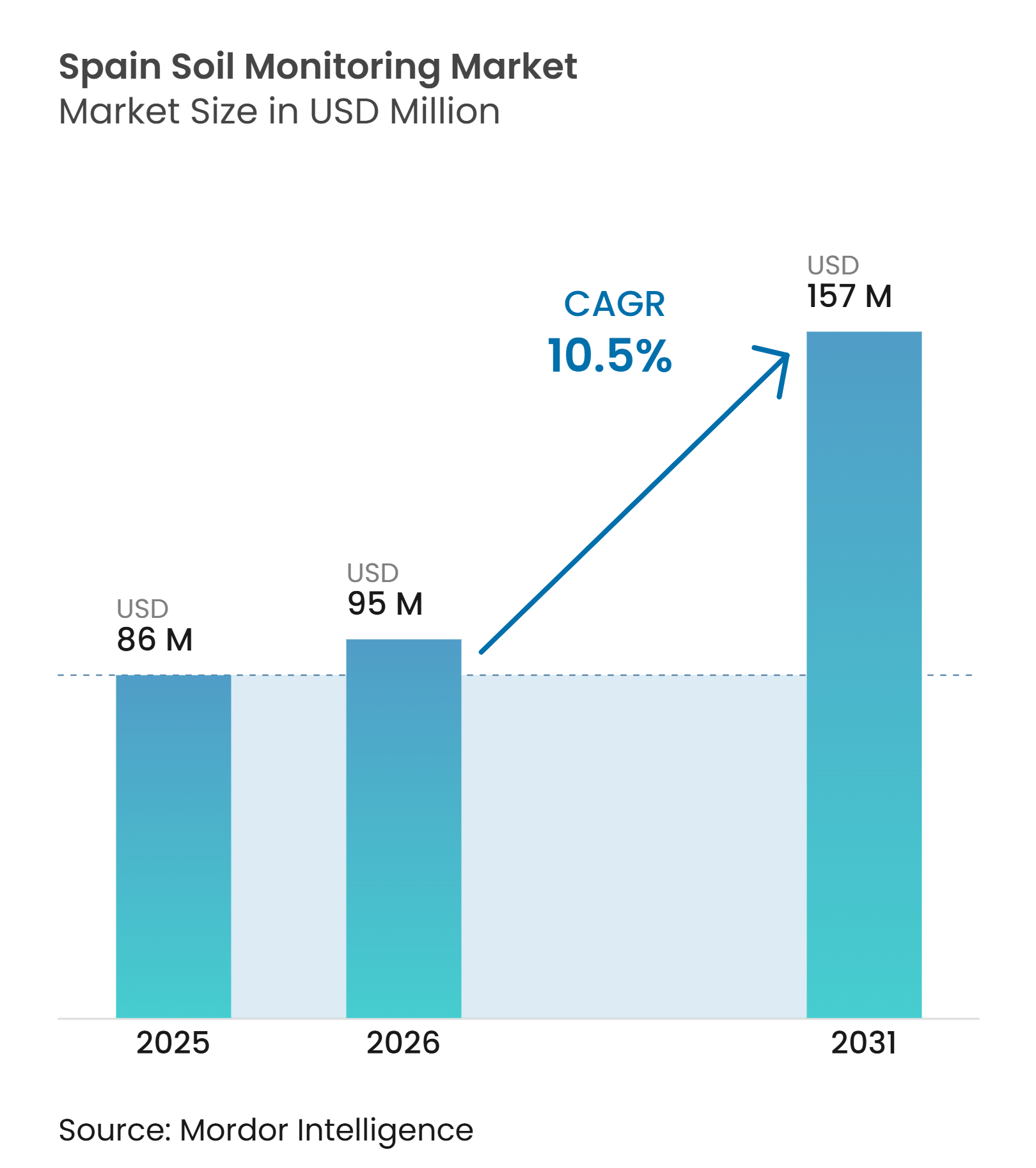
The Spain soil monitoring market size was valued at USD 86 million in 2025 and is forecast to grow from USD 95 million in 2026 to reach USD 157 million by 2031, at a CAGR of 10.5% during the forecast period (2026-2031). Regulatory requirements, water constraints, and the need for more precise irrigation are shaping demand across the Spain soil monitoring market. Peninsular reservoir reserves stood at 53.3% of capacity in late 2025, above the 5-year average, although southern basins such as Segura remained under pressure [1]. The EU Soil Monitoring and Resilience Directive, adopted in November 2025, requires Member States to perform their first soil measurements by December 2030 and their first soil health assessments by December 2031 [2]. This deadline supports procurement planning in the Spain soil monitoring market and reduces its exposure to short-term farm income cycles. Providers are increasingly competing through connected platforms, service support, and documentation capabilities rather than through sensor hardware alone, particularly where buyers require reliable records, timely decisions, and routine field measurements across multiple growing areas, crop cycles, and irrigation conditions.
Key Report Takeaways
- By component, hardware accounted for 56% of the Spain soil monitoring market share in 2025, while services are forecast to grow at a CAGR of 15.2% from 2026 to 2031.
- By product type, in-situ sensors accounted for 47% of the Spain soil monitoring market size in 2025, while remote sensing platforms are forecast to grow at a CAGR of 17.1% from 2026 to 2031.
- By connectivity technology, wireless technologies accounted for 72% of the Spain soil monitoring market in 2025 and are forecast to grow at a CAGR of 16.8% from 2026 to 2031.
- By application, open field accounted for 61% of the market in 2025, while protected cultivation is forecast to grow at a CAGR of 13.9% from 2026 to 2031.
- By end user, large commercial farms accounted for 39% of the market in 2025, while research institutes and universities are forecast to grow at a CAGR of 14.2% from 2026 to 2031.
Note: Market size and forecast figures in this report are generated using Mordor Intelligence’s proprietary estimation framework, updated with the latest available data and insights as of January 2026.
Market Trends and Insights
Drivers Impact Analysis of Spain Soil Monitoring Market*
| Driver | (~) % Impact on CAGR Forecast | Geographic Relevance | Impact Timeline |
|---|---|---|---|
| EU and CAP-linked soil health compliance | +1.5% | Spain, with relevance across Andalusia, Castilla-La Mancha, Castilla y León, and Catalonia | Medium term (2-4 years) |
| Water scarcity and precision irrigation adoption | +2% | Spain, with strong relevance in Andalusia, Murcia, Valencia, and Extremadura | Short term (≤ 2 years) |
| Integration with farm management and irrigation software | +1.8% | Spain, particularly Catalonia, Valencia, and Andalusia | Medium term (2-4 years) |
| Expansion of greenhouse and high-value crop production | +1.6% | Spain, with concentrations in Almería, Murcia, Valencia, Catalonia, and La Rioja | Short term (≤ 2 years) |
| Low-power wireless connectivity for rural monitoring | +1.4% | Spain, with relevance across Castilla-La Mancha, Andalusia, and Castilla y León | Medium term (2-4 years) |
| Soil carbon and regenerative agriculture verification | +1% | Spain, with relevance in Castilla y León, Castilla-La Mancha, and Andalusia | Long term (≥ 4 years) |
| Source: Mordor Intelligence | |||
EU and CAP-Linked Soil Health Compliance
Spain’s fourth CAP Strategic Plan amendment, approved in December 2025, reinforced good agricultural and environmental condition requirements across more than 86% of utilized agricultural area. Real Decreto 934/2025, enacted in October 2025, strengthened documentation requirements for nutrient balances. The regulation increases the value of recurring field data that can support digital records, allowing monitoring suppliers to address an administrative need alongside agronomic management. The EU directive also covers soil organic carbon, salinization, compaction, nutrient excess, and water retention. These requirements increase the value of systematic soil measurements and may support demand for monitoring solutions that complement periodic laboratory sampling. The directive's laboratory quality-management requirements may also influence procurement criteria for public bodies and cooperatives.
Water Scarcity and Precision Irrigation Adoption
Banco de España researchers reported that the 2022-2023 drought reduced average wheat and barley yields by 20%-30% and olive yields by at least 10%, with water scarcity accounting for 85%-90% of the shortfall in wheat and barley production [3]. Hydric deficits ranged from -450 mm to -600 mm across Extremadura, Andalusia, and Castilla-La Mancha during summer 2025, placing pressure on areas where irrigation already carries a central production role. Spain’s irrigated area increased 11% to 3.8 million hectares between 2000 and 2022. This larger irrigated base increases the importance of measuring root-zone conditions before irrigation decisions are made, rather than relying solely on visual crop assessment or fixed schedules. The Spain soil monitoring market benefits from this dynamic, as soil moisture data supports both resource management and operating-cost control on high-value farms.
Integration With Farm Management and Irrigation Software
Connected systems shift the purchase decision from a standalone sensor acquisition toward a broader irrigation and farm management outcome. A CODECS project demonstration in Almería during October 2025 linked electrical conductivity readings, valve control, and traceability within a single workflow. The demonstration showed how field data can feed directly into operational decisions, reducing the need to handle measurement, control, and recordkeeping as separate tasks. A 2025 study published in Smart Agricultural Technology on greenhouse adoption in Almería found greater acceptance of semi-automated and low-cost solutions than high-end technologies. The AI4WATER project in Catalunya achieved soil moisture forecasting with a Pearson correlation coefficient of 0.63. These developments encourage suppliers in the Spain soil monitoring market to emphasize compatibility with existing farm software and irrigation controllers.
Expansion of Greenhouse and High-Value Crop Production
Almería has the highest concentration of greenhouses, creating a concentrated demand base for soil monitoring equipment. The economic case for monitoring is stronger where water, fertilizer, and crop quality directly affect farm returns and where crop conditions can change rapidly. Soil-moisture-based irrigation programming was identified as a priority upgrade among Almería operators in 2025. Vineyards in Navarra and La Rioja are using NB-IoT-connected SDI-12 soil probes at depths of 10-40 cm. These probes transmit readings every 20 minutes to cloud platforms, providing a regular stream of data for irrigation decisions. Entry-level monitoring starts from EUR 1,500 (USD 1,650), widening access for olive, citrus, and stone-fruit operations beyond the main greenhouse regions.
Restraints Impact Analysis of Spain Soil Monitoring Market*
| Restraint | (~) % Impact on CAGR Forecast | Geographic Relevance | Impact Timeline |
|---|---|---|---|
| Fragmented farm ownership and cooperative procurement barriers | -1.2% | Spain, with greater relevance in Galicia, Asturias, and regions with smaller agricultural holdings | Long term (≥ 4 years) |
| Calibration drift across soil and salinity conditions | -0.9% | Spain, particularly Murcia, Valencia, Andalusia, and other irrigated coastal areas | Medium term (2-4 years) |
| Uneven rural connectivity and power availability | -0.8% | Spain, with relevance in Castilla y León, Aragon, and Extremadura | Medium term (2-4 years) |
| Uncertain payback for low-value dryland crops | -0.7% | Spain, particularly Castilla-La Mancha, Castilla y León, and Aragon | Long term (≥ 4 years) |
| Source: Mordor Intelligence | |||
Fragmented Farm Ownership and Cooperative Procurement Barriers
About half of Spain’s more than 800,000 farmers own farms of 5 hectares or less. Small plots make it difficult for individual farmers to justify investment in connected monitoring systems, as equipment and support costs are spread across less productive land. Galicia and Asturias have particularly fragmented holdings, with some parcels below 2 hectares. Cooperative procurement could reduce the cost burden for individual farms. However, governance requirements, varied soil conditions, and data-sharing concerns can slow collective decision-making and make standardizing a shared configuration difficult. As a result, shared monitoring services and cooperative data platforms remain underdeveloped within the Spain soil monitoring market.
Calibration Drift Across Soil and Salinity Conditions
Spain’s diverse soil conditions present a practical challenge for consistent sensor calibration. Salinity is particularly relevant in the irrigated coastal zones of Murcia, Valencia, and Andalusia, where its effect on sensor readings can be significant for operational use. A reading that is reliable in one soil profile may require adjustment in another. This increases service requirements beyond the initial equipment installation and can raise the need for laboratory reference work and local agronomic support before users can rely on data for routine decisions. Providers that offer calibration support can address this challenge, though the additional work may reduce the economic viability of smaller deployments.
*Our forecasts treat driver/restraint impacts as directional, not additive. The impact forecasts reflect baseline growth, mix effects, and variable interactions.
Spain Soil Monitoring Market Segment Analysis
By Component:
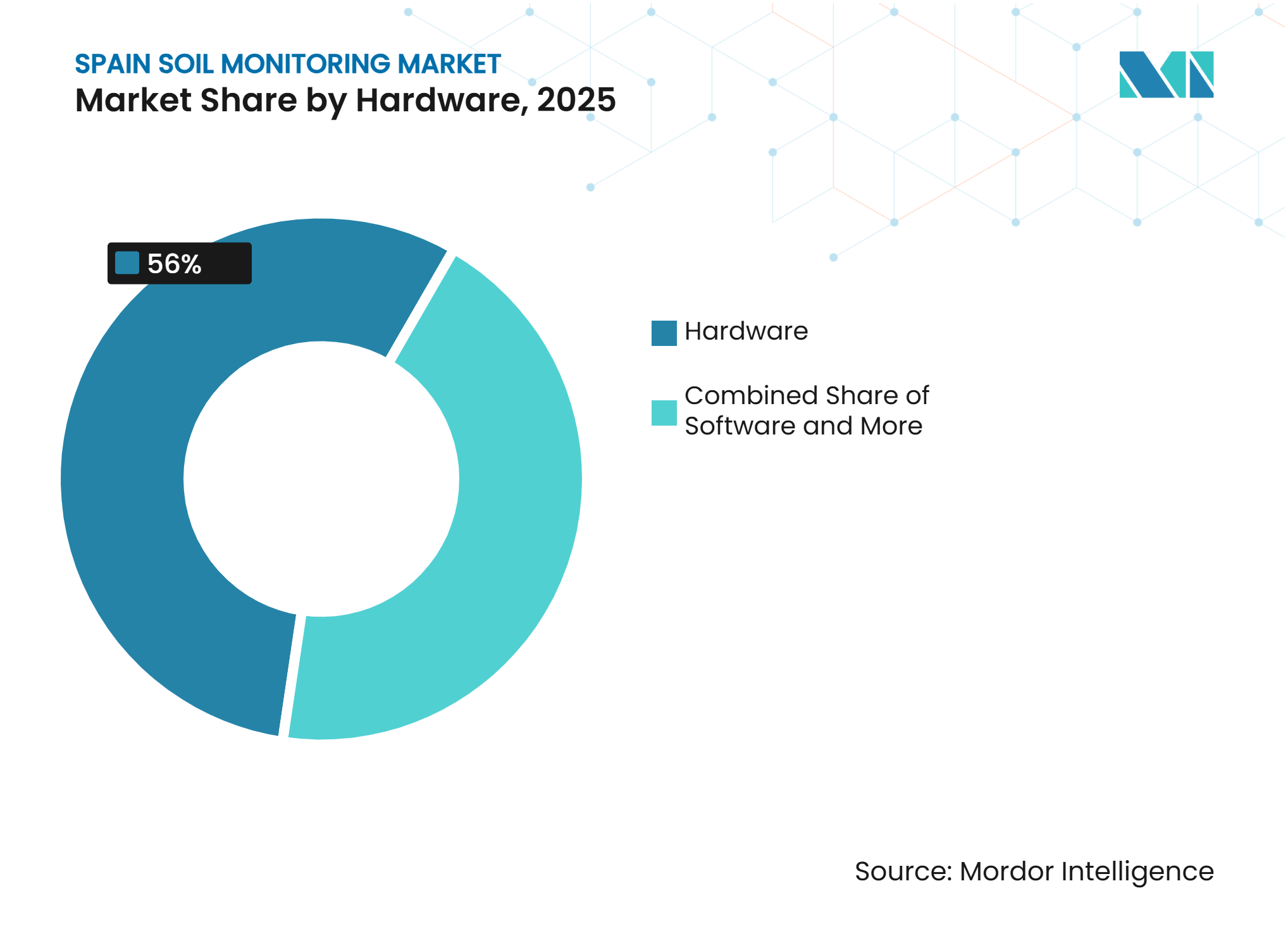
Hardware Leads While Services Record the Fastest GrowthHardware accounted for 56% of the market in 2025, reflecting the upfront investment required for sensors and low-power wide-area network gateways. Initial deployments are concentrated in Andalusia’s irrigated areas and Valencia’s citrus production zones. Software has a smaller but growing role, as operators require analysis and integration capabilities beyond field readings. Analytics platforms can convert sensor outputs into irrigation and farm-management actions. Services include calibration, advisory support, after-sales work, and subscription analytics.
Services are forecast to grow at a 15.2% CAGR through 2031, the fastest rate among components. Diverse agroclimatic conditions increase the need for ongoing technical support. Carbon monitoring and measurement, reporting, and verification services also contribute to this demand. The component pattern indicates that equipment remains necessary, while recurring support becomes more valuable after installation, as field conditions, data interpretation, and compliance records require continued attention beyond delivery of the physical devices. This shift moves part of revenue from one-time hardware sales toward ongoing service relationships.
The move toward bundled offerings is visible among early users in commercial horticulture. These farms are renewing hardware arrangements with analytics and irrigation support included. BrioAgro’s AQUA system combines soil probes, weather forecasts, and remote irrigation control. Its entry level starts from EUR 1,500 (USD 1,650) and can scale to intelligent fertigation subscriptions. This structure gives operators a route from basic monitoring to broader data-supported irrigation management, allowing the initial installation to serve as a starting point for later software, advisory, and fertigation support. It also allows suppliers to maintain an ongoing relationship after the first installation. SGS won an EU tender for soil-quality advancement in February 2025. The award illustrates demand for laboratory-grade assessment alongside field-monitoring services. Providers that can connect field data with documented assessment may address public and cooperative procurement needs. The Spain soil monitoring market is therefore moving toward a mix of equipment, software, and specialist support.



By Product Type:
In-Situ Sensors Lead While Remote Sensing Platforms Record the Fastest GrowthIn-situ sensors held 47% of product-type revenue in 2025, providing the direct root-zone readings used in precision irrigation. They remain important in greenhouse and high-value crop environments. Readings at several depths can inform actual irrigation scheduling. In situ data remain necessary for local measurements and ground reference. The two approaches serve different operating needs rather than replacing each other, as local root-zone conditions and wider field patterns must often be assessed together before a farm changes its irrigation plan.
Remote sensing platforms are forecast to grow at a 17.1% CAGR through 2031, the fastest rate among product types. A 2026 study published in Remote Sensing of Environment examined Sentinel-1-based soil moisture retrieval and highlighted advances in high-resolution soil moisture monitoring using radar remote sensing. This level of spatial detail supports plot-level use of satellite-derived information. Remote sensing can also reduce reliance on physical installation networks in fragmented areas, making it useful where continuous ground equipment is difficult to deploy.
Portable probes and test kits serve farms and research users seeking a lower-cost option between laboratory testing and continuous monitoring. They are relevant where a permanent sensor network cannot be justified. The product mix is increasingly built around several sources of information. Permanent in-situ sensors can provide continuous measurements from fixed points. UAV surveys and satellite indices extend coverage across larger areas. This combination is common in Spain’s European Union-funded soil projects. Providers with multiple product types can offer a more complete monitoring package, allowing users to combine permanent readings with periodic coverage of areas without fixed sensor installations. Satellite-based agricultural APIs can also connect remote sensing data to farm management software, helping users compare field observations with broader spatial patterns.
By Connectivity Technology:
Wireless Connectivity Leads the Market and Records the Fastest GrowthWireless technologies accounted for 72% of the Spain soil monitoring market in 2025, as wired infrastructure is difficult to install across dispersed plots. The large wireless share reflects the need to collect data over distance with limited power use. LoRaWAN supports distributed sensor arrays in the Basque Country, Extremadura, and Andalusia. NB-IoT is gaining use in areas where irrigation and water-metering requirements call for regular transmission. Hidroconta’s La Mancha installation covered more than 4,000 wells with NB-IoT modules. This configuration supports hourly readings from remote irrigation assets. Wireless systems also reduce the need for extensive cabling at field sites.
Wireless technologies are also forecast to grow at a CAGR of 16.8% from 2026 to 2031, the fastest rate among connectivity technologies. The strong wireless position reflects practical infrastructure conditions, rather than a single preferred technical standard. Network performance and available power remain important constraints in remote locations, where a technically suitable sensor still depends on reliable transmission, battery management, and periodic maintenance access.
Wired systems retain a role in Almería's advanced permanent greenhouse installations. These sites have reliable power and require frequent electrical conductivity and moisture readings, with data needs that can exceed the duty-cycle limits of low-power wireless systems. As a result, a hybrid approach is increasingly common. Wired sensor buses operate inside protected structures, while wireless gateways transmit the collected information from the site. This design balances data reliability with the cost of reaching remote areas and allows farm operators to use different connectivity methods within one installation. Connectivity suppliers need to support integration across those methods so users can maintain a single practical data flow despite differences in equipment, power availability, and communications needs across the farm. The Spain soil monitoring market is likely to continue using wireless networks for dispersed farms and wired systems for selected intensive sites.
By Application:
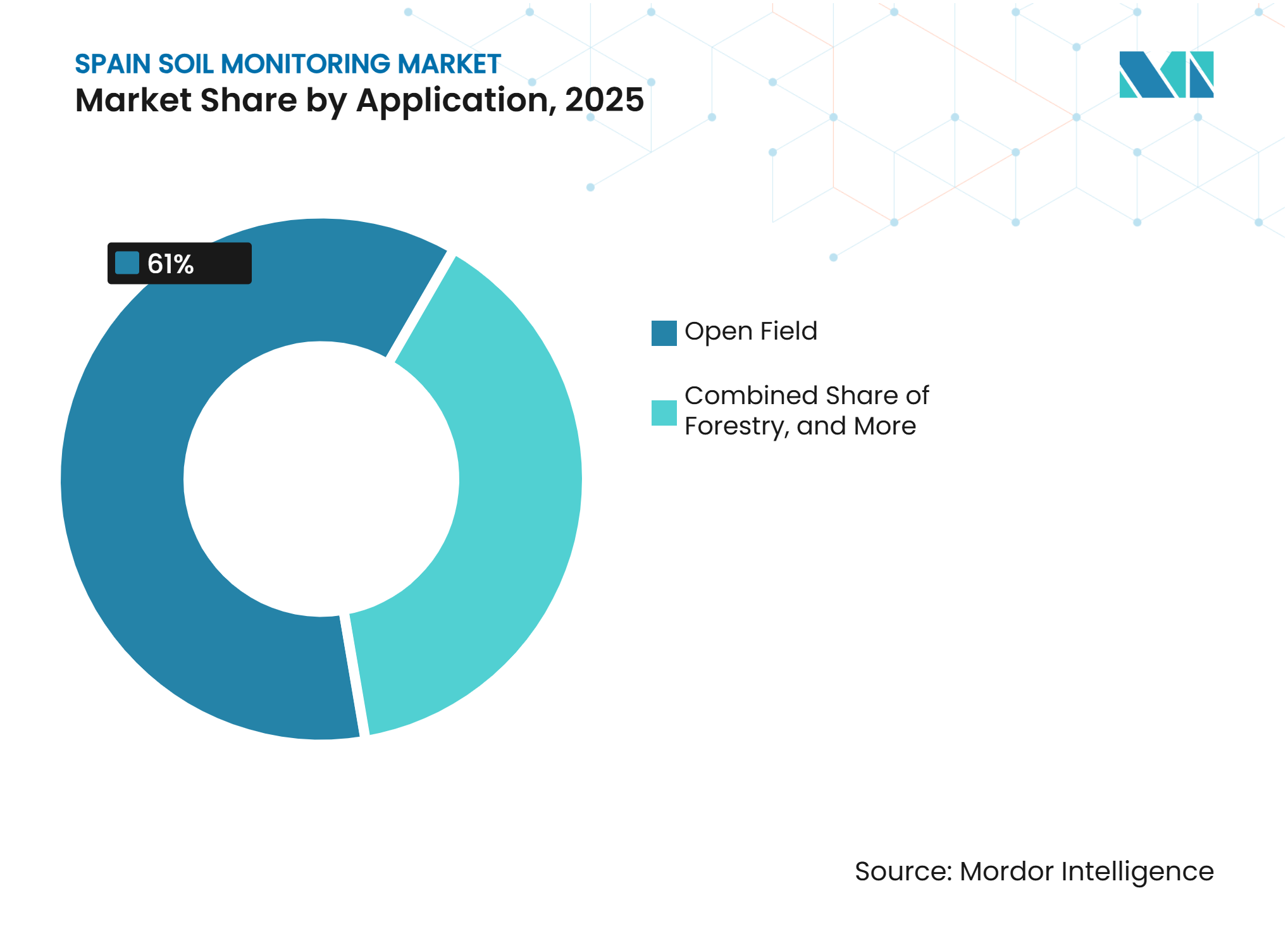
Open Field Leads the Market While Protected Cultivation Records the Fastest GrowthOpen field accounted for 61% of 2025 revenue, reflecting Spain's extensive agricultural area. The segment includes varied operating conditions. Intensive irrigated farms in Murcia and Valencia generate monitoring revenue per hectare that can be comparable to greenhouse operations, while rainfed cereal farms in Castilla y León create much lower recurring demand. Forestry remains an early application for the technology, with soil moisture data becoming more relevant to wildfire-risk management. These differences mean that application demand depends heavily on water use, crop value, and the operating environment, as monitoring value changes with the decisions each grower can make.
Protected cultivation is forecast to grow at a 13.9% CAGR through 2031. Spain’s greenhouse production base supports that rate. Protected cultivation continues to offer a clearer payback because irrigation and crop conditions are tightly controlled, and operators can act quickly on readings within an enclosed production environment where inputs are managed closely.
The SENSE4SOIL initiative in southeastern Spain combines salinity risk identification with irrigation decision support in a real-time platform. This type of application-specific package can offer greater value than a general sensor installation. It brings measurement and operating guidance together for users dealing with both water and salinity issues. Real Decreto 934/2025 has increased documentation needs for fertilizer application and soil organic matter. The EU Nitrates Directive also directs attention toward nutrient management. Open-field operators can add nutrient monitoring to existing moisture programs, which may broaden the value of a deployment without requiring a wholly separate system.

By End-User:
Large Commercial Farms Lead While Research Institutes and Universities Record the Fastest GrowthLarge commercial farms accounted for 39% of end-user demand in 2025, as scale improves the return on connected monitoring systems. These farms are concentrated in high-value irrigated operations across Andalusia, Murcia, and Catalonia. Larger sites can distribute installation and support costs across more hectares and have greater capacity to deploy multiple sensors and subscription analytics. Large farms remain the primary source of demand because their daily operational decisions create a direct use case for the data.
Research institutes and universities are forecast to grow at a CAGR of 14.2% from 2026 to 2031, driven by EU-funded programs expanding soil-monitoring work and living-lab sensor networks. The Andalusian Living Lab activated an Internet of Things monitoring network across 15 olive grove sites in 2026. These sites generate validated data that commercial operators can review before deploying their own systems. Research users support technical testing and broader awareness by producing validated local examples that help commercial operators assess whether a particular monitoring configuration suits their fields and crops.
Smallholder and cooperative farms continue to face cost and technical-support barriers. Agronomy cooperatives are beginning to bundle sensor data with advisory services, which can reduce the need for individual farms to manage the technology independently and distribute equipment and support costs across multiple users. Government and NGO buyers are also contributing to demand through soil-health, agricultural modernization, and precision-irrigation programs. Regional governments in Murcia and Andalusia are funding pilot precision-irrigation programs. These public and research deployments help establish reference points for commercial users but do not address the economic challenges facing small dryland farms. End-user growth will therefore depend on whether service models become viable for smaller holdings, including arrangements that provide growers access to agronomic interpretation without requiring each farm to maintain its own technical infrastructure. The Spain soil monitoring market encompasses commercial, research, cooperative, and public demand, each with distinct purchasing requirements.
Geography Analysis
Spain's soil monitoring market is supported by regulated irrigated farmland, a large greenhouse base, and mandatory CAP compliance timelines. Initial adoption is supported by agricultural modernization initiatives, with Spain's 2026 Plan Renove allocating EUR 9.6 million (USD 10.5 million) for agricultural machinery modernization, including EUR 1.6 million (USD 1.7 million) for eligible precision-agriculture equipment. These initiatives are lowering first-adoption barriers for mid-tier operators. Water-management requirements, agricultural modernization, and compliance needs are collectively supporting the adoption of soil monitoring technologies across Spain.
Regional agricultural conditions also influence demand for soil monitoring technologies. Irrigated agricultural areas in Levante and Andalusia have greater requirements for monitoring soil moisture, salinity, and nutrient conditions, while greenhouse production areas require continuous monitoring to support controlled crop production. As a result, adoption varies according to water availability, crop value, irrigation intensity, and production systems across Spanish regions.
The EU Soil Monitoring Directive is also expected to support demand for soil-monitoring systems in Spain by requiring Member States to establish soil-district monitoring frameworks and complete their first measurements by December 2030. Spain's CAP Strategic Plan amendment, approved in December 2025, realigned agri-environmental spending toward soil-health verification and added a government-funded layer of demand. These regulatory developments give agricultural stakeholders a clearer basis for planning soil measurement systems ahead of the required reporting dates.
The SENSE4SOIL initiative in southeastern Spain combines salinity risk identification with irrigation decision support in a real-time platform. Such application-specific solutions can offer greater value than a general sensor installation by combining measurement with operating guidance for users managing water and salinity issues. BrioAgro Technologies is also applying its Mediterranean soil and irrigation experience to support the deployment of monitoring solutions. These developments indicate that regional agricultural conditions, water-management requirements, and regulatory initiatives will continue to shape the adoption of soil monitoring technologies across Spain.
Competitive Landscape
Market Concentration
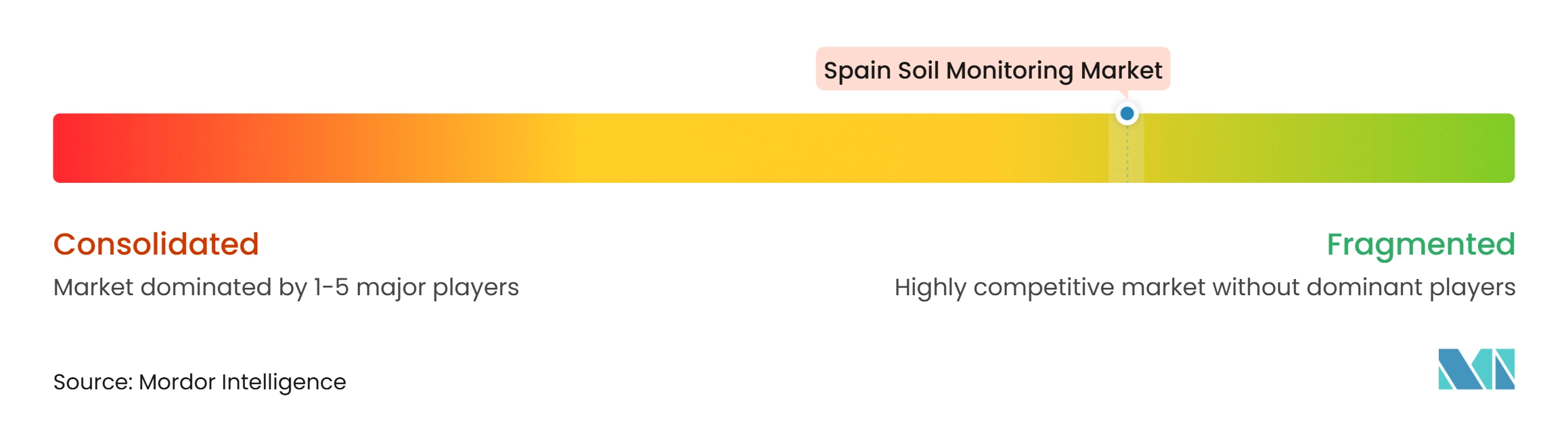
The Spain soil monitoring market is fragmented, with METER Group, Pessl Instruments GmbH, Stevens Water Monitoring Systems, Sentek Technologies, and BrioAgro Technologies among the key players. Product preferences vary by crop and operating environment, with capacitance and time-domain reflectometry specialists serving horticulture, tensiometer suppliers supporting vineyard and olive applications, and satellite analytics platforms addressing institutional and research demand. Domestic providers such as PRISMAB, Cesens, and BrioAgro Technologies leverage local soil knowledge and Spanish-language support to retain customers, while international suppliers compete through wider product portfolios.
METER Group released the SOLYX 14 soil moisture sensor in February 2026, using CDX technology to directly measure dielectric permittivity and reduce errors linked to salinity and temperature variation in saline irrigated areas. Pessl Instruments integrated METOS weather station data into the OneSoil platform in July 2026, extending access to agronomic data without requiring new hardware installation and providing satellite analytics users with access to ground-based information. These developments reflect how suppliers are using interoperability to improve the value of installed products and connect measurement tools with farm software.
Sentek is commercializing the BILBY below-ground wireless node in 2026, eliminating surface wires that can be damaged in open-field settings. Cooperative data platforms for smallholder users and affordable monitoring for dryland cereal farms remain limited, leaving room for focused solutions. Suppliers that combine field monitoring with CAP-compliant soil documentation can serve institutional buyers by integrating laboratory-grade certification with continuous sensor data streams. Such offerings can reduce the gap between hardware purchasing and analytical service procurement, despite the presence of established international suppliers.
Spain Soil Monitoring Industry Leaders
-
METER Group, Inc.
-
Pessl Instruments GmbH
-
Stevens Water Monitoring Systems, Inc.
-
Sentek Technologies
-
BrioAgro Technologies
- *Disclaimer: Major Players sorted in no particular order
Spain Soil Monitoring Market Companies Covered in this Report
- METER Group, Inc.
- Stevens Water Monitoring Systems, Inc.
- Sentek Technologies
- Pessl Instruments GmbH
- CropX Technologies, Ltd.
- SGS SA
- The Toro Company
- Irrometer Company, Inc.
- Soil Scout Oy
- Arable, Inc.
- EOS Data Analytics, Inc.
- BrioAgro Technologies
- PRISMAB
- IED Company
- Cesens
Recent Industry Developments in Spain Soil Monitoring Market
- July 2026: Pessl Instruments GmbH integrated METOS weather station data into the OneSoil farm management platform, extending its Internet of Things agronomic data reach into a new digital agronomy interface and reinforcing a platform-connectivity strategy over hardware dependence.
- June 2026: The SOILCRATES Living Lab in Granada began a new SoilHeroic deployment phase using drone remote sensing and in-situ sensors to develop soil-resilience models for commercial measurement, reporting, and verification contracts.
Spain Soil Monitoring Market Report Scope
Soil monitoring refers to the use of technologies and solutions to measure and analyze soil parameters, including moisture, temperature, pH, salinity, and nutrient levels, to support informed agricultural and land management decisions.
The Spain Soil Monitoring Market is Segmented by Component (Hardware, Software, and Services), by Product Type (In-situ Sensors, Remote Sensing Platforms, and Portable Probes and Test Kits), by Connectivity Technology (Wired and Wireless), by Application (Open Field, Protected Cultivation, and Forestry), and by End-User (Large Commercial Farms, Smallholder and Cooperative Farms, Research Institutes and Universities, and Government and NGOs). The Market Forecasts are Provided in Terms of Value (USD).
Segmentation Overview
| Hardware |
| Software |
| Services |
| In-situ Sensors |
| Remote Sensing Platforms |
| Portable Probes and Test Kits |
| Wired |
| Wireless (LPWAN, Cellular, Satellite) |
| Open Field |
| Protected Cultivation |
| Forestry |
| Large Commercial Farms |
| Smallholder and Cooperative Farms |
| Research Institutes and Universities |
| Government and NGOs |
| By Component | Hardware |
| Software | |
| Services | |
| By Product Type | In-situ Sensors |
| Remote Sensing Platforms | |
| Portable Probes and Test Kits | |
| By Connectivity Technology | Wired |
| Wireless (LPWAN, Cellular, Satellite) | |
| By Application | Open Field |
| Protected Cultivation | |
| Forestry | |
| By End-User | Large Commercial Farms |
| Smallholder and Cooperative Farms | |
| Research Institutes and Universities | |
| Government and NGOs |
Key Questions Answered in the Report
What is the size of Spain’s soil monitoring sector?
It is valued at USD 86 million in 2025 and is forecast to reach USD 95 million in 2026 and USD 157 million by 2031, growing at a 10.5% CAGR.
What is driving demand for soil monitoring in Spain?
Soil health compliance, water scarcity, farm software integration, greenhouse production, wireless monitoring, and carbon verification are driving adoption.
Which component leads soil monitoring spending in Spain?
Hardware led with 56% of revenue in 2025, while services are forecast to grow fastest at a 15.2% CAGR through 2031.
Which product type will grow fastest through 2031?
Remote sensing platforms are forecast to grow at a 17.1% CAGR, supported by plot-level mapping and integration with farm software.
Why are wireless systems important for Spanish farms?
Wireless technologies held 72% of revenue in 2025 because many agricultural plots are dispersed and difficult to connect with wired infrastructure.