
Market Overview
| Study Period | 2020 - 2031 |
|---|---|
| Forecast Data Period | 2026 - 2031 |
| Base Year Market Size (2025) | USD 62.33 Billion |
| Market Size (2026) | USD 67.69 Billion |
| Market Size (2031) | USD 97.72 Billion |
| Growth Rate (2026 - 2031) | 7.62 % |
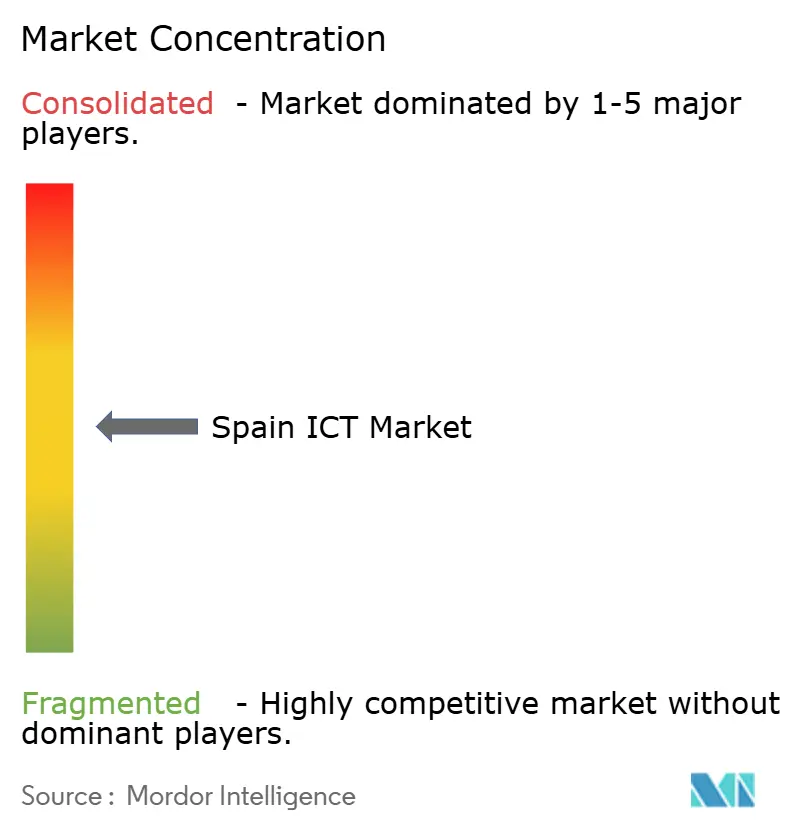
| Market Concentration | Medium |
Major Players *Disclaimer: Major Players sorted in no particular order Image © Mordor Intelligence. Reuse requires attribution under CC BY 4.0. | |
Spain ICT Market Analysis by Mordor Intelligence
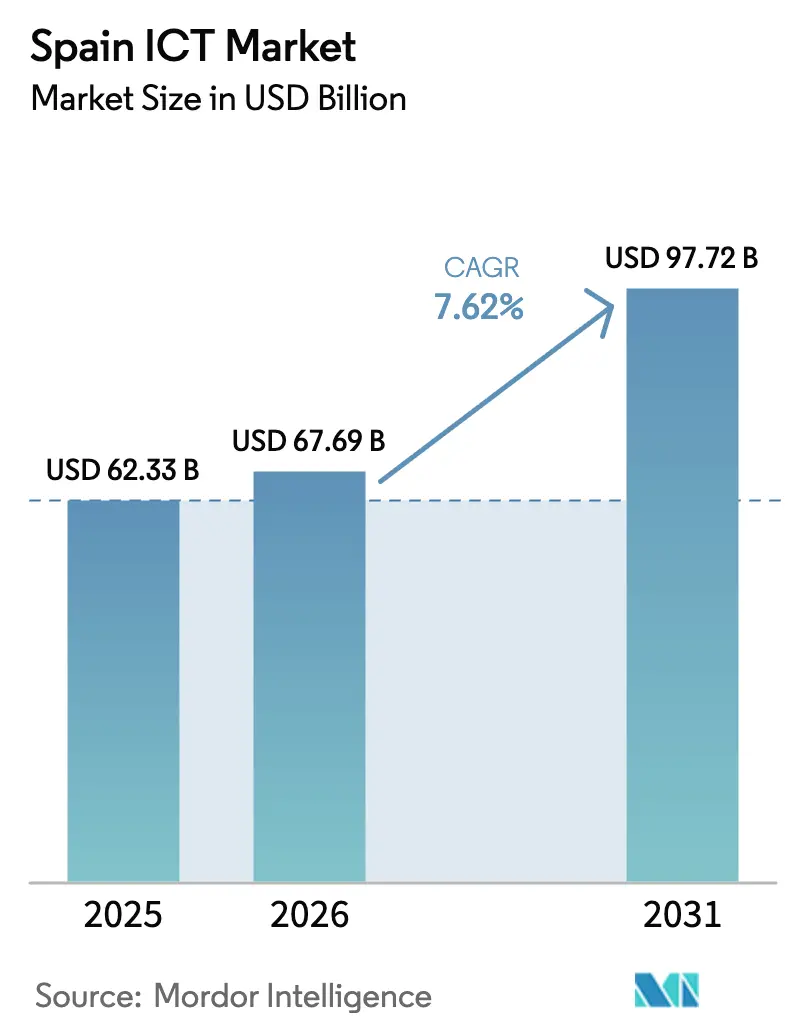
The Spain ICT Market size is expected to increase from USD 62.33 billion in 2025 to USD 67.69 billion in 2026 and reach USD 97.72 billion by 2031, growing at a CAGR of 7.62% over 2026-2031. Cloud build-outs in Aragon, a nationwide 5G footprint topping 90% population coverage, and EUR 40.4 billion (USD 47.94 billion) in stimulus funding have raised digital-infrastructure density and compressed deployment timelines, lifting technology spending among both public bodies and private firms. Hyperscalers alone earmarked more than EUR 22 billion (USD 26.10 billion) for new capacity through 2026, effectively anchoring the Spain ICT market to Europe’s third-largest cloud node after London and Frankfurt. Security budgets are expanding faster than headline outlays because ransomware strikes climbed 35% year on year in 2025, while the EU’s NIS2 directive imposes new compliance deadlines that push zero-trust architecture to the top of the executive agenda. Small and medium-sized enterprises, armed with Kit Digital vouchers that underwrite up to 80% of software costs, are accelerating cloud adoption even as large enterprises dominate absolute spending. Intensifying vendor consolidation, Telefónica trimmed its IT supplier roster from more than 20 firms to three lead integrators, signaling rising competitive barriers for mid-tier providers.
Key Report Takeaways
- By product type, IT services led with 38.23% revenue share in 2025, while IT security recorded the highest projected CAGR at 8.18% through 2031.
- By enterprise size, large enterprises accounted for 56.47% of 2025 spend, whereas SMEs are on track for the fastest growth at an 8.43% CAGR to 2031.
- By industry vertical, government and public administration captured 22.74% of 2025 revenue; manufacturing is set to post the strongest expansion at a 9.19% CAGR through 2031.
Note: Market size and forecast figures in this report are generated using Mordor Intelligence’s proprietary estimation framework, updated with the latest available data and insights as of 2026.
Spain ICT Market Trends and Insights
Drivers Impact Analysis*
| Driver | (~) % Impact on CAGR Forecast | Geographic Relevance | Impact Timeline |
|---|---|---|---|
| Government-funded Digital Agenda 2026 programs | +1.8% | National (Madrid, Catalonia) | Medium term (2-4 years) |
| EU-backed SME cloud-voucher scheme uptake | +1.2% | National (industrial regions) | Short term (≤2 years) |
| 5G and FTTH densification accelerates ICT upgrades | +1.5% | National (rural gaps) | Medium term (2-4 years) |
| Near-shoring of LATAM tech support to Spain | +0.8% | Madrid, Barcelona, Valencia | Long term (≥4 years) |
| Spanish-language AI/LLM tool-chain expansion | +1.1% | National, LATAM spill-over | Medium term (2-4 years) |
| Mandatory EU cyber-certification (EUCS) spend | +1.4% | National (critical sectors) | Short term (≤2 years) |
| Source: Mordor Intelligence | |||
Accelerated Cloud Adoption Among Spanish SMEs
More than 710,000 vouchers worth EUR 2.9 billion (USD 3.44 billion) lowered the payback period on SaaS investments from three years to under 18 months, lifting the SME cloud-utilization rate to 34% in late 2025. Software vendors now chase monthly recurring revenue, embedding GDPR modules that lock firms into multi-year contracts. Madrid and Catalonia captured nearly half of all vouchers, while rural Extremadura trailed because of limited broadband. As subsidies sunset in late 2026, churn metrics will reveal whether SMEs internalize cloud workflows or retreat to on-premise stacks. For the Spain ICT market, retention, not acquisition, will determine post-subsidy momentum.
EU-Funded Digitalization Surge Post-2026
Spain received the EU’s highest per-capita digital allocation, exceeding EUR 800 (USD 949.24) per inhabitant through 2025. The PERTE Chip initiative injects EUR 12.25 billion (USD 14.54 billion) into semiconductor R&D, while Spain Digital 2026 targets nationwide fiber coverage and online availability of all public services by end-2026. Systems integrators with framework agreements stand to book back-to-back projects as ministries race to hit EU milestones. Municipalities lacking project-management bandwidth risk missing funds, widening the urban-rural digital divide. From 2027 onward, grants morph into blended finance, favoring partners able to absorb balance-sheet risk, a dynamic that reshapes the Spain ICT market’s competitive landscape.
Rapid 5G Roll-Out Catalyzing Edge Demand
Telefónica’s standalone 5G network already touches 94% of Spain’s population, supported by 17 edge nodes co-located with radio sites.[1]Telefónica, “Integrated Annual Report 2024,” telefonica.com Vodafone and MasOrange pledged EUR 4 billion (USD 4.75 billion) to densify their networks, shifting real-time analytics from hyperscale centers to the edge. Automotive plants in the Barcelona-Zaragoza corridor run digital twins that demand sub-10-millisecond latency; edge gateways now process machine-vision feeds locally, slashing production downtime. EU security mandates require every critical-infrastructure edge node to pass ENISA audits, tilting advantage toward carriers with certified facilities. Edge adoption therefore expands the Spain ICT market while narrowing entry routes for independent startups.
Rising Cyber-Attack Sophistication Driving Security Spend
INCIBE now records over 45,000 daily alerts as ransomware and hacktivist campaigns intensify. A EUR 1.157 billion (USD 1.37 billion) national cybersecurity plan funds a centralized security operations center and compulsory penetration testing for essential-service operators. The insurance sector raises the bar by requiring ISO 27001 audits for cyber-liability coverage, embedding compliance as a cost of doing business. Spanish mid-sized providers struggle to deliver zero-trust frameworks, opening doors to global specialists. As regulatory pressure converges with threat escalation, security outlays grow faster than overall ICT budgets, reinforcing the Spain ICT market’s pivot toward managed security services.
Restraints Impact Analysis*
| Restraint | (~) % Impact on CAGR Forecast | Geographic Relevance | Impact Timeline |
|---|---|---|---|
| Persistent Shortage of Senior Cloud Architects | -0.9% | National, acute in Madrid and Barcelona tech hubs | Medium term (2-4 years) |
| High Electricity Prices Undermining Local Data-centre Economics | -0.7% | National, grid saturation concentrated in Madrid, Catalonia | Short term (≤ 2 years) |
| Legacy ERP Lock-in Across Public Administration | -0.5% | Central Government ministries, regional administrations | Long term (≥ 4 years) |
| Procurement Bureaucracy Slowing Large-Scale IT Projects | -0.6% | Public sector nationwide | Medium term (2-4 years) |
| Source: Mordor Intelligence | |||
Persistent Shortage of Senior Cloud Architects
Spain had up to 200,000 unfilled ICT roles in 2025, with senior cloud architects commanding 20-30% salary premiums. Only 9.2% of graduates emerge with STEM degrees, and women fill just 1.4% of ICT posts, dampening diversity and supply lines.[2]European Commission, “Digital Economy and Society Index (DESI) 2025,” ec.europa.eu Project queues lengthen 6-12 months, inflating migration costs by up to 25%. Although a government-backed Digital Talent program subsidizes bootcamps, the first cohort enters the labor market in late 2026, leaving a critical talent gap that slows the Spain ICT market’s velocity.
High Electricity Prices and Grid Saturation
Wholesale power averaged EUR 0.09 per kWh in 2025, but 83% of grid interconnection points reached capacity, forcing data-center projects into 18-24-month queues. Hyperscalers offset volatility through long-term renewable contracts. AWS lined up 100% green power for Aragon, yet smaller colocation firms lack balance-sheet heft to do the same. Intermittent wind and solar output trigger price spikes that erode Spain’s cost advantage. As grid bottlenecks persist, developers explore on-site solar and batteries, raising capital needs and tempering near-term capacity growth within the Spain ICT market.
*Our forecasts treat driver/restraint impacts as directional, not additive. The impact forecasts reflect baseline growth, mix effects, and variable interactions.
Segment Analysis
By Product Type: Services Lead, Security Surges
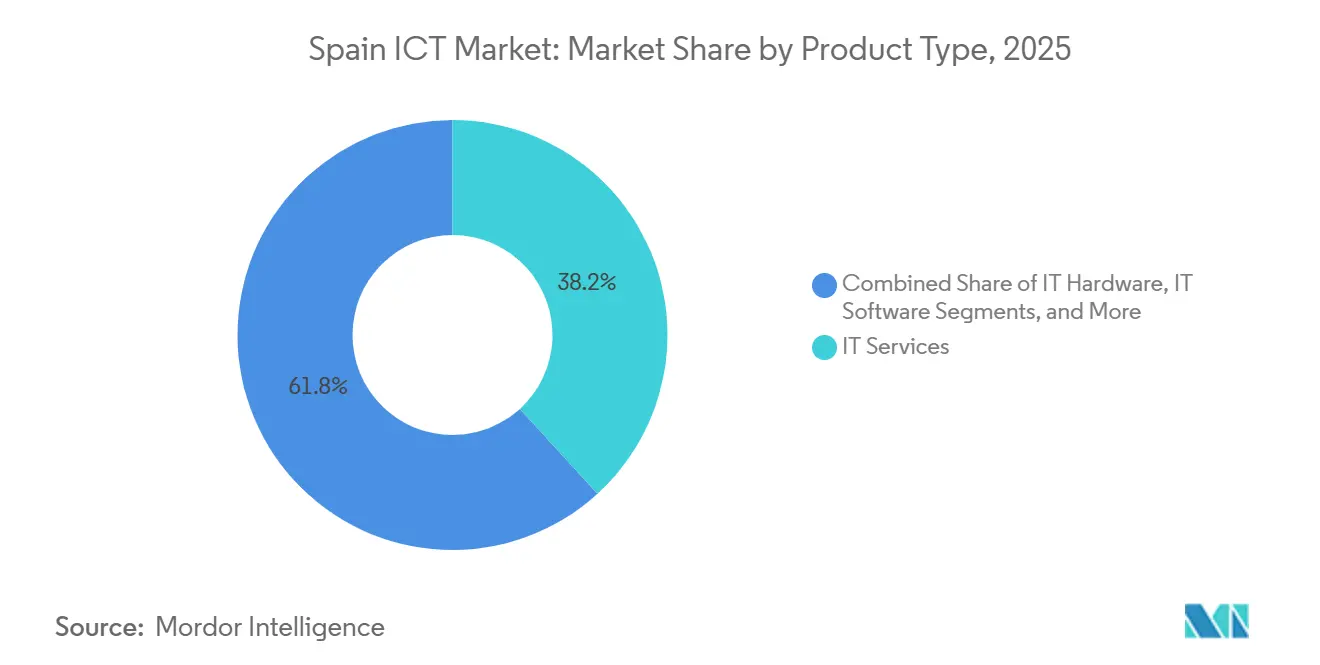
IT services contributed 38.23% of 2025 revenue, giving the segment the largest Spain ICT market share across product lines. Managed services, application modernization, and integration workstreams drive this dominance as enterprises transition to hybrid architectures. Meanwhile, IT security revenue is set to grow at an 8.18% CAGR to 2031, the fastest among all categories, driven by ransomware escalation and NIS2 compliance deadlines. Hardware faces margin compression as clients prolong refresh cycles, though network equipment enjoys a bump from 5G rollouts.
Spending patterns demonstrate overlap: cloud vendors now embed automated patching, while managed security providers supply compliance dashboards, blurring classic product boundaries. Hyperscale data-center builds in Aragon illustrate this convergence, pairing infrastructure investment with high-margin professional services. These shifts reinforce the Spain ICT market size at the intersection of services and security, redirecting vendor innovation toward outcome-based pricing.



By Enterprise Size: SMEs Accelerate, Large Enterprises Anchor
Large enterprises captured 56.47% of 2025 revenue, cementing their role as financial anchors for the Spain ICT market. Their spending flows toward multiyear ERP estates, colocation contracts, and sophisticated systems-integration engagements. In contrast, SMEs show the fastest growth, with an 8.43% CAGR projected to 2031, abetted by the Kit Digital program’s subsidy, which cut the payback on SaaS from 3 years to 18 months.
While SMEs embrace cloud velocity, their seat-based spend remains lower, compelling vendors to favor usage-based or freemium models. The compliance load associated with GDPR and the Cyber Resilience Act nudges SMEs toward bundled “compliance-as-a-service” offerings. Consequently, the Spain ICT market size for SME solutions will scale through volume rather than deal value, reshaping partner strategies and customer-success metrics.
By Industry Vertical: Government Anchors, Manufacturing Accelerates
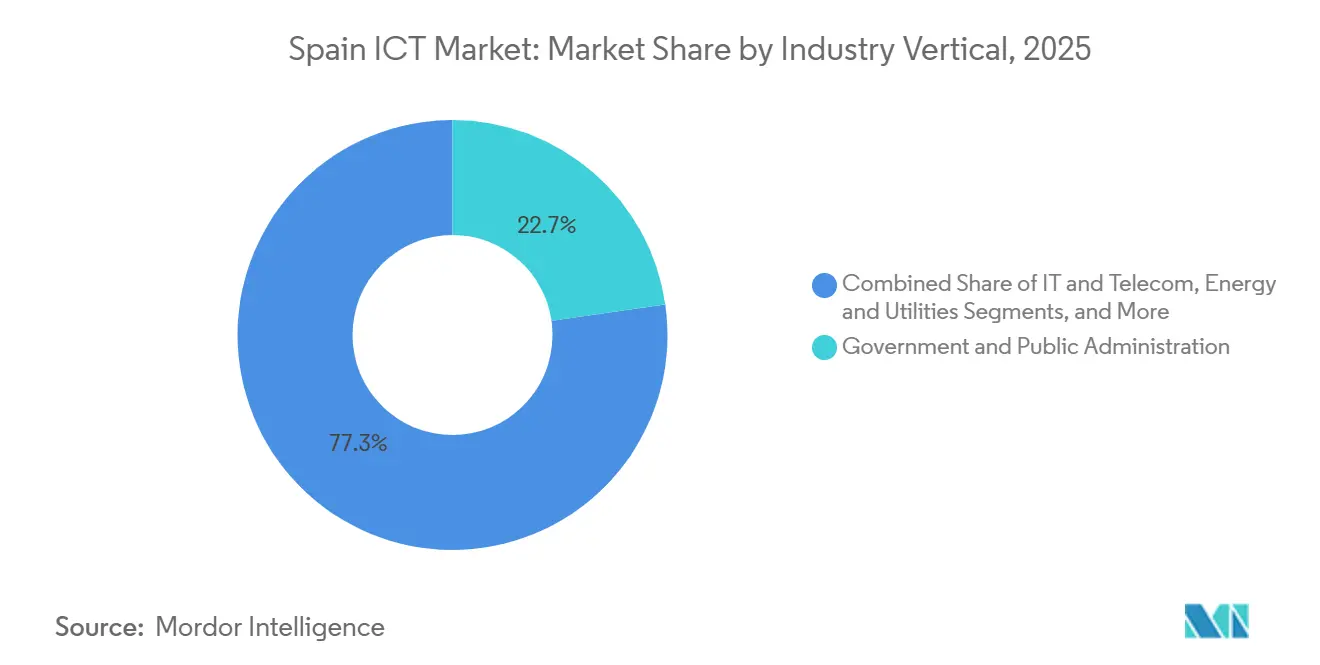
Government and public administration accounted for 22.74% of 2025 spend, marking the largest share of the Spain ICT market by vertical. Activity centers on ERP modernization and electronic health record rollouts under Spain Digital 2026. Manufacturing, particularly automotive, is projected to clock a 9.19% CAGR through 2031, the fastest among all verticals, as plants deploy digital twins and Catena-X protocols for end-to-end supply-chain visibility.[3]seat.com
BFSI modernizes core platforms to meet real-time payment mandates, while energy utilities apply AI to optimize renewable assets. Each use case relies on secure, low-latency connectivity to link vertical demand to the broader Spain ICT market size trajectory. Vendors with deep regulatory fluency and OT-IT integration skills will capture disproportionate growth in these domains.
Geography Analysis
Central Spain, anchored by Madrid, delivered the highest regional contribution in 2025, benefiting from headquarters density, three hyperscaler availability zones, and a EUR 1.2 billion (USD 1.42 billion) regional innovation fund. Economies of scale allow consulting giants to base client teams locally, but this clustering inflates rents and heightens the talent crunch, nudging back-office roles to secondary cities like Valladolid.
Eastern Spain Catalonia and Valencia ranks second in regional spending thanks to Barcelona’s startup magnetism and port-logistics digitalization. Barcelona alone secured EUR 1.8 billion (USD 2.13 billion) in VC inflows during 2024, underpinning mobility and health-tech ventures. SEAT’s Martorell plant showcases how edge gateways perform on-site analytics to orchestrate 16 million daily component moves at sub-10-millisecond latency, a proof point for industrial demand propelling the Spain ICT market.
Northern territories Basque Country, Navarre, Asturias specialize in industrial IoT and renewable analytics, with Iberdrola and Siemens Gamesa co-locating R&D labs in Bilbao. Southern regions lag owing to lower GDP per capita and patchy fiber penetration, yet Málaga Tech Park’s 600-plus companies illustrate the pull of nearshore delivery for Northern European clients. Islands such as the Balearics mandate electronic invoicing for hotels, sparking SaaS uptake that narrows the digital gap. Geography thus shapes go-to-market tactics within the Spain ICT market, tilting resource allocation toward high-density corridors while EU cohesion funds chase inclusion.
Regulatory Landscape
Spain’s ICT market operates under Ley 11/2022, General de Telecomunicaciones, which sets requirements for operator authorizations, spectrum-related obligations, and end-user safeguards, alongside EU rules that shape service delivery. The Ministry of Economic Affairs and Digital Transformation supervises open Internet and net-neutrality compliance under Regulation (EU) 2015/2120, influencing how telecom operators manage traffic and retail offers.
Cybersecurity and digital-sovereignty requirements are also tightening for networks and cloud-dependent services. Royal Decree-Law 7/2022 (5G cybersecurity) sets security requirements for 5G networks and services, while España Digital 2026 provides the national policy umbrella, tracked by ONTSI, and links public funding to milestones such as digital public services and secure infrastructure. Within this framework, Spain has also set up the Agencia Espanola de Supervision de Inteligencia Artificial, which adds governance capacity for AI deployment in regulated and public-sector use cases.
Value Chain Analysis
Spain’s ICT value chain starts with infrastructure and connectivity providers, including fiber, 5G, data centers, and critical communications networks, which underpin cloud and digital-service delivery. Hyperscalers, enterprise software vendors, and cybersecurity suppliers then provide platforms and tools, and systems integrators and IT services firms (consulting, modernization, outsourcing, and managed security services) package these components into end-to-end programs for large buyers, especially government and regulated industries.
Demand is pulled by two dominant buyer groups: public administration, which ties large framework procurements to España Digital 2026 and EU recovery-linked programs, and large enterprises running multi-year transformation and rationalizing sourcing. SMEs are increasingly adopting SaaS through subsidy mechanisms. Sector specialists such as Indra (via Minsait) deliver vertically oriented digital and mission-critical capabilities across defense, air traffic management, mobility, and IT, while Telefónica spans connectivity, cloud, cybersecurity, IoT, and AI as an integrated operator-led supplier. Public programs such as PADIH and the SME Digitalization Plan help reduce adoption friction and expand partner participation across regions.
Competitive Landscape
The top ten suppliers controlled an estimated major share of 2025 revenue, signaling moderate concentration across the Spain ICT market. Accenture, Capgemini, IBM, and NTT DATA dominate large-scale transformation engagements, leveraging offshore hubs while maintaining Spanish-speaking client teams. Telefónica’s supplier rationalization to Capgemini, Inetum, and Minsait strengthens integration around 5G core and AI-driven automation, raising switching costs for mid-tier rivals.
Indra Sistemas’ EUR 725 million (USD 859.59 million) acquisition of Hispasat consolidates space communications and aims to reach EUR 1 billion (USD 1.19 billion) in defense revenue by 2030. Hyperscalers court local ISVs by extending marketplace revenue-sharing terms, and AWS recruited 120 Spanish partners to build vertical apps in its Aragon region. Niche cybersecurity firms differentiate through bundled ISO 27001 audits and managed SOCs, a proposition resonating with SMEs.
Outcome-based pricing gains traction: providers now peg fees to transaction volumes or uptime SLAs, embedding AI for predictive maintenance and anomaly detection. White-space opportunities persist in edge orchestration for latency-sensitive workloads, but success hinges on carrier partnerships that furnish last-mile connectivity. Competition therefore revolves around platform alliances and regulatory fluency, not merely rate cards.
Spain ICT Industry Leaders
Telefonica S.A.
Indra Sistemas S.A.
Amadeus IT Group S.A.
IBM Corporation
Accenture plc
- *Disclaimer: Major Players sorted in no particular order

Market Opportunities and Future Outlook
Compliance-led cybersecurity and sovereign-cloud architectures create a whitespace for vendors that can package governance, identity, monitoring, and auditability into services that can be deployed in regulated environments. Royal Decree-Law 7/2022 (5G cybersecurity) and the open-Internet obligations overseen by the Ministry of Economic Affairs and Digital Transformation increase the operational burden on telecom and critical-infrastructure environments. At the same time, Spain’s national cybersecurity initiatives and rising alert volumes at INCIBE are pushing buyers toward managed security services and standardized assurance. Telefónica’s May 2026 sovereign cloud partnership with Google Cloud, along with its DataSphere data-spaces platform launch, signals that data-boundary controls, trusted collaboration, and regulated workload hosting are being productized for Spanish organizations.
Public digitalization programs and sector platforms also expand opportunity in integration-heavy work, particularly for providers with framework access and vertical software depth. España Digital 2026 and recovery-linked funding (over EUR 40 billion earmarked for digital transformation in the Recovery, Transformation and Resilience Plan) continue to translate into modernization backlogs across public services and national infrastructure. Initiatives such as UNICO Advanced 5G and 6G R&D and the Spanish Natural Language Processing environment further open room for applied AI, language tooling, and edge-enabled use cases in Spanish. In travel tech, the May 2026 collaboration between Amadeus and Accenture on the Amadeus Travel Advertising Platform highlights an active shift toward data-driven monetization layers on existing platforms, which supports incremental demand for cloud migration, data engineering, and privacy-by-design implementations.
Recent Industry Developments
- July 2026: Telefónica S.A. awarded a contract alongside Amper to modernize DMR and TETRA radio communication networks at ten Aena airports over 36 months. The project updates critical aviation communications infrastructure. It strengthens national airport resilience and public sector telecom integration.
- May 2026: Telefónica S.A. launched the Telefónica DataSphere platform and a demonstration center in Barcelona. The data sovereignty and multi-sector data spaces platform enables secure data collaboration. It establishes a framework for cross-sector data sharing in Spain.
- May 2026: Telefónica S.A. and Google Cloud announced a partnership to deliver sovereign cloud solutions for Spanish organizations using Google Cloud Data Boundary services. The collaboration expands Spain's sovereign cloud capabilities with a major hyperscale partner. It enhances public and private sector cloud options in the country.


Research Methodology Framework and Report Scope
Market Definition and Coverage
For this report, the Spain ICT market is defined as the value of spending by businesses and public sector entities on ICT products and services delivered in Spain, including hardware, software, and related IT services that support digital operations.
Scope exclusions: We exclude consumer electronics retail sales that are not purchased for ICT use cases, and we also exclude ICT activity generated outside Spain even if suppliers are headquartered locally.
Segmentation Overview
- By Product Type
- IT Hardware
- Computer Hardware
- Networking Equipment
- Peripherals
- IT Software
- IT Services
- IT Consulting and Implementation
- IT Outsourcing (ITO)
- Business Process Outsourcing (BPO)
- Managed Security Services
- Cloud and Platform Services
- IT Infrastructure
- IT Security/Cybersecurity
- Communication Services
- IT Hardware
- By Enterprise Size
- Small and Medium-sized Enterprises
- Large Enterprises
- By Industry Vertical
- Government and Public Administration
- BFSI
- IT and Telecom
- Energy and Utilities
- Retail, E-commerce, and Logistics
- Manufacturing and Industry 4.0
- Healthcare and Life Sciences
- Oil and Gas
- Other Industry Verticals
Data Sources, Market Sizing, and Validation
Desk Research
Desk research was used to set the market boundary, build the historical context, and collect reference series that can be checked year over year. Common public sources for Spain ICT include the Spanish National Statistics Institute (INE) for ICT sector business metrics, the National Commission on Markets and Competition (CNMC) for telecom and connectivity indicators, and Eurostat for harmonized digital economy and enterprise adoption series.
We also referenced Spain's Ministry of Digital Transformation and Civil Service for policy programs and coverage updates, OECD digital economy datasets for cross-country comparability, and the European Commission digital scoreboards for broadband and adoption signals. In addition, we reviewed company annual reports, investor presentations, and reputed press to track investment cycles, service mix shifts, and pricing direction. Where needed, paid subscriptions for company financials and intelligence, patent databases, and an import and export shipment-level database were used to fill gaps in supplier presence and hardware movement. These desk sources are illustrative only, and we used other references to collect, validate, and clarify data points before finalizing the model.
Primary Interviews and Surveys
Primary work was used to pressure-test assumptions that are hard to observe in public data, especially for mix shifts between hardware, software, and services and for the pace of contract renewals. We spoke with a spread of ICT suppliers, channel partners, enterprise buyers, and domain specialists across Spain, and we covered demand pockets across large enterprises and SMEs so the final sizing is not driven by one customer type.
Distribution of primary research fieldwork respondents
| Company type | Respondent position |
|---|---|
| Top tier: 39% | CXOs: 13% |
| Mid tier: 45% | Functional/Unit leaders: 39% |
| Smaller Players: 16% | Managers: 48% |
Market-Sizing & Forecasting
Market sizing starts from a top-down reconstruction of Spain ICT demand by linking national ICT business activity indicators with category splits and end-user spending patterns, and then converting the totals into a value view in USD. We corroborate the output with selective bottom-up approximations, including sampled supplier revenue exposures to Spain, channel checks on deal momentum, and a price per unit times shipment logic for hardware where it is practical.
Key inputs used in the model include ICT services intensity by enterprise size, cloud and managed services adoption direction shared by interviewees, telecom and broadband investment signals that pull related ICT spend, the share of public sector digital programs that turns into executed contracts, and inflation and currency timing assumptions for USD conversion. Forecasting relies on multivariate regression supported by scenario checks, where demand drivers such as enterprise digitalization rates and connectivity investment are combined with cycle indicators including refresh periods and budget sentiment from primary discussions. When bottom-up visibility is uneven for smaller categories, we fill gaps using ratio-based benchmarks anchored to observed spend shares, then re-check the outcome with expert feedback.
Data Validation & Update Cycle
Validation is done through multiple checks so the final value does not depend on one dataset or one interview. Our analysts compare model outputs against independent signals, such as national ICT turnover series, telecom investment indicators, and the direction of enterprise IT budget plans captured in interviews, then investigate any unusual jumps before sign-off.
A second review pass confirms that assumptions, conversions, and category boundaries are applied consistently across the time series. Reports are refreshed annually, and interim updates are triggered when material events occur, such as major regulatory shifts, sharp currency moves, or large changes in public funding cycles. Before delivery, the model is re-opened for a final update pass so clients receive the latest view available at the time of purchase.
Mordor Intelligence's Spain Ict Market Size Compared Against Other Published Estimates
Published market values for Spain ICT often differ because the market boundary is not identical across sources, and because some estimates lean more on turnover reporting while others focus on end-user spending. Differences also show up when currency conversion timing, inflation handling, and the mix between telecom related spend and IT spend are treated differently.
CNMC connectivity indicators and INE business activity series are used as external checks that keep Mordor Intelligence's estimate aligned to an executed-demand view in Spain, rather than a broader digital economy revenue pool. The remaining gaps usually come from scope choices, such as whether telecom services, consumer-facing digital content, or adjacent electronics are blended into ICT, and from how fast ASPs are assumed to change in multi-year forecasts. Update cadence also matters because major public programs and large enterprise contract cycles can shift within a short window, which older models may not capture cleanly.
Benchmark comparison
| Source | Market Size | Gaps in Research Methodology |
|---|---|---|
| Mordor Intelligence | USD 62.33 B (2025) | |
| Independent Data Publisher A | USD 53.37 B (2025) | A narrower scope is implied, with hardware, software, and IT services emphasized and telecom services treated as a separate add-on, which compresses the final value for the same year. |
| Industry Association B | USD 79.66 B (2024) | This figure reflects IT systems revenue reporting for 2024 and can sit closer to industry turnover, which may not map one-to-one to ICT end-user spending, and it also uses a different year and currency basis. |
The table shows that the spread is largely explained by what gets counted inside ICT, plus whether the estimate is built from spending logic or reported turnover. By keeping the boundary consistent, converting currency with clear timing, and re-checking totals against observable Spain signals, the final number stays traceable to inputs that can be repeated and reviewed.


Key Questions Answered in the Report
How fast is ICT spending increasing in Spain?
Overall outlays are projected to climb at a 7.62% CAGR between 2026 and 2031, moving the total from USD 67.69 billion to USD 97.72 billion.
Which product category is growing the quickest?
IT security tops the growth table with an 8.18% CAGR through 2031 as firms respond to sharper cyber threats and stricter EU regulations.
Why are SMEs important for Spanish tech vendors?
SMEs are forecast to expand spend at an 8.43% CAGR thanks to Kit Digital subsidies, making them the fastest-growing customer segment even though individual deal sizes remain small.
What geographic area hosts the most data-center investment?
The Aragon region leads new capacity builds, buoyed by EUR 22 billion in hyperscaler commitments that turn the corridor into Europe’s third-largest cloud hub.
Which vertical will post the strongest ICT growth?
Manufacturing, especially automotive plants deploying digital twins, is projected to advance at a 9.19% CAGR through 2031, outpacing all other industry segments.
Page last updated on:


 Your data is secure and never sold or shared.


