
Market Overview
| Study Period | 2020 - 2031 |
|---|---|
| Forecast Data Period | 2026 - 2031 |
| Base Year Market Size (2025) | USD 233.72 Million |
| Market Size (2026) | USD 263.54 Million |
| Market Size (2031) | USD 480.63 Million |
| Growth Rate (2026 - 2031) | 12.76 % |
| Market Concentration | Medium |
Major Players *Disclaimer: Major Players sorted in no particular order Image © Mordor Intelligence. Reuse requires attribution under CC BY 4.0. | |
Spain Aesthetic Devices Market Analysis by Mordor Intelligence
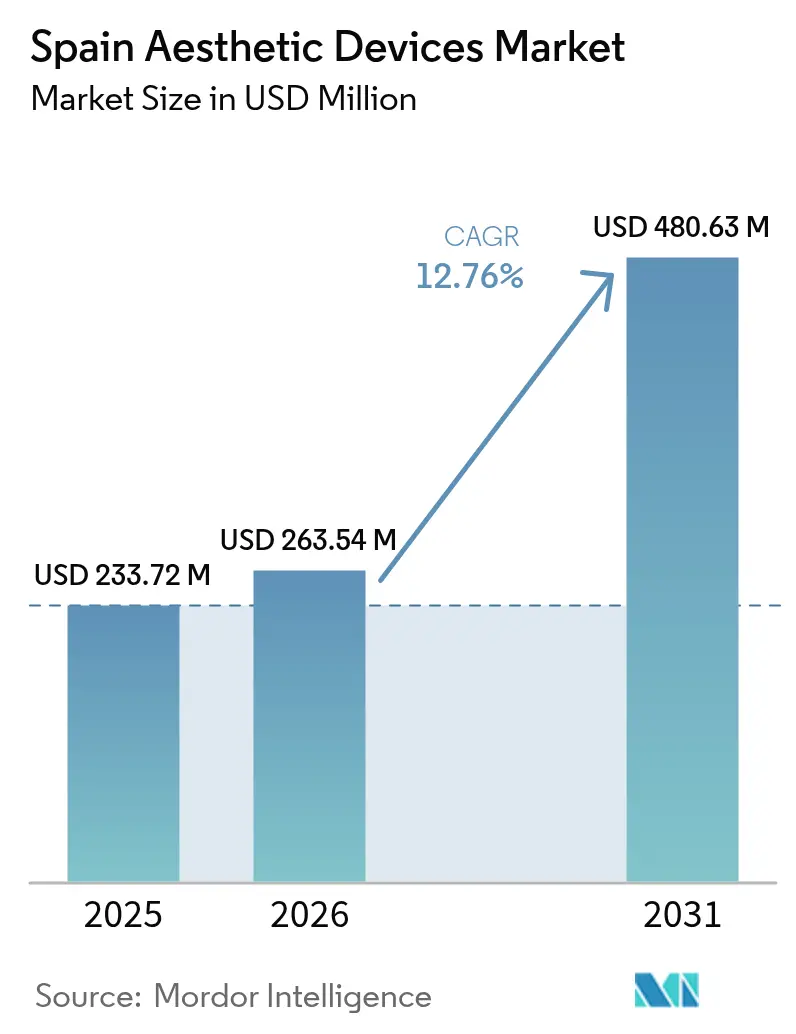
The Spain Aesthetic Devices Market size was valued at USD 233.72 million in 2025 and estimated to grow from USD 263.54 million in 2026 to reach USD 480.63 million by 2031, at a CAGR of 12.76% during the forecast period (2026-2031).
Persistent demand for sophisticated, minimally invasive procedures anchors this trajectory, helped by 400,000 cosmetic interventions performed in the country every year. Recent regulatory tightening that limits invasive surgeries to board-certified plastic surgeons is concentrating procedure volumes in high-quality facilities, encouraging clinics to acquire compliant, premium equipment. Parallel advances in energy-based platforms, artificial intelligence–guided imaging, and home-use technologies are broadening the user base while improving treatment outcomes, reinforcing the long-term growth outlook for the Spain aesthetic devices market.
Key Report Takeaways
- By device type, energy-based platforms led with 59.02% of Spain aesthetic devices market share in 2025, and ultrasound-based systems are poised for the fastest expansion at a 15.62% CAGR through 2031.
- By application, skin resurfacing and tightening accounted for 32.55% of the Spain aesthetic devices market size in 2025, whereas body contouring and cellulite reduction is projected to grow quickest at a 14.28% CAGR to 2031.
- By end user, dermatology and cosmetic clinics captured 43.10% revenue share of the Spain aesthetic devices market in 2025, while home-use settings are set to record the highest 13.22% CAGR during the forecast horizon.
Note: Market size and forecast figures in this report are generated using Mordor Intelligence’s proprietary estimation framework, updated with the latest available data and insights as of 2026.
Spain Aesthetic Devices Market Trends and Insights
Drivers Impact Analysis*
| Driver | (~) % Impact on CAGR Forecast | Geographic Relevance | Impact Timeline |
|---|---|---|---|
| Aging Population & Youthful Appearance Demand | 3.2% | National, concentrated in Madrid, Barcelona, Valencia | Long term (≥ 4 years) |
| Rising Medical Tourism in Cosmetic Procedures | 2.8% | National, with coastal regions leading | Medium term (2-4 years) |
| Growing Popularity of Minimally-Invasive Treatments | 2.1% | National, urban centers primarily | Short term (≤ 2 years) |
| Technological Advancements in Aesthetic Devices | 1.7% | National, early adoption in major cities | Medium term (2-4 years) |
| Cultural Emphasis on Beauty & Wellness | 1.9% | National, stronger in metropolitan areas | Long term (≥ 4 years) |
| Expanding Private Aesthetic Clinics in Urban Centers | 1.3% | Urban centers, Madrid and Barcelona leading | Short term (≤ 2 years) |
| Source: Mordor Intelligence | |||
Aging Population & Youthful-Appearance Demand
Spain’s median age continues to inch upward, yet cosmetic consciousness is rising in parallel, pushing the 45-65 cohort toward non-surgical tightening and resurfacing options. Energy-based modalities that stimulate collagen, such as micro-focused ultrasound with visualization, fit this preference by delivering visible yet discreet results. Uptake is further reinforced by 3D skin-mapping systems that provide precise pre-treatment assessments, a feature embraced by quality-oriented consumers in Madrid and Barcelona.[1]Frontiers Editorial Team, “Three-Dimensional Imaging for Dermatologic Assessment,” frontiersin.org Hospitals and large clinic groups continue to market these procedures as preventive rather than corrective, lengthening patient lifecycles. As demographic momentum endures, so does the baseline demand floor for the Spain aesthetic devices market.
Rising Medical Tourism in Cosmetic Procedures
Spain’s accession to the EU cross-border healthcare directive through Real Decreto 81/2014 smooths reimbursement for intra-EU patients, making the country a logical destination for elective aesthetics.[2]Ministerio de Sanidad, “Real Decreto 81/2014 sobre Asistencia Sanitaria Transfronteriza,” sanidad.gob.es The September 2024 rule that confines cosmetic surgery to board-certified plastic surgeons has paradoxically improved the nation’s brand by signaling strict safety oversight. Clinics in Valencia and Málaga now bundle accommodation with HIFU-based body-contouring packages, leveraging coastal appeal to foreign visitors. High patient satisfaction ratings feed digital word-of-mouth, reinforcing a virtuous inflow cycle that elevates procedure volumes and equipment replacement needs across the Spain aesthetic devices market.
Growing Popularity of Minimally Invasive Treatments
Demand for reduced downtime is steering consumers toward injectables, fractional lasers, and temperature-controlled radiofrequency systems. The Spanish Agency for Medicines and Health Products classifies fillers under EU MDR 2017/745, boosting confidence in product safety. New ready-to-use liquid neuromodulator formulations such as Galderma’s Relfydess show perceptible effects one day after administration, resonating with time-pressed patients. Clinics are responding by training staff in combination protocols that merge energy-based skin-tightening with injectables, enhancing both ticket size and clinical outcomes.
Technological Advances in Aesthetic Devices
Artificial-intelligence algorithms embedded in the latest multi-modal systems tailor energy delivery to each patient’s skin impedance profile, elevating safety and efficacy.[3]MDPI Editors, “AI-Enhanced Personalized Aesthetic Protocols,” mdpi.com Innovators are commercializing 1726 nm lasers able to clear moderate acne across all phototypes while avoiding significant epidermal damage. Ultra-high-frequency ultrasound scanners are extending into diagnostic mapping, enabling real-time visualization of treatment impact. Regenerative aesthetics, including acoustic-wave therapies that activate endogenous stem cells, signal a future where biological stimulation complements mechanical correction. As clinics refresh equipment to stay competitive, technology diffusion sustains double-digit expansion in the Spain aesthetic devices market.
Restraints Impact Analysis*
| Restraint | (~) % Impact on CAGR Forecast | Geographic Relevance | Impact Timeline |
|---|---|---|---|
| Limited Insurance Coverage for Cosmetic Procedures | -2.4% | National, affecting all regions equally | Long term (≥ 4 years) |
| Shortage of Certified Aesthetic Professionals in Rural Areas | -1.8% | Rural regions, northern and central Spain | Medium term (2-4 years) |
| Stringent EU Regulatory Oversight on Devices & Fillers | -1.2% | National, with stronger impact on smaller manufacturers | Short term (≤ 2 years) |
| Economic Sensitivity of Elective Procedures | -0.9% | National, with higher impact in lower-income regions | Medium term (2-4 years) |
| Source: Mordor Intelligence | |||
Limited Insurance Coverage for Cosmetic Procedures
Public insurance excludes elective aesthetics, obliging patients to self-fund expensive treatments. Average out-of-court settlements for cosmetic-related claims exceed EUR 33,000, illustrating the financial stakes involved. Because device amortization costs are rolled into procedure pricing, clinics must keep utilization high to remain profitable, raising affordability barriers for middle-income groups. The legal framework under Ley 29/2006 mandates rigorous proof of safety and efficacy, driving up manufacturer compliance costs that, again, echo down to consumers. Although consumer-grade light-therapy masks and handheld RF tools are proliferating, professional equipment remains inaccessible to many Spaniards outside major cities.
Shortage of Certified Aesthetic Professionals in Rural Areas
Concentration of plastic surgeons and dermatologists in Madrid, Barcelona, and coastal tourism belts leaves much of rural Spain underserved. The 2024 regulation that permits only board-certified specialists to perform invasive aesthetic surgery tightens supply still further. Smaller towns often lack the volumes needed to justify the capital expenditure on Class IIb or III devices, delaying technology penetration. The EU Medical Device Quality Management System requirement effective in 2024 adds training and documentation burdens, widening the urban-rural gap. Over time, tele-aesthetics consults and more automated equipment may mitigate access disparities, yet short-term growth outside metropolitan zones stays constrained.
*Our forecasts treat driver/restraint impacts as directional, not additive. The impact forecasts reflect baseline growth, mix effects, and variable interactions.
Segment Analysis
By Device Type: Energy-Based Systems Sustain Dominance
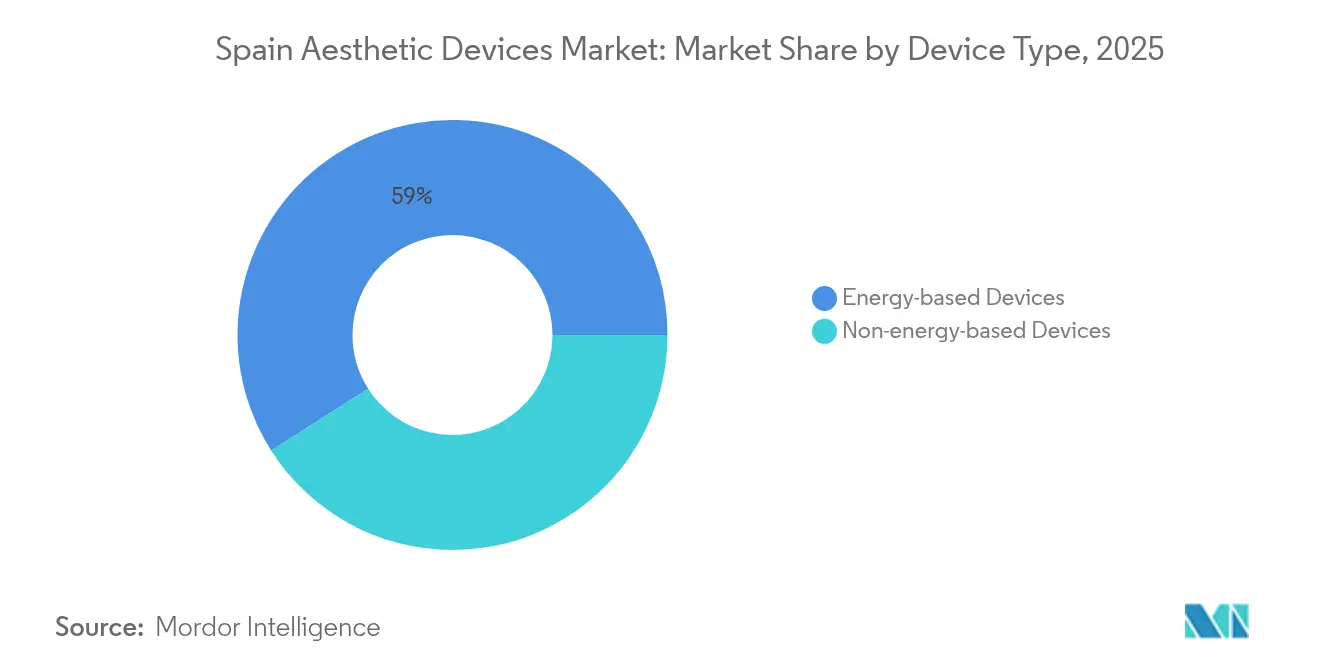
Energy-based equipment accounted for 59.02% of Spain aesthetic devices market share in 2025 as lasers, radiofrequency, and ultrasound platforms proved versatile across multiple indications. Ultrasound-based systems are forecast to log a 15.62% CAGR through 2031, propelled by high-intensity focused ultrasound procedures that now extend to scalp rejuvenation protocols validated for androgenetic alopecia treatment.
Laser manufacturers are commercializing 1726 nm devices with real-time thermal imaging that achieve durable acne clearance without pigmentary complications. Temperature-controlled RF microneedling platforms record 86.7% patient satisfaction in clinical trials, keeping radiofrequency relevant even as lasers evolve. Non-energy alternatives such as fillers maintain share through improved rheology and tighter AEMPS oversight, while chemical peels enjoy a niche revival as cost-effective adjuncts. Microneedle rollers now fall under Class IIa rules, prompting clinics to adopt safer cartridge-based systems. Collectively, these trends ensure that the Spain aesthetic devices market continues to favor energy platforms while leaving space for targeted innovation in adjunct categories.



By Application: Body Contouring Accelerates
Skin resurfacing and tightening held 32.55% of Spain aesthetic devices market size in 2025 with micro-focused ultrasound systems that visualize collagen bands during treatment gaining traction. Body contouring and cellulite reduction, however, is the most dynamic niche, projected at a 14.28% CAGR, powered by cryolipolysis, multipolar RF, and AI-guided treatment mapping that reduces operator variability.
Laser hair removal remains resilient as diode heads achieve faster repetition rates, while tattoo-removal devices deploy dual-wavelength Q-switching to minimize ghosting. Acne and scar management benefit from 1726 nm laser breakthroughs that blend photothermal clearance with sebaceous-gland moderation. Emerging regenerative aesthetics, including platelet-rich plasma combined with low-energy acoustic waves, are blurring therapeutic lines and could spawn new application sub-segments by 2030. This broadening palette sustains multi-device procurement cycles, reinforcing revenue momentum in the Spain aesthetic devices market.
By End User: Home-Use Platforms Gain Ground
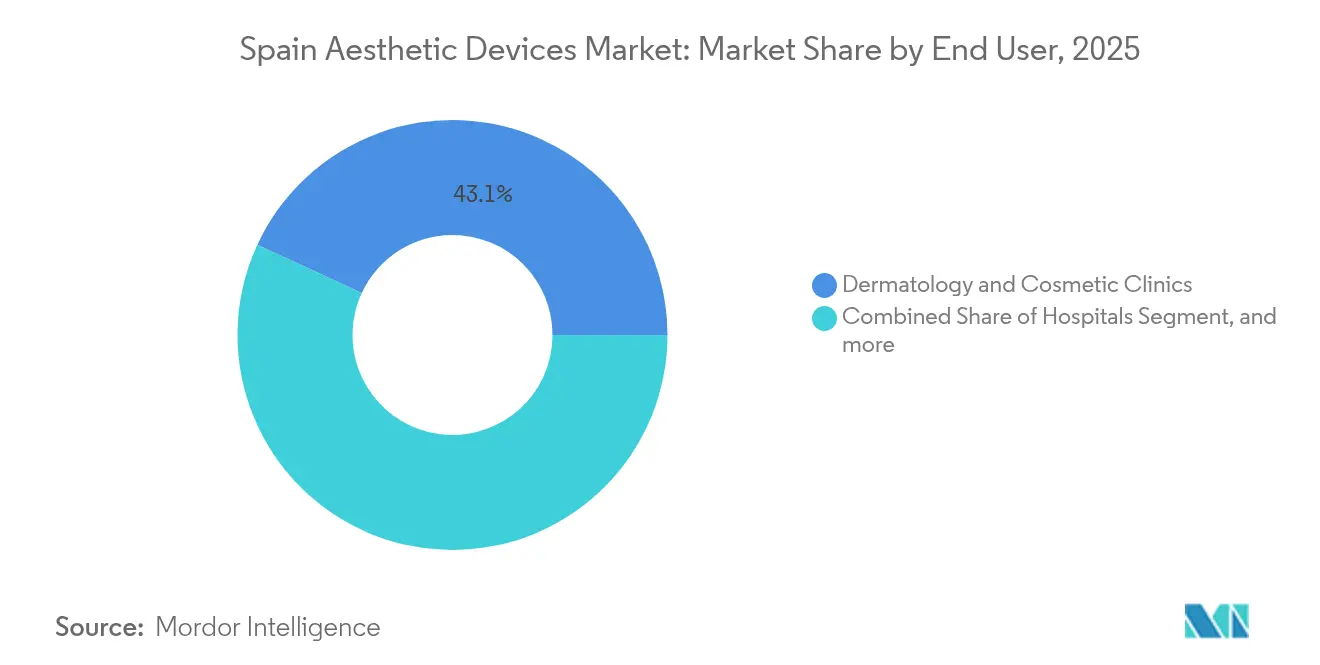
Dermatology and cosmetic clinics retained 43.10% revenue share of the Spain aesthetic devices market in 2025, still the primary channel for energy-intensive equipment. Hospitals are retreating from routine aesthetics to concentrate on reconstructive and high-complexity interventions, redirecting capital budgets toward robotics and hybrid operating rooms.
Home-use devices are the fastest-advancing outlet, set for a 13.22% CAGR through 2031 as miniaturization and automated safety cutoffs make consumer operation feasible. Skinvity’s revenue leap of 70% in 2024 to EUR 3 (USD 3.4) million illustrates domestic appetite for FDA-cleared light-therapy masks and RF pens. Peer-reviewed studies on home-phototherapy lamps for acne corroborate efficacy when protocols are followed, nurturing confidence in DIY regimens. Medical spas occupy a middle ground, marketing physician-overseen facial filler packages bundled with low-energy LED sessions to widen client funnels. As device ecosystems extend from clinics to living rooms, manufacturers that engineer modular product families stand to win share in the Spain aesthetic devices market.
Geography Analysis
Spain leverages its EU membership and robust hospitality infrastructure to attract patients from France, Italy, and the United Kingdom, amplifying procedure volumes in Barcelona, Madrid, and Valencia. Integration within Real Decreto 81/2014 removes administrative friction for visiting EU citizens, streamlining reimbursement and reinforcing Spain’s allure as a cosmetic hub. Coastal provinces combine leisure tourism with non-surgical body-contouring packages, while interior regions rely largely on domestic demand fueled by rising disposable incomes.
AEMPS enforces EU Medical Device Regulation 2017/745, mandating CE marking for fillers and implants, which consolidates the vendor base and channels purchases toward compliant distributors. The September 2024 statute confining invasive cosmetic surgery to plastic-surgery specialists further elevates procedural credibility, but also exacerbates specialist scarcity in Castilla-La Mancha and Extremadura. Tele-consultation portals now let urban surgeons pre-screen candidates from rural areas, yet physical treatment capacity remains uneven.
Spain’s contribution of EUR 10.4 (USD 12.0) billion to Europe’s EUR 96 (USD 111.0) billion cosmetics economy underscores national consumer zeal for beauty products, which extends naturally to device-based services. Venture funding gravitates to Barcelona’s health-tech cluster, supporting AI-driven skin-diagnostic startups that collaborate with local clinics on pilot deployments. Despite persisting regional disparities, the Spain aesthetic devices market benefits from coordinated national regulation, EU-level patient mobility, and a cultural affinity for personal appearance that spans age cohorts.
Regulatory Landscape
Spain regulates aesthetic devices primarily through the EU Medical Device Regulation (EU) 2017/745, with national implementation and market-control procedures set out in Real Decreto 192/2023. The Agencia Espanola de Medicamentos y Productos Sanitarios (AEMPS) is the competent authority for supervision, inspections, vigilance, and commercialization oversight, while clinics and distributors typically rely on CE marking and notified-body assessment where required to place products on the market.
A key tightening point for aesthetics is Annex XVI of MDR 2017/745, which brings several products without an intended medical purpose (including certain high-intensity lasers and filler-type implantables) under medical-device-like safety, performance, and clinical-evidence expectations, aligned with EU common specifications (including Regulation (EU) 2022/2346). In 2025, AEMPS issued an updated commercialization guide detailing economic-operator obligations and reinforcing documentation, traceability, and post-market surveillance processes (including EUDAMED-related requirements), which raises the compliance bar for smaller suppliers while favoring vendors able to sustain robust clinical and regulatory files.
Competitive Landscape
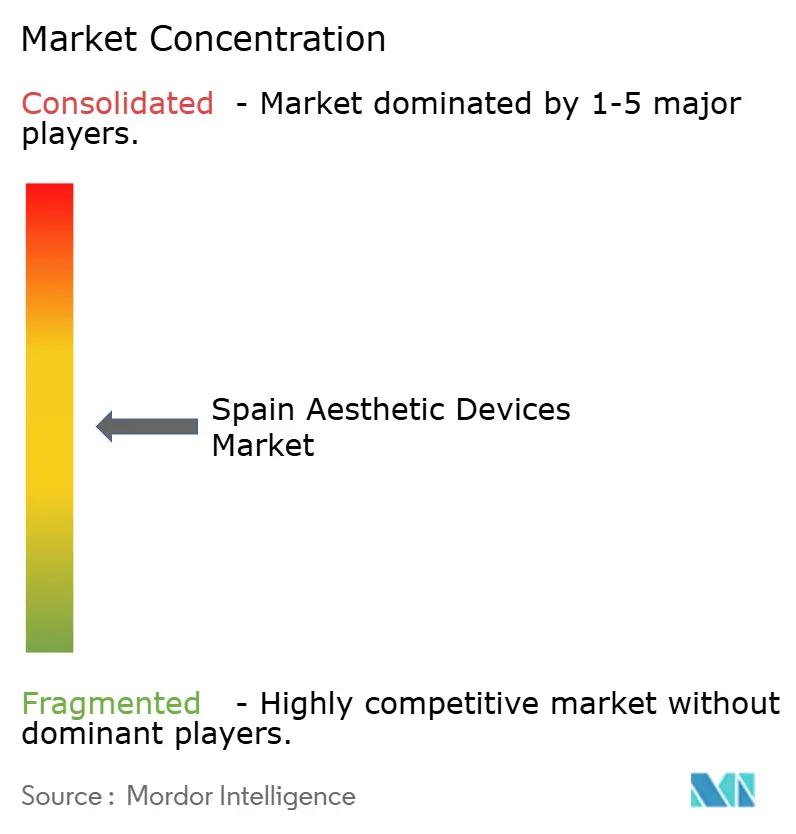
The Spain aesthetic devices market exhibits moderate consolidation, with the top five suppliers owning significant market share of revenue in 2024. Cynosure’s January 2025 merger with Lutronic forged Cynosure Lutronic Inc., combining strong diode-laser intellectual property with broad distribution in 130 countries. This union pressures smaller laser manufacturers to differentiate through niche wavelengths or proprietary feedback algorithms.
Financial distress hit other incumbents: Cutera filed for Chapter 11 in March 2025 while arranging USD 65 million debtor-in-possession financing to stabilize operations. InMode’s reported 20% revenue slide in 2024 and Venus Concept’s 15% drop spurred cost-rationalization programs yet left R&D spend intact, evidencing belief in innovation-led turnaround strategies. Galderma contrasted by recording USD 1.13 billion in Q1 2025 sales, buoyed by 9.9% growth in injectable aesthetics, reinforcing the value of product-line breadth.
Emerging challengers include domestic firm Skinvity, which sells app-linked RF devices for home users and partners with dermatologists for post-treatment maintenance kits. Regenerative-medicine ventures also attract capital, exemplified by Merz Aesthetics’ investment in Acorn Biolabs to commercialize patient-specific stem-cell preservation services. Competitive success hinges on mastering EU MDR compliance, integrating AI for treatment personalization, and, increasingly, maintaining omni-channel portfolios that span clinical and at-home settings. Against this backdrop, continuous technology refresh cycles and customer-training support remain primary levers for sustaining advantage in the Spain aesthetic devices market.
Spain Aesthetic Devices Industry Leaders
Cutera Inc.
AbbVie (Allergan Aesthetics)
Bausch + Lomb (Solta Medical)
Hologic Inc. (Cynosure)
Lumenis
- *Disclaimer: Major Players sorted in no particular order

Market Opportunities and Future Outlook
Regulatory harmonization under MDR 2017/745 and Spain's Real Decreto 192/2023 creates a practical whitespace for suppliers that can package compliance as a service, particularly for Annex XVI products that must meet medical-device-grade evidence and quality obligations despite having no medical purpose. AEMPS maintains public-facing oversight elements such as the registry and listing of CE-marked filler implants commercialized in Spain, and this tends to push clinics toward procurement from traceable, documented portfolios rather than gray-market channels. Vendors that support clinics with MDR-ready labeling, vigilance workflows, and operator training can convert regulatory friction into switching momentum, especially as clinics concentrate volumes following tighter rules around who can perform invasive aesthetic procedures.
On the demand side, Spain performs roughly 400,000 cosmetic interventions per year, supporting equipment utilization and replacement cycles for core energy-based platforms while also widening the funnel for home-use maintenance devices. The market is also shifting toward multimodal protocols that combine injectables with energy-based procedures, which increases the value of integrated product families and standardized treatment planning across clinic and home-use settings. Recent company activity provides early signals for this direction, including Cynosure Lutronic advancing MDR access for a fractional rejuvenation platform and Allergan Aesthetics expanding skin-quality offerings in Spain, which together support the commercial pull for compliant, combination-friendly portfolios in dermatology and cosmetic clinics.
Recent Industry Developments
- July 2026: Cynosure Lutronic introduced the XERF monopolar radiofrequency skin-tightening platform across the EMEA region. The rollout supports clinic demand for non-invasive tightening with newer RF architectures and expands the companys European footprint with a differentiated energy-based offering. The launch also intensifies competitive pressure on incumbent RF and ultrasound vendors competing for skin tightening and contouring budgets in Spain.
- September 2025: Allergan Aesthetics (AbbVie) announced the expansion of SKINVIVE by JUVEDERM into Spain as part of a broader rollout. The move strengthens its presence in skin-quality indications and supports clinic protocols that pair injectables with device-based resurfacing and tightening. Expanded availability also raises the bar for distributors and clinics around compliant supply and standardized patient pathways.
- March 2025: Cutera filed for Chapter 11 bankruptcy protection while continuing operations and arranging debtor-in-possession financing. The restructuring aimed to stabilize operations and reduce debt, affecting customer confidence and purchasing cycles for capital equipment. In Spain, such supplier-side volatility can shift clinic procurement toward vendors perceived as lower risk for service, consumables continuity, and long-term platform support.


Research Methodology Framework and Report Scope
Market Definition and Coverage
For this report, the market covers revenues generated in Spain from aesthetic devices used in cosmetic and appearance-improving procedures across clinical and, where relevant, home-use settings. It includes energy-based systems and non-energy-based products used for treatments like skin tightening, resurfacing, contouring, and hair removal.
Scope exclusions: We exclude general skincare consumables, salon-only beauty tools without medical or aesthetic treatment positioning, and purely pharmaceutical therapies that are not device-led.
Segmentation Overview
- By Device Type
- Energy-based Devices
- Laser-based
- Light-based (IPL)
- Radio-frequency-based
- Ultrasound-based
- Cryolipolysis & Plasma-based
- Non-energy-based Devices
- Botulinum Toxin
- Dermal Fillers & Threads
- Chemical Peels
- Microdermabrasion
- Implants
- Mesotherapy & Others
- Energy-based Devices
- By Application
- Skin Resurfacing & Tightening
- Body Contouring & Cellulite Reduction
- Hair Removal
- Tattoo & Pigmentation Removal
- Breast Augmentation
- Acne & Scar Treatment
- Other Applications
- By End User
- Hospitals
- Dermatology & Cosmetic Clinics
- Medical Spas
- Home-use Settings
Data Sources, Market Sizing, and Validation
Desk Research
Desk work starts with building a simple fact base for Spain, then mapping it to device usage and procedure demand. We used public sources such as Spain's health system and statistical publications, Eurostat series, and selected OECD health indicators to understand population structure and care delivery context. We also reviewed trade and product movement signals using sources such as UN Comtrade and EU customs-facing statistics, where device categories allow a clean read.
To keep assumptions practical, we reviewed manufacturer annual reports, investor decks, product brochures, and Spanish and European dermatology and plastic surgery association websites for procedure mix and clinical adoption cues. Peer-reviewed journals were used for treatment patterns and safety updates, and patent databases were referenced selectively to track technology direction and replacement cycles. For cross-checking company footprint and financial context, we used paid subscriptions for company financials and news intelligence, plus patent databases and shipment-level import and export data when needed. These desk sources are illustrative, and many other public references were checked for data collection, validation, and clarification during the analysis.
Primary Interviews and Surveys
Primary work focused on validating what gets purchased and used in Spain, and how pricing and replacement behavior are changing for key aesthetic device categories. We spoke with a mix of manufacturers and distributors, clinic and hospital-side users, and service providers who see shifts in procedure demand, then reconciled their inputs against desk indicators to close gaps and confirm the final assumptions.
Distribution of primary research fieldwork respondents
| Company type | Respondent position |
|---|---|
| Top tier: 36% | CXOs: 14% |
| Mid tier: 50% | Functional/Unit leaders: 33% |
| Smaller Players: 14% | Managers: 53% |
Market-Sizing & Forecasting
Sizing was built using a top-down approach where procedure demand and care-setting activity in Spain are translated into device revenues through penetration and usage assumptions, then mapped to device categories. Inputs were guided by how treatment volumes shift across applications like hair removal, skin resurfacing and tightening, and body contouring, and how quickly clinics rotate platforms due to technology upgrades.
To keep the totals realistic, we corroborated results with selective bottom-up approximations, including sampled price bands by device category, channel markups where they apply, and sanity checks on supplier and distributor footprint in Spain. Where direct volume proxies were thin, gaps were handled by using a narrow range of plausible utilization rates and replacement cycles that were validated in interviews, then stress-tested against the final market total.
For forecasting, scenario analysis was used so the outlook reflects how sensitive demand is to consumer spending, clinic capacity expansion, and medical tourism flows, followed by adjustments that reflect expected pricing progression and mix shifts between energy-based and non-energy-based products. Over time, we tracked indicators such as procedure intensity by application, share of minimally invasive treatments, average selling price direction, device replacement cadence, and adoption of newer modalities like RF and ultrasound, and updated them with expert consensus before finalizing the forecast.
Data Validation & Update Cycle
Validation is done through repeated cross-checks between the model output and independent signals, so large jumps are questioned before anything is finalized. We run variance checks by device group and end-user setting, then review whether the implied pricing and utilization levels stay within what interviews and public references indicate.
Before sign-off, the work is reviewed in steps, starting with internal logic checks, followed by a second-analyst review that focuses on outliers and assumptions that move the market total. If a material inconsistency shows up, we re-contact sources to confirm the specific input driving it. Reports are refreshed annually, and interim updates are made when major regulatory, pricing, or product-launch events materially change demand, with a final pre-delivery pass to keep the view current.
Mordor Intelligence's Spain Aesthetic Devices Market Size Measured Against Other Published Estimates
Published numbers for Spain's aesthetic devices space can look far apart even when they use the same country label, because the counted product set, end-use settings, and timing assumptions can shift the total quickly. Differences also show up when one estimate leans heavily on a single anchor, such as import values, or when it blends professional devices with adjacent consumer beauty tools.
The table highlights that the spread is mainly explained by what is treated as an aesthetic device revenue and how base-year pricing is carried into the forecast, and in Mordor Intelligence's model the total is tied to energy-based and non-energy-based aesthetic device categories used for defined clinical and aesthetic applications rather than broader beauty-device spending.
Benchmark comparison
| Source | Market Size | Gaps in Research Methodology |
|---|---|---|
| Mordor Intelligence | USD 233.72 M (2025) | |
| Industry Publisher A | USD 438.40 M (2025) | Uses a wider product framing that can bundle facial and skin devices with adjacent beauty-device spending, and the segmentation lens leans on product families and materials which can pull in non-comparable revenues. |
| Research House B | USD 750.00 M (2023) | Uses an earlier base year and a broader valuation that may mix professional and home-use categories more aggressively, which can inflate totals if device revenues and related spend are not separated cleanly. |
When these scope and timing choices are normalized, the remaining gap becomes easier to interpret as a definition and input issue rather than a demand surprise. Our approach keeps the market traceable to procedure-linked demand cues, price progression logic, and repeatable checks, which makes it simpler for readers to reconcile changes year over year.


Key Questions Answered in the Report
How fast is demand for at-home aesthetic devices growing in Spain?
Home-use platforms are forecast to expand at a 13.22% CAGR between 2026 and 2031, reflecting rapid consumer adoption and technology miniaturization.
Which technology will lead future growth?
Ultrasound-based systems are projected to post the strongest 15.62% CAGR through 2031, driven by expanded indications in skin tightening and body contouring.
What regulation most affects suppliers today?
EU Medical Device Regulation 2017/745, enforced locally by AEMPS, sets stringent CE-marking and quality-management requirements for all aesthetic devices marketed in Spain.
Why are energy-based devices so dominant?
They deliver versatile, clinically validated outcomes across multiple applications, securing 59.02% of 2025 revenue and attracting continuous R&D investment.
Is medical tourism still important post-regulation?
Yes; stricter standards enhanced Spain’s reputation, and cross-border directives keep the country attractive to EU patients seeking affordable, high-quality treatments.
Page last updated on:


 Your data is secure and never sold or shared.


