
South Korea LTPS LCD Module In Automotive Market Size and Share
Market Overview
| Study Period | 2021 - 2032 |
|---|---|
| Forecast Data Period | 2027 - 2032 |
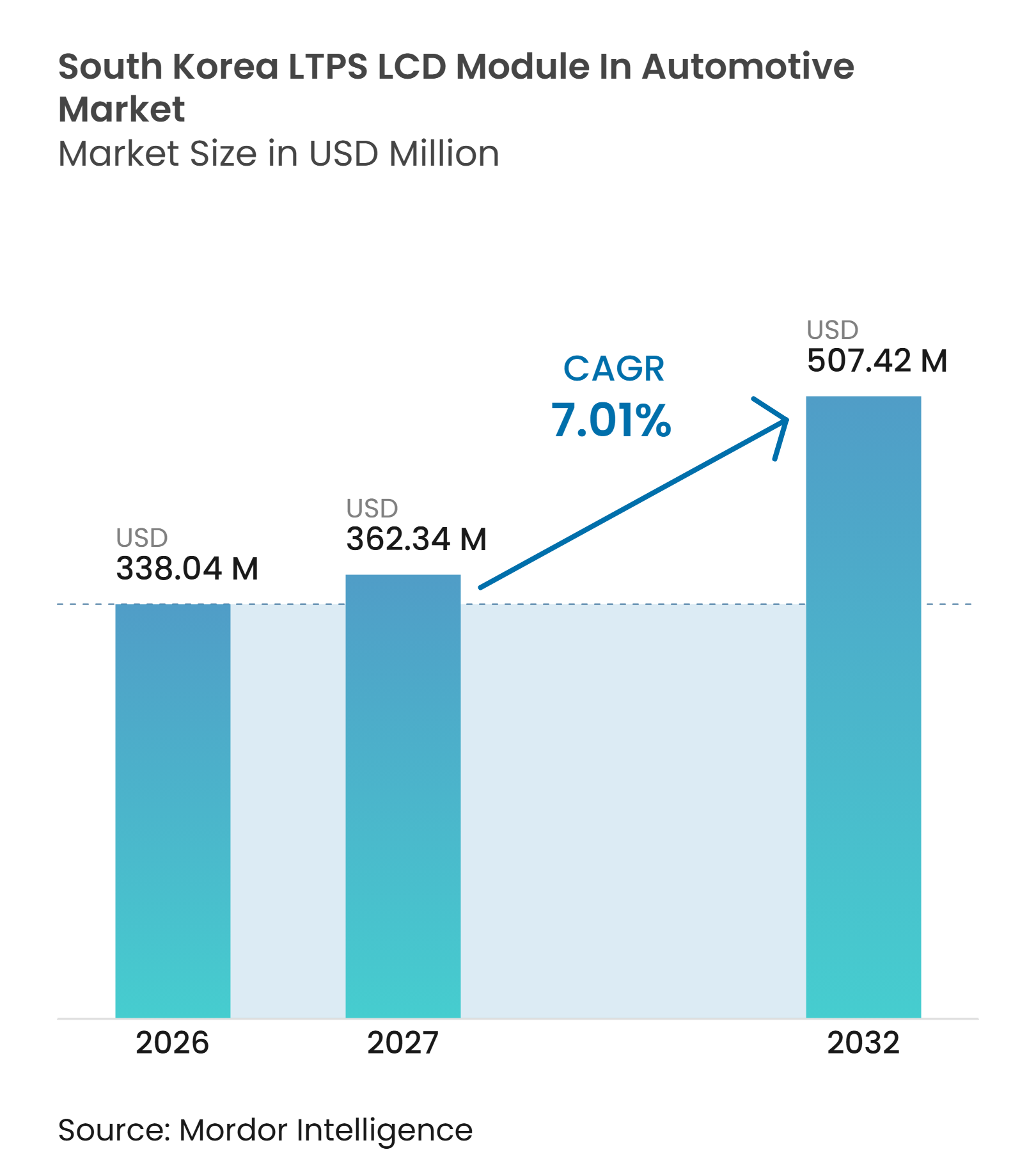
| Base Year Market Size (2026) | USD 338.04 Million |
| Market Size (2027) | USD 362.34 Million |
| Market Size (2032) | USD 507.42 Million |
| Growth Rate (2027 - 2032) | 7.01 % |
| Market Concentration | Medium |
Major Players *Disclaimer: Major Players sorted in no particular order Image © Mordor Intelligence. Reuse requires attribution under CC BY 4.0. | |
South Korea LTPS LCD Module In Automotive Market Analysis by Mordor Intelligence
The South Korea LTPS LCD Module (LCM) in Automotive Market size was valued at USD 338.04 million in 2026 and is estimated to expand to USD 507.42 million by 2032, at a CAGR of 7.01% during the forecast period 2027-2032. The South Korea LTPS LCD Module (LCM) in Automotive Market is being shaped by the shift toward software-defined vehicle cockpits, where multi-screen interfaces need high-resolution panels with in-cell touch capability and stable operation across long vehicle model cycles. Hyundai Motor Group is rolling out Pleos Connect across its vehicle portfolio, which supports demand for advanced cockpit displays in domestic vehicle programs and creates a common software environment for connected functions. In the South Korea LTPS LCD Module (LCM) in Automotive Market, this platform transition encourages early cooperation between vehicle makers, cockpit integrators, and module suppliers on display specification choices. Korean producers are moving toward premium configurations, including Mini-LED backlighting, switchable privacy features, and thinner bonding formats, while low-cost standard programs face stronger competition and remain important in qualified volume models. Long vehicle qualification cycles continue to favor suppliers that already meet automotive reliability and functional-safety requirements, while electric and hybrid vehicle production supports higher display content than comparable internal combustion engine models in the South Korea LTPS LCD Module (LCM) in Automotive Market.
Key Report Takeaways
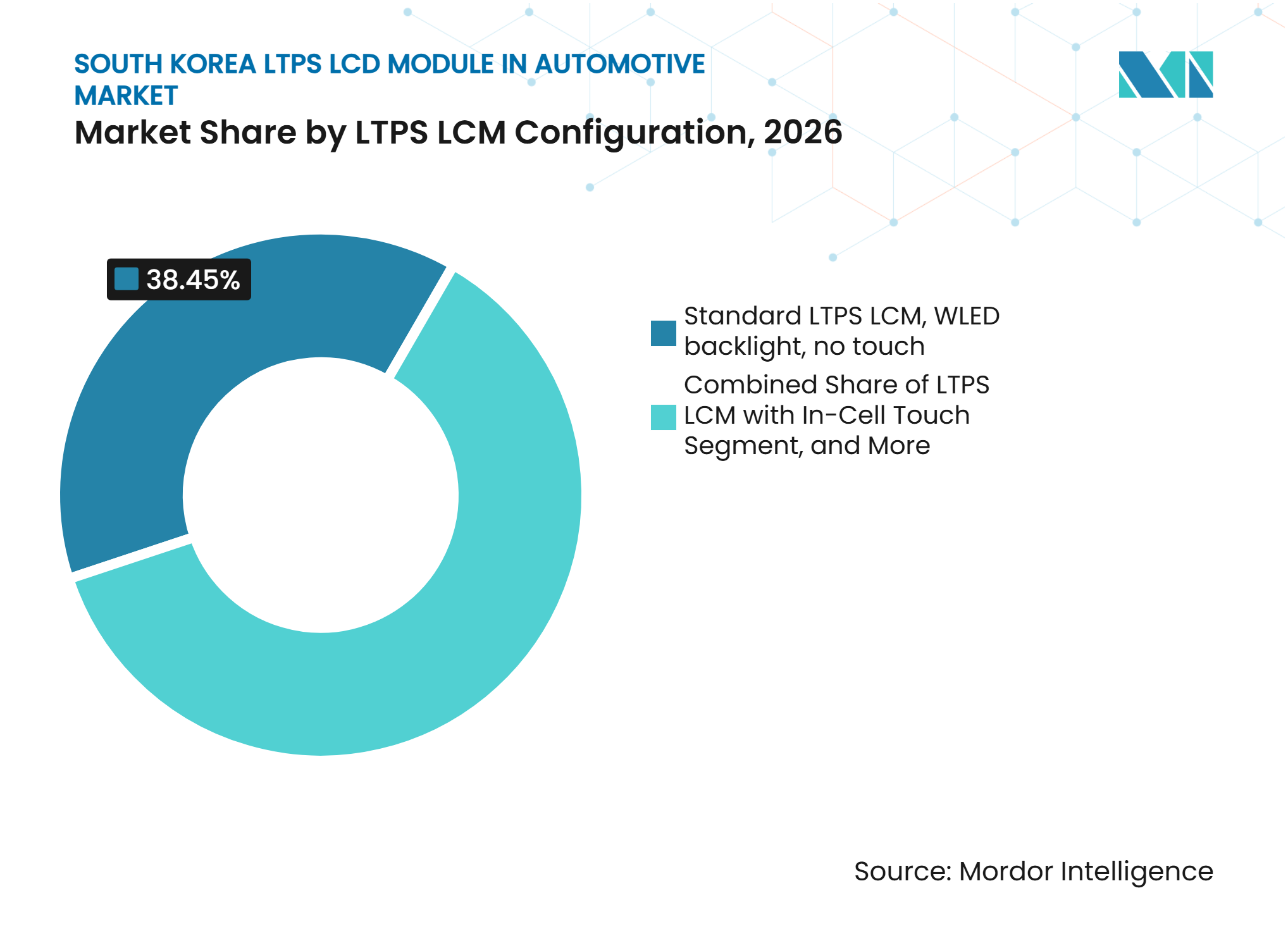
- By LTPS LCM configuration, standard LTPS LCM with WLED backlight and no touch held 38.45% of the South Korea LTPS LCD Module (LCM) in Automotive Market share in 2026, while LTPS LCM with Mini-LED backlight and in-cell touch is projected to expand at an 8.81% CAGR through 2032.
- By application, center stack and infotainment accounted for 45.38% of the South Korea LTPS LCD Module (LCM) in Automotive Market size in 2026, while pillar-to-pillar center console is expected to advance at an 8.78% CAGR through 2032.
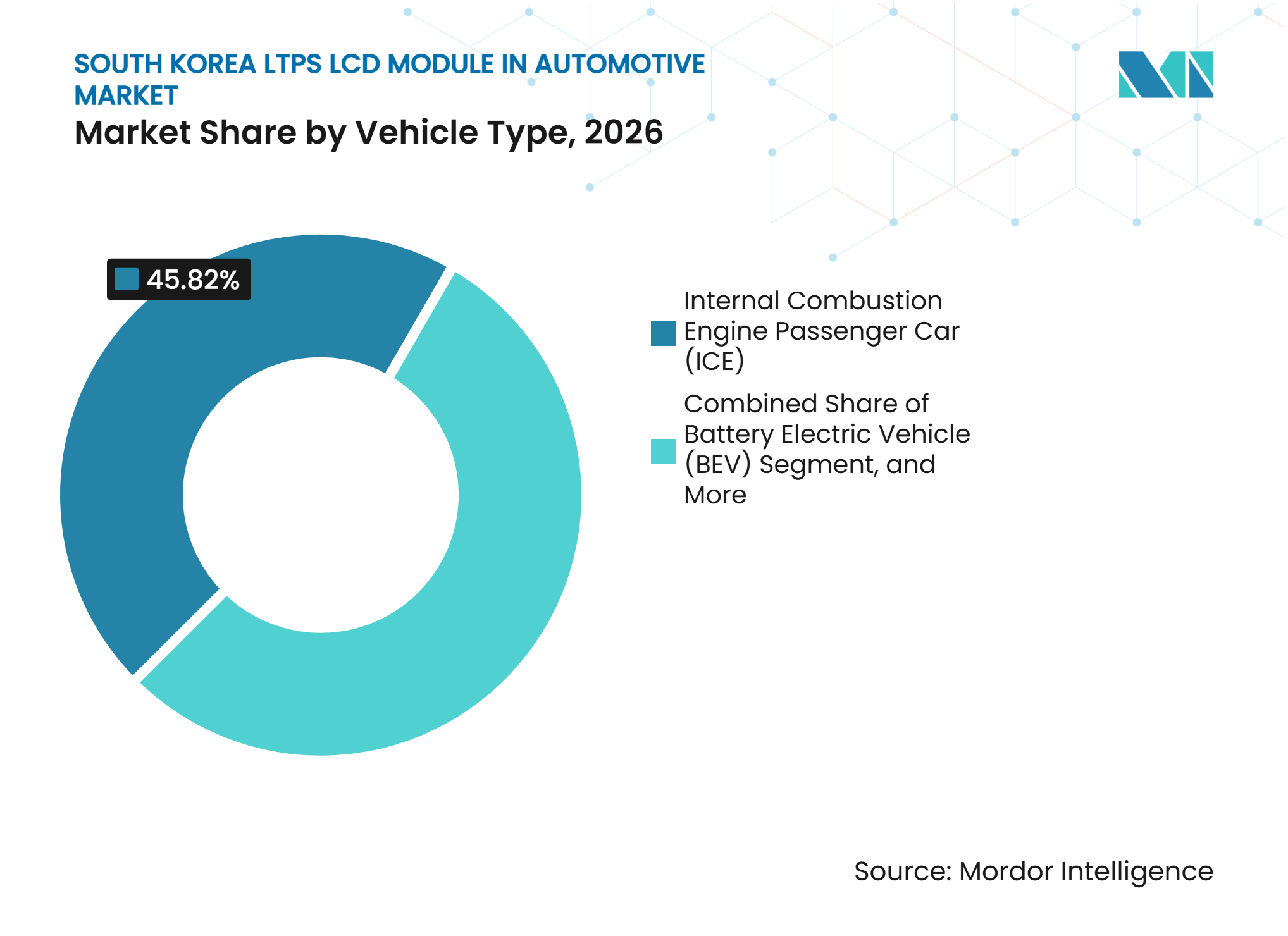
- By vehicle type, internal combustion engine passenger car represented 45.82% of the South Korea LTPS LCD Module (LCM) in Automotive Market size in 2026, while battery electric vehicles are projected to expand at an 8.72% CAGR through 2032.
- By bonding process, Film on Glass held 70.47% of market value in 2026, while Chip on Glass is expected to expand at an 8.83% CAGR through 2032.
Note: Market numbers in this report are based on Mordor Intelligence's proprietary estimation framework, which combines nine months of actuals with Q4 projections for base year 2026.
Market Trends and Insights
Drivers Impact Analysis of South Korea LTPS LCD Module In Automotive Market*
| Driver | (~) % Impact on CAGR Forecast | Geographic Relevance | Impact Timeline |
|---|---|---|---|
| Software-Defined Vehicle Cockpit Expansion | +2.5% | National, with early program gains in Seoul, Ulsan, and Hwaseong OEM design centers | Short term (≤ 2 years) |
| LTPS Adoption in High-Resolution Center-Stack Displays | +1.8% | National, centered on Paju and Gumi display panel production clusters | Short term (≤ 2 years) |
| Growth of Korean EV and Hybrid Vehicle Production | +1.4% | National, centered on Ulsan, Hwaseong, Asan, and Gwangju assembly plants | Medium term (2-4 years) |
| Rising Demand for Large-Format and Multi-Display Cockpits | +1.2% | National | Medium term (2-4 years) |
| Embedded Camera and Safe-View Display Integration | +0.6% | National | Medium term (2-4 years) |
| OEM-Tier 1 Co-Design for Display Module Differentiation | +0.5% | National | Long term (≥ 4 years) |
| Source: Mordor Intelligence | |||
Software-Defined Vehicle Cockpit Expansion
Hyundai Motor Group introduced Pleos Connect on the new GRANDEUR in South Korea in May 2026 and targets deployment in 20 million Hyundai Motor, Kia, and Genesis vehicles by 2030.[1] The system places software at the center of the cockpit and links infotainment, content, and vehicle functions through connected display interfaces. These vehicles need sharp panels and integrated touch functions, which creates a clear role for LTPS LCMs in new cockpit programs. The South Korea LTPS LCD Module (LCM) in Automotive Market therefore gains demand from display content per vehicle rather than vehicle production alone. The planned rollout connects cockpit design to a consistent software architecture across the group’s vehicle brands. Component partners can align panel and module validation with platform requirements earlier in vehicle development.
LTPS Adoption in High-Resolution Center-Stack Displays
LTPS panels support fine pixel density and can incorporate touch sensing without an added touch overlay. This helps module suppliers reduce thickness and simplify the stack used behind the cover glass. The benefit matters in center-stack displays because vehicle teams need thermal control, durability, and readable interfaces in limited dashboard space. LG Display has positioned its high-end LTPS LCD lineup for large, high-resolution automotive displays in the software-defined vehicle era.[2] As consumer electronics capacity shifts toward OLED, automotive programs provide a longer-cycle outlet for LTPS panel production. The South Korea LTPS LCD Module (LCM) in Automotive Market can therefore benefit when suppliers combine a panel, touch layer, cover glass, and bonding process in a qualified module.
Growth of Korean EV and Hybrid Vehicle Production
Hyundai Motor Group sold 961,812 electrified vehicles globally in 2025, including 275,669 battery electric vehicles and 634,990 hybrid electric vehicles, representing 27% year-over-year growth.[3] The company’s mix illustrates why electrified platforms are important to the South Korea LTPS LCD Module (LCM) in Automotive Market. Battery electric and hybrid vehicles often include larger center displays, digital clusters, and more software-enabled functions than comparable conventional vehicles. Their cockpit designs can use wider displays because designers face fewer mechanical packaging constraints from a combustion powertrain. Hyundai Motor Group and Kia also passed 5 million cumulative hybrid electric vehicle sales in 2025, which shows that hybrid vehicles remain a material source of advanced cockpit demand. This production mix supports premium display specifications even when total vehicle output changes gradually.
Rising Demand for Large-Format and Multi-Display Cockpits
Large integrated display surfaces are becoming a defining feature of premium vehicle interiors. LG Display showed a 57-inch pillar-to-pillar LCD and a 47.8-inch LTPS LCD with Switchable Privacy Mode at K-Display 2025 in Seoul. The products demonstrate the use of LTPS LCD in large single-panel vehicle designs and show how passenger content can be separated from the driver’s view. A single wide display can remove visible breaks between separate panels and give vehicle makers more freedom in dashboard design. Multi-display systems also raise the display bill of materials per vehicle, especially when a center screen, instrument cluster, and passenger screen operate together. This makes large-format display programs important for the South Korea LTPS LCD Module (LCM) in Automotive Market, even if their vehicle volumes are lower than mainstream models.
Restraints Impact Analysis of South Korea LTPS LCD Module In Automotive Market*
| Restraint | (~) % Impact on CAGR Forecast | Geographic Relevance | Impact Timeline |
|---|---|---|---|
| Price Erosion From Chinese and Taiwanese Panel Suppliers | -1.8% | Global, with direct downstream impact on South Korean OEM procurement decisions | Short term (≤ 2 years) |
| Automotive Qualification and Long Development Cycles | -1.4% | National | Medium term (2-4 years) |
| Limited Domestic Scale for Non-Premium Automotive Programs | -0.9% | National | Medium term (2-4 years) |
| Competition From OLED and Oxide TFT Alternatives | -0.8% | National, with spillover from premium global cockpit programs | Long term (≥ 4 years) |
| Source: Mordor Intelligence | |||
Price Erosion From Chinese and Taiwanese Panel Suppliers
Chinese panel suppliers compete strongly in standard automotive LCD programs, where price is a central purchasing criterion. This pressure is strongest in lower-specification configurations that do not require advanced touch integration, local dimming, or specialized optical functions. LG Display approved the transfer of its Nanjing automotive LCD module business for CNY 491.5 million, equivalent to USD 67 million, in February 2026. The decision reflects a move away from lower-margin module assembly and toward automotive OLED and premium LTPS production. Korean suppliers still face a gap in mid-tier programs because customers can compare their offers with Chinese and Taiwanese alternatives. The South Korea LTPS LCD Module (LCM) in Automotive Market must therefore rely on configuration differentiation and established qualification records rather than standard panel pricing.
Automotive Qualification and Long Development Cycles
Automotive LTPS displays must meet strict requirements before production begins. Relevant compliance factors include AEC-Q100 semiconductor qualification, IATF 16949 quality management, and ISO 26262 functional safety practices. Validation can take 24 to 36 months from early design work to production start. Newer Mini-LED and in-cell touch modules may need additional thermal and electromagnetic compatibility assessment. The lengthy process slows new entrants, but it also makes it harder for established suppliers to respond quickly when a customer changes a program requirement. For the South Korea LTPS LCD Module (LCM) in Automotive Market, this creates a durable advantage for suppliers that have already documented compliance across several OEM programs.
*Our forecasts treat driver/restraint impacts as directional, not additive. The impact forecasts reflect baseline growth, mix effects, and variable interactions.
South Korea LTPS LCD Module In Automotive Market Segment Analysis
By LTPS LCM Configuration:
Standard Formats Retain Volume While Premium Variants AccelerateStandard LTPS LCM with WLED backlight and no touch held 38.45% of the South Korea LTPS LCD Module (LCM) market share in 2026. The configuration serves mid-tier instrument clusters and secondary cabin displays where customers prioritize cost and established reliability. A panel design that has completed qualification often remains in place for a vehicle model cycle lasting 5 to 7 years. That practice preserves demand for standard WLED modules even as higher-end technologies enter new programs. LTPS LCM with in-cell touch and WLED backlight forms the next important tier for center-stack applications. It gives OEMs touch control without a separate overlay in front of the panel and helps maintain a simpler optical stack.
LTPS LCM with Mini-LED backlight and in-cell touch is projected to expand at an 8.81% CAGR through 2032, the fastest rate among configuration types. The configuration combines local dimming, higher contrast, and direct touch input for premium cockpit designs. Hyundai Motor Group and Genesis can use these modules as advanced display features move from flagship models into broader vehicle lines. Mini-LED modules without touch continue to serve rear-seat entertainment and instrument-cluster use cases where bright, high-contrast viewing is required. Passive viewing in those applications reduces the need for touch capability. The configuration mix shows that the South Korea LTPS LCD Module (LCM) industry is not replacing standard products at once, but is directing new value toward differentiated modules.



By Application:
Infotainment Leads While Pillar-to-Pillar Designs Change Cockpit LayoutsCenter stack and infotainment represented 45.38% of the South Korea LTPS LCD Module (LCM) market size in 2026. The category is the main display point for navigation, media, vehicle settings, and connected services. Its role is structural because new passenger vehicles commonly include a center display as standard equipment. Hyundai Motor Group’s Pleos Connect system gives the center interface a broader software role by connecting information and content within the cockpit. This supports steady module demand across conventional, hybrid, and electric vehicle programs. Center-stack volume also gives panel makers a route to deploy touch-enabled LTPS modules at scale.
Pillar-to-pillar center console is expected to expand at an 8.78% CAGR through 2032. These displays extend across the dashboard and can replace a set of separated display units with one continuous surface. LG Display’s 57-inch pillar-to-pillar LCD demonstrates that Korean suppliers can produce automotive panels at this scale. Instrument clusters remain an important secondary application because they are present across internal combustion, hybrid, and battery electric vehicles. Rear-seat entertainment and passenger screens have a smaller role, but premium Genesis and Kia programs support their use. Software-enabled content updates can also make these additional screens more useful throughout a vehicle’s life.
By Vehicle Type:
Internal Combustion Models Support Volume and Battery Electric Vehicles Raise Content ValueInternal combustion engine passenger cars accounted for 45.82% of the South Korea LTPS LCD Module (LCM) market size in 2026. This position reflects the large installed base of Hyundai Motor Group’s conventional passenger vehicle programs. LTPS display upgrades can be introduced during model refreshes even when a vehicle was not designed as a battery electric model. South Korea produced more than 4.1 million automobiles in 2025, which maintains a substantial base for cockpit display demand. Conventional vehicle programs also help keep panel production lines utilized as powertrain demand changes. Their continuing role makes the overall display market less dependent on a single vehicle type.
Battery electric vehicles are projected to expand at an 8.72% CAGR through 2032. These vehicles can support wider, taller, and curved display layouts because interior design is less constrained by conventional powertrain components. This has made BEV programs an important source of high-specification LTPS modules. Hybrid and plug-in hybrid vehicles also make a material contribution because their sales volumes support multi-screen and digital-cluster features. Hyundai Motor Group’s 2025 electrified vehicle performance confirms that both battery electric and hybrid models remain important product lines. Light commercial vehicles remain the smallest vehicle category, but connected cockpit features can create further display opportunities in commercial programs.

By Bonding Process:
Film on Glass Anchors Current Demand While Chip on Glass Gains in Premium ProgramsFilm on Glass held 70.47% of the South Korea LTPS LCD Module (LCM) market share in 2026. The process works with established panel production lines and has a cost profile suited to mid- and high-volume automotive programs. Its wide use also reflects the reluctance of automakers to change a bonding design after a module passes vehicle qualification. Film on Glass modules can support large panels, including pillar-to-pillar designs that need stable mechanical assembly. The process provides a reliable option for the lengthy production runs common in automotive supply programs. It remains the main bonding format for existing high-volume LTPS LCM applications.
Chip on Glass is expected to expand at an 8.83% CAGR through 2032. The process mounts the driver IC directly on the glass substrate, which can reduce module thickness and support higher-density interconnects. This characteristic matters when an OEM specifies curved panels or needs more freedom behind a dashboard surface. Chip on Glass is closely linked to in-cell touch modules, where reducing external connections can improve the packaging of a thin display assembly. The format therefore fits newer premium cockpit applications rather than replacing Film on Glass across all programs. The South Korea LTPS LCD Module (LCM) industry can use this process to address demand for thinner and more integrated display modules.
Geography Analysis
Ulsan and the Southern Industrial Corridor
Ulsan is home to Hyundai Motor Company’s largest single manufacturing complex, with annual production capacity of 1.5 million vehicles. This makes the city a major demand location for automotive display modules in South Korea. The site builds global volume models and electric vehicles, linking vehicle output with local demand for center displays and instrument clusters. Hyundai Motor Group began deploying Pleos Connect on the new GRANDEUR in 2026, which brings software-defined cockpit architecture into a domestic production model. Kia facilities in Hwaseong, Sohari, and Gwangju, together with Hyundai’s Asan plant, extend this manufacturing corridor. The Ministry of Trade, Industry and Resources reported that South Korea’s eco-friendly vehicle exports exceeded 100,000 units in June 2026, showing the importance of electrified vehicle output for the region’s supply base. As these plants introduce more electric and hybrid models, demand can shift toward multi-screen and premium cockpit specifications.
Seoul Metropolitan Area and the Paju-Gumi Panel Belt
Paju and Gumi host important domestic production assets for LG Display’s automotive LTPS LCD operations. LG Display has described its automotive display lineup as including high-end LTPS LCD, automotive OLED, and new form factors for vehicle interiors. Nearby OEM design and user-experience teams in the Seoul metropolitan area can work closely with panel suppliers on display curvature, optical functions, and bonding choices. This proximity can shorten sampling and design discussions compared with overseas supplier relationships. It also helps Tier 1 companies coordinate panel specifications with cockpit software and vehicle interior design. The 47.8-inch LTPS LCD with Switchable Privacy Mode shown by LG Display illustrates the type of function that can be developed for advanced passenger-display applications. Cheonan adds a related display manufacturing base through Samsung Display’s automotive OLED activity, creating both a competing and complementary technology ecosystem.
Daegu, Busan, and the Emerging Tier 2 Cluster
Daegu and North Gyeongsang Province support automotive display production through suppliers of connector housings, thermal interface materials, and bonding films. These components enter LTPS LCM assembly even when final panel production occurs elsewhere. Busan is South Korea’s key automotive export port, which makes its logistics role relevant for display modules installed in export vehicles. The southern logistics corridor connects vehicle assembly, parts production, and overseas shipments in a single industrial system. Cheonan and Asan also support the move toward complete cockpit module integration, where a Tier 1 supplier combines the display, driver IC, and computing hardware before delivery to an OEM line. This model can shift more value from stand-alone panel supply to module-level integration. It also strengthens the case for local suppliers that can meet quality documentation and software-compatibility requirements across the full cockpit assembly.
Competitive Landscape
Market Concentration
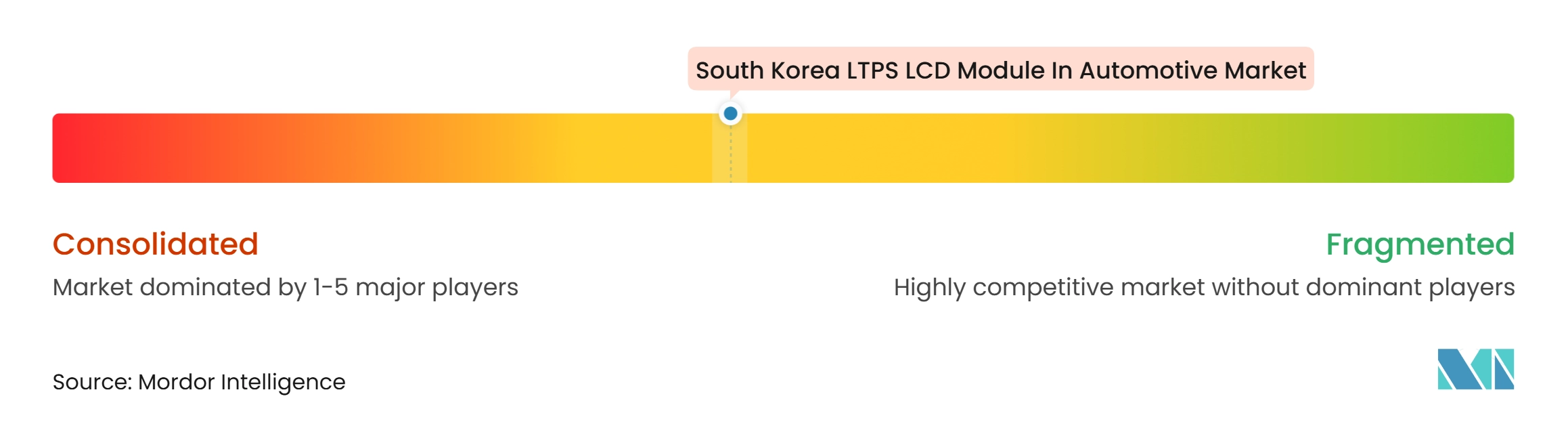
The South Korea LTPS LCD Module (LCM) in Automotive Market is moderately concentrated among panel makers but more fragmented across the Tier 1 cockpit integration layer. LG Display holds a leading position in automotive LTPS LCD shipments and supplies automotive display products across premium vehicle programs. The company is repositioning its portfolio toward high-margin automotive OLED, tandem OLED, and high-end LTPS LCD offerings. Its February 2026 agreement to transfer the Nanjing automotive LCD module business for CNY 491.5 million, equivalent to USD 67 million, was part of that change in focus. The transaction moved the company away from commodity module assembly and supported investment in higher-value display programs. Chinese panel companies, including BOE Technology Group, Tianma Microelectronics, and TCL China Star Optoelectronics Technology, remain important competitors in standard and mid-tier automotive LCD applications.
Tier 1 cockpit integrators such as Visteon Corporation, Hyundai Mobis, and Continental influence which display modules enter an OEM cockpit platform. Their role is increasingly based on joint engineering rather than simple system assembly. Hyundai Mobis can create supplier lock-in when a display module is qualified within a cockpit reference design that is used across several vehicle models. This gives qualified panel and module suppliers access to wider program volumes, but also raises the cost of losing a design win. The strongest space for differentiation is where Mini-LED backlighting, in-cell touch, and Chip on Glass bonding are combined in one automotive-qualified module. Such products can offer a thinner profile and advanced image performance for premium cockpit applications. Compliance with IATF 16949 and ISO 26262 remains a meaningful barrier for new suppliers that want to serve export-oriented vehicle programs.
Samsung Display’s automotive OLED activity adds competitive pressure at the premium end of the display market. In September 2025, the company introduced DRIVE, its automotive OLED brand, with display options designed for different pricing and program-timing requirements. In August 2026, Samsung Display began shipping 24.6-inch and 13.2-inch OLED panels for the Genesis GV90, an example of the larger and more flexible displays being used in high-end electric vehicles. LG Display also demonstrated a 57-inch pillar-to-pillar LCD and a 47.8-inch LTPS LCD with Switchable Privacy Mode at K-Display 2025. These moves show that competition is focused on advanced cockpit functions as well as panel supply. Suppliers with qualified LTPS modules still have a role where customers require a balance between display performance, reliability, and cost.
South Korea LTPS LCD Module In Automotive Industry Leaders
-
LG Display Co., Ltd.
-
Japan Display Inc.
-
AUO Corporation
-
Tianma Microelectronics Co., Ltd.
-
BOE Technology Group Co., Ltd.
- *Disclaimer: Major Players sorted in no particular order
South Korea LTPS LCD Module In Automotive Market Companies Covered in this Report
- LG Display Co., Ltd.
- Samsung Display Co., Ltd.
- BOE Technology Group Co., Ltd.
- AUO Corporation
- Japan Display Inc.
- Tianma Microelectronics Co., Ltd.
- TCL China Star Optoelectronics Technology Co., Ltd.
- Sharp Corporation
- Innolux Corporation
- Varitronix International Limited
- HannStar Display Corporation
- HKC Corporation Limited
- Hyundai Mobis Co., Ltd.
- Hyundai Motor Company
- Kia Corporation
- Robert Bosch GmbH
- Continental AG
- Visteon Corporation
- Marelli Holdings Co., Ltd.
- DENSO Corporation
Recent Industry Developments in South Korea LTPS LCD Module In Automotive Market
- August 2026: Samsung Display began shipping 24.6-inch and 13.2-inch OLED panels to the Genesis GV90, Hyundai Motor Group’s flagship electric SUV. The GV90 features a pop-up variable format cinematic display that expands to 24.6 inches when stationary, demonstrating the premium cockpit escalation path that is indirectly pulling LTPS LCM specifications upward in adjacent model tiers.
- July 2026: South Korea’s eco-friendly vehicle exports crossed 100,000 units in a single month for the first time in June 2026, with auto exports rising 5.8% year-over-year to USD 6.71 billion, a record for June. The milestone confirmed that Korean EV and hybrid production has reached a scale at which premium cockpit display content drives material LTPS LCM volumes.
- May 2026: Hyundai Motor Group launched the Pleos Connect software-defined vehicle infotainment system on the new GRANDEUR in South Korea. The production debut targeted 20 million vehicles by 2030 and used a multi-screen LTPS display layout combining a primary central screen and a driver-facing slim cluster display.
- September 2025: Samsung Display launched DRIVE, its dedicated automotive OLED brand, at IAA Mobility 2025 in Munich. The launch included a rigid OLED platform designed for customer needs across price tiers and program timing requirements.
South Korea LTPS LCD Module In Automotive Market Report Scope
The South Korea LTPS LCD Module (LCM) in Automotive Market encompasses the development, manufacturing, and supply of automotive-grade display modules using Low-Temperature Polycrystalline Silicon (LTPS) technology. These modules deliver high-resolution visuals, enhanced display performance, and power efficiency for advanced vehicle interfaces. Market growth is driven by increasing vehicle digitalization, adoption of sophisticated cockpit systems, and demand for high-quality automotive displays.
The South Korea LTPS LCD Module (LCM) in Automotive Market Report is Segmented by LTPS LCM Configuration (Standard LTPS LCM (WLED Backlight, No Touch), LTPS LCM with In-Cell Touch (WLED Backlight), LTPS LCM with Mini-LED Backlight (No Touch), and LTPS LCM with Mini-LED Backlight and In-Cell Touch), Application (Center Stack/Infotainment, Instrument Cluster, Pillar-to-Pillar Center Console, and Rear Seat Entertainment and Passenger Screen), Vehicle Type (Battery Electric Vehicle (BEV), Hybrid / Plug-in Hybrid Electric Vehicle (HEV/PHEV), Internal Combustion Engine Passenger Car (ICE), and Light Commercial Vehicle (LCV)), and Bonding Process (Film on Glass (FOG), and Chip on Glass (COG)). The Market Forecasts are Provided in Terms of Value (USD).
Segmentation Overview
| Standard LTPS LCM, WLED Backlight, No Touch |
| LTPS LCM with In-Cell Touch, WLED Backlight |
| LTPS LCM with Mini-LED Backlight, No Touch |
| LTPS LCM with Mini-LED Backlight and In-Cell Touch |
| Center Stack / Infotainment |
| Instrument Cluster |
| Pillar-to-Pillar Center Console |
| Rear Seat Entertainment and Passenger Screen |
| Battery Electric Vehicle (BEV) |
| Hybrid / Plug-in Hybrid Electric Vehicle (HEV/PHEV) |
| Internal Combustion Engine Passenger Car (ICE) |
| Light Commercial Vehicle (LCV) |
| Film on Glass (FOG) |
| Chip on Glass (COG) |
| By LTPS LCM Configuration | Standard LTPS LCM, WLED Backlight, No Touch |
| LTPS LCM with In-Cell Touch, WLED Backlight | |
| LTPS LCM with Mini-LED Backlight, No Touch | |
| LTPS LCM with Mini-LED Backlight and In-Cell Touch | |
| By Application | Center Stack / Infotainment |
| Instrument Cluster | |
| Pillar-to-Pillar Center Console | |
| Rear Seat Entertainment and Passenger Screen | |
| By Vehicle Type | Battery Electric Vehicle (BEV) |
| Hybrid / Plug-in Hybrid Electric Vehicle (HEV/PHEV) | |
| Internal Combustion Engine Passenger Car (ICE) | |
| Light Commercial Vehicle (LCV) | |
| By Bonding Process | Film on Glass (FOG) |
| Chip on Glass (COG) |
Key Questions Answered in the Report
What is the size of the South Korea LTPS LCD Module market for automotive applications?
The South Korea LTPS LCD Module (LCM) in Automotive Market was valued at USD 338.04 million in 2026 and is estimated to reach USD 507.42 million by 2032, at a CAGR of 7.01% during 2027-2032. The estimate reflects demand from display upgrades in new vehicle cockpit programs, including center-stack, instrument-cluster, and connected infotainment installations.
Which LTPS LCM configuration has the largest share in South Korea automotive applications?
Standard LTPS LCM with WLED backlight and no touch led with a 38.45% share in 2026. Its position is supported by cost-sensitive, qualified vehicle programs that continue across established model cycles and serve instrument clusters, secondary cabin displays, and other mainstream cockpit functions.
Which automotive display application is advancing fastest in South Korea?
Pillar-to-pillar center console is expected to expand at an 8.78% CAGR through 2032 as OEMs use large integrated display surfaces in premium cockpits. This application can replace several separate display units with one continuous dashboard surface, while also supporting distinctive interior design and passenger-display concepts.
Why are electric vehicles important for LTPS LCD module demand?
Battery electric vehicles are projected to expand at an 8.72% CAGR through 2032 and typically use more digital cockpit display content than conventional vehicle models. The South Korea LTPS LCD Module (LCM) in Automotive Market can therefore gain when vehicle interiors adopt wider and more curved screen designs.
Which bonding process leads South Korea automotive LTPS LCM demand?
Film on Glass held 70.47% of market value in 2026 because it fits established automotive production and qualification practices. It also supports stable assembly for high-volume and large-format display programs.
What factors limit entry into automotive LTPS LCM supply?
Suppliers must meet reliability and quality requirements, including AEC-Q100, IATF 16949, and ISO 26262 practices, while vehicle qualification can take 24 to 36 months. The process is especially demanding for newer Mini-LED and in-cell touch designs.