
South Korea Hydrogen Fuel Cell Vehicle Market Size and Share
Market Overview
| Study Period | 2019 - 2032 |
|---|---|
| Forecast Data Period | 2027 - 2032 |
| Base Year Market Size (2026) | USD 0.33 Billion |
| Market Size (2027) | USD 0.39 Billion |
| Market Size (2032) | USD 0.86 Billion |
| Growth Rate (2027 - 2032) | 17.19 % |
| Market Concentration | High |
Major Players *Disclaimer: Major Players sorted in no particular order Image © Mordor Intelligence. Reuse requires attribution under CC BY 4.0. | |
South Korea Hydrogen Fuel Cell Vehicle Market Analysis by Mordor Intelligence
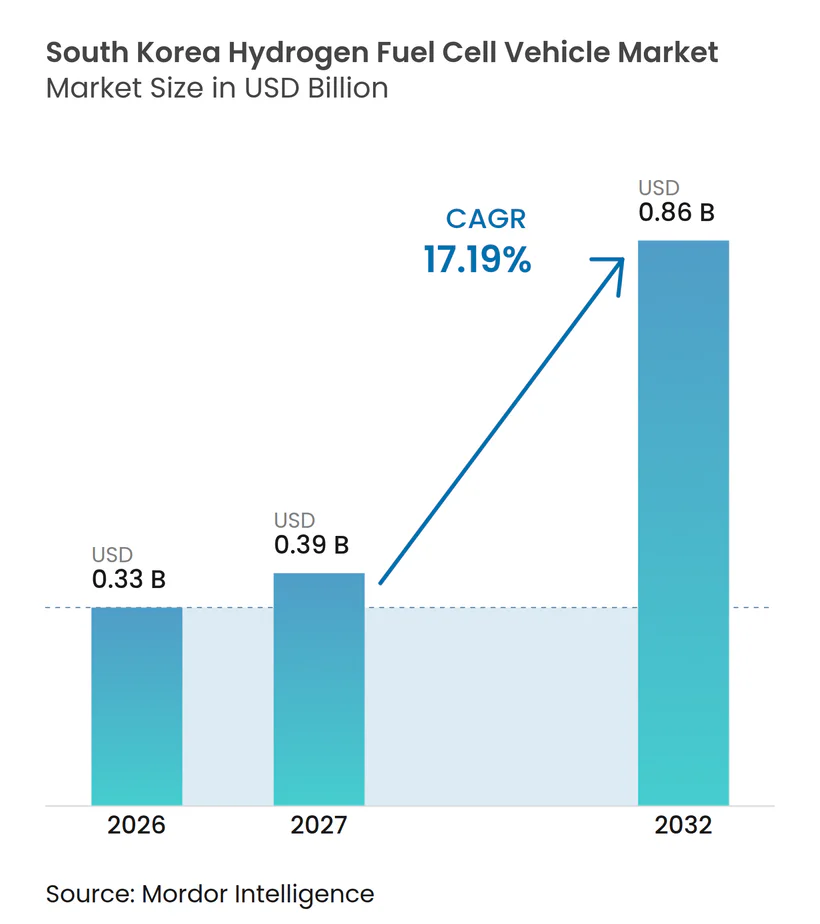
The South Korea hydrogen fuel cell vehicle market size was valued at USD 0.33 billion in 2026 and is expected to grow from USD 0.39 billion in 2027 to USD 0.86 billion by 2032, at a CAGR of 17.19% during 2027-2032. The recovery in vehicle deployments is expected to follow Hyundai Motor’s launch of the second-generation Nexo, which is projected to increase hydrogen vehicle deployments. Government purchase incentives are expected to remain important; however, the vehicle budget indicates lower support than in the previous period. Commercial fleets are emerging as the primary source of demand, with buses, trucks, and logistics vehicles refueling along predictable depot routes. The South Korea hydrogen fuel cell vehicle market is therefore expected to shift toward fleet use cases, where driving range, vehicle availability, and fixed refueling access take precedence over retail adoption.
Key Report Takeaways
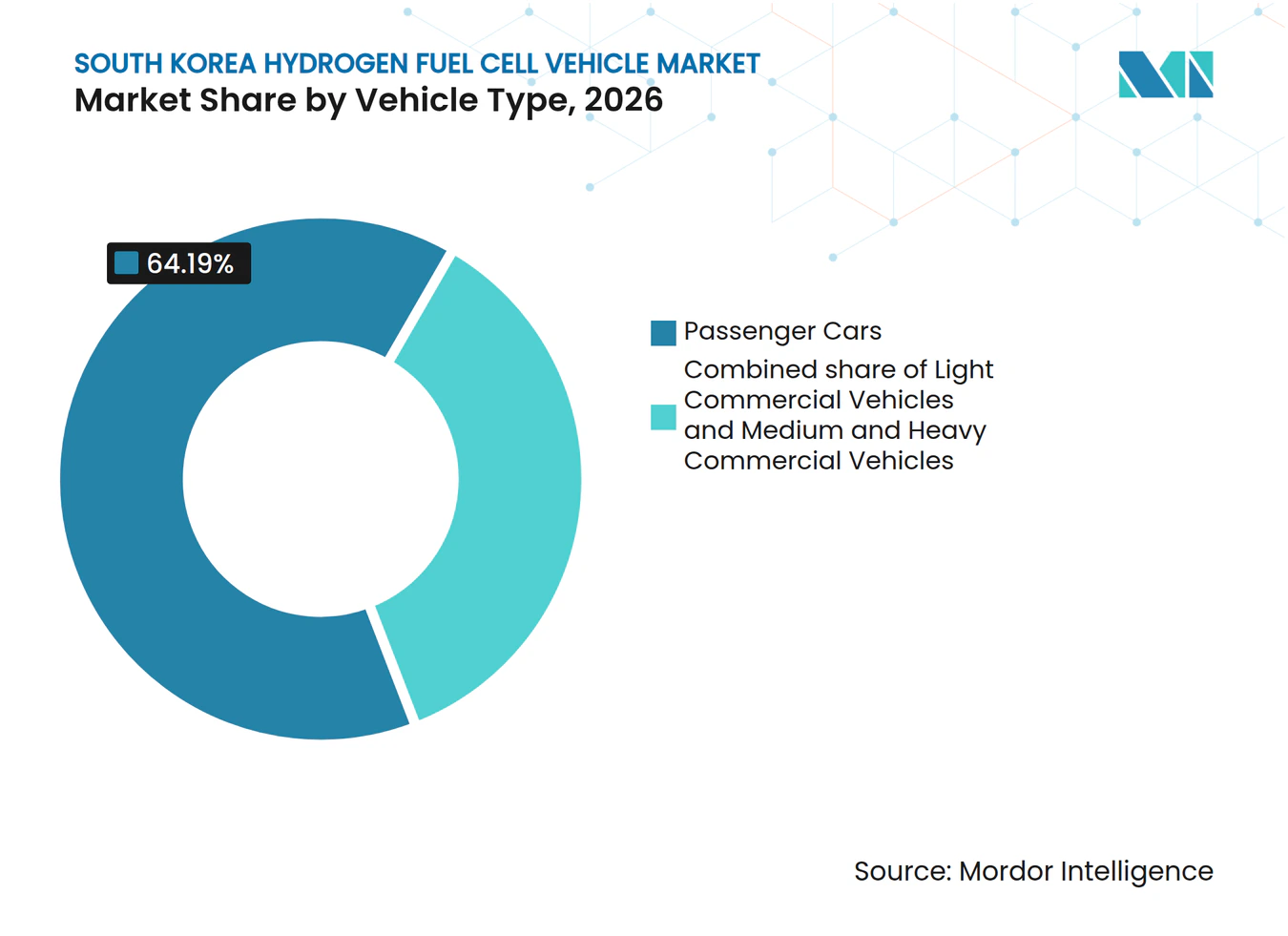
- By vehicle type, passenger cars held a 64.19% share of the South Korea hydrogen fuel cell vehicle market in 2026, while medium and heavy commercial vehicles are projected to grow at an 18.21% CAGR through 2032.
- By technology, proton-exchange-membrane fuel cells held a 99.20% share in 2026, while solid-oxide fuel cell range extenders are projected to grow at a 21.00% CAGR through 2032.
- By power output, the 100–200 kW category held a 57.11% share in 2026, while the more than 200 kW category is projected to grow at a 20.43% CAGR through 2032.
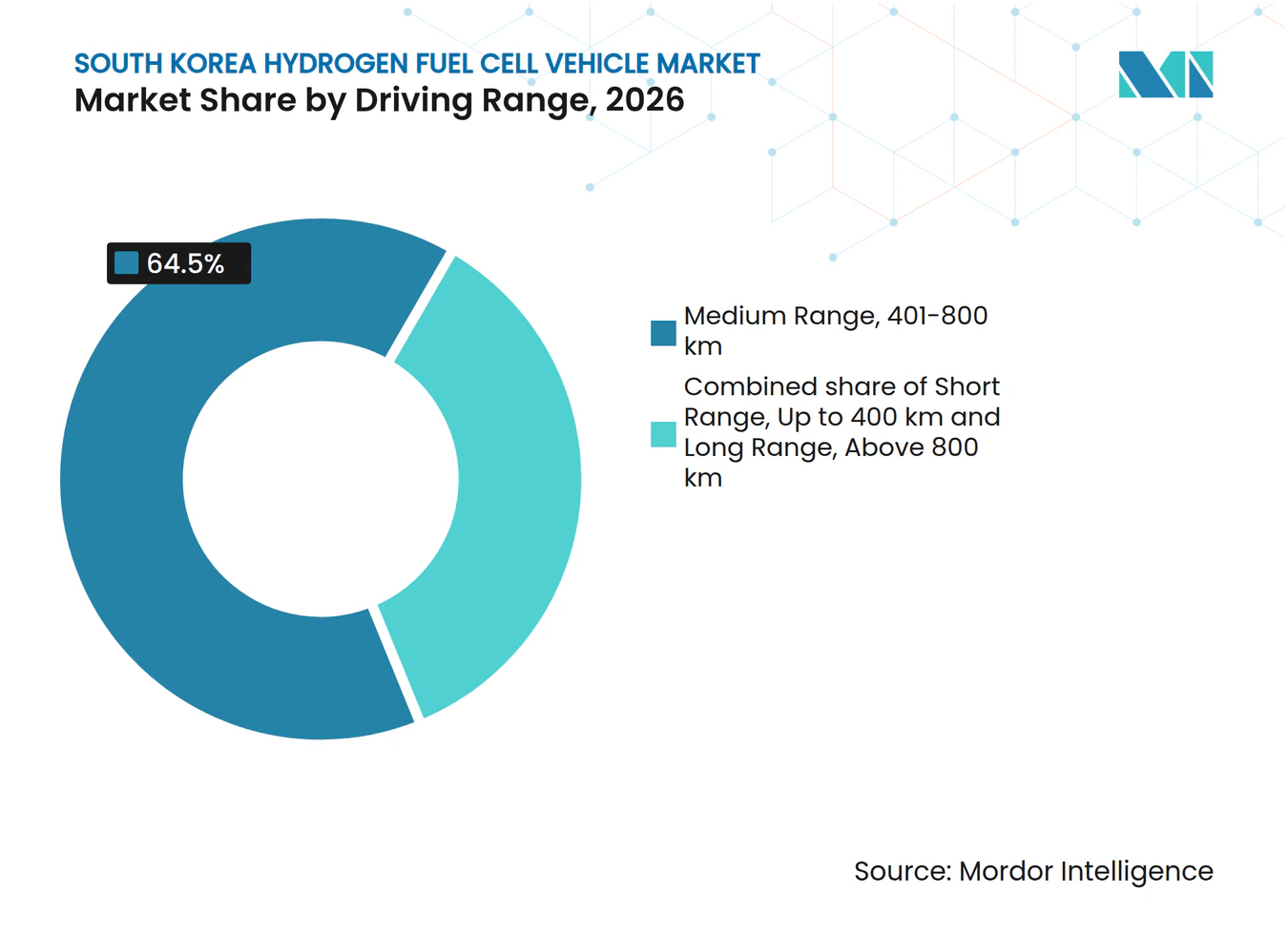
- By driving range, medium-range vehicles held a 64.50% share in 2026, while long-range vehicles are projected to grow at an 18.60% CAGR through 2032.
- By application, private transportation held a 62.00% share in 2026, while commercial freight and logistics is projected to grow at a 21.50% CAGR through 2032.
- By end user ownership, individual consumers held a 55.00% share in 2026, while fleet operators and logistics companies are projected to grow at a 20.50% CAGR through 2032.
- By component, fuel-cell stacks held a 41.17% share in 2026 and are projected to grow at a 17.60% CAGR through 2032.
- By geography, the Seoul Capital Area held a 56.87% share in 2026, while the Yeongnam Southeastern Region is projected to grow at an 18.40% CAGR through 2032.
Note: Market numbers in this report are based on Mordor Intelligence's proprietary estimation framework, which combines nine months of actuals with Q4 projections for base year 2026.
Market Trends and Insights
Drivers Impact Analysis of South Korea Hydrogen Fuel Cell Vehicle Market*
| Driver | (~) % Impact on CAGR Forecast | Geographic Relevance | Impact Timeline |
|---|---|---|---|
| Government Hydrogen Vehicle Deployment Targets and Purchase Subsidies | +4.8% | National, concentrated in the Seoul Capital Area, Ulsan, and Daejeon | Short term (≤ 2 years) |
| Commercial Fleet Decarbonization for Buses, Trucks, and Municipal Vehicles | +3.9% | National, with early gains in Seoul, Ulsan, Changwon, and Seosan | Medium term (2–4 years) |
| Expansion of Hydrogen Refueling and Liquid-Hydrogen Infrastructure | +2.9% | National, expanding from Seoul–Gyeonggi core to Yeongnam and Hoseo | Medium term (2–4 years) |
| Advances in PEMFC Power Density, Durability, and Cost | +2.1% | Global research and development, primary automotive deployment in South Korea | Long term (≥ 4 years) |
| Depot-Based Economics for High-Utilization Fleet Routes | +1.6% | Seoul Capital Area, Yeongnam (Busan–Ulsan corridor), Hoseo industrial zones | Medium term (2–4 years) |
| Hydrogen Model-Cycle Effects from New Vehicle Launches and Subsidy Windows | +1.3% | National, with international spillover via Hyundai export markets | Short term (≤ 2 years) |
| Source: Mordor Intelligence | |||
Government Hydrogen Vehicle Deployment Targets and Purchase Subsidies
South Korea’s 2026 subsidy program allocated KRW 576.2 billion (~ USD 396 million) for 7,820 hydrogen vehicles, including KRW 22.5 million (~ USD 15,463) for passenger cars, with separate support for low-floor and high-floor buses [1]. These payments reduce the initial price gap for vehicle classes that have not yet reached cost parity with alternatives. Local and national support can be combined in cities such as Pohang and Yeosu, which improves the affordability of the Nexo for eligible buyers. The Hydrogen Economy Promotion and Safety Management Act also supports recurring procurement by public agencies, thereby creating demand less dependent on individual retail decisions. New vehicle launches and defined subsidy windows can still bring forward purchase decisions, as the second-generation Nexo showed during its first sales period.
Commercial Fleet Decarbonization for Buses, Trucks, and Municipal Vehicles
Commercial fleet demand gives the South Korea hydrogen fuel cell vehicle market a clearer operating case than the passenger segment. Commercial vehicles account for a large share of transport-sector greenhouse gas emissions, which keeps buses, freight trucks, and municipal vehicles central to transport decarbonization plans. Hydrogen buses can be refueled in less than five minutes, while the Elec City FCEV has a range of more than 500 km, and the 2026 Universe FCEV has a range of up to 960 km. These operating characteristics can reduce vehicle downtime on high-frequency services where long charging periods would disrupt fleet schedules. Hyundai Motor’s cumulative domestic hydrogen bus sales passed 3,000 units by March 2026 (3,062 units), showing that bus procurement has moved beyond small pilot fleets. Depot conversion from existing natural-gas facilities can also reduce the need for wholly new refueling sites and support higher daily station utilization.
Expansion of Hydrogen Refueling and Liquid-Hydrogen Infrastructure
The cumulative hydrogen refueling network reached 461 charging units at 268 stations by the end of 2025, meeting the government’s cumulative target of 450 units. Of the 75 stations built during 2025, 67 were designed for commercial vehicles, including 50 liquid-hydrogen stations and 17 specialized gaseous stations. The government allocated funds to extend the network beyond its current target and initiate a mobile refueling pilot in underserved areas. This approach favors fleet corridors, as a small number of high-throughput locations can support a large number of buses or trucks. Air Liquide's Ener'Hy filling center in Daesan can process a significant volume of hydrogen per day, providing centralized supply capacity for commercial mobility demand [2]. As station capacity becomes more concentrated around depots and freight routes, the South Korea hydrogen fuel cell vehicle market can expand even where nationwide retail coverage remains incomplete.
Advances in PEMFC Power Density, Durability, and Cost
Proton exchange membrane fuel cell development remains important because stack cost and durability determine the economics of long-lived fleet assets. Reducing platinum group metal use and extending stack lifetimes are key targets. Longer stack life can reduce replacement risk for operators that finance buses and trucks under multiyear contracts. Platinum-transition-metal intermetallic catalysts and hybrid platinum/M–N–C catalysts offer routes to reduce precious metal content while retaining durability under heavy-duty cycling. K-Fuel Cell received New Technology certification for a separator plate that reduced thickness and achieved high conductivity [3]. This type of component improvement can lower stack manufacturing complexity without relying solely on movements in platinum prices.
Restraints Impact Analysis of South Korea Hydrogen Fuel Cell Vehicle Market*
| Restraint | (~) % Impact on CAGR Forecast | Geographic Relevance | Impact Timeline |
|---|---|---|---|
| High Acquisition and Total Cost of Ownership Versus BEVs and Hybrids | -2.7% | National, most acute in passenger and light commercial segments | Short term (≤ 2 years) |
| Uneven Hydrogen Refueling Coverage and Station Reliability | -1.9% | Non-metropolitan regions: Gangwon, Jeju, rural Honam and Hoseo | Medium term (2–4 years) |
| Battery-Electric Competition in Passenger and Urban Commercial Segments | -1.5% | Seoul Capital Area and major urban centers | Medium term (2–4 years) |
| Maintenance, Recall, and Residual-Value Confidence Gaps | -0.9% | National, concentrated among individual consumers and SME fleet buyers | Long term (≥ 4 years) |
| Source: Mordor Intelligence | |||
High Acquisition and Total Cost of Ownership Versus BEVs and Hybrids
High vehicle prices continue to limit adoption beyond supported fleet applications. The Nexo is priced above comparable battery-electric crossovers even after the national subsidy is applied. Hydrogen dispensing costs also remain high, as high-pressure compression and liquid-hydrogen storage require expensive equipment. These costs are highest on short routes where battery-electric vehicles can utilize established charging networks. South Korea has significantly more EV charging stations than hydrogen refueling stations, a disparity that favors battery-electric vehicles for urban passenger and light-commercial use. Fleet cost parity with diesel vehicles is expected later in the decade, leaving the South Korea hydrogen fuel cell vehicle market dependent on applications where refueling speed and range justify the initial price premium.
Uneven Hydrogen Refueling Coverage and Station Reliability
Station count alone does not indicate whether a route can support regular commercial service. Refueling times, including waiting periods, can be considerable. Areas with limited stations relative to the number of registered fuel-cell vehicles face availability constraints. Reported rates of fuel-cell system repairs and recalls can weaken confidence in repurchase decisions and residual values. Some regions remain outside much of the viable mobility network, and rural areas offer limited private investment incentives without an anchor fleet. These conditions make route planning, reliable station maintenance, and residual-value evidence important considerations before smaller operators expand their fleets.
*Our forecasts treat driver/restraint impacts as directional, not additive. The impact forecasts reflect baseline growth, mix effects, and variable interactions.
South Korea Hydrogen Fuel Cell Vehicle Market Segment Analysis
By Vehicle Type:
Commercial Demand Is Expanding Beyond Passenger CarsPassenger cars held a 64.19% share of the South Korea hydrogen fuel cell vehicle market in 2026. This leading position reflected the Nexo-centered subsidy system and Hyundai's established retail presence for its passenger platform. Passenger vehicle deployments rose significantly following the launch of the second-generation Nexo. The model received a substantial number of orders in the months after its launch, indicating that the availability of a new model can drive demand among subsidized buyers. Light commercial vehicles remained a smaller category due to limited access to dedicated refueling outside major metropolitan corridors.
Medium and heavy commercial vehicles are projected to grow at an 18.21% CAGR through 2032. The category includes freight trucks, buses, coaches, municipal vehicles, and waste-collection equipment. Its growth reflects the operational value of shorter refueling stops and predictable routes rather than broad consumer preference. Hyundai's hydrogen vehicle carrier truck can carry multiple vehicles and offers a considerable range, illustrating the use of hydrogen in logistics support. The South Korea hydrogen fuel cell vehicle market is likely to rely more heavily on these working vehicles as depot infrastructure develops.



By Technology:
PEMFC Retains the Main Automotive RoleProton-exchange-membrane fuel cells held a 99.20% share of the South Korea hydrogen fuel cell vehicle market in 2026 and are projected to grow at a 17.20% CAGR through 2032. PEMFC systems are suited to both passenger and heavy-duty platforms due to their fast cold starts and moderate operating temperatures. Their scalable design supports a range of configurations, from smaller systems to large multi-stack platforms. Reinforced ePTFE composite membranes have shown potential to improve membrane durability under heavy-duty cycling conditions. These characteristics explain why PEMFC remains the dominant technology in South Korea hydrogen fuel cell vehicle market.
Solid-oxide fuel cell range extenders are projected to grow at the fastest technology CAGR of 21.00% through 2032, although from a small base, as solid-oxide fuel cells play a limited role in road transport and are more closely associated with stationary applications and range-extender concepts. Doosan Fuel Cell's SOFC facility in Jeollabuk-do targets export and stationary uses rather than road vehicles. Alkaline and phosphoric acid fuel cells also serve specialized applications, but face constraints in automotive use. Their relative weight, operating requirements, and balance-of-plant needs are less favorable than PEMFC systems for most vehicle platforms. The technology mix, therefore, remains concentrated around PEMFC for passenger cars, buses, and trucks. Continued improvements in membranes, catalysts, separator plates, and stack control systems will influence the pace of fleet adoption.
By Power Output:
High-Power Systems Scaling with Fleet DemandThe 100–200 kW class held a 57.11% share of the South Korea hydrogen fuel cell vehicle market in 2026, consistent with the power needs of city buses and midsize commercial vehicles. This range includes many deployments supported by public transit and fleet procurement programs. The Nexo’s 150 kW motor places it in the 100–200 kW band. The less-than-100-kW group primarily serves smaller passenger configurations and plays a narrower role in commercial operations. The 100–200 kW category remains closely tied to the installed base of buses and passenger FCEVs.
More than 200 kW systems are projected to grow at a 20.43% CAGR through 2032. These configurations are needed for multi-stack freight trucks and high-capacity logistics platforms that operate for extended periods. Hyundai's XCIENT Fuel Cell truck fleet has accumulated 20 million km in European operations, supporting the HTWO dual-stack heavy-duty platform's operating record. Planned logistics corridors connecting Ulsan, Incheon, and Busan require vehicles capable of completing routes without mid-route refueling. This demand supports the shift toward higher output systems in the South Korea hydrogen fuel cell vehicle market.
By Driving Range:
Medium Range Leads, Long Range Grows FastestMedium-range vehicles, with about 400-800 km of range, held a 64.50% share of the South Korea hydrogen fuel cell vehicle market in 2026. This position reflects the second-generation Nexo, whose certified range of about 720 km places it in the medium-range band, together with city buses such as the Elec City FCEV, which offers more than 500 km. These vehicles meet daily urban and suburban duty cycles without mid-route refueling. Medium range, therefore, remains the volume base for both retail and transit buyers.
Long-range vehicles, with more than 800 km of range, held a 25.30% share in 2026 and are projected to grow at an 18.60% CAGR through 2032. The 2026 Universe FCEV offers a range of up to 960 km, which suits intercity coach trips without mid-route refueling. Extended range reduces the risk of vehicles leaving service to refuel during scheduled routes, and fleet leasing practices reinforce long-range procurement as operators set minimum range thresholds to protect vehicle utilization. Short-range vehicles remain limited to applications such as sanitation vehicles and port equipment in compact industrial areas, where depot refueling is available. As a result, the South Korea hydrogen fuel cell vehicle market is shifting toward longer-range models, particularly where refueling station availability remains uneven.

By Application:
Freight and Logistics Lead Fleet GrowthPrivate transportation held a 62.00% share of the South Korea hydrogen fuel cell vehicle market in 2026, supported by retail Nexo purchases. Public transportation held a 30.00% share, supported by Elec City and Universe buses in Seoul, Busan, Ulsan, and Daejeon. Commercial freight and logistics held a 5.00% share but is projected to grow at the fastest application CAGR of 21.50% through 2032. This application has the strongest direct connection to predictable routes, central depots, and high annual vehicle use. It can also support dedicated refueling sites that are harder to justify for dispersed passenger vehicles.
Municipal waste and sanitation represent smaller but well-defined local fuel-supply use cases. Hyundai Motor Group's Cheongju waste-to-hydrogen facility produces hydrogen daily, sufficient to fuel Nexo vehicles and hydrogen buses. This facility demonstrates how municipal waste treatment can be integrated with a dedicated public fleet supply. Port, airport, industrial, rail, and specialized mobility applications remain at the demonstration stage, with commercial expansion dependent on purpose-built infrastructure in the coming years. Freight and logistics are expected to be the fastest-growing source of demand for the South Korea hydrogen fuel cell vehicle market throughout the forecast period.
By End User Ownership:
Fleet Operators Provide Demand CertaintyIndividual consumers held a 55.00% share of the South Korea hydrogen fuel cell vehicle market in 2026, reflecting retail Nexo demand, while fleet operators and logistics companies held a 12.00% share and are projected to grow at the fastest end user CAGR of 20.50% through 2032. Their purchasing volumes provide the station throughput needed to support investment in hydrogen supply and refueling. Individual consumers cannot offer the same predictable demand signal. Fleet operators also have clearer access to controlled depots and can plan vehicle routes around existing station locations. This makes fleet ownership the main growth engine of the South Korea hydrogen fuel cell vehicle market.
Public transit authorities are the most established institutional buyers, supported by national subsidies for both low-floor and high-floor hydrogen buses. Government and defense organizations are also evaluating hydrogen freight and logistics vehicles, although their purchasing plans are less defined. Mining, construction, and industrial operators remain in the early assessment stage, as remote refueling and site certification continue to pose challenges. Individual consumers continue to face prices above mass-market thresholds in most municipalities. This ownership pattern keeps procurement focused on organizations with scheduled utilization and direct access to fuel infrastructure.
By Component:
Fuel-Cell Stacks Remain the Main Value CenterFuel-cell stacks held a 41.17% share of the South Korea hydrogen fuel cell vehicle market in 2026 and are projected to grow at a 17.60% CAGR through 2032. Stack cost has a large effect on the full vehicle bill of materials because precious-metal catalysts, membrane electrode assemblies, and separator plates are concentrated in this system. Hyundai Mobis and HTWO supply much of the domestic automotive-grade stack base. Bumhan Fuel Cell and K-Fuel Cell participate in the separator plate and membrane electrode assembly components. This concentration makes stack improvement central to vehicle affordability and durability.
K-Fuel Cell’s certified separator plate used an integrated gasket structure and reduced thickness by 42%, removing a manufacturing step from stack production. Hydrogen storage tanks, valves, and regulators form another specialized supply chain, with Iljin Hysolus and Hyosung Advanced Materials associated with Type IV tank and carbon-fiber capabilities. Power electronics, motors, batteries, thermal systems, and sensors support every vehicle platform rather than a single fuel-cell configuration. South Korea’s existing automotive electronics and semiconductor base provides suppliers with experience in related systems. Component localization can reduce supply risk for the South Korea hydrogen fuel cell vehicle market. The fuel-cell stack is expected to remain the main focus for cost reduction because it accounts for the largest cost share and faces the most demanding durability requirements.
Geography Analysis
The Seoul Capital Area held a 56.87% share of the South Korea hydrogen fuel cell vehicle market in 2026 and is projected to grow at a 16.80% CAGR through 2032. Seoul, Incheon, and Gyeonggi have the country’s highest concentration of hydrogen stations and fleet agreements. This geography also has the strongest base of retail Nexo demand because local and national support can be combined in some districts. The region's scale helps spread station investment across bus depots, commercial fleets, and passenger vehicles. HyNet (Korea Hydrogen Energy Network), whose shareholders include Hyundai Motor and Air Liquide, operates numerous stations and holds a substantial share of domestic station capacity, supporting the capital-area network. The plan to convert additional large-capacity bus depots is expected to further strengthen this infrastructure advantage.
The Yeongnam Southeastern Region serves as the country’s hydrogen production and industrial mobility hub and is projected to grow at the fastest regional CAGR of 18.40% through 2032. Ulsan accounts for a significant share of domestic hydrogen production and has an extensive hydrogen pipeline network, multiple refueling stations, and a growing number of hydrogen electric vehicles. This infrastructure gives Yeongnam lower hydrogen supply costs than inland regions that rely on truck deliveries. The region also supports logistics connections between Ulsan's industrial complex and Busan's port activities. The Hoseo Central Region is developing as an interior hydrogen mobility corridor through industrial areas such as Seosan and Daesan. Clean Hydrogen Certification requirements are shaping procurement across regions, as subsidy eligibility depends on sourcing lower-carbon hydrogen.
Honam and the Gangwon–Jeju cluster are at an earlier stage of development in South Korea hydrogen fuel cell vehicle market. Hyundai Motor Group's Saemangeum development has a substantial investment target for robotics, AI, and hydrogen energy activities. Jeju is pursuing a hydrogen tram corridor as part of the hydrogen city program. Gangwon's mountainous terrain and dispersed population make it more difficult to sustain permanent station investment. The mobile refueling pilot addresses some coverage gaps but does not, by itself, create viable economics for private stations. These regions represent future geographic expansion opportunities when supply costs and fleet demand are sufficient to support regular hydrogen mobility operations.
Competitive Landscape
Market Concentration
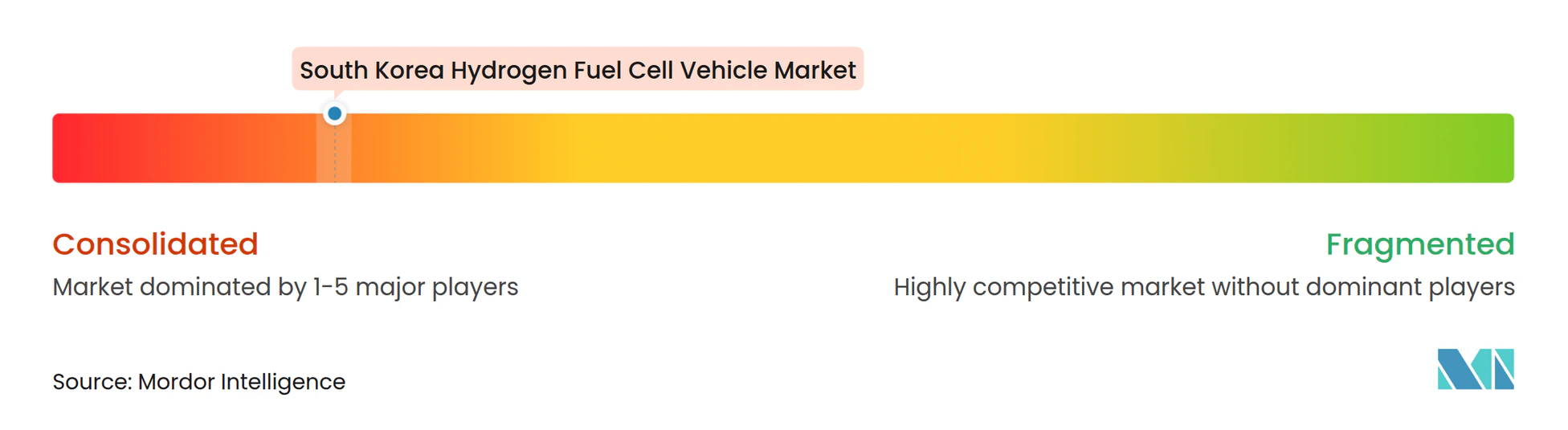
The South Korea hydrogen fuel cell vehicle market is highly concentrated around Hyundai Motor Group. Hyundai links vehicle manufacturing, HTWO fuel-cell systems, Hyundai Mobis components, Hyundai Glovis logistics, and HyNet refueling infrastructure. This structure supports coordination between vehicle output, stack supply, fleet routes, and station development. It also gives Hyundai a cost and implementation advantage that is difficult for standalone entrants to match. Toyota, Honda, Daimler Truck, and Volvo offer fuel-cell vehicles, but their domestic volumes remain well below Hyundai’s. Hyundai sold 6,861 fuel-cell vehicles globally in 2025, up 78.9% year over year, according to SNE Research, underlining its established position in the category.
The first strategic move is Hyundai’s continued use of dedicated commercial-vehicle platforms, including XCIENT trucks and hydrogen buses, to drive fleet demand. The second is its deployment of hydrogen buses, with cumulative domestic hydrogen bus sales passing 3,000 units by March 2026 (3,062 units). The third is vertical coordination through affiliated stack, component, logistics, and station operations. These actions reduce dependence on an isolated retail vehicle business and tie vehicle sales to infrastructure development. After-sales services, stack refurbishment, predictive diagnostics, and warranty support remain potential areas for specialized providers. The first commercial vehicle generation is approaching end-of-warranty periods, which can increase demand for those services.
Component competition is visible in hydrogen tanks, separator plates, membranes, and related stack materials. Hyosung Advanced Materials and Iljin Hysolus are associated with the Type IV tank supply chain, while K-Fuel Cell and other specialists support stack subcomponents. Woojin Industrial Systems provides hydrogen bus platforms that offer procurement alternatives for commercial bus tenders. POSCO, Hanwha, and SK entities support broader hydrogen production and infrastructure activity. Software for route planning, fleet energy management, and stack degradation diagnostics could provide an entry path for firms without vehicle manufacturing assets. The overall competitive pattern remains concentrated because the leading company combines market access, vehicle platforms, parts supply, and refueling relationships.
South Korea Hydrogen Fuel Cell Vehicle Industry Leaders
-
Hyundai Motor Company
-
Hyundai Mobis
-
Iljin Hysolus Co., Ltd.
-
Bumhan Fuel Cell Co., Ltd.
-
Woojin Industrial Systems Co., Ltd.
- *Disclaimer: Major Players sorted in no particular order
South Korea Hydrogen Fuel Cell Vehicle Market Companies Covered in this Report
- Hyundai Motor Company
- Hyundai Mobis
- Kia Corporation
- Toyota Motor Corporation
- Honda Motor Co., Ltd.
- Daimler Truck AG
- Volvo Group
- SK E&S Co., Ltd.
- Korea Gas Corporation
- Doosan Fuel Cell Co., Ltd.
- Iljin Hysolus Co., Ltd.
- Hyosung Heavy Industries Corporation
- Bumhan Fuel Cell Co., Ltd.
- Woojin Industrial Systems Co., Ltd.
- POSCO Future M Co., Ltd.
- Hanwha Solutions Corporation
Recent Industry Developments in South Korea Hydrogen Fuel Cell Vehicle Market
- July 2026: Hyundai Motor Group completed HTWO ENERGY Cheongju, a sewage-sludge waste-to-hydrogen production and refueling facility producing about 500 kg of hydrogen per day.
- April 2026: Hyundai Motor’s cumulative domestic hydrogen bus sales passed 3,000 units, reaching 3,062 by the end of March 2026.
- February 2026: Hyundai Motor’s XCIENT Fuel Cell truck fleet surpassed 20 million kilometers of cumulative operation in Europe.
- January 2026: The Ministry of Climate, Energy and Environment finalized its 2026 guidelines, allocating KRW 576.2 billion for 7,820 hydrogen vehicles and KRW 189.7 billion for refueling infrastructure.
South Korea Hydrogen Fuel Cell Vehicle Market Report Scope
The South Korea Hydrogen Fuel Cell Vehicle Market Report is Segmented by Vehicle Type (Passenger Cars, Light Commercial Vehicles, and Medium and Heavy Commercial Vehicles), Technology (Proton-Exchange-Membrane Fuel Cell, Solid-Oxide Fuel Cell Range Extender, Alkaline Fuel Cell, Phosphoric Acid Fuel Cell, and Other Fuel-Cell Technologies), Power Output (Less Than 100 kW, 100-200 kW, and More Than 200 kW), Driving Range (Short Range, Medium Range, and Long Range), Application (Private Transportation, Public Transportation, Commercial Freight and Logistics, Municipal Waste and Sanitation, Port, Airport, and Industrial Mobility, and Rail and Specialized Mobility), End User Ownership (Individual Consumers, Fleet Operators and Logistics Companies, Public Transit Authorities, Government and Defense Organizations, and Mining, Construction, and Industrial Operators), Component (Fuel-Cell Stack, Membrane Electrode Assembly, and More), and Geography (Seoul Capital Area, Yeongnam, Hoseo, Honam, and Gangwon and Jeju). The Market Forecasts are Provided in Terms of Value (USD) and Volume (Units).
Segmentation Overview
| Passenger Cars | |
| Light Commercial Vehicles | |
| Medium and Heavy Commercial Vehicles | Trucks |
| Buses and Coaches | |
| Municipal and Waste-Collection Vehicles |
| Proton-Exchange-Membrane Fuel Cell |
| Solid-Oxide Fuel Cell Range Extender |
| Alkaline Fuel Cell |
| Phosphoric Acid Fuel Cell |
| Other Fuel-Cell Technologies |
| Less Than 100 kW |
| 100-200 kW |
| More Than 200 kW |
| Short Range, Up to 400 km |
| Medium Range, 401-800 km |
| Long Range, Above 800 km |
| Private Transportation |
| Public Transportation |
| Commercial Freight and Logistics |
| Municipal Waste and Sanitation |
| Port, Airport, and Industrial Mobility |
| Rail and Specialized Mobility |
| Individual Consumers |
| Fleet Operators and Logistics Companies |
| Public Transit Authorities |
| Government and Defense Organizations |
| Mining, Construction, and Industrial Operators |
| Fuel-Cell Stack |
| Membrane Electrode Assembly |
| Bipolar Plate |
| Air Compressor and Humidifier |
| Hydrogen Storage Tanks, Valves, and Regulators |
| Power Electronics, Motor, and Battery |
| Thermal Management and Sensors |
| Seoul Capital Area | Seoul |
| Incheon | |
| Gyeonggi | |
| Yeongnam, Southeastern Region | Busan |
| Ulsan | |
| Gyeongsangnam-do | |
| Daegu and Gyeongsangbuk-do | |
| Hoseo, Central Region | Daejeon |
| Chungcheongnam-do | |
| Chungcheongbuk-do | |
| Honam, Southwestern Region | Gwangju |
| Jeollanam-do | |
| Jeollabuk-do | |
| Gangwon and Jeju | Gangwon |
| Jeju |
| By Vehicle Type | Passenger Cars | |
| Light Commercial Vehicles | ||
| Medium and Heavy Commercial Vehicles | Trucks | |
| Buses and Coaches | ||
| Municipal and Waste-Collection Vehicles | ||
| By Technology | Proton-Exchange-Membrane Fuel Cell | |
| Solid-Oxide Fuel Cell Range Extender | ||
| Alkaline Fuel Cell | ||
| Phosphoric Acid Fuel Cell | ||
| Other Fuel-Cell Technologies | ||
| By Power Output | Less Than 100 kW | |
| 100-200 kW | ||
| More Than 200 kW | ||
| By Driving Range | Short Range, Up to 400 km | |
| Medium Range, 401-800 km | ||
| Long Range, Above 800 km | ||
| By Application | Private Transportation | |
| Public Transportation | ||
| Commercial Freight and Logistics | ||
| Municipal Waste and Sanitation | ||
| Port, Airport, and Industrial Mobility | ||
| Rail and Specialized Mobility | ||
| By End User Ownership | Individual Consumers | |
| Fleet Operators and Logistics Companies | ||
| Public Transit Authorities | ||
| Government and Defense Organizations | ||
| Mining, Construction, and Industrial Operators | ||
| By Component | Fuel-Cell Stack | |
| Membrane Electrode Assembly | ||
| Bipolar Plate | ||
| Air Compressor and Humidifier | ||
| Hydrogen Storage Tanks, Valves, and Regulators | ||
| Power Electronics, Motor, and Battery | ||
| Thermal Management and Sensors | ||
| By Geography | Seoul Capital Area | Seoul |
| Incheon | ||
| Gyeonggi | ||
| Yeongnam, Southeastern Region | Busan | |
| Ulsan | ||
| Gyeongsangnam-do | ||
| Daegu and Gyeongsangbuk-do | ||
| Hoseo, Central Region | Daejeon | |
| Chungcheongnam-do | ||
| Chungcheongbuk-do | ||
| Honam, Southwestern Region | Gwangju | |
| Jeollanam-do | ||
| Jeollabuk-do | ||
| Gangwon and Jeju | Gangwon | |
| Jeju | ||
Key Questions Answered in the Report
What is driving hydrogen fuel cell vehicle adoption in South Korea?
Commercial fleets are driving adoption because buses, trucks, and logistics vehicles can use fixed depot routes and refuel quickly.
How large is the South Korea hydrogen fuel cell vehicle market?
The market was valued at USD 0.33 billion in 2026 and is projected to reach USD 0.86 billion by 2032, at a 17.19% CAGR.
Why do fleet operators use hydrogen fuel cell vehicles?
Fleet operators can plan around depot refueling, need long range, and require higher vehicle availability than many passenger users.
Which region leads hydrogen mobility deployment in South Korea?
The Seoul Capital Area held a 56.87% share in 2026, while the Yeongnam Southeastern Region is projected to grow fastest, at an 18.40% CAGR through 2032.
What limits wider FCEV adoption in South Korea?
Vehicle cost, limited station coverage outside core regions, reliability concerns, and strong battery-electric competition remain the main constraints.