
South Korea Electric Vehicle CNC Turning Centers Market Size and Share
Market Overview
| Study Period | 2020 - 2031 |
|---|---|
| Forecast Data Period | 2026 - 2031 |
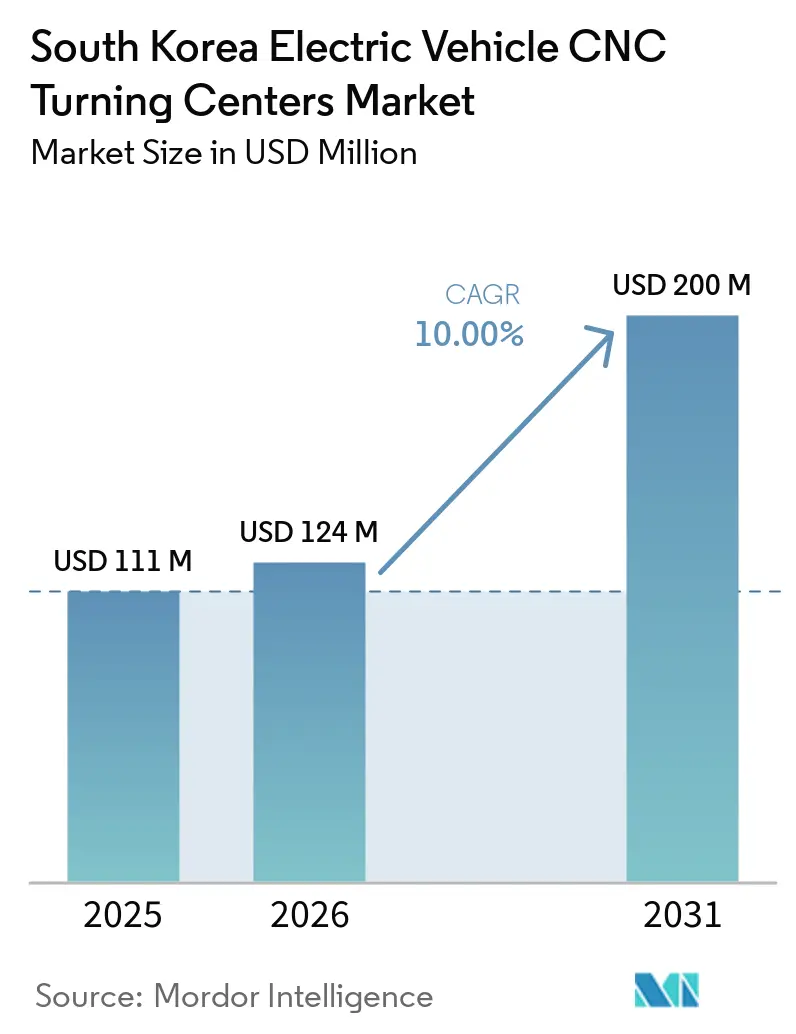
| Base Year Market Size (2025) | USD 111 Million |
| Market Size (2026) | USD 124 Million |
| Market Size (2031) | USD 200 Million |
| Growth Rate (2026 - 2031) | 10.00 % |
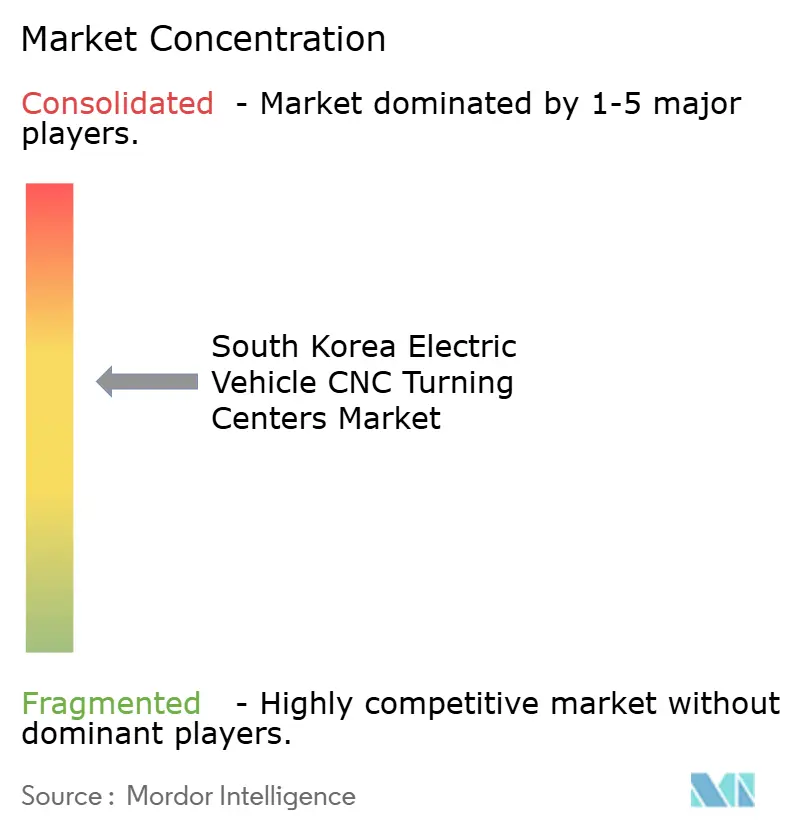
| Market Concentration | Medium |
Major Players *Disclaimer: Major Players sorted in no particular order Image © Mordor Intelligence. Reuse requires attribution under CC BY 4.0. | |
South Korea Electric Vehicle CNC Turning Centers Market Analysis by Mordor Intelligence
The South Korea Electric Vehicle CNC Turning Centers Market size is expected to grow from USD 111 million in 2025 to USD 124 million in 2026 and is forecast to reach USD 200 million by 2031 at 10% CAGR over 2026-2031.
The South Korea electric vehicle CNC turning centers market is supported by the shift in automotive production toward electrified vehicles and the related need for accurately machined parts. Electric vehicles accounted for 13.1% of new vehicle registrations in full-year 2025, with the share increasing to 23% in H1 2026, thereby increasing demand for motor, e-axle, and battery-related components. Hyundai Motor Group is investing KRW 42 trillion (USD 29.5 billion) over 10 years in the Yeongnam region, including an EV-focused plant in Ulsan, which is due to begin operations in Q4 2026, and new Hyundai Mobis production lines in Daegu and Ulsan. This investment should keep machining demand connected to domestic final assembly and the export supply chain. The South Korea electric vehicle CNC turning centers market also benefits when manufacturers replace separate machining steps with automated, connected equipment that improves process control.
Key Report Takeaways
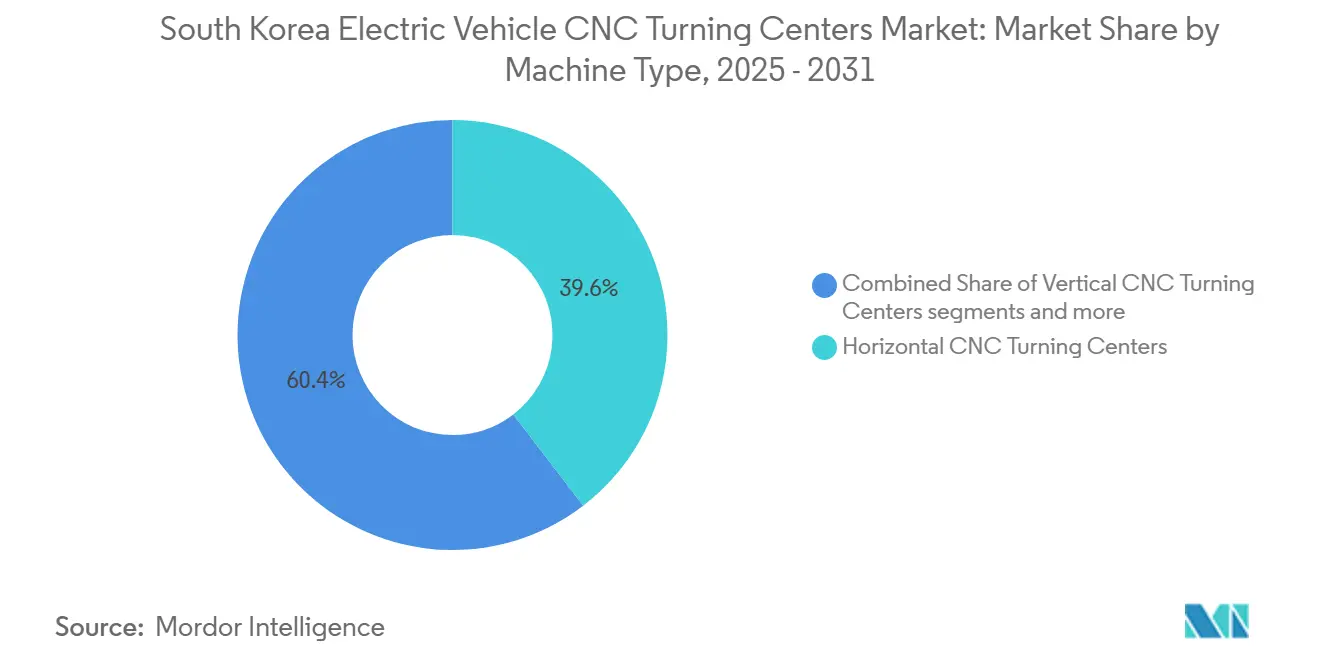
- By machine type, horizontal CNC turning centers held 39.6% of the South Korea electric vehicle CNC turning centers market share in 2025, while multi-tasking turn-mill centers are projected to grow at a 12.1% CAGR through 2031.
- By component application, electric motor components accounted for 34.7% of the South Korea electric vehicle CNC turning centers market size in 2025, while battery system components are forecast to advance at an 11.3% CAGR through 2031.
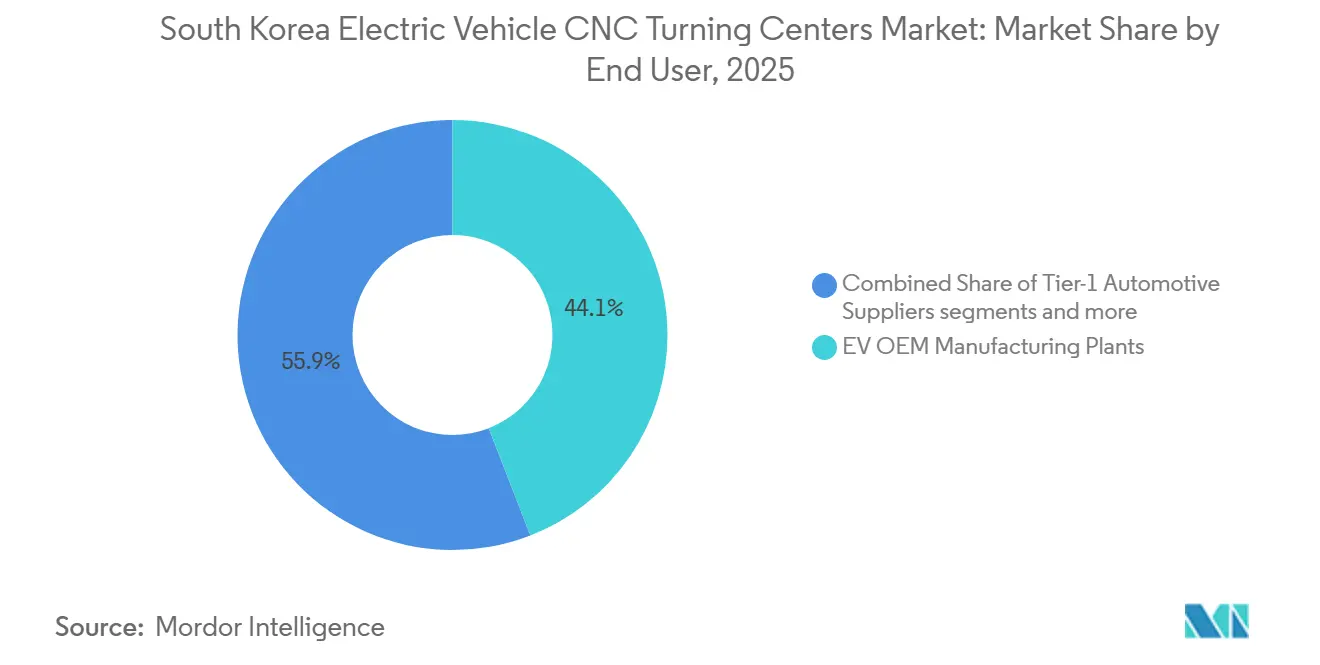
- By end user, EV OEM manufacturing plants held 44.1% share in 2025, while Tier-2 component manufacturers are forecast to expand at an 11.2% CAGR through 2031.
Note: Market size and forecast figures in this report are generated using Mordor Intelligence’s proprietary estimation framework, updated with the latest available data and insights as of January 2026.
South Korea Electric Vehicle CNC Turning Centers Market Trends and Insights
Drivers Impact Analysis*
| Driver | (~) % Impact on CAGR Forecast | Geographic Relevance | Impact Timeline |
|---|---|---|---|
| Rapid EV Powertrain Manufacturing Expands Precision Turning Center Demand | +2.8% | National, concentrated in Ulsan, Gwangmyeong, and Hwaseong | Short term (≤ 2 years) |
| Strong Semiconductor and Automotive Ecosystem Accelerates CNC Modernization | +2.0% | National, with export spillover into APAC | Medium term (2-4 years) |
| Government Support for Smart Manufacturing Boosts Advanced Machine Tool Adoption | +1.5% | National, with early gains in Daegu, Ulsan, and Gyeongnam | Medium term (2-4 years) |
| Growing Production of E-Motors and Reduction Gear Components Increases Precision Machining Needs | +1.3% | National, concentrated in Gyeongnam and Chungnam | Short term (≤ 2 years) |
| Rising Deployment of Multi-Axis CNC Turning Centers Enhances Factory Productivity | +0.8% | National, concentrated in Tier-1 Gyeonggi plants | Medium term (2-4 years) |
| Expansion of Battery Manufacturing Strengthens Demand for High-Accuracy Machined Components | +0.7% | Ulsan and North Chungcheong battery clusters | Long term (≥ 4 years) |
| Source: Mordor Intelligence | |||
Rapid EV Powertrain Manufacturing Expands Precision Turning Center Demand
South Korea registered 220,177 electric vehicles in full-year 2025, up 52.2% from the prior year, and EVs accounted for 13.1% of total vehicle registrations in full-year 2025. The share increased to 23% in H1 2026, indicating a larger production and component base for the South Korean electric-vehicle CNC turning centers market. Hyundai Motor Group’s new Ulsan EV-dedicated plant is intended to add 200,000 units of annual capacity when operations begin in Q4 2026. EV assembly requires repeatable production of motor shafts, differential housings, and e-axle flanges. These components require consistent dimensional accuracy and stable feed rates across high-volume production cycles. Hyundai’s introduction of extended-range EV platforms in 2026 also preserves machining content for both electric and combustion systems.
Strong Semiconductor and Automotive Ecosystem Accelerates CNC Modernization
The South Korea electric vehicle CNC turning centers market is supported by a strong domestic machine-tool manufacturing base serving automotive and other precision-manufacturing industries. Data from the Korea Machine Tool Manufacturers’ Association (KMTMA) showed machine tool orders totaling KRW 1.1924 trillion (USD 0.84 billion) from January through April 2026, including KRW 798.1 billion (USD 561.3 million) in overseas orders. Strong machine-tool order activity indicates continued investment in advanced manufacturing capacity and supports the availability of higher-precision CNC equipment for automotive component production. As EV suppliers expand production of precision components such as shafts, gears, housings, and other rotational parts, demand can shift toward CNC turning centers offering tighter tolerances, greater automation, and higher process consistency. This supports modernization of South Korea’s automotive precision-machining base and strengthens the adoption potential for advanced CNC turning centers in EV component manufacturing.
Government Support for Smart Manufacturing Boosts Advanced Machine Tool Adoption
The Smart Manufacturing Innovation Initiative had a 2025 budget of USD 175 million, with 95% allocated directly to smart-factory adoption.[1]Organisation for Economic Co-operation and Development, “Korea’s Smart Manufacturing Innovation Initiative,” OECD, oecd.org. The 2026 Manufacturing AX program provides KRW 700 billion (USD 492.34 million) for manufacturing AI and factory applications, with a further KRW 700 billion (USD 492.34 million) committed by 2032. The 2026 support cycle includes 30 Autonomous Factory projects and 400 AI-specialized smart-factory implementations.[2]Ministry of SMEs and Startups, “2026 Smart Manufacturing Innovation Support Program,” Ministry of SMEs and Startups, mss.go.kr. These programs can reduce the gap in connected manufacturing technology between large OEMs and smaller suppliers. The Smart Manufacturing Innovation Promotion Act also makes data interoperability an important consideration for equipment that receives public support. As a result, Tier-2 suppliers may give greater weight to connectivity and process-data functions when choosing turning centers.
Growing Production of E-Motors and Reduction Gear Components Increases Precision Machining Needs
POSCO International is building a traction motor core production network with a target capacity of 7.5 million units a year by 2030, with Cheonan and Pohang supporting the domestic base. The company also secured an order for 1.03 million units for Hyundai and Kia’s European EV production. Daedong Gear accumulated KRW 1.7 trillion (USD 1.2 billion) in EV and hybrid component orders across 2024 and 2025, and 78% related to electric and next-generation hybrid programs. It began full mass production of EV components in 2026. Hyundai Mobis is establishing a motor and control-unit line in Daegu under the Yeongnam regional plan.[3]Hyundai Motor Group, “Kia to Strengthen Growth Engine Through Launch of New EV, PBV and Next-Gen Technologies,” Hyundai Motor Group Newsroom, hyundaimotorgroup.com. These programs increase demand for accurate turning of motor and gear components, especially where thermal stability and vibration control are required.
Restraints Impact Analysis*
| Restraint | (~) % Impact on CAGR Forecast | Geographic Relevance | Impact Timeline |
|---|---|---|---|
| High Investment Costs Limit Adoption Among Small Component Manufacturers | -2.2% | National, especially Tier-2 and Tier-3 SME clusters in Gyeongbuk and Jeonnam | Short term (≤ 2 years) |
| Dependence on Imported Premium CNC Technologies for Specialized Applications | -1.8% | National, with elevated risk in export-oriented Gyeonggi plants | Medium term (2-4 years) |
| Rising Labor and Manufacturing Costs Pressure Equipment Investments | -1.2% | National, concentrated in Ulsan and the greater Seoul industrial zones | Medium term (2-4 years) |
| Demand Volatility in the Automotive Sector Delays Capacity Expansion Decisions | -0.8% | National, with spillover into the Gyeonggi and Gyeongnam plant networks | Long term (≥ 4 years) |
| Source: Mordor Intelligence | |||
High Investment Costs Limit Adoption Among Small Component Manufacturers
Multi-axis and multi-tasking turning centers for EV component production typically cost USD 500,000 to USD 2 million. Fully automated cells can cost materially more, straining the capital budgets of Tier-2 and Tier-3 suppliers. The smart-manufacturing co-investment program can cover 50% to 80% of qualifying equipment procurement and installation costs, but qualification and documentation requirements can delay projects. The process can take 6 to 18 months, which leaves smaller companies with a slower adoption path. Many manufacturers also operate conventional lathes or earlier-generation turning centers that still compete for maintenance and replacement budgets. This makes the case for a premium replacement more difficult when subsidies do not close the full cost gap.
Dependence on Imported Premium CNC Technologies for Specialized Applications
Domestic machine tool production remains important, but premium controllers, spindle assemblies, and thermal-compensation systems are still supplied largely by Japanese and German firms. These components are relevant for high-accuracy motor shaft and e-axle applications. Dependence on imported technologies exposes equipment purchasers to currency movements and changing delivery times. Extended controller lead times during the post-COVID disruption delayed commissioning at Korean Tier-1 plants. The Korea Institute for Advancement of Technology and the Ministry of Trade, Industry, and Energy have identified controller localization as a priority. However, local alternatives for the highest-precision EV powertrain applications remain in their early stages, so this exposure is likely to continue in the medium term.
*Our forecasts treat driver/restraint impacts as directional, not additive. The impact forecasts reflect baseline growth, mix effects, and variable interactions.
Segment Analysis
By Machine Type: Horizontal Models Lead Volume, Multi-Tasking Changes the Value Mix
Horizontal CNC turning centers accounted for 39.6% of the South Korea electric vehicle CNC turning centers market in 2025. Their position reflects established use in high-volume production of rotor shafts, drive shafts, and e-axle housings. These parts require reliable feed rates and chip removal over repeat production cycles. DN Solutions’ PUMA series and Hwacheon’s Hi-TECH models are used across OEM and Tier-1 production lines for these applications. Vertical CNC turning centers serve larger, disc-shaped parts, including brake rotors and battery-module end plates. Their role remains steady within capital plans for suppliers that produce heavy automotive and energy components.
Multi-tasking turn-mill centers are forecast to grow at a 12.1% CAGR through 2031 within the South Korea electric vehicle CNC turning centers market. They combine turning, milling, and multi-sided operations in a single setup, reducing the need for repeated workpiece handling. This is relevant for integrated e-axle housings with bored features and intersecting slots. The South Korean electric-vehicle CNC turning centers industry is therefore moving toward equipment that can perform multiple operations without repositioning the part. Swiss-type CNC turning centers are used to machine small, precise components such as battery contact pins, sensor housings, and micro-connectors. Their demand rises with the number of electrical connections and control components used in battery management systems.



By Component Application: Electric Motor Components Anchor Demand, Battery Machining Accelerates
Electric motor components accounted for 34.7% of the South Korea electric vehicle CNC turning centers market share in 2025. The category includes stator housings, rotor shafts, and motor end shields that require precise, repeatable machining. Motor shaft concentricity requirements can direct buyers toward multi-axis machines with thermal-compensation capability rather than general-purpose equipment. Daedong Gear’s Sacheon facility uses clean production conditions and gear honing for EV motor rotor shafts. This operating model highlights the production standards associated with noise and vibration control in electric motors. E-axle and transmission components also require complex turning because integrated housings combine motor, inverter, and reduction-gear functions.
Battery system components are forecast to expand at an 11.3% CAGR through 2031. Investment in domestic cell production creates related demand for machined module housings and cooling-channel components. The South Korean electric vehicle CNC turning centers industry has an opportunity in equipment configured for aluminum structures and related battery-cooling parts. Domestic manufacturers are also building battery-related production capacity in Ulsan and other industrial areas. The other application category includes aftermarket tooling holders and test-bench components for EV research and development. It remains smaller in value but receives support from continued domestic vehicle and component design activity.
By End User: OEM Plants Drive Volume, Tier-2 Suppliers Support Growth
EV OEM manufacturing plants held 44.1% of the South Korea electric vehicle CNC turning centers market share in 2025. Their equipment spending reflects the size and capital intensity of Hyundai Motor Group and Kia production complexes. Kia’s Gwangmyeong EVO Plant began operations in late 2024, while the Hwaseong EVO Plant started PV5 production in July 2025. These plants are major sources of demand for direct and supplier-linked CNC equipment. Tier-1 automotive suppliers maintain an important installed base of equipment for high-volume powertrain parts. Their procurement cycles generally follow the launch timing of new OEM vehicle platforms.
Tier-2 component manufacturers are projected to grow at an 11.2% CAGR through 2031. OEM outsourcing of precision-machined subassemblies can shift equipment investment toward independent suppliers. This group may also have stronger access to smart-manufacturing co-investment than captive OEM facilities. The South Korea electric vehicle CNC turning centers market, therefore, has a wider group of potential equipment buyers than final assembly plants alone. Precision contract manufacturers serve prototype and pre-series requirements that do not fit large-volume lines. Their role supports flexible machining demand alongside the volume requirements of OEMs and Tier-1 suppliers.
Geography Analysis
Gyeongnam is a leading demand cluster for the South Korea electric vehicle CNC turning centers market because it brings together production activities in Changwon, Sacheon, and Busan. Changwon is the headquarters location of DN Solutions, while Sacheon hosts Daedong Gear’s EV component facility. Hyundai Motor Group’s Yeongnam program includes a Hyundai WIA thermal-management line in Changwon and a Hyundai Mobis motor-and-control-unit line in Daegu. This group of investments supports ongoing equipment procurement for component production. The region also benefits from its existing machine tool and automotive supply base.
Greater Gyeonggi is another major demand center, covering the Hwaseong, Gwangmyeong, and Goyang industrial corridors. Kia production in Gwangmyeong and Hwaseong supports CNC procurement by nearby suppliers. Kia is targeting production of 2.63 million EVs in Korea between 2026 and 2030. The area is also closely connected to semiconductor zones in Icheon and Pyeongtaek. This proximity can speed the adoption of advanced precision equipment across automotive component plants. Goyang remains an important location for machine tool procurement because it hosts major industry exhibitions and supplier activity.
Ulsan has a distinct role because it concentrates final vehicle assembly. Ulsan continues to advance smart-factory adoption through government-supported smart manufacturing programs, with the city providing financial and technical support to local small and medium-sized manufacturers for smart-factory deployment. The Ulsan EV-dedicated plant is planned to begin operations in the fourth quarter of 2026, with an annual capacity of 200,000 units. This facility supports demand for horizontal and multi-tasking turning centers at OEM operations and Tier-1 suppliers. Hyundai Mobis is also establishing a battery-system assembly line in Ulsan. Chungnam and Incheon provide additional demand through battery manufacturing and precision contract machining, although their current contribution remains smaller than that of the Gyeongnam, Gyeonggi, and Ulsan corridor.
Competitive Landscape
The South Korean electric-vehicle CNC turning centers market exhibits a medium level of market concentration with established service coverage and automotive relationships. DN Solutions, SMEC, Hwacheon Machinery, Hanwha Precision Machinery, and Korea Machine Tool Co. have an important domestic installed base across OEM and Tier-1 facilities. Their proximity enables shorter service response times and application support for local plants. International suppliers compete more heavily in premium or specialized applications. DMG MORI and Mazak serve high-mix multi-tasking requirements, while EMAG and INDEX address vertical pick-up turning applications. Tsugami, Citizen Machinery, Star Micronics, and Nakamura-Tome serve smaller Swiss-type and sub-spindle applications.
Hyundai WIA’s 2025 sale of its machine tool division changed the domestic supplier structure. The company directed KRW 1.7 trillion (USD 1.2 billion) toward thermal management, robotics, and EV component production for 2026 through 2028 after the divestment. This changes Hyundai WIA’s position from machine tool supplier to a potential customer for equipment used in EV component production. DN Solutions has continued to strengthen its international position and has sold more than 290,000 machines across 66 countries by 2025. It also expanded its premium European portfolio through the acquisition of HELLER. These actions support its ability to offer broader automation and machining solutions to automotive customers.
Competition increasingly depends on the ability to offer connected equipment, technical support, and applications for new EV component designs. The Ministry of SMEs and Startups plans 30 Autonomous Factory projects in 2026, which creates funded demand for equipment that supports automated process control. Suppliers with predictive-maintenance and connected-machine capabilities are well placed to address these projects. Battery module structures and cooling components also represent a product-development opportunity for turning center suppliers. Energy-efficiency standards for industrial equipment increasingly factor into procurement decisions at OEM plants, where newer CNC turning centers offer measurable reductions in power consumption versus legacy machines. The South Korea electric vehicle CNC turning centers market remains open to domestic and overseas suppliers, but local service and application engineering remain important competitive factors.
South Korea Electric Vehicle CNC Turning Centers Industry Leaders
DN Solutions Co., Ltd.
SMEC Co., Ltd.
Hwacheon Machinery Co., Ltd.
Hanwha Precision Machinery Co., Ltd.
- *Disclaimer: Major Players sorted in no particular order

Recent Industry Developments
- July 2026: Hyundai Motor Group unveiled a KRW 42 trillion (USD 29.54 billion) 10-year investment blueprint for Korea's Yeongnam region, including the Ulsan EV-dedicated plant, scheduled to begin operations in the fourth quarter of 2026; a Hyundai Mobis motor and control unit production line in Daegu; and a Hyundai Mobis battery system assembly line in Ulsan.
- June 2026: Korea Machine Tool Manufacturers' Association reported that total machine tool orders from January to April 2026 reached KRW 1.1924 trillion (USD 0.84 billion), up 11.2% year on year, while overseas orders reached KRW 798.1 billion (USD 561.34 million), up 23.3%.
- February 2026: Daedong Gear's fully automated EV component smart factory in Sacheon entered full operation with 42 processing lines and uses clean production protocols and gear honing for EV motor rotor shafts.
- December 2025: South Korea announced the KRW 700 billion (USD 492.34 million) Manufacturing AI transformation program for 2026, covering AI model development for automobiles and AI factories, with a further KRW 700 billion (USD 492.34 million) committed by 2032.


South Korea Electric Vehicle CNC Turning Centers Market Report Scope
| Horizontal CNC Turning Centers |
| Vertical CNC Turning Centers |
| Multi-Tasking Turn-Mill Centers |
| Swiss-Type CNC Turning Centers |
| Others |
| Electric Motor Components |
| E-Axles & Transmission Components |
| Battery System Components |
| Others |
| EV OEM Manufacturing Plants |
| Tier-1 Automotive Suppliers |
| Tier-2 Component Manufacturers |
| Precision Contract Manufacturers |
| By Machine Type | Horizontal CNC Turning Centers |
| Vertical CNC Turning Centers | |
| Multi-Tasking Turn-Mill Centers | |
| Swiss-Type CNC Turning Centers | |
| Others | |
| By Component Application | Electric Motor Components |
| E-Axles & Transmission Components | |
| Battery System Components | |
| Others | |
| By End User | EV OEM Manufacturing Plants |
| Tier-1 Automotive Suppliers | |
| Tier-2 Component Manufacturers | |
| Precision Contract Manufacturers |


Key Questions Answered in the Report
What is the projected growth rate for South Korea electric vehicle CNC turning centers?
The South Korea electric vehicle CNC turning centers market is forecast to grow at a 10% CAGR from 2026 to 2031, reaching USD 200 million by 2031.
Which machine type leads demand in South Korea?
Horizontal CNC turning centers led with 39.6% share in 2025 because they support repeat production of shafts and housings.
Which application is growing fastest?
Battery system components are forecast to grow at an 11.3% CAGR through 2031, supported by demand for module housings and cooling-related parts.
Which end users create the strongest equipment demand?
EV OEM manufacturing plants held 44.1% share in 2025, while Tier-2 component manufacturers are projected to expand at an 11.2% CAGR.
Which Korean regions have the largest CNC turning center demand?
Gyeongnam, Greater Gyeonggi, and Ulsan are the key demand clusters because they combine machine tool supply, EV component production, and final assembly.
What limits adoption of advanced CNC turning centers?
High capital costs, imported premium controls and spindle systems, rising manufacturing costs, and automotive demand volatility can slow investment decisions.
Page last updated on:





