
South Korea Electric Motorcycle Market Size and Share
Market Overview
| Study Period | 2019 - 2032 |
|---|---|
| Forecast Data Period | 2027 - 2032 |
| Base Year Market Size (2026) | USD 95.73 Million |
| Market Size (2027) | USD 111.25 Million |
| Market Size (2032) | USD 235.78 Million |
| Growth Rate (2027 - 2032) | 16.21 % |
| Market Concentration | Medium |
Major Players *Disclaimer: Major Players sorted in no particular order Image © Mordor Intelligence. Reuse requires attribution under CC BY 4.0. | |
South Korea Electric Motorcycle Market Analysis by Mordor Intelligence
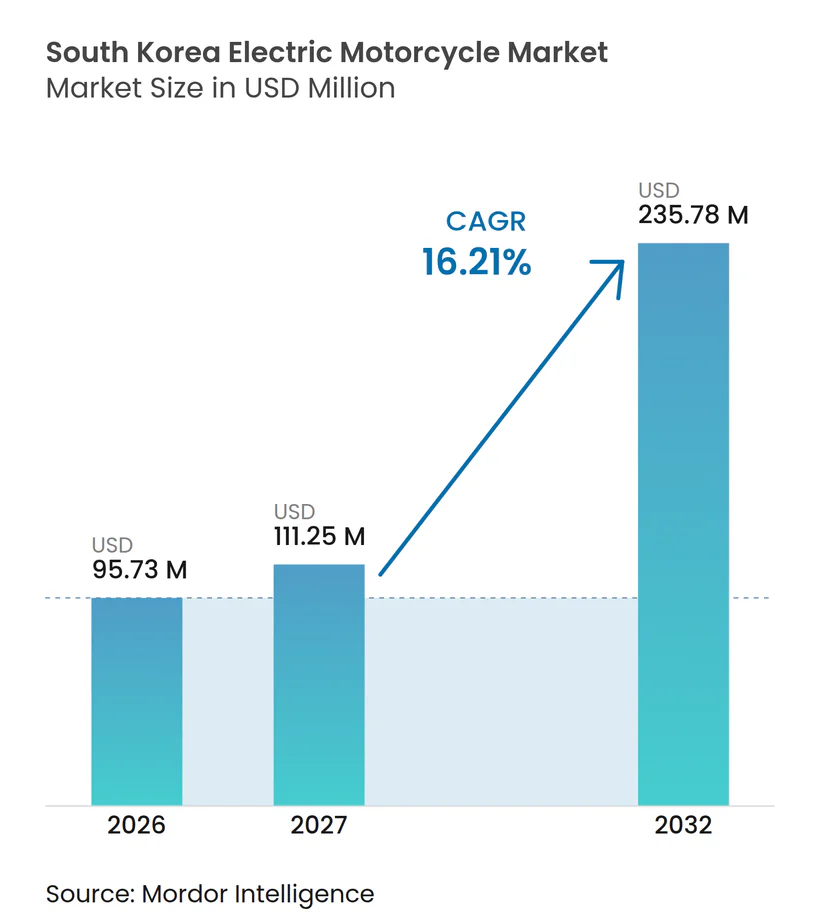
The South Korea electric motorcycle market size was valued at USD 95.73 million in 2026 and is expected to grow from USD 111.25 million in 2027 to USD 235.78 million by 2032, at a CAGR of 16.21% during 2027-2032. Government purchase support, delivery fleet commitments, and wider battery-swapping coverage are shaping the South Korea electric motorcycle market. The subsidy formula rewards certified single-charge ranges of 90 km or more, placing greater emphasis on usable range and battery performance. Under a recent public-private agreement, delivery platforms and logistics operators are linking vehicle procurement with charging access and fleet operations. Infrastructure operators stand to benefit as commercial riders require energy access suited to long daily routes. Domestic manufacturers also have room to differentiate through locally assembled models, service coverage, and products suited to provincial plug-in use.
Key Report Takeaways
- By battery type, non-LFP lithium-ion held a 78.48% share of the South Korea electric motorcycle market in 2026, while lithium iron phosphate is projected to grow at a 17.11% CAGR through 2032.
- By voltage, the 48-60 V category held a 46.19% share of the South Korea electric motorcycle market in 2026, while the above-96 V category is projected to grow at a 16.52% CAGR through 2032.
- By peak power, the 3-6 kW category held a 45.29% share of the South Korea electric motorcycle market in 2026, while the above-10 kW category is projected to grow at an 18.29% CAGR through 2032.
- By battery format, removable and plug-in batteries held a 57.38% share of the South Korea electric motorcycle market in 2026, while battery-swappable formats are projected to grow at an 18.78% CAGR through 2032.
- By motor placement, hub motors held a 76.87% share of the South Korea electric motorcycle market in 2026, while chassis-mounted and mid-drive motors are projected to grow at a 16.78% CAGR through 2032.
- By usage, commercial use held a 58.39% share of the South Korea electric motorcycle market in 2026 and is projected to grow at an 18.34% CAGR through 2032.
- By application, urban mobility held a 73.14% share of the South Korea electric motorcycle market in 2026, while shared mobility is projected to grow at an 18.86% CAGR through 2032.
Note: Market numbers in this report are based on Mordor Intelligence's proprietary estimation framework, which combines nine months of actuals with Q4 projections for base year 2026.
Market Trends and Insights
Drivers Impact Analysis of South Korea Electric Motorcycle Market*
| Driver | (~) % Impact on CAGR Forecast | Geographic Relevance | Impact Timeline |
|---|---|---|---|
| Government Purchase Subsidies and Battery-Swap Infrastructure Support | +4.2% | National, with concentrated gains in Seoul, Gyeonggi, and major metropolitan cities | Short term (≤ 2 years) |
| Delivery-Fleet Electrification and Reduced Charging Downtime | +3.8% | National, with the highest density in Seoul-Gyeonggi delivery corridors | Medium term (2–4 years) |
| Urban Congestion, Parking Friction, and Lower Operating Cost | +2.6% | Seoul, Busan, Daegu, Incheon, and other Tier-1 urban centers | Short term (≤ 2 years) |
| Battery-Diagnostics, Connected Fleet Management, and Smart-Mobility Adoption | +1.9% | Seoul metropolitan area, with spillover to secondary cities | Medium term (2–4 years) |
| Retrofit Pathways for Existing Gasoline Motorcycles | +1.2% | National, with early concentration in high-density delivery zones | Long term (≥ 4 years) |
| Noise-Complaint Reduction as a Local Government Adoption Trigger | +0.8% | Seoul, Gyeonggi, and residential-dense metropolitan areas | Short term (≤ 2 years) |
| Source: Mordor Intelligence | |||
Government Purchase Subsidies and Battery-Swap Infrastructure Support
Government support plays a central role in the South Korea electric motorcycle market by reducing purchase barriers and funding the energy network used by high-use riders. The Ministry of Climate, Energy and Environment has allocated funds for electric motorcycles and battery-swap charging stations, while also raising coverage for battery-swappable vehicle purchases [1]. The 2026 guidelines add KRW 10,000 per km for small-class models with a single-charge range of 90 km or more and deduct KRW 35,000 per km below that threshold, giving manufacturers an incentive to improve certified range. Battery-swap stations must meet KS standards to qualify for infrastructure support.
Delivery-Fleet Electrification and Reduced Charging Downtime
Commercial delivery demand is a major source of volume for the South Korea electric motorcycle market. In February 2026, the Ministry of Climate, Energy and Environment signed an agreement with delivery platforms and logistics operators. The agreement targets electric motorcycles for 25% of newly registered delivery motorcycles by 2030 and 60% by 2035 [2]. Daedong Mobility joined the initiative and committed to supplying purpose-built delivery models and supporting battery-swap infrastructure. Battery swapping allows riders to exchange a battery in under 60 seconds, supporting daily routes of 150-200 km. Battery-as-a-Service subscriptions can separate battery ownership from vehicle purchase and bundle maintenance, battery health, stations, and fleet tools.
Urban Congestion, Parking Friction, and Lower Operating Cost
Dense urban areas create a practical case for electric motorcycles in Korea. Two-wheelers avoid congestion on short urban delivery trips and need far less parking space than cars, while electricity costs per kilometer are well below gasoline. Daedong Mobility stated that its GS100 Lite could save up to about KRW 1.5 million per year in fuel and maintenance costs compared with gasoline alternatives. The government is also examining electric drivetrain retrofits for gasoline motorcycles. These factors support electric motorcycle adoption in residential and delivery zones.
Battery-Diagnostics, Connected Fleet Management, and Smart-Mobility Adoption
Data services are becoming more important to the South Korea electric motorcycle market as fleets look beyond vehicle specifications. LG Energy Solution's KooRoo system collects charging and discharging data to monitor battery condition, estimate residual value, and help prevent electrical faults in wet conditions. Daedong Mobility's GS100 Lite Plug-in has a 92% localization rate, according to the company. Samsung SDI began mass-producing 4695 cylindrical batteries for micromobility in March 2025, with initial deliveries to a United States customer. Connected diagnostics can reduce unexpected downtime and improve decisions on battery replacement, usage, financing, and subscription management. These tools make energy and data services more important alongside the vehicle.
Restraints Impact Analysis of South Korea Electric Motorcycle Market*
| Restraint | (~) % Impact on CAGR Forecast | Geographic Relevance | Impact Timeline |
|---|---|---|---|
| Upfront Price Premium and Subsidy-Budget Dependence | -3.1% | National, structural across all regions | Medium term (2–4 years) |
| Range Mismatch Between Typical Vehicle Capability and Full-Time Delivery Duty Cycles | -2.6% | National, acute in nonmetropolitan areas with low battery-swap density | Short term (≤ 2 years) |
| Fragmented Battery-Swap Standards and Compatibility Risk | -1.8% | National, concentrated where multiple battery-swap operators compete | Medium term (2–4 years) |
| Residual-Value, Battery-Health, and Used-Vehicle Financing Uncertainty | -1.4% | National, more acute in commercial fleet procurement | Long term (≥ 4 years) |
| Source: Mordor Intelligence | |||
Upfront Price Premium and Subsidy-Budget Dependence
Electric motorcycle affordability in South Korea remains dependent on public subsidies in many purchase decisions. Registered electric motorcycle counts were below the annual subsidy target in recent periods. The maximum government subsidy cap remained fixed per vehicle, while local government additions varied by district. This creates unequal effective purchase prices and exposes the South Korea electric motorcycle market to annual budget decisions. Battery health and residual value also add uncertainty to used-vehicle financing and fleet procurement. In July 2026, Cycloid's Badream service raised KRW 500 million from AXE Ventures to expand its subscription offerings, which bundle vehicle access, subsidy processing, maintenance, and fleet management.
Range Mismatch Between Typical Vehicle Capability and Full-Time Delivery Duty Cycles
Range limitations remain a direct operational barrier in the South Korea electric motorcycle market. Full-time delivery riders often travel more than 100 km daily, while many available electric models provide 70-80 km per charge. This gap can prevent a rider from completing a shift without reliable access to battery exchange or charging. The subsidy formula rewards a longer certified range, but higher battery density can increase cost or weight. The KS R framework covers battery packs, charging stations, and vehicle interfaces, though users of non-certified hardware may not qualify for subsidies. Certified systems can reduce compatibility risk, but accessible systems are also needed outside the largest metropolitan areas.
*Our forecasts treat driver/restraint impacts as directional, not additive. The impact forecasts reflect baseline growth, mix effects, and variable interactions.
South Korea Electric Motorcycle Market Segment Analysis
By Battery Type:
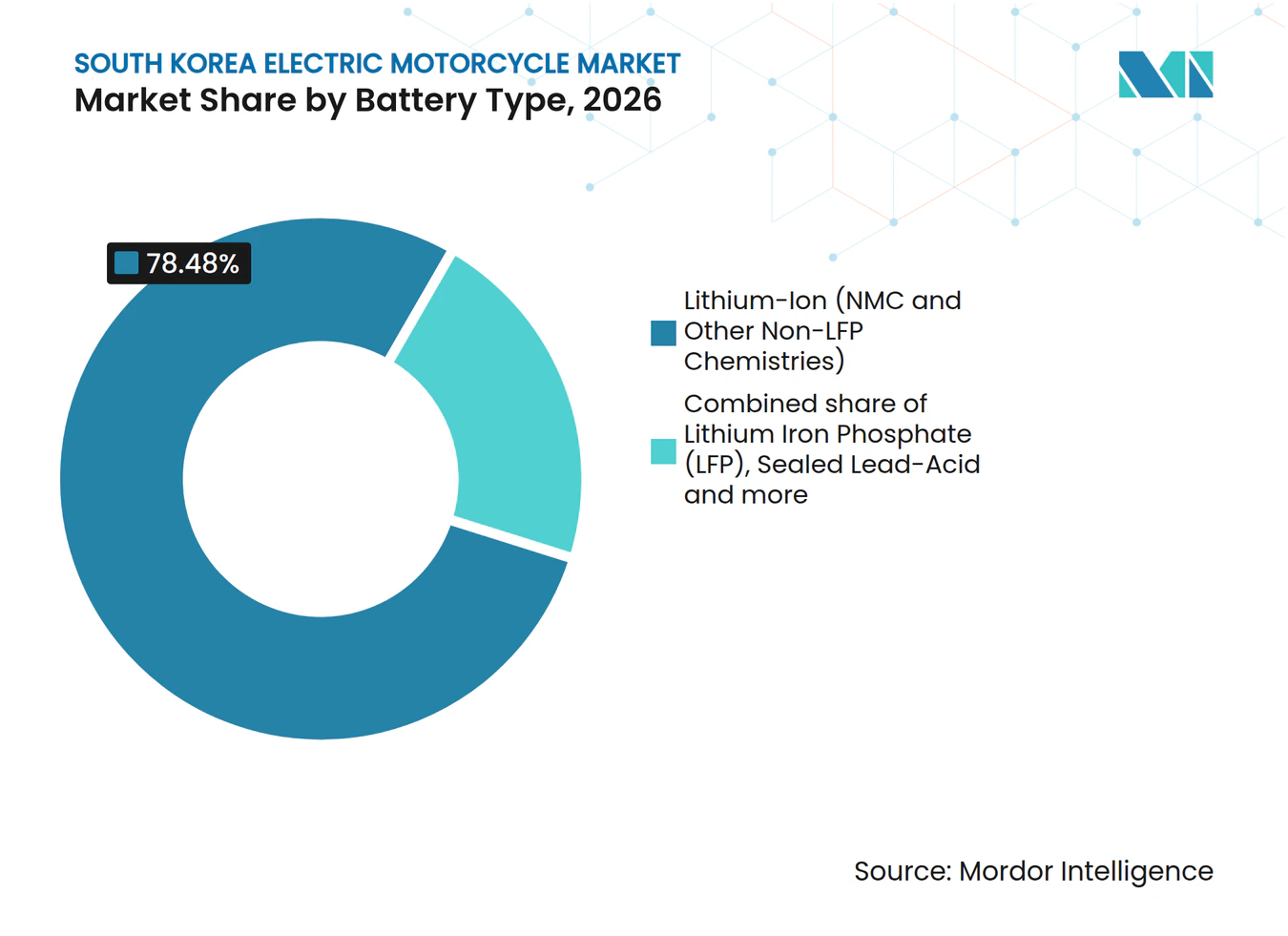
Non-LFP Lithium-Ion Leads, LFP Redefines Fleet EconomicsLithium-ion (NMC and other non-LFP chemistries) held a 78.48% share of the South Korea electric motorcycle market in 2026. Its position reflects high energy density, established cycle-life performance, and integration with Korea's battery manufacturing base. Demand for non-LFP lithium-ion is supported by certified swap systems that use lithium-ion packs. Lithium iron phosphate (LFP) is the fastest-growing battery type and is projected to grow at a 17.11% CAGR through 2032. Its lower cell cost and thermal stability appeal to cost-sensitive fleet buyers. The choice between non-LFP lithium-ion and LFP reflects a balance between energy density and fleet economics.
Sealed lead-acid batteries retain a limited role in low-cost entry products outside the subsidy-supported tier. These products are more relevant to private or leisure users for whom weight and charge time are less important. Nickel metal hydride has a negligible position because it compares poorly with lithium chemistries in terms of cost and weight. KooRoo became the first Korean operator with KS certification for battery-swap packs and stations in March 2025. Its network uses lithium-ion packs, which reinforces the chemistry's place in the policy-supported segment. LFP can gain ground where lower ownership costs carry more weight than maximum energy density.



By Voltage:
48-60 V Anchors the Market, High-Voltage Tier AcceleratesThe 48-60 V category held a 46.19% share of the South Korea electric motorcycle market in 2026. It is the standard configuration for small and midsize registered scooters used in urban delivery fleets. This voltage range balances battery weight, station charger availability, and manufacturing cost. The 61-72 V and 73-96 V categories serve heavier commercial scooters and premium commuter products. Together, they account for the remaining value outside the leading 48-60 V tier. The category structure reflects the different power and range needs of users.
The above-96 V category is projected to grow at a 16.52% CAGR through 2032. Higher-voltage products can support faster, heavier-duty riding, where users accept a more demanding specification. The 2026 subsidy formula favors longer single-charge range, which can shift purchases away from low-voltage and short-range products. Below-48 V models remain relevant to light-duty and entry-level personal use. Higher-voltage models will depend on whether their added performance is matched by affordability and charging support. This allows the South Korea electric motorcycle market to retain a broad product range while commercial demand moves toward higher specifications.
By Peak Power:
3-6 kW Segment Is Structural Core, High-Power Band Grows FastestThe 3-6 kW category held a 45.29% share of the South Korea electric motorcycle market in 2026. It matches the usual performance needs of urban delivery scooters and registered commuter models. The 2026 subsidy guidelines raised the innovation incentive for models supporting 3 kW or faster charging from KRW 50,000 to KRW 250,000, rewarding products built for intensive delivery use. The 7-10 kW category serves intermediate performance needs. It is expected to grow broadly in line with the overall sector.
The above-10 kW category is projected to grow at an 18.29% CAGR through 2032. It serves performance-oriented private riders and commercial users with higher torque requirements. This tier addresses demands that sub-6 kW motors cannot meet. The below-3 kW category is used for light-duty applications that may fall outside standard registration requirements in many municipalities. Demand for high-power models must be considered alongside their higher purchase cost and intensive operating requirements. As delivery work becomes more demanding, buyers may show greater interest in power bands that support heavier loads and longer routes.
By Battery Format:
Removable and Plug-In Holds the Volume Base, Swappable Moves FastestRemovable and plug-in batteries held a 57.38% share of the South Korea electric motorcycle market in 2026. The format suits private users and nonfleet commercial operators who can charge at home or through standard outlets overnight. Daedong Mobility launched the GS100 Lite Plug-in in 2025 for nonmetropolitan users without access to swap stations. This design addresses both a geographic and a user-access gap. Nonremovable formats remain the smallest category. Users remain cautious about depending on fixed charging infrastructure.
Battery-swappable formats are projected to grow at an 18.78% CAGR through 2032. Their growth is supported by Seoul's 2025 increase in the city subsidy for delivery and shared battery-swap models from 10% to 30%. LG Energy Solution, which was building about 440 KooRoo stations nationwide as of March 2025, planned to extend the network to Busan, Daegu, Daejeon, and Gwangju. Each city added to the network makes swap-capable vehicles more practical for riders. Plug-in products remain relevant as an alternative where station density is insufficient for daily delivery operations.
By Motor Placement:
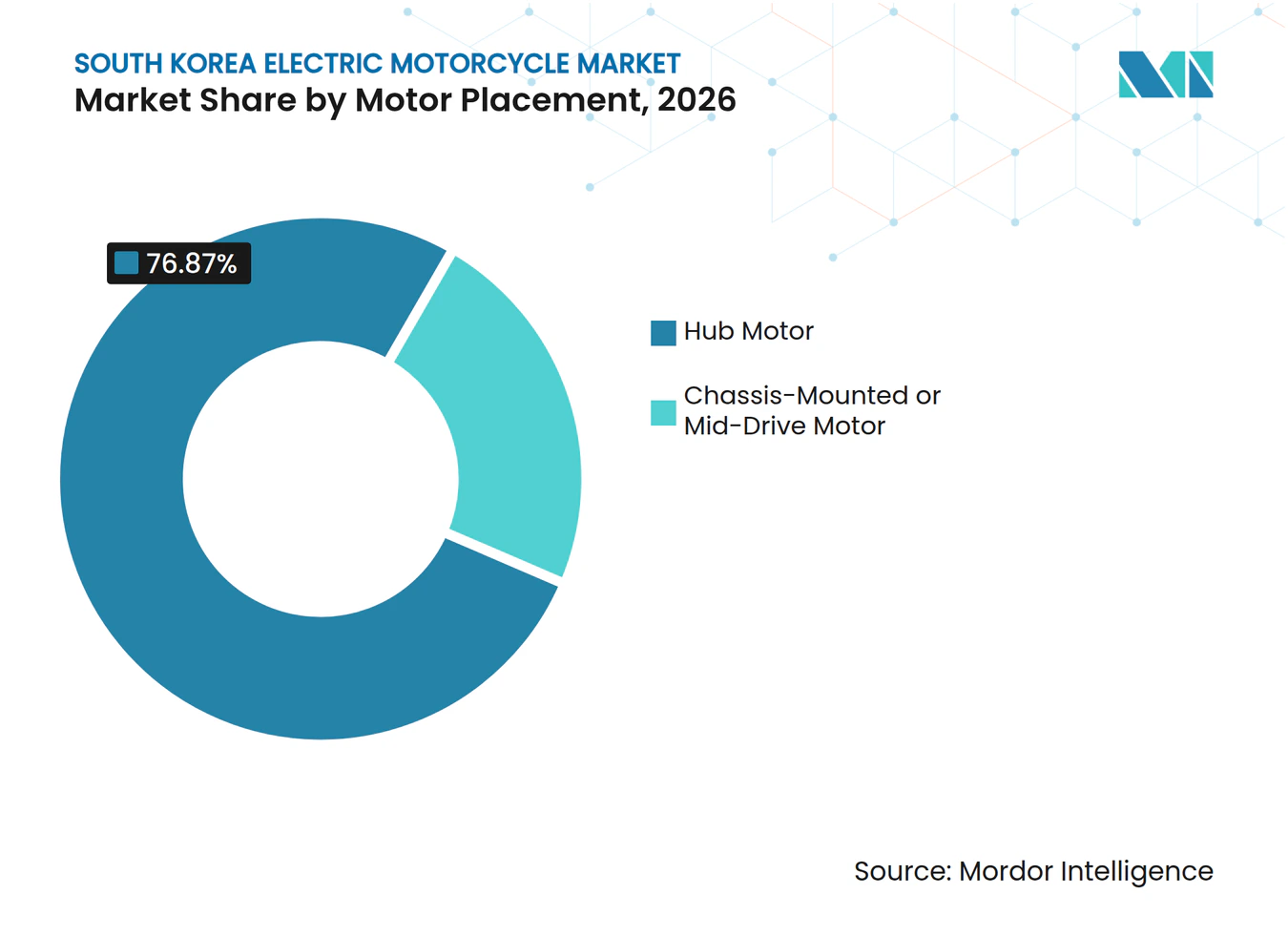
Hub Motor Commands Share, Mid-Drive Configuration Gains Ground on PerformanceHub motors held a 76.87% share of the South Korea electric motorcycle market in 2026. Their lead comes from lower manufacturing cost, simpler drivetrain integration, and adequate performance for lighter urban work. They also have maintenance advantages for small delivery operators. Individual riders often manage service costs directly and may prefer fewer points of mechanical failure. Hub designs, therefore, remain well-suited to the large base of ordinary delivery and commuting models. Hub-motor share reflects this practical operating preference.
Chassis-mounted and mid-drive motors are projected to grow at a 16.78% CAGR through 2032. They can better serve high-torque commercial work and performance-focused private models. Mid-drive architecture can also improve weight distribution by allowing more flexible battery placement. KR Motors approved an absorption merger with Dynamac, which operates major cold-forging facilities and produces brake caliper pistons and electric drive components. The merger enables KR Motors to build higher-torque configurations that favor mid-drive layouts.

By Usage:
Commercial Leads in Both Scale and Growth RateCommercial use held a 58.39% share of the South Korea electric motorcycle market in 2026 and is projected to grow at an 18.34% CAGR through 2032. It is both the largest and fastest-growing usage group. Food delivery and last-mile delivery are the main commercial uses. Rental, leasing, and shared-mobility fleets also offer growth opportunities as subscriptions lower the capital required to enter the market. The February 2026 agreement formalizes support for the electrification of the delivery fleet. This gives the commercial category a clear connection to national policy and platform participation.
Private use represented the remaining 41.61% share in 2026. It includes urban commuting, leisure, and personal mobility. Noise restrictions in Seoul can encourage owners of internal-combustion motorcycles to consider electric replacements in affected zones. Subscription services can also bring fleet-style vehicle access and maintenance to single-rider businesses. The boundary between commercial and private use can therefore be less clear for sole proprietors who use a motorcycle for delivery work. Both groups will be affected by improvements in pricing, range, and access to service.
By Application:
Urban Mobility Is the Volume Base, Shared Mobility Is the Growth FrontierUrban mobility held a 73.14% share of the South Korea electric motorcycle market in 2026. Korea's dense metropolitan areas support short-distance delivery and commuting by two-wheelers. Long-distance travel and adventure riding remain smaller uses because range constraints and the lack of intercity swap corridors limit their suitability. These users depend largely on plug-in charging and are more likely to ride for leisure. Urban mobility, therefore, provides the current volume base. It is supported by the existing pattern of daily movement in major cities.
Shared mobility is projected to grow at an 18.86% CAGR through 2032. In March 2026, Seoul added a top-up of 50% of the city subsidy for shared electric motorcycles that use battery-swap stations. Greater KooRoo station density in secondary cities can also reduce energy costs for shared fleets. Cycloid's July 2026 funding supports delivery subscriptions that overlap with shared-use functions. As swap networks develop, electric two-wheelers can offer lower per-trip energy costs in shared operations than gasoline alternatives. The outcome will depend on station availability, subscription pricing, and fleet utilization.
Geography Analysis
The South Korea electric motorcycle market is concentrated in the Seoul-Gyeonggi corridor, which hosts the majority of the country's battery-swap stations. This infrastructure pattern reflects the concentration of delivery riders and fleet operators in the region. Seoul's noise ordinance provides an additional incentive to replace internal-combustion motorcycles in designated areas. These conditions make metropolitan Korea the primary location for infrastructure-led adoption, with activity closely tied to areas with dense delivery operations and station coverage.
Secondary cities are gaining importance as infrastructure expands. LG Energy Solution planned to extend its KooRoo network to Busan, Daegu, Daejeon, and Gwangju. Gogoro's partnership with Bikebank, announced in May 2023, brought the Dotstation-branded network to eight Korean cities. These investments broaden the range of applications where swappable motorcycles can serve commercial users. Daedong Mobility's plug-in GS100 Lite remains relevant in provinces where the density of swap stations is still limited. Provincial buyers will require either more stations or longer real-world range to match the operating flexibility available in the metropolitan core.
Korea differs from several Asia-Pacific electric two-wheeler markets in that its adoption is closely tied to infrastructure development and government coordination. Delivery riders typically cover significant daily distances, creating a demanding duty cycle. This requirement raises the performance threshold for vehicle range, energy access, and fleet management. Solutions developed in Korea may be applicable to other markets with intensive delivery operations, where high station density and telematics are particularly important for riders working long, predictable shifts. The South Korea electric motorcycle market therefore represents both a domestic mobility opportunity and a demanding environment for service models built around commercial two-wheelers.
Competitive Landscape
Market Concentration
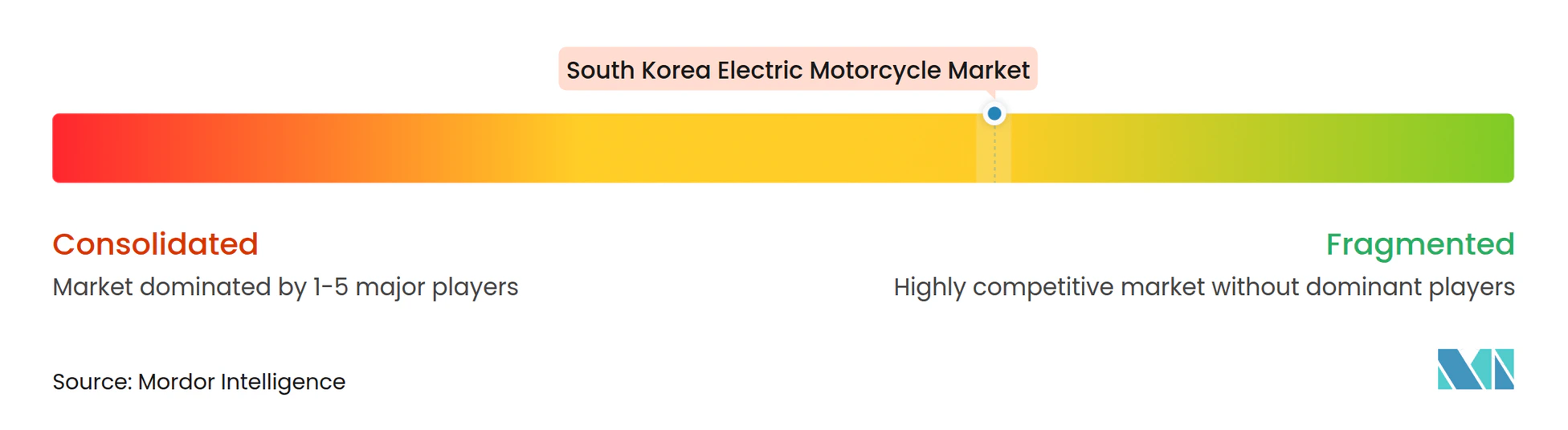
The South Korea electric motorcycle market includes domestic manufacturers DNA Motors, KR Motors, Daedong Mobility, Enuri, and smaller producers, as well as international players such as Gogoro, Niu Technologies, Vmoto, Zero Motorcycles, Honda, and Yamaha. Domestic manufacturers can benefit from subsidy criteria that favor locally assembled vehicles. Daedong Mobility reported a 92% localization rate for its GS100 Lite Plug-in. Battery manufacturers LG Energy Solution, Samsung SDI, and SK On also participate through cell supply, battery technology, and energy services. This creates competition across both the vehicle manufacturing and energy infrastructure sectors. The result is a moderately concentrated market rather than one controlled by a single vehicle company.
LG Energy Solution's KooRoo platform illustrates how battery companies can compete at the infrastructure level. KooRoo became the first Korean operator to receive KS certification for battery packs and swap stations in March 2025. This status supports eligibility for government infrastructure subsidies and raises the importance of regulatory compliance. Gogoro's expansion through Bikebank introduces a competing vehicle, network, and fleet-services model across multiple cities. KR Motors' merger with Dynamac is another strategic development, consolidating production capabilities for electric drive components and higher-value mobility parts.
A notable opportunity remains in provincial and mid-tier cities where swap-station density is insufficient for high-intensity fleet operations. Plug-in models with a certified range of 90 km or more can address this gap when supported by local after-sales services. The latest subsidy formula directly rewards models that meet range requirements. Companies also need strong maintenance and software capabilities, as delivery users prioritize vehicle uptime. Battery subscriptions and diagnostics may help suppliers retain riders within their service networks. The South Korea electric motorcycle market is moderately concentrated, with vehicle manufacturers and battery-swap infrastructure providers competing alongside one another.
South Korea Electric Motorcycle Industry Leaders
-
DNA Motors Co., Ltd.
-
LG Energy Solution Ltd.
-
Daedong Mobility Co., Ltd.
-
Yamaha Motor Co., Ltd.
-
Niu Technologies
- *Disclaimer: Major Players sorted in no particular order
South Korea Electric Motorcycle Market Companies Covered in this Report
- DNA Motors Co., Ltd.
- KR Motors Co., Ltd.
- Gogoro Inc.
- Bikebank Co., Ltd.
- LG Energy Solution Ltd.
- Samsung SDI Co., Ltd.
- SK On Co., Ltd.
- E3 Mobility Co., Ltd.
- BM Motors Co., Ltd.
- Daedong Mobility Co., Ltd.
- Niu Technologies
- Yamaha Motor Co., Ltd.
- Honda Motor Co., Ltd.
- BMW AG
- Zero Motorcycles, Inc.
- Vmoto Limited
Recent Industry Developments in South Korea Electric Motorcycle Market
- October 2026: Daedong Mobility began piloting an energy self-sufficient electric scooter sharing service with 100 GS100 scooters at Daegu's Seongseo Industrial Complex.
- July 2026: KR Motors decided to absorb its wholly owned subsidiary Dynamac, a maker of brake caliper pistons and electric drive components.
- July 2026: Cycloid raised KRW 500 million in pre-Series A funding from AXE Ventures to expand Badream, its electric motorcycle subscription service for delivery riders.
- March 2026: Seoul opened its 2026 electric motorcycle subsidy program, adding a 50% city top-up for shared models that use battery-swap stations.
- February 2026: The Ministry of Climate, Energy and Environment signed an agreement with delivery platforms, agencies, and manufacturers to make electric models at least 25% of new delivery motorcycles by 2030 and 60% by 2035.
South Korea Electric Motorcycle Market Report Scope
The South Korea Electric Motorcycle Market Report is Segmented by Battery Type (Lithium-Ion [NMC and Other Non-LFP Chemistries], Lithium Iron Phosphate [LFP], Sealed Lead-Acid, and Nickel Metal Hydride), Voltage (Below 48 V, 48-60 V, 61-72 V, 73-96 V, and Above 96 V), Peak Power (Below 3 kW, 3-6 kW, 7-10 kW, and Above 10 kW), Battery Format (Removable and Plug-In Battery, Battery-Swappable Battery, and Non-Removable Battery), Motor Placement (Hub Motor and Chassis-Mounted or Mid-Drive Motor), Usage (Commercial and Private), and Application (Urban Mobility, Long-Distance Travel, Shared Mobility, and Adventure Riding). The Market Forecasts are Provided in Value (USD).
Segmentation Overview
| Lithium-Ion (NMC and Other Non-LFP Chemistries) |
| Lithium Iron Phosphate (LFP) |
| Sealed Lead-Acid |
| Nickel Metal Hydride |
| Below 48 V |
| 48-60 V |
| 61-72 V |
| 73-96 V |
| Above 96 V |
| Below 3 kW |
| 3-6 kW |
| 7-10 kW |
| Above 10 kW |
| Removable and Plug-In Battery |
| Battery-Swappable Battery |
| Non-Removable Battery |
| Hub Motor |
| Chassis-Mounted or Mid-Drive Motor |
| Commercial | Food Delivery and Last-Mile Delivery |
| Rental, Leasing, and Shared Mobility Fleets | |
| Government, Campus, and Utility Fleets | |
| Private | Urban Commuting |
| Leisure and Personal Mobility |
| Urban Mobility |
| Long-Distance Travel |
| Shared Mobility |
| Adventure Riding |
| By Battery Type | Lithium-Ion (NMC and Other Non-LFP Chemistries) | |
| Lithium Iron Phosphate (LFP) | ||
| Sealed Lead-Acid | ||
| Nickel Metal Hydride | ||
| By Voltage | Below 48 V | |
| 48-60 V | ||
| 61-72 V | ||
| 73-96 V | ||
| Above 96 V | ||
| By Peak Power | Below 3 kW | |
| 3-6 kW | ||
| 7-10 kW | ||
| Above 10 kW | ||
| By Battery Format | Removable and Plug-In Battery | |
| Battery-Swappable Battery | ||
| Non-Removable Battery | ||
| By Motor Placement | Hub Motor | |
| Chassis-Mounted or Mid-Drive Motor | ||
| By Usage | Commercial | Food Delivery and Last-Mile Delivery |
| Rental, Leasing, and Shared Mobility Fleets | ||
| Government, Campus, and Utility Fleets | ||
| Private | Urban Commuting | |
| Leisure and Personal Mobility | ||
| By Application | Urban Mobility | |
| Long-Distance Travel | ||
| Shared Mobility | ||
| Adventure Riding | ||
Key Questions Answered in the Report
What is the projected value of electric motorcycles in South Korea by 2032?
The market is forecast to reach USD 235.78 million by 2032, growing at a 16.21% CAGR during 2027-2032.
Which battery chemistry leads electric motorcycles in South Korea?
Lithium-ion (NMC and other non-LFP chemistries) led with a 78.48% share in 2026, while lithium iron phosphate is projected to grow at a 17.11% CAGR through 2032.
Why are battery-swapping systems important for Korean delivery riders?
Swapping reduces charging downtime for delivery work and is supported by vehicle subsidies and expanding station networks.
What is the largest usage category for electric motorcycles in South Korea?
Commercial use led with a 58.39% share in 2026 and is also the fastest-growing usage category, projected to grow at an 18.34% CAGR through 2032.
Which application is growing fastest in South Korea?
Shared mobility is projected to grow at an 18.86% CAGR through 2032, supported by Seoul's subsidy top-up for shared models and wider swap access.