
Market Overview
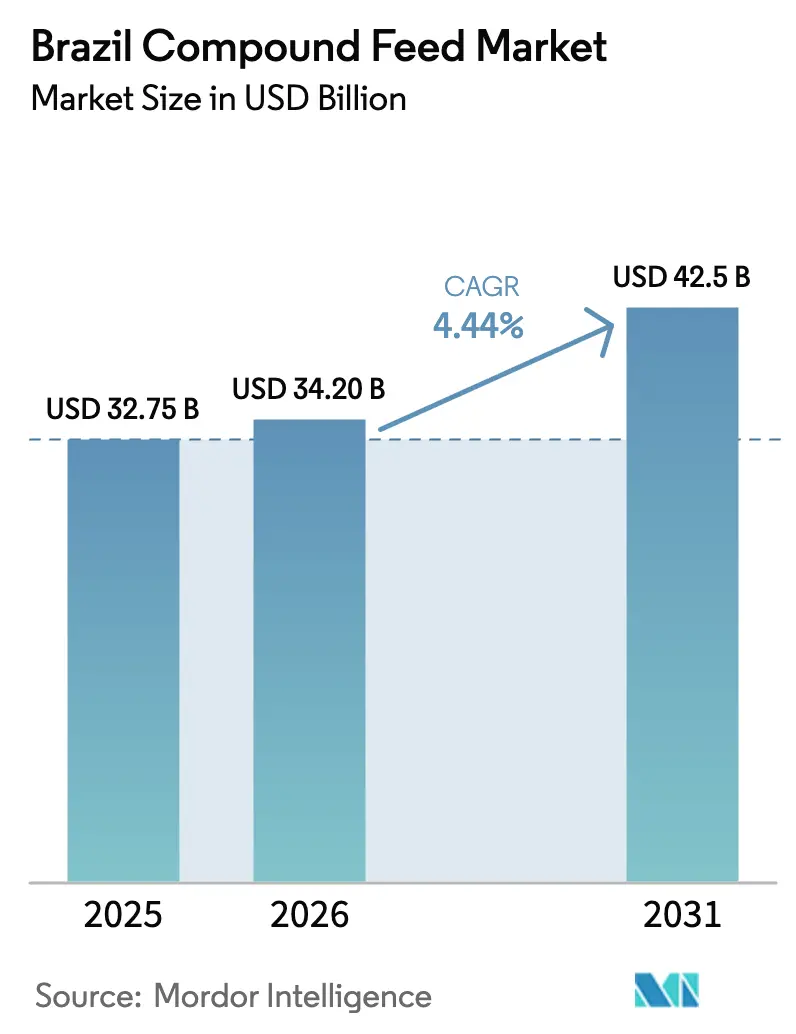
| Study Period | 2021 - 2031 |
|---|---|
| Forecast Data Period | 2026 - 2031 |
| Base Year Market Size (2025) | USD 32.75 Billion |
| Market Size (2026) | USD 34.20 Billion |
| Market Size (2031) | USD 42.5 Billion |
| Growth Rate (2026 - 2031) | 4.44 % |
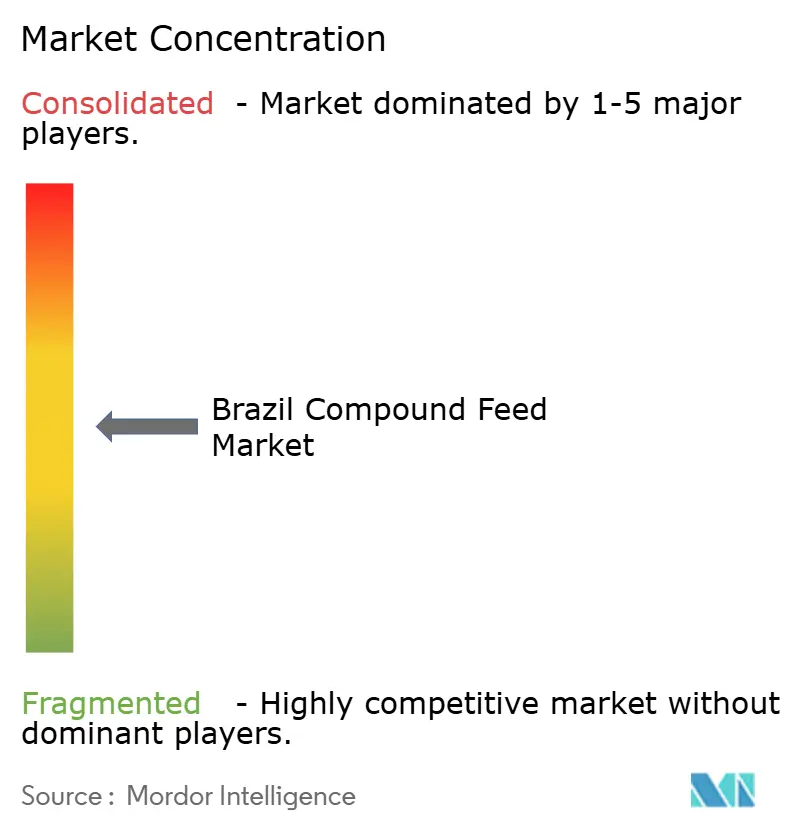
| Market Concentration | Medium |
Major Players *Disclaimer: Major Players sorted in no particular order Image © Mordor Intelligence. Reuse requires attribution under CC BY 4.0. | |
Brazil Compound Feed Market Analysis by Mordor Intelligence
The Brazil compound feed market was valued at USD 32.75 billion in 2025 and estimated to grow from USD 34.20 billion in 2026 to reach USD 42.50 billion by 2031, at a CAGR of 4.44% during the forecast period (2026-2031). Strong grain harvests, captive feed capacity within poultry and swine integrators, and increasing protein consumption among urban households provide a stable demand foundation, mitigating the impact of cyclical fluctuations in global commodity prices. Continued poultry and pork exports support production levels, while the adoption of specialty feed additives and precision nutrition technologies enhances average selling prices by improving efficiency. Government-subsidized credit facilitates mill modernization efforts, even amid depreciation of the Brazilian real, while the growing cost advantage of Brazilian corn over United States corn further strengthens the country's global competitiveness.
Key Report Takeaways
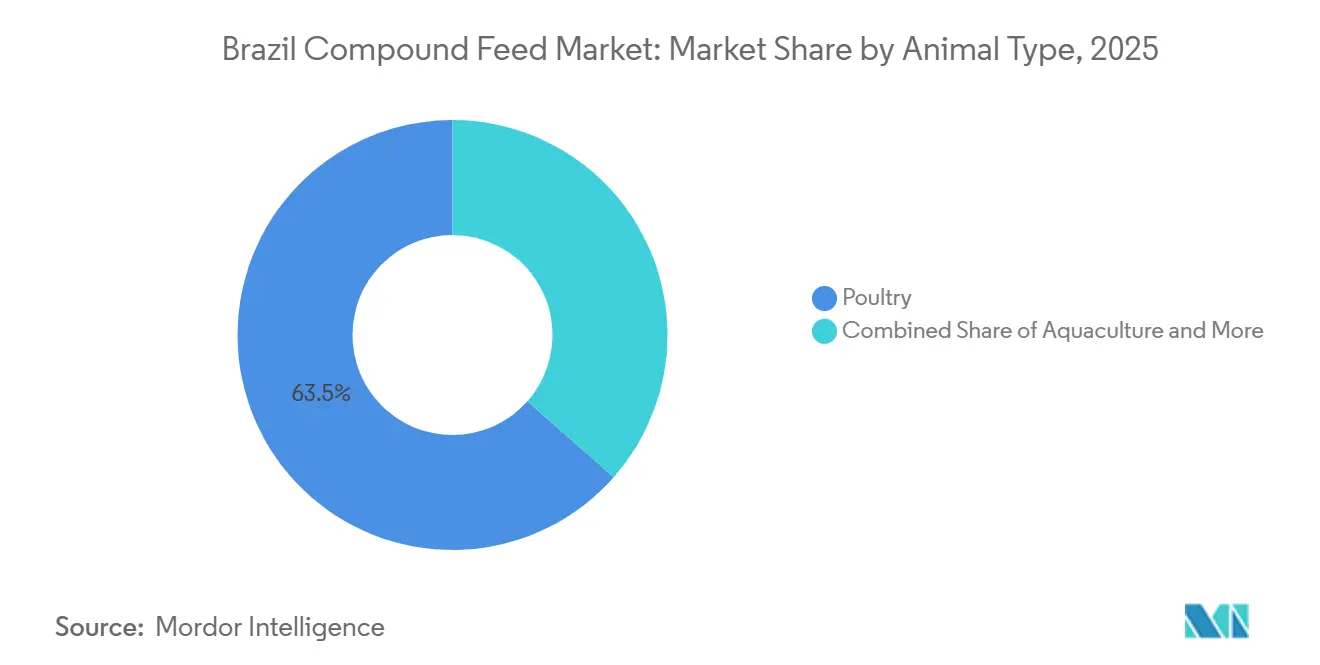
- By animal type, poultry feed accounted for 63.5% of the Brazil compound feed market size in 2025, while aquaculture is projected to expand at a 4.3% CAGR through 2031.
- By ingredient, cereals accounted for a 72.1% share in 2025, and supplements are poised to register a 4.7% CAGR during the forecast years.
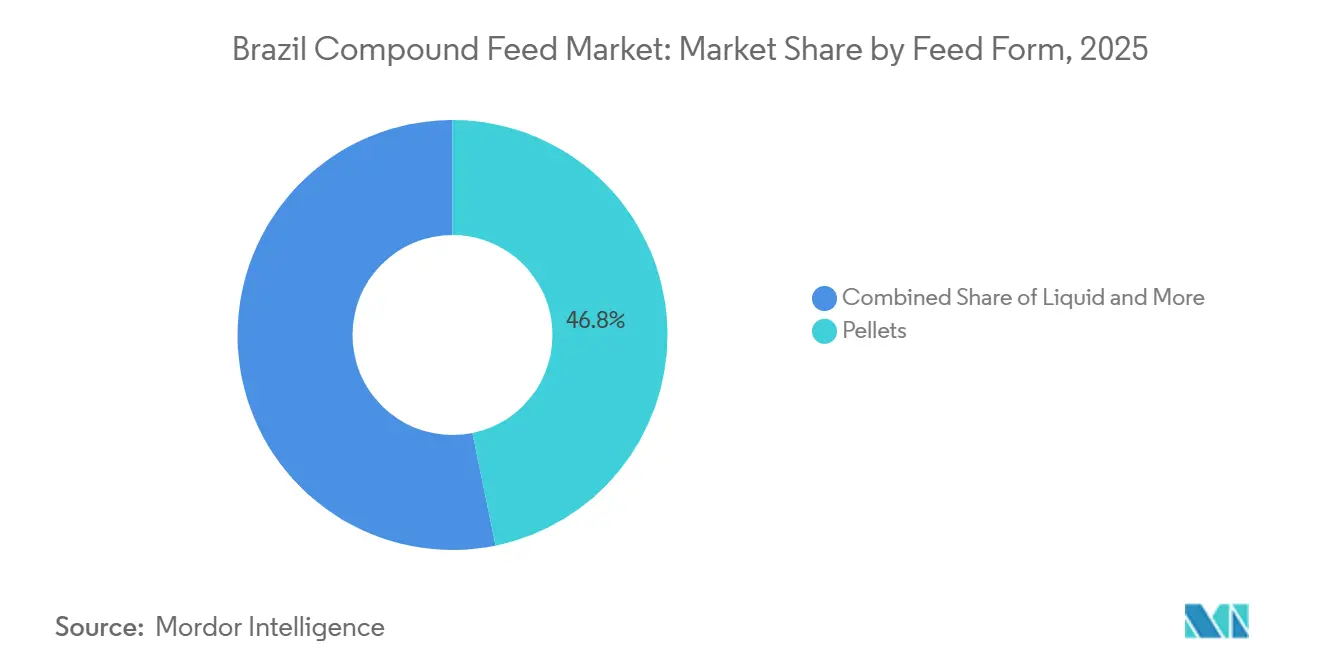
- By feed form, pellets led with 46.8% of the 2025 market size, whereas liquid feed is forecast to grow at a 3.5% CAGR through 2031.
- By functionality, conventional feed captured 74.5% of the 2025 market, yet antibiotic-free formulations are projected to post a 4.2% CAGR from 2026 to 2031.
Note: Market size and forecast figures in this report are generated using Mordor Intelligence’s proprietary estimation framework, updated with the latest available data and insights as of January 2026.
Brazil Compound Feed Market Trends and Insights
Drivers Impact Analysis*
| Driver | (~) % Impact on CAGR Forecast | Geographic Relevance | Impact Timeline |
|---|---|---|---|
| Booming poultry and pork export volumes | +0.90% | South and Southeast states | Medium term (2–4 years) |
| Competitive cost advantage from abundant domestic corn and soybean crops | +0.80% | Center West grain belt | Long term (≥ 4 years) |
| Growing domestic demand for animal protein | +0.60% | Urban centers nationwide | Medium term (2–4 years) |
| Adoption of precision-feeding technologies and on-farm data analytics | +0.50% | Large integrated operations nationwide | Medium term (2–4 years) |
| Surge in specialty feed additives | +0.40% | Premium poultry and aquaculture clusters | Short term (≤ 2 years) |
| Government incentives and support for livestock feeding | +0.30% | Rural credit corridors in South, Southeast, Center West | Long term (≥ 4 years) |
| Source: Mordor Intelligence | |||
Booming Poultry and Pork Export Volumes
Brazil’s poultry industry continues to expand its global presence, with shipments reaching record levels in recent years. The United States Department of Agriculture reports that Brazil's chicken meat exports rose from 4,447 thousand metric tons in 2022 to 4,770 thousand metric tons in 2023. Government trade reports highlight strong demand from Middle Eastern and Asian markets, where poultry enjoys a competitive edge. Pork exports have also strengthened, supported by sanitary certifications that open doors to high‑value destinations. Regulatory mandates from Asian countries encourage the use of enzyme-rich and probiotic feed blends, underscoring the importance of specialized additives[1]. Integrated processors maintain captive feed mills that stabilize costs and ensure a consistent supply. Government agricultural bulletins confirm that southern states remain the backbone of poultry feed output, benefiting from proximity to ports.
Competitive Cost Advantage from Abundant Domestic Corn and Soybean Crops
Brazil’s grain harvests underpin the feed industry’s cost advantage, with official crop reports showing consistent growth in corn and soybean output[2]. Government agencies note that domestic feed prices remain well below international benchmarks, reinforcing competitiveness. Double‑cropping practices in central states reduce weather risks and secure grain availability for integrators. Soybean crushing capacity has expanded steadily, ensuring a stable supply of protein meal for feed manufacturers. Spot market data from government sources confirms that Brazilian corn trades at a significant discount compared with the United States equivalents. This cost gap directly supports livestock margins and strengthens Brazil’s global position in feed exports.
Growing Domestic Demand for Animal Protein
Government statistics indicate a rising per-capita meat intake, reflecting urbanization and higher disposable incomes. For instance, according to the Organisation for Economic Co-operation and Development (OECD), domestic per capita demand for swine meat was 17.5 kg in 2022, increasing to 18.6 kg in 2024. Beef and pork consumption also continues to grow, and poultry remains the most widely consumed protein, supported by its affordability and positive health perceptions[3]. Quick‑service restaurants are expanding their purchases of chicken, driving demand for uniform portioning and strict feed specifications. Dairy intake has increased steadily, with government reports emphasizing the importance of high-energy rations in confined animal feeding operations (CAFOs).
Adoption of Precision Feeding Technologies and On-farm Data Analytics
Government agricultural research institutes report growing adoption of digital platforms that monitor livestock performance. These technologies reduce feed waste and improve efficiency, delivering measurable benefits to producers. Automated feeders are increasingly installed in large poultry operations. Near‑infrared sensors are being deployed to optimize feed formulations and reduce margin losses. Blockchain pilots with major processors are creating verifiable antibiotic‑free claims that enhance export competitiveness. In August 2023, Brazil's Ministry of Agriculture and Livestock introduced the 2023/2024 Crop Plan, allocating BRL 364.22 billion (approximately USD 60 billion) to support national agricultural and livestock development. Government extension services highlight aquaculture trials where precision feeding tools have lowered feed conversion ratios and reduced environmental impacts.
Restraints Impact Analysis*
| Restraint | (~) % Impact on CAGR Forecast | Geographic Relevance | Impact Timeline |
|---|---|---|---|
| Volatile corn and soybean price cycles | -0.7% | Non-integrated mills nationwide | Short term (≤ 2 years) |
| Dependence on imported high-value additives | -0.5% | Enzyme and amino acid supply chains | Medium term (2–4 years) |
| Logistics bottlenecks in road and storage infrastructure | -0.4% | Center West and North corridors | Long term (≥ 4 years) |
| Currency devaluation pressure on equipment and premix imports | -0.3% | Capital expenditure pipelines nationwide | Short term (≤ 2 years) |
| Source: Mordor Intelligence | |||
Dependence on Imported High-Value Additives
Government trade data confirm Brazil’s reliance on imported feed additives, with the majority of supplies sourced from major global regions. This dependence exposes buyers to freight volatility and currency fluctuations. Sharp increases in methionine prices and shortages of lysine have affected feed formulations. Domestic fermentation capacity remains limited, and new plant approvals require significant investment and regulatory clearance. Government agencies emphasize that near-term substitution of imports is unlikely, thereby maintaining high reliance. This structural dependence continues to shape Brazil’s feed industry strategy.
Logistics Bottlenecks in Road and Storage Infrastructure
Government infrastructure assessments highlight persistent challenges in road and storage capacity. Truck freight costs rise during harvest seasons as silo shortages force on‑farm storage solutions. Many highways in the Center West remain unpaved, adding delays and costs to feed delivery. Vessel queues at major ports increase waiting times, prompting mills to hold higher safety stocks. Government transport authorities confirm that these inefficiencies tie up working capital and raise storage burdens.
*Our forecasts treat driver/restraint impacts as directional, not additive. The impact forecasts reflect baseline growth, mix effects, and variable interactions.
Segment Analysis
By Animal Type: Poultry Sustains Leadership While Aquaculture Accelerates
Poultry feed sustained leadership in the Brazil compound feed market, holding 63.5% of revenue share in 2025. Export contracts and integrated milling systems reinforce its dominance, while vertical integration ensures ingredient consistency and compliance with international residue standards. Poultry remains the backbone of Brazil’s feed industry, supported by strong domestic consumption and global demand. Swine and ruminants continue to play supporting roles, but poultry’s scale and efficiency secure its position as the largest segment.
Aquaculture feed is emerging as the fastest‑growing category, advancing at a 4.3% CAGR through 2031. Rising tilapia and shrimp production across key regions drives this growth, supported by the establishment of new feed plants and improved logistics. Specialty formulations for companion animals are also expanding steadily, reflecting consumer preferences for premium nutrition. Confined dairy herds continue to support growth in ruminant feed, while the rapid rise of aquaculture signals Brazil’s expanding focus beyond conventional livestock. This evolution highlights how innovation and sustainability are becoming central drivers of future feed demand.

By Ingredient: Cereals Still Core While Supplements Capture Margin Upside
Cereals remained the core of Brazil’s feed industry, accounting for 72.1% of ingredient share in 2025. Corn remains a staple in monogastric diets, providing the majority of metabolizable energy. Oilseed meals and processing by‑products contribute to balanced rations, but cereals dominate due to availability and cost competitiveness. Cereals will remain central to feed formulations, ensuring stability in supply chains and supporting Brazil’s competitive edge in global protein markets.
Supplements are forecast to expand at a 4.7% CAGR through 2031, capturing margin upside as formulators invest in enzymes, amino acids, and probiotics. These additives enhance feed conversion and sustainability, aligning with export requirements and consumer preferences. Advances in synthetic nutrition and fermentation technologies enable mills to reduce their reliance on costly cereals while maintaining optimal performance. Supplements thus represent the fastest‑growing ingredient segment, reshaping Brazil’s feed industry toward higher efficiency and value‑added formulations.
By Feed Form: Pellet Dominance Coupled With Niche Liquid Feed Uptick
Pellets led the Brazil compound feed market with a 46.8% share in 2025, reflecting greater efficiency and lower waste than mash. Integrated processors continue to expand pellet capacity, reinforcing their role as the dominant feed form. Crumbles remain important for starter diets, while mash persists among smallholders due to lower upfront costs. Pellets will retain their leadership, supported by investments in conditioning technology and export-driven quality standards.
Liquid feed is the fastest‑growing form, advancing at a 3.5% CAGR through 2031. Precision feeding systems in dairy and swine operations drive adoption by incorporating by-products such as whey and molasses. Crumbles gain traction in aquaculture nurseries, while mash maintains relevance in traditional systems. The rise of liquid feed highlights Brazil’s shift toward specialized nutrition and efficiency, complementing pellet dominance and diversifying feed form strategies across species.
By Functionality: Conventional Still Majority While Antibiotic‑Free Gains Ground
Conventional feed formulations retained a 74.5% share in 2025, underscoring their continued importance in Brazil’s domestic market. Cost sensitivity and established practices sustain conventional dominance, even as export markets demand stricter compliance with residue limits. Medicated feed remains relevant for disease management, but regulatory tightening is reshaping its role in this context. Conventional feed will remain the majority segment, although its share will gradually decline as alternatives gain traction.
Antibiotic‑free feed is the fastest‑growing functionality, advancing at a 4.2% CAGR through 2031. Rising demand from European and Asian importers is driving zero-tolerance regimes, prompting mills to adopt enzyme and organic-acid solutions. Producers reformulate rations to meet these standards, maintaining performance while reducing reliance on medicated inputs. Antibiotic‑free growth reflects Brazil’s alignment with global sustainability and animal welfare trends, positioning the industry for long‑term competitiveness in premium export markets.
Geography Analysis
Brazil’s South and Southeast regions accounted for the largest share of the Brazil compound feed market size in 2025, with Paraná, Santa Catarina, and Rio Grande do Sul leading the production. These states benefit from strong port access, integrated poultry and swine complexes, and established grain contracting practices that stabilize costs and ensure consistent supply. Leveraging coastal logistics, established milling capacity, and long‑standing integration models, the South and Southeast remain the backbone of Brazil’s feed industry, supporting both domestic consumption and international shipments while reinforcing the country’s competitive position in global protein markets.
The Center West is the fastest‑growing region, supported by lower corn costs and expanding rail capacity that connect grain belts to export corridors. Investments by multinational feed companies strengthen its role as a rising hub, tilting production toward the interior where grain availability is abundant. Structural advantages in grain supply and logistics, combined with double‑cropping practices and modernized infrastructure projects that reduce freight costs, make the Center West increasingly attractive for integrators. As production shifts inland, the region is positioned to capture a larger portion of Brazil’s feed output and enhance national competitiveness.
The Northeast and North contribute smaller shares but show distinct dynamics that highlight regional diversity. The Northeast is experiencing rapid growth with the expansion of aquaculture, supported by government grants and new mill projects that reduce logistics costs for shrimp and tilapia farmers. The North lags behind due to high trucking costs and infrastructure constraints, which limit profitability in fish feed and delay technology adoption. Regional disparities are anticipated to persist, with growth concentrated in aquaculture‑focused zones. While the Northeast benefits from targeted investment and rising demand for aquatic protein, the North continues to face structural challenges that restrict its ability to scale feed production, leaving its role secondary in the national market.
Regulatory Landscape
Brazil’s compound feed sector is regulated primarily by the Ministry of Agriculture and Livestock (MAPA), with core requirements grounded in Lei 6.198/1974 and Decreto 6.296/2007 (as amended by Decreto 7.045/2009). Establishments producing, importing, or handling animal feed must register with MAPA and operate under technical responsibility (Responsavel Tecnico), with labeling and traceability obligations extending even to categories that may be exempt from individual product registration.
On the trade side, import procedures run through SISCOMEX and are linked to MAPA systems for inspection and establishment controls, including foreign facility registration workflows referenced for animal feed. MAPA also maintains official positive lists of authorized ingredients and additives, with a published list update dated November 24, 2025, which shapes formulation choices and compliance planning for premix and additive suppliers serving Brazil.
Competitive Landscape
The Brazil compound feed market share remains moderately concentrated, with leading suppliers accounting for a significant portion of the value, while leaving room for smaller players to emerge. Multinational firms such as Archer Daniels Midland Company, Cargill, Incorporated, BRF S.A., Nutreco N.V. (a subsidiary of SHV Holdings N.V.), and Alltech, Inc. leverage integrated grain contracts and digital platforms to secure efficiency, compliance, and visibility across their supply chains. Concentration is projected to persist, although cooperatives and specialty firms will continue to retain opportunities to carve out niches. The balance between global corporations and local disruptors creates a dynamic competitive environment, where scale advantages coexist with innovation‑driven strategies. This moderate concentration ensures stability while allowing new entrants to differentiate through specialized formulations, sustainability credentials, and regional focus.
Regional disruptors emphasize organic and non-genetically modified supply, targeting premium European buyers who demand transparency and sustainability. Multinational additive vendors are localizing production to buffer against currency volatility, while sustainability‑focused innovations gain traction across cattle and aquaculture lines. The rise of localized premix hubs and fermentation facilities further strengthens resilience against global supply shocks. These strategies demonstrate how both cooperatives and multinational suppliers adapt to shifting consumer preferences, regulatory frameworks, and sustainability scorecards, thereby ensuring long-term competitiveness in diverse markets.
The competitive focus is increasingly shifting toward antibiotic‑free and aquaculture segments, reflecting global demand for cleaner protein and sustainable practices. Reformulation strategies, protected acids, and advanced enzymes demonstrate how innovation drives market share retention while meeting tightening residue protocols. As aquaculture expands and antibiotic‑free formulations gain traction, suppliers that prioritize research and development will secure long‑term advantages. This emphasis on innovation highlights the industry’s shift from volume-driven growth to value-added solutions, positioning Brazil as a leader in sustainable feed production.
Brazil Compound Feed Industry Leaders
-
Archer Daniels Midland Company
-
BRF S.A.
-
Nutreco N.V. (SHV Holdings N.V.)
-
Alltech, Inc.
-
Cargill, Incorporated
- *Disclaimer: Major Players sorted in no particular order
Market Opportunities and Future Outlook
Investment attention is clustering around higher-value premixes, additives, and quality-assurance capabilities that support residue control and antibiotic-free programs in poultry and swine supply chains. ADM starting operations of a new animal nutrition premix plant in Apucarana, Parana in March 2026 (40,000 tonnes per year capacity) underscores that momentum, with an emphasis on automation, dosage control, and traceability.
Feedstock competition is also becoming more structural in formulation and procurement strategies, as policy-driven biofuel demand tightens the corn balance and increases the value of precision nutrition tools that protect feed conversion and reduce over-formulation. At the same time, intensification trends in cattle feedlots and continued scaling in aquaculture (tilapia and shrimp) are keeping specialty diets, functional supplements, and localized premix hubs in focus, which can shorten lead times and reduce exposure to imported additive supply volatility.
Recent Industry Developments
- June 2026: ADM highlighted the operational status of its new animal nutrition premix plant in Apucarana, Parana, strengthening its Brazil footprint in higher-value premix and specialty nutrition. The facility adds modern automation and traceability capabilities that support tighter quality control and segregation requirements demanded by integrated protein chains.
- July 2025: Cargill, Incorporated acquired MigPlus to strengthen its position in Brazil’s compound feed sector. The transaction expanded production capacity and regional reach, supporting broader service coverage for livestock producers and integrated protein customers.
- January 2024: JBS S.A. invested in constructing three new feed factories in Seberi, Santo Inacio, and Itaiopolis in Southern Brazil to support its Seara business unit. The added capacity increased Seara’s annual feed production by more than 1 million metric tons, improving alignment between feed supply and poultry production expansion.
Research Methodology Framework and Report Scope
Market Definition and Coverage
This market covers the value of manufactured compound feed sold in Brazil for feeding farmed animals, where feed is formulated by blending cereals, oilseed meals, by-products, and supplements to meet nutritional needs in a consistent way.
Scope exclusions: We exclude on-farm single-ingredient feeding (such as straight corn or soybean meal) and unprocessed fodder that is not sold as formulated compound feed.
Segmentation Overview
- By Animal Type
- Poultry
- Swine
- Ruminants
- Aquaculture
- Other Animals
- By Ingredient
- Cereals
- Oilseed Meals
- Processing By-products
- Supplements
- By Feed Form
- Mash
- Pellets
- Crumbles
- Liquid
- By Functionality
- Conventional
- Medicated
- Antibiotic-free
Data Sources, Market Sizing, and Validation
Desk Research
Desk research was used to build the basic fact base and keep the model tied to measurable signals in Brazil. We relied on public datasets and official releases such as IBGE livestock and agriculture statistics, MAPA regulations and technical notes, CONAB crop balance sheets, FAOSTAT supply and use series, and UN Comtrade trade flows for grains and meals.
To convert those signals into a usable market model, we also reviewed company filings and investor decks, association websites for feed and animal protein, and credible press coverage of capacity additions or animal health policy changes. A paid subscription for company financials and a separate patent database were used selectively to cross-check expansion plans, product claims, and timing of major formulation shifts. The sources listed above are illustrative only, and many other references were used to collect data points, validate assumptions, and resolve gaps.
Primary Interviews and Surveys
Primary work was done through expert interviews and structured surveys with feed manufacturers, premix and additive participants, distributors, large livestock and poultry producers, and a few independent nutrition specialists. Since this is a Brazil-only market, inputs were balanced across major producing states and customer groups so we could confirm inclusion rules, typical pricing movement, and how volume shifts across poultry, swine, ruminants, and aquaculture.
Distribution of primary research fieldwork respondents
| Company type | Respondent position |
|---|---|
| Top tier: 30% | CXOs: 18% |
| Mid tier: 51% | Functional/Unit leaders: 27% |
| Smaller Players: 19% | Managers: 55% |
Market-Sizing & Forecasting
Sizing starts from a top-down demand pool build, where animal inventories and production cycles are translated into feed requirements, and then aligned to industrial compound feed penetration by species. We then corroborate the totals with selective bottom-up checks, mainly by sampling price bands and volumes by feed form and functionality, and by sense-checking implied revenues against a practical set of supplier and channel signals.
Key inputs used in the model include Brazil livestock headcounts and output trends, crop availability for major feed ingredients (corn and soybean meal), feed conversion and ration practices by animal type, the share shift between mash, pellets, crumbles, and liquid, and pricing movements linked to grain cost pass-through. When data is thin, gaps are handled with conservative interpolation and then re-tested in interviews to make sure the assumption fits how purchases happen in the market.
For forecasting, scenario analysis is used, anchored on expected animal protein demand, crop balance outlook, and realistic feed price progression, with expert feedback used to pick the most likely path and stress-test downside cases such as grain shocks or slower herd growth.
Data Validation & Update Cycle
Validation is done in layers so the final number is not driven by one dataset or one interview. We compare implied feed demand against independent signals like livestock production trends, ingredient availability, and typical cost pass-through patterns, and then we run variance checks by animal type and feed form to catch outliers.
Before sign-off, the model and assumptions go through multi-step analyst review, and re-contact is triggered when pricing, volume shares, or inclusion rules do not reconcile across sources. Reports are refreshed annually, and material events are incorporated sooner when they meaningfully change demand, supply, or pricing. Right before delivery, a final update pass is completed so clients receive the latest view that can be traced back to clear inputs.
Mordor Intelligence's Brazil Compound Feed Market Size Versus Other Published Estimates
Published market sizes for Brazil compound feed can look far apart even when they use similar labels, because the counted value chain and the way price and volume are combined often differ. The split usually comes from what is treated as compound feed versus feed ingredients, how medicated and antibiotic-free formulations are counted, and whether the estimate is tied to animal production signals or mostly to revenue narratives.
The main gap comes from whether single-ingredient feed materials and broader animal feed baskets are folded into the total, where Mordor Intelligence counts only formulated compound feed sold for livestock and applies species-specific consumption and penetration checks before value is built up. Differences also show up when studies use aggressive price progression during grain spikes, apply a single national average price across all feed forms, or do not clearly state the refresh timing for currency and input-cost assumptions.
Benchmark comparison
| Source | Market Size | Gaps in Research Methodology |
|---|---|---|
| Mordor Intelligence | USD 32.75 B (2025) | |
| Global Consultancy A | USD 43.43 B (2024) | Uses an earlier base year and appears to apply broader market aggregation, which can inflate the total if adjacent animal feed categories or wider value chain elements are included beyond formulated compound feed sold in Brazil. |
| Industry Publisher B | USD 10.40 B (2025) | The figure is materially lower, which typically happens when the scope narrows to specific sub-uses or when pricing assumptions lean conservative, for example by using limited price references or excluding higher-value medicated and specialty formulations. |
The table shows that scope and pricing logic drive most of the spread, followed by base-year timing. By keeping inclusions explicit, linking volume to animal production realities, and checking price bands by feed form and functionality, the estimate stays repeatable and easier to audit in future updates.
Key Questions Answered in the Report
What is the projected value of the Brazil compound feed market in 2031?
The Brazil compound feed market size is forecast to reach USD 42.5 billion by 2031.
Which species accounts for the largest share of feed volume?
Poultry leads with 63.5% of total volume in 2025, reflecting Brazil’s role as the top global chicken exporter.
How are corn and soybean costs affecting feed profitability?
Domestic corn trades at roughly USD 3.20 per bushel, a 33% discount to United States quotes, lowering energy costs and boosting margins.
What growth rate is projected for antibiotic-free formulations?
Antibiotic-free feed is advancing at a 4.2% CAGR through 2031, as European and Asian buyers tighten residue limits.