
Market Overview
| Study Period | 2021 - 2031 |
|---|---|
| Forecast Data Period | 2026 - 2031 |
| Base Year Market Size (2025) | USD 68.1 Billion |
| Market Size (2026) | USD 71.59 Billion |
| Market Size (2031) | USD 91.87 Billion |
| Growth Rate (2026 - 2031) | 5.12 % |
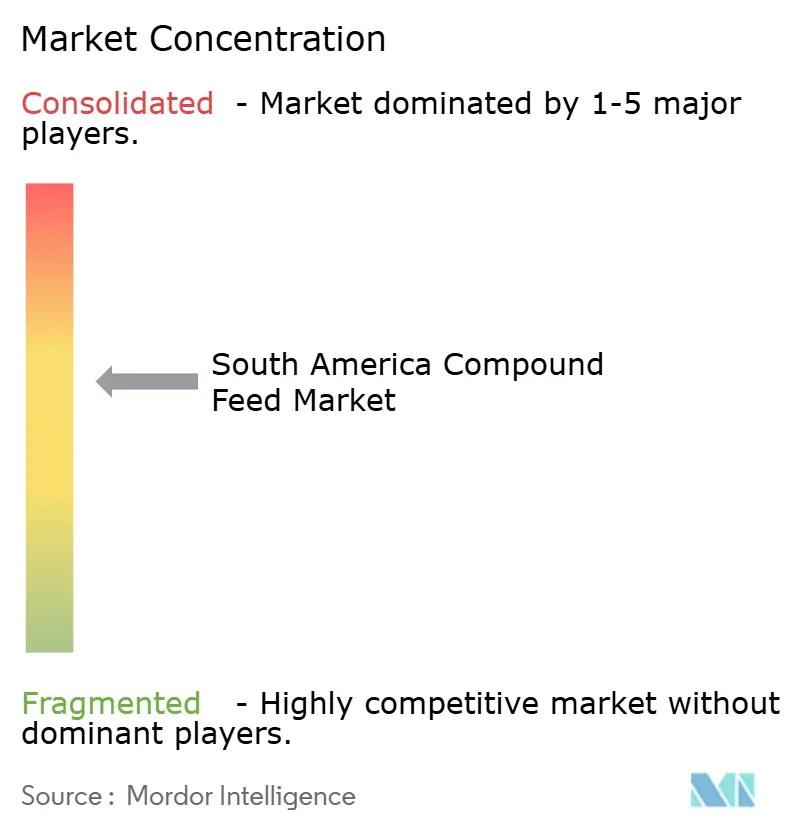
| Market Concentration | Medium |
Major Players *Disclaimer: Major Players sorted in no particular order Image © Mordor Intelligence. Reuse requires attribution under CC BY 4.0. | |
South America Compound Feed Market Analysis by Mordor Intelligence
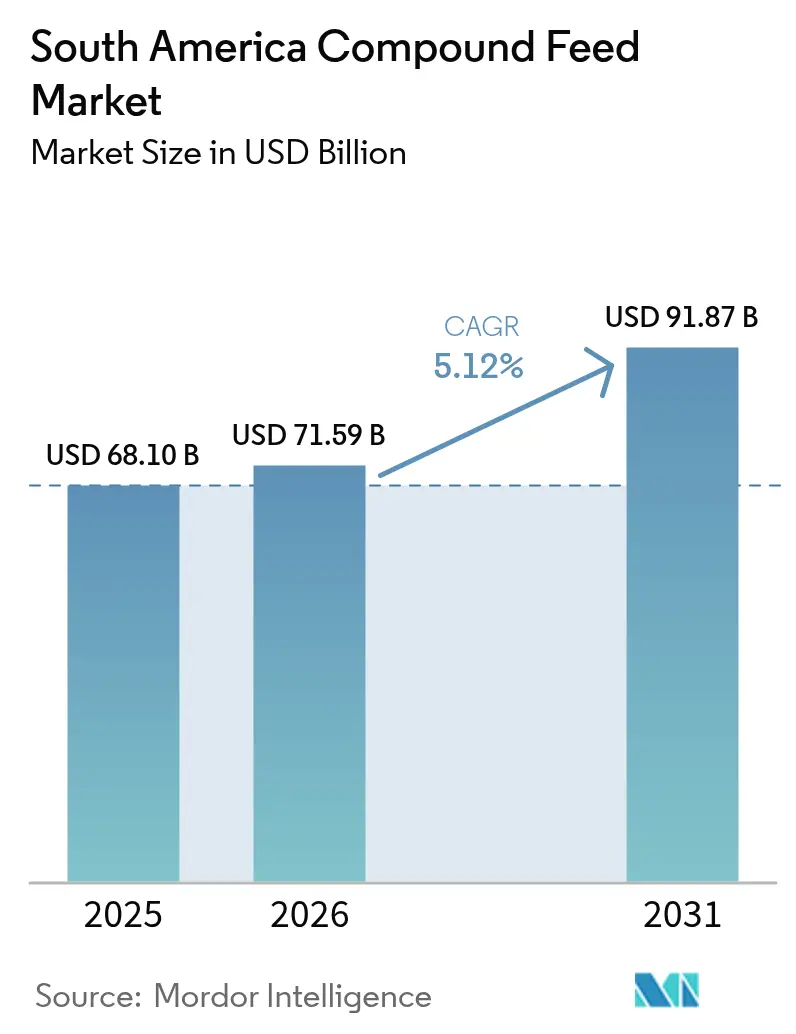
South America compound feed market size in 2026 is estimated at USD 71.59 billion, growing from 2025 value of USD 68.1 billion with 2031 projections showing USD 91.87 billion, growing at 5.12% CAGR over 2026-2031. Strong export-oriented poultry, pork, and beef supply chains are integrating backward into nutrition to secure consistent quality and hedge against fluctuations in commodity costs. Brazil’s fast-track approval process for enzymes and probiotics gives early adopters a cost advantage, while Argentine integrators rely on forward grain contracts to mitigate currency risk. Aquaculture’s rapid expansion, tightening antibiotic-residue limits, and carbon-linked certifications further diversify demand, favoring mills that invest in functional additives and traceable soy. Competitive intensity is moderate, with scale economies, research and development partnerships, and sustainability credentials shaping strategy across the South America compound feed market.
Key Report Takeaways
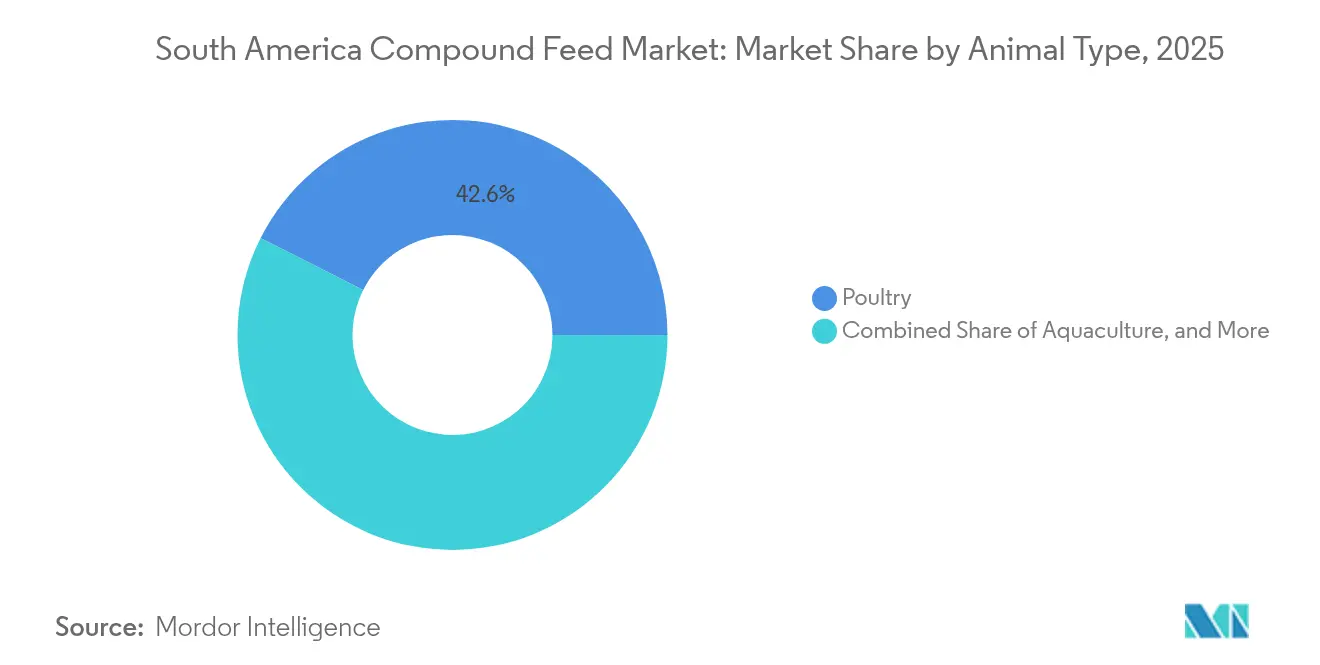
- By animal type, poultry led with 42.55% of South America compound feed market size in 2025, while aquaculture is forecast to expand at a 7.42% CAGR to 2031.
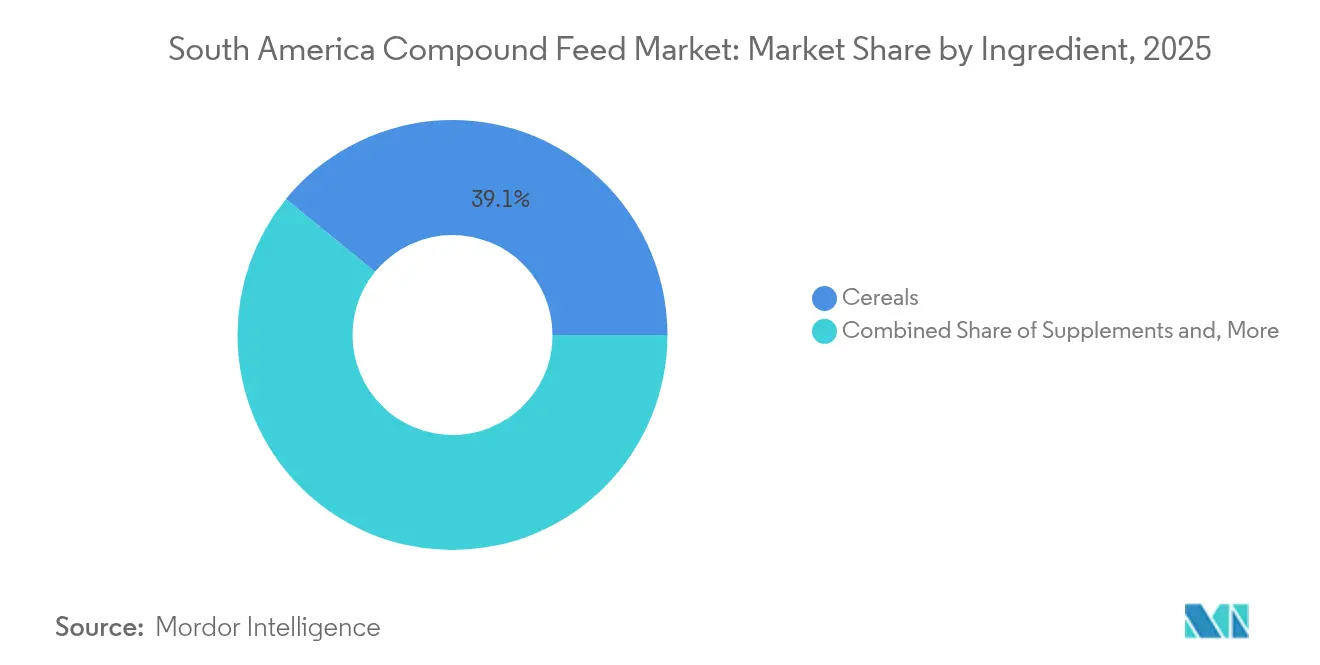
- By ingredient, cereals accounted for a 39.10% share of the South America compound feed market size in 2025, and supplements are projected to advance at an 7.68% CAGR through 2031.
- By geography, Brazil accounted for 61.65% of the 2025 revenue, and Argentina is poised to grow at a 5.98% CAGR through 2031.
Note: Market size and forecast figures in this report are generated using Mordor Intelligence’s proprietary estimation framework, updated with the latest available data and insights as of 2026.
Market Trends and Insights
Drivers Impact Analysis of South America Compound Feed Market*
| Driver | (+) % Impact on CAGR Forecast | Geographic Relevance | Impact Timeline |
|---|---|---|---|
| Rising livestock production and export demand | +1.2% | Brazil dominance, with spillover to Argentina and Paraguay | Medium term (2-4 years) |
| Adoption of nutritional and specialty feed additives | +0.9% | Brazil and Argentina core, expanding to Chile and Colombia | Long term (≥ 4 years) |
| Government programs that incentivize animal protein supply chains | +0.7% | Brazil federal and state programs, Argentina provincial credits | Short term (≤ 2 years) |
| Expansion of integrated feed milling capacity | +0.8% | Brazil southern states, Argentina pampas region | Medium term (2-4 years) |
| Aquaculture boom in Amazon basin and coastal fisheries | +0.6% | Brazil northern states, Ecuador and Chile coastal zones | Long term (≥ 4 years) |
| Carbon-credit linked sustainable feed initiatives | +0.4% | Brazil and Argentina pilot projects, with EU buyer linkage | Long term (≥ 4 years) |
| Source: Mordor Intelligence | |||
Rising Livestock Production and Export Demand
Brazil exported 4.9 million metric tons of chicken meat in 2024, solidifying its position as the world's leading exporter and creating a structural demand for high-performance broiler feed [1]. This export intensity compels integrators to optimize feed conversion ratios below 1.60, a threshold that necessitates the precise formulation of amino acids and enzymes. Argentina's pork shipments to China rebounded in 2024 after disruptions from African swine fever eased, prompting local millers to expand their swine-feed lines with synthetic lysine and threonine blends. The feedback loop between export competitiveness and feed quality means that any disruption in ingredient supply or formulation consistency immediately erodes margin at the farm gate. Cattle ranching in Brazil's Center-West continues to intensify, with feedlot finishing now accounting for over 30% of the slaughter volume. This shift replaces pasture grazing with concentrated rations, driving demand for high-energy pellets.
Adoption of Nutritional and Specialty Feed Additives
Enzyme inclusion rates in poultry feed exceeded 85% penetration in Brazil's southern states in 2024, reflecting a strategic shift toward phytase and xylanase combinations that unlock phosphorus and energy from plant-based ingredients. This trend reduces reliance on inorganic phosphate supplements, which are subject to price volatility tied to global fertilizer markets. Probiotic strains, such as Bacillus subtilis and Lactobacillus acidophilus, gained traction in swine rations after field trials demonstrated improved gut health and reduced mortality in weanling pigs. The regulatory pathway for novel additives in Brazil follows Ministry of Agriculture guidelines that require efficacy data from local trials, a barrier that favors multinational ingredient suppliers with established research infrastructure.
Government Programs That Incentivize Animal Protein Supply Chains
Brazil's National Program for Agricultural Credit (Pronaf) allocated BRL 71 billion (USD 14.2 billion) in 2024 for rural financing, with a dedicated line for feed mill modernization that carries interest rates 4 percentage points below commercial benchmarks. This subsidy structure enables regional cooperatives to install automated batching systems and expand storage capacity, narrowing the operational gap with multinational competitors. Argentina's provincial governments in Córdoba and Santa Fe extended tax exemptions on feed-ingredient imports through 2025, a measure designed to offset the inflationary impact of currency devaluation on input costs. These fiscal incentives lower the effective cost of feed production, resulting in improved farm-level profitability and higher livestock retention rates.
Expansion of Integrated Feed Milling Capacity
JBS S.A. and BRF S.A. companies collectively operate 32 feed mills across Brazil, with a combined annual capacity exceeding 12 million metric tons, a scale that allows them to negotiate volume discounts on corn and soybean meal directly with crushing plants. This vertical integration model insulates these firms from spot-market price spikes and enables them to formulate rations tailored to proprietary poultry and swine genetics. Cargill commissioned a 500,000-metric-ton feed facility in Mato Grosso in late 2024, positioning the plant within 200 kilometers of major soybean-crushing operations and reducing inbound freight costs by an estimated 8%. The strategic logic behind these mega-mills is straightforward: fixed costs per ton decline as throughput increases, and proximity to ingredient sources reduces the working capital tied up in inventory. Smaller commercial mills face a structural disadvantage in this environment, as they lack the balance-sheet capacity to forward-contract grain on a large scale or invest in automation that reduces labor intensity.
Restraints Impact Analysis of South America Compound Feed Market*
| Restraint | (~) % Impact on CAGR Forecast | Geographic Relevance | Impact Timeline |
|---|---|---|---|
| Volatility in commodity and feed ingredient prices | -0.8% | Brazil and Argentina soy-corn belt, import-dependent markets | Short term (≤ 2 years) |
| Stringent environmental and land-use regulations | -0.5% | Brazil Amazon and Cerrado regions, Argentina northern provinces | Medium term (2-4 years) |
| Logistics bottlenecks and port congestion | -0.3% | Brazil Santos and Paranaguá ports, Argentina Rosario corridor | Short term (≤ 2 years) |
| Consumer shift toward plant-based protein | -0.2% | Urban centers in Brazil, Argentina, and Chile | Long term (≥ 4 years) |
| Source: Mordor Intelligence | |||
Volatility in Commodity and Feed Ingredient Prices
Corn futures on the Chicago Board of Trade traded in a USD 4.20 to USD 5.80 per bushel range during 2024, a 38% swing that forced feed millers to adjust formulations weekly to maintain target margins. Soybean meal prices in Brazil's domestic market surged to BRL 2,400 per metric ton (USD 480 per metric ton) in mid-2024, following a drought in Rio Grande do Sul that reduced crushing volumes by 18%. This price volatility compresses feed margins because livestock contracts are often locked in months ahead of delivery, leaving millers exposed to input-cost inflation without a corresponding revenue adjustment. The financial strain is most acute for commercial mills serving independent farmers, as these customers lack the balance-sheet flexibility to absorb sudden feed-price increases and may delay orders or switch to lower-cost rations that compromise animal performance. Integrated producers partially mitigate this risk by hedging their grain purchases through futures contracts, but this strategy requires treasury expertise and capital reserves that smaller players often cannot afford.
Stringent Environmental and Land-Use Regulations
Brazil's Forest Code requires rural properties in the Amazon biome to maintain 80% native vegetation cover, a mandate that restricts soybean expansion and tightens the supply of domestically sourced meal for feed production. Enforcement intensified in 2024, with federal agencies blocking credit access for farms found in violation, a policy that reduced the area available for soy cultivation by an estimated 1.2 million hectares. Argentina's northern provinces implemented land-use zoning in 2024, which prohibits the conversion of agricultural land in high-conservation-value forests. This measure limits the geographic footprint for feed-crop production and raises the cost of compliance for millers sourcing from these regions. The regulatory influence extends to traceability requirements, with the European Union's Deforestation Regulation (EUDR) mandating the collection of geolocation data for all soy and beef imports starting in 2025 [2]. Feed millers exporting to the European Union-bound livestock operations must now invest in supply-chain mapping and third-party audits, which add an estimated USD 5 to USD 8 per metric ton to the cost of certified feed.
*Our forecasts treat driver/restraint impacts as directional, not additive. The impact forecasts reflect baseline growth, mix effects, and variable interactions.
South America Compound Feed Market Segment Analysis
By Animal Type:
Poultry Dominance Meets Aquaculture SurgePoultry feed captured 42.55% of South America's 2025 compound feed market, a dominance rooted in Brazil's broiler export machine and Argentina's resurgence in egg production. Broiler integrators demand feed-conversion ratios below 1.60, a target that requires precision balancing of metabolizable energy and digestible amino acids, pushing millers to adopt near-infrared spectroscopy for real-time ingredient analysis. The poultry segment's maturity means growth will come from incremental efficiency gains rather than volume expansion, a dynamic that favors ingredient suppliers offering novel enzymes or gut-health additives over commodity grain traders. Swine feed benefits from Argentina's renewed pork exports to China, with formulations shifting toward synthetic lysine and low-crude-protein diets that reduce nitrogen excretion and comply with emerging environmental standards.
Aquaculture feed is expected to expand at a 7.42% CAGR through 2031, driven by the fastest growth among animal types, as tilapia cage farming scales up in Brazil's reservoirs and shrimp production intensifies in Ecuador's coastal provinces. The aquaculture segment's outperformance reflects a structural arbitrage: fish convert feed into body mass more efficiently than terrestrial livestock, with tilapia achieving feed-conversion ratios of nearly 1.20 compared to 1.60 for broilers and 2.80 for cattle. This efficiency advantage positions aquaculture as a lower-cost protein source, particularly in regions where water resources are abundant and support intensive production. Regulatory frameworks are catching up, with Brazil's Ministry of Fisheries issuing new guidelines in 2024 for aquafeed labeling that mandate disclosure of fishmeal and fish-oil content, a transparency measure aimed at addressing sustainability concerns .

By Ingredient:
Cereals Lead, Functional Supplements AccelerateCereals accounted for 39.10% of ingredient revenue in 2025, with corn and wheat serving as the primary energy sources in most rations across poultry, swine, and ruminant applications. Brazil's second corn crop, harvested in the first quarter, supplies the bulk of domestic feed demand, yet logistics bottlenecks during peak harvest compress prices in producing regions while elevating costs in deficit areas. Cakes and meals, primarily composed of soybean meal, serve as the primary protein source. Crushing plants in Mato Grosso and Argentina's Pampas region operate at near-full capacity to meet both export and domestic demand. By-products, including wheat bran and rice hulls, provide cost-effective fiber and energy, particularly in ruminant rations where digestive physiology can tolerate lower-quality ingredients.
Supplements are projected to grow at an 7.68% CAGR through 2031, driven by prebiotics and probiotics that are replacing antibiotic growth promoters as residue limits tighten across export markets. Within the supplements category, vitamins remain a stable revenue contributor, with synthetic A, D, and E blends sourced primarily from European and Chinese manufacturers. Amino acids, particularly lysine, methionine, and threonine, are seeing adoption rates above 90% in poultry and swine feed as nutritionists optimize least-cost formulations that reduce crude-protein levels without sacrificing growth performance. Enzymes, including phytase and xylanase, unlock nutrients from plant-based ingredients and reduce the environmental footprint of livestock operations by lowering phosphorus and nitrogen excretion.
Geography Analysis
Brazil Compound Feed Market
Brazil held 61.65% of South America compound feed market in 2025, a share underpinned by the world's largest broiler export program, a cattle herd exceeding 230 million head, and a swine sector that targets Asian buyers. The country's feed industry benefits from domestic corn and soybean production, which supplies over 90% of ingredient needs, insulating millers from import price volatility and currency risk. Brazil's southern states, including Paraná, Santa Catarina, and Rio Grande do Sul, are home to significant poultry and swine operations, with feed mills strategically located near crushing plants and port terminals to minimize logistics costs.
Argentina Compound Feed Market
Argentina will expand at a 5.98% CAGR through 2031, driven by the fastest geographic growth, fueled by grass-fed beef exports, a resurgent pork sector, and a poultry industry that serves both domestic and regional buyers. The country's feed market is shaped by peso volatility, which forces millers to hedge ingredient costs through forward contracts with United States grain exporters and complicates pricing for livestock producers operating on thin margins. Argentina's Pampas region, encompassing the provinces of Buenos Aires, Córdoba, and Santa Fe, is home to the majority of the country's feed-milling capacity. The proximity to soybean-crushing plants and cattle feedlots reduces inbound freight costs. The government extended tax exemptions on feed-ingredient imports through 2025, a measure designed to offset inflationary pressures and support farm-level profitability.
South America Compound Feed Market
Rest of South America, including Colombia, Peru, Chile, and Ecuador, held significant share, the fastest geographic growth. Chile's salmon aquaculture industry consumed over 900,000 metric tons of feed in 2024, with formulations increasingly incorporating algae-based omega-3 oils to replace fishmeal and address sustainability concerns from European retailers. Colombia's dairy sector is intensifying, with farmers adopting total mixed rations and precision feeding systems that improve milk yields and reduce methane emissions per liter produced. Peru's poultry industry is modernizing, with integrators investing in automated feed-delivery systems and biosecurity protocols that support higher stocking densities and faster turnover.
Regulatory Landscape
Brazil and Argentina anchor South America compound feed compliance through centralized inspection, facility authorization, and additive registration regimes that increasingly depend on digital workflows and traceability. In Brazil, the Ministry of Agriculture and Livestock (MAPA) is the key authority, and Decree No. 12.031/2024 strengthened the inspection and mandatory control framework for products destined for animal feed, aligning enforcement with the existing legal base (including Law No. 6.198/1974 and Law No. 14.515/2022) and tightening accountability across the supply chain.
In Argentina, SENASA consolidated the technical compliance baseline for animal feed via Resolucion SENASA 1415/24 (Technical Standard for Animal Feed) and complemented it with Resolucion SENASA 1416/2024 governing authorization of establishments destined for animal feed. Export-oriented feed and livestock chains also face tighter upstream documentation requirements, including geolocation-linked traceability for soy and beef connected to the European Union Deforestation Regulation (EUDR) beginning in 2025, which raises the compliance bar for mills serving EU-bound animal protein supply chains.
Competitive Landscape
The South America compound feed market is highly consolidated with major players like Cargill Inc., Kemin Industries, Marfrig Global Foods (BRF), JBS S.A., and Aurora Alimentos. These leading companies are focused on acquiring feed mills and small manufacturing for expansion of the business in local as well as foreign markets. Also, the leading companies focused on the expansion of the business across regions and setting up a new plant for increasing production capacity as well as a product line. The companies are also increasing the production capacities of their existing plants.
South America Compound Feed Industry Leaders
-
Cargill, Incorporated
-
ADM
-
JBS S.A.
-
BRF S.A
-
Alltech, Inc.
- *Disclaimer: Major Players sorted in no particular order
South America Compound Feed Market Companies Covered in this Report
- Cargill, Incorporated
- ADM
- JBS S.A.
- BRF S.A
- Alltech, Inc.
- Kemin Industries, Inc.
- Nutreco N.V.
- Royal De Heus Group B.V.
- Evonik Industries AG
- Phibro Animal Health Corporation
- Adisseo France S.A.S.
- Vitapro S.A
- Italcol S.A.
- Aurora Alimentos Cooperativa Central
- DSM-Firmenich AG
Market Opportunities and Future Outlook
Higher-precision nutrition and additives manufacturing are opening pockets of demand beyond commodity grinding, supported by capacity additions and automation investments in Brazil. ADM opened a 7,500 sq m premix and feed additives facility in Apucarana, Parana, in 2026 with installed capacity of 40,000 tons per year, and production capacity 40% higher than its previous local site. The company’s scale-up points to demand for traceable, customized premixes that help integrators manage tighter residue requirements and formulation volatility.
Consolidation and portfolio expansion in premixes and concentrates is also a clear route for scale, route-to-market reach, and cross-border trade within South America. Cargill advanced this direction with a binding offer in 2025 to acquire Mig-Plus in Brazil (premixes, concentrates, and rations), while local groups continue to review mill assets, including ADM entering advanced negotiations in 2026 to sell an idle feed mill in Tres Coracoes, Minas Gerais, to Agronorte. Alongside mature poultry and swine demand, aquaculture feed and sustainability-linked traceability requirements across Brazil, Chile, Ecuador, and Peru continue to pull the market toward functional additives, documented sourcing, and specialized formulations that command more value per ton than standard rations.
Recent Industry Developments in South America Compound Feed Market
- June 2026: ADM opened a new premix and feed additives plant in Apucarana, Parana, Brazil, with installed capacity of 40,000 tons per year. The facility adds automation and traceability capabilities, strengthening ADM's ability to supply higher-spec formulations to integrators and distributors across Brazil and nearby South American markets.
- July 2025: Cargill made a binding offer to acquire Mig-Plus, a Brazilian producer of premixes, concentrates, and rations based in Rio Grande do Sul. The offer expands Cargill's higher-value animal nutrition portfolio in Brazil and supports deeper penetration with poultry, swine, and ruminant customers that buy formulated solutions rather than commodity feed.
- January 2024: JBS invested in three new feed factories in Seberi, Santo Inacio, and Itaiópolis in Southern Brazil to supply its Seara business unit. Adding more than 1 million metric tons of annual feed production capacity reinforces vertical integration and increases internal feed security for large-scale poultry and swine operations.
South America Compound Feed Market Report Scope and Research Methodology
Market Definition and Coverage
For this study, the market covers manufactured compound feed sold for livestock and aquaculture in South America, valued at the point of sale from feed makers to farms and integrators. It reflects formulated feed mixtures made from grains, meals, by-products, and supplements.
Scope exclusions: We exclude on-farm single ingredient feeding, unprocessed fodder and forage, and veterinary medicines that are not sold as feed supplements.
Segments Covered in This Report
- By Animal Type
- Ruminants
- Poultry
- Swine
- Aquaculture
- Other Animal Types
- By Ingredient
- Cereals
- Cakes and Meals
- By-products
- Supplements
- Vitamins
- Amino Acids
- Enzymes
- Prebiotics and Probiotics
- Acidifiers
- Other Supplements
- By Geography
- Brazil
- Argentina
- Rest of South America
Data Sources, Market Sizing, and Validation
Desk Research
Desk work starts with building a clear fact base on feed output, livestock inventories, and grain supply, because these points explain most demand changes for compound feed in the region. We use public sources such as FAOSTAT, USDA PSD and GAIN releases, UN Comtrade, and national agriculture ministries and statistical institutes across South America to anchor volumes, trade flows, and animal numbers.
To ground pricing and mix assumptions, we also review company annual reports, investor presentations, association websites, customs releases, and reputable press coverage on grain and oilseed meal pricing. Where needed, a paid subscription focused on company financials and business intelligence is used only to improve consistency in revenue splits and facility footprints, and then the outputs are checked back to public signals. The sources listed here are illustrative, and we used additional references during the research process to collect, clarify, and validate inputs.
Primary Interviews and Surveys
Our interviews and surveys cover feed manufacturers, integrators, distributors, nutrition specialists, and livestock producers within South America. We use their views to test production tonnage, realized feed prices, capacity use, channel mix, and missing-country assumptions against desk evidence. Re-contact is considered when reported changes conflict with trade, livestock, or input-cost signals.
Distribution of primary research fieldwork respondents
| Company type | Respondent position |
|---|---|
| Top tier: 26% | CXOs: 15% |
| Mid tier: 49% | Functional/Unit leaders: 30% |
| Smaller Players: 25% | Managers: 55% |
Market-Sizing & Forecasting
Sizing is built using a top-down demand pool that reconstructs compound feed consumption from species-level production and feeding needs, and then converts volumes into value using observed price ranges by feed type. We start with poultry, swine, ruminant, and aquaculture activity, apply realistic feed intensity and commercial feed penetration, and then allocate demand across Brazil, Argentina, and the rest of South America.
Several market fingerprints are tracked as inputs, such as poultry and swine output trends, cattle finishing intensity, aquaculture expansion signals, corn and soybean meal price movements, and the typical use of supplements in finished feed. Selective bottom-up approximations are then used to corroborate totals, including sampled checks on feed mill capacity discussions, channel checks on average selling prices, and consistency checks against reported feed production where available. Where company detail is thin for smaller mills, gaps are handled through calibrated penetration and pricing assumptions that were validated in interviews.
Forecasts are developed using scenario analysis tied to grain cost outlooks, protein production trajectories, and expected shifts in on-farm mixing versus commercial purchasing. Where forecasts looked too optimistic or conservative, we adjusted the variable paths until they aligned with what respondents described as workable over the cycle.
Data Validation & Update Cycle
Model outputs are validated through triangulation across independent signals, including livestock and aquaculture indicators, input commodity movements, and implied feed intensity by species. Large variances trigger a deeper review of assumptions, followed by a re-check with selected primary contacts when the mismatch cannot be explained by seasonality, currency timing, or policy-related shifts.
Before sign-off, the work is reviewed in multiple analyst passes so arithmetic, units, and scope treatment stay consistent across animal types and countries. Reports are refreshed annually, with interim updates for material events such as grain price shocks or major regulatory changes that alter formulations. Right before delivery, we do a final scan of the latest public releases so clients receive an up-to-date view.
Mordor Intelligence's South American Compound Feed Market Size Compared With Other Published Estimates
Published market values for South American compound feed often do not match, even when the titles look similar, because the boundaries and conversion steps are not the same. Differences usually come from whether the estimate tracks compound feed only or broader animal feed, how the geography is defined, and how volume is translated into value when grain prices move quickly.
The gap is typically driven by scope and pricing logic, where some estimates blend Latin America with South America, or fold in fodder, forage, and on-farm mixes that are not sold as compound feed. Another driver is the year and currency basis, since using a different price window or exchange rate timing can shift the USD value noticeably in a commodity-linked market.
Benchmark comparison
| Source | Market Size | Gaps in Research Methodology |
|---|---|---|
| Mordor Intelligence | USD 68.10 B (2025) | |
| Industry Data Publisher A | USD 56.10 B (2025) | Uses a Latin America scope that includes countries outside South America, and the country mix can shift the value when regional averages are applied. |
| Regional Consultancy B | USD 18.70 B (2026) | Uses a different year anchor and a narrower spend definition, which can undercount complete feed volumes when pricing and commercial penetration are not aligned to the same base year. |
The table shows a wide spread that is mainly explained by geography coverage and what is counted as commercially sold compound feed. In Mordor Intelligence's model, the total is built for South America only and is limited to formulated compound feed sold to farms and integrators, with base-year pricing aligned to 2025. With those assumptions made explicit, the estimate stays traceable to livestock output, feed intensity, and repeatable price checks.
Key Questions Answered in the Report
What is the projected value of the South America compound feed market by 2031?
The market is projected to reach USD 91.87 billion by 2031.
Which animal type is growing fastest in South America feed demand?
Aquaculture feed is forecast to register the highest CAGR of 7.42% between 2026 and 2031.
How large is Brazil's share in regional compound feed revenues?
Brazil accounted for 61.65% of South America's feed revenue in 2025.
What is driving pellet dominance in South American feed forms?
Pellets reduce waste, improve feed conversion, and withstand long-distance transport better than mash, giving them a 51.35% share in 2025.