
Market Overview
| Study Period | 2020 - 2031 |
|---|---|
| Forecast Data Period | 2026 - 2031 |
| Base Year Market Size (2025) | USD 1.10 Billion |
| Market Size (2026) | USD 1.23 Billion |
| Market Size (2031) | USD 2.01 Billion |
| Growth Rate (2026 - 2031) | 10.39 % |
| Market Concentration | Medium |
Major Players *Disclaimer: Major Players sorted in no particular order Image © Mordor Intelligence. Reuse requires attribution under CC BY 4.0. | |
South America Wireless Sensors Market Analysis by Mordor Intelligence
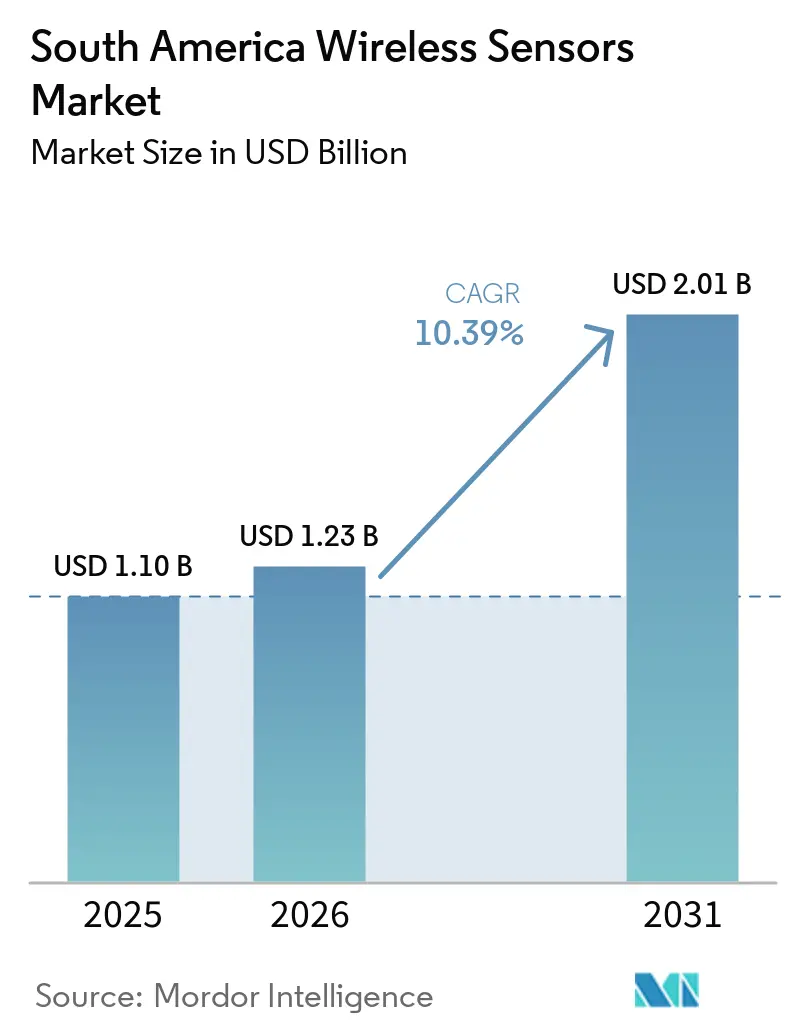
The South America wireless sensors market size was valued at USD 1.10 billion in 2025 and estimated to grow from USD 1.23 billion in 2026 to reach USD 2.01 billion by 2031, at a CAGR of 10.39% during the forecast period 2026-2031. Industrial digitalization is increasing the demand for connected sensing in manufacturing, energy, mining, and utilities. Brazil has the region’s largest demand base due to its broad industrial and agricultural activity. Mining and energy operators are adopting remote monitoring where cabling is costly or difficult to maintain. Lower MEMS and connectivity costs are widening the range of assets that can support wireless monitoring. Suppliers are responding with multi-protocol, edge-capable, and lower-power products that address both established plants and dispersed field operations.
Key Report Takeaways
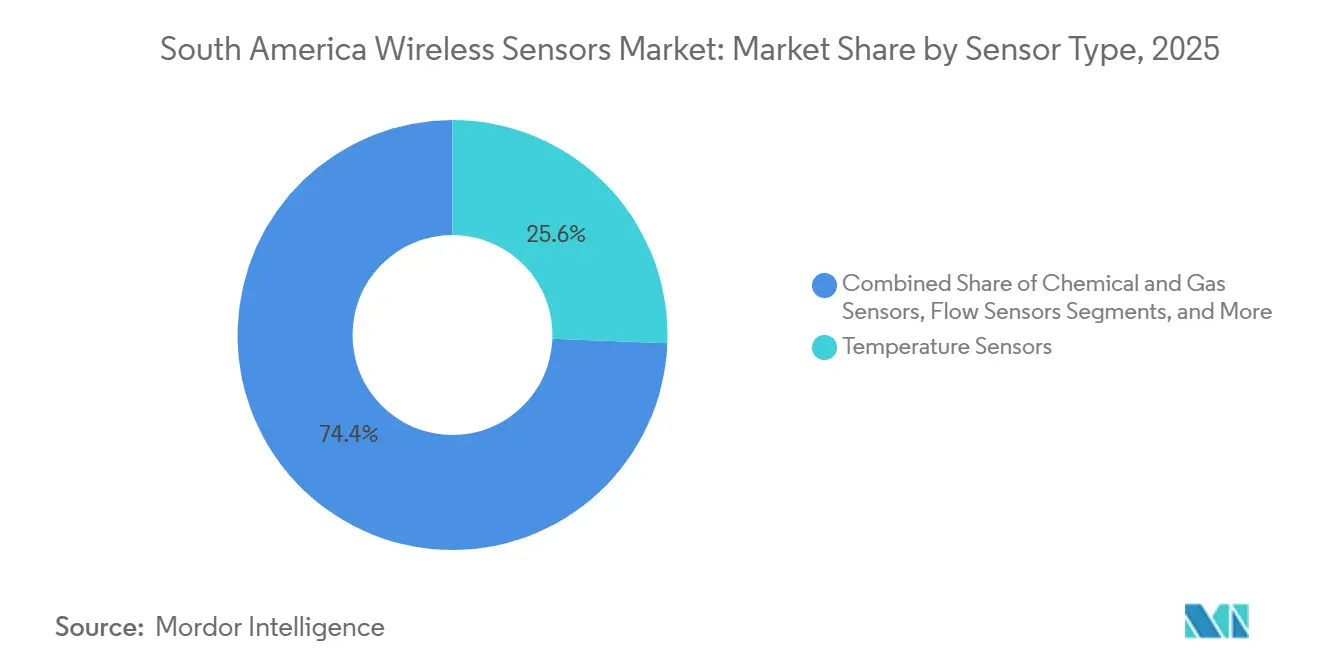
- By sensor type, temperature sensors held 25.61% of the South America wireless sensors market share in 2025, while image sensors are projected to expand at a 12.06% CAGR through 2031.
- By end-user industry, energy and power accounted for 20.45% of the South America wireless sensors market size in 2025, while agriculture is expected to grow at an 11.64% CAGR through 2031.
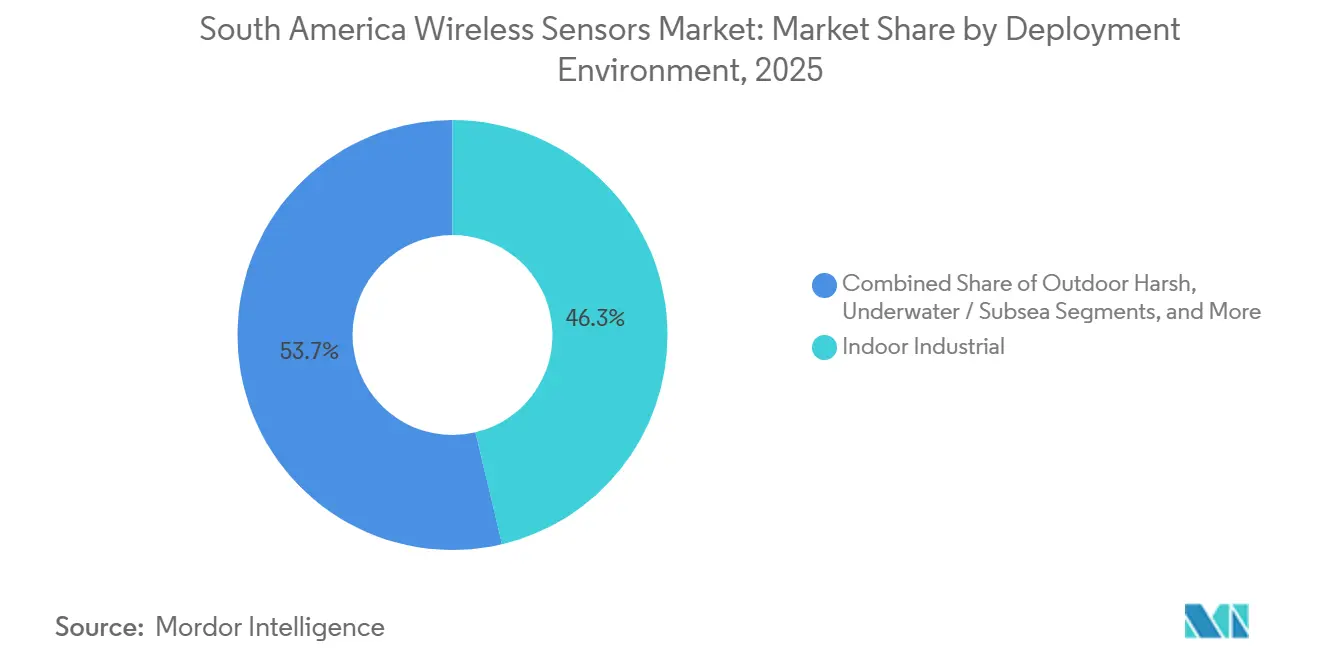
- By deployment environment, indoor industrial applications held 46.31% of the South America wireless sensors market share in 2025, while remote and hazardous locations are projected to record a 12.24% CAGR through 2031.
- By geography, Brazil held 48.02% share in 2025, while Chile is projected to grow at a 13.02% CAGR through 2031.
Note: Market size and forecast figures in this report are generated using Mordor Intelligence’s proprietary estimation framework, updated with the latest available data and insights as of January 2026.
South America Wireless Sensors Market Trends and Insights
Drivers Impact Analysis*
| Driver | (~) % Impact on CAGR Forecast | Geographic Relevance | Impact Timeline |
|---|---|---|---|
| Industry 4.0 and Industrial IoT Adoption | +2.8% | Brazil, Argentina, Colombia | Medium term (2-4 years) |
| Smart-City and Infrastructure Digitization | +2.1% | Brazil, Chile, Colombia | Medium term (2-4 years) |
| Precision Agriculture and Remote Asset Monitoring | +1.8% | Brazil, Chile, Argentina | Long term (≥ 4 years) |
| Falling Wireless Connectivity and MEMS Costs | +1.5% | Global, concentrated in Brazil and Chile | Short term (≤ 2 years) |
| Battery-Free Energy Harvesting for Maintenance-Free Nodes | +0.9% | Brazil, Chile | Long term (≥ 4 years) |
| Retrofit Demand in Harsh and Inaccessible Industrial Sites | +0.7% | Brazil, Chile, Colombia | Medium term (2-4 years) |
| Source: Mordor Intelligence | |||
Industry 4.0 and Industrial IoT Adoption
Industrial sites in South America are integrating digital sensing into existing operations, which supports wider adoption of wireless sensors in the South America wireless sensors market. Plants in Brazil and Argentina that installed early wireless nodes during 2019 and 2020 are replacing them with more capable equipment. Buyers are choosing devices with edge processing and predictive maintenance capabilities rather than basic telemetry products. This replacement activity increases the value of each deployment when equipment requires greater sensing and communications capabilities. Rockwell Automation presented edge IoT sensing tools for predictive maintenance and retrofit use at Automation Fair 2025. The company’s focus on integration with existing plant networks aligns with the upgrade requirements of established industrial sites. São Martinho contracted Telefónica Vivo in March 2026 to deploy 44 cellular towers across up to 3 million hectares, supporting smart irrigation, environmental monitoring, and fleet telemetry at 4 agro-industrial complexes.
Smart-City and Infrastructure Digitization
Utility and city programs drive dense wireless sensor deployments, with long procurement cycles, in the South America wireless sensors market. These programs can support recurring demand for network management, meters, gateways, and associated maintenance in the South America wireless sensors market. SABESP, Telefónica Vivo, and IDEMIA Secure Transactions formalized a 14-year initiative in August 2026 to connect 4.4 million NB-IoT smart water meters across São Paulo and São José dos Campos. The deployment supports hourly consumption visibility, leak detection, and water-balance management. It also uses an eSIM architecture designed to meet GSMA SGP.32 requirements. The city of Pindamonhangaba deployed environmental sensor networks for early warning of floods and wildfires across nearby rural and mountainous areas in 2025. Large programs can provide secondary cities with a proven model for evaluating related sensor systems.
Precision Agriculture and Remote Asset Monitoring
Agriculture is the fastest-growing end-user area in the South America wireless sensors market, supported by field-level monitoring needs. Soil, weather, and crop-health nodes can replace manual field checks across commodity and horticultural operations. A LoRaWAN infrastructure in Santa Rosa, Rio Grande do Sul, collected temperature, humidity, precipitation, wind, and UV data for phytosanitary analysis and irrigation scheduling. These data streams help producers make field decisions using conditions at the point of production. Water scarcity in Chilean vineyards and fruit-growing areas strengthens the case for soil-moisture monitoring. A FAPESP-supported project combined ground sensors across up to 3,000 hectares with water-availability models to support predictive irrigation management. Broader rural coverage through NB-IoT and LTE-M can make such systems practical across large, dispersed farms.
Falling Wireless Connectivity and MEMS Costs
Lower component and connection costs are changing the economics of wireless sensing across the South America wireless sensors market. Standard-resolution CMOS sensor prices declined by 3-5% annually in the supplied research, while MEMS accelerometers achieved noise levels sufficient for condition monitoring on assets that previously did not justify instrumentation.[1]Analog Devices, “New Edge Sensing Solution for Industrial Asset Health,” Analog Devices, analog.com. STMicroelectronics completed its acquisition of NXP Semiconductors’ MEMS sensor business for up to USD 950 million in July 2025. The acquisition added automotive and industrial accelerometers, gyroscopes, pressure sensors, and tire-pressure monitoring systems to STMicroelectronics’ portfolio. Commercial NB-IoT and LoRaWAN expansion in Brazil and Chile is also reducing the infrastructure barrier for rural deployments. Entry-level nodes are increasingly assessed against wired equipment on lifecycle cost rather than initial device price.
Restraints Impact Analysis*
| Restraint | (~) % Impact on CAGR Forecast | Geographic Relevance | Impact Timeline |
|---|---|---|---|
| High Deployment and Integration Costs | -1.8% | Global, most acute in Brazil and Argentina | Short term (≤ 2 years) |
| Cybersecurity and Data-Privacy Exposure | -1.3% | Brazil, Argentina | Medium term (2-4 years) |
| Interoperability Gaps Across Proprietary Protocols | -0.9% | Global | Medium term (2-4 years) |
| Battery Replacement and Spectrum Constraints in Remote Sites | -0.5% | Brazil, Chile | Long term (≥ 4 years) |
| Source: Mordor Intelligence | |||
High Deployment and Integration Costs
The price of an individual wireless node has fallen, but full deployment costs remain material for many buyers in the South America wireless sensors market. Gateway infrastructure, IT and OT integration, cybersecurity work, and network management add to the project budget. ANATEL device certification in Brazil can require 8-16 weeks of testing and documentation. This process adds expense before a small-batch project can proceed. Legacy distributed control systems also need middleware, translation hardware, and edge gateways to connect with newer wireless networks. Such requirements can double the unit cost of the sensor system. Limited availability of integrators with cross-protocol certification can extend commissioning and delay approval of later projects.
Cybersecurity and Data-Privacy Exposure
A growing number of connected endpoints expands the security burden for operators in the South America wireless sensors market. Research on industrial IoT architectures identifies denial-of-service, ransomware, man-in-the-middle, and replay attacks as important threats. Brazil’s energy sector has responded with an OT cybersecurity framework from ANEEL. Equatorial Group integrated more than 4,000 OT devices into a unified cybersecurity architecture in line with ANEEL guidance. The case shows the operating effort that security compliance can require at scale. Lower-cost nodes may not include mutual authentication or hardware security modules. These limitations add evaluation steps for agricultural and building-automation deployments with many distributed endpoints.
*Our forecasts treat driver/restraint impacts as directional, not additive. The impact forecasts reflect baseline growth, mix effects, and variable interactions.
Segment Analysis
By Sensor Type: Temperature Sensors Lead Demand, While Image Sensors Grow Fastest
Temperature sensors held 25.61% of the South America wireless sensors market share in 2025, making them the largest sensor category in the South America wireless sensors market. Their position reflects broad use in food cold chains, power-generation cooling systems, pharmaceutical storage, and industrial process monitoring across the South America wireless sensors market. Energy and agro-industrial operations provide a stable installed base for this category. Thermal events can disrupt process quality and asset performance, which supports continued demand for reliable monitoring. Brazil’s oil, gas, and agribusiness activities are important sources of demand for these devices. Wireless temperature nodes can improve coverage where installing a wired point is difficult. The category also supports routine monitoring requirements across dispersed facilities. These uses give temperature sensors a broad role in the wireless sensors industry.
Image sensors are projected to expand at a 12.06% CAGR from 2026 to 2031. Growth is linked to machine vision moving beyond dedicated inspection stations into distributed applications. Automotive assembly and electronics manufacturing in South America are key areas for adoption. These systems can support inspection, identification, and process control functions closer to the production line. Cognex reported 9% full-year revenue growth in 2025 and a 10% year-over-year revenue increase in the fourth quarter of 2025. The reported results indicate demand in machine-vision markets that serve original equipment manufacturer supply chains. Pressure sensors remain relevant to pipeline integrity and compressor monitoring in Brazil and Argentina. Chemical and gas, position and proximity, vibration, flow, humidity, acoustic, level, and force sensors address specialized safety, maintenance, logistics, water, and agricultural uses.



By End-User Industry: Energy and Power Remain Largest, While Agriculture Gains Ground
Energy and power accounted for 20.45% of the South America wireless sensors market size in 2025, making it the largest end-user category in the South America wireless sensors market. Oil and gas operators, electric utilities, and renewable facilities across Brazil, Argentina, and Colombia drive this demand. These sites need continuous information on operating conditions and equipment health. Petrobras used Emerson Rosemount 708 WirelessHART acoustic transmitters to monitor pressure-relief valves at the Presidente Bernardes de Cubatão refinery. The application shows how wireless sensing can support monitoring within hydrocarbon assets. Chile’s Atacama solar facilities and Brazil’s northeast wind corridor also require performance monitoring and predictive maintenance. The scale and operational importance of these installations sustain demand across this end-user category.
Agriculture is projected to record an 11.64% CAGR from 2026 to 2031. Producers are using sensing to manage water availability, environmental conditions, and crop performance. Rural connectivity initiatives help extend the reach of field equipment beyond established coverage areas. Commodity price volatility also increases the value of using inputs and irrigation more precisely. Automotive and consumer electronics applications create a steady demand for production-line sensing in Brazil. Healthcare supports remote patient monitoring and cold-chain applications, while aerospace and defense need rugged equipment for structural monitoring. Food and beverage operations use temperature and humidity sensing for quality control. Building automation, logistics, transportation, mining, and water utilities add demand across several smaller application areas.
By Deployment Environment: Indoor Industrial Sites Lead, While Remote Locations Accelerate
Indoor industrial sites accounted for 46.31% of the South America wireless sensors market in 2025. Factory floors, processing plants, refineries, and utility facilities account for this concentration. WirelessHART and ISA100 have established operating environments for large industrial deployments. Their maturity helps operators integrate sensors with plant control architecture. Honeywell’s OneWireless platform supports ISA100, WirelessHART, LoRaWAN, and Wi-Fi in a unified infrastructure.[2]Honeywell Process Solutions, “Honeywell OneWireless Network,” Honeywell Process Solutions, honeywell.com. Multi-protocol support can reduce operating complexity in facilities that use several connectivity approaches. The indoor segment remains central to the South America wireless sensors market because industrial plants require routine equipment and process monitoring. It also benefits from the installed base of industrial automation equipment across the region.
Remote and hazardous locations are projected to grow at a 12.24% CAGR from 2026 to 2031. Mining in Chile and Peru, Brazilian pre-salt offshore platforms, and remote farms face high costs for wired instrumentation. A March 2026 industrial demonstration showed that a thermoelectric harvester on a 0.25 kW motor supported 41 LoRa transmissions over 9,612 seconds with a positive energy balance. This result supports battery-free sensing where battery replacement is difficult. ISO/IEC 18000-65 received approval in February 2026 for UHF-band battery-free RFID sensor tags. The standard can support interoperability among manufacturers. Outdoor harsh locations, underwater and subsea sites, and building infrastructure represent smaller but developing environments for wireless equipment.
Geography Analysis
Brazil held 48.02% of the South America wireless sensors market share in 2025 and remained the largest national base in the South America wireless sensors market. Its industrial base includes oil and gas, agribusiness, automotive manufacturing, utilities, and smart-city infrastructure. The 14-year SABESP initiative will connect 4.4 million NB-IoT water meters in São Paulo and São José dos Campos. The program provides a large reference point for utility procurement of connected sensing. Brazil’s 5G rollout is extending low-latency connectivity beyond major urban areas. This supports industrial IoT use in interior industrial parks that had relied on sub-GHz proprietary networks.
Chile is projected to expand at a 13.02% CAGR from 2026 to 2031. Copper mining supports this pace because operators are investing in sensor-based operational efficiency. Anglo American and Particulas installed IoT sulfur dioxide sensor networks with a 72-hour environmental forecasting system at a Chilean copper smelter. The system feeds real-time data to the control room for alerts and operational adjustments. Argentina’s Vaca Muerta activity supports remote field-device monitoring, and YPF has used field connectivity solutions across thousands of instruments.[3]YPF and PTC, “YPF, IoT Application in the Oil and Gas Industry,” PTC, ptc.com. Córdoba also installed its first LoRaWAN flood sensor on the Suquía River in August 2025.
Colombia is a developing secondary market for the South America wireless sensors market. Demand is concentrated in coffee, flower, and avocado export areas in Antioquia and Cundinamarca. Smart metering and grid monitoring requirements support utility demand, while rural programs extend NB-IoT and LTE-M coverage to farming communities. Peru, Ecuador, Bolivia, Uruguay, and Paraguay provide a growing base of additional demand. Worldsensing deployed LoRa-networked loggers for extensometers, load cells, and inclinometers at the Chuquicamata mine in Chile, demonstrating a relevant mining application for regional operators. Uruguay and Paraguay are beginning to create demand for precision agriculture in soy and maize production. Ecuador’s oil sector is adopting pressure and flow monitoring for pipeline surveillance, while research institution LoRaWAN networks can lower initial infrastructure costs across the subregion.
Competitive Landscape
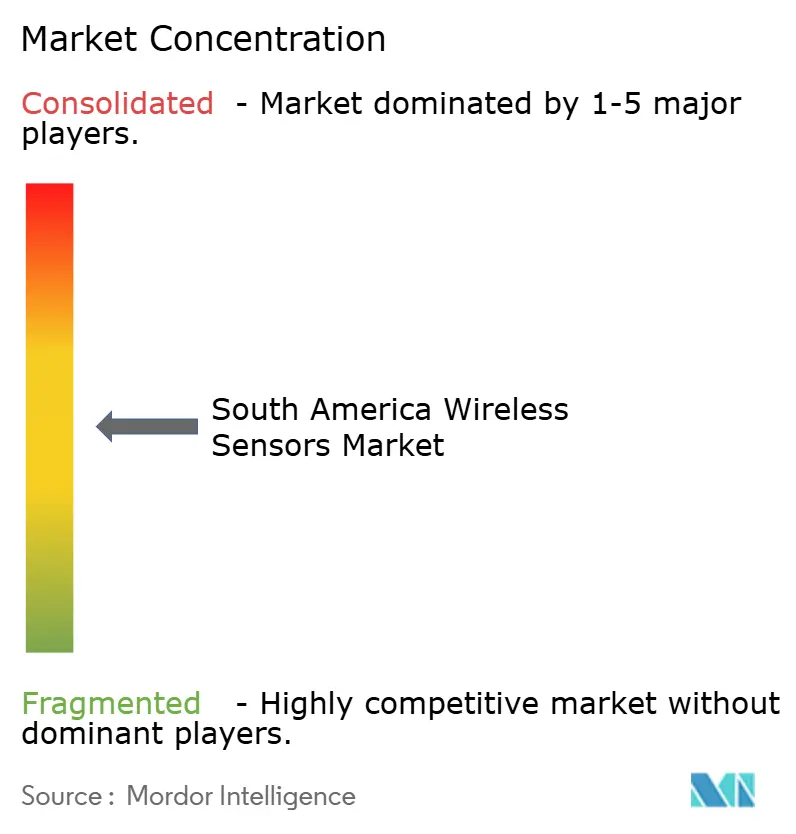
The South America wireless sensors market is semi-consolidated, with demand split between established industrial systems and specialized sensing applications. Global industrial automation suppliers are strong in oil and gas, power, and process manufacturing because their products are embedded in established plant control systems. Honeywell International Inc., Emerson Electric Co., Siemens AG, and ABB Ltd. form the upper tier in these compliance-driven applications. WirelessHART and ISA100-certified sensor families are important in their installed positions. Honeywell launched the Versatilis Transmitter in March 2025, a battery-powered LoRaWAN platform with MEMS sensing and Bluetooth Low Energy configuration. The product extends Honeywell’s offering into equipment-health monitoring and emissions tracking. This positioning also addresses lower-criticality applications that use lower-cost IoT architectures.
Siemens Brazil presented Tech4Amazonia results in April 2026. The program used IoT sensors and automation in Amazon bioeconomy supply chains, reducing seedling mortality at the Amazon Biotechnology Center from 34% to 2%.[4]Siemens Brazil, “From the Laboratory to the Forest,” Siemens Brazil, siemens.com. The program also reported sensor-based nut classification accuracy above 95% and plans to move to field scaling in 2026. This type of deployment gives large suppliers a presence in applications outside their traditional industrial base. Smaller suppliers such as Everactive Inc., Disruptive Technologies AS, and Monnit Corporation focus on battery-free nodes, low-power modules, and cost-sensitive deployments in the South America wireless sensors market. These companies are relevant to remote, agricultural, and building-automation applications where maintenance and purchase costs are central concerns for buyers.
Protocol choices remain an important competitive factor in the South America wireless sensors market. LoRaWAN, Zigbee, WirelessHART, and NB-IoT can coexist within the same customer environment. IEEE research in 2025 found that frame conversion between Zigbee and WirelessHART reduces transmission efficiency and raises processing time. Suppliers that offer multi-protocol gateways can address this operating challenge. ISO/IEC 18000-65 may favor suppliers whose battery-free products align with the new standard. The market, therefore, combines strong positions in critical industrial systems with room for specialized vendors in targeted applications. Product interoperability, security capability, and lifecycle support remain important bases of supplier selection.
South America Wireless Sensors Industry Leaders
Honeywell International Inc.
Emerson Electric Co.
Siemens AG
ABB Ltd.
Texas Instruments Incorporated
- *Disclaimer: Major Players sorted in no particular order

Recent Industry Developments
- August 2026: SABESP, Telefónica Vivo, and IDEMIA Secure Transactions launched the world’s largest IoT smart-water-management initiative, a 14-year partnership to connect 4.4 million NB-IoT water meters across São Paulo and São José dos Campos using GSMA SGP.32-compliant eSIM technology, enabling real-time leak detection, water-balance optimization, and 100% smart-meter coverage targeting São Paulo.
- August 2026: NTT DOCOMO BUSINESS and Codelco initiated a joint study and proof of concept at the El Teniente copper mine in Chile, using the IOWN All-Photonics Network, to assess the feasibility of remotely operating heavy mining equipment via a 1,500 km high-definition video and sensor-monitoring link to a Rancagua operations center.
- April 2026: Siemens Brazil disclosed Tech4Amazonia results at Hannover Messe 2026. IoT sensor and automation deployments in Amazon bioeconomy supply chains reduced the Amazon Biotechnology Center's seedling mortality from 34% to 2%, and AI-driven, sensor-based nut classification achieved over 95% accuracy. The program advanced to field scaling in 2026.
- April 2026: Anglo American partnered with Chilean startup Particulas to deploy a network of IoT SO₂ sensors with an integrated 72-hour environmental forecasting system at a Chilean copper smelter, feeding real-time sensor data into the facility’s control room for automated alerts and preemptive operational adjustments.


South America Wireless Sensors Market Report Scope
The South America Wireless Sensors Market comprises the revenue generated from the sale, deployment, integration, and maintenance of wireless sensing devices and related communication-enabled sensor systems used for monitoring, measurement, control, and data acquisition applications across South America. The market includes wireless sensors that transmit data through wireless communication technologies and are deployed across industrial, commercial, residential, agricultural, healthcare, transportation, and environmental monitoring applications.
The South America Wireless Sensors Market Report is Segmented by Sensor Type (Pressure Sensors, Temperature Sensors, Chemical and Gas Sensors, Position and Proximity Sensors, Vibration Sensors, Flow Sensors, Humidity Sensors, Image Sensors, and Other Sensor Types), End-user Industry (Automotive, Healthcare, Aerospace and Defense, Energy and Power, Food and Beverage, Agriculture, Building Automation and Smart Homes, Consumer Electronics, Logistics and Transportation, and Other End-user Industries), Deployment Environment (Indoor Industrial, Outdoor Harsh, Remote/Hazardous Locations, Underwater/Subsea, and Building Infrastructure/Residential), and Geography (Brazil, Argentina, Chile, Colombia, and Rest of South America). The Market Forecasts are Provided in Terms of Value (USD).
By Sensor Type
| Pressure Sensors |
| Temperature Sensors |
| Chemical and Gas Sensors |
| Position and Proximity Sensors |
| Vibration Sensors |
| Flow Sensors |
| Humidity Sensors |
| Image Sensors |
| Other Sensor Types |
By End-user Industry
| Automotive |
| Healthcare |
| Aerospace and Defense |
| Energy and Power |
| Food and Beverage |
| Agriculture |
| Building Automation and Smart Homes |
| Consumer Electronics |
| Logistics and Transportation |
| Other End-user Industries |
By Deployment Environment
| Indoor Industrial |
| Outdoor Harsh |
| Remote / Hazardous Locations |
| Underwater / Subsea |
| Building Infrastructure / Residential |
By Geography
| Brazil |
| Argentina |
| Chile |
| Colombia |
| Rest of South America |
| By Sensor Type | Pressure Sensors |
| Temperature Sensors | |
| Chemical and Gas Sensors | |
| Position and Proximity Sensors | |
| Vibration Sensors | |
| Flow Sensors | |
| Humidity Sensors | |
| Image Sensors | |
| Other Sensor Types | |
| By End-user Industry | Automotive |
| Healthcare | |
| Aerospace and Defense | |
| Energy and Power | |
| Food and Beverage | |
| Agriculture | |
| Building Automation and Smart Homes | |
| Consumer Electronics | |
| Logistics and Transportation | |
| Other End-user Industries | |
| By Deployment Environment | Indoor Industrial |
| Outdoor Harsh | |
| Remote / Hazardous Locations | |
| Underwater / Subsea | |
| Building Infrastructure / Residential | |
| By Geography | Brazil |
| Argentina | |
| Chile | |
| Colombia | |
| Rest of South America |


Key Questions Answered in the Report
What is the South America wireless sensors market size?
The 2026 value is USD 1.23 billion and is forecast to reach USD 2.01 billion by 2031, at a 10.39% CAGR. Industrial digitalization, remote monitoring, and lower device costs support the forecast.
Which sensor type leads wireless sensor demand in South America?
Temperature sensors led with 25.61% share in 2025 because they are used across industrial processes, cold chains, power facilities, pharmaceutical storage, and agricultural operations. These applications need recurring thermal condition monitoring.
Which end-user application is growing fastest for wireless sensors in South America?
Agriculture is projected to grow at an 11.64% CAGR through 2031 as producers expand irrigation, weather, and crop-condition monitoring. Rural connectivity and water-management needs support adoption across large farms.
Why are remote wireless sensing applications growing in South America?
Remote and hazardous locations are projected to grow at a 12.24% CAGR through 2031 because wired instrumentation is costly in mines, offshore sites, and dispersed farms. Battery-free options can also reduce maintenance constraints in difficult locations.
Which country has the largest wireless sensor demand in South America?
Brazil held 48.02% share in 2025, supported by activity in oil and gas, utilities, agribusiness, manufacturing, and smart-city infrastructure. Large water-meter and industrial connectivity programs reinforce this position.
What factors can slow adoption of wireless sensors in South America?
Integration costs, cybersecurity exposure, protocol interoperability gaps, and battery and spectrum limits at remote sites can slow project deployment. These factors increase system design work and can lengthen procurement approval cycles.
Page last updated on:





