
South America Warehouse Real Estate Market Size and Share
Market Overview
| Study Period | 2021 - 2032 |
|---|---|
| Forecast Data Period | 2027 - 2032 |
| Base Year Market Size (2026) | USD 4.21 Billion |
| Market Size (2027) | USD 4.52 Billion |
| Market Size (2032) | USD 6.45 Billion |
| Growth Rate (2027 - 2032) | 7.40 % |
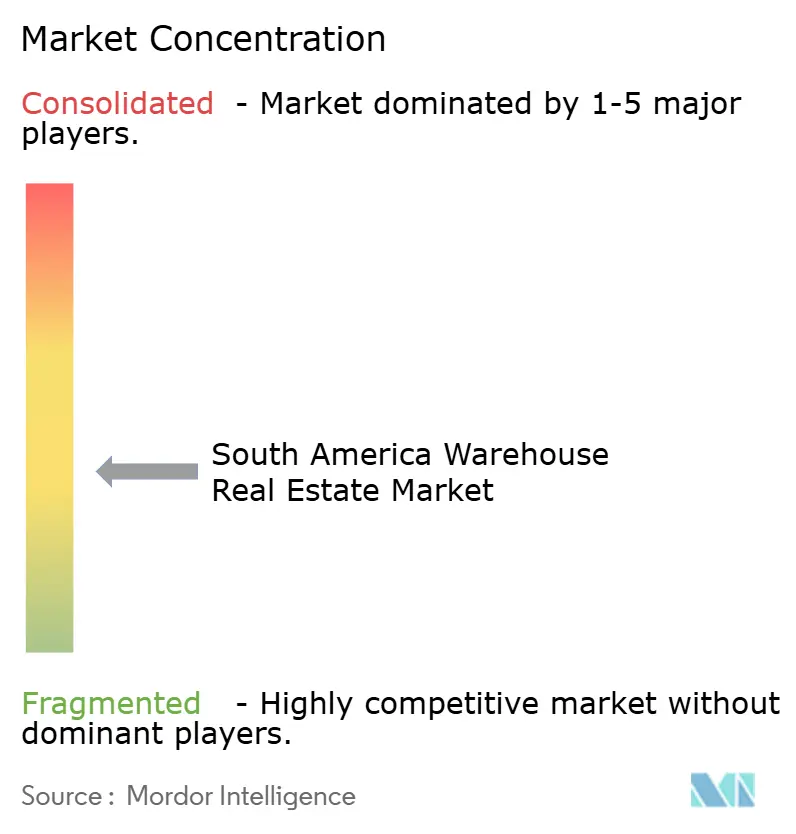
| Market Concentration | Medium |
Major Players *Disclaimer: Major Players sorted in no particular order Image © Mordor Intelligence. Reuse requires attribution under CC BY 4.0. | |
South America Warehouse Real Estate Market Analysis by Mordor Intelligence
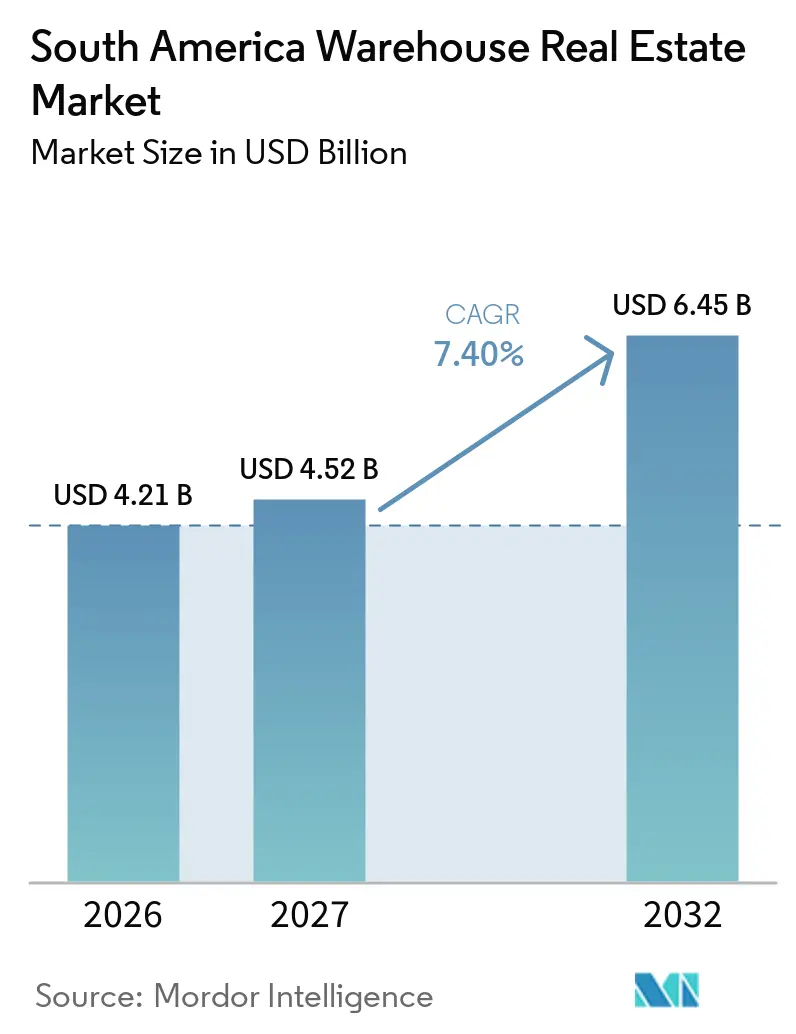
The South America Warehouse Real Estate Market size is projected to expand from USD 4.21 billion in 2026 and USD 4.52 billion in 2027 to USD 6.45 billion by 2032, registering a CAGR of 7.40% between 2027 and 2032.
The South America warehouse real estate market is shaped by limited modern logistics capacity in the region’s largest cities and by rising demand for facilities closer to consumers, ports, and production centers. E-commerce, food exports, healthcare distribution, and outsourced logistics are expanding the range of warehouse requirements. Investors are increasingly favoring facilities with established tenants, reliable infrastructure, and specifications that support temperature-controlled storage or high-volume fulfillment. The South America warehouse real estate market also faces higher financing costs, uneven infrastructure, and lengthy approval processes outside leading logistics corridors.
Key Report Takeaways
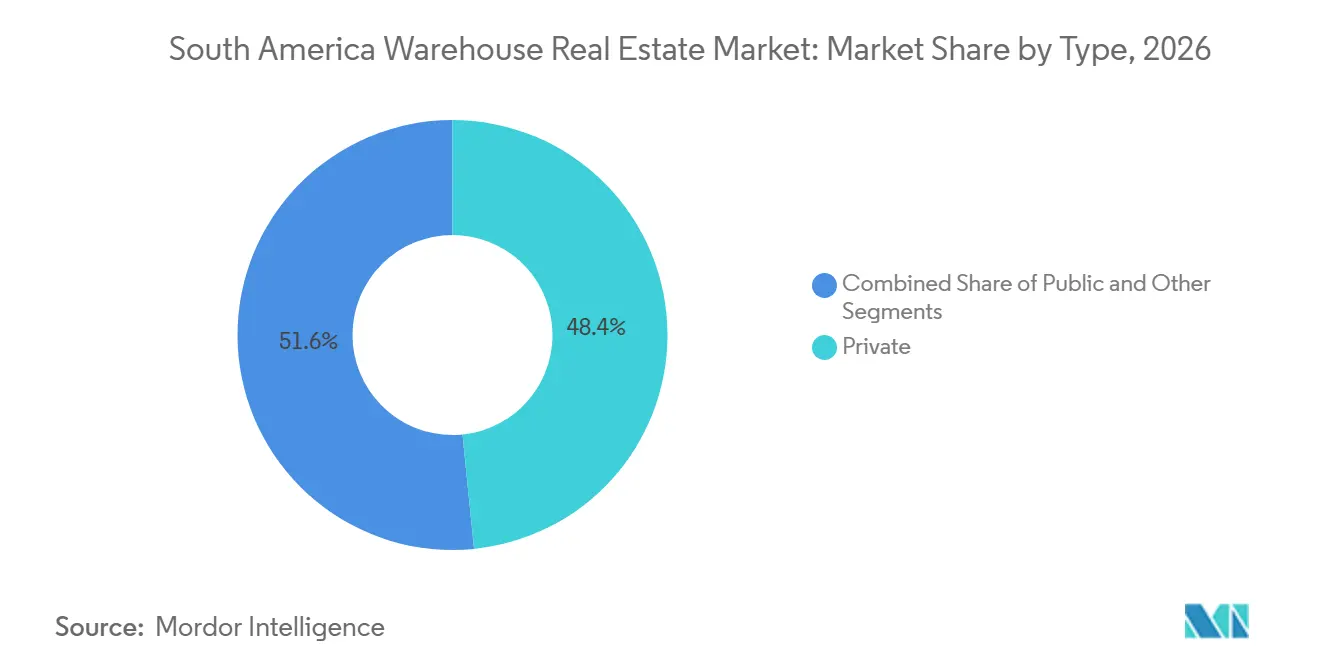
- By type, private facilities held 48.40% of the regional total in 2026, while other facilities are projected to grow at an 8.00% CAGR through 2032.
- By temperature control, general warehouses accounted for 58.00% of the regional total in 2026, while refrigerated warehouses are forecast to expand at a 8.10% CAGR through 2032.
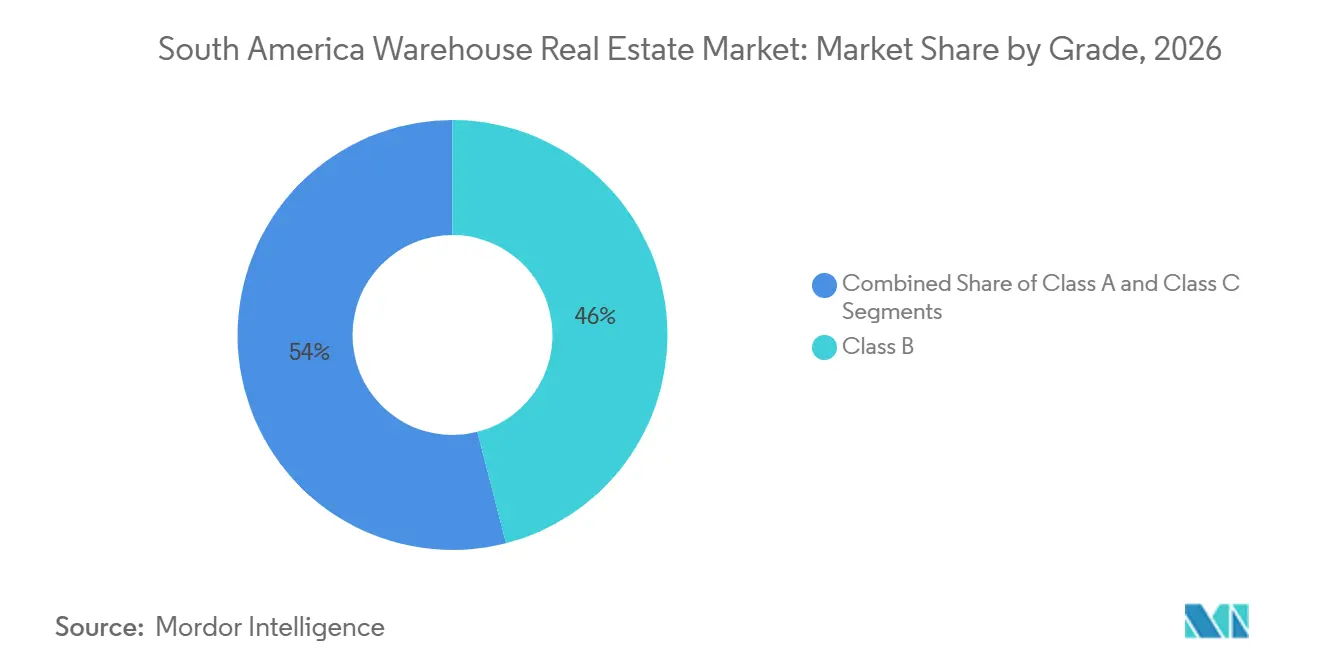
- By grade, Class B warehouses held 46.00% of the regional total in 2026, while Class A warehouses are projected to grow at an 8.00% CAGR through 2032.
- By warehouse size, large-scale facilities held 39.00% of the regional total in 2026, while small-scale warehouses are forecast to expand at a 7.90% CAGR through 2032.
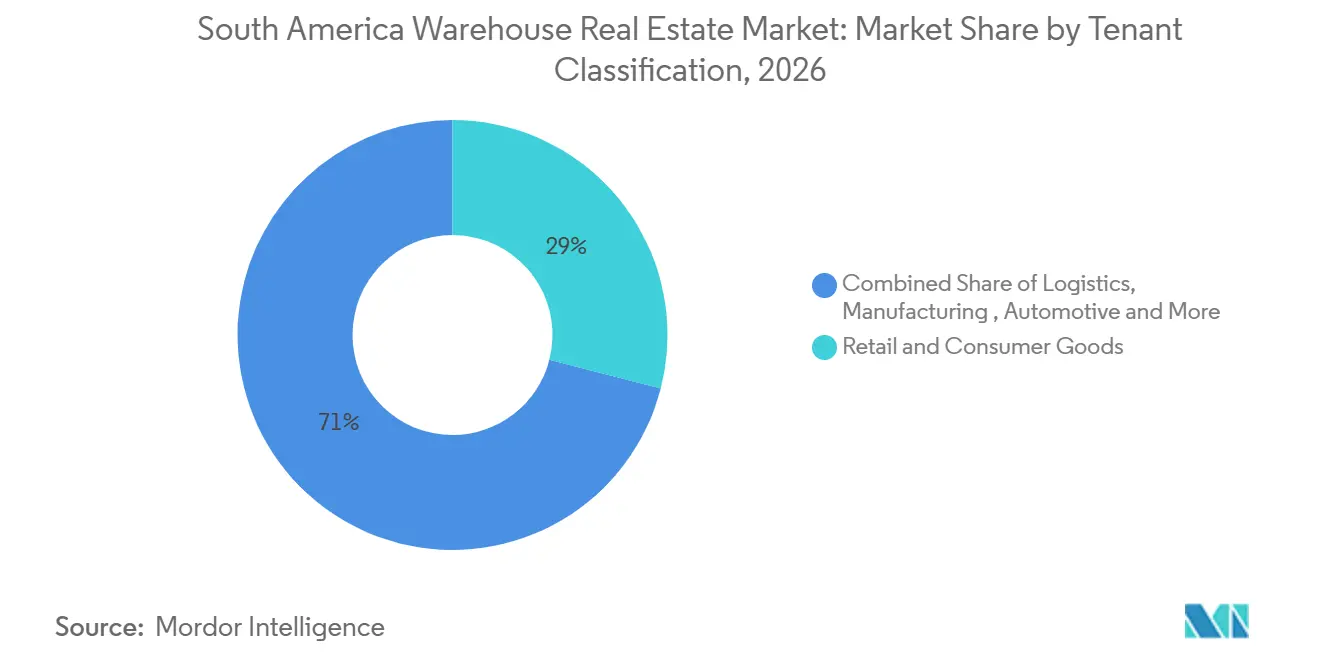
- By tenant classification, retail and consumer goods held 29.00% of the regional total in 2026, while pharmaceuticals and healthcare are projected to grow at an 8.20% CAGR through 2032.
- By geography, Brazil held 55.00% of the regional total in 2026, while Colombia is forecast to grow at an 8.00% CAGR through 2032.
Note: Market numbers in this report are based on Mordor Intelligence's proprietary estimation framework, which combines nine months of actuals with Q4 projections for base year 2026.
Market Trends and Insights
Drivers Impact Analysis of South America Warehouse Real Estate Market*
| Drivers | (~) % Impact on CAGR Forecast | Geographic Relevance | Impact Timeline |
|---|---|---|---|
| E-commerce, Marketplace, and Omnichannel Retail Expansion | +2.0% | Brazil, Argentina, and Colombia, led by São Paulo, Buenos Aires, and Bogotá | Short term (≤ 2 years) |
| Brazilian Logistics-Condominium and Sale-Leaseback Activity | +1.5% | Brazil, especially São Paulo and Rio de Janeiro corridors | Medium term (2-4 years) |
| Agriculture, Food Export, and Port-Linked Supply Chains | +1.0% | Brazil, Argentina, Peru, and Colombia, including Santos, Rosario, Callao, and Barranquilla | Medium term (2-4 years) |
| Pharmaceutical, Grocery, and Temperature-Controlled Distribution | +0.9% | Brazil, Colombia, Peru, Chile, and Argentina | Short term (≤ 2 years) |
| Regional Manufacturing and Automotive Localization | +0.8% | Brazil and Argentina, including São Paulo state, Bahia, Zárate, and Buenos Aires province | Medium term (2-4 years) |
| Port, Rail, and Intermodal Corridor Investment | +0.7% | Brazil, Colombia, Peru, and Chile, with effects in Bolivia and Ecuador | Long term (≥ 4 years) |
| Source: Mordor Intelligence | |||
E-commerce, Marketplace, and Omnichannel Retail Expansion
E-commerce is increasing demand for large fulfillment centers and smaller facilities that can support last-mile delivery. Mercado Libre stated that it planned to end 2026 with 72 logistics centers in Brazil, up from 52 in the prior year. The company reported that these facilities would support a national logistics network exceeding 3.3 million square meters[1]. The South America warehouse real estate market benefits because larger fulfillment centers need high dock capacity, ample truck circulation, and space for automation. Urban delivery facilities have different requirements because they need access to dense consumer areas and rapid courier routes. This creates separate demand for regional distribution hubs and smaller urban warehouses.
Brazilian Logistics-Condominium and Sale-Leaseback Activity
Sale-leaseback transactions are bringing more warehouse assets into institutional ownership in Brazil. Companies use these transactions to release capital from owned real estate while continuing to occupy the facilities under long-term leases. LOG Commercial Properties completed 3 asset-recycling transactions in 2025 totaling USD 136 million[2]. These transactions can improve the availability of stabilized assets for funds seeking rental income. They also show that occupiers are reviewing capital structures when borrowing costs remain high. Developers with pre-leased projects and established tenants are better placed to manage this environment.
Agriculture, Food Export, and Port-Linked Supply Chains
Agricultural exports are increasing demand for storage close to ports, airports, and food-processing areas. Peru reported record agro-export revenue of USD 15.013 billion in 2025, a 17.3% increase from 2024[3]. The growth supports demand for facilities that can handle fresh produce, packing operations, and temperature-sensitive cargo. Argentina’s Rosario complex handled 75.7 million tons of grains, oils, and by-products in 2025. These occupiers often have seasonal volumes and food-safety needs that differ from the requirements of urban retail tenants. The South America warehouse real estate market therefore requires specialized operational capability in port-linked locations.
Pharmaceutical, Grocery, and Temperature-Controlled Distribution
Pharmaceutical and refrigerated distribution requires facilities that maintain reliable temperature conditions and quality controls. Peru’s Ministry of Health commissioned a 9,400-square-meter public pharmaceutical warehouse in 2025 with 6,260 rack positions. The facility can operate at 4°C, -22°C, and control ambient conditions, illustrating the range of requirements for healthcare storage. Maersk opened a 17,500-square-meter cold-chain facility in Olmos, Peru, to manage avocados, blueberries, and mangoes. These projects show how food and healthcare distribution can rely on similar temperature-controlled building standards. The South America warehouse real estate market gains from this demand because certified facilities have a higher technical threshold than ambient warehouses.
Restraints Impact Analysis of South America Warehouse Real Estate Market*
| Restraints | (~) % Impact on CAGR Forecast | Geographic Relevance | Impact Timeline |
|---|---|---|---|
| High Local Interest Rates and Macroeconomic Volatility | -1.2% | Brazil and Argentina, with effects in Chile and Colombia | Short term (≤ 2 years) |
| Currency Depreciation and Tenant Credit Risk | -0.8% | Brazil, Argentina, Colombia, and Chile | Short term (≤ 2 years) |
| Infrastructure Bottlenecks Outside São Paulo, Bogotá, and Santiago Corridors | -0.7% | Brazil, Peru, Argentina, and Colombia | Long term (≥ 4 years) |
| Permitting, Land Assembly, and Informal-Development Risk | -0.6% | Brazil and Chile | Medium term (2-4 years) |
| Source: Mordor Intelligence | |||
High Local Interest Rates and Macroeconomic Volatility
High interest rates make speculative warehouse development more difficult to finance. Brazil’s policy rate remained in double digits during the easing cycle reported in 2026. Higher debt costs can lead developers to require pre-leasing or build-to-suit contracts before construction begins. This can constrain new supply even when tenant demand remains strong. The South America warehouse real estate market can then experience higher rents in prime locations alongside limited project starts. Conditions will depend on the pace of monetary easing and the availability of long-term financing.
Currency Depreciation and Tenant Credit Risk
Currency movements can affect the financial position of tenants and investors in several South American countries. Tenants with imported equipment, foreign-currency debt, or international supply contracts may face higher costs when local currencies weaken. This may delay expansion plans or increase demand for shorter and more flexible lease commitments. Investors also need to consider whether rents and development costs are aligned with the currency of their financing. These conditions can make underwriting more conservative outside the largest logistics corridors. The South America warehouse real estate market is more resilient where tenants have stable domestic revenue and long-term lease structures.
*Our forecasts treat driver/restraint impacts as directional, not additive. The impact forecasts reflect baseline growth, mix effects, and variable interactions.
South America Warehouse Real Estate Market Segment Analysis
By Type:
Private Lead While Other Formats ExpandPrivate facilities held 48.40% of the South America warehouse real estate market in 2026, making them the largest warehouse type. Their position reflects the preference of many occupiers for dedicated space that can be designed around one operating model. Retailers, manufacturers, and logistics operators often use private facilities when they require customized layouts and predictable access. Dedicated warehouses can support specialized dock configurations, security requirements, and tenant-specific processes. The South America warehouse real estate industry continues to rely on these facilities in the largest national markets.
Other facilities are expected to grow at an 8.00% CAGR through 2032. This category includes bonded warehouses, free-trade-zone facilities, and public-private hybrid models. These formats can serve companies that need customs support, fiscal incentives, or access to export corridors. Their expansion is linked to sites around trade zones, ports, and industrial areas. Brazil’s tax changes may alter the value of location-specific incentives after 2032, which makes regulatory planning and customs capability important for these projects.

By Temperature Control:
General Warehouse Retains the Largest BaseGeneral warehouses accounted for 58.00% of the South America warehouse real estate market size in 2026. They remain the largest category because a broad range of goods can be stored at ambient temperatures. Manufacturers, consumer-goods distributors, and general retailers rely on this type of space. The existing warehouse base also contains more ambient capacity than temperature-controlled capacity. General facilities remain important in secondary cities where formal cold storage is still limited.
Refrigerated warehouses are projected to grow at a 8.10% CAGR through 2032. Food exports, biologic medicines, vaccines, and online grocery services support the demand for this specialized space. Maersk’s 17,500-square-meter Olmos facility shows the operational scale needed for modern produce exports. Peru’s public pharmaceutical facility also shows the importance of controlled temperatures in healthcare distribution. Refrigerated facilities need stronger equipment, energy systems, and operating controls, which can limit supply and raise the importance of experienced operators.
By Grade:
Class B Holds the Largest Installed BaseClass B warehouses held 46.00% of the South America warehouse real estate market share in 2026. This grade reflects the large stock of older logistics facilities outside the main Class A corridors. Cost-sensitive manufacturers and distributors can continue to use these buildings when their operations do not require the newest specifications. Class B properties may have lower clear heights, fewer docks, and smaller yards than newer facilities. They remain relevant where rents and available land favor existing stock over replacement projects.
Class A warehouses are forecast to grow at an 8.00% CAGR through 2032. E-commerce operators and major logistics providers are seeking taller buildings, reinforced floors, sufficient dock ratios, and reliable power supplies. Fulwood opened Guarulhos Business Park in 2025 with 53,321 square meters of Class A logistics space, 57 docks, and 12-meter clear heights. The project shows the specification level expected in prime Brazilian locations. Owners of older buildings may need upgrades to remain competitive with new Class A supply.
By Warehouse Size:
Large-Scale Facilities Lead Current DemandLarge-scale warehouses held 39.00% of the South America warehouse real estate market size in 2026. Large facilities support high-volume fulfillment, third-party logistics, and regional distribution. They are commonly located near major highways because they need large sites, deep yards, and efficient truck access. São Paulo state and Bogotá’s outer logistics areas are suited to this format because they connect large consumer markets with national transport networks. These assets are central to the South America warehouse real estate market where e-commerce and national distribution networks are expanding.
Small-scale warehouses are expected to grow at a 7.90% CAGR through 2032. This demand is supported by last-mile distribution and specialized healthcare storage in cities where large sites are not practical. Logistic Properties of the Americas announced that its 215,300-square-foot Callao facility was 73.1% pre-leased before completion. The project shows demand for well-located Class A space near major urban and port areas. Smaller facilities can serve urban delivery and pharmaceutical tenants, with success depending on access, zoning, and delivery times rather than building scale alone.
By Tenant Classification:
Retail and Consumer Goods Lead OccupancyRetail and consumer goods held 29.00% of the South America warehouse real estate market share in 2026. Supermarkets, fashion retailers, and consumer-goods distributors form a large and established tenant base. These tenants often need facilities that support regular replenishment and wide product ranges. Their requirements include access to population centers and transport routes that can support frequent deliveries. Retail occupancy provides an important foundation for logistics parks in Brazil, Colombia, and Argentina.
Pharmaceuticals and healthcare are forecast to grow at an 8.20% CAGR through 2032. This is the fastest growth rate among the reported segment categories. Biologics distribution, public vaccine programs, and wider healthcare investment support the category. Peru’s 2025 public pharmaceutical warehouse establishes a high standard for secure temperature-controlled storage. Healthcare tenants often require strict handling and traceability standards, which can support longer leases in suitable certified facilities.
Geography Analysis
Brazil held 55.00% of the South America warehouse real estate market share in 2026, giving it the largest national position in the region. Mercado Libre’s planned 72 logistics centers in Brazil by the end of 2026 show the scale of demand for national delivery infrastructure. São Paulo remains the principal location for prime logistics development because it combines consumer demand, transport links, and a deep tenant base. Expansion is also moving toward the Northeast and Center-West, while financing conditions and project approvals continue to shape supply.
Colombia is projected to grow at an 8.00% CAGR through 2032, making it the fastest-growing country in the reported geography. Bogotá’s tight industrial vacancy and Colombia’s agro-export activity are supporting demand for logistics facilities. The country can serve both domestic distribution and export-linked storage through its airport, Caribbean ports, and inland production areas. Colombia’s opportunity is strongest where facilities can link Bogotá with the Caribbean corridor and regional agricultural areas. Build-to-suit projects are relevant where standard available space does not meet occupier requirements.
Peru is gaining attention because its agro-export sector and port infrastructure are creating new logistics requirements. Peru reported USD 15.013 billion in agro-export revenue in 2025, supported by products such as blueberries, grapes, avocados, and cacao. Logistic Properties of the Americas is expanding Parque Logístico Callao with a Class A facility that was 73.1% pre-leased at announcement. Chile and Argentina face slow approvals and limited modern inventory, while smaller countries remain earlier in their warehouse development. These markets may gain from trade routes and export activity.
Competitive Landscape
The South America warehouse real estate market includes global real estate platforms, domestic real estate investment funds, and regional developers. Competition is strongest in Brazil’s prime corridors, where large, modern facilities attract institutional tenants. Global players tend to focus on larger stabilized assets and large development sites. At the same time, domestic funds and regional developers compete through local site knowledge, build-to-suit projects, and relationships with occupiers. The market is fragmented across countries because legal systems, infrastructure, and tenant requirements vary widely.
Companies are using development, conversion, acquisitions, and asset recycling to build scale. Fulwood’s 2025 opening of Guarulhos Business Park added a 53,321-square-meter Class A facility in São Paulo. Logistic Properties of the Americas is expanding its Callao park with a facility that had major pre-leasing before completion. Volvo expanded its São José dos Pinhais parts facility in 2025, reinforcing the role of manufacturer-led distribution demand. These moves show that both property companies and occupiers are investing in locations that improve delivery coverage and operating control.
Technology, building quality, and certification are becoming more important in the South America warehouse real estate market. Temperature control, loading capacity, floor strength, and power reliability can determine whether a building can serve e-commerce, pharmaceutical, or food customers. High-quality facilities also need locations with reliable road access and manageable approval timelines. Developers that control suitable land and can deliver compliant buildings have a stronger position in constrained urban areas. Competition will remain active as funds seek stabilized income and occupiers seek facilities that support faster, more controlled distribution.
South America Warehouse Real Estate Industry Leaders
-
Prologis, Inc.
-
GLP Pte. Ltd.
-
BTG Pactual Logística
-
Bresco
-
LOG Commercial Properties
- *Disclaimer: Major Players sorted in no particular order
South America Warehouse Real Estate Market Companies Covered in this Report
- Prologis, Inc.
- GLP Pte. Ltd.
- BTG Pactual Logística
- Bresco
- LOG Commercial Properties
- Mills Locação, Serviços e Logística S.A.
- Hines
- Patria Investments
- VBI Real Estate
- TRX Investimentos Imobiliários
- CBRE Group, Inc.
- JLL
- Colliers International Group Inc.
- DHL Supply Chain
- M3storage
- Fulwood
- Maua Capital
- Kinea Investimentos
- XP Asset Management
- BR Properties S.A.
Recent Industry Developments in South America Warehouse Real Estate Market
- October 2026: Mercado Libre announced plans to close 2026 with 72 large-scale logistics centers in Brazil and reported that it already operated more than 3.3 million square meters of logistics space nationally.
- August 2026: BTG Pactual Logística completed the acquisition of a high-specification logistics warehouse in Guarulhos, São Paulo, for USD 65 million.
- January 2026: Fulwood projected delivery of more than 150,000 square meters of new logistics gross leasable area in 2026 after investing USD 86 million in 2025.
South America Warehouse Real Estate Market Report Scope
Segmentation Overview
| Public |
| Private |
| Others |
| General Warehouse |
| Refrigerated Warehouse |
| Class A |
| Class B |
| Class C |
| Small-Scale Warehouses, Under 50,000 sq ft |
| Medium-Scale Warehouses, 50,000-250,000 sq ft |
| Large-Scale Warehouses, Above 250,000 sq ft |
| Manufacturing |
| Retail and Consumer Goods |
| Food and Beverage |
| Pharmaceuticals and Healthcare |
| Logistics |
| Other End Users |
| Brazil |
| Argentina |
| Chile |
| Colombia |
| Peru |
| Rest of South America |
| By Type | Public |
| Private | |
| Others | |
| By Temperature Control | General Warehouse |
| Refrigerated Warehouse | |
| By Grade | Class A |
| Class B | |
| Class C | |
| By Warehouse Size | Small-Scale Warehouses, Under 50,000 sq ft |
| Medium-Scale Warehouses, 50,000-250,000 sq ft | |
| Large-Scale Warehouses, Above 250,000 sq ft | |
| By Tenant Classification | Manufacturing |
| Retail and Consumer Goods | |
| Food and Beverage | |
| Pharmaceuticals and Healthcare | |
| Logistics | |
| Other End Users | |
| By Countries | Brazil |
| Argentina | |
| Chile | |
| Colombia | |
| Peru | |
| Rest of South America |
Key Questions Answered in the Report
What is the South America warehouse real estate market value?
The South America warehouse real estate market is valued at USD 4.21 billion in 2026 and is forecast to reach USD 6.45 billion by 2032 at a 7.40% CAGR.
Which South American country has the largest warehouse real estate base?
Brazil leads with a 55.00% share in 2026, supported by its scale in e-commerce, logistics assets, and institutional capital.
Which country is growing fastest in warehouse real estate?
Colombia is forecast to grow at an 8.00% CAGR through 2032, supported by demand around Bogotá, export corridors, and build-to-suit projects.
Which warehouse type is expanding fastest?
Other warehouse formats, including bonded and free-trade-zone facilities, are projected to grow at an 8.00% CAGR through 2032.
What is driving refrigerated warehouse demand in South America?
Agro-exports, biologics, vaccine distribution, and fresh grocery logistics are supporting a 8.10% CAGR for refrigerated warehouses through 2032.
Which tenant group has the highest projected growth?
Pharmaceuticals and healthcare are forecast to grow at an 8.20% CAGR through 2032 as certified temperature-controlled capacity becomes more important.