
South America Telecom Towers Market Size and Share
Market Overview
| Study Period | 2020 - 2031 |
|---|---|
| Forecast Data Period | 2026 - 2031 |
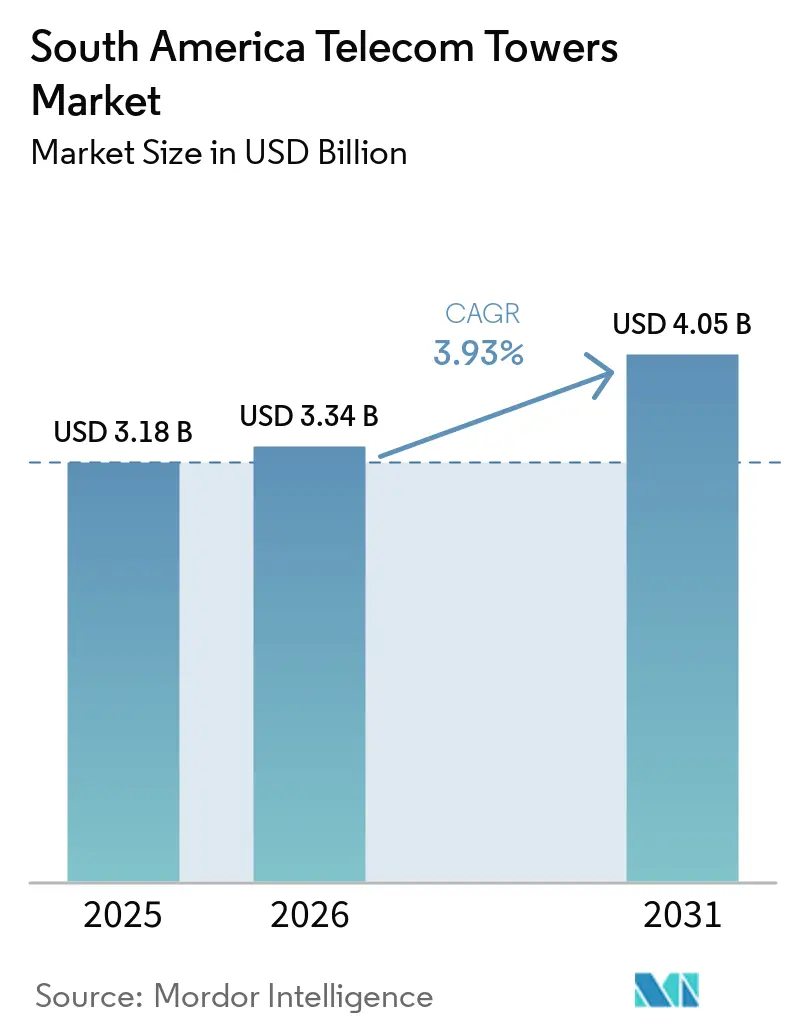
| Base Year Market Size (2025) | USD 3.18 Billion |
| Market Size (2026) | USD 3.34 Billion |
| Market Size (2031) | USD 4.05 Billion |
| Growth Rate (2026 - 2031) | 3.93 % |
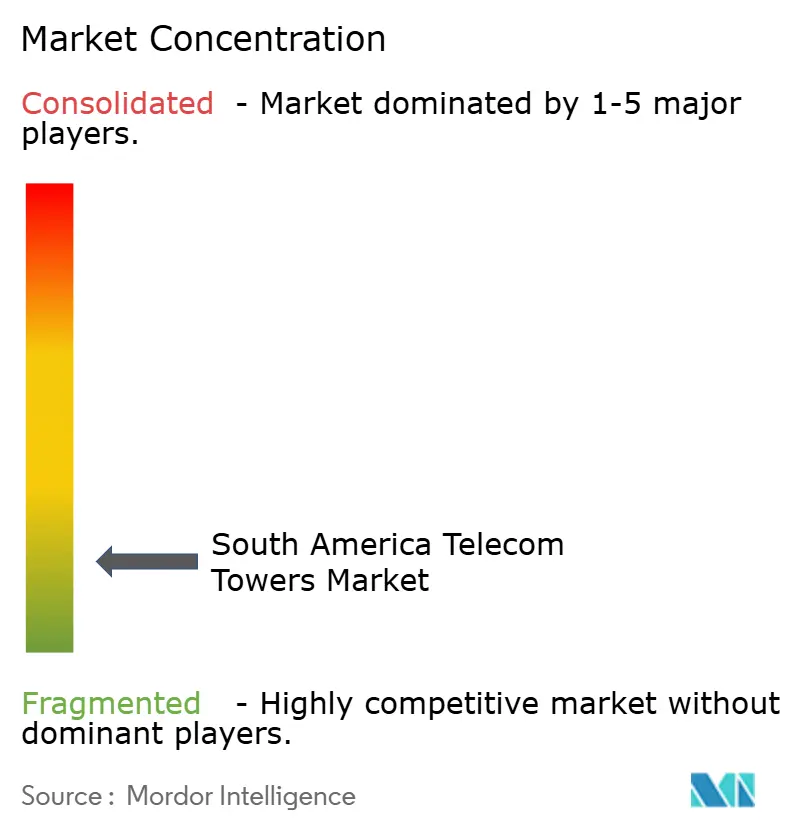
| Market Concentration | Low |
Major Players *Disclaimer: Major Players sorted in no particular order Image © Mordor Intelligence. Reuse requires attribution under CC BY 4.0. | |
South America Telecom Towers Market Analysis by Mordor Intelligence
The South America Telecom Towers Market size was valued at USD 3.18 billion in 2025 and is estimated to grow from USD 3.34 billion in 2026 to reach USD 4.05 billion by 2031, at a CAGR of 3.93% during the forecast period (2026-2031). The South America Telecom Towers Market is supported by a lower towers-per-subscriber ratio than mature markets, which leaves room for new sites and co-location upgrades. 5G coverage obligations, asset sales by mobile operators, and energy needs at remote sites shape investment decisions. Operators are also balancing network expansion with lease renegotiations, site consolidation, and permitting delays. Demand is strongest where coverage rules and mobile traffic growth create a clear need for capacity. The South America Telecom Towers Market, therefore, offers opportunities for operators that can combine efficient site development with resilient power systems.
Key Report Takeaways
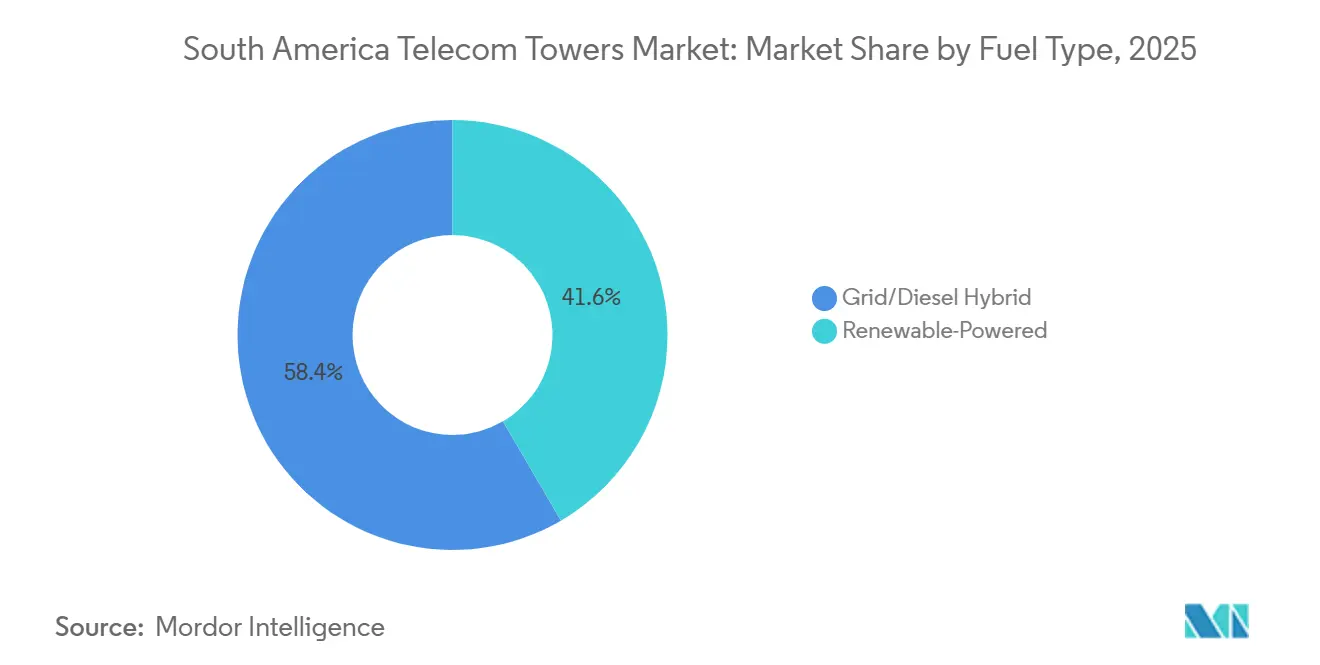
- By fuel type, grid/diesel hybrid configurations held 58.41% of the South America Telecom Towers Market revenue in 2025, while renewable-powered towers are forecast to grow at a 5.24% CAGR through 2031.
- By tower type, lattice towers held 44.12% of the South America Telecom Towers Market revenue in 2025, while monopole towers are forecast to grow at a 5.12% CAGR through 2031.
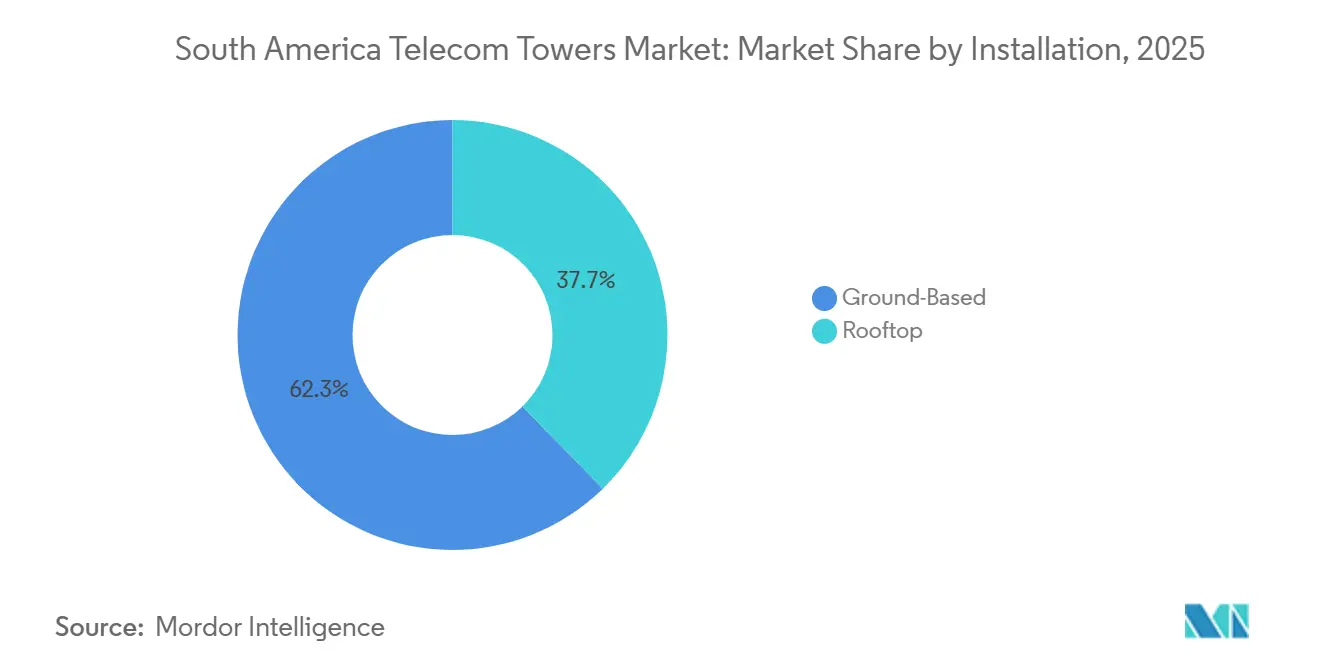
- By installation type, ground-based sites accounted for 62.33% of the South America Telecom Towers Market revenue in 2025, while rooftop installations are forecast to grow at a 5.46% CAGR through 2031.
- By ownership, independent TowerCos held 47.81% of the South America Telecom Towers Market revenue in 2025, while joint-venture TowerCos are forecast to grow at a 5.69% CAGR through 2031.
- By geography, Brazil held 38.92% of the South America Telecom Towers Market revenue in 2025, while Colombia is forecast to grow at a 5.78% CAGR through 2031.
Note: Market size and forecast figures in this report are generated using Mordor Intelligence’s proprietary estimation framework, updated with the latest available data and insights as of January 2026.
Market Trends and Insights
Drivers Impact Analysis of South America Telecom Towers Market*
| Driver | (~) % Impact on CAGR Forecast | Geographic Relevance | Impact Timeline |
|---|---|---|---|
| 5G and Private-Network Densification | +1.2% | Brazil, Colombia, Chile, Argentina | Medium term (2-4 years) |
| Rising Mobile Data and Smartphone Usage | +1.0% | Urban South America, including São Paulo, Bogotá, Buenos Aires, and Lima | Long term (≥ 4 years) |
| Rural Connectivity Programs and Universal-Service Funding | +0.7% | Brazil, Argentina, Colombia, and Peru | Medium term (2-4 years) |
| MNO Passive-Asset Monetization and Independent TowerCo Expansion | +0.5% | Brazil, Colombia, Argentina, Uruguay, and Paraguay | Short term (≤ 2 years) |
| Edge Data Center and Low-Latency Infrastructure Co-Location | +0.3% | Brazil, Chile, and Colombia | Long term (≥ 4 years) |
| Brazilian Local-Fabrication Incentives for Telecom Structures | +0.2% | Brazil | Medium term (2-4 years) |
| Source: Mordor Intelligence | |||
5G and Private-Network Densification
5G deployment is creating a direct need for denser radio networks in the South America Telecom Towers Market. By August 2025, 37 operators across 18 countries had launched commercial 5G services, while adoption remained below 15% and 4G coverage exceeded 90% in most countries. Mid-band 3.5 GHz deployments need closer site spacing than many 4G deployments. This requirement supports new tower construction and antenna upgrades in cities and expansion corridors. Private 5G networks for mining, agriculture, and energy add demand that is less dependent on consumer mobile plans. Brazil’s auction obligations also create a defined coverage pipeline for tower companies.
Rising Mobile Data and Smartphone Usage
Mobile traffic growth continues to raise capacity requirements across the South America Telecom Towers Market. Monthly mobile data traffic per connection rose from 7 GB in 2023 and is forecast to reach 32 GB by the end of the decade, while total regional traffic is projected to grow at a 25.5% CAGR from 2023 to 2030. Higher use of video, gaming, and enterprise applications can place added pressure on existing macro sites. Secondary cities and peri-urban corridors may need more new sites than mature downtown grids, where co-location can often add capacity. Average monthly traffic per smartphone is forecast to reach 35 GB by 2027. This traffic pattern supports both additional tenants on existing structures and new coverage locations.[1]
Rural Connectivity Programs and Universal-Service Funding
Public connectivity programs are widening the addressable area for the South America Telecom Towers Market. Brazil’s Ministry of Communications approved FUST support for network expansion and modernization in July 2025.[2] The ministry directed further FUST support in August 2025 to small providers serving remote locations. These programs can make rural sites viable where commercial demand alone would not support construction. Argentina allocated ARS 60 billion (USD 47.8 million) for the shared deployment of 5G in underserved areas under Resolution No. 1182/2025. The funding supports shared infrastructure rather than duplicative networks, which can improve the case for co-located tower sites.[3]
MNO Passive-Asset Monetization and Independent TowerCo Expansion
Asset sales and leaseback models are changing ownership across the South America Telecom Towers Market. Macquarie Asset Management agreed in February 2026 to acquire IHS Towers’ South American operations for an enterprise value of BRL 3,550 million (USD 685 million). The portfolio included more than 8,500 sites in Brazil and 270 sites in Colombia. ATIS Group acquired Millicom’s Lati Paraguay subsidiary in 2025, adding 281 sites to its portfolio. Sites Latam had 37,625 towers across 16 countries by the first quarter of 2026, including 432 net new sites in Brazil over the prior 12 months. These transactions allow mobile operators to reduce capital tied up in passive infrastructure while TowerCos pursue co-location, power services, and lease revenue.
Restraints Impact Analysis of South America Telecom Towers Market*
| Restraint | (~) % Impact on CAGR Forecast | Geographic Relevance | Impact Timeline |
|---|---|---|---|
| Tower-Sharing Saturation and Carrier Network Rationalization | -0.4% | Brazil and Colombia | Short term (≤ 2 years) |
| Environmental, Zoning, and Site-Acquisition Delays | -0.3% | Brazil, Chile, and Argentina | Medium term (2-4 years) |
| Amazon Environmental Licensing and Logistics Lead Times | -0.2% | Brazil | Medium term (2-4 years) |
| Chilean Seismic Reinforcement Cost Premiums | -0.2% | Chile | Long term (≥ 4 years) |
| Source: Mordor Intelligence | |||
Tower-Sharing Saturation and Carrier Network Rationalization
Carrier consolidation is a near-term restraint for the South America Telecom Towers Market. The Tigo-Movistar merger in Colombia was formally completed in February 2026, necessitating a review of overlapping network sites. TIM renegotiated tower contracts in Brazil during 2025, with more than 6,000 sites shut down or relocated. American Tower reported a net decline of 135 South American sites between the first and second quarters of 2026. Operators per tower range from 1.1 to 1.5 across countries, leaving many single-tenant assets exposed when networks are rationalized. Long-term inflation-linked leases can mitigate the revenue impact, while short-cycle agreements carry a higher churn risk.
Environmental, Zoning, and Site-Acquisition Delays
Permitting and site access can extend development cycles in the South America Telecom Towers Market. Brazil’s environmental authority required revised operating licenses for Infovias 03 and 04 in the Norte Conectado program, which added 8 months between installation licensing and final operating authorization. A telecom framework for the Amazon under Bill PL 4897/24 was still under committee review in 2025. In Chile, land leases in congested urban areas can account for up to 55% of site operating costs. Chile’s NCh2369:2025 standard also raises structural requirements for tower foundations. These conditions can delay launches and increase the capital required for greenfield sites and upgrades.[4]
*Our forecasts treat driver/restraint impacts as directional, not additive. The impact forecasts reflect baseline growth, mix effects, and variable interactions.
South America Telecom Towers Market Segment Analysis
By Fuel Type:
Hybrid Systems Lead While Renewable Sites AdvanceGrid/diesel hybrid configurations held 58.41% of the South America Telecom Towers Market share by fuel type in 2025. Their role is strongest where grid power is available but unreliable. Hybrid systems can keep sites operating without incurring the full upfront cost of a fully off-grid design. Brazil’s less-electrified interior and Venezuela’s unstable grid are important use cases. The configuration also gives operators flexibility when fuel delivery or grid availability changes.
Renewable-powered towers are forecast to grow at a 5.24% CAGR from 2026 to 2031. TIM Brasil operated 133 solar, wind, and biogas plants in the first quarter of 2026, serving more than 17,000 tower sites. The count had risen from 106 plants a year earlier. Claro Peru replaced 42 generator sets with 40 solar panels at base stations in 2024, reporting annual fuel savings of USD 1.46 million. Renewable sites can reduce dependence on diesel logistics and help operators serve remote communities.
By Tower Type:
Lattice Structures Retain Their Role as Monopoles GrowLattice towers accounted for 44.12% of the South America Telecom Towers Market revenue by tower type in 2025. Their structure remains cost-effective for rural, multi-tenant deployments with sufficient ground area. They can support multiple antenna arrays and are well-suited to broad-coverage corridors. Guyed towers continue to serve low-population areas where cost is the main consideration. Stealth designs serve smaller urban and heritage locations where visual concerns limit the use of conventional structures.
Monopole towers are forecast to grow at a 5.12% CAGR from 2026 to 2031. Their smaller footprint helps developers address municipal zoning limits in dense areas. The design can also host compact Massive MIMO antenna arrays used in 5G networks. Claro Peru and Huawei deployed an EcoMatrix single-pole site in December 2025 that supported multiple sub-3 GHz bands. The project reported 35% site-wide energy savings and a 30% reduction in antenna installation space.
By Installation:
Ground-Based Sites Lead and Rooftops Address DensityGround-based installations held 62.33% of the South America Telecom Towers Market share by installation in 2025. Macro-tower buildout across Brazil’s interior supports this leading position. Rural corridor expansion in Andean countries also favors ground-based structures. These sites have space for larger equipment and multiple tenants. They remain important where coverage distance matters more than compact design.
Rooftop installations are forecast to advance at a 5.46% CAGR from 2026 to 2031. Land scarcity is encouraging operators to use building rooftops in major cities. Rooftop hosting fees were 20% to 30% below comparable ground leases in Brazil’s major cities in 2025. These sites can also shorten deployment, where a new ground pad would face environmental review. Rooftops and street furniture can provide the lower-height antenna locations needed for 5G capacity.
By Ownership:
Independent TowerCos Hold the Largest ShareIndependent TowerCos held 47.81% of the South America Telecom Towers Market revenue by ownership in 2025. Mobile network operators use asset sales to reduce the capital tied to passive infrastructure. Independent owners seek additional tenants and inflation-indexed lease escalators. The Macquarie transaction covering more than 8,800 sites confirms continued investor interest in these assets. This ownership model supports a wider separation between network service delivery and physical infrastructure management.
Joint-venture TowerCos are forecast to grow at a 5.69% CAGR from 2026 to 2031. These structures can spread financial and regulatory exposure across partners. Argentina had 3,400 mobile subscribers per tower, compared with 1,100 in the United States, which indicates a remaining coverage gap. Joint ventures can use this gap to pursue co-location revenue where standalone ownership is more difficult. Operator-owned and captive categories are losing revenue share as large carriers place greater focus on service operations. A USD 140 million financing package was provided for Torrecom in July 2026 to support independent tower expansion.
Geography Analysis
Brazil Telecom Towers Market
Brazil accounted for 38.92% of the South America Telecom Towers Market revenue in 2025. Its position reflects its large subscriber base, 5G coverage obligations, and active TowerCo deal activity. Sites Latam had 12,316 towers in Brazil in the first quarter of 2026. Public funding for remote connectivity can add demand alongside metropolitan densification.
Northern Brazil Telecom Towers Market
Brazil’s northern states have a distinct development profile. Norte Conectado fiber links can support sites that were previously difficult to connect. TIM Brasil partnered with AXIA Energia to deploy 4G and 5G networks at 20 hydroelectric plants through 2026. The initiative shows how private networks can support tower demand beyond consumer services.
South America Telecom Towers Market
Colombia is forecast to grow at a 5.78% CAGR from 2026 to 2031. The country recorded 7 million 5G users by September 2025, and the base grew 15.6% between the second and third quarters of 2025. Claro had installed more than 2,200 5G base stations across 50 cities by that point. The Tigo-Movistar merger may remove overlapping sites in the near term, but can support denser 5G deployment later. Chile faces higher seismic and land costs, while Peru, Ecuador, and Paraguay remain targets for independent TowerCo expansion.
Competitive Landscape
The South America Telecom Towers Market has moderate to high concentration at the national level. Global TowerCos, regional operators, and infrastructure funds are reshaping a sector that mobile operators once owned more directly. Macquarie’s February 2026 agreement to acquire IHS Towers’ regional operations for BRL 3,550 million, reported in USD at USD 685 million, is a major example of this shift. The acquisition includes more than 8,500 sites in Brazil and 270 in Colombia.
Companies are prioritizing tenancy and co-location over broad greenfield expansion. SBA Communications identified new tenant leases and co-location amendments as key parts of its 2026 growth approach. Highline do Brasil secured BNDES FUST funding to construct 182 towers tied to coverage obligations. Tower operators can also improve site economics through solar-battery systems, distributed generation credits, and power purchase agreements.
Edge infrastructure is becoming another way to raise revenue per site. Unifique activated tower-attached edge data center sites with 20-30 racks across microregions during 2025. The format can position towers as both local compute points and antenna hosts. ATIS Group is strengthening its position in Argentina, Uruguay, and Paraguay through targeted acquisitions. Torrecom is expanding in Chile, Colombia, Ecuador, Paraguay, and Peru with external financing. The South America Telecom Towers Market is rewarding firms that combine portfolio discipline with local execution.
South America Telecom Towers Industry Leaders
-
Seccional Brasil
-
Grupo ITM
-
Amerite Towers
-
Sabre Industries, Inc.
-
Salasar Techno Engineering Ltd.
- *Disclaimer: Major Players sorted in no particular order
South America Telecom Towers Market Companies Covered in this Report
- Sabre Industries, Inc.
- Scanmast AB
- Şa-Ra Enerji İnşaat Ticaret ve San. A.Ş.
- Salasar Techno Engineering Ltd.
- TELCA ENGINEERING PVT LTD
- Monsud SpA
- Carl C. A/S
- MAFI
- VOERAL
- Nan'an Minyi Steel Tower Co., Ltd.
- Grupo ITM
- MER Group
- Captel
- Retis Construction
- Andel
- WIEGEL
- MTS Tower
- LARS Communications
- Estudener
- Amerite Towers
- Seccional Brasil
Recent Industry Developments in South America Telecom Towers Market
- August 2026: Solar energy systems deployed under Brazil’s Forest Peoples Connection Network initiative are providing off-grid connectivity to more than 2,000 remote Amazon communities, significantly expanding the addressable tower market for renewable-powered site solutions in areas without grid access.
- July 2026: IDB Invest led a USD 140 million financing package for Torrecom Partners LP to expand its tower portfolio to more than 2,550 sites across Chile, Colombia, Ecuador, Paraguay, and Peru, with five international co-investors including DEG, Proparco, and Allianz Credit Emerging Markets Fund. The transaction supports tower co-location and next-generation 5G deployments across the Andean corridor.
- February 2026: Macquarie Asset Management agreed to acquire IHS Towers’ South American wireless tower operations for an enterprise value of BRL 3,550 million, reported as USD 685 million, covering more than 8,500 sites in Brazil and 270 sites in Colombia. The deal marks IHS’s full exit from South America and Macquarie’s expansion of its regional digital infrastructure portfolio.
- February 2026: Millicom formally consolidated its merger with Telefónica in Colombia, creating a combined mobile operator that will rationalize tower leases across overlapping network sites while triggering longer-term demand for 5G densification infrastructure.
South America Telecom Towers Market Report Scope
The South America Telecom Towers Market refers to the physical infrastructure that supports antennas and other communication equipment for mobile networks across the region. This includes various tower structures, such as lattice, monopole, and guyed towers, installed on rooftops or ground-based locations, and powered by grid/diesel hybrid or renewable energy sources. These towers are owned either directly by mobile network operators or by independent and joint-venture tower companies, serving as the critical backbone for expanding network coverage and capacity.
The South America Telecom Towers Market Report is Segmented by Fuel Type (Renewable-Powered and Grid/Diesel Hybrid), Type of Tower (Lattice Tower, Guyed Tower, Monopole Tower, and Stealth/Concealed Tower), Installation (Rooftop and Ground-Based), Ownership (Operator-Owned, Independent TowerCo, Joint-Venture TowerCo, and MNO Captive), and Geography (Brazil, Argentina, Colombia, Chile, Venezuela, and Rest of South America). The Market Forecasts are Provided in Terms of Value (USD).
Segmentation Overview
| Renewable-Powered |
| Grid/Diesel Hybrid |
| Lattice Tower |
| Guyed Tower |
| Monopole Tower |
| Stealth/Concealed Tower |
| Rooftop |
| Ground-Based |
| Operator-Owned |
| Independent TowerCo |
| Joint-Venture TowerCo |
| MNO Captive |
| Brazil |
| Argentina |
| Colombia |
| Chile |
| Rest of South America |
| By Fuel Type | Renewable-Powered |
| Grid/Diesel Hybrid | |
| By Type of Tower | Lattice Tower |
| Guyed Tower | |
| Monopole Tower | |
| Stealth/Concealed Tower | |
| By Installation | Rooftop |
| Ground-Based | |
| By Ownership | Operator-Owned |
| Independent TowerCo | |
| Joint-Venture TowerCo | |
| MNO Captive | |
| By Geography | Brazil |
| Argentina | |
| Colombia | |
| Chile | |
| Rest of South America |
Key Questions Answered in the Report
What is the South America Telecom Towers Market size?
The South America Telecom Towers Market is valued at USD 3.34 billion in 2026 and is forecast to reach USD 4.05 billion by 2031 at a 3.93% CAGR.
What is driving telecom tower demand in South America?
5G densification, rising mobile data use, rural connectivity programs, and operator asset sales are increasing demand. Private networks in mining, agriculture, and energy also need reliable local coverage.
Which tower fuel type leads in South America?
Grid/diesel hybrid systems held 58.41% of revenue in 2025. Renewable-powered towers are forecast to grow at a 5.24% CAGR through 2031 as operators seek more resilient remote-site power.
Which South American country leads telecom tower revenue?
Brazil held 38.92% of revenue in 2025. Its lead reflects its subscriber base, mandatory coverage commitments, public connectivity funding, and an active TowerCo transaction environment.
Which country is growing fastest for telecom towers?
Colombia is forecast to grow at a 5.78% CAGR from 2026 to 2031. Expanding 5G use and network investment support growth, despite near-term site reviews following carrier consolidation.
Why are independent TowerCos important to the sector?
Independent TowerCos held 47.81% of revenue in 2025. They benefit from carrier asset sales, co-location opportunities, energy services, and long-term lease structures that can support portfolio investment.