
South America Subscription and Billing Management Market Size and Share
Market Overview
| Study Period | 2020 - 2031 |
|---|---|
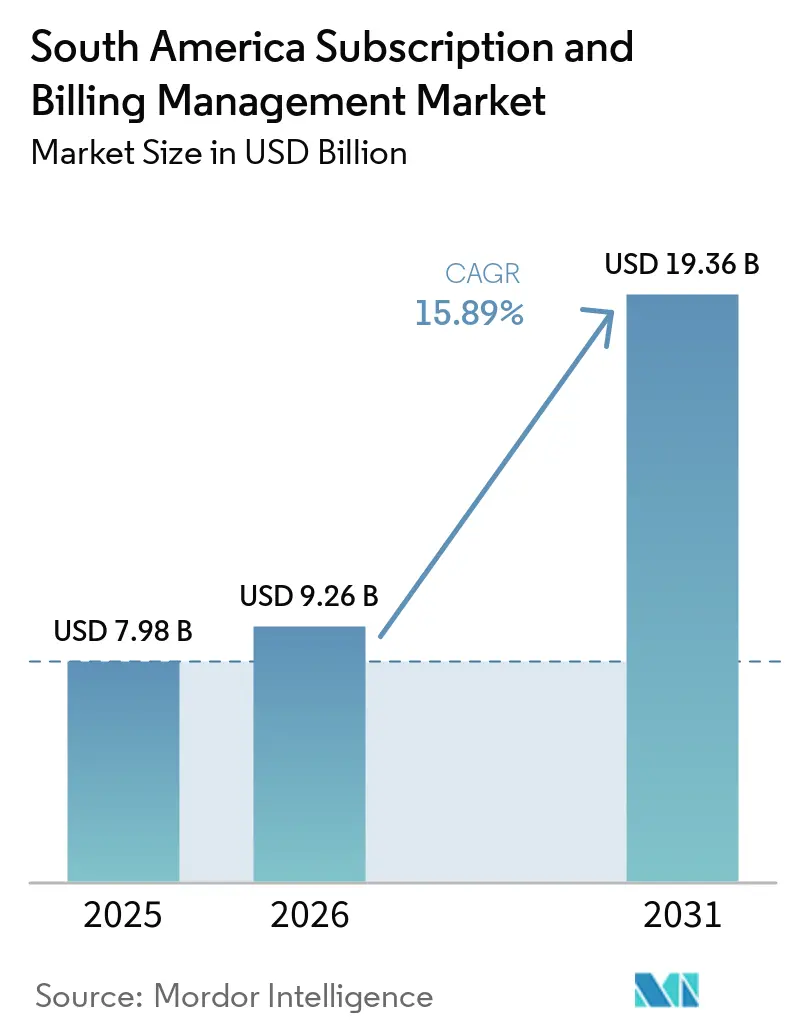
| Base Year Market Size (2025) | USD 7.98 Billion |
| Market Size (2026) | USD 9.26 Billion |
| Market Size (2031) | USD 19.36 Billion |
| Growth Rate (2026 - 2031) | 15.89 % |
| Fastest Growing Market | Asia-Pacific |
| Largest Market | North America |
Major Players *Disclaimer: Major Players sorted in no particular order Image © Mordor Intelligence. Reuse requires attribution under CC BY 4.0. | |
South America Subscription and Billing Management Market Analysis by Mordor Intelligence
The South America subscription and billing management market size was valued at USD 7.98 billion in 2025 and estimated to expand from USD 9.26 billion in 2026 to reach USD 19.36 billion by 2031, at a CAGR of 15.89% during the forecast period 2026-2031. Recurring revenue models are spreading across software, media, telecom, retail, education, health services, logistics, and hardware services. Real-time payment systems are widening access to subscription services for consumers who do not use credit cards. Cloud deployments are helping enterprises update pricing, payment connections, and collection workflows without long upgrade cycles. This creates opportunities for platforms that combine local payment acceptance, tax configuration, and revenue recovery tools. Competition therefore depends on regional payment coverage and operating knowledge as much as on broad enterprise functionality.
Key Report Takeaways
- By component, software accounted for 78.14% of the South America Subscription and Billing Management Market in 2025, while services are projected to expand at a CAGR of 15.92% through 2031.
- By deployment mode, cloud accounted for 78.22% of revenue in 2025 and is projected to expand at a CAGR of 16.11% through 2031.
- By enterprise size, large enterprises held 57.16% revenue share in 2025, while small and medium enterprises are projected to expand at a CAGR of 16.24% through 2031.
- By end-user industry, IT and telecom accounted for 29.28% of revenue in 2025, while retail and e-commerce are projected to expand at a CAGR of 16.33% through 2031.
- By geography, Brazil held a 48.37% revenue share in 2025, while Colombia is projected to expand at a 16.32% CAGR through 2031.
Note: Market size and forecast figures in this report are generated using Mordor Intelligence’s proprietary estimation framework, updated with the latest available data and insights as of January 2026.
South America Subscription and Billing Management Market Trends and Insights
Drivers Impact Analysis*
| Driver | (~) % Impact on CAGR Forecast | Geographic Relevance | Impact Timeline |
|---|---|---|---|
| Expansion of Subscription-Based Business Models | +3.5% | Global, concentrated in Brazil, Colombia, and Argentina | Long term (≥ 4 years) |
| Growth of Digital Payments and Real-Time Payment Rails | +3.2% | Brazil and Colombia, with spillover to Argentina | Medium term (2-4 years) |
| Demand for Automated Churn Reduction and Revenue Recovery | +2.1% | Global, with high operational urgency in Brazil and Colombia | Short term (≤ 2 years) |
| Cloud Adoption Across SaaS, Media, Retail, and Telecom | +2.8% | Brazil, Colombia, and the rest of South America | Medium term (2-4 years) |
| Pix Automático and Account-to-Account Recurring Payments | +2.4% | Brazil, with emerging options in Colombia | Short term (≤ 2 years) |
| Localized Payment Orchestration for Underbanked Subscribers | +1.5% | Brazil, Colombia, and Argentina | Medium term (2-4 years) |
| Source: Mordor Intelligence | |||
Expansion of Subscription-Based Business Models
Brazilian recurring card spending increased significantly in the first quarter of 2026 compared with the previous year, excluding Pix Automático transactions.[1]Associação Brasileira das Empresas de Cartões de Crédito e Serviços, “Resultados 2025/4T25: Pagamentos com Cartões Crescem 10.1% em 2025,” Associação Brasileira das Empresas de Cartões de Crédito e Serviços, ABECS.ORG.BR Vindi’s 2026 consumer study found a higher share of consumers held only digital subscriptions than in 2025, while the share expecting higher subscription spending over the next 5 years was the highest since the study began. Health services, education, logistics, and hardware services are adopting recurring pricing alongside more established digital businesses. These models require flexible plans, proration, and automated customer lifecycle controls. The South America subscription and billing management market benefits when providers move from basic invoicing to systems that can manage these operating requirements.
Growth of Digital Payments and Real-Time Payment Rails
Pix Automático in Brazil and Bre-B in Colombia are reshaping the payment infrastructure for recurring commerce. Banco de la República reported strong transaction activity and widespread adoption of payment keys among Bre-B users following its launch.[2]Banco de la República, “Report on Financial Market Infrastructures and Payment Instruments 2026,” Banco de la República, BANREP.GOV.CO Worldwide also reported rapid early adoption of Bre-B, with the platform passing 500 million transactions in March 2026.[3]ACI Worldwide, “Colombia’s Bre-B Hits More than 500 Million Transactions,” ACI Worldwide, ACIWORLDWIDE.COM Each rail has its own consent, retry, and payment-recovery requirements. Providers that manage these requirements through one interface can reduce operating complexity for merchants active in several countries. This makes payment orchestration a central product requirement in the South America subscription and billing management market.
Cloud Adoption Across SaaS, Media, Retail, and Telecom
A survey by TOTVS and H2R Insights found that most Brazilian companies used cloud services, while many adopted the SaaS delivery model. FGV reported that a substantial share of medium and large Brazilian companies processed significant volumes of data in cloud environments, with many planning multicloud expansion. Claro invested in cloud platform development and packaged SaaS applications for small and medium-sized enterprise customers. Cloud billing systems can deploy payment connectors, tax updates, and collection rules without requiring customer-managed upgrades. This operating model supports the South America subscription and billing management market as payment and compliance rules change more frequently.
Pix Automático and Account-to-Account Recurring Payments
Brazil’s Central Bank launched Pix Automático, enabling consumers to approve recurring payments through a single consent. The feature expands subscription access for consumers who do not use credit cards. EBANX reported strong monthly growth in active enrollments on its platform, with many users subscribing to the services they paid for for the first time. The company also noted that business-to-business payments accounted for a small share of transaction volumes but represented a substantial portion of financial value. These developments increase the need for account-level mandate management and localized collection workflows in the South America subscription and billing management market.
Restraints Impact Analysis*
| Restraint | (~) % Impact on CAGR Forecast | Geographic Relevance | Impact Timeline |
|---|---|---|---|
| Cross-Border Payment Fraud and Chargeback Exposure | -0.9% | Brazil, Colombia, and Argentina | Short term (≤ 2 years) |
| Legacy ERP and CRM Integration Complexity | -0.7% | Global, most acute for large enterprises in Brazil and Argentina | Medium term (2-4 years) |
| Currency Volatility and Dynamic Price Indexation | -0.8% | Argentina, with spillover to the rest of South America | Medium term (2-4 years) |
| Tax, Data-Residency, and Capital-Control Fragmentation | -0.7% | Brazil and Colombia, with national requirements | Long term (≥ 4 years) |
| Source: Mordor Intelligence | |||
Cross-Border Payment Fraud and Chargeback Exposure
Mastercard reported that Brazil recorded a higher chargeback rate than the United States and France. The report also indicated that Brazilian merchants experienced a notable increase in third-party fraud chargebacks. Mastercard and Datos Insights project that chargeback volumes will continue to rise across South America. Payment failures and disputes make retries, tokenization, and evidence management essential billing functions. These pressures can increase implementation effort and operating costs in the South America subscription and billing management market.
Currency Volatility and Dynamic Price Indexation
Argentina’s annual inflation declined significantly in 2025 compared with the previous year. The Banco Central de la República Argentina introduced a consumer price index-indexed exchange-rate band in early 2026. Billing platforms, therefore, require current conversion logic, pricing controls, and collection thresholds that account for exchange-rate changes between payment approval and settlement. Bango found that many Argentine subscribers canceled at least one subscription after a price increase. The South America subscription and billing management market requires flexible multicurrency tools in Argentina, where fixed foreign-currency pricing can increase voluntary and involuntary churn.
*Our forecasts treat driver/restraint impacts as directional, not additive. The impact forecasts reflect baseline growth, mix effects, and variable interactions.
Segment Analysis
By Component: Software Complexity Sustains Platform Lock-In
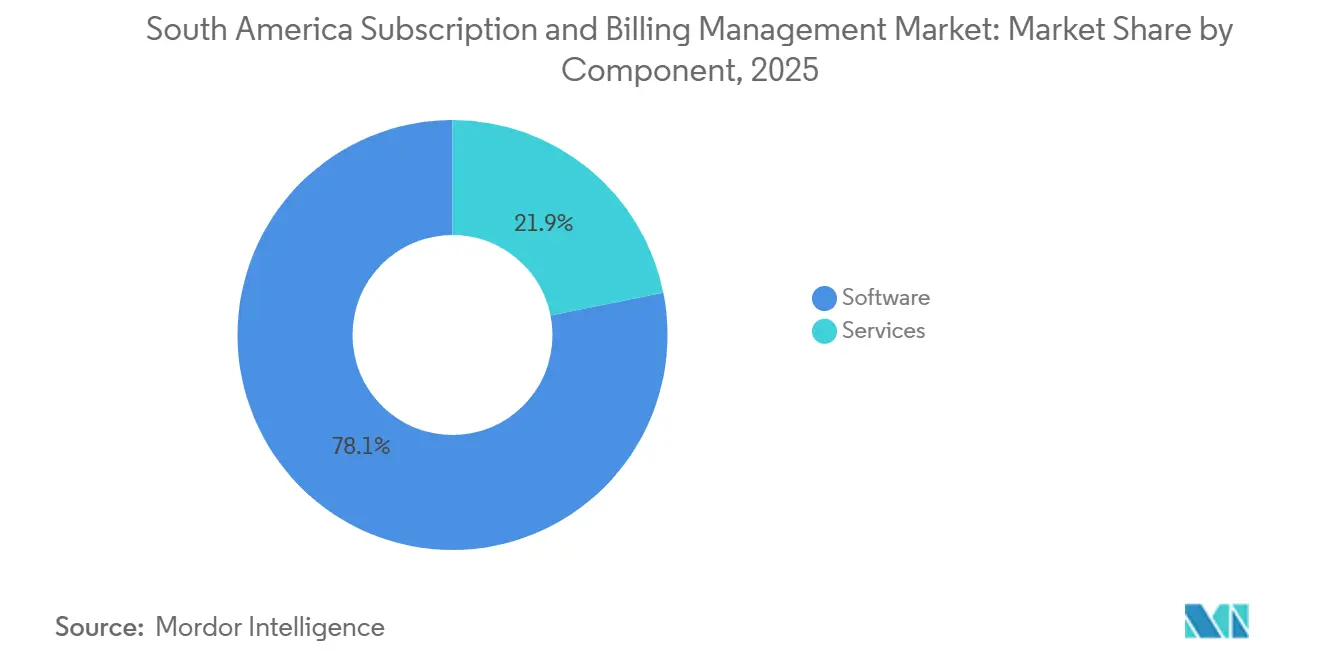
Software held 78.14% of the South America subscription and billing management market share in 2025. Integrated software combines credit and collections management, receivables, quote and pricing management, subscription order management, and dispute management. These capabilities create configuration depth and make platform replacement more difficult after implementation. Zuora launched its AI Monetization Suite in June 2026, adding an AI Pricing Simulator and metered entitlements to its quote-to-cash workflow. SAP expanded recurring service contract support in its Subscription Order Management 2025 FPS01 release in February 2026.
Services are projected to expand at a CAGR of 15.92% through 2031. Implementation and managed services are becoming more important as companies connect Pix Automático, Bre-B, Nequi, and Yape with tax and finance systems. Brazil’s data-transfer standard contractual clauses took full effect in August 2025, adding configuration considerations for international data transfers. Mid-market customers often need ongoing support for payment recovery and reconciliation. Local implementation teams can shorten the time between deployment and the first billing cycle. The South America subscription and billing management industry, therefore, has a rising services need alongside platform sales.


By Deployment Mode: Cloud Becomes the Default Architecture
Cloud accounted for 78.22% of the South America subscription and billing management market share in 2025. Its projected CAGR of 16.11% through 2031 reflects demand for continuous product updates. Cloud systems can add payment methods, revise recovery rules, and apply compliance updates without a customer-led upgrade project. The Brazilian cloud adoption data from TOTVS and H2R Insights indicates that customer familiarity with SaaS delivery is already high. Claro’s 2025 cloud investment also shows that telecommunications providers are helping distribute SaaS capabilities to smaller customers.
On-premise systems remain relevant to regulated financial institutions and utilities with data sovereignty requirements. New agreements in these sectors increasingly use hybrid models that keep some processing locally while moving billing functions to hosted platforms. This model allows firms to modernize payment and plan management without replacing every core system at once. Brazil’s data protection requirements make data location and contract terms important during deployment. The South America subscription and billing management market is consequently moving toward cloud-led architectures rather than a simple cloud or on-premise choice. Hybrid operating models can also ease migration for organizations with long-standing ERP environments.
By Enterprise Size: SME Adoption Changes Demand Patterns
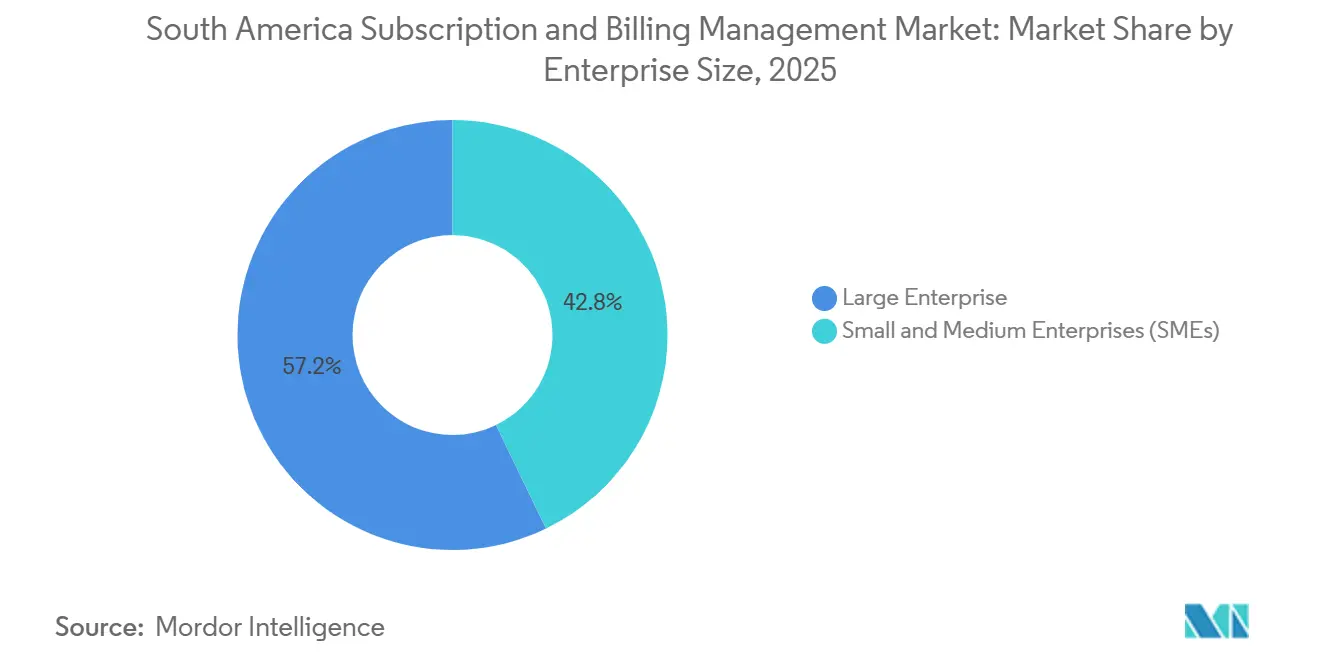
Large enterprises held 57.16% of the market in 2025. Telecom operators, media groups, and financial institutions have long used ERP-connected billing systems and have the resources for complex implementation work. Their continuing investment is linked to revenue-recognition requirements and the need to connect billing engines with general ledgers. BillingPlatform notes that customer relationship management records often lack billing frequency, proration, and revenue-recognition fields, so additional data mapping is needed before accurate billing can begin. This integration burden supports the established positions of ERP-linked providers. It also creates demand for professional services and certified connectors.
Small and medium enterprises are projected to expand at a CAGR of 16.24% through 2031. Cloud-native platforms with free, revenue-share, and usage-based tiers lower entry costs for firms that previously relied on manual invoicing. Chargebee introduced a free Starter tier that provides access to subscription controls for early-stage software firms until they reach a specified cumulative billing threshold. Pix Automático eliminates the need for merchants to negotiate separate automatic-debit arrangements with banks. Smaller firms can therefore establish recurring collections through a fintech connection in less time. This supports a broader customer base for the South America subscription and billing management market.

By End-User Industry: Telecom Leads While Retail Accelerates
IT and telecom held 29.28% of the South America subscription and billing management market in 2025. The sector has long managed metered and usage-based charging, which uses many of the same controls as current subscription systems. Telecom operators process large volumes of recurring events and require mediation, taxation, and payment recovery at scale. These requirements have influenced the feature sets of enterprise billing providers. Financial services is another important customer group because digital banks, lending firms, and insurers are adding recurring product bundles. The South America subscription and billing management industry remains closely tied to the complex operational needs of these established users.
Retail and e-commerce are projected to expand at a CAGR of 16.33% through 2031. Direct-to-consumer subscriptions, retail membership programs, and loyalty services are extending recurring payment use beyond traditional digital services. Colombia’s electronic commerce association reported strong growth in digital payment volume across retail and service categories. Media and entertainment providers also require flexible plan controls and involuntary churn management as streaming adoption expands. Public utilities represent a later-stage opportunity, as consent-based Pix Automático collections can reduce multi-bank administration. Health technology, online learning, and logistics create additional demand as recurring service models become more widespread.
Geography Analysis
Brazil held 48.37% of the South America subscription and billing management market share in 2025. Pix achieved widespread adoption among Brazilian adults, while recurring card payments increased significantly from the previous year. EBANX processed a substantial share of Pix Automático transactions in Brazil. The country’s cloud adoption supports demand for hosted billing tools. New electronic fiscal-document requirements for nonresident digital-service providers make embedded tax logic increasingly important for the South America subscription and billing management market.
Colombia is projected to expand at a CAGR of 16.32% through 2031. Bre-B’s early transaction activity and payment-key adoption indicate rapid consumer enrollment in instant payments. The Financial Superintendency reported that most financial transactions were conducted through digital channels. Colombia’s e-commerce transaction volumes continued to increase. EBANX expanded Nequi’s recurring payment capabilities into Colombia. These payment options broaden the addressable customer base for the South America subscription and billing management market.
Argentina and the rest of South America offer meaningful demand but need more flexible operations. Argentina’s elevated annual inflation and the new exchange-rate band require frequent price and collection adjustments. High customer cancellations following price increases make price localization important in the country. EBANX added Yape in Peru to its recurring payment offering. dLocal reported strong revenue growth, demonstrating the scale that payment infrastructure can achieve across regional markets. These conditions favor systems that support local wallets, currency controls, and country-specific recovery processes.
Competitive Landscape
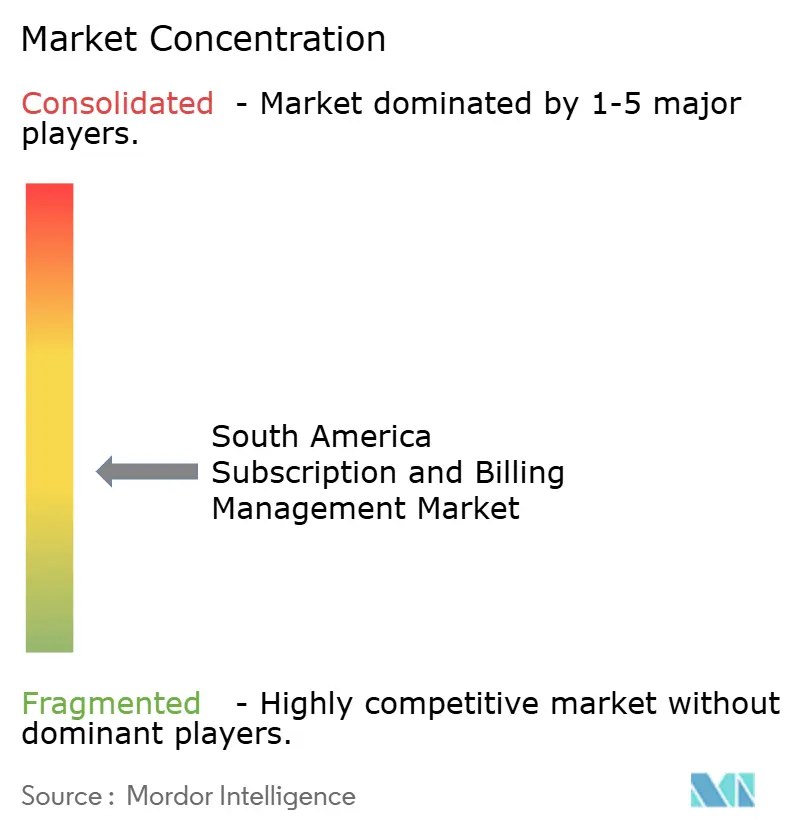
The South America subscription and billing management market has a moderately fragmented structure. Global providers, including Zuora, Stripe, Chargebee, Oracle, SAP, and Salesforce, compete through enterprise functionality, integration depth, and broad compliance coverage. Regional firms such as EBANX, Vindi, and Kushki compete through domestic payment connections and knowledge of local collection conditions. Zuora launched its AI Monetization Suite in June 2026, providing pricing simulation and flexible commitment tools for usage, token, credit, and hybrid offers. SAP’s February 2026 update expanded its native recurring-service contract support in S/4HANA.
Regional payment connectivity is a key competitive factor in the South America subscription and billing management market. EBANX’s Pix Automático processing position and its April 2026 Nequi and Yape expansion offer merchants access to local recurring payment methods. Vindi and Kushki focus on payment recovery, smart retries, card updating, and local payment execution. These capabilities respond to high payment failure and chargeback exposure. Global providers increasingly need partnerships or direct integration with domestic rails to offer equivalent payment coverage. This leaves regional firms with defensible positions where localized access and operational support matter most.
Payment recovery can be more important than basic plan management for regional customers. Recurly’s April 2026 release added Checkout.com and Nuvei support for Brazil and South America, alongside automated collection and chargeback-management capabilities. Chargebee integrated Paraglide AI in February 2026 to automate accounts receivable conversations and payment-reminder escalation. Colombia, Peru, and Argentina remain less developed distribution areas for cloud platforms that support account-to-account rails. Public utilities and public-sector organizations are also early-stage opportunities for formal recurring billing.
South America Subscription and Billing Management Industry Leaders
EBANX Ltda.
Stripe, Inc.
Oracle Corporation
SAP SE
Chargebee, Inc.
- *Disclaimer: Major Players sorted in no particular order

Recent Industry Developments
- August 2026: Chargebee was recognized as a Leader in the 2026 Gartner Magic Quadrant for Recurring Billing Applications for the third consecutive year, per Chargebee's press release, underscoring sustained investment in multi-entity support, hybrid pricing models, and AI-driven dunning for enterprise clients.
- June 2026: Zuora launched its AI Monetization Suite, including the AI Pricing Simulator and Flexible Commitments tools, enabling companies to model AI-native pricing structures across usage, token, credit, and hybrid models before commercial launch, connecting quoting, billing, collections, and revenue recognition within a single system.
- June 2026: EBANX published its one-year Pix Automático data, confirming 64% of users were new subscribers to the platforms they were paying, active enrollments grew at 177% monthly, and EBANX processed 38% of all national Pix Automático transactions in Brazil.
- April 2026: EBANX expanded recurring alternative payment method capabilities to Colombia, Nequi, and Peru, Yape, among 6 new markets, announced at Money20/20 Asia in Bangkok, extending its recurring APM coverage to 12 emerging markets representing over 1 billion potential consumers.


South America Subscription and Billing Management Market Report Scope
South America Subscription and Billing Management Market refers to software platforms and services that manage the complete lifecycle of recurring and usage-based customer subscriptions across South American countries. It supports SaaS, telecommunications, streaming, media, e-commerce, financial services, education, healthcare, memberships, and other subscription-driven businesses.
The South America Subscription and Billing Management Market Report is Segmented by Component (Software, and Services), Deployment Mode (On-Premise, and Cloud), Enterprise Size (Large Enterprises, and SMEs), End-User Industry (Retail and E-Commerce, BFSI, IT and Telecom, Media and Entertainment, and Public Sector), and Geography (Brazil, Argentina, Colombia, and Rest of South America). The Market Forecasts are Provided in Terms of Value (USD).
| Software | Credit and Collection Management |
| Receivables Management | |
| Quote and Pricing Management | |
| Subscription Order Management | |
| Dispute Management | |
| Other Software Functions | |
| Services | Professional Services |
| Managed Services |
| On-Premise |
| Cloud |
| Large Enterprises |
| Small and Medium Enterprises (SMEs) |
| Retail and E-Commerce |
| BFSI |
| IT and Telecom |
| Media and Entertainment |
| Public Sector and Utilities |
| Other End-User Industries |
| Brazil |
| Argentina |
| Colombia |
| Rest of South America |
| By Component | Software | Credit and Collection Management |
| Receivables Management | ||
| Quote and Pricing Management | ||
| Subscription Order Management | ||
| Dispute Management | ||
| Other Software Functions | ||
| Services | Professional Services | |
| Managed Services | ||
| By Deployment Mode | On-Premise | |
| Cloud | ||
| By Enterprise Size | Large Enterprises | |
| Small and Medium Enterprises (SMEs) | ||
| By End-User Industry | Retail and E-Commerce | |
| BFSI | ||
| IT and Telecom | ||
| Media and Entertainment | ||
| Public Sector and Utilities | ||
| Other End-User Industries | ||
| By Geography | Brazil | |
| Argentina | ||
| Colombia | ||
| Rest of South America | ||


Key Questions Answered in the Report
What is the size of the South America subscription and billing management market?
The sector was valued at USD 7.98 billion in 2025, is estimated at USD 9.26 billion in 2026, and is forecast to reach USD 19.36 billion by 2031.
What is driving adoption of subscription billing platforms in South America?
Recurring business models, real-time payments, cloud adoption, and the need for stronger payment recovery are expanding demand.
Which deployment model leads subscription billing adoption in South America?
Cloud led with 78.22% share in 2025 and is projected to expand at a CAGR of 16.11% through 2031.
Which customer group is expanding fastest for billing platforms?
Small and medium enterprises are projected to expand at a CAGR of 16.24% through 2031 as cloud tools reduce adoption barriers.
Which end-user sector is expanding fastest?
Retail and e-commerce are projected to expand at a CAGR of 16.33% through 2031, supported by direct-to-consumer subscriptions and loyalty programs.
Why are Pix Automático and Bre-B important for recurring payments?
They allow consumers to authorize account-to-account recurring payments, extending access beyond credit-card users in Brazil and Colombia.
Page last updated on:





