
South America Social Commerce Market Size and Share
Market Overview
| Study Period | 2020 - 2031 |
|---|---|
| Forecast Data Period | 2026 - 2031 |
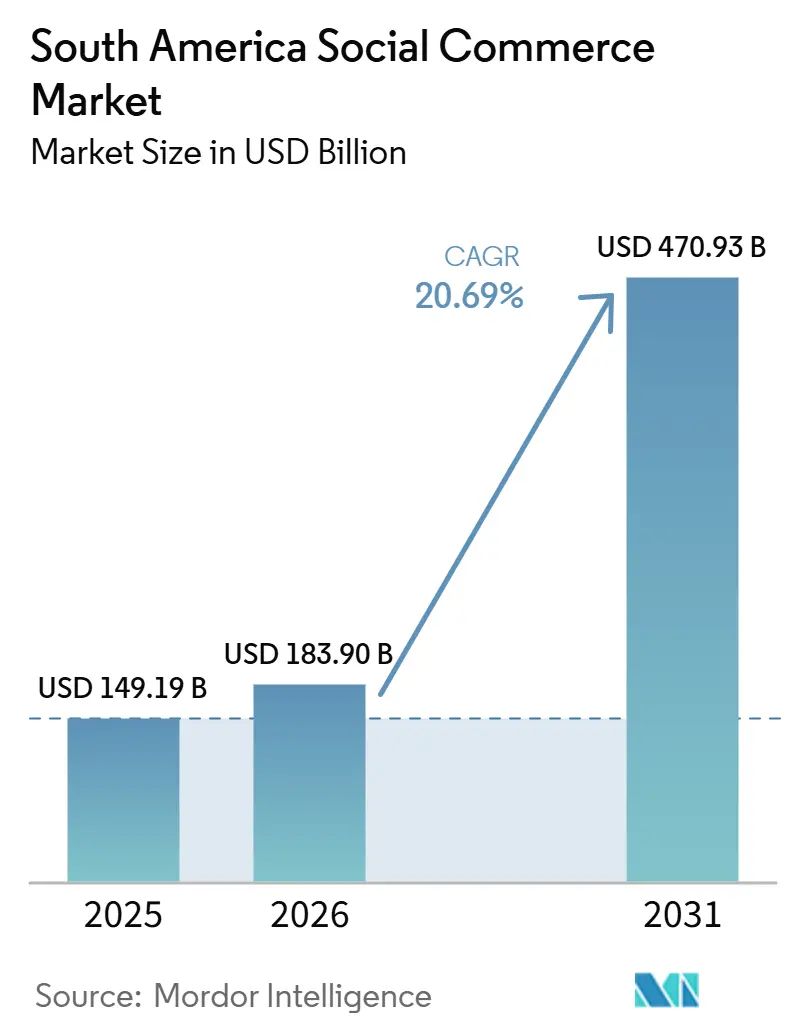
| Base Year Market Size (2025) | USD 149.19 Billion |
| Market Size (2026) | USD 183.90 Billion |
| Market Size (2031) | USD 470.93 Billion |
| Growth Rate (2026 - 2031) | 20.69 % |
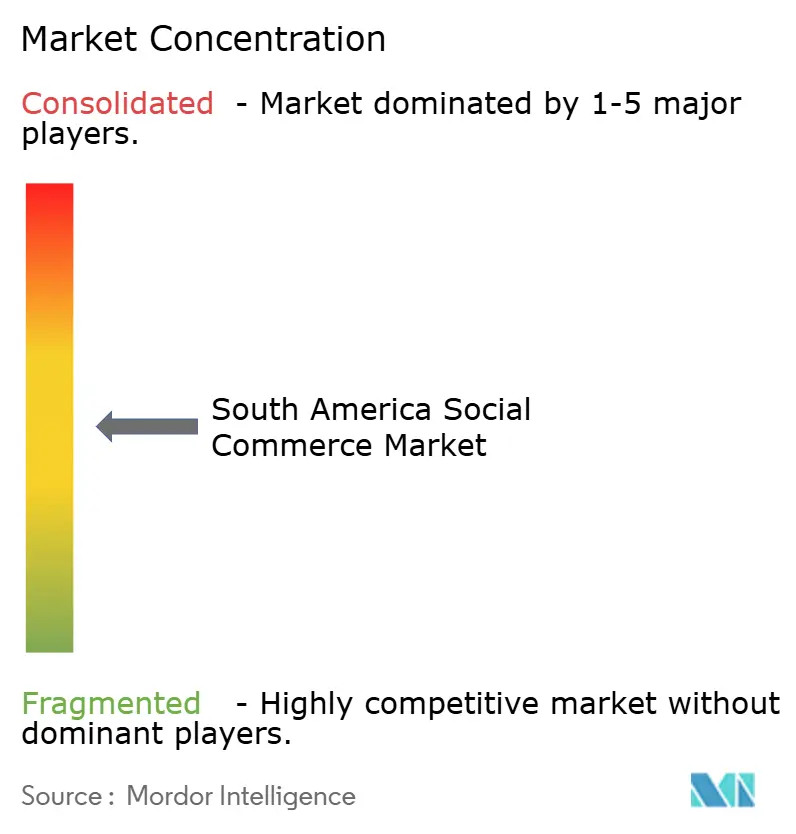
| Market Concentration | Medium |
Major Players *Disclaimer: Major Players sorted in no particular order Image © Mordor Intelligence. Reuse requires attribution under CC BY 4.0. | |
South America Social Commerce Market Analysis by Mordor Intelligence
The South America social commerce market size was valued at USD 149.19 billion in 2025 and estimated to expand from USD 183.90 billion in 2026 to reach USD 470.93 billion by 2031, at a CAGR of 20.69% during the forecast period 2026-2031. Instant payments, short-form video, live shopping, and creator-led selling are bringing discovery, checkout, and payment closer together. This structure favors mobile-first buying behavior and gives small sellers a lower-cost route to customers. Brazil remains the regional center because Pix supports fast payments and major platforms have expanded commerce functions there. The South America social commerce market also has room to expand outside large cities, although fraud prevention and delivery capacity will shape the pace of adoption.
Key Report Takeaways
- By product type, Apparel held 30.20% of the South America social commerce market share in 2025, while Personal and Beauty Care is projected to expand at a 20.75% CAGR through 2031.
- By device, Smartphones accounted for 80.50% of the South America social commerce market share in 2025, while the same segment is projected to expand at 21.94% CAGR through 2031.
- By sales channel, Video Commerce held 37.50% of value in 2025, while Social Reselling is projected to expand at a 21.22% CAGR through 2031.
- By geography, Brazil accounted for 55.57% of regional value in 2025, while Argentina is projected to expand at a 21.44% CAGR through 2031.
Note: Market size and forecast figures in this report are generated using Mordor Intelligence’s proprietary estimation framework, updated with the latest available data and insights as of January 2026.
South America Social Commerce Market Trends and Insights
Drivers Impact Analysis*
| Driver | (~) % Impact on CAGR Forecast | Geographic Relevance | Impact Timeline |
|---|---|---|---|
| Embedded Instant Payments and Conversational Checkout | +4.2% | Brazil, expanding to Argentina and Rest of South America | Short term (≤ 2 years) |
| Rising Smartphone and Mobile Internet Use | +3.8% | Pan-regional, with accelerating uptake in Rest of South America | Medium term (2-4 years) |
| Short-Form Video and Live Shopping Adoption | +3.5% | Brazil-led, with early traction in Argentina and Colombia | Short term (≤ 2 years) |
| Creator-Led Product Discovery and Affiliate Commerce | +3.0% | Brazil, with spillover to Argentina and Chile | Medium term (2-4 years) |
| Improved Creator Attribution for Merchant Returns | +2.1% | Brazil and Argentina, with growing regional relevance | Medium term (2-4 years) |
| Localized Selling for Informal and Micro-Merchants | +1.8% | Pan-regional, strongest in informal economies of Rest of South America | Long term (≥ 4 years) |
| Source: Mordor Intelligence | |||
Embedded Instant Payments and Conversational Checkout
Pix processed USD 6.7 trillion in 2025, 34% more than in the prior year, and approached 7.9 billion monthly transactions in December 2025.[1] Its use among Brazilian online consumers reached 84% in 2025, which reduces checkout friction for purchases initiated on social platforms. Sellers can share a Pix key in a WhatsApp conversation, allowing payment confirmation without requiring a separate storefront. This payment pattern gives informal merchants a simple way to complete sales with limited upfront cost. The South America social commerce market benefits where sellers can connect content, customer questions, and payment in one conversation. Banco Central do Brasil Resolution BCB No. 1/2020 established Pix as an open real-time payment arrangement, creating the regulatory basis for this form of conversational checkout.
Rising Smartphone and Mobile Internet Use
South America recorded strong handset demand in 2025, with the wider regional smartphone market shipping 140.5 million units. Mobile internet reached 413 million users by the end of 2024, or 64% of the regional population, although a 32% usage gap remained among people already covered by mobile networks.[2] A smartphone can now serve as a discovery channel, review source, payment device, and basic seller storefront. This lowers the operational threshold for consumers and small merchants entering the South America social commerce market. Argentina already had 8 in 10 adults who purchased online in 2024, shifting competitive attention toward purchase frequency and basket value. Lower-cost Android devices and messaging-led storefronts are likely to remain important in secondary cities, where storage limits and connectivity conditions can make full app downloads less practical.
Short-Form Video and Live Shopping Adoption
TikTok Shop entered Brazil on May 8, 2025, combining short-video purchase links, live shopping, and creator storefronts in one launch. During its first year, the service reported that gross merchandise value increased 102 times, daily live-stream volumes increased 20 times, and its active affiliate network increased 56 times. Its early results show that buyers use video for discovery but still seek marketplace validation before purchase. Video Commerce held 37.50% of the South America social commerce market in 2025, making it the leading sales channel. The format is extending beyond fashion and beauty as sellers test home products, food, grocery, and fitness supplements. Natura and Co reported a 228% improvement in shopping-cart recovery and a 1,600% increase in new-customer acquisition from a 12-hour Black Friday live session in 2025.
Creator-Led Product Discovery and Affiliate Commerce
MercadoLibre's affiliate and creator program expanded active participants by 310% in Q2 2025 from Q2 2024. Affiliate-driven sales reached 72 per minute in Q3 2025 and 168 orders per minute in Q1 2026, while users spent more than 6 million hours viewing product clips in that quarter. These programs allow marketplaces to treat creators as a performance-based selling network rather than relying only on conventional advertising. Natura reported that 42% of orders through beauty consultants came from digital content, while trained consultants sold 2.3 times more than untrained peers. The South America social commerce market therefore rewards brands that retain creator relationships and measurement practices over time. Mercado Ads also announced in June 2026 that it would extend its creator network to TikTok and connected TV, linking its catalog to additional content surfaces.
Restraints Impact Analysis*
| Restraint | (~) % Impact on CAGR Forecast | Geographic Relevance | Impact Timeline |
|---|---|---|---|
| Fraud, Counterfeit Listings, and Social-Engineering Scams | -2.8% | Brazil, Argentina, and pan-regional | Short term (≤ 2 years) |
| Uneven Logistics and Returns Infrastructure Outside Major Cities | -2.1% | Rest of South America and secondary cities in Brazil and Argentina | Medium term (2-4 years) |
| Rising Customer Acquisition Costs on Mature Platforms | -1.5% | Brazil and Argentina, expanding regionally | Medium term (2-4 years) |
| Platform and Payment Policy Volatility for Small Sellers | -0.9% | Pan-regional, most acute for cross-border sellers in Argentina | Long term (≥ 4 years) |
| Source: Mordor Intelligence | |||
Fraud, Counterfeit Listings, and Social-Engineering Scams
Serasa Experian identified 37,845 fraudulent advertisements, profiles, pages, and applications impersonating legitimate brands in 2025. Social media platforms accounted for 77% of those cases, exposing consumers at the discovery stage. Fraud-related losses consumed 2% of online-store revenue in the region in 2025, and regional chargeback rates exceeded the 3.0% global average. Fake-store schemes often copy established brand profiles, collect Pix payments, and fail to fulfill orders. Brazil established an e-commerce fraud task force in April 2026 through Senacon and the National Council for Combating Piracy and Intellectual Property Crimes.[3] The South America social commerce market needs stronger seller verification and visible consumer protection to reduce hesitation among first-time buyers.
Uneven Logistics and Returns Infrastructure Outside Major Cities
Last-mile delivery represented 41% of total supply-chain cost globally, and sparse routes outside urban centers can increase that burden in South America. The Inter-American Development Bank estimated that 30% of regional roads were in poor condition, affecting delivery times and reverse-logistics costs. In northern Brazil, transport costs can represent 25% of final product price, compared with 10-12% in the south. This creates a different customer experience outside major cities, particularly for lower-value orders that are not economical to return. MercadoLibre delivered 76% of fast shipments within 48 hours in the region during Q1 2026 and extended same-day delivery to São Paulo, Campinas, Florianópolis, and Salvador. Further investment in fulfillment and returns networks will determine how evenly the South America social commerce market develops across the region.
*Our forecasts treat driver/restraint impacts as directional, not additive. The impact forecasts reflect baseline growth, mix effects, and variable interactions.
Segment Analysis
By Product Type: Apparel Leads While Personal and Beauty Care Accelerates
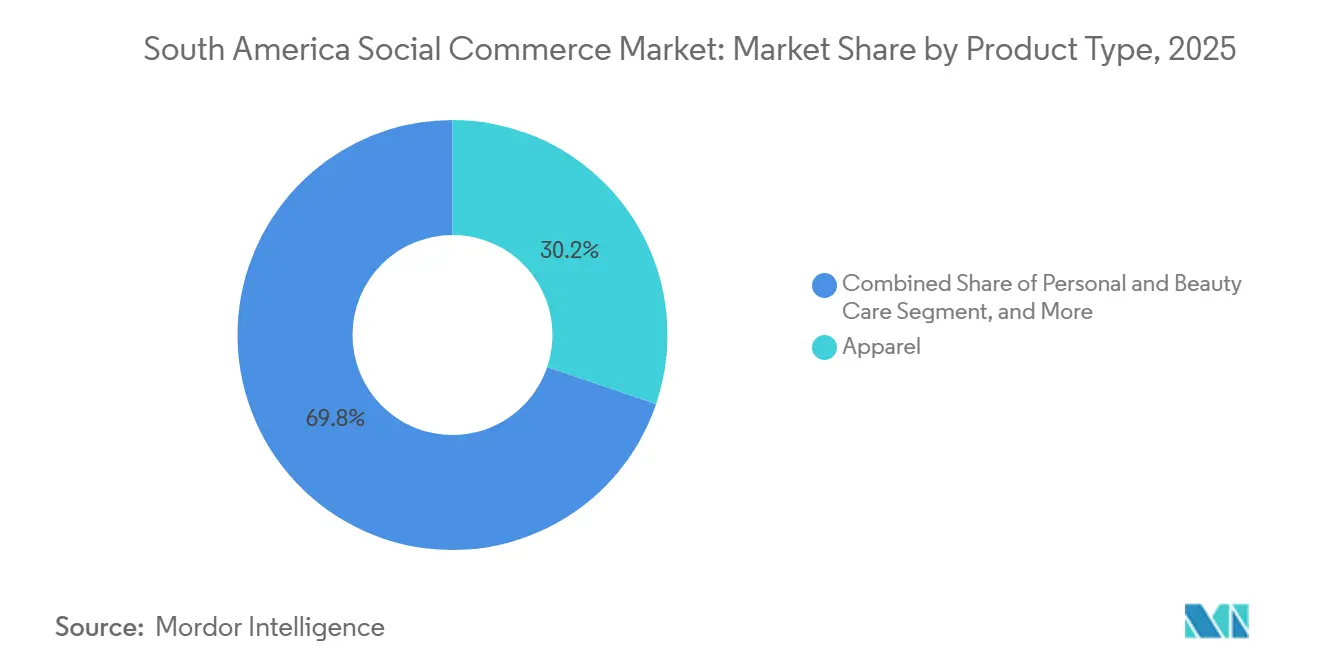
Apparel held 30.20% of the South America social commerce market size in 2025, supported by established fashion creators and frequent product discovery on Instagram and TikTok. Personal and Beauty Care is projected to expand at a 20.75% CAGR through 2031. Live demonstrations help beauty sellers explain product use, respond to questions, and address concerns before buyers leave checkout. This format provides an advantage for products where routine, texture, shade, or application affect buyer confidence. Natura converted its consultant network into a digital selling channel, with more than 52,000 live broadcasts in 2025 and 60% produced by consultants. The scale of this activity gives established direct-selling brands an advantage in the South America social commerce industry.
Accessories, Home Products, and Health Supplements occupy mid-tier positions and have more room for creator specialization. Health Supplements need more careful content because many product demonstrations require clinical knowledge that general affiliates do not have. Food and Beverages remain more suited to shelf-stable products and subscription models because cold-chain fulfillment limits the role of perishables. The South America social commerce industry has broadened beyond its earlier concentration in fashion and electronics. By 2025, five product categories had meaningful participation in social selling. This diversity supports continued category testing while leaving different fulfillment and content requirements in place.

By Device: Smartphones Define the Transactional Interface
Smartphones accounted for 80.50% of the South America social commerce market share in 2025, while the same segment is projected to expand at 21.94% CAGR through 2031. TikTok Shop, Instagram Shopping, and WhatsApp Business catalogs are designed primarily for mobile use. Their checkout flows support biometric authentication and Pix key entry, rather than desktop card forms. A seller can operate with a smartphone, social account, and Pix key, which lowers entry barriers for informal merchants. Smartphone shipments expanded in Brazil, Argentina, Chile, and Ecuador during 2025. VTEX expanded an AI-enabled commerce architecture across Brazil, Colombia, and Ecuador to help enterprise sellers maintain consistent catalogs across devices.
Laptops and desktops retain a smaller role for higher-consideration business purchases and older Facebook Marketplace users. Larger screens can remain useful for Home Products and electronics, where specifications require closer comparison. Their relevance is likely to narrow as platforms direct more product and checkout investment to mobile interfaces. Sellers will still need multidevice experiences for categories with higher ticket values. Tiendanube introduced Lumi in 2025 to manage listings, pricing, and shipping calculations across WhatsApp and Instagram for its merchant base. Such tools can reduce the operating effort needed to manage several buyer touchpoints.
By Sales Channel: Video Commerce Anchors Volumes While Social Reselling Gains Pace
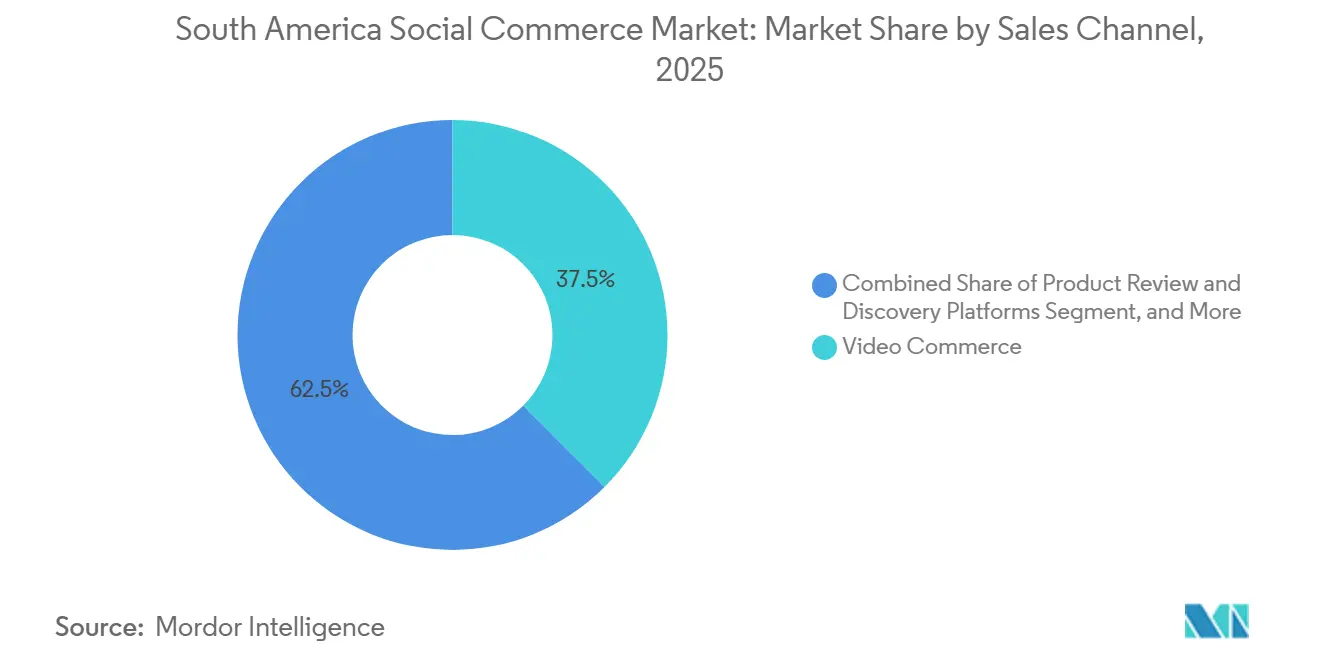
Video Commerce held 37.50% of the South America social commerce market size in 2025, making it the largest sales-channel format. Social Reselling is projected to expand at a 21.22% CAGR through 2031. Reselling is becoming more structured across WhatsApp groups, OLX Brasil, TikTok affiliate activity, and MercadoLibre programs. Video content combines product explanation with direct shopping links, while reselling depends more heavily on personal connections and local networks. Facebook Marketplace retains a role among older users, and Meta announced tools in 2026 that allow Brazilian creators to tag MercadoLibre and Amazon products for affiliate commissions. These models allow the South America social commerce market to accommodate both formal catalog sales and peer-to-peer transactions.
Group Buying and Team Purchase remain less developed than in Southeast Asia. Consumer familiarity is limited, and the region lacks a large homegrown platform built around coordinated buying. WhatsApp groups and Pix split-payment features could support localized group purchase models, but broad adoption has not yet emerged. Product Review and Discovery Platforms can create intent but still lose buyers when checkout occurs elsewhere. Mercado Ads introduced shoppable video formats in 2026 to connect creator content directly to MercadoLibre catalog purchases. Argentina recorded 253 million e-commerce orders in 2025, an increase of 3% from the previous year, showing a broad base of online transactions for social channels to address.
Geography Analysis
Brazil accounted for 55.57% of South America social commerce market share in 2025. Pix processed USD 6.7 trillion in 2025 and reached 84% use among online consumers, giving the country a payment system well suited to rapid social checkout. TikTok Shop reached USD 46.1 million in gross merchandise value in August 2025 after beginning at USD 1 million in May. MercadoLibre increased unique buyers in Brazil by 32% year over year in Q1 2026. Open payment access has enabled many informal sellers to complete transactions in messaging conversations without a separate payment rail.
Argentina is projected to expand at a 21.44% CAGR through 2031, the fastest rate among the geographic segments. CACE reported ARS 35.3 trillion in 2025 e-commerce billing, equivalent to USD 24 billion at average annual exchange rates, with real growth of 22% above inflation. MercadoLibre recorded 75% foreign-exchange-neutral gross merchandise value expansion in Argentina in Q2 2025. Adult access to banking or fintech services reached 100%, giving social sellers and buyers a broad payments base. The country still has less social commerce infrastructure than Brazil, leaving room for platforms and logistics providers to build capacity in Buenos Aires and Córdoba.
Chile and Colombia are the most developed markets in the Rest of South America after Brazil and Argentina. Chile had high internet penetration in 2025, supporting premium categories and a more mature delivery environment. MercadoLibre recorded 40% foreign-exchange-neutral gross merchandise value expansion in Chile in Q1 2026, alongside record free-shipping penetration. Colombia, Peru, and Ecuador are earlier in adoption, with WhatsApp-based selling by informal merchants playing a larger role. Regional mobile internet penetration is projected to reach 66% by 2030, which could bring more secondary-city buyers and sellers into digital commerce.
Competitive Landscape
The South America social commerce market has a moderately concentrated platform layer and a fragmented seller base. Meta provides broad audience reach through Instagram, Facebook, and WhatsApp. WhatsApp is a central channel for conversational selling in Brazil. ByteDance provides a high-velocity discovery channel through TikTok, while MercadoLibre supplies marketplace trust, payments, and fulfillment. MercadoLibre delivered 76% of fast shipments within 48 hours in Q1 2026, strengthening its role after product discovery. VTEX and Tiendanube compete in the software layer that helps merchants manage catalogs and checkout across platforms.
Meta announced in March 2026 that creators could tag products from MercadoLibre, Amazon, Shopee, and eBay in Facebook and Instagram posts for affiliate commissions. The move makes marketplace catalogs more visible inside social content without requiring a buyer to search a separate storefront. Meta also selected Tiendanube as an official regional integration partner for WhatsApp Business AI in 2026. Tiendanube had more than 180,000 regional merchants and had invested USD 17.5 million in small and medium business tools, including Lumi. These strategic moves reflect competition over merchant operations as well as consumer attention.
Natura and Co and Grupo Boticário use direct-selling networks and creator content to compete with digital-native sellers. Grupo Boticário became the first Brazilian brand to use TikTok's E-Commerce Search Hub and the first regional brand across product categories to use the feature. OLX Brasil and Via S.A. are positioned in reselling and value retail, although they face pressure from low-cost affiliate sourcing. Opportunities remain in business-to-business social selling, localized group buying, and verified-seller programs that reduce fraud. The fragmented seller base limits concentration outside the leading platform layer.
South America Social Commerce Industry Leaders
-
MercadoLibre, Inc.
-
Meta Platforms, Inc.
-
ByteDance Ltd.
-
Sea Limited
-
Alphabet Inc.
- *Disclaimer: Major Players sorted in no particular order
Recent Industry Developments
- June 2026: Mercado Ads, MercadoLibre's advertising unit, announced at Cannes Lions 2026 the launch of its creator network expansion to TikTok and connected TV, enabling brands to use MercadoLibre's first-party purchase data for audience targeting across social and streaming platforms. The company also introduced shoppable video formats that link creator-driven TikTok content directly to MercadoLibre catalog purchases, closing the attribution gap between content consumption and transaction.
- May 2026: TikTok Shop marked its first year of operation in Brazil with gross merchandise value increasing 102 times, daily live-streaming volumes rising 20 times, and the active affiliate base expanding 56 times compared with the same period in 2025. The platform's scale-up established ByteDance as a direct competitive pressure on domestic marketplace leaders and prompted Natura and Co, Grupo Boticário, Magazine Luiza, and Lojas Renner to formalize dedicated TikTok commerce strategies.
- April 2026: Brazil's National Consumer Secretariat, operating through the National Council for Combating Piracy and Intellectual Property Crimes, established a dedicated e-commerce fraud task force to audit platform prevention measures against counterfeit listings and social-engineering scams. The body is also monitoring Senate legislation that would amend Brazil's criminal code to criminalize possession of materials intended to falsify consumer goods.
- March 2026: Meta announced at Shoptalk 2026 in Las Vegas that creators could tag products from MercadoLibre, Amazon, Shopee, and eBay directly in Facebook and Instagram posts to earn affiliate commissions. It confirmed that Instagram product links in Reels would expand to 22 countries, including Brazil. The company also unveiled an AI-powered automated showcase feature that generates product carousels over videos and Stories.
South America Social Commerce Market Report Scope
The South America Social Commerce Market refers to the ecosystem of buying and selling products and services directly through social media platforms, messaging applications, creator-driven channels, and integrated digital communities across South America.
The South America Social Commerce Market Report is Segmented by Product Type (Apparel, Personal and Beauty Care, Accessories, Home Products, Health Supplements, Food and Beverages, and Other Product Types), Device (Laptops and Desktops and Smartphone), Sales Channel (Video Commerce, Social Network-Led Commerce, Social Reselling, Group Buying/Team Purchase, and Product Review and Discovery Platforms), and Geography (Brazil, Argentina, and Rest of South America). The Market Forecasts are Provided in Terms of Value (USD).
| Apparel |
| Personal and Beauty Care |
| Accessories |
| Home Products |
| Health Supplements |
| Food and Beverages |
| Other Product Types |
| Laptops and Desktops |
| Smartphones |
| Video Commerce |
| Social Network-Led Commerce |
| Social Reselling |
| Group Buying / Team Purchase |
| Product Review and Discovery Platforms |
| Brazil |
| Argentina |
| Rest of South America |
| By Product Type | Apparel |
| Personal and Beauty Care | |
| Accessories | |
| Home Products | |
| Health Supplements | |
| Food and Beverages | |
| Other Product Types | |
| By Device | Laptops and Desktops |
| Smartphones | |
| By Sales Channel | Video Commerce |
| Social Network-Led Commerce | |
| Social Reselling | |
| Group Buying / Team Purchase | |
| Product Review and Discovery Platforms | |
| By Geography | Brazil |
| Argentina | |
| Rest of South America |
Key Questions Answered in the Report
What is the South America social commerce market size?
The South America social commerce market was valued at USD 149.19 billion in 2025 and is estimated at USD 183.90 billion in 2026. It is projected to reach USD 470.93 billion by 2031 at a 20.69% CAGR.
Which product type leads social commerce in South America?
Apparel led product types with a 30.20% share in 2025. Personal and Beauty Care is expected to post the fastest expansion at a 20.75% CAGR through 2031.
Why are smartphones important for social selling in South America?
Smartphones accounted for 80.50% of value in 2025. They support product discovery, messaging, Pix payments, and seller storefronts in one device.
Which sales channel is expanding fastest?
Social Reselling is projected to expand at a 21.22% CAGR through 2031. Video Commerce held the largest sales-channel share at 37.50% in 2025.
Which country has the largest regional position?
Brazil held 55.57% of regional value in 2025. Its Pix system and large social-media audience support rapid conversational checkout.
What are the principal challenges for social selling platforms?
Fraud, counterfeit listings, uneven last-mile delivery, rising acquisition costs, and policy changes can increase seller costs and weaken buyer confidence.