
Market Overview
| Study Period | 2020 - 2031 |
|---|---|
| Forecast Data Period | 2026 - 2031 |
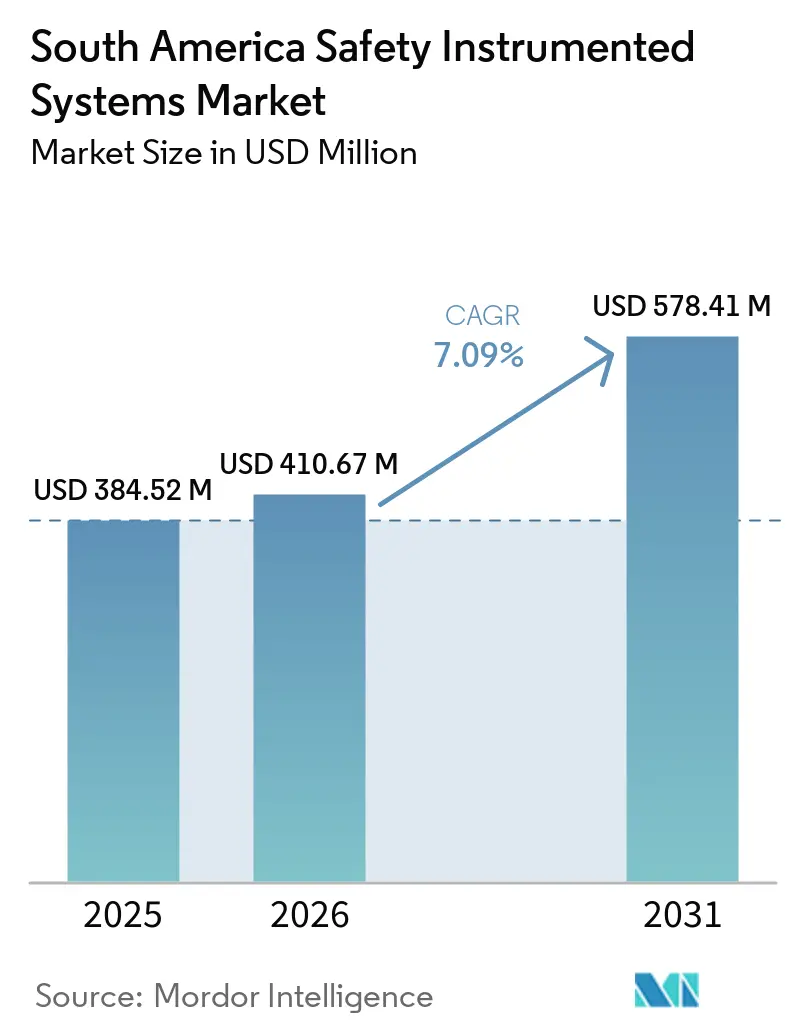
| Base Year Market Size (2025) | USD 384.52 Million |
| Market Size (2026) | USD 410.67 Million |
| Market Size (2031) | USD 578.41 Million |
| Growth Rate (2026 - 2031) | 7.09 % |
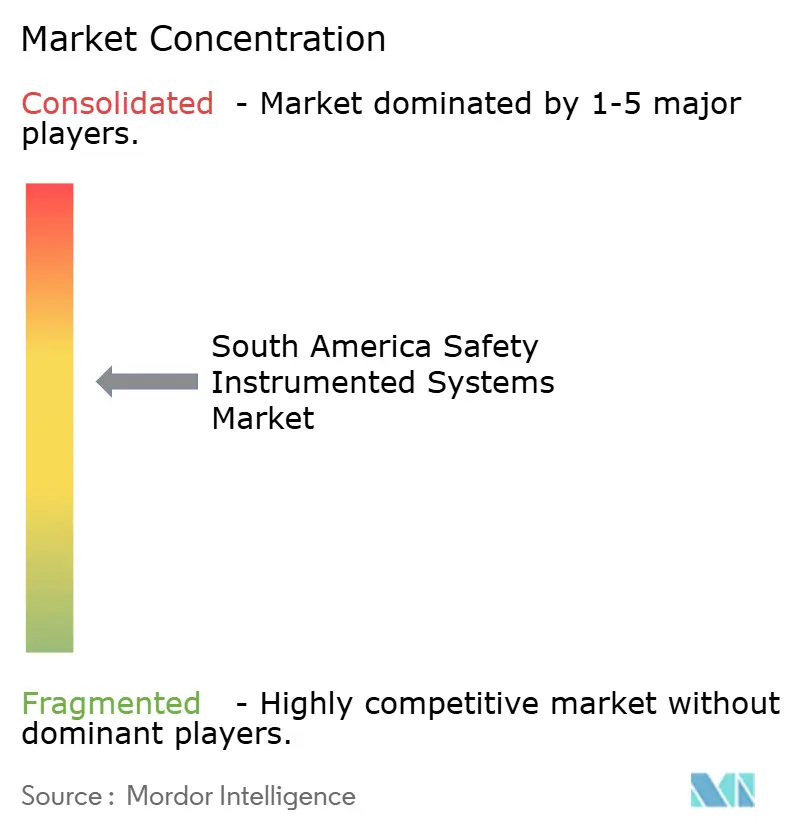
| Market Concentration | Medium |
Major Players *Disclaimer: Major Players sorted in no particular order Image © Mordor Intelligence. Reuse requires attribution under CC BY 4.0. | |
South America Safety Instrumented Systems Market Analysis by Mordor Intelligence
The South America safety instrumented systems market size was valued at USD 384.52 million in 2025 and is estimated to grow from USD 410.67 million in 2026 to reach USD 578.41 million by 2031, at a CAGR of 7.09% during the forecast period, 2026-2031. Demand is centered on process industries that must maintain formal safety lifecycle practices across design, operation, testing, and modification. Brazil and Argentina concentrate much of the region’s spending because offshore oil and gas, refining, pipelines, and petrochemicals require complex protection systems. New work is also emerging in mining and regulated manufacturing, where operators are placing more emphasis on documented safety functions and system validation. Suppliers are increasingly combining devices, software, diagnostics, and engineering services rather than competing only on individual hardware specifications. This places recurring testing, verification, and lifecycle support alongside new project installation as important sources of activity in the South America safety instrumented systems market.
Key Report Takeaways
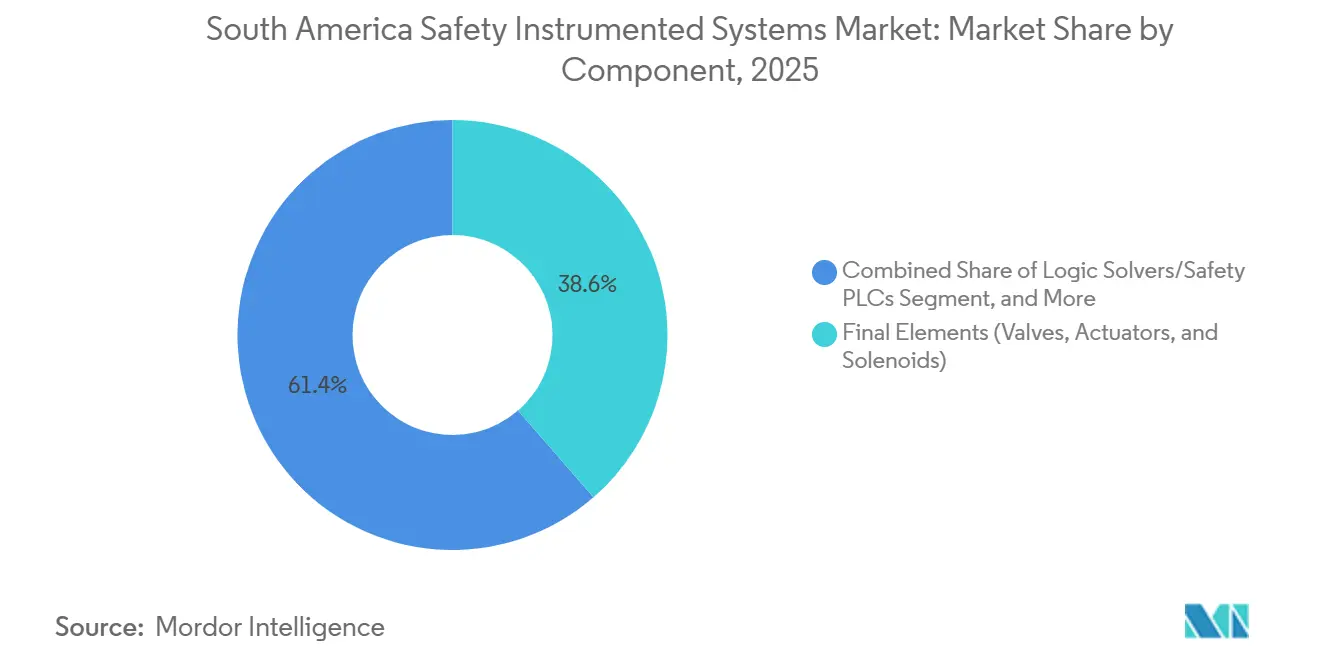
- By component, final elements held 38.62% of the South America safety instrumented systems market share in 2025, while software and services are projected to expand at a 7.64% CAGR through 2031.
- By application, emergency shutdown systems accounted for 42.36% of the South America safety instrumented systems market size in 2025, while high-integrity pressure protection systems are projected to grow at an 8.56% CAGR through 2031.
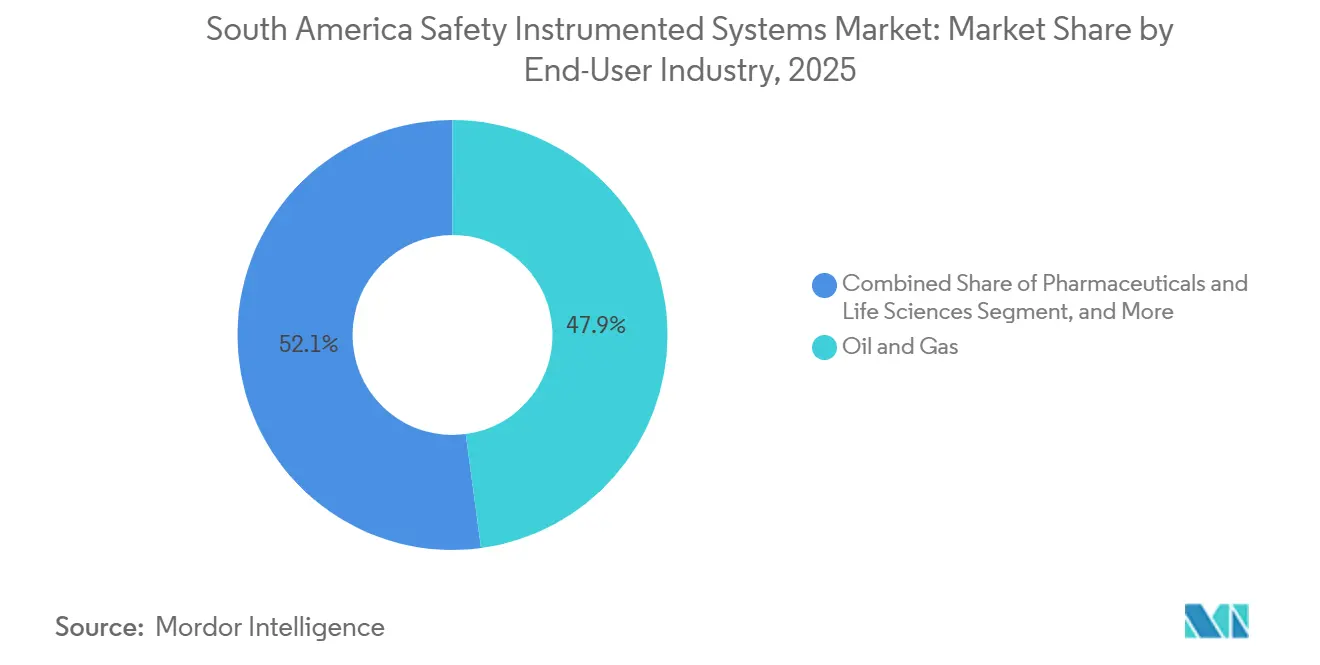
- By end-user industry, oil and gas held 47.89% share in 2025, while pharmaceuticals and life sciences are projected to grow at a CAGR of 8.23% through 2031.
- By service, integration and installation commanded 37.74% share in 2025, while testing, certification, and auditing are projected to expand at a 7.91% CAGR through 2031.
- By geography, Brazil held 58.46% of regional revenue in 2025, while Chile is projected to expand at a 7.59% CAGR through 2031.
Note: Market size and forecast figures in this report are generated using Mordor Intelligence’s proprietary estimation framework, updated with the latest available data and insights as of January 2026.
South America Safety Instrumented Systems Market Trends and Insights
Drivers Impact Analysis*
| Driver | (~) % Impact on CAGR Forecast | Geographic Relevance | Impact Timeline |
|---|---|---|---|
| Stricter Functional Safety Compliance Requirements | +2.1% | Brazil, Argentina, Colombia | Short term (≤ 2 years) |
| Brownfield Upgrades Across Offshore Oil and Gas Facilities | +1.7% | Brazil, Argentina | Short term (≤ 2 years) |
| Expansion of Petrochemical and Chemical Processing Capacity | +1.3% | Brazil, Colombia, Argentina | Medium term (2-4 years) |
| IIoT-Enabled Safety Diagnostics and Predictive Maintenance | +0.8% | Brazil, Chile, Colombia | Medium term (2-4 years) |
| Digital Safety Barrier Management Across Complex Facilities | +0.5% | Brazil, Argentina | Medium term (2-4 years) |
| Cybersecure SIS Demand in Connected Industrial Operations | +0.4% | Brazil, Chile, Colombia | Long term (≥ 4 years) |
| Source: Mordor Intelligence | |||
Stricter Functional Safety Compliance Requirements
Brazil published ABNT NBR IEC 61511-1:2024 in March 2024, followed by Part 2 guidance in January 2025 and Part 3 guidance on safety integrity level determination in November 2025. The three parts provide a national framework that spans hazard analysis, design, operation, assessment, and decommissioning of safety instrumented systems. Regional engineering firms also use the Brazilian standard as a practical reference in cross-border work where comparable local frameworks are less detailed. This changes the South America safety instrumented systems market because operators must prepare more formal safety requirements specifications, verification records, and functional safety assessments. Assets without documented safety integrity level assignments may require reviews that identify changes to logic solvers, final elements, or voting configurations. The resulting work can move safety instrumentation from an informal operating practice into a defined procurement and compliance program.
Brownfield Upgrades Across Offshore Oil and Gas Facilities
Brazil’s offshore fleet creates a concentrated base for safety-system modernization, as aging facilities require periodic upgrades to remain compliant with operating and safety requirements. The 2024-2025 Peregrino field campaign mobilized more than 700 personnel and involved more than 240 metric tons of fabricated piping and structures, showing the scale of offshore modification work. In June 2026, Rockwell Automation reported a firmware modernization at a Brazilian natural gas processing terminal that achieved SIL 3 compliance without interrupting operations.[1]Rockwell Automation, “Gas Terminal Firmware Upgrade Improves Safety,” Rockwell Automation, rockwellautomation.com The terminal handled 1,600 m³/h and had experienced unplanned shutdowns before the project. This work shows that software and firmware changes can address some safety gaps without a full hardware replacement program. Suppliers that can modify systems in service can be well positioned where production continuity limits replacement options in the South America safety instrumented systems market.
Expansion of Petrochemical and Chemical Processing Capacity
Argentina’s unconventional energy development supports demand for safety functions in pipelines, compressor stations, metering points, and hazardous-fluid transfer facilities. Oldelval’s completed USD 1.4 billion Duplicar Plus project and the Duplicar Norte initiative add to the operating and planned infrastructure in the Vaca Muerta region. Duplicar Norte targets early commissioning by late 2026 and a capacity of 20,000-45,000 m³/day. The RIGI-backed Vaca Muerta Sur project has USD 3 billion in shareholder commitments, indicating ongoing construction and commissioning work along the export route. In Brazil, Braskem applies the Center for Chemical Process Safety’s risk-based process safety approach, including the management of protection layers, which may include safety instrumented systems. Its safety program across more than 40 Brazilian manufacturing facilities supports continued engineering and certification activity beyond a single capital project.
IIoT-Enabled Safety Diagnostics and Predictive Maintenance
Industrial IoT data is changing how operators manage proof testing, partial-stroke testing, and the condition of safety barriers. Petrobras presented its Dynamic Process Safety Barriers Management architecture at the AIChE Spring Meeting in 2024. The system integrates information from 28 internal platforms to give users real-time visibility into safety-barrier degradation across facilities. This type of architecture provides maintenance teams with more up-to-date information on instrument condition than fixed calendar intervals alone. It can increase interest in field devices with embedded diagnostics and in platforms that connect condition data to safety lifecycle decisions. The South America safety instrumented systems market, therefore, has a growing need for tools that support both operational monitoring and initial project design.
Restraints Impact Analysis*
| Restraint | (~) % Impact on CAGR Forecast | Geographic Relevance | Impact Timeline |
|---|---|---|---|
| High Upfront Investment and Lifecycle Maintenance Costs | -1.8% | South America, especially Colombia, Chile, and Rest of South America | Short term (≤ 2 years) |
| Legacy-System Integration Complexity | -1.2% | Brazil, Argentina | Medium term (2-4 years) |
| Shortage of Certified Functional Safety Professionals | -0.9% | South America | Long term (≥ 4 years) |
| Long Proof-Test Intervals and Operational Bypass Exposure | -0.6% | Brazil, Argentina, Colombia | Medium term (2-4 years) |
| Source: Mordor Intelligence | |||
High Upfront Investment and Lifecycle Maintenance Costs
A complete safety instrumented system requires certified field devices, a logic solver, final element assemblies, software, and lifecycle documentation. This package carries a higher capital cost than a conventional process control configuration. The cost can limit adoption among medium-size chemical, food, utility, and industrial plants in Colombia, Chile’s non-mining base, and other smaller regional markets. Lifecycle costs also include proof-test labor, independent certification, spare parts, and updates to safety documentation. These costs continue over an asset life of 15-20 years and may be underestimated when the initial system is selected. Providers that reduce site testing requirements or extend the usable life of logic hardware can address a material constraint in the South America safety instrumented systems market.
Legacy-System Integration Complexity
Many operating refineries, petrochemical sites, and offshore facilities in the region were commissioned before IEC 61511 became the usual framework for safety instrumented systems. Modernization often requires reverse-engineering of cause-and-effect matrices, wiring reviews, and checks between older distributed control systems and newer safety gateways. Turnaround work can also reveal undocumented changes from earlier modifications. A 2024 paper on Vaca Muerta described how remote field operations and rapid asset additions created challenges in addressing process safety requirements in real time. The operator was responding through consolidated alarm management systems. These conditions make technical validation, complete documentation, and site-specific engineering central requirements for modernization projects.
*Our forecasts treat driver/restraint impacts as directional, not additive. The impact forecasts reflect baseline growth, mix effects, and variable interactions.
Segment Analysis
By Component: Final Elements Retain the Largest Hardware Position While Software Expands
Final elements held 38.62% of the component segment in 2025. Valves, actuators, and solenoids are highly valuable because every emergency shutdown, pressure protection, or fire-and-gas response requires a physical device to move the process to a safe state. Their role is especially significant in offshore oil and gas systems, where a defined response time and fail-safe behavior are essential requirements. Certified actuator packages, solenoid assemblies, and partial-stroke testing equipment continue to support the category’s established revenue position. Safety sensors and logic solvers account for the remaining demand for core hardware. Logic solvers are gaining importance on FPSO projects where integrated control and safety systems centralize protection functions within a redundant platform. In June 2026, Rockwell Automation reported an integrated system at a remote Brazilian gas liquefaction facility that combined process control, safety instrumented, and fire-and-gas functions.
Software and services are projected to grow at a 7.64% CAGR through 2031, the fastest rate among component categories. This group includes safety PLC configuration tools, SIL verification applications, digital twin validation platforms, remote diagnostics, and performance dashboards. These tools are moving from one-time engineering aids toward systems used throughout operation and maintenance. Software subscriptions and digital service agreements can provide recurring revenue that differs from hardware purchases made during major turnarounds. The shift also changes competition because suppliers must demonstrate usable diagnostics, integration capabilities, and lifecycle support. Yokogawa’s CENTUM VP R7 received the Control Engineering 2026 Product of the Year Gold Award in the Control Platforms category in June 2026. The recognition reflected the role of integrated control platforms in procurement decisions for refinery and offshore operators.



By Application: Emergency Shutdown Systems Lead While HIPPS Gains Momentum
Emergency shutdown systems held 42.36% of the application segment in 2025. These systems protect personnel, equipment, and production assets in oil and gas, chemicals, and petrochemicals, where hydrocarbon release can create severe consequences. Their use is particularly important on Brazilian FPSOs, which require coordinated shutdown functions for topside processing, subsea wellheads, and gas-export systems. Fire-and-gas monitoring and control, burner management systems, and turbomachinery control make up the remaining applications. Fire-and-gas systems remain necessary in enclosed process areas that handle flammable or toxic materials. Petrobras documented a real-time statistical quality control implementation that used dynamic limits to identify developing unsafe conditions before emergency shutdown actions were triggered. The approach was intended to reduce nuisance trips and preserve the operating life of the safety system's final elements. This operational role supports the continuing importance of emergency shutdown systems in the South America safety instrumented systems market.
High-integrity pressure protection systems are projected to grow at an 8.56% CAGR through 2031, the highest rate among applications. Their use is supported by high-pressure wellhead and subsea conditions in Vaca Muerta and Brazil’s pre-salt fields. Conventional pressure relief configurations may not meet the required risk-reduction target within the space and weight limits of FPSO topsides. Pipeline compressor stations along export corridors also need dependable overpressure protection where gas volumes are high. A HIPPS application requires more specialized engineering than a standard emergency shutdown system. Suppliers must support full SIL verification, documented demand-rate analysis, and qualified final element selection. These requirements raise the technical threshold for participation and favor vendors with established safety engineering capability.
By End-User Industry: Oil and Gas Leads While Pharmaceuticals and Life Sciences Advance
Oil and gas held 47.89% of end-user demand in 2025. Offshore production, refining, gas processing, pipelines, and associated export infrastructure all require protection layers that support emergency isolation and controlled shutdown. Brazil, Argentina, and Colombia provide the largest concentration of these operating assets. Chemicals and petrochemicals are the second-largest end-user category. Braskem’s multi-plant process safety program and Argentina’s gas-to-chemicals investment activity sustain demand for engineering services and certified equipment. Power generation, food and beverage, metals and mining, water and wastewater, and other end users account for the remaining demand base. Mining is gaining relevance through automation programs in Chile and Brazil. ABB and Vale expanded their mining automation partnership at the Conceição II iron ore complex, where more than 7,000 automated instruments and advanced sensor networks had been deployed since 2024.
Pharmaceuticals and life sciences are projected to grow at an 8.23% CAGR through 2031, faster than the other end-user groups. Brazil’s ANVISA requirements under RDC 301/2019 cover computerized system validation, electronic batch records, data integrity, and continuous process verification. These requirements support more formal management of instrumented process controls in bioreactor, distillation, and filling operations. In January 2025, ValGenesis iRisk was selected by a Brazilian government vaccine producer to digitize quality-risk management processes. The selection shows the increasing use of digital tools in regulated biomanufacturing environments. Argentina is developing biopharmaceutical manufacturing capacity, while Colombia is expanding generics production. Both markets may increase the use of industrial automation and safety systems in facilities that had relied more heavily on manual procedures or basic SCADA monitoring.
By Service: Integration and Installation Leads While Audits and Certification Grow
Integration and installation held 37.74% of the service segment in 2025. Major FPSO, pipeline, and petrochemical projects require detailed engineering, loop checking, cause-and-effect validation, factory acceptance testing, site acceptance testing, and operator training. These activities are often provided as one coordinated project scope. Engineering and consulting serve the early stage of the safety lifecycle through hazard analysis and SIL target setting. Maintenance and training support operation through proof testing, competency development, and continuing system care. The regional project cycle, therefore, creates a large installed-work base for specialists who can coordinate design and commissioning. New facilities provide clear opportunities, but existing sites also need installation support during brownfield modifications. This structure keeps integration and installation at the center of revenue generation in the South America safety instrumented systems market.
Testing, certification, and auditing are projected to grow at a 7.91% CAGR through 2031. National functional safety frameworks and the greater use of independent functional safety assessors support this category. Assessors review designs before insurance underwriting, financing decisions, and regulatory approvals. Cybersecurity is also becoming part of formal safety review work. IEC PAS 62443-2-2:2025 provides a security protection scheme for industrial automation and control systems, while the ISA/IEC 62443 series provides the related standards framework.[2]International Electrotechnical Commission, “IEC PAS 62443-2-2:2025,” IEC, webstore.iec.ch This expands the skills required for safety assessments in connected industrial environments. Independent firms that perform SIL verification, safety-case development, and functional safety management can benefit from this recurring lifecycle work. The South America safety instrumented systems market is consequently supported by ongoing verification needs after the initial equipment sale.
Geography Analysis
Brazil accounted for 58.46% of regional revenue in 2025, giving it the largest share of the South America safety instrumented systems market. Deep-water FPSOs, refinery complexes, and offshore gas facilities create a concentration of safety-intensive assets unmatched elsewhere in the region. ABB received automation contracts for Petrobras’s P-84 and P-85 FPSO vessels at the Atapu and Sépia fields, which have been under construction since 2024 and are designed for a capacity of 225,000 barrels of oil per day each. In August 2026, Siemens Energy was selected by SBM Offshore to supply power generation and gas compression systems for Petrobras FPSOs P-81 and P-87.[3]Siemens Energy, “Siemens Energy Advances Offshore Expansion in Brazil with Supply for Petrobras,” Siemens Energy, assets.siemens-energy.com The systems are for facilities with a combined capacity of up to 240,000 barrels of oil and 22 million m³ of natural gas per day.
Argentina is the second-most active procurement area because Vaca Muerta is adding production and export infrastructure. In 2025, the government approved a 14 million m³/day pipeline expansion between Vaca Muerta and Buenos Aires province. The Transportadora de Gas del Sur project was estimated to cost USD 500 million. It will require safety-rated functions at 4 new compressor stations. Chile is the fastest-growing geography, with a projected CAGR of 7.59% through 2031, as copper and lithium mining add safety and automation investment.
Colombia and the Rest of South America represent smaller but meaningful opportunities for the South America safety instrumented systems market. Ecopetrol uses ISO 14001 and ISO 45001-certified management systems and applies risk-based process safety fundamentals across its drilling, refinery, and pipeline activities. HIMA opened legal entities in Bogotá and Lima in March 2026 to support oil and gas, chemical, and petrochemical customers in Colombia, Peru, and neighboring markets. These moves indicate that specialist suppliers see increasing room for service and modernization work outside Brazil and Argentina.
Competitive Landscape
The South America safety instrumented systems market is moderately concentrated around global automation vendors that participate in large integrated control and safety contracts. Emerson Electric Co. and ABB Ltd are active in projects where process control, safety, and fire-and-gas systems are supplied together. This model is common for greenfield FPSOs and refinery projects. Owners can use a single provider for distributed control systems, safety instrumented systems, and fire-and-gas functions. It gives full-scope vendors an advantage when the main purchase is an integrated control and safety system rather than a standalone safety application.
Specialists, including HIMA Paul Hildebrandt GmbH, SIS-TECH Solutions LP, Proserv Group Inc., and Moore Industries-International Inc., compete in brownfield modernization, SIL verification, and functional safety consulting. Their work is most relevant when a facility needs site-specific hazard analysis, proof-test planning, or upgrades to mixed-vintage equipment. Baker Hughes Company and Endress+Hauser Group Services AG contribute through instrumentation, subsea control, and sensor-intensive applications. IEC PAS 62443-2-2:2025 addresses protection schemes for industrial automation and control systems, and vendors that combine cybersecurity assessment with SIL verification can meet a broader set of requirements.
Regional integrators can compete for smaller brownfield projects because they understand local regulatory conditions, site practices, and operator preferences. Lithium and critical-minerals processing has process safety needs comparable to chemicals, yet its supplier coverage remains less developed than in oil and gas. Honeywell has been positioning automation and integrated control and safety offerings across South American LNG and critical-minerals applications. In August 2026, Siemens Energy’s selection for the P-81 and P-87 FPSO systems showed continued demand for suppliers that can support critical power and compression infrastructure alongside safety functions. The South America safety instrumented systems market is shaped by broad platform vendors, specialist safety firms, and regional service providers with different strengths.
South America Safety Instrumented Systems Industry Leaders
ABB Ltd.
Azbil Corporation
Baker Hughes Company
Emerson Electric Co.
Endress+Hauser Group Services AG
- *Disclaimer: Major Players sorted in no particular order

Recent Industry Developments
- August 2026: Shape Digital, Shell Brasil, MODEC Brasil, and Unicamp signed a 36-month partnership to develop AI-based operational risk monitoring for offshore units in Brazil. The work enhances the Shape Reef process safety tool to identify safety-barrier degradation in real time and is financed through the Brazilian National Petroleum Agency’s R&D clause.
- June 2026: Rockwell Automation deployed an integrated architecture that combined a process control system, safety instrumented system, and fire-and-gas systems on a single platform at a remote gas liquefaction facility in Brazil. The project achieved SIL 2 compliance and supported continuous LNG production in an environment with extreme weather and limited infrastructure.
- June 2026: Rockwell Automation completed an AADvance firmware upgrade at a Brazilian natural gas processing terminal handling 1,600 m³/h. The project achieved SIL 3 compliance and reduced unplanned shutdowns to zero without interrupting terminal operations.
- March 2026: Codelco and Microsoft signed an MoU to evaluate joint AI, advanced analytics, automation, and cybersecurity initiatives across Codelco’s mining operations. The areas of focus included automation of critical processes and stronger operational technology cybersecurity.


South America Safety Instrumented Systems Market Report Scope
The South America safety instrumented systems market encompasses hardware, software, and services that monitor industrial processes, detect hazardous conditions, and automatically initiate protective actions to prevent accidents and mitigate operational risks. The market includes safety sensors, logic solvers, final control elements, and related engineering, maintenance, and testing services used across industries such as oil and gas, chemicals, power generation, pharmaceuticals, food and beverages, and mining in South American countries.
The South America Safety Instrumented Systems Market Report is Segmented by Component (Safety Sensors, Logic Solvers/Safety PLCs, Final Elements (Valves, Actuators, and Solenoids), and Software and Services), Applications (Emergency Shutdown Systems, Fire and Gas Monitoring and Control, High-Integrity Pressure Protection Systems, Burner Management Systems, and Turbomachinery Control), End-User Industry (Oil and Gas, Chemicals and Petrochemicals, Power Generation, Pharmaceuticals and Life Sciences, Food and Beverage, Metals and Mining, Water and Wastewater, and Other End-User Industries), Service (Engineering and Consulting, Integration and Installation, Testing, Certification, and Auditing, and Maintenance and Training), and Geography (Brazil, Argentina, Chile, Colombia, and Rest of South America). The Market Forecasts are Provided in Terms of Value (USD).
By Component
| Safety Sensors |
| Logic Solvers/Safety PLCs |
| Final Elements (Valves, Actuators, and Solenoids) |
| Software and Services |
By Applications
| Emergency Shutdown Systems |
| Fire and Gas Monitoring and Control |
| High-Integrity Pressure Protection Systems |
| Burner Management Systems |
| Turbomachinery Control |
By End-User Industry
| Oil and Gas |
| Chemicals and Petrochemicals |
| Power Generation |
| Pharmaceuticals and Life Sciences |
| Food and Beverage |
| Metals and Mining |
| Water and Wastewater |
| Other End-User Industries |
By Service
| Engineering and Consulting |
| Integration and Installation |
| Testing, Certification, and Auditing |
| Maintenance and Training |
By Geography
| Brazil |
| Argentina |
| Chile |
| Colombia |
| Rest of South America |
| By Component | Safety Sensors |
| Logic Solvers/Safety PLCs | |
| Final Elements (Valves, Actuators, and Solenoids) | |
| Software and Services | |
| By Applications | Emergency Shutdown Systems |
| Fire and Gas Monitoring and Control | |
| High-Integrity Pressure Protection Systems | |
| Burner Management Systems | |
| Turbomachinery Control | |
| By End-User Industry | Oil and Gas |
| Chemicals and Petrochemicals | |
| Power Generation | |
| Pharmaceuticals and Life Sciences | |
| Food and Beverage | |
| Metals and Mining | |
| Water and Wastewater | |
| Other End-User Industries | |
| By Service | Engineering and Consulting |
| Integration and Installation | |
| Testing, Certification, and Auditing | |
| Maintenance and Training | |
| By Geography | Brazil |
| Argentina | |
| Chile | |
| Colombia | |
| Rest of South America |


Key Questions Answered in the Report
What is the size of the South America safety instrumented systems market?
The market was valued at USD 384.52 million in 2025 and is estimated at USD 410.67 million in 2026. It is projected to reach USD 578.41 million by 2031 at a 7.09% CAGR.
Which country has the largest regional demand for safety instrumented systems?
Brazil held 58.46% of regional revenue in 2025, supported by offshore FPSOs, refinery complexes, and gas-processing infrastructure.
Which application is growing fastest in South America?
High-integrity pressure protection systems are projected to grow at an 8.56% CAGR through 2031, supported by high-pressure oil, gas, and pipeline applications.
Which end-user group is expected to grow the fastest?
Pharmaceuticals and life sciences are projected to grow at an 8.23% CAGR through 2031 as regulated production facilities use more formal validation and risk-management practices.
Why are testing and certification services becoming more important?
Testing, certification, and auditing are projected to expand at a 7.91% CAGR through 2031 as operators use formal safety assessments, independent verification, and cybersecurity reviews.
What limits wider adoption of safety instrumented systems?
High upfront equipment costs, ongoing proof testing and certification costs, legacy-system integration, skills shortages, and bypass exposure constrain adoption.
Page last updated on:





