
Market Overview
| Study Period | 2020 - 2031 |
|---|---|
| Forecast Data Period | 2026 - 2031 |
| Base Year Market Size (2025) | USD 6.48 Billion |
| Market Size (2026) | USD 6.98 Billion |
| Market Size (2031) | USD 9.75 Billion |
| Growth Rate (2026 - 2031) | 6.93 % |
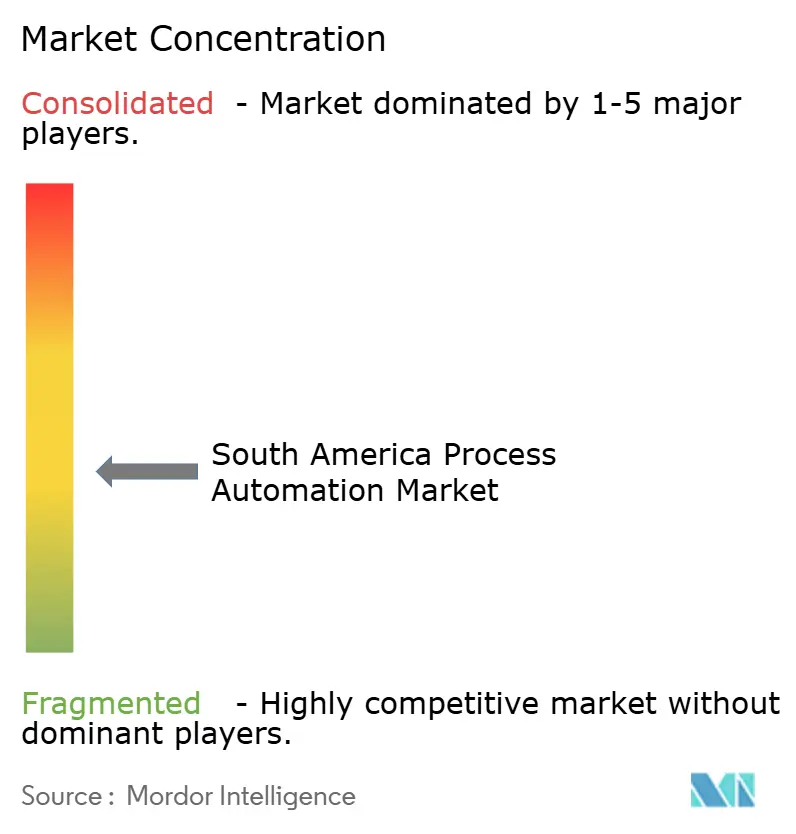
| Market Concentration | Medium |
Major Players *Disclaimer: Major Players sorted in no particular order Image © Mordor Intelligence. Reuse requires attribution under CC BY 4.0. | |
South America Process Automation Market Analysis by Mordor Intelligence
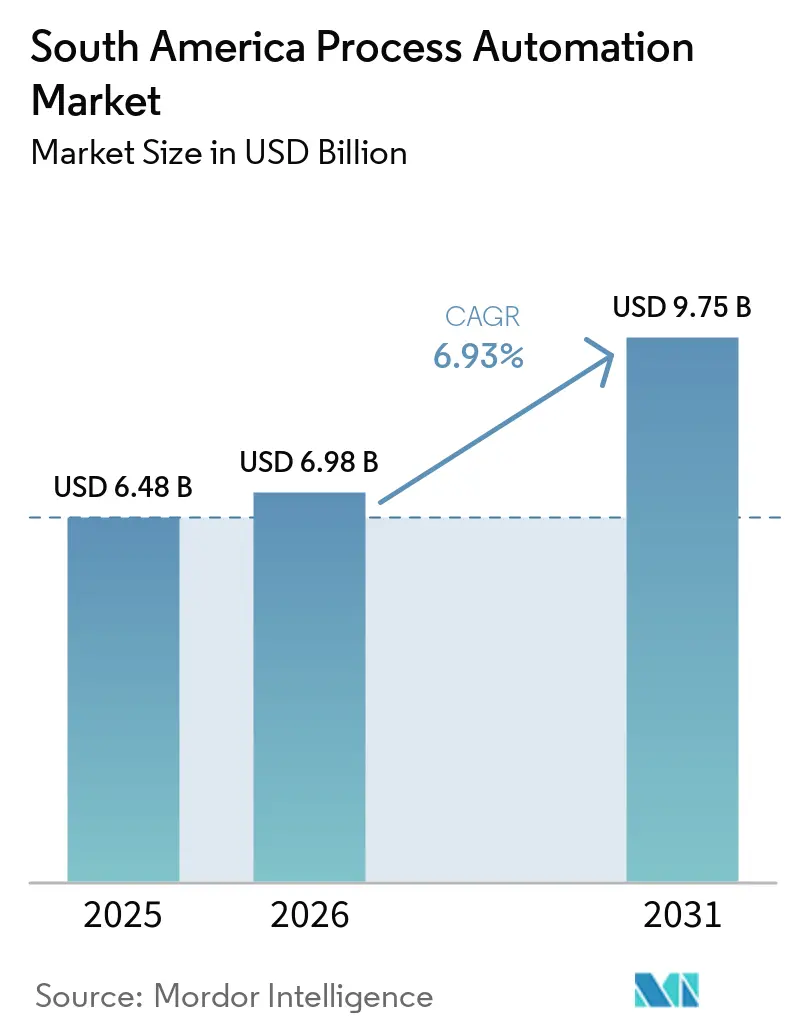
The South America Process Automation Market size was valued at USD 6.48 billion in 2025 and estimated to grow from USD 6.98 billion in 2026 to reach USD 9.75 billion by 2031, at a CAGR of 6.93% during the forecast period (2026-2031). Industrial investment is broadening beyond hydrocarbons as lithium processing, biofuels, and pharmaceutical production add new requirements for measurement, control, and production software. Public industrial digitalization programs in Brazil support a longer investment cycle, while modernization spending is also rising as legacy control equipment reaches its support and reliability limits. Customers are increasingly buying connected systems that combine field instruments, controllers, data platforms, and service support rather than isolated equipment. This approach favors suppliers that can connect older assets with newer architectures and provide local engineering capabilities. The South America Process Automation Market also faces project delays and higher integration costs because of skilled-worker shortages and operational technology security concerns.
Key Report Takeaways
- By system type, Sensors and Transmitters held 20.12% of the South America Process Automation Market share in 2025, while Manufacturing Execution Systems are projected to expand at an 8.06% CAGR through 2031.
- By communication protocol, Wired Protocol held 74.31% of the South America Process Automation Market revenue share in 2025, while Wireless Protocol is projected to expand at an 8.29% CAGR through 2031.
- By end-user industry, Oil and Gas held 24.33% of the South America Process Automation Market revenue share in 2025, while Pharmaceutical is projected to expand at a 7.96% CAGR through 2031.
- By deployment mode, Cloud-based deployment accounted for 68.29% of revenue in 2025 and is projected to expand at a 7.82% CAGR through 2031.
- By geography, Brazil held 45.19% revenue share in 2025, while Chile is projected to expand at an 8.54% CAGR through 2031.
Note: Market size and forecast figures in this report are generated using Mordor Intelligence’s proprietary estimation framework, updated with the latest available data and insights as of January 2026.
Market Trends and Insights
Drivers Impact Analysis of South America Process Automation Market*
| Driver | (~) % Impact on CAGR Forecast | Geographic Relevance | Impact Timeline |
|---|---|---|---|
| Industry 4.0 and IIoT Adoption | +1.8% | Brazil core, spillover to Argentina, Chile, and Colombia | Short term (≤ 2 years) |
| Industrial Asset Modernization | +1.3% | Brazil core, spillover to Argentina and Chile | Medium term (2-4 years) |
| Demand for Energy Efficiency and Process Optimization | +1.1% | Brazil, Chile, and Colombia | Medium term (2-4 years) |
| Rising Automation Demand in Mining and Metals | +1.0% | Chile, Brazil, Peru, and Argentina | Short term (≤ 2 years) |
| Expansion of Pharmaceutical and Food Processing Capacity | +0.7% | Brazil core, emerging in Argentina and Colombia | Medium term (2-4 years) |
| Localized Engineering for Lithium, Biofuels, and Renewable Energy Projects | +0.5% | Argentina, Chile, and Brazil | Long term (≥ 4 years) |
| Source: Mordor Intelligence | |||
Industry 4.0 and IIoT Adoption
Industrial Internet of Things deployments are bringing field-device information closer to operating and management decisions across South America. Manufacturers are connecting instruments, controllers, and operational software to improve visibility across production systems. These projects make it easier to move from periodic operating reviews toward more frequent monitoring. Connected architectures also create demand for sensor, edge, and cloud components that work together. The operating case becomes stronger where better data can support maintenance planning and production decisions. The South America Process Automation Market therefore benefits as projects move from individual equipment purchases toward integrated systems.
Industrial Asset Modernization
Modernizing older facilities remains a major source of work for automation suppliers because many DCS and PLC installations are approaching end-of-support. Valmet migrated Irani Celulose’s Vargem Bonita mill in Brazil from existing PLCs across the fiberline, evaporation, water-treatment, and causticizing areas without stopping production. The project consolidated separate control nodes into a single platform and improved access to plant data for reliability management. Such work shows that the value of modernization often comes from integrating information, not only replacing hardware. Open networking approaches also reduce concerns about being tied to a single supplier and can make replacement decisions easier. The South America Process Automation Market gains when asset owners treat control upgrades as long-term data infrastructure rather than as a one-time maintenance event.
Demand for Energy Efficiency and Process Optimization
Industrial activity accounted for 40% of Brazil’s electricity use, which makes energy management a direct operating concern for process plants.[1] Brazil expanded the PotencializEE industrial energy-efficiency program in February 2026, allocating a significant budget for SENAI energy audits and setting a target of at least 1,500 smaller industrial firms by 2027. Its São Paulo phase mobilized a significant budget in financing, saved 1,746 GWh, and avoided 445,000 tCO₂e. These programs help firms support investments in energy management systems and variable-speed drive upgrades. Better energy monitoring can make control-system upgrades easier to assess within operating budgets. The South America Process Automation Market is supported when energy savings make instrumentation and control upgrades easier to fund.
Rising Automation Demand in Mining and Metals
Mining requires precise ore processing in remote, high-altitude locations, where manual operating models are costly and pose safety risks. Vale inaugurated its Conceição II Model Plant in June 2026 with more than 7,000 automated instruments and more than 100 monitoring cameras at an 11.2 million-tonne-per-year iron ore facility. The plant monitored more than 400 variables and reported a 25% increase in productivity, a 40% increase in premium direct-reduction ore output, and a 26% reduction in iron losses in tailings. Vale also activated autonomous Komatsu 930E trucks at its Salobo copper mine in August 2026 to target a 7% increase in total mine movement. Codelco’s March 2026 agreement with Microsoft covered artificial intelligence, advanced analytics, autonomous operations, and cybersecurity for mining assets. The South America Process Automation Market benefits as mine operators seek integrated systems for instruments, safety, equipment autonomy, and centralized data management.
Restraints Impact Analysis of South America Process Automation Market*
| Restraint | (~) % Impact on CAGR Forecast | Geographic Relevance | Impact Timeline |
|---|---|---|---|
| High Upfront Cost of Automation Projects | -0.9% | Region-wide, acute for SMEs in Brazil, Colombia, and Argentina | Short term (≤ 2 years) |
| Shortage of Skilled Automation and Instrumentation Personnel | -0.7% | Region-wide, acute in remote mining zones of Chile and Brazil | Medium term (2-4 years) |
| Industrial Connectivity and Cybersecurity Gaps | -0.5% | Brazil, Argentina, and Colombia, highest risk in oil and gas and manufacturing | Medium term (2-4 years) |
| Fragmented Brownfield Infrastructure and Integration Complexity | -0.4% | Brazil and Argentina, dispersed across multi-site industrial footprints | Long term (≥ 4 years) |
| Source: Mordor Intelligence | |||
High Upfront Cost of Automation Projects
Upfront costs remain a significant obstacle for smaller manufacturers in the food and beverage, chemicals, and packaging sectors. Equipment, software, and site-infrastructure upgrades can require capital that smaller businesses cannot release quickly. Brazilian small and medium-sized enterprises lag large firms by up to 2 times in automation adoption rates, with investment costs being the main barrier. Currency volatility adds pressure because many control systems, sensors, and precision instruments are purchased in USD or EUR. A weaker local currency can alter expected returns during project planning and delay approval. Financing arrangements, phased deployment plans, and public loan programs can help, but their reach remains uneven across automation categories.
Shortage of Skilled Automation and Instrumentation Personnel
A shortage of qualified automation engineers slows implementation across the region’s main industrial centers. The OECD reported that firms in Latin America were 13 times more likely than East Asian peers to face performance challenges related to skills shortages. Four out of 5 advanced manufacturing companies in South America reported difficulty finding qualified digital, technical, and automation talent. Chile’s mining industry needs more people skilled in process automation, remote operations, and data analysis, while many programs remain focused on geology and extraction. Asset owners consequently rely more heavily on vendor commissioning support, which raises total project costs. Suppliers that provide training, simulation tools, and managed services can reduce this constraint and strengthen their role in the South America Process Automation Market.
*Our forecasts treat driver/restraint impacts as directional, not additive. The impact forecasts reflect baseline growth, mix effects, and variable interactions.
South America Process Automation Market Segment Analysis
By System Type:
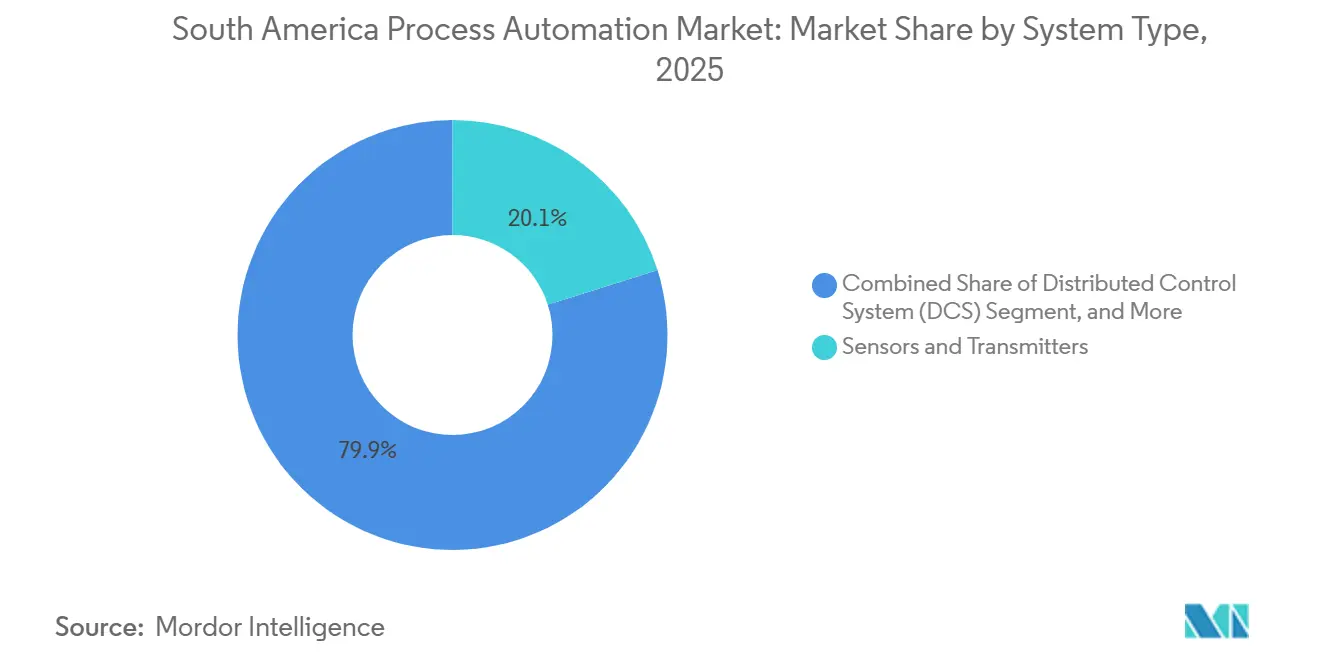
Sensors Lead Installed Demand While MES ExpandsSensors and Transmitters accounted for 20.12% of the South America Process Automation Market share in 2025. Their position reflects continuous requirements for flow, pressure, temperature, and level measurement in oil and gas, mining, pulp and paper, and chemicals. New biofuel and direct lithium extraction facilities add demand because these measurements are specified during plant design. Sensors also create the base data that supports advanced control, maintenance systems, and production analytics. Manufacturing Execution Systems are projected to record the fastest system-type growth at an 8.06% CAGR through 2031. This growth reflects a second phase of investment by operators that have already installed core field instrumentation.
Eurofarma Laboratórios deployed Körber’s PAS-X MES at its Itapevi facility in São Paulo in 2025, covering more than 200 workstations and 5 production buildings. The rollout included electronic batch records, traceability, equipment setup, cleaning processes, and electronic logbooks. DCS and SCADA continue to hold substantial demand because oil and gas sites and utilities depend on long-duration control contracts. PLC adoption is also increasing in food and pharmaceutical manufacturing where local deterministic control is important. Process safety systems support chemical and lithium facilities that require certified safety functions. Valves, actuators, electric motors, HMI, analyzers, and condition-monitoring equipment complete the system stack and generally grow with broader capital spending in the South America Process Automation Market.

By Communication Protocol:
Wired Systems Retain Scale as Wireless Adoption RisesWired Protocol held 74.31% of the South America Process Automation Market share in 2025. Its installed base remains important in established process plants and in safety-critical applications requiring predictable response times. Oil and gas operators also value protected physical signal paths in hazardous locations. Ethernet-APL has demonstrated the ability to combine power and high-speed data over a single two-wire cable in heterogeneous plant architectures. This capability can increase instrumentation density without requiring an entirely new cable network. It may slow the pace of wired-share loss, although it does not remove the need for wireless connectivity.
Wireless Protocol is projected to grow at an 8.29% CAGR through 2031, the fastest rate among communication segments. Remote mines, distributed water-treatment sites, and lithium facilities can avoid high costs by not having to lay copper cable to every measurement point. Chile and Brazil are using private 5G networks to link autonomous haulage systems, environmental sensors, and remote operating centers. ISA100 and WirelessHART are expanding where process operators need dependable and secure alternatives to the fieldbus. Radio-enabled transmitters carried a 15-30% price premium over wired equivalents. This shift changes the equipment mix and supports higher average selling prices within the South America Process Automation Market.
By End-User Industry:
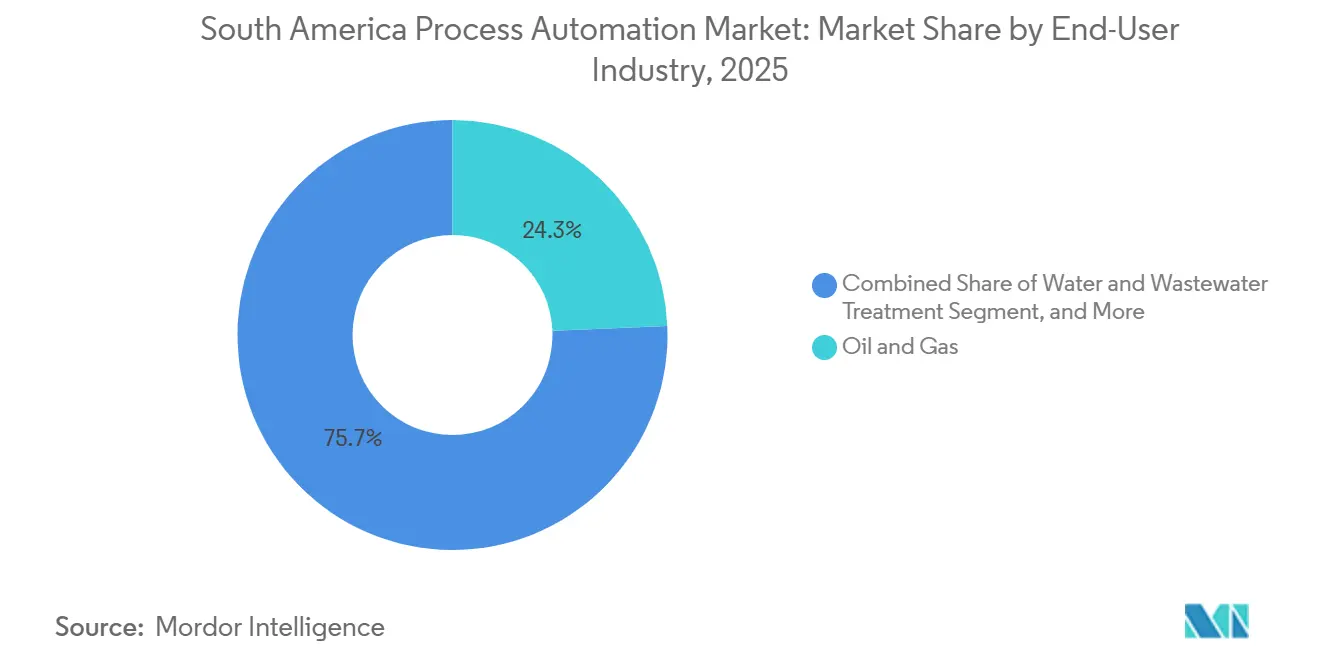
Oil and Gas Leads While Pharmaceutical Capacity BuildsOil and Gas accounted for 24.33% of the South America Process Automation Market share in 2025. Upstream and downstream control projects at Petrobras facilities, offshore operations, and midstream infrastructure supported its leading position. Refinery digitalization and legacy SCADA upgrades are progressing alongside renewable-fuels projects that embed advanced process control from the start. Petrobras selected Honeywell UOP’s Ethanol-to-Jet technology for the REPLAN refinery in April 2026, targeting up to 10,000 barrels per day of sustainable aviation fuel. The project illustrates the continued link between traditional refining sites and new control requirements. These investments preserve demand for DCS, safety systems, analyzers, and process optimization software.
The pharmaceutical industry is projected to grow at a 7.96% CAGR through 2031. Novo Nordisk announced USD 1.09 billion to expand injectable manufacturing at Montes Claros in April 2025, with expanded operations expected to begin in 2028. Brazil’s pharmaceutical sector is projected to make cumulative investments through 2026, much of which will be directed toward plant modernization and advanced equipment.[2] Electronic batch record and traceability requirements are increasing the demand for MES. Chemicals, food and beverages, utilities, water and wastewater, and paper and pulp provide a broad secondary base for the South America Process Automation Market. Smaller ceramics, fertilizer, and specialty-chemical operations are adopting systems more gradually because their installed bases are smaller and capital cycles are longer.
By Deployment Mode:
Cloud Leads as Hybrid Architectures Become CommonCloud-based deployment accounted for 68.29% of the South America Process Automation Market size in 2025 and is projected to expand at a 7.82% CAGR through 2031. Operators value scalable access to monitoring and data tools across geographically dispersed sites. This model is particularly useful in mining and energy, where centralized teams supervise several remote facilities. On-premise systems remain important where safety-critical operations need local control logic, low latency, and defined network reliability. Cybersecurity requirements also support local operation in oil and gas and chemical facilities. Most new projects, therefore, use hybrid designs rather than choosing only one deployment mode.
Local PLCs and DCS platforms manage real-time control loops, while cloud platforms aggregate historian data for predictive analytics, remote diagnostics, and reporting. Vale and Codelco used cloud analytics to develop digital twins and centralize fleet management across their iron ore and copper operations. Vendors that combine embedded controllers with managed analytics can win broader contracts than suppliers offering only hardware or software. Private 5G expansion at industrial sites can improve reliability for cloud-dependent decisions during the forecast period. Lower-latency functions may gradually migrate to cloud environments as network performance improves. The South America Process Automation Market is thus moving toward connected architectures that preserve local safety and control functions.
Geography Analysis
Brazil Process Automation Market
Brazil held 45.19% of the South America Process Automation Market share in 2025. Its scale stems from the concentration of resource extraction, manufacturing, bioenergy, and pharmaceutical production within a single national investment environment. Missão 4 and the goal of increasing industrial digitalization from 23.5% to 90% of firms by 2033 support multiyear demand for sensors, DCS, SCADA, and MES. Renewable fuels are creating a separate source of control-system demand beyond commodity cycles. Honeywell announced in June 2026 that its Experion PKS integrated control and safety system will support Acelen Renewables’ greenfield sustainable aviation fuel and renewable diesel facility in Bahia.[3] Pharmaceutical capacity investments add another demand stream for instrumentation, traceability, and manufacturing software.
Chile Process Automation Market
Chile is projected to grow at an 8.54% CAGR through 2031, the fastest regional rate in the South America Process Automation Market. Copper and lithium projects require closely controlled processes in challenging environments and create a high need for measurement and remote operations. Codelco’s March 2026 agreement with Microsoft focused on artificial intelligence, advanced analytics, critical-process automation, autonomous operations, and cybersecurity. Albemarle initiated an environmental review for its first direct lithium extraction project at Salar de Atacama in 2026. CleanTech Lithium produced high-purity lithium carbonate from its Laguna Verde pilot in July 2026. Glencore also deployed a Level 9 collision-avoidance system at Lomas Bayas in July 2026, adding mobile-equipment safety systems to Chile’s demand profile.
Argentina and Andean South America Process Automation Market
Argentina and Colombia remain important secondary markets, each with distinct drivers. Argentina’s lithium triangle includes Eramet’s Centenario direct lithium extraction plant and ILiAD Technologies’ pilot at Rio Tinto’s Sal de Vida site in Catamarca, commissioned in January 2026. These sites need sophisticated process measurement and control. Colombia’s improving investment setting and manufacturing base support demand around refinery digitalization and automotive assembly in Bogotá and Medellín. Peru, Ecuador, Bolivia, and smaller markets are progressing more gradually because their industrial bases are narrower and infrastructure gaps remain. Peru’s SEIN grid-digitalization and IEC 61850 substation modernization work nevertheless point to broader long-term connectivity needs.
Competitive Landscape
The South America Process Automation Market has a moderate concentration because the top 5 suppliers leave a substantial role for regional specialists, integrators, and focused instrumentation providers. Suppliers are expanding local service capacity to shorten response times for brownfield maintenance and upgrades. Metso invested EUR 45 million (USD 48.9 million) over 2 years in South American service centers and opened a San Juan office in Argentina in Q2 2026. Its network also includes sites in Antofagasta, Parauapebas, and Arequipa. This local presence matters where mines and industrial facilities need nearby technical support. It also gives suppliers a closer position for future expansion work.
Interoperability is another important basis for competition. A large-scale Ethernet-APL test involving Endress+Hauser, Yokogawa, Covestro, and BASF validated multivendor connections between DCS systems and field devices in May 2026. Plant owners increasingly seek systems that can integrate with existing equipment and reduce dependence on a single vendor. WEG S.A. is also moving from its established motors and drives position toward artificial intelligence and digitalization platforms. Its 66 factories and 144 test laboratories across 13 countries provide a broad manufacturing and engineering base. The South America Process Automation Market allows WEG to compete for installed-base renewal work alongside multinational suppliers.
New lithium and biofuel facilities offer an opportunity for full-lifecycle digital service contracts because they lack the legacy vendor relationships of established plants. Asset owners are likely to assess interoperability, functional-safety credentials, and local commissioning support during supplier selection. Cybersecurity-integrated automation is another area of demand for mid-tier oil and gas and mining operators without dedicated operational technology security teams. Kaspersky reported that 20.4% of industrial control system computers in South America had malicious objects blocked in Q4 2025.[4] ISA/IEC 62443 is becoming a more relevant procurement framework for DCS and SCADA projects in regulated settings. Vendors with certified security portfolios and implementation support can differentiate their offerings within the South America Process Automation Market.
South America Process Automation Industry Leaders
-
Endress+Hauser AG
-
Yokogawa Electric Corporation
-
Azbil Corporation
-
KROHNE Messtechnik GmbH
-
Samson AG
- *Disclaimer: Major Players sorted in no particular order
South America Process Automation Market Companies Covered in this Report
- Endress+Hauser AG
- Yokogawa Electric Corporation
- Azbil Corporation
- KROHNE Messtechnik GmbH
- Samson AG
- Pepperl+Fuchs SE
- Brooks Instrument LLC
- Badger Meter, Inc.
- Spirax-Sarco Engineering plc
- HIMA Paul Hildebrandt GmbH
- Mettler-Toledo International Inc.
- AMETEK, Inc.
- Valmet Flow Control Oy
- Omega Engineering, Inc.
- KROHNE Messtechnik GmbH
- R. Stahl AG
- WIKA Alexander Wiegand SE & Co. KG
- SMC Corporation
- Festo SE & Co. KG
- Beckhoff Automation GmbH & Co. KG
- WEG S.A.
- Metso Corporation
- Bürkert Fluid Control Systems
- KSB SE & Co. KGaA
Recent Industry Developments in South America Process Automation Market
- August 2026: Vale and ABB entered into a strategic alliance to scale automation, AI, and integrated IT/OT solutions across multiple Vale iron ore plants in Brazil, replicating the approach validated at the Conceição II Model Plant in Itabira, inaugurated in June 2026, where more than 7,000 automated instruments and over 100 cameras delivered a 25% productivity increase and a 26% reduction in iron losses in tailings. The partnership framework enables systematic technology transfer across Vale's full iron ore production network.
- August 2026: The autonomous Komatsu 930E truck fleet at Vale's Salobo copper mine in Pará, Brazil, went live using the FrontRunner automated hauling system, targeting a 7% increase in total mine movement through fleet expansion and autonomy. The operation additionally employs Hexagon's TeleOp dozer teleoperation system, which surpassed 5,000 operating hours in July 2026.
- August 2026: SANY Heavy Equipment dispatched the first batch of SKT110Ei pure-electric autonomous mining trucks to South America from its Shenyang Industrial Park, marking the entry of Chinese autonomous mining technology into the region's market and adding a new competitive dimension to the autonomous haulage systems segment.
- July 2026: Glencore's Compañía Minera Lomas Bayas in Chile deployed a Level 9 collision avoidance system, integrating sensors and AI-enabled cameras capable of autonomously halting mobile equipment upon detecting nearby personnel, on its mining tire handlers, the first such deployment in the mine's operations department.
South America Process Automation Market Report Scope
The South America Process Automation Market comprises the revenue generated from the sale, deployment, integration, software licensing, maintenance, and support of automation systems and control technologies used to monitor, control, optimize, and automate industrial and process operations across South America. The market includes industrial control systems, process safety solutions, instrumentation devices, industrial communication technologies, and automation software utilized by process industries to improve operational efficiency, safety, reliability, and productivity.
The South America Process Automation Market Report is Segmented by System Type (Supervisory Control and Data Acquisition [SCADA], Programmable Logic Controller [PLC], Distributed Control System [DCS], Manufacturing Execution System [MES], Valves and Actuators, Electric Motors, Human Machine Interface [HMI], Process Safety Systems, Sensors and Transmitters, and Other System Types), Communication Protocol (Wired Protocol and Wireless Protocol), End-User Industry (Chemical and Petrochemical, Paper and Pulp, Water and Wastewater Treatment, Energy and Utilities, Oil and Gas, Pharmaceutical, Food and Beverages, and Other End-User Industries), Deployment Mode (On-Premise and Cloud-Based), and Geography (Brazil, Argentina, Chile, Colombia, and Rest of South America). The Market Forecasts are Provided in Terms of Value (USD).
Segmentation Overview
By System Type
| Supervisory Control and Data Acquisition (SCADA) |
| Programmable Logic Controller (PLC) |
| Distributed Control System (DCS) |
| Manufacturing Execution System (MES) |
| Valves and Actuators |
| Electric Motors |
| Human Machine Interface (HMI) |
| Process Safety Systems |
| Sensors and Transmitters |
| Other System Types |
By Communication Protocol
| Wired Protocol |
| Wireless Protocol |
By End-User Industry
| Chemical and Petrochemical |
| Paper and Pulp |
| Water and Wastewater Treatment |
| Energy and Utilities |
| Oil and Gas |
| Pharmaceutical |
| Food and Beverages |
| Other End-User Industries |
By Deployment Mode
| On-premise |
| Cloud-based |
By Geography
| Brazil |
| Argentina |
| Chile |
| Colombia |
| Rest of South America |
| By System Type | Supervisory Control and Data Acquisition (SCADA) |
| Programmable Logic Controller (PLC) | |
| Distributed Control System (DCS) | |
| Manufacturing Execution System (MES) | |
| Valves and Actuators | |
| Electric Motors | |
| Human Machine Interface (HMI) | |
| Process Safety Systems | |
| Sensors and Transmitters | |
| Other System Types | |
| By Communication Protocol | Wired Protocol |
| Wireless Protocol | |
| By End-User Industry | Chemical and Petrochemical |
| Paper and Pulp | |
| Water and Wastewater Treatment | |
| Energy and Utilities | |
| Oil and Gas | |
| Pharmaceutical | |
| Food and Beverages | |
| Other End-User Industries | |
| By Deployment Mode | On-premise |
| Cloud-based | |
| By Geography | Brazil |
| Argentina | |
| Chile | |
| Colombia | |
| Rest of South America |
Key Questions Answered in the Report
What is the South America Process Automation Market size?
The South America Process Automation Market was valued at USD 6.48 billion in 2025, is estimated at USD 6.98 billion in 2026, and is forecast to reach USD 9.75 billion by 2031.
What growth rate is expected for process automation in South America?
The regional sector is forecast to grow at a 6.93% CAGR during 2026-2031.
Which system type led regional demand in 2025?
Sensors and Transmitters led system-type demand with 20.12% share in 2025, supported by continuous measurement needs in process industries.
Why is wireless connectivity becoming more important at industrial sites?
Wireless Protocol is projected to grow at an 8.29% CAGR as remote mines, water assets, and lithium sites seek to avoid extensive cable installation.
Which country has the strongest position in regional automation spending?
Brazil held 45.19% share in 2025 because it combines mining, manufacturing, bioenergy, and pharmaceutical production.
Which end-user sector is growing fastest?
Pharmaceutical is projected to grow at a 7.96% CAGR through 2031, supported by manufacturing expansion, traceability, and electronic batch-record requirements.