
South America Pre-Engineered Building Construction Market Size and Share
Market Overview
| Study Period | 2020 - 2031 |
|---|---|
| Forecast Data Period | 2026 - 2031 |
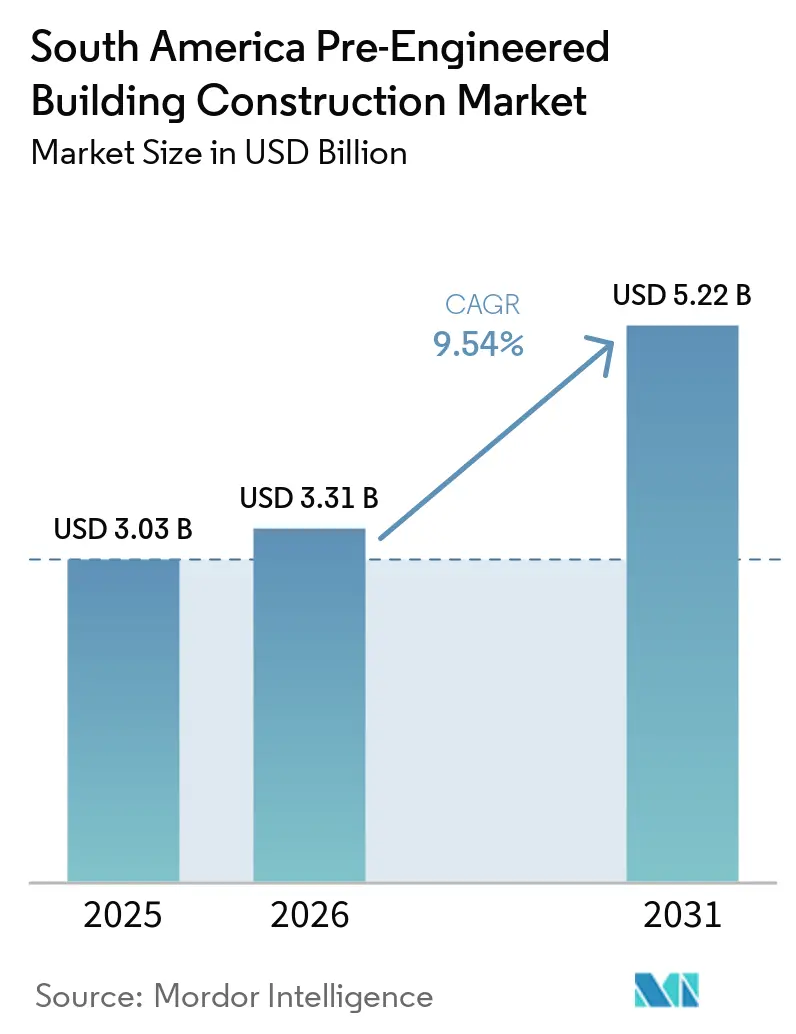
| Base Year Market Size (2025) | USD 3.03 Billion |
| Market Size (2026) | USD 3.31 Billion |
| Market Size (2031) | USD 5.22 Billion |
| Growth Rate (2026 - 2031) | 9.54 % |
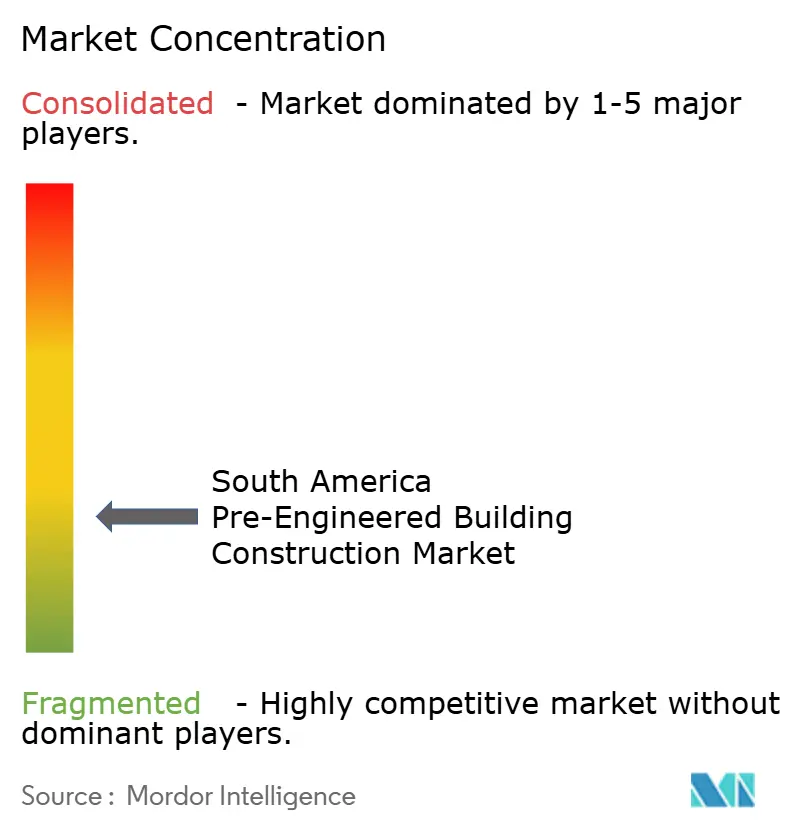
| Market Concentration | Low |
Major Players *Disclaimer: Major Players sorted in no particular order Image © Mordor Intelligence. Reuse requires attribution under CC BY 4.0. | |
South America Pre-Engineered Building Construction Market Analysis by Mordor Intelligence
The South America pre-engineered building construction market size is projected to expand from USD 3.03 billion in 2025 and USD 3.31 billion in 2026 to USD 5.22 billion by 2031, registering a CAGR of 9.54% between 2026 and 2031. Mining investment, food storage projects, and logistics construction are expanding the customer base for factory-made steel structures. Pre-engineered systems help owners shorten on-site work and manage schedules for mines, warehouses, and processing plants. Demand is strongest where projects need large clear spans, equipment enclosures, or buildings in remote locations. Suppliers with local engineering, seismic design capability, and trained erection teams are better placed to win work in the South America pre-engineered building construction market. Currency risk, port delays, and approval processes still limit how quickly announced projects become construction orders.
Key Report Takeaways
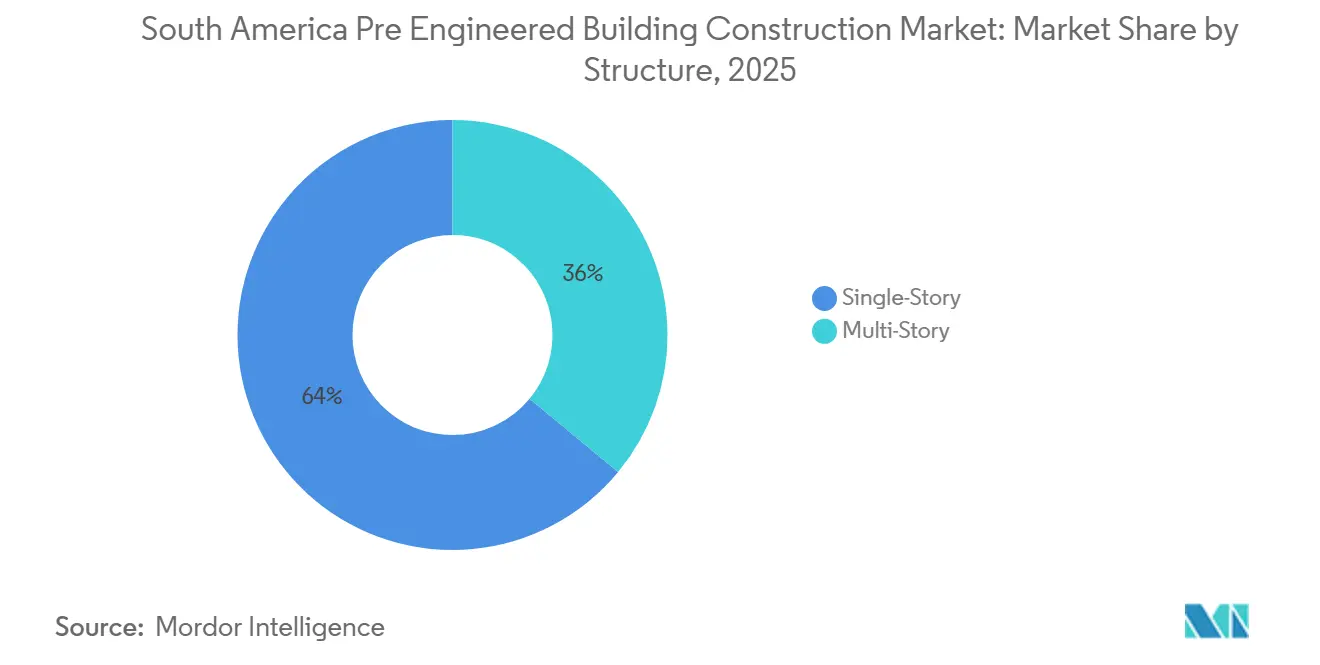
- By structure, single-story buildings accounted for a 64% South America pre-engineered building construction market share in 2025, while multi-story buildings are forecast to grow at a 10.4% CAGR through 2031.
- By product type, panelized and componentized systems accounted for a 39% South America pre-engineered building construction market share in 2025, while modular buildings are forecast to grow at an 11% CAGR through 2031.
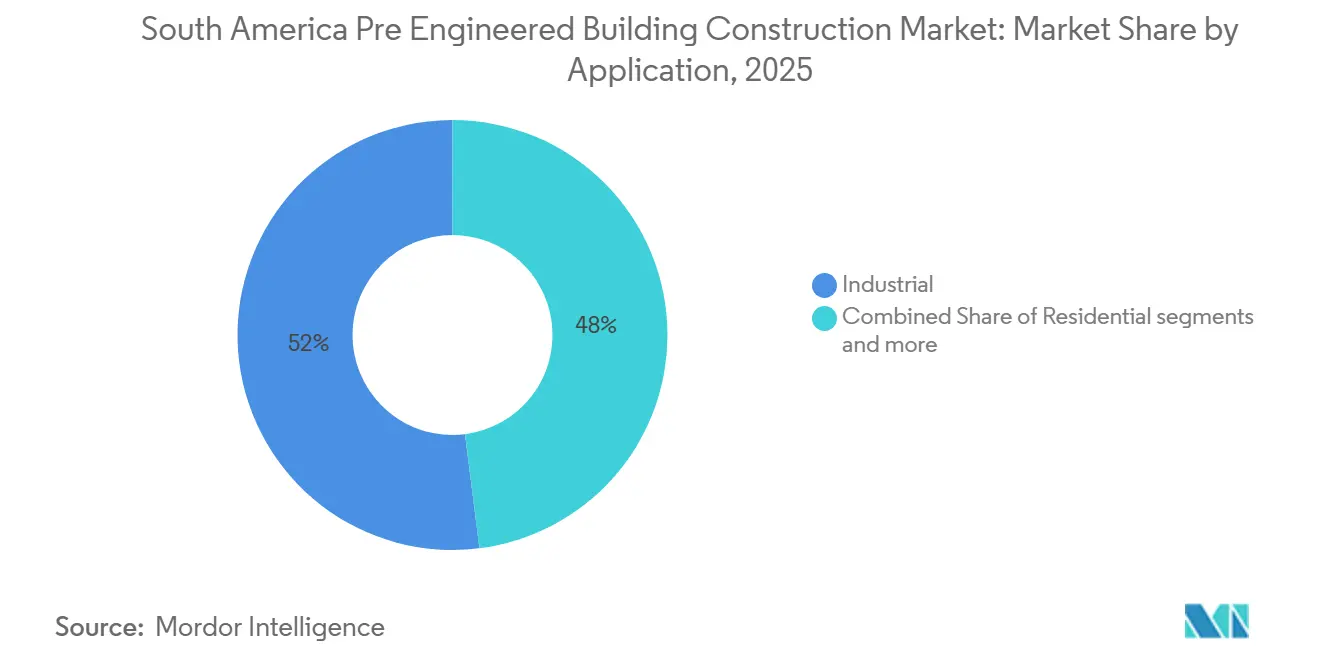
- By application, industrial buildings accounted for 52% of the South America pre-engineered building construction market size in 2025, while commercial buildings are forecast to grow at a 10.3% CAGR through 2031.
- By geography, Brazil accounted for a 46% South America pre-engineered building construction market share in 2025, while Colombia is forecast to grow at a 10.5% CAGR through 2031.
Note: Market size and forecast figures in this report are generated using Mordor Intelligence’s proprietary estimation framework, updated with the latest available data and insights as of January 2026.
South America Pre-Engineered Building Construction Market Trends and Insights
Drivers Impact Analysis*
| Drivers | (~) % Impact on CAGR Forecast | Geographic Relevance | Impact Timeline |
|---|---|---|---|
| Mining-Linked Processing, Renewable-Energy Equipment, and Regional Nearshoring | +2.0% | Chile, Peru, Colombia, and Brazil | Medium term (2-4 years) |
| Copper, Lithium, Oil, Gas, and Renewable-Energy Project Infrastructure | +1.8% | Chile, Peru, and Argentina | Long term (≥ 4 years) |
| Grain, Meat, Food-Processing, and Temperature-Controlled Storage Expansion | +1.5% | Brazil, Argentina, and Chile | Short term (≤ 2 years) |
| Urban Delivery Hubs and E-Commerce Warehousing in Sao Paulo and Santiago | +1.4% | Brazil and Chile | Short term (≤ 2 years) |
| Fast-Deployable Camps and Processing Buildings for Remote Resource Projects | +1.2% | Chile, Peru, and Colombia | Medium term (2-4 years) |
| Source: Mordor Intelligence | |||
Mining-Linked Processing, Renewable-Energy Equipment, and Regional Nearshoring
Mining, renewable energy, and nearshoring projects are supporting demand for the South America pre-engineered building construction market. Latin America had attracted USD 45 billion in greenfield copper and lithium mining investment since 2015, with Chile, Peru, and Argentina receiving much of that capital. Mines need sorting sheds, maintenance workshops, electrical rooms, and worker facilities before production can begin. These structures are often required in remote locations where concrete work takes longer and needs larger site crews. Tecno Fast completed its 786,734-square-foot camp at the Collahuasi copper mine in Chile in 394 days, according to the Modular Building Institute[1]. Colombia also benefits from nearshoring investment that needs industrial buildings designed for the country’s seismic requirements.
Copper, Lithium, Oil, Gas, and Renewable-Energy Project Infrastructure
Resource and energy projects create repeat demand for workshops, substations, equipment rooms, and camps in the South America pre-engineered building construction market. Chile’s mining project portfolio for 2024 through 2033 totaled USD 83.1 billion across 51 initiatives. Codelco and SQM established their Salar de Atacama public-private partnership in 2024, which supports long-term lithium processing needs rather than short-term facilities. Atlas Renewable Energy closed USD 475 million in financing in October 2025 for the Copiapó Solar hybrid project in Chile[2]. The project includes 357 MWp of solar capacity and a 320 MW battery energy storage system, and supplies power to CAP Group mining operations. Argentina’s Vaca Muerta oil and gas area provides another source of demand for quickly deployed processing modules and accommodation buildings.
Grain, Meat, Food-Processing, and Temperature-Controlled Storage Expansion
Food processing and storage projects provide a more stable order pipeline for the South America pre-engineered building construction market. In March 2025, Brazil’s BNDES approved USD 37 million in loans for 4 grain and animal feed storage projects, including Copacol’s expansion of grain storage capacity in Cascavel, Paraná. Conab also committed USD 9.4 million to expand storage capacity at Ponta Grossa, Paraná. In Chile, Emergent Cold LatAm planned an expansion at Talcahuano that would create a frozen-food facility with 37,000 pallet positions and 323,000 square feet of space. Grain and food exporters often have contracted sales in USD, which can reduce the effect of local currency volatility on building decisions. This makes food and cold-chain work useful to suppliers when discretionary industrial investment slows.
Urban Delivery Hubs and E-Commerce Warehousing in Sao Paulo and Santiago
Low logistics vacancy and e-commerce investment are increasing warehouse requirements in the South America pre-engineered building construction market. Santiago ended 2025 with 6.19 million m² of logistics inventory and a 6.37% vacancy rate, while Class A additions were largely pre-leased. The city recorded 4.8% general vacancy in the first quarter of 2026, and 7 projects totaling 200,000 m² were expected to be delivered during the year. These conditions favor clear-span, fast-build warehouse designs and vertical picking layouts. Remote mines also need modular camps, offices, laboratories, and logistics facilities that can be assembled with fewer workers on site. Suppliers that can manage both urban delivery projects and isolated resource sites can spread their work across different customer groups.
Restraints Impact Analysis*
| Restraints | (~) % Impact on CAGR Forecast | Geographic Relevance | Impact Timeline |
|---|---|---|---|
| Currency Depreciation, Inflation, and Imported Steel Price Volatility | -0.9% | Argentina, Brazil, and other regional markets | Short term (≤ 2 years) |
| Mercosur Duties, Port Bottlenecks, and Long Inland Transport Distances | -0.7% | Brazil, Argentina, Peru, and Colombia | Medium term (2-4 years) |
| Shortage of Certified Erectors in Andean, Amazonian, and Remote Mining Regions | -0.5% | Chile, Peru, and Colombia | Long term (≥ 4 years) |
| Environmental Licensing, Seismic Design, and Public-Works Approval Delays | -0.4% | Chile, Peru, and Colombia | Medium term (2-4 years) |
| Source: Mordor Intelligence | |||
Currency Depreciation, Inflation, and Imported Steel Price Volatility
Currency movements make pricing and project approvals less predictable in the South America pre-engineered building construction market. Argentina produced 808,600 tons of steel in 2025, 38% more than in 2024, but construction demand remained below earlier levels. Imported kits become more expensive when the contract is priced in USD, but the project earns revenue in pesos or reais. Brazilian fabricators also face long lead times for steel coils purchased under international benchmark contracts. Procurement teams may wait for exchange rates to stabilize before approving a building package. This delay favors local fabricators when they can offer locally sourced sections and shorter price-validity periods.
Mercosur Duties, Port Bottlenecks, and Long Inland Transport Distances
Trade and transport costs reduce the price advantage of imported systems in the South America pre-engineered building construction market. Mercosur duties on steel and fabricated products create different cost positions for suppliers inside and outside the trade bloc. Customs delays at Santos and Buenos Aires can add 2 to 4 weeks to deliveries that are tied to construction schedules. Land freight can account for 10% to 18% of delivered structure costs for sites located 300 to 1,500 kilometers from a port. The Mercosur Trade Commission extended Argentina’s tariff-rate quota for certain non-alloy steel bars for 365 days in May 2026. The EU-Mercosur agreement can reduce tariff friction for European suppliers, but it does not solve inland transport limits[3].
*Our forecasts treat driver/restraint impacts as directional, not additive. The impact forecasts reflect baseline growth, mix effects, and variable interactions.
Segment Analysis
By Structure: Single-Story Buildings Lead While Multi-Story Formats Expand
Single-story buildings held 64% of the South America pre-engineered building construction market share in 2025. Industrial and agricultural buyers favor them because portal-frame systems support clear spans, crane access, and heavy floor loads. Warehouses, ore-handling sheds, and food-processing halls commonly need layouts without interior columns. Brazilian grain cooperatives and mining contractors in Chile and Peru are major users of these buildings. Their designs also allow owners to add roof-only or partial mezzanines when operations need more internal capacity.
Multi-story buildings are forecast to grow at a 10.4% CAGR through 2031. Land constraints in São Paulo and Santiago encourage developers to create vertical picking floors rather than purchase new sites. Mezzanine additions can be completed faster than a new warehouse development in supply-constrained locations. Brazil’s ABNT NBR 8800:2024 standard added requirements for joint classification and seismic load combinations in multi-story steel buildings. This change supports suppliers with in-house structural engineering and detailed approval processes in the South America pre-engineered building construction industry

By Product Type: Panelized Systems Retain the Lead as Modular Buildings Gain Ground
Panelized and Componentized Systems held 39% of the South America pre-engineered building construction market in 2025. Buyers use these systems for factory precision and the ability to configure the building on site. Erection crews can complete the shell while interior requirements are still being finalized. This method works well for fast-track industrial projects with separate mechanical, electrical, and plumbing contractors. It also allows local fabricators to adapt sections and panels to site conditions.
Modular buildings are forecast to grow at an 11% CAGR through 2031. Mining camps and urban micro-fulfillment locations value modules because services can be integrated before delivery. Grupo Cintac inaugurated its Planta Modular Chacabuco in June 2026, tripling its modular capacity to more than 150,000 m² annually. Other prefabricated building types include light-gauge steel frames, hybrid concrete-steel systems, and volumetric housing units. SteelCorp invested USD 7.2 million in 2025 in a 16,000 m² steel panel factory in Cajamar, São Paulo, showing the investment needed to build capacity in this part of the South America pre-engineered building construction industry.
By Application: Industrial Buildings Remain Central While Commercial Use Rises
Industrial buildings accounted for 52% of the South America pre-engineered building construction market size in 2025. Mining, grain processing, and manufacturing operations need large-span structures that can carry heavy loads. Greenfield mines in Chile, grain cooperatives in Brazil’s Central-West, and manufacturers in Colombian industrial parks support this demand. These customers prioritize delivery times because delays can affect production schedules. Industrial work, therefore, remains the main revenue base for the South America pre-engineered building construction market.
Commercial buildings are forecast to grow at a 10.3% CAGR through 2031. Fulfillment centers and small urban warehouses are increasing the use of steel envelopes and modular interior layouts. Chile had 60,000 m² of new modular mini-warehouse space absorbed in Santiago’s Metropolitan Region during 2025. Residential projects remain smaller, although public financing and urban densification programs support factory-built components. Brazil’s metal-structure manufacturers generated USD 557 million in gross revenue in 2025 and produced 262,400 tons annually at full capacity, according to ABCEM.
Geography Analysis
Brazil held 46% of the South America pre-engineered building construction market share in 2025. ABCEM member companies generated USD 27.1 billion in gross revenue in 2025 and invested USD 1.2 billion in plant construction and operational upgrades. Financing for grain cooperatives, cold-chain facilities, and industrial parks supports building demand across the country. Agricultural storage projects also create opportunities beyond the largest cities. Brazil remains exposed to steel costs and currency movements, but its broad manufacturing base gives domestic suppliers a strong position.
Colombia is forecast to grow at a 10.5% CAGR through 2031. Nearshoring activity on the Caribbean coast and mining in Chocó and Antioquia support demand for industrial space. Some Colombian logistics submarkets had vacancy rates of 1.1%, increasing the need for new facilities. The NSR-10 seismic framework creates a barrier for suppliers without compliant designs and local erection capability. Chile also remains important because its mining pipeline totals USD 83.1 billion across 51 projects through 2033. Santiago’s low vacancy supports logistics construction, while remote mining and energy sites need workshops, equipment enclosures, and camps.
Peru provides a second Andean growth path through power and mining development. The government awarded 14 independent power transmission projects worth more than USD 2 billion in 2024, according to the International Energy Agency. Argentina was the second-largest named country by absolute share in 2025, but currency instability and weaker industrial investment limit its growth. The EU-Mercosur agreement can improve access to European systems, although local freight and procurement risks remain. Bolivia, Uruguay, Paraguay, Ecuador, and other smaller markets add demand from agribusiness storage and energy projects. A 17,250 m² truck-assembly workshop in Uruguay shows the type of industrial project that can emerge in these countries.
Competitive Landscape
The South America pre-engineered building construction market is fragmented in nature. The market is characterized by a mix of large-scale steel fabricators and smaller regional manufacturers, with competition varying across countries and project types. Brazil's Metasa operates at a production capacity of approximately 3,500 tonnes per month, with exports accounting for around 35% of revenue and shipments serving Chile, Argentina, and Uruguay. EMTEC Construções Metálicas competes in Brazil's metro rail, mining, and renewable energy infrastructure segments, supported by ISO 9001:2015 certification. In comparison, smaller manufacturers such as Metavo Estruturas Metálicas in Brazil and MIC SAS in Colombia primarily serve regional customers. Chinese steel building package suppliers add competitive pressure by offering lower-cost solutions for standard industrial and logistics buildings, particularly where local manufacturers have limited product differentiation.
Technology adoption, production efficiency, and regional manufacturing investments are shaping competition in the South America pre-engineered building construction market. Grupo Salvatore integrates structural engineering, fabrication detailing, and production management across its manufacturing facilities in Argentina, while Miller Building International adopted digital production management software in May 2026 to improve manufacturing coordination. In Paraguay, HORMETAL's USD 20 million investment in its Ñemby plant strengthens its manufacturing capacity and export potential across Argentina, Uruguay, and Paraguay.
ATCO Sabinco competes in Chile's mining accommodation segment through its modular building capabilities and experience serving customers across multiple countries. Meanwhile, multi-story modular steel buildings above four floors represent an emerging opportunity, with Grupo Salvatore's IDERO having delivered a six-story steel modular building in Añelo, Argentina. Competition in the South America pre-engineered building construction market will increasingly depend on manufacturing scale, cost efficiency, digital production capabilities, regional delivery networks, and the ability to meet specialized industrial and infrastructure requirements.
South America Pre-Engineered Building Construction Industry Leaders
-
Merigo Estruturas Metálicas
-
Metasa
-
Estrutel (Estruturas Metálicas Estrutel)
-
EMTEC Construções Metálicas
-
Nacional Estruturas Metálicas
- *Disclaimer: Major Players sorted in no particular order
Recent Industry Developments
- September 2026: BITA Construction completed a 126-unit modular hotel in Argentine Patagonia using industrialized Steel Frame construction, with modules incorporating the structure, cladding, thermal insulation, plumbing, and finishes manufactured in a controlled factory environment before on-site assembly.
- September 2026: ArcelorMittal Brasil approved a BRL 4–5 billion (USD 690–862 million) investment at its Tubarão plant in Serra, Espírito Santo, to install a new cold rolling mill and continuous metallic coating line with 560,000 tonnes per year of capacity, supporting higher-value coated steel demand across automotive, white goods, and construction sectors.
- August 2026: Kingspan acquired a majority stake in Grupo LTN, an Argentine manufacturer of structural insulated panels, marking Kingspan's entry into Argentina and strengthening its Latin American manufacturing platform.
South America Pre-Engineered Building Construction Market Report Scope
| Single-Story |
| Multi-Story |
| Modular Buildings |
| Panelized and Componentized Systems |
| Other Prefabricated Building Types |
| Residential |
| Commercial |
| Industrial |
| Institutional |
| Others |
| Brazil |
| Argentina |
| Chile |
| Peru |
| Colombia |
| Rest of South America |
| By Structure | Single-Story |
| Multi-Story | |
| By Product Type | Modular Buildings |
| Panelized and Componentized Systems | |
| Other Prefabricated Building Types | |
| By Application | Residential |
| Commercial | |
| Industrial | |
| Institutional | |
| Others | |
| By Country | Brazil |
| Argentina | |
| Chile | |
| Peru | |
| Colombia | |
| Rest of South America |
Key Questions Answered in the Report
What is the 2026 value of South America's pre-engineered building construction?
The sector is estimated at USD 3.31 billion in 2026 and is forecast to reach USD 5.22 billion by 2031.
What is driving demand for pre-engineered buildings in South America?
Mining, renewable energy, grain storage, cold-chain facilities, and e-commerce warehouses are supporting demand.
Which building structure has the largest share?
Single-story buildings held 64% of 2025 revenue because industrial and agricultural customers need clear spans and heavy-load floors.
Which product type is growing the fastest?
Modular buildings are forecast to grow at an 11% CAGR through 2031, supported by mining camps and urban fulfillment uses.
Which application leads to demand for these building systems?
Industrial buildings accounted for 52% of 2025 revenue, led by mining, manufacturing, and food-processing projects.
Which country is growing fastest in this sector?
Colombia is forecast to grow at a 10.5% CAGR through 2031, supported by nearshoring, logistics, and mining projects.