
Market Overview
| Study Period | 2020 - 2031 |
|---|---|
| Forecast Data Period | 2026 - 2031 |
| Base Year Market Size (2025) | USD 1.62 Billion |
| Market Size (2026) | USD 1.71 Billion |
| Market Size (2031) | USD 2.48 Billion |
| Growth Rate (2026 - 2031) | 7.72 % |
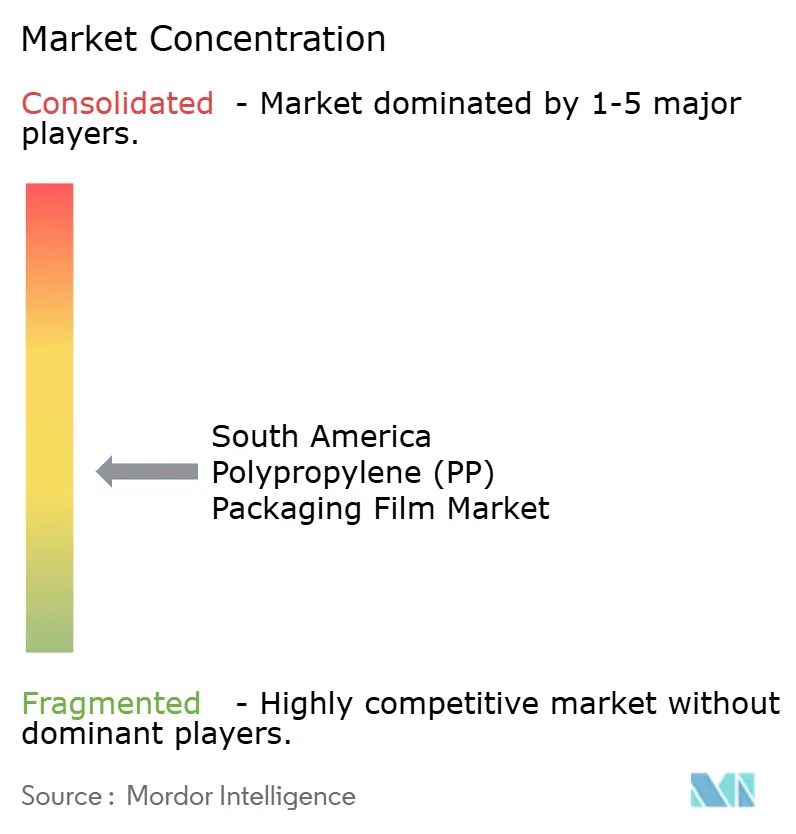
| Market Concentration | Medium |
Major Players *Disclaimer: Major Players sorted in no particular order Image © Mordor Intelligence. Reuse requires attribution under CC BY 4.0. | |
South America Polypropylene (PP) Packaging Film Market Analysis by Mordor Intelligence
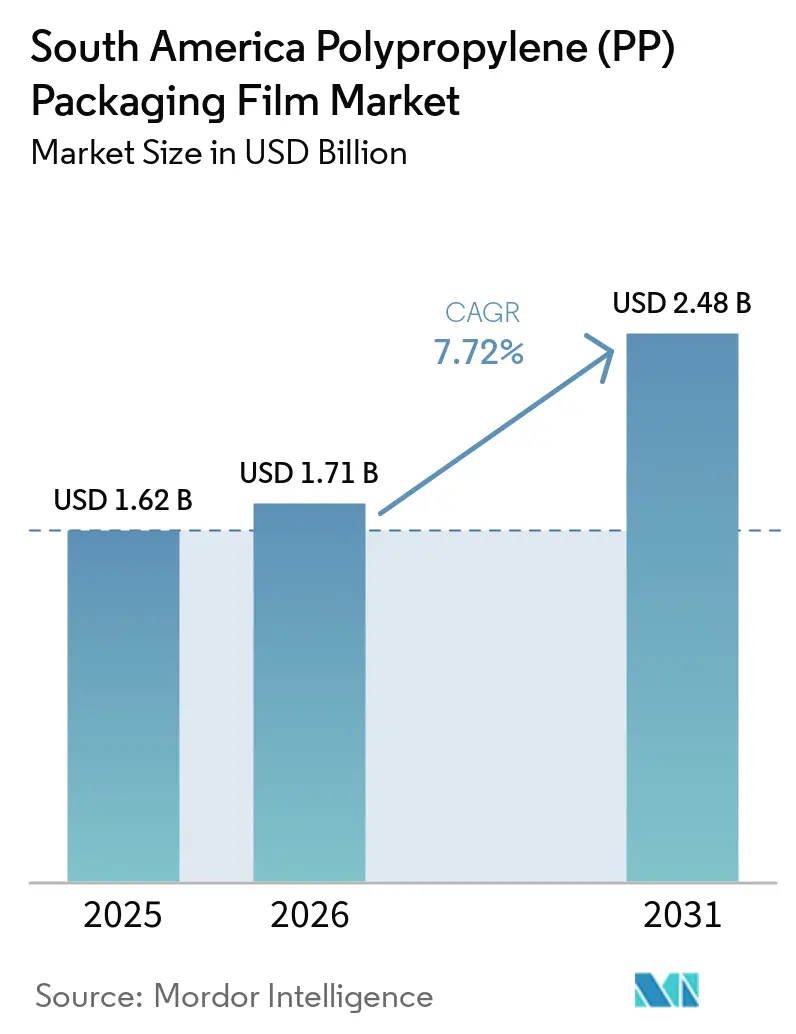
The South America polypropylene (PP) packaging film market size was valued at USD 1.62 billion in 2025 and estimated to grow from USD 1.71 billion in 2026 to reach USD 2.48 billion by 2031, at a CAGR of 7.72% during the forecast period (2026-2031). Demand in the South America polypropylene (PP) packaging film market is supported by packaged food, modern retail, e-commerce, and export supply chains that need moisture protection, reliable sealing, high-quality printing, and consistent performance during transport, while food processors increasingly require film that works on high-speed lines and protects products during longer distribution cycles. Film suppliers are moving toward recyclable mono-polypropylene structures as packaging rules become more stringent in Brazil and Colombia, favoring coated, metalized, and higher-barrier grades that meet product protection, visual presentation, and recyclability requirements within a single material family. Brazil’s agribusiness and Chile’s seafood exports also sustain demand for pouches, lidding, and barrier films that withstand cold-chain and export conditions. Domestic capacity investment in Brazil can improve supply availability, while resin imports, exchange-rate movements, and freight costs still influence converter margins. Competition remains active because regional producers must contend with suppliers that can offer imported film at competitive landed costs, while pharmaceutical and food applications raise the value of approved specialty materials.
Key Report Takeaways
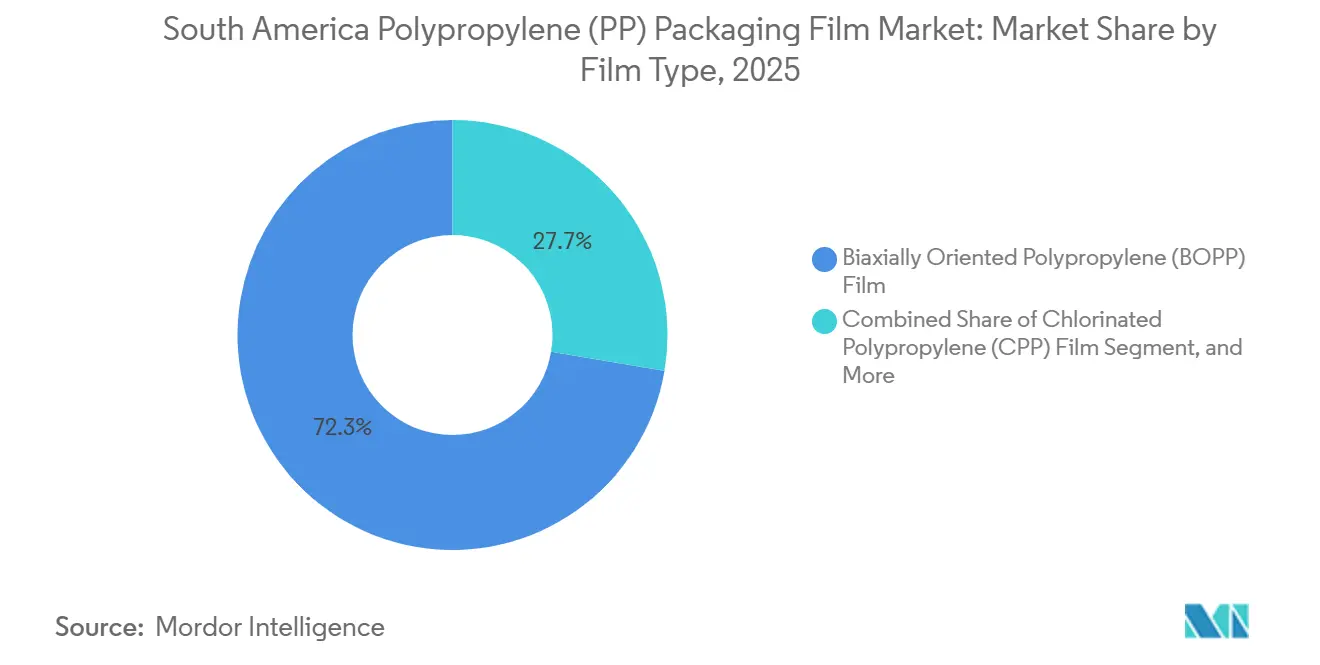
- By film type, biaxially oriented polypropylene (BOPP) film held 72.34% of the South America polypropylene (PP) packaging film market share in 2025, while chlorinated polypropylene (CPP) film is projected to expand at a 8.16% CAGR through 2031.
- By packaging format, bags and pouches accounted for 34.62% of revenue in 2025, while lidding and flow-wrap films are projected to expand at a 8.34% CAGR through 2031.
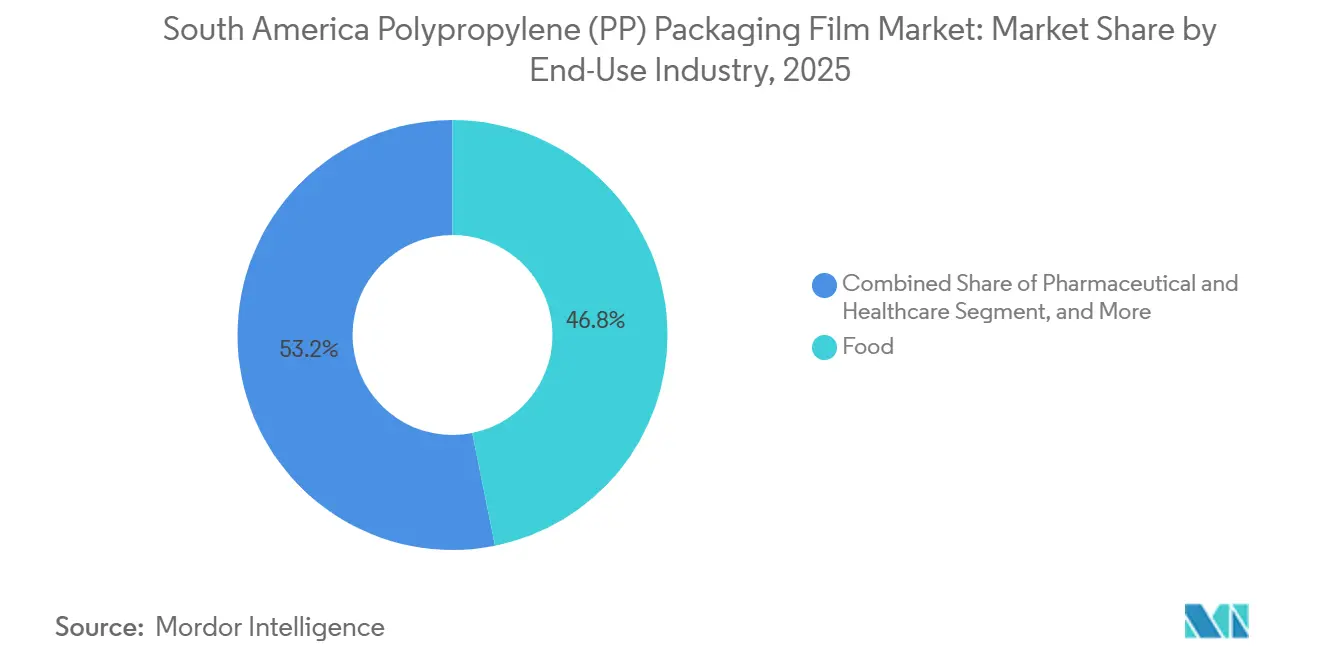
- By end-use industry, food accounted for 46.83% of revenue in 2025, while pharmaceutical and healthcare are projected to expand at a 8.47% CAGR through 2031.
- By geography, Brazil accounted for 44.72% of revenue in 2025, while Colombia is projected to expand at a 8.53% CAGR through 2031.
Note: Market size and forecast figures in this report are generated using Mordor Intelligence’s proprietary estimation framework, updated with the latest available data and insights as of January 2026.
South America Polypropylene (PP) Packaging Film Market Trends and Insights
Drivers Impact Analysis*
| Driver | (~) % Impact on CAGR Forecast | Geographic Relevance | Impact Timeline |
|---|---|---|---|
| Packaged Food and Convenience Consumption Expansion | +2.4% | Brazil, Argentina, Colombia | Short term (≤ 2 years) |
| Shift Toward Recyclable Mono-Polypropylene Structures | +1.6% | Brazil, Chile, Colombia | Medium term (2-4 years) |
| E-Commerce and Secondary Packaging Resilience Requirements | +1.1% | Brazil, Colombia | Short term (≤ 2 years) |
| Regional BOPP and CPP Capacity Additions | +0.9% | Brazil, Colombia | Medium term (2-4 years) |
| Higher Barrier and Shelf-Life Requirements | +0.6% | Brazil, Chile, Argentina | Medium term (2-4 years) |
| Export-Oriented Fresh Food and Seafood Packaging Growth | +0.5% | Chile, Brazil, Argentina | Long term (≥ 4 years) |
| Source: Mordor Intelligence | |||
Packaged Food and Convenience Consumption Expansion
Processed and convenience food remains a stable source of demand for the South America polypropylene (PP) packaging film market across Brazil, Colombia, Argentina, and Chile. South America and the Caribbean economies grew 2.5% in 2025, compared with 2.2% in 2024, supporting household spending on packaged products across the region. Brazil’s food processors use coated and uncoated BOPP film for bakery, confectionery, snacks, dairy, and fresh-produce products that require clarity, seal reliability, and moisture protection. Organized retail requires each product to be sealed, labeled, and protected during warehousing, transport, and shelf display, unlike many open-market sales. This change increases film use per retail unit and encourages converters to offer consistent printing, barrier performance, controlled slip, and dependable machine performance. Snack and cereal producers in Andean countries are selecting metalized and high-barrier BOPP grades for urban consumers, supporting a shift from basic overwrap toward materials with higher revenue per kilogram and more demanding product specifications.
Shift Toward Recyclable Mono-Polypropylene Structures
The move to mono-polypropylene packaging is becoming an operating requirement for the South America polypropylene (PP) packaging film market. Brazil’s Decree No. 12,688/2025 established a 22% recycled-content requirement and a 32% recovery rate for large companies from January 2026, with targets increasing to 40% and 50% by 2040. Colombia’s Resolution 803 of 2024 also set requirements for packaging collection, material tracking, and the use of recycled raw materials, raising the commercial cost of conventional multi-material structures. Vitopel installed a BOBST EXPERT K5 metallizer, which increased its metalized film capacity by 40% and enabled recyclable mono-PP structures. Thinner mono-PP structures can maintain barrier performance while lowering plastic use per pack, even as roll demand rises in converting operations and brands pursue lower material intensity. Certification pathways promoted by ABRE and Abiplast can help converters show that their packaging meets recyclability requirements, document material choices for customers, and improve access to formal compliance programs.
E-Commerce and Secondary Packaging Resilience Requirements
E-commerce is changing film specifications within the South America polypropylene (PP) packaging film market, especially for food delivery, online grocery, and direct-to-consumer orders. These channels require mailer films and pouches that protect products after they leave a warehouse and pass through several handling points. Automated picking systems, conveyor belts, and last-mile delivery create puncture and burst stresses that standard overwrap film, designed mainly for shelf display, may not withstand. Cast polypropylene pouches and heat-resistant flow-wrap laminates can address these handling demands while providing reliable seals for ambient food, grocery orders, and branded consumer shipments. Free-trade-zone clusters in Bogotá and Medellín are attracting fulfillment operations that need secondary packaging materials with consistent thickness, tensile behavior, and surface quality. Suppliers that maintain tensile strength and coefficient-of-friction performance across changing temperatures can build durable relationships with converters and avoid competing solely on unit price.
Regional BOPP and CPP Capacity Additions
Capacity investment reflects expectations that regional demand will support domestic supply in the South America polypropylene (PP) packaging film market. Oben Group signed an agreement in June 2026 for a 94,000 metric ton per year, 12-meter BOPP line for Brazil. The investment followed Oben’s August 2025 acquisition of Vitopel do Brasil, which received regulatory approval in June 2025, thereby joining the Vitopel and Terphane platforms.[1]Oben Group, “Oben Group Completes Acquisition of Vitopel Do Brasil, Expanding High-Quality BOPP Film Offering,” Oben Group, obengroup.com Innova acquired Polo Films in 2025 and integrated the Montenegro facility as Unit III of its operations, extending its BOPP footprint from Manaus into southern Brazil. These projects expand access to wide-width, high-productivity output and can improve regional competitiveness when freight, tariff, and delivery-time costs make imported film less attractive. Long-term supply agreements can give converters more predictable material availability, improve production planning, and reduce their reliance on spot purchases as new lines reach full operation.
Restraints Impact Analysis*
| Restraint | (~) % Impact on CAGR Forecast | Geographic Relevance | Impact Timeline |
|---|---|---|---|
| Volatility in Polypropylene Resin Prices | -1.5% | Brazil, Argentina, Chile, import-dependent markets | Short term (≤ 2 years) |
| Competition From Paper, Aluminum, and Polyethylene Structures | -0.9% | Brazil, Colombia, Chile | Medium term (2-4 years) |
| Limited Collection and Recycling Infrastructure | -0.6% | Brazil, Argentina, Rest of South America | Long term (≥ 4 years) |
| Electricity, Foreign-Exchange, and Import-Cost Exposure | -0.7% | Argentina, Brazil, Colombia | Short term (≤ 2 years) |
| Source: Mordor Intelligence | |||
Volatility in Polypropylene Resin Prices
Resin price changes remain a direct margin constraint for converters in the South America polypropylene (PP) packaging film market. PP homopolymer spot prices in Brazil ranged from USD 970 to USD 1,020 per metric ton in May 2025, and subsequent supply disruptions increased local price pressure. Many converters buy resin in USD while selling finished film in the local currency, creating simultaneous exposure to resin price increases and currency depreciation. Brazil imported 3.32 million metric tons of plastic resin in 2025, showing that converters continue to replace import origins rather than reduce their material needs. Brazil’s PRESIQ program is set to provide BRL 3 billion (USD 580 million) in annual chemical-industry incentives for 5 years from 2027, but it does not remove near-term spot-market risk. Long-term resin contracts, flexible sourcing, careful price pass-through, and efficient inventory planning remain important for converters seeking to protect margins.
Competition From Paper, Aluminum, and Polyethylene Structures
Paper, aluminum foil laminates, and polyethylene film compete with the South America polypropylene (PP) packaging film market in food and industrial applications. Paper has gained attention in fresh-produce and e-commerce packaging, where buyers place a high value on visible recyclability, even when it may offer less shelf-life protection. AquaChile replaced expanded polystyrene with corrugated cardboard for fresh salmon distribution, reporting lower emissions, storage costs, and transportation costs. Aluminum laminates retain an advantage in cold-form pharmaceutical blister packs that need demanding moisture-barrier performance at an acceptable cost. Polyethylene remains widely used in heavy-duty wrapping and pallet-stretch applications, which limits PP’s reach in these higher-volume uses. PP film suppliers need to demonstrate moisture resistance, seal strength, printability, and recyclability while also providing consistent availability and cost control during customer packaging-system reviews.
*Our forecasts treat driver/restraint impacts as directional, not additive. The impact forecasts reflect baseline growth, mix effects, and variable interactions.
Segment Analysis
By Film Type: BOPP Retains Its Lead While CPP Advances in Specialized Uses
BOPP film held 72.34% of the South America polypropylene (PP) packaging film market in 2025. Its position rests on broad compatibility with gravure and flexographic printing, high processing speeds, and use across snack, coffee, dairy, and confectionery packaging. Transparent grades are widely used for shelf-stable bakery and snack wraps because they provide product visibility and work efficiently on automated lines. Metallized BOPP gained support after Vitopel’s 2024 metallizer investment increased capacity by 40% and targeted processed cheese, powdered milk, and oilseed packaging. Coated grades with PVDC, acrylic, or EVOH layers serve export food formats that need stronger oxygen and moisture barriers, while uncoated BOPP remains common in label stock, primary wraps, and value-oriented confectionery applications.
Cast polypropylene, commonly called CPP, is projected to grow at an 8.16% CAGR through 2031, the fastest rate among film types. Pharmaceutical lidding and blister applications value its thermal stability and controlled seal-peel performance, while general-purpose grades support multilayer pouches and laminate substrates. Retort-grade CPP is used for ready meals and processed foods that must retain film integrity during high-temperature sterilization cycles. Metallized CPP is gaining use in premium coffee and snack packs as an alternative to foil-based structures where mono-material recyclability is important. Other oriented and cast PP variants occupy smaller technical niches in the South America polypropylene (PP) packaging film industry, serving specific barrier, sealing, and processing requirements.



By Packaging Format: Bags and Pouches Lead While Lidding and Flow-Wrap Formats Gain Ground
Bags and pouches accounted for 34.62% of the South America polypropylene (PP) packaging film market size in 2025. Stand-up pouches, pillow bags, and sachets are used throughout Brazil’s processed food, personal care, and industrial supply chains. Single-serve coffee, snacks, and condiments need films with stable unwind tension, anti-block performance, and precise print registration at high line speeds. These requirements have expanded the use of BOPP in modern retail formats, where reliable visual presentation and seal quality remain important. Wraps and over-wraps retain a stable base in tobacco, confectionery, and premium bakery products because their clarity and gloss support shelf presentation.
Lidding and flow-wrap films are projected to grow at an 8.34% CAGR through 2031. Growth is linked to modified-atmosphere packs for fresh produce, chilled meat, dairy, and similar products in Brazil and Argentina. Food processors in Colombia are adding form-fill-seal equipment that needs films with tight dimensional tolerances and predictable seal initiation. Labels and pressure-sensitive tapes benefit from private-label food ranges and pharmaceutical packaging growth in Colombia and Chile. Blister and strip packs remain the smallest format by value, but their detailed quality approval requirements create durable relationships for suppliers of CPP and higher-barrier PP film.
By End-Use Industry: Food Supports Volume While Pharmaceutical and Healthcare Drives Faster Growth
Food accounted for 46.83% of revenue in the South America polypropylene (PP) packaging film market in 2025. Snack, bakery, confectionery, and fresh-produce supply chains provide a broad and relatively stable base of BOPP demand. Bakery and confectionery products use substantial film volumes on automatic wrapping lines, while metallized BOPP supports snack and cereal packs that need shelf-life protection. Processed cheese and powdered milk are also target applications for metallized BOPP, as identified in Vitopel’s capacity investment.[2]Think Plastic Brazil, “Vitopel Invests in a Metallizing Machine That Marks the Beginning of a New Generation of Metallized Flexible Films,” Think Plastic Brazil, thinkplasticbrazil.com Fresh produce, meat, poultry, and seafood require retort-compatible or modified-atmosphere packaging for extended cold-chain transport.
The pharmaceutical and healthcare is projected to grow at an 8.47% CAGR through 2031. Generic drug producers in Brazil’s São Paulo industrial corridors are increasing their use of blister packaging, supporting demand for controlled-sealing films. Demand also reflects a regional move away from PVC-dominated blisters toward PP and PET structures without halogen content. Colombia’s pharmaceutical manufacturing and medical-device assembly activities in Bogotá and Medellín support specialty lidding and blister films, while personal care and cosmetics support clear and metallized BOPP in sachets and pouches. Agricultural film, protective wrapping, and other non-food industrial uses provide the South America polypropylene (PP) packaging film industry with a predictable baseline when consumer-facing demand weakens.
Geography Analysis
Brazil accounted for 44.72% of the South America polypropylene (PP) packaging film market share in 2025. The country combines a large food-manufacturing base, flexible-packaging converters, and domestic BOPP production assets. Oben’s June 2026 agreement for a 94,000 metric ton per year BOPP line reflects continued confidence in Brazilian film demand.[3]Oben Group, “Brazil Expansion: Oben Group Signs Agreement for New 12-Meter BOPP Line With 94,000 Tons of Annual Capacity,” Oben Group, obengroup.com Brazil’s recycled-content and plastic packaging recovery rules became effective for large companies in January 2026, increasing interest in mono-PP structures that can satisfy material-recovery needs without compromising food and consumer-goods performance.
Argentina, Chile, and Colombia have different demand conditions within the South America polypropylene (PP) packaging film market. Argentina’s converters are moving toward mono-PP packaging that fits regional requirements for phthalate-free materials. Currency controls and import restrictions constrained purchasing power for import-dependent Argentine converters in 2024 and 2025. Chile’s film demand is tied to seafood exports, in which salmon processors need pouches and modified-atmosphere lidding films that perform at low temperatures. Chilean suppliers presented reduced-plastic technologies at AquaSur 2026, indicating a continued focus on packaging requirements for export markets.
Colombia is projected to grow at an 8.53% CAGR through 2031, the fastest rate among the geographic markets. Taghleef’s Cartagena operation provides an established regional source of BOPP film for converters in Colombia and nearby Andean markets. Pharmaceutical manufacturing in Bogotá and Medellín supports consumption of CPP lidding and blister films. Peru, Ecuador, Bolivia, Uruguay, Paraguay, and Venezuela remain more import-dependent markets for commodity BOPP and CPP. Brazilian producers, Andean converters, and Asian exporters compete in these countries on landed cost, local distribution capacity, and reliable access to resin supply.
Competitive Landscape
The South America polypropylene (PP) packaging film market is fragmented among converters, while primary film production is becoming more concentrated. Wide-width BOPP lines require substantial capital and favor producers that can maintain scale, dependable resin access, and consistent utilization. Oben Group completed the acquisition of Vitopel do Brasil in August 2025 and later agreed to install a 94,000 metric ton per year BOPP line in Brazil in June 2026. This sequence strengthened Oben’s regional platform after the integration of Vitopel and Terphane. Taghleef Industries supplies BOPP film from Cartagena, Colombia, while Grupo Plastilene, Valfilm, and Prolam compete through formulation flexibility, shorter lead times, and regional logistics.
Indian suppliers, including Jindal Poly Films and UFlex, add pricing pressure through large-scale film production and established distribution networks. Their presence gives converters supply alternatives when regional availability or pricing becomes less favorable. Pharmaceutical applications can partly protect approved suppliers because new materials require lengthy qualification, barrier documentation, and sterilization compatibility testing. This process creates more stable relationships for companies with proven quality systems and consistent product records. Brazil’s reliance on specialty retort-grade CPP creates an opening for suppliers that can offer high-temperature food and pharmaceutical film at competitive local cost.
Valgroup has developed Nano101 stretch-film technology with up to 101 ultra-thin nanolayers, with availability targeted for 2027.[4]Valgroup, “Nano101: How 101-Nanolayer Technology Redefines Performance in Stretch Films,” Valgroup, valgroupco.com The technology serves stretch film, but it shows local capability in multilayer material development that can inform further specialty-film work. Valgroup also acquired Innova’s plastic caps segment in Manaus in August 2025. The South America polypropylene (PP) packaging film market therefore retains room for specialized converters that offer responsive artwork changes, application-specific support, and certified mono-PP structures.
South America Polypropylene (PP) Packaging Film Industry Leaders
Oben Holding Group S.A.C.
Taghleef Industries, Inc.
Innovia Films Limited
Cosmo Films Limited
Inteplast Group, Ltd.
- *Disclaimer: Major Players sorted in no particular order

Recent Industry Developments
- June 2026: Oben Group signed an agreement with Brückner Maschinenbau to install a new 94,000 metric ton per year, 12-meter BOPP production line in Brazil, targeting the Brazilian market and the broader Southern Cone. The June 8, 2026, announcement followed the full integration of Terphane and Vitopel do Brasil. It represented the largest capacity commitment by a South American-based BOPP producer during the current decade. The line is expected to expand domestic supply and reduce converter dependence on Asian imports for standard and coated BOPP grades.
- January 2026: Taghleef Industries relaunched the former Treofan production site in Neunkirchen, Germany, as Polyopt, following AGP Holdco’s strategic investment and full operational control. The site, now a sister company to Taghleef Industries under the Al Ghurair Group, was repositioned as a European specialty BOPP hub. Treofan Germany GmbH and Co. KG ceased independent commercial operations.
- August 2025: Oben Group completed the acquisition of Vitopel do Brasil Ltda. on August 13, 2025, following CADE regulatory approval in June 2025. The transaction integrated Vitopel’s Mauá and Votorantim facilities in São Paulo state into Oben’s platform. Vitopel brought nearly 4 decades of operating history and exports to more than 30 countries. The acquisition expanded the combined group to 18 plants across 11 countries and strengthened the company’s ability to serve Brazilian and export customers.
- August 2025: Valgroup acquired the plastic caps segment of Innova’s Manaus operations and began managing the unit on August 1, 2025. The transaction expanded Valgroup’s beverage-packaging presence in northern Brazil. It consolidated compression-molded PET cap production for water, carbonated beverages, and juice markets. The move added a complementary packaging activity to the company’s existing regional materials and converting operations.


South America Polypropylene (PP) Packaging Film Market Report Scope
The South America polypropylene (PP) packaging film market includes films manufactured from polypropylene resins for packaging applications across food and beverages, consumer goods, pharmaceuticals, and industrial products. These films offer properties such as moisture resistance, clarity, heat resistance, and durability. The report analyzes market size, demand trends, key growth drivers, challenges, competitive landscape, and future outlook for polypropylene packaging films across South America.
The South America Polypropylene (PP) Packaging Film Market Report is Segmented by Film Type (Biaxially Oriented Polypropylene (BOPP) Film [Coated BOPP, and Uncoated BOPP], Chlorinated Polypropylene (CPP) Film [General-Purpose CPP, Retort-Grade CPP, and Metallized CPP], and Other Film Types), Packaging Format (Wraps and Over-wraps, Labels and Pressure-Sensitive Tapes, Bags and Pouches, Lidding and Flow-wrap Films, and Blister and Strip Packs), End-Use Industry (Food [Bakery and Confectionery, Snacks and Breakfast Cereals, Fresh Produce, Meat, Poultry, and Seafood, and Dairy Products], Beverages [Non-Alcoholic Beverages, and Alcoholic Beverages], Pharmaceutical and Healthcare, Personal Care and Cosmetics, Industrial, and Other End-Use Industries), and Geography (Brazil, Argentina, Chile, Colombia, and Rest of South America). The Market Forecasts are Provided in Terms of Value (USD).
By Film Type
| Biaxially Oriented Polypropylene (BOPP) Film | Coated BOPP (PVDC, Acrylic, EVOH) |
| Uncoated BOPP | |
| Chlorinated Polypropylene (CPP) Film | General-Purpose CPP |
| Retort-Grade CPP | |
| Metallized CPP | |
| Other Film Types |
By Packaging Format
| Wraps and Over-wraps |
| Labels and Pressure-Sensitive Tapes |
| Bags and Pouches |
| Lidding and Flow-wrap Films |
| Blister and Strip Packs |
By End-Use Industry
| Food | Bakery and Confectionery | |
| Snacks and Breakfast Cereals | ||
| Fresh Produce | ||
| Meat, Poultry, and Seafood | ||
| Dairy Products | ||
| Beverages | Non-Alcoholic Beverages | Bottled Water |
| Carbonated Drinks | ||
| Juices | ||
| Other Non-Alcoholic Beverages | ||
| Alcoholic Beverages | Beer | |
| Spirits | ||
| Other Alcoholic Beverages | ||
| Pharmaceutical and Healthcare | ||
| Personal Care and Cosmetics | ||
| Industrial | ||
| Other End-Use Industries | ||
By Geography
| Brazil |
| Argentina |
| Chile |
| Colombia |
| Rest of South America |
| By Film Type | Biaxially Oriented Polypropylene (BOPP) Film | Coated BOPP (PVDC, Acrylic, EVOH) | |
| Uncoated BOPP | |||
| Chlorinated Polypropylene (CPP) Film | General-Purpose CPP | ||
| Retort-Grade CPP | |||
| Metallized CPP | |||
| Other Film Types | |||
| By Packaging Format | Wraps and Over-wraps | ||
| Labels and Pressure-Sensitive Tapes | |||
| Bags and Pouches | |||
| Lidding and Flow-wrap Films | |||
| Blister and Strip Packs | |||
| By End-Use Industry | Food | Bakery and Confectionery | |
| Snacks and Breakfast Cereals | |||
| Fresh Produce | |||
| Meat, Poultry, and Seafood | |||
| Dairy Products | |||
| Beverages | Non-Alcoholic Beverages | Bottled Water | |
| Carbonated Drinks | |||
| Juices | |||
| Other Non-Alcoholic Beverages | |||
| Alcoholic Beverages | Beer | ||
| Spirits | |||
| Other Alcoholic Beverages | |||
| Pharmaceutical and Healthcare | |||
| Personal Care and Cosmetics | |||
| Industrial | |||
| Other End-Use Industries | |||
| By Geography | Brazil | ||
| Argentina | |||
| Chile | |||
| Colombia | |||
| Rest of South America | |||


Key Questions Answered in the Report
What is the size of the South America polypropylene packaging film market?
The South America polypropylene (PP) packaging film market was valued at USD 1.62 billion in 2025, is estimated at USD 1.71 billion in 2026, and is forecast to reach USD 2.48 billion by 2031. The forecast represents a 7.72% CAGR from 2026 to 2031.
What is driving demand for polypropylene packaging film in South America?
Packaged food, modern retail, e-commerce, export-oriented food supply chains, and recyclable mono-PP packaging requirements are supporting demand. These uses require dependable barriers, seals, printing, and handling performance.
Which film type leads regional demand?
BOPP film led with 72.34% of revenue in 2025 because it supports high-speed printing and packaging lines across food applications. Transparent, metallized, coated, and uncoated grades address different shelf-life and presentation needs.
Which packaging format is growing fastest?
Lidding and flow-wrap films are projected to grow at an 8.34% CAGR through 2031, supported by fresh food and dairy packaging needs. Modified-atmosphere formats and form-fill-seal equipment support this demand.
Which end-use sector is expanding fastest?
Pharmaceutical and healthcare is projected to grow at an 8.47% CAGR through 2031, led by specialty lidding and blister-pack applications. Supplier approval and quality documentation can shape purchasing decisions in this sector.
Which country is expected to record the fastest growth?
Colombia is projected to grow at an 8.53% CAGR through 2031, supported by BOPP supply capacity and pharmaceutical manufacturing activity. Its Bogotá and Medellín clusters support demand for specialty packaging films.
Page last updated on:





