
South America Packaging Technical Textile Market Size and Share
Market Overview
| Study Period | 2021 - 2032 |
|---|---|
| Forecast Data Period | 2027 - 2032 |
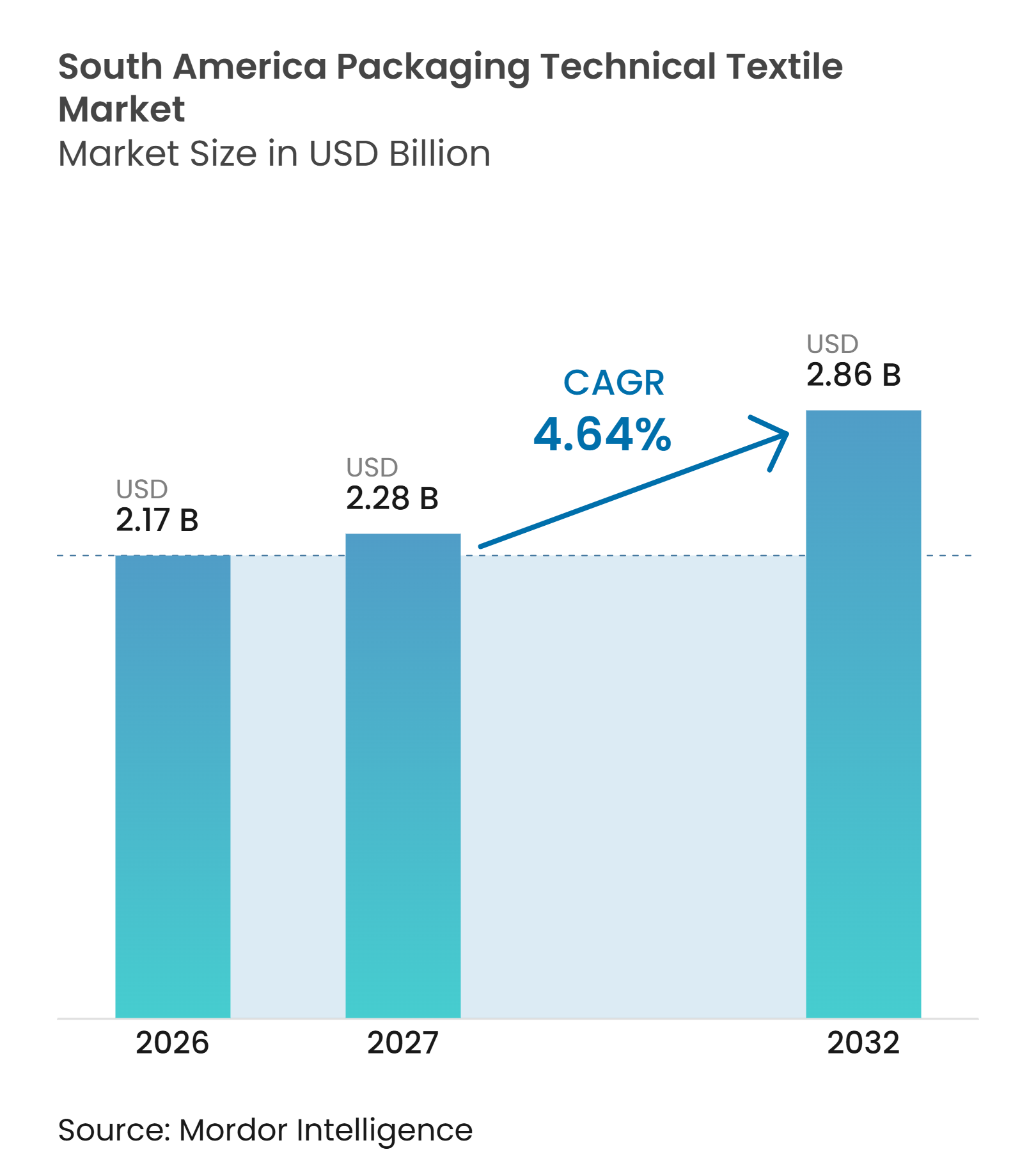
| Base Year Market Size (2026) | USD 2.17 Billion |
| Market Size (2027) | USD 2.28 Billion |
| Market Size (2032) | USD 2.86 Billion |
| Growth Rate (2027 - 2032) | 4.64 % |
| Market Concentration | Medium |
Major Players *Disclaimer: Major Players sorted in no particular order Image © Mordor Intelligence. Reuse requires attribution under CC BY 4.0. | |
South America Packaging Technical Textile Market Analysis by Mordor Intelligence
The South America Packaging Technical Textile Market size was valued at USD 2.17 billion in 2026 and is estimated to grow from USD 2.28 billion in 2027 to reach USD 2.86 billion by 2032, at a CAGR of 4.64% during the forecast period (2027-2032).
The South America packaging technical textile market is moving toward higher-specification products as exporters need packaging that protects materials during longer storage and transport cycles. Demand is supported by agricultural, fertilizer, food-processing, and mineral supply chains that require woven sacks, liners, and bulk containers. Recycling obligations are also changing material selection and production practices, particularly where buyers need traceable recovered content. This creates openings for converters that can combine reliable production, certification, and local technical support. Competition remains intense in standard sack grades, while customized bulk packaging has greater scope for product differentiation.
Key Report Takeaways
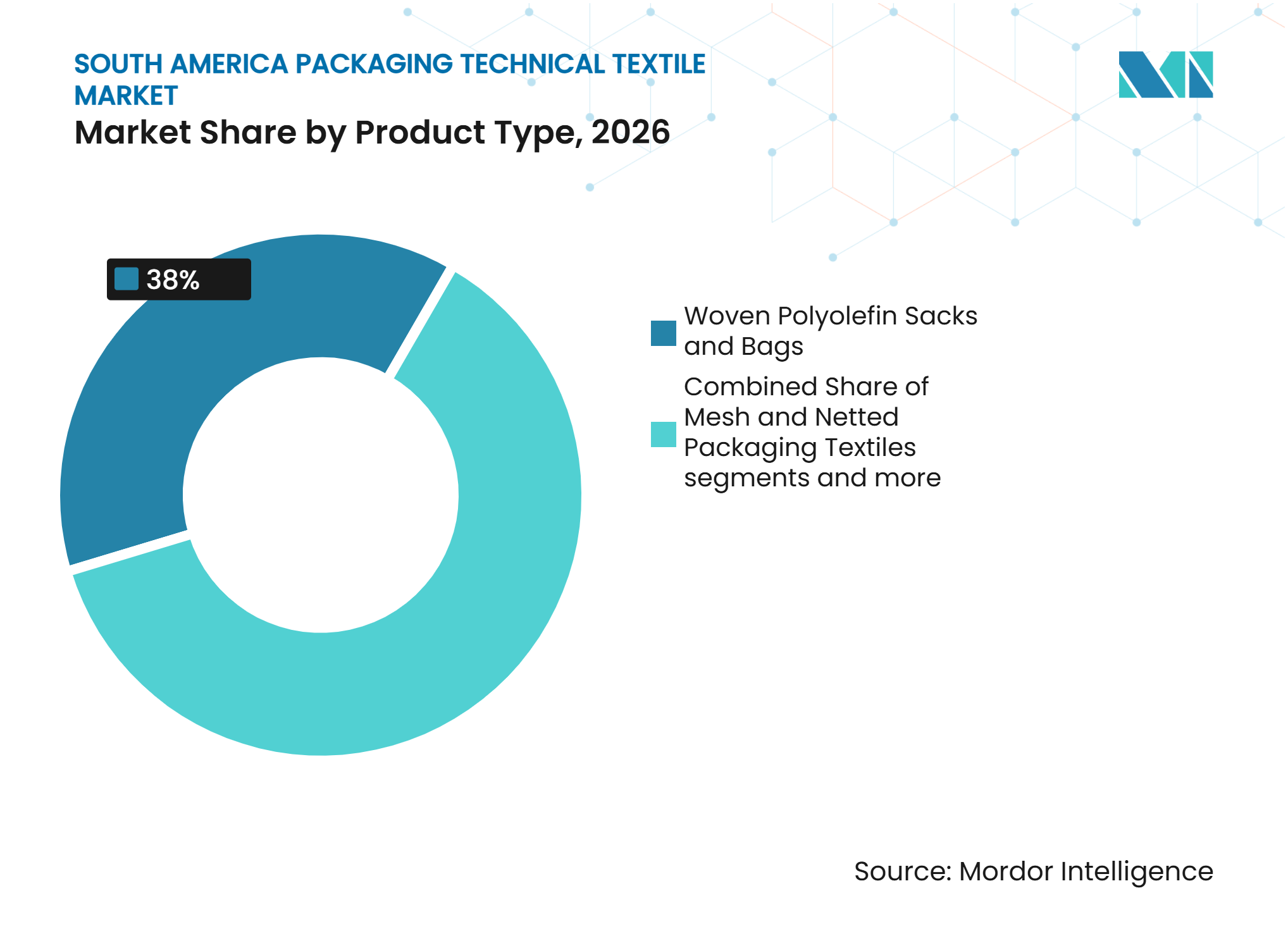
- By product type, woven polyolefin sacks and bags held 38.0% of the South America packaging technical textile market share in 2026, while flexible intermediate bulk containers are forecast to grow at a 6.5% CAGR through 2032.
- By material type, polypropylene held 52.0% of the South America packaging technical textile market share in 2026, while regenerated cellulosic fibers are forecast to grow at a 6.8% CAGR through 2032.
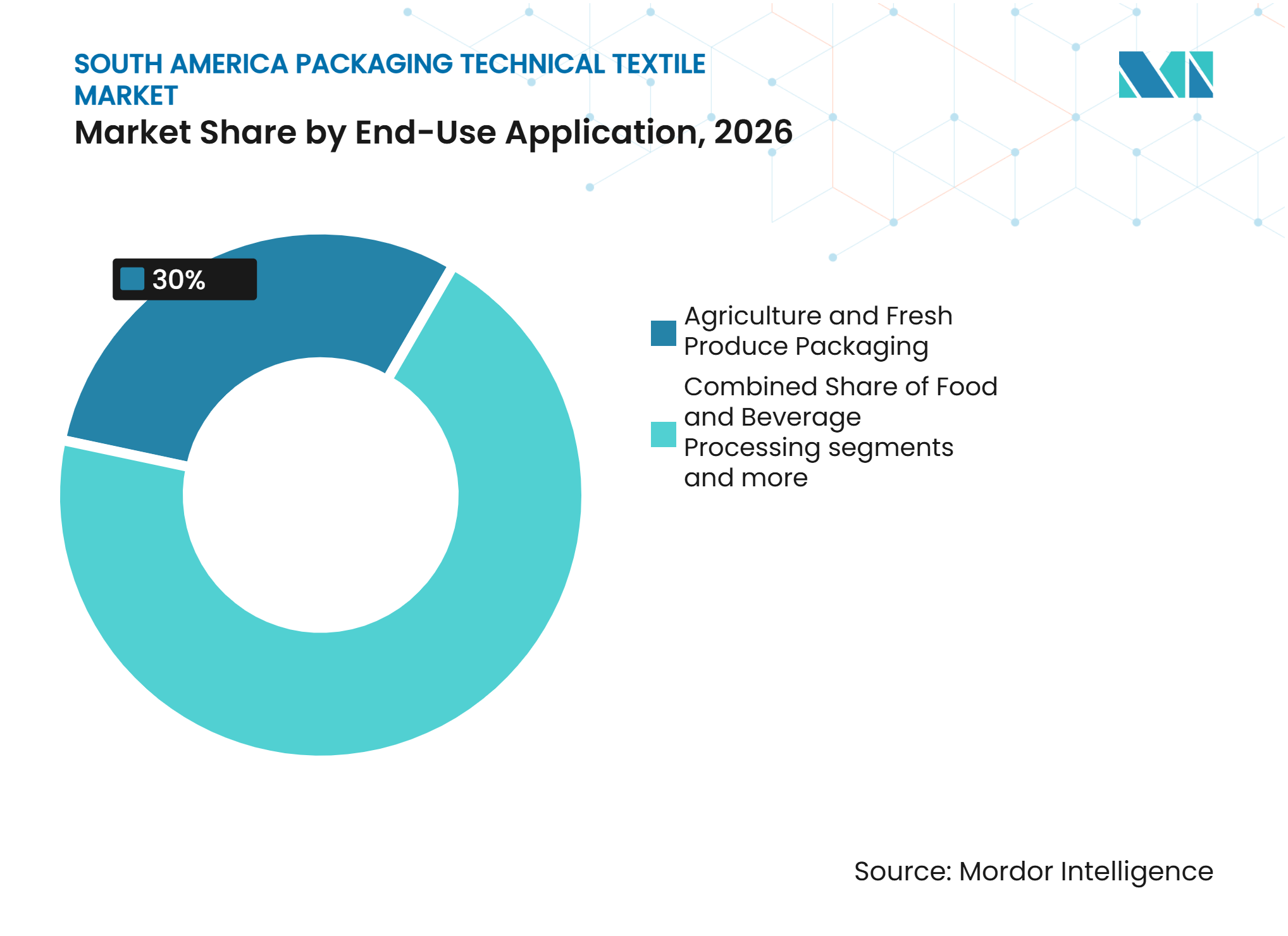
- By end-use application, agriculture and fresh produce packaging held 30.0% of the South America packaging technical textile market size in 2026, while pharmaceuticals and healthcare products are forecast to grow at a 6.7% CAGR through 2032.
- By geography, Brazil held 55.0% of the South America packaging technical textile market size in 2026, while Colombia is forecast to grow at a 5.8% CAGR through 2032.
Note: Market numbers in this report are based on Mordor Intelligence's proprietary estimation framework, which combines nine months of actuals with Q4 projections for base year 2026.
Market Trends and Insights
Drivers Impact Analysis of South America Packaging Technical Textile Market*
| Driver | (~) % Impact on CAGR Forecast | Geographic Relevance | Impact Timeline |
|---|---|---|---|
| Agricultural and Mineral Export Growth | +1.4% | Brazil, Argentina, Chile, Colombia, Peru | Short term (≤ 2 years) |
| FIBC Adoption in Mechanized Bulk Handling | +1.1% | Brazil, Chile, Argentina, Colombia, Peru | Medium term (2-4 years) |
| Growth of Food, Feed, Fertilizer and Chemical Processing | +0.9% | Brazil, Argentina, Colombia | Medium term (2-4 years) |
| Lightweighting and Secondary-Packaging Reduction | +0.5% | Brazil, Colombia, regional spillover | Long term (≥ 4 years) |
| Recycled-Content and Closed-Loop Packaging Demand | +0.4% | Brazil, Chile, Colombia | Long term (≥ 4 years) |
| Rural Supply Chains Requiring UV-Stabilized and Moisture-Barrier Packaging | +0.3% | Brazil, Argentina, Bolivia, Peru | Medium term (2-4 years) |
| Source: Mordor Intelligence | |||
Agricultural and Mineral Export Growth Sustains Structural Bulk Packaging Demand
Brazil’s agroindustry exports reached USD 169.2 billion in 2025, supported by a 352.2 million-ton harvest and soybean shipments of 108.2 million tons[1]. Argentina’s grain and sub-product shipments reached 88.9 million tons through September 2026, supported by wheat and sunflower volumes. These flows require dependable packaging for storage, dispatch, and export handling across the South America packaging technical textile market. Seasonal harvest cycles make product availability important because growers, merchants, processors, and exporters all depend on packaging during concentrated shipping periods. Bulk materials moving through ports and inland terminals also need products that resist moisture, ultraviolet exposure, handling damage, and prolonged storage. The demand profile favors suppliers that can serve high-volume agricultural customers and specialized mineral customers without sacrificing product consistency.
FIBC Adoption in Mechanized Bulk Handling Deepens Across Commodity Verticals
Mechanized filling, stacking, and pallet handling are increasing the demand for form-stable and baffle-flexible intermediate bulk containers. These containers help operators maintain stable loads on automated conveyors, in warehouses, and during container loading. Embrasa acquired Tech Bag in February 2026 and added a Bahia facility with 3.24 million units of annual FIBC capacity. The acquisition also added in-house fabric, loop, and film production, which strengthens control over quality, supply scheduling, and product design. Buyers operating fast loading lines increasingly need bags that fit their equipment and maintain stable geometry after filling. This approach supports the South America packaging technical textile market as mineral, fertilizer, seed, feed, and cement users seek consistent bulk-handling performance.
Growth of Food, Feed, Fertilizer and Chemical Processing Reinforces Certified Packaging Demand
Food, animal feed, fertilizer, and chemical processing expand the need for packaging that can meet product protection and traceability requirements. Moisture-resistant woven polypropylene sacks are needed for fertilizer distribution, while certified bulk containers are used for specialized chemicals. Food and feed customers also require packaging that limits contamination risks during filling, storage, and transport. The range of applications increases the importance of liners, coatings, controlled production conditions, and reliable handling instructions. Suppliers that serve these customers must manage demanding requirements for strength, cleanliness, delivery reliability, and product identification. These operating requirements support higher-value demand within the South America packaging technical textile market.
Lightweighting and Secondary-Packaging Reduction Redefines Material Specification
Lighter woven structures can reduce material use while maintaining the performance required for bulk transport. Oben Group introduced a 30-micron sealable BOPP film containing 11% mechanical post-consumer recycled polypropylene for PepsiCo Brazil’s snack secondary packaging in February 2026. The project replaced a two-layer laminated structure and removed a lamination stage. This shows that material reduction and recycled-content use can be considered together rather than as separate product decisions. Comparable material choices can influence packaging specifications for converters serving large food and agricultural customers. The South America packaging technical textile market can benefit when lower material use is paired with suitable barrier, printing, and load-bearing performance.
Restraints Impact Analysis of South America Packaging Technical Textile Market*
| Restraint | (~) % Impact on CAGR Forecast | Geographic Relevance | Impact Timeline |
|---|---|---|---|
| Polypropylene Resin and Foreign-Exchange Volatility | -0.8% | Brazil, Argentina, West Coast South America | Short term (≤ 2 years) |
| Import Competition in Standardized Bags | -0.6% | Argentina, Chile, Colombia | Medium term (2-4 years) |
| Inconsistent Reverse-Logistics Infrastructure | -0.4% | Brazil, Argentina, Chile | Long term (≥ 4 years) |
| Rural Collection Friction for Post-Consumer FIBCs | -0.3% | Brazil, Andean agricultural zones | Long term (≥ 4 years) |
| Source: Mordor Intelligence | |||
Polypropylene Resin and Foreign-Exchange Volatility Compress Converter Margins
Polypropylene is a central input for woven sacks and bulk containers, making resin costs important to converter margins. Currency movements can increase the local cost of imported resin, spare parts, and equipment when pricing is linked to USD. This pressure is most difficult for suppliers serving agricultural users with tight purchasing budgets and regular seasonal orders. Converters cannot always pass increased material costs to buyers when standard products are readily available from several suppliers. Recycled resin can add another input-cost challenge where compliant grades are scarce or carry a premium. The South America packaging technical textile market therefore rewards suppliers that improve procurement control, production efficiency, inventory planning, and material recovery capability.
Import Competition in Standardized Bags Squeezes Domestic Producers in Price-Sensitive Grades
Standardized woven bags face greater import competition because buyers can compare products on price and basic specifications. This pressure is stronger where local producers lack scale or face higher tax, freight, and logistics costs. Specialized FIBCs are less exposed because customers often need application-specific designs, certifications, short delivery times, and technical support. Food-grade, antistatic, moisture-barrier, and high-load products also require closer collaboration between converters and customers. Domestic producers can protect margins by directing investment toward these requirements and maintaining reliable local service. The South America packaging technical textile market remains vulnerable in commodity grades but has more defensible opportunities in specialized packaging.
*Our forecasts treat driver/restraint impacts as directional, not additive. The impact forecasts reflect baseline growth, mix effects, and variable interactions.
South America Packaging Technical Textile Market Segment Analysis
By Product Type:
FIBCs Expand with Mechanized Bulk HandlingWoven polyolefin sacks and bags held 38.0% of the South America packaging technical textile market in 2026, reflecting their broad use in grain, sugar, fertilizer, cement, and agricultural distribution. Their format suits high-volume applications that need dependable load strength, efficient filling, clear printing, and broad availability. The South America packaging technical textile market continues to rely on conventional sacks where price and widespread availability are the main purchasing factors. Jute and natural-fiber packaging textiles retain a place where biodegradable formats are preferred. Leno woven and Raschel knitted mesh bags remain important for onions, potatoes, citrus, and other fresh produce that needs airflow.
Flexible intermediate bulk containers are forecast to grow at a 6.5% CAGR through 2032 as ports, fertilizer plants, and mineral operations increase mechanized handling. Form-stable, baffle, and ventilated designs help users maintain load shape, manage airflow, and support handling equipment. The fastest-growing product format is suited to customers that seek fewer handling steps and greater payload control. Wrapping and transit-protection textiles serve protective transport requirements, while nonwoven and specialty products address selected retail and industrial uses. Product choice often depends on the commodity’s weight, storage time, handling conditions, and moisture exposure. Embrasa’s integration of Tech Bag shows how regional suppliers are expanding FIBC capacity and internal manufacturing capability. [2]



By Material Type:
Polypropylene Leads as Circular Materials Gain AttentionPolypropylene held 52.0% of the South America packaging technical textile market in 2026 because it combines tensile strength, moisture resistance, and compatibility with woven structures, lamination, ultraviolet stabilization, and printing. The material is widely used for agricultural and industrial packaging that must perform through storage, loading, transport, and export delivery. Material selection also reflects the customer’s requirements for barrier properties, durability, recyclability, product contact, and processing efficiency. Performance, recovery requirements, and customer specifications increasingly shape material selection in the South America packaging technical textile market.
Regenerated cellulosic fibers are forecast to grow at a 6.8% CAGR through 2032, supported by interest in bio-derived materials for specialty food and pharmaceutical applications. Polyethylene remains important for FIBC liners and moisture-barrier uses, particularly where direct product protection is required. Buyers may use different material combinations when the application requires both structural strength and a separate protective layer. Polyester and recycled PET are becoming more relevant as converters evaluate circular bulk packaging options. The European Food Safety Authority found that the Starlinger recoSTAR PET iV+ recycling process can produce recycled PET that meets conditions for food-contact use at up to 100% recycled content. This finding is relevant to processors seeking validated recycling pathways for packaging applications. Jute, cotton, and other natural fibers serve niche export-produce uses, while polyamide and other specialty synthetics serve high-load applications.
By End-Use Application:
Agriculture Leads While Pharmaceuticals Grow FasterAgriculture and fresh produce packaging held 30.0% of the South America packaging technical textile market size in 2026, supported by exports of soybeans, maize, sugar, coffee, fresh fruit, and seeds. Mesh formats are used for fruits and vegetables, while laminated or liner-equipped woven sacks protect seeds and agricultural commodities during storage and ocean transit. Food and beverage processing is another major demand area for flour, sugar, feed, and beverage ingredients. Chemicals, petrochemicals, and fertilizers require strong packaging with features such as antistatic protection, safe handling, moisture resistance, and appropriate labeling. Construction materials, minerals, and mining use cement sacks and bulk containers for concentrates and other materials. Eramine completed its first lithium carbonate export through the Chilean corridor in October 2025 using 100 big bags for an 80-ton shipment.
Pharmaceuticals and healthcare products are forecast to grow at a 6.7% CAGR through 2032 as customers need hygienic, controlled, and traceable bulk packaging. These applications create demand for cleanroom-manufactured products and packaging that protects active ingredients, excipients, and finished-dose materials. Supplier qualification is particularly important when packaging enters regulated manufacturing and distribution environments. Retail, e-commerce, consumer goods, and other industrial products add smaller but diverse requirements across the South America packaging technical textile market. Each end-use group evaluates packaging against its own mix of protection, handling, compliance, cost, and delivery needs.

Geography Analysis
Brazil
Brazil held 55.0% of the regional market in 2026, supported by its agricultural exports and large domestic food, fertilizer, and chemical sectors. Brazil’s agroindustry exports reached USD 169.2 billion in 2025, while soybean shipments reached 108.2 million tons. These volumes create a recurring need for woven sacks, laminated bags, and agricultural bulk containers. The country’s scale also supports domestic conversion capacity and a deeper supplier base than many neighboring markets. Brazil’s Ministry of Environment opened public consultations in January 2026 as part of efforts to advance regulation of reverse logistics for plastic packaging. This policy direction raises the value of traceability and recycled-content capability. Greif reopened its modernized Esteio-RS facility in May 2026 with redesigned operations, expanded capacity, and real-time monitoring.[3]
Colombia
Colombia is forecast to grow at a 5.80% CAGR through 2032, supported by food and beverage processing, pharmaceutical manufacturing, and its packaging compliance requirements. The country’s fruit and flower supply chains need breathable and protective packaging for handling and export. Colombia’s National Environmental Licensing Authority published updated resources in October 2025 to support the submission of environmental management plans for packaging waste. This regulatory influence encourages converters to prepare recyclable structures and recovery systems. The need for compliant packaging can favor suppliers with local production, customer support, and material-traceability systems. The country also offers scope for mesh packaging and higher-value industrial bags that meet food and pharmaceutical requirements. These factors support the South America packaging technical textile market as Colombian customers move toward more structured packaging management.
Chile, Argentina, and Rest of South America
Chile’s mining economy supports demand for moisture-barrier and electrostatically dissipative FIBCs used in mineral logistics. Eramine’s 2025 export through the Chilean corridor illustrates the need for specialized packaging on lithium routes. Argentina’s grain and sub-product shipments reached 88.9 million tons through September 2026, sustaining demand for agricultural sacks and bulk containers. Argentina also faces strong competition in standard sack grades, which limits pricing flexibility for local converters. Peru, Bolivia, Ecuador, Paraguay, and Uruguay provide additional demand for mineral, cocoa, grain, animal-feed, and agricultural packaging. These countries favor durable products that can perform in rural supply chains and cross-border logistics. The South America packaging technical textile market has opportunities in these geographies where local service, product adaptation, and dependable delivery matter more than basic bag pricing.
Competitive Landscape
Market Concentration
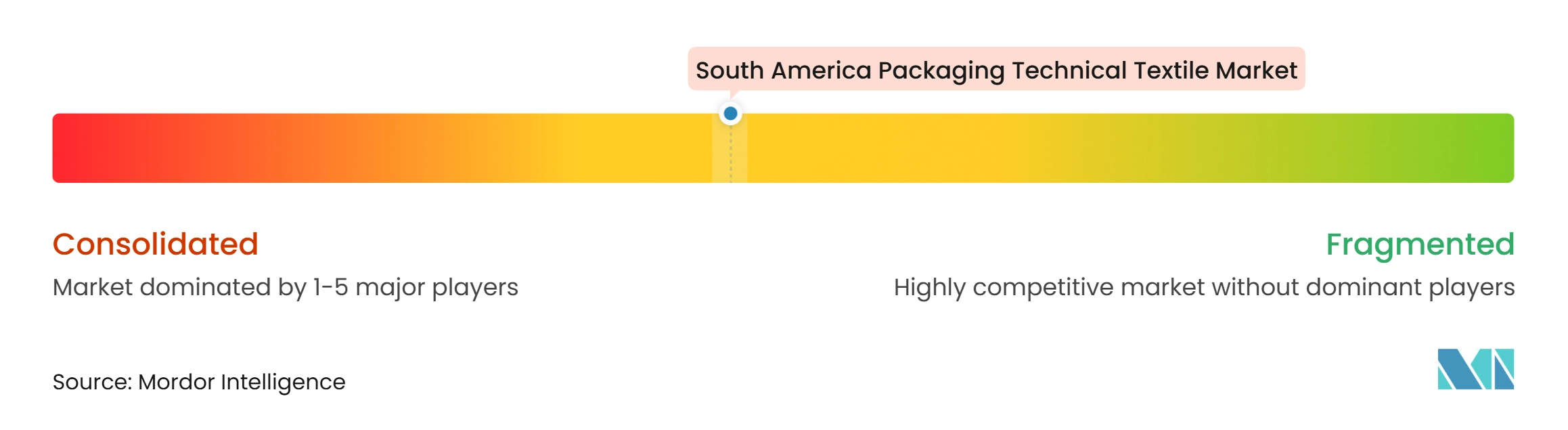
The South America packaging technical textile market has medium level of concentration, with vertically integrated Brazilian and Argentine converters competing alongside smaller regional specialists. Large converters often control tape extrusion, weaving, lamination, and bag conversion, which improves supply reliability and cost control. Smaller businesses compete through local service, customization, and customer relationships. Commodity sack categories remain price-sensitive, especially where imported products meet basic customer needs. Higher-value segments place more weight on certification, traceability, material performance, and consistent manufacturing standards.
Embrasa expanded its specialized bulk packaging position by acquiring Tech Bag in February 2026. The added facility brings 3.24 million units of annual FIBC capacity and supports fertilizer, seed, feed, mining, sugar, and cement customers. Greif’s Esteio-RS reopening is another strategic move that expands modern manufacturing capability in Brazil. Amcor completed its combination with Berry Global in April 2025, bringing their capabilities together under Amcor.
Suppliers can create stronger positions through food-grade cleanroom production, UN-certified mineral packaging, and pharmaceutical-grade woven products. These applications have more demanding qualification requirements than standard woven sacks. Recycled-content capability is also becoming more important as customers seek packaging that aligns with recovery and materials-management objectives. Oben Group’s recycled-content BOPP project for PepsiCo Brazil demonstrates a commercial route for circular material use in regional packaging. The South America packaging technical textile market rewards companies that link material innovation with practical performance, technical support, and reliable regional operations.
South America Packaging Technical Textile Industry Leaders
-
Embrasa
-
Packem
-
Bonsucesso Têxtil
-
CORESA
-
Bag Flex S.A.
- *Disclaimer: Major Players sorted in no particular order
South America Packaging Technical Textile Market Companies Covered in this Report
- Embrasa
- Packem
- Bonsucesso Textil
- CORESA
- Bag Flex S.A.
- Open Bag Group
- Textil Oeste
- Grupo BBA
- Grupo BBV/RAFIFORT
- PackBem
- Grupo AMB
- Coresa Argentina S.A.
- Sharmar Bag Argentina
- Group-Bag
- Alfabag
- Agilbag
- Safra Bag
- EmbTec Embalagens Tecnologicas Ltda.
- Greif, Inc.
- Berry Global Inc.
- LC Packaging
- Conitex Sonoco
- Global-Pak, Inc.
- Intertape Polymer Group
Recent Industry Developments in South America Packaging Technical Textile Market
- May 2026: Greif reopened its Esteio-RS plant in Brazil, rebuilt after 2024 flood damage, with a fully redesigned layout incorporating Industry 4.0 real-time monitoring, expanded production capacity, and state-of-the-art equipment, reinforcing the company’s South American industrial packaging presence.
- February 2026: Embrasa formally integrated the acquired Tech Bag facility in Riachão do Jacuípe, Bahia, as “Embrasa Nordeste.” The facility has 3.24 million units per year of specialty FIBC capacity serving fertilizer, sugar, seed, animal feed, mining, and cement segments, with planned expansions targeting more than 1,000 direct jobs and an in-house plastic waste recovery unit.
- February 2026: Oben Group announced the first regional implementation of mechanical PCR content in BOPP film, a 30-micron sealable BOPP film with 11% post-consumer recycled polypropylene for PepsiCo Brazil’s snack secondary packaging, replacing a two-layer laminated structure and demonstrating commercial scalability of PCR integration in South America.
South America Packaging Technical Textile Market Report Scope
The South America Packaging Technical Textile Market Report is Segmented by Product Type (Flexible Intermediate Bulk Containers (FIBCs), Woven Polyolefin Sacks and Bags, and More), by Material Type (Polypropylene and More), by End-Use Application (Agriculture and Fresh Produce Packaging and More), and by Geography (Brazil, Argentina, and More). The Report Offers Market Size and Forecasts in Value (USD) for all the Above Segments.
Segmentation Overview
| Flexible Intermediate Bulk Containers (FIBCs) | Conventional Bulk FIBCs |
| Form-Stable and Baffle FIBCs | |
| Ventilated FIBCs | |
| Other Specialized FIBCs | |
| Woven Polyolefin Sacks and Bags | |
| Jute and Other Natural-Fiber Packaging Textiles | Jute Sacking and Finished Packaging Bags |
| Others (Hessian, Burlap, Natural-Fiber Packaging Cloth, Speciality Packaging) | |
| Mesh and Netted Packaging Textiles | Leno Woven Packaging Bags |
| Raschel Knitted Packaging Bags | |
| Tubular Knitted Packaging Nets and Sleeves | |
| Other Textile Mesh Packaging Products | |
| Wrapping and Transit-Protection Textiles | Industrial Bale and Goods Wrapping Fabrics |
| Textile Packaging Covers and Protective Wraps | |
| Textile-Based Container Liners and Cargo Protection Fabrics | |
| Textile Pallet Netwrap and Load-Securing Materials | |
| Textile Packaging Sleeves, Padding, and Dunnage | |
| Nonwoven and Specialty Textile Packaging Products (Shopping and Carrying Bags, Protective Packaging Bags and Pouches, etc.) |
| Polypropylene |
| Polyethylene |
| Polyester |
| Jute |
| Cotton and Other Natural Fibers |
| Regenerated Cellulosic Fibers |
| Polyamide and Other Specialty Synthetic Fibers |
| Other Materials |
| Agriculture and Fresh Produce Packaging | Fresh Fruits and Vegetables |
| Seeds and Other Agricultural Commodities | |
| Food and Beverage Processing | Food Grains, Flour, and Sugar |
| Processed Food and Food Ingredients | |
| Animal Feed and Pet Food | |
| Beverage Ingredients and Infusion Products | |
| Chemicals, Petrochemicals, and Fertilizers | |
| Construction Materials, Minerals, and Mining | |
| Pharmaceuticals and Healthcare Products | |
| Retail, E-Commerce, and Consumer Goods | |
| Other Industrial Products and Materials |
| Brazil |
| Argentina |
| Chile |
| Colombia |
| Rest of South America |
| By Product Type | Flexible Intermediate Bulk Containers (FIBCs) | Conventional Bulk FIBCs |
| Form-Stable and Baffle FIBCs | ||
| Ventilated FIBCs | ||
| Other Specialized FIBCs | ||
| Woven Polyolefin Sacks and Bags | ||
| Jute and Other Natural-Fiber Packaging Textiles | Jute Sacking and Finished Packaging Bags | |
| Others (Hessian, Burlap, Natural-Fiber Packaging Cloth, Speciality Packaging) | ||
| Mesh and Netted Packaging Textiles | Leno Woven Packaging Bags | |
| Raschel Knitted Packaging Bags | ||
| Tubular Knitted Packaging Nets and Sleeves | ||
| Other Textile Mesh Packaging Products | ||
| Wrapping and Transit-Protection Textiles | Industrial Bale and Goods Wrapping Fabrics | |
| Textile Packaging Covers and Protective Wraps | ||
| Textile-Based Container Liners and Cargo Protection Fabrics | ||
| Textile Pallet Netwrap and Load-Securing Materials | ||
| Textile Packaging Sleeves, Padding, and Dunnage | ||
| Nonwoven and Specialty Textile Packaging Products (Shopping and Carrying Bags, Protective Packaging Bags and Pouches, etc.) | ||
| By Material Type | Polypropylene | |
| Polyethylene | ||
| Polyester | ||
| Jute | ||
| Cotton and Other Natural Fibers | ||
| Regenerated Cellulosic Fibers | ||
| Polyamide and Other Specialty Synthetic Fibers | ||
| Other Materials | ||
| By End-Use Application | Agriculture and Fresh Produce Packaging | Fresh Fruits and Vegetables |
| Seeds and Other Agricultural Commodities | ||
| Food and Beverage Processing | Food Grains, Flour, and Sugar | |
| Processed Food and Food Ingredients | ||
| Animal Feed and Pet Food | ||
| Beverage Ingredients and Infusion Products | ||
| Chemicals, Petrochemicals, and Fertilizers | ||
| Construction Materials, Minerals, and Mining | ||
| Pharmaceuticals and Healthcare Products | ||
| Retail, E-Commerce, and Consumer Goods | ||
| Other Industrial Products and Materials | ||
| By Geography | Brazil | |
| Argentina | ||
| Chile | ||
| Colombia | ||
| Rest of South America | ||
Key Questions Answered in the Report
What is the projected value of the South America packaging technical textile sector by 2032?
The market is projected to reach USD 2.86 billion by 2032, growing at a 4.64% CAGR from 2027. The outlook reflects demand from agricultural, industrial, food-processing, and mineral supply chains that require durable textile-based packaging.
Which product category leads regional demand?
Woven polyolefin sacks and bags lead with a 38.0% share in 2026. Their use across grain, sugar, fertilizer, cement, and agricultural distribution supports their large position, particularly where standardized, high-volume packaging is required.
Which packaging format is growing fastest?
Flexible intermediate bulk containers are forecast to grow at a 6.5% CAGR through 2027 to 2032. Growth is linked to mechanized filling, stable stacking, and bulk handling at export and industrial sites, where load shape and safe movement are important.
Why is polypropylene widely used in packaging technical textiles?
Polypropylene held a 52.0% share in 2026 because it offers strength, moisture resistance, and compatibility with weaving, lamination, and printing. These characteristics allow it to serve a broad range of agricultural and industrial packaging requirements.
Which end-use application is growing fastest?
Pharmaceuticals and healthcare products are forecast to grow at a 6.7% CAGR through 2032. The need for hygienic, controlled, and traceable packaging for sensitive products, ingredients, and manufacturing inputs supports demand.
Which country is forecast to grow fastest in the region?
Colombia is forecast to grow at a 5.80% CAGR through 2032. Food processing, pharmaceutical activity, packaging compliance requirements, export supply chains, and the need for recyclable structures support the country’s outlook.