
South America Outdoor LED Lighting Market Size and Share
Market Overview
| Study Period | 2020 - 2031 |
|---|---|
| Forecast Data Period | 2026 - 2031 |
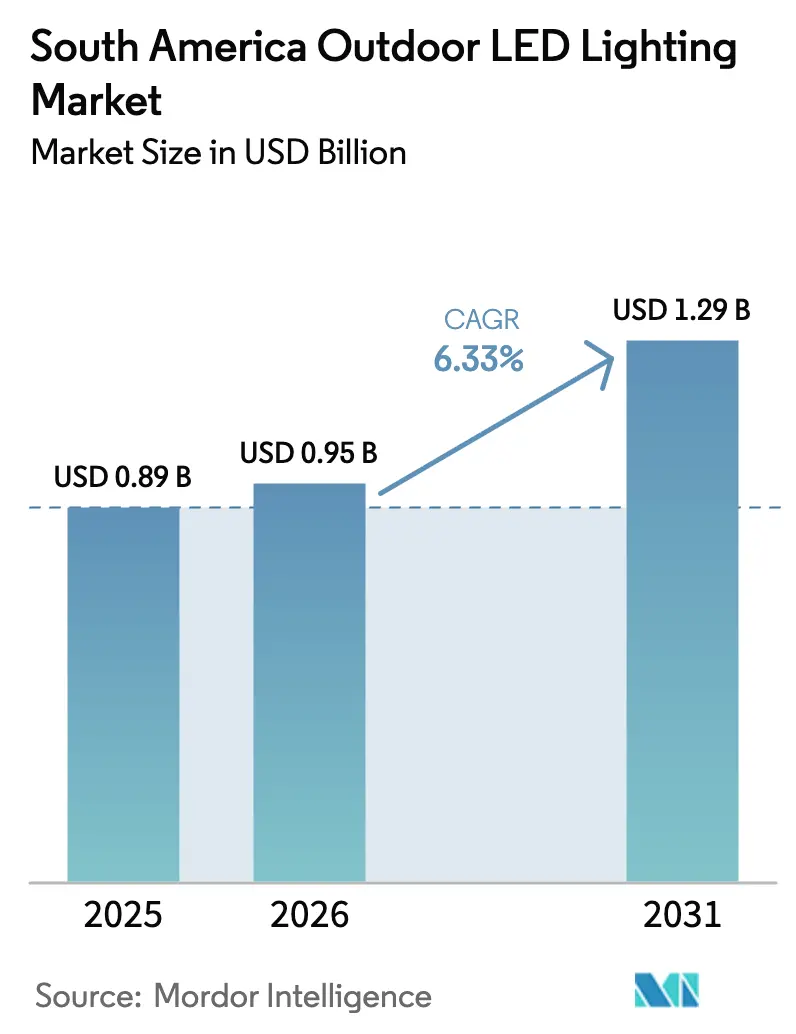
| Base Year Market Size (2025) | USD 0.89 Billion |
| Market Size (2026) | USD 0.95 Billion |
| Market Size (2031) | USD 1.29 Billion |
| Growth Rate (2026 - 2031) | 6.33 % |
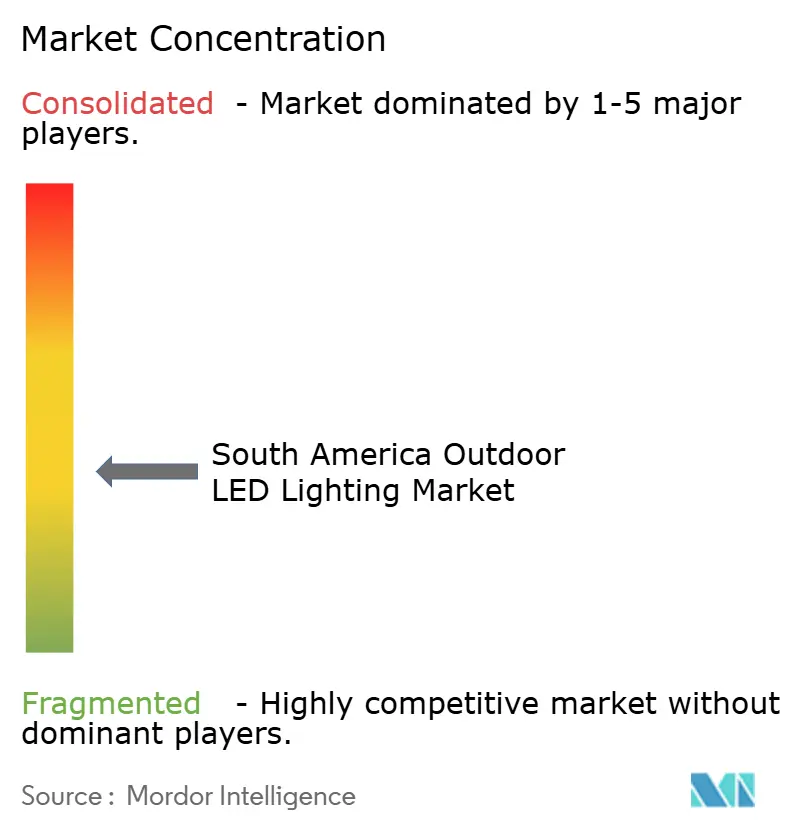
| Market Concentration | Medium |
Major Players *Disclaimer: Major Players sorted in no particular order Image © Mordor Intelligence. Reuse requires attribution under CC BY 4.0. | |
South America Outdoor LED Lighting Market Analysis by Mordor Intelligence
The South America outdoor LED lighting market size is expected to grow from USD 0.89 billion in 2025 to USD 0.95 billion in 2026 and is forecast to reach USD 1.29 billion by 2031 at 6.33% CAGR over 2026-2031. Rising infrastructure spending, stringent energy efficiency mandates, and growing acceptance of performance-based public-private partnerships (PPPs) are driving this expansion. Brazil’s permissive infrastructure-bond framework eases capital access for concessionaires, while São Paulo’s multi-billion-dollar administrative hub and waterway projects inject fresh procurement volumes for high-efficacy luminaires. Across the region, falling LED component prices continue to shorten payback periods, while the growing integration of smart-city platforms positions connected lighting as a foundational layer of urban services. Large-scale sporting events, including FIFA-mandated stadium upgrades, accelerate demand for high-uniformity, broadcast-ready lighting systems. Finally, solar-powered fixtures extend the addressable markets to off-grid and peri-urban zones, particularly in Peru’s rapidly growing rural electrification programs.
Key Report Takeaways
- By product type, luminaires and fixtures led with a 65.74% share of South America's outdoor LED lighting market in 2025, while lamps registered the fastest expansion at a 6.68% CAGR through 2031.
- By application, street and roadway lighting accounted for a 41.93% share of the South America outdoor LED lighting market size in 2025; sports and stadium projects are advancing at a 6.52% CAGR to 2031.
- By installation type, new installations held 59.72% revenue share of South America's outdoor LED lighting market in 2025, whereas retrofit activity is forecast to progress at a 6.61% CAGR through 2031.
- By distribution channel, direct sales dominated with a 58.92% share of South America's outdoor LED lighting market in 2025, but e-commerce is poised for a 6.49% CAGR, the fastest of all channels.
- By country, Brazil led with a 42.35% share of South America's outdoor LED lighting market in 2025; Peru is projected to expand at a 6.74% CAGR, the highest regional growth rate.
Note: Market size and forecast figures in this report are generated using Mordor Intelligence’s proprietary estimation framework, updated with the latest available data and insights as of 2026.
South America Outdoor LED Lighting Market Trends and Insights
Drivers Impact Analysis*
| Driver | (~) % Impact on CAGR Forecast | Geographic Relevance | Impact Timeline |
|---|---|---|---|
| Government-backed LED street-light replacement programs | +2.1% | Brazil, Chile, Colombia, spillovers to Argentina and Peru | Medium term (2-4 years) |
| Declining LED component prices | +1.8% | Region-wide, strongest in Brazil and Argentina | Short term (≤ 2 years) |
| Smart-city initiatives with connected lighting | +1.4% | São Paulo, Buenos Aires, Santiago, Bogotá | Long term (≥ 4 years) |
| Concession-based PPP upgrades | +1.2% | Brazil, Colombia, emerging adoption in Chile and Peru | Medium term (2-4 years) |
| Solar-powered LEDs in off-grid areas | +0.9% | Peru, Colombia, rural Brazil and Argentina | Medium term (2-4 years) |
| Graphene-enhanced heat-sink designs | +0.3% | Brazil, Chile | Long term (≥ 4 years) |
| Source: Mordor Intelligence | |||


Government-backed LED street-light replacement programs
National and sub-national mandates now require LED technology for publicly funded outdoor lighting purchases, creating multi-year procurement pipelines that transcend election cycles. Brazil’s federal decree permitting infrastructure bonds for municipal street-lighting concessions lowers borrowing costs and enables private partners to recover investments through energy savings and COSIP-secured fees.[1]Agência Nacional de Energia Elétrica, “PRODIST Módulo 8 Qualidade da Energia Elétrica,” aneel.gov.br Chile has paired United Nations Development Programme training modules with performance-based tenders, boosting municipal technical competence and standardizing minimum efficacy levels. Colombia’s 2024 green taxonomy unlocks climate-finance channels by clarifying project eligibility, allowing cities to label street-lighting endeavors as green-bond-ready instruments.[2]Climate Bonds Initiative, “Colombia’s Green Taxonomy,” climatebonds.net These concerted policies channel long-term capital into the South America outdoor LED lighting market and encourage consistent product specifications, enhancing supply-chain predictability for vendors.
Declining LED component prices lowering total cost of ownership
Region-wide LED lamp prices fell sharply between 2021 and 2024, narrowing acquisition cost differences with traditional high-pressure sodium fixtures. Municipalities now achieve energy savings of 40-60% after retrofitting, translating into payback intervals of 2.4 to 8 months, depending on the baseline technology. Chinese component suppliers, which command roughly three-quarters of global lighting exports, continue to exercise scale economies that compress margins while stimulating volume adoption in the South America outdoor LED lighting market. Lower upfront costs, combined with reduced maintenance expenses, strengthen the total cost-of-ownership economics, even for cash-constrained municipalities, driving faster penetration across second-tier urban centers.
Smart-city initiatives integrating connected outdoor lighting
Municipal digital-transformation agendas increasingly position lighting poles as sensor-rich urban infrastructure. Brazil’s LoRaCELL deployment showed that an integrated gateway can cost USD 30, vastly below legacy LoRaWAN alternatives, while providing remote dimming, power-quality monitoring, and environmental sensing. These capabilities help cities optimize illumination schedules, extend asset life, and monetize ancillary data streams. Colombia’s productive-transformation blueprint earmarks 2 GW of new renewable energy, aligning distributed photovoltaic canopies with adaptive LED luminaires for parking lot projects. Such convergence cements connected luminaires as gateways for future 5G small cells and electric-vehicle charging telemetry, multiplying the addressable value pool within the South America outdoor LED lighting market.
Concession-based PPP upgrades for municipal roadway lighting
Performance-based PPPs shift technology and performance risk to private consortia while guaranteeing municipalities significant energy savings. Brazil’s standardized bidding templates, refined by the World Bank’s PPP Infrastructure Resource Center, shorten tender cycles and attract international investors. The January 2024 Incentivised Infrastructure Bonds Act further enlarges investor appetite by providing tax exemptions for long-dated infrastructure notes. Similar structures are now under replication in Colombia, where ring-fenced utility surcharges stabilize cash flows. By aligning reimbursement with operational metrics, PPPs accelerate large-scale conversions and augment the investability of the South America outdoor LED lighting market.
Restraints Impact Analysis*
| Restraint | (~) % Impact on CAGR Forecast | Geographic Relevance | Impact Timeline |
|---|---|---|---|
| High up-front capital outlay | -1.9% | Peru, Bolivia, smaller municipalities region-wide | Short term (≤ 2 years) |
| Fragmented photometric standards | -1.1% | Cross-border procurement | Medium term (2-4 years) |
| Port-side driver and chip bottlenecks | -0.8% | Chile, Peru, Colombia | Short term (≤ 2 years) |
| Ecological push-back on blue-rich LEDs | -0.4% | Coastal and protected areas | Long term (≥ 4 years) |
| Source: Mordor Intelligence | |||
High up-front capital outlay for cash-strapped municipalities
Municipalities often face weighted-average borrowing costs of 8-20%, discouraging large one-time LED procurements. Brazil’s federal reallocation of regional development funds, totaling BRZ 816 million for the Transnordestina railway and BRZ 350 million for Amazon projects, demonstrates how fiscal instruments can alleviate these constraints.[3]Valor Econômico, “Government Reallocates Regional Funds to Speed Infrastructure,” valorinternational.com World Bank modeling indicates an unrealized USD 6.3 billion energy-efficiency savings opportunity in Brazil; however, converting potential into executed contracts requires tailor-made financing tools, such as green bonds and super-ESCO aggregation. Without such mechanisms, smaller cities tend to defer LED conversion, thereby diluting the near-term growth trajectory of the South America outdoor LED lighting market.
Fragmented photometric and performance standards across countries
Harmonization gaps between ANEEL’s PRODIST Module 8 in Brazil and Ecuador’s IEC-derived guidelines compel manufacturers to maintain multiple SKU variants, thereby increasing certification costs and extending the time-to-market. A Galápagos field study recorded current-harmonic distortion exceeding 46.5% at nominal load, underscoring the need for tighter power-quality controls. Absent mutual-recognition regimes, cross-border tendering remains complex, particularly for smaller suppliers, tempering economies of scale in the South America outdoor LED lighting industry.
*Our forecasts treat driver/restraint impacts as directional, not additive. The impact forecasts reflect baseline growth, mix effects, and variable interactions.
Segment Analysis
By Product Type: Dominance of Integrated Luminaires
The luminaires category captured 65.74% of South America's outdoor LED lighting market share in 2025, reflecting municipal preference for turnkey assemblies that bundle optics, drivers, and controls in a single warranty package. Lamps, although accounting for a smaller revenue pool, are projected to post a 6.68% CAGR through 2031 as budget-constrained cities retrofit legacy housing with LED bulbs instead of replacing full fixtures. This two-track demand pattern widens supplier opportunity sets: system integrators cater to comprehensive smart-city upgrades, while component specialists address incremental refurbishments.
Continuous efficacy gains and falling aluminum prices solidify the luminaires segment’s cost-leadership position. Concurrently, field-replaceable LED engines and Zhaga-standard sockets enhance upgradability, tempering lumen depreciation and prolonging asset life. Lamp retrofits penetrate heritage districts and remote villages where civil works budgets are thin, underscoring the nuanced adoption curve within the South America outdoor LED lighting market.



By Application: Street Lighting Leads; Stadiums Surge
Street and roadway projects accounted for 41.93% of the South America outdoor LED lighting market size in 2025, driven by national safety mandates and high electricity subsidy expenditures. Large concession contracts, many exceeding 30,000 light points, create volume orders that stabilize factory loading. In parallel, sports and stadium installations are forecast to rise at a 6.52% CAGR, propelled by FIFA-compliance requirements ahead of continental youth tournaments and the 2030 centennial World Cup co-hosting bid. Professional clubs seek HDTV-quality illumination that meets 2,000-lux vertical illuminance norms and flicker-free broadcasting standards, spawning premium-priced projects that elevate blended average selling prices in the South America outdoor LED lighting industry.
Architectural-landscape segments see renewed interest as tourism boards beautify waterfronts and heritage sites, while bridge and tunnel lighting gains relevance from trans-Andean logistics corridors. The breadth of applications signals continued diversification of revenue streams and mitigates overexposure to macro-linked street-lighting budgets.
By Installation Type: Retrofit Momentum Builds
New installations accounted for 59.72% of the revenue share in 2025, driven by greenfield urban expansion zones and highway extensions. Yet, retrofit projects exhibit a 6.61% CAGR, reflecting the maturation of first-generation LED deployments as they approach the end of their warranty life. Municipalities are leveraging improved efficacy ratings, now surpassing 180 lm/W, for mass-market cobra heads to justify swaps that can yield an incremental 15-20% energy reduction.
Super-ESCO consortia bundle multiple city contracts, harnessing scale to negotiate favorable finance terms and bulk component discounts, sustaining retrofit acceleration across the South America outdoor LED lighting market.

By Distribution Channel: Digital Commerce Gains Traction
Direct sales continued to dominate at 58.92% in 2025 as project-specific technical consultations remain indispensable for high-mast and tunnel applications. Nevertheless, e-commerce platforms are forecasted to grow to have a 6.49% CAGR, catalyzed by government procurement portals that pre-qualify vendors and standardize SKUs.
Rural contractors source replacement drivers and surge protectors online, shrinking delivery times and lowering inventory holding costs. This digital shift compels incumbents to establish omnichannel strategies that blend factory-trained field forces with self-service configurators, broadening customer touchpoints in the South America outdoor LED lighting market.
Geography Analysis
Brazil retained first-position status with 42.35% of South America's outdoor LED lighting market share in 2025, benefiting from ANEEL’s rigorous PRODIST Module 8 requirements that stabilize product quality expectations. Federal authorization of infrastructure bonds enhances municipal liquidity, supporting marquee projects such as São Paulo’s BRL 7 billion administrative hub, which features networked LED luminaires for plazas, bridges, and façade uplights. Companhia Energética de Minas Gerais (Cemig) earmarked BRZ 39.2 billion for distribution upgrades between 2025 and 2029, embedding smart control nodes in suburban feeder networks. These multi-year pipelines cement Brazil’s role as a logistical and R&D nucleus for the South America outdoor LED lighting industry.
Peru, with a 6.74% forecast CAGR, represents the fastest-growing opportunity node. The country’s renewable generation increased by 96% in 2024, which aligns neatly with solar-powered LED kits for remote Amazonian communities. Nonetheless, coordination flaws, as witnessed in Lima’s USD 2 billion airport development, plagued by access-infrastructure lags, reveal execution risks that vendors must price into contract terms. To mitigate capital shortfalls, Peru channels climate-resilience grants and seeks regional inter-municipal procurement pools, enlarging project scopes in a single tender.
Argentina, Chile, and Colombia form a second-tier cluster characterized by tournament-linked lighting standards, renewable-capacity expansions, and maturing PPP jurisprudence. Colombia’s 2024 green taxonomy rollout facilitates green bond issuance for LED retrofits, while a target to raise non-conventional renewables by 670% before 2026 amplifies distributed generation synergies. Chile’s coastal cities are adopting amber LEDs to reduce their ecological impact in nesting grounds, which entails specialized optics and phosphor formulations that increase product-mix complexity.
The Rest-of-South-America cohort, comprising Bolivia, Paraguay, Uruguay, and Ecuador, features nascent yet promising prospects. Ecuador’s statutory ban on non-LED public lighting purchases guarantees baseline demand, and its early-stage 200 MW La Ceiba solar farm may pioneer hybrid PV lighting demonstration sites. Paraguay and Uruguay, part of the 2030 centennial World Cup bid, plan major stadium renovations that strengthen cross-border supply-chain flows. Although smaller economies lack Brazil’s financing depth, pooled procurement and multilateral lending enable steady penetration of the South America outdoor LED lighting market.
Competitive Landscape
Competition remains moderately fragmented, with the top five suppliers accounting for roughly 35-40% of the South America outdoor LED lighting market share. Signify maintains regional leadership through its Interact City platform, while Osram leverages high-power chipsets for sports venues. Acuity Brands partners with Latin American contractors to localize controls software, and WEG Equipamentos Elétricos capitalizes on domestic production incentives to serve Brazil’s PPP pipeline. Chinese exporters intensify price pressure as their global LED sales surpassed USD 43.3 billion in 2023, prompting incumbents to shift toward integrated service offerings.[4]LEDinside, “How Chinese LED Companies Tap Overseas Markets,” ledinside.com
Strategic differentiation centers on financing packages, smart-city software, and localized after-sales support. World Bank-aligned super-ESCO structures are increasingly favoring vendors capable of underwriting performance guarantees for 10 years or more, reinforcing a service-oriented shift in the South America outdoor LED lighting industry. Technologically, the proliferation of universal dimming protocols and open API stacks enables third-party analytics firms to overlay asset-management dashboards, creating a micro-ecosystem around data monetization.
Forward-looking innovations emphasize material science and cyber-secure connectivity. Graphene-reinforced heat sinks and UV-C antimicrobial coatings aim to extend asset life and address public health concerns. On the digital front, blockchain-based power-consumption ledgers trialed in Recife offer tamper-resistant audit trails for verifying energy savings, potentially lowering blended finance costs. Collectively, these trends indicate a maturing yet opportunity-rich South America outdoor LED lighting market where holistic solution design outweighs sheer unit-volume scale.
South America Outdoor LED Lighting Industry Leaders
Signify N.V.
Osram Licht AG
Acuity Brands, Inc.
Hubbell Incorporated
Eaton Corporation plc
- *Disclaimer: Major Players sorted in no particular order

Recent Industry Developments
- June 2025: São Paulo State finalized tender models for BRL 7 billion administrative-center and waterway projects, opening multi-site bids that require smart outdoor LED packages.
- April 2025: The World Bank has cleared a USD 200 million development policy loan for Bahia’s Sustainable Infrastructure Program, targeting 43 MW of rooftop PV and associated lighting retrofits across 161 public buildings.
- March 2025: Panama and Colombia accorded presidential-priority status to a 400 MW bi-national HVDC interconnection, which includes specialized corridor-lighting contracts scheduled for 2026 mobilization.
- February 2025: Argentina’s River Plate club inaugurated an HDTV-grade LED ring at the renovated Mâs Monumental stadium, confirming tournament-driven premium fixture demand.


South America Outdoor LED Lighting Market Report Scope
Public Places, Streets and Roadways, Others are covered as segments by Outdoor Lighting.| Lamps |
| Luminaires / Fixtures |
| Street and Roadway Lighting |
| Architectural and Landscape |
| Sports and Stadium |
| Tunnel and Bridge |
| Parking and Transit Areas |
| Other Applications |
| New Installation |
| Retrofit Installation |
| Direct Sales |
| Wholesale |
| Retail |
| E-commerce |
| Brazil |
| Argentina |
| Chile |
| Colombia |
| Peru |
| Rest of South America |
| By Product Type | Lamps |
| Luminaires / Fixtures | |
| By Application | Street and Roadway Lighting |
| Architectural and Landscape | |
| Sports and Stadium | |
| Tunnel and Bridge | |
| Parking and Transit Areas | |
| Other Applications | |
| By Installation Type | New Installation |
| Retrofit Installation | |
| By Distribution Channel | Direct Sales |
| Wholesale | |
| Retail | |
| E-commerce | |
| By Country | Brazil |
| Argentina | |
| Chile | |
| Colombia | |
| Peru | |
| Rest of South America |


Market Definition
- INDOOR LIGHTING - It incorporates all LED based lamps and fixtures/luminaire that are used to illuminate indoor section of residential, commercial, industrial buildings and agricultural lighting. LED offers efficient brightness with higher durability in comparison to other lighting technology.
- OUTDOOR LIGHTING - It incorporates the LED lighting fixtures that is used for illumination for exterior/outdoor illumination. For instance, LED lighting fixtures used to illuminate streets and highways, transport hubs, stadiums and other public places such as parking spaces.
- AUTOMOTIVE LIGHTING - It refers to the lighting fixtures installed for illumination and signaling purposes. It is used in both exterior and interior lighting of the vehicle. Headlamps, fog lamp, daytime running light (DRLs) are examples of exterior light whereas cabin light are interior lights.
- END USER - It refers to the end use application area where the LED fixture will be installed. For instance, in terms of indoor lighting, we have residential, commercial and industrial as end user category. For automotive lighting, primary end user considered are automotive manufacturers and aftermarket sale
| Keyword | Definition |
|---|---|
| Lumen | Lumen is a unit of luminous flux in the International System of Units that is equal to the amount of light given out through a solid angle by a source of one-candela intensity radiating equally in all directions. |
| Footcandle | A foot-candle (or foot-candle, fc, lm/ft2, or ft-c) is a measurement of light intensity. One foot-candle is defined as enough light to saturate a one-foot square with one lumen of light. |
| Colour Rendering Index (CRI) | Color Rendering Index (CRI) is a measurement of how natural colors render under an artificial white light source when compared with sunlight. The index is measured from 0-100, with a perfect 100 indicating that colors of objects under the light source appear the same as they would under natural sunlight. |
| Luminous flux | Luminous flux is a measure of the power of visible light produced by a light source or light fitting. It is measured in lumens (lm). |
| Annual Energy Cost | Annual Energy Cost means the average daily energy consumption multiplied by 365 (days per year), expressed in kilowatt hour per year (kWh/a). |
| Constant voltage drivers | Constant voltage drivers are designed for a single direct current (DC) output voltage. Most common constant voltage drivers (or Power Supplies) are 12VDC or 24VDC. An LED light that is rated for constant voltage usually specifies the amount of input voltage it needs to operate correctly. |
| Constant Current Driver | Constant current LED drivers are designed for a designated range of output voltages and a fixed output current (mA). LEDs that are rated to operate on a constant current driver require a designated supply of current usually specified in milliamps (mA) or amps (A). These drivers vary the voltage along an electronic circuit which allows current to remain constant throughout the LED system. |
| Minimum Energy Performance Standards (MEPS) | Minimum Energy Performance Standards specify the minimum level of energy performance that appliances and equipment must meet or exceed before they can supply or used for commercial purposes. |
| Luminous Efficacy | Luminous efficacy is a measurement commonly used in the lighting industry that indicates the ability of a light source to emit visible light using a given amount of power. |
| Solid State Lighting | Solid-state lighting (SSL) is a type of lighting that uses semiconductor light-emitting diodes (LEDs), organic light-emitting diodes (OLED), or polymer light-emitting diodes (PLED) as sources of illumination rather than electrical filaments, plasma (used in arc lamps such as fluorescent lamps), or gas. |
| Rated Lamp Life | Lamp life, also referred to as rated life, is the time in hours a lamp will last before a percentage of lamps will burn out. |
| Color Temperature | Colour temperature is a scale that measures how ‘warm’ (yellow) or ‘cool’ (blue) the light from a particular source is. It is measured in degrees of the Kelvin scale (abbreviated to K), and the higher the number, the ‘cooler’ the light. The lower the ‘K’ number, the ‘warmer’ the light. |
| Ingress Protection rating (IP rating) | The IP (Ingress Protection) rating of a bulb or light fixture declares the level of protection it has against dirt and water. |
| Fidelity Index | The general colour fidelity index, Rf, represents how closely the colour appearances of the entire sample set are reproduced (rendered) on average by a test light as compared to those under a reference illuminant. |
| Gamut Index | The gamut area is defined as “the area enclosed by a set of test color samples illuminated by a light source, in a two-dimensional chromaticity diagram or a plane of color space.”1 Within a defined color space, a “gamut” describes the subset of colors that can be perceived under specific lighting conditions. |
| Binning | In the lighting industry, the act of "binning" of LEDs is the process of sorting LEDs by certain characteristics, such as color, voltage, and brightness. |
| Accent lighting | Accent lighting, also called highlighting, emphasizes objects by focusing light directly on them. Accent lighting is used inside and outside the home to feature locations such as an entrance or to create dramatic effects. |
| Dimmable driver | A dimming driver has two functions: As a driver, it converts the 230V AC mains input to a low voltage DC output. As a dimmer, it reduces the amount of electrical energy flowing to the LEDs, thereby causing them to dim. |
| Flicker | Flicker is the repeated and frequent variation in the output of a light source over time. |
| Fluorescent | A property of materials defined as the ability to emit light after absorbing electromagnetic radiation such as visible or UV light. |
| Candela | The candela is the unit of luminous intensity in the International System of Units. It measures the light output per unit solid angle emitted from a light source in a specific direction. |
| LUX | Lux is used to measure the amount of light output in a given area - one lux is equal to one lumen per square meter. It enables us to measure the total "amount" of visible light present and the intensity of the illumination on a surface. |
| Uniformity (U0) | The uniformity of lighting has significant effects on visual performance in both indoor and outdoor areas. Uniformity (represented as U0) value can be found by dividing the minimum brightness (Emin) resulting from calculations according to the current lighting order, to the average brightness value (Eavg). |
| Visible Light Spectrum | The visible light spectrum is the segment of the electromagnetic spectrum that the human eye can view. More simply, this range of wavelengths is called visible light. Typically, the human eye can detect wavelengths from 380 to 700 nanometers. |
| Ambient Temperature | Ambient Temperature is the temperature of the air surrounding an electrical enclosure. |
| Current-controlled dimming control | Current-controlled dimming controls LED brightness by varying the applied current using a 0-10V dimmer. Current-controlled dimming is smooth and HD-video friendly. It can only dim to a minimum of 5% of light output. |
| Design Light Consortium | It is a partnership of energy efficiency stakeholders in the United States and Canada to “promote quality, performance and energy efficient lighting solutions for the commercial sector”. |
| Pulse Width Modulation | Pulse-width modulation, or pulse-duration modulation, is a method of controlling the average power delivered by an electrical signal. |
| Surface Mounted Device | A surface mount device (SMD) is an electronic device whose components are mounted or placed directly on the surface of a printed circuit board. |
| Alternating Current | Alternating current is an electric current which periodically reverses direction and changes its magnitude continuously with time, in contrast to direct current, which flows only in one direction. |
| Direct Current | Direct current (DC) is an electric current that is uni-directional, so the flow of charge is always in the same direction. |
| Beam Angle | Beam angle (also called beam spread) is a measure of how light is distributed. On any plane perpendicular to the centerline of the light, the beam angle is the angle between two rays where the light intensity is 50% of the maximum light intensity. |
| LED Based Solar High Mast Lighting Systems | A Solar LED High Mast Light is a raised source of High illumination lights (6~8 lights) and with high intensity on the middle of major junctions (Ring roads, Outer Ring roads), turned on or lit automatically in the absence of light (at specified timings or at periodic times, every night). |
| Surface Mounted Diode (SMD) LEDs | A surface mount diode is a type that emits light and is flat mounted and soldered onto a circuit board. |
| Chip on Board (COB) LEDs | A COB LED is basically multiple LED chips (usually 9 or more) glued directly onto a substrate by the manufacturer to form a single module. |
| Dual In-Line Package (DIP) LEDs | A dual in-line package (DIP or DIL) is an electronic component package with a rectangular case and two parallel rows of electrical connector pins. |
| Graphene LED Lights | A graphene LED light bulb is simply an LED light bulb where the filament has been coated in graphene. A graphene LED bulb is reported to be 10% more efficient than regular LED light bulbs and they are cheaper to manufacture and buy. |
| LED Corn Bulbs | LED Corn lights are designed as an energy efficient alternative to high intensity discharge (HID) and SON lamps. It uses a large number of LEDs on a metal structure to provide sufficient light. This arrangement of LEDs looks a lot like a corn cob, hence the name "corn light". |
| Per Capita Income | Per capita income or total income measures the average income earned per person in a given area in a specified year. It is calculated by dividing the area's total income by its total population. Per capita income is national income divided by population size. |
| Charging Stations | A charging station, also known as a charging station or electric vehicle utility, is a power supply that provides electrical energy for charging plug-in electric vehicles. |
| Headlight | A headlight is a light that is mounted on the front of a car and illuminates the road in front of it. Low beam and high beam LED headlights are additional categories for these LED headlights. |
| Day Time Running Light (DRLs) | A daytime running lamp is a white, yellow, or amber lighting device mounted on the front of a road-going motor vehicle or bicycle. |
| Directional Signal Light | Directional signal lights are the front and rear lights on an automobile that flash to show the direction of a turn. |
| Stop Light | A red light that is mounted to the back of a car and turns on when the brakes are used to show that the car is stopped. |
| Reverse Light | The reverse light is at the back of the vehicle to indicate its backward motion. |
| Tail Light | A red light that can be seen in the dark is mounted on the rear of a road vehicle. Stop, reverse, and directional signal lights are all part of it. |
| Fog Light | Bright lights in automobiles used to increase visibility on the road in foggy conditions or to warn other drivers of the presence of the vehicle. |
| Passenger Vehicle | A passenger vehicle is a road vehicle, other than a moped or a motorcycle, intended for the transportation of people and designed for up to 8 to 9 seats. |
| Commercial Vehicle | A commercial vehicle (Bus, Truck, Van) is any type of motor vehicle used to transport goods or pay passengers. |
| Two Wheelers (2W) | A two-wheeler is a vehicle that runs on two wheels. |
| Streets & Roadways | Both roads and streets refer to hard, flat surfaces on the ground on which vehicles, people, and animals can travel. Since streetways are usually in cities and towns, they often have houses and buildings on both sides. The roadway is in the countryside and sometimes passes through forests and fields |
| Horticulture Lighting | Horticulture is the science and art of sustainably growing, producing, marketing and using high quality, intensively cultivated food and ornamental plants. |

Research Methodology
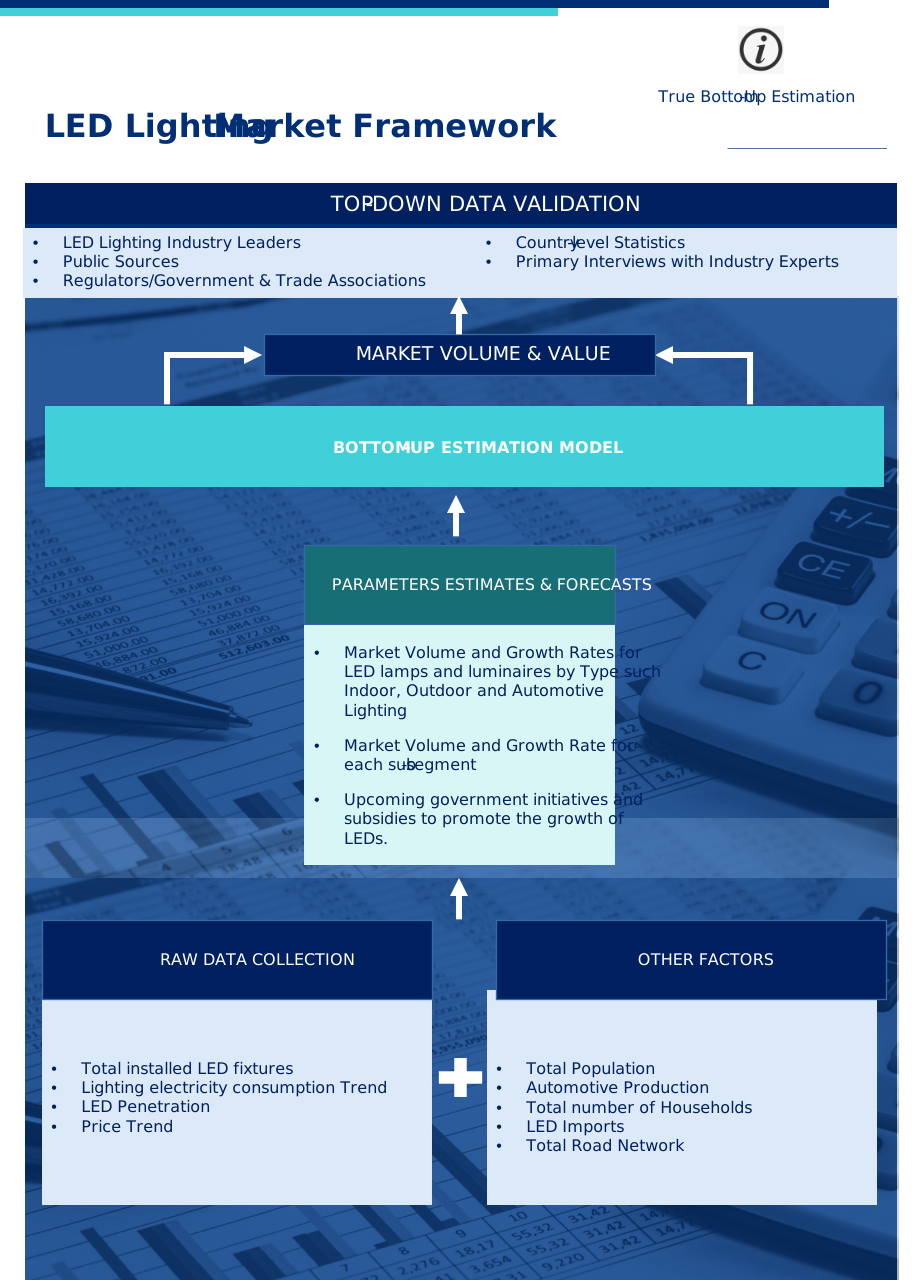
Mordor Intelligence has followed the following methodology in all our data center reports.
- Step 1: Raw Data Collection: To understand the market, initially, all crtical data points were identified. Critical information about countries and regions of interest including Per-capita Income, Population, Automotive Production, Interest rate on Auto-Loans, Number of Automobiles on Road, Total LED Import, Lighting Electricity Consumption among others were recorded or estimated based on internal calculations.
- Step 2: Identify Key Variables: To build a robust forecasting model, key variables such as Number of Households, Automotive Production, Road Networks among others were identified. Through an iterative process, the variables required for the market forecast were set, and the model was built using these variables.
- Step 3: Build a Market Model: Based on data and critical industry trend data (variables), including LED pricing, LED penetration rate, and project macro and micor economic factors were utilized for building the market forecasting.
- Step 4: Validate and Finalize: In this crucial step, all market numbers and variables derived through an internal mathematical model were validated through an extensive network of primary research experts from all the markets studied. The respondents are selected across levels and functions to generate a holistic picture of the market studied.
- Step 5: Research Outputs: Syndicated Reports, Custom Consulting Assignments, Databases & Subscription Platforms





 Your data is secure and never sold or shared.


