
Market Overview
| Study Period | 2020 - 2031 |
|---|---|
| Forecast Data Period | 2026 - 2031 |
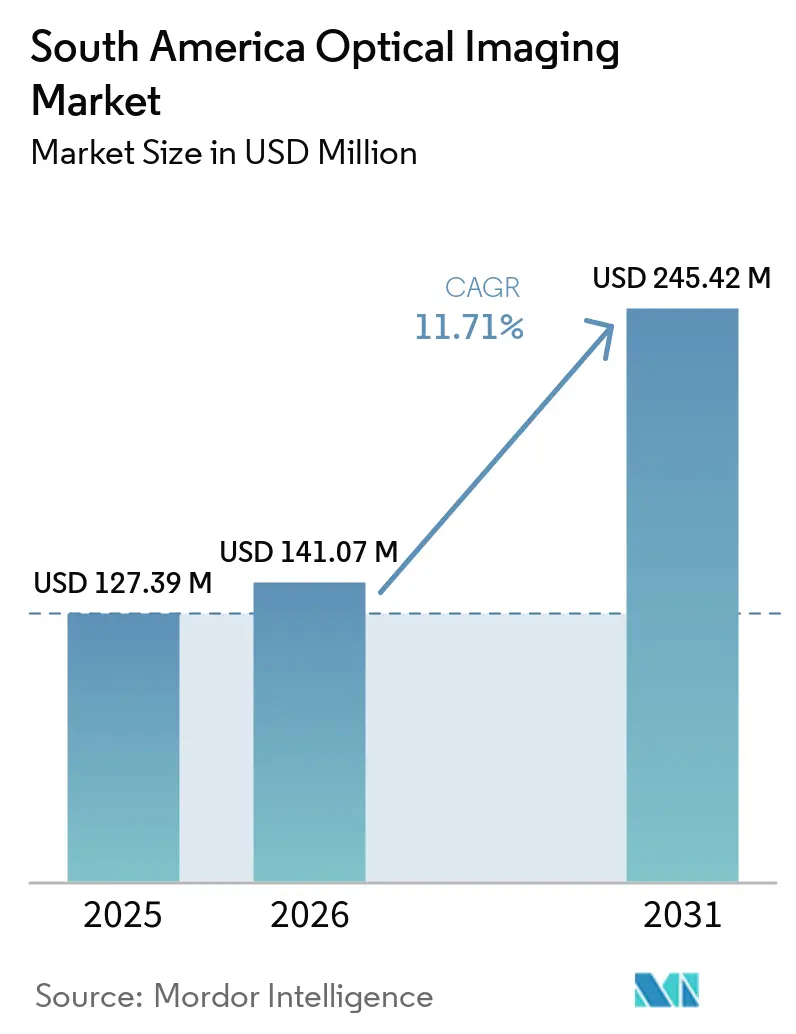
| Base Year Market Size (2025) | USD 127.39 Million |
| Market Size (2026) | USD 141.07 Million |
| Market Size (2031) | USD 245.42 Million |
| Growth Rate (2026 - 2031) | 11.71 % |
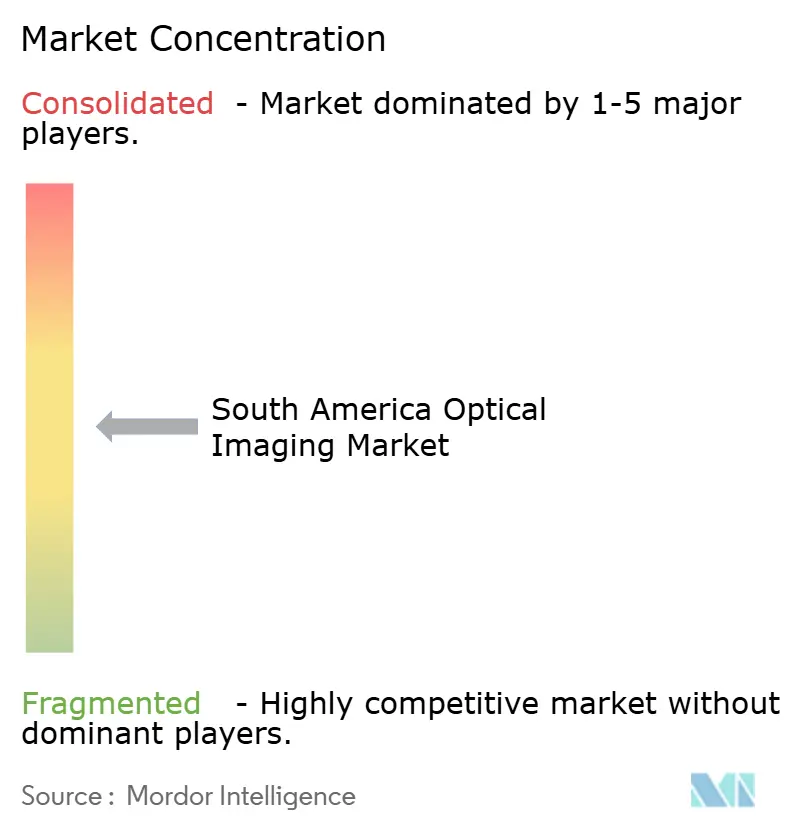
| Market Concentration | Medium |
Major Players *Disclaimer: Major Players sorted in no particular order Image © Mordor Intelligence. Reuse requires attribution under CC BY 4.0. | |
South America Optical Imaging Market Analysis by Mordor Intelligence
The South America optical imaging market size was valued at USD 127.39 million in 2025 and is estimated to expand from USD 141.07 million in 2026 to reach USD 245.42 million by 2031, at a CAGR of 11.71% during the forecast period (2026-2031). The rising burden of diabetes and retinal disease is increasing the need for earlier eye examinations across public and private care settings. Digital health programs are bringing retinal imaging into primary care locations that previously lacked diagnostic imaging equipment. This shift expands demand beyond replacement purchases in major hospitals. Suppliers are pairing portable devices with artificial intelligence software and remote clinical review systems. Import costs, currency movements, service coverage, and training capacity remain important limits on adoption.
Key Report Takeaways
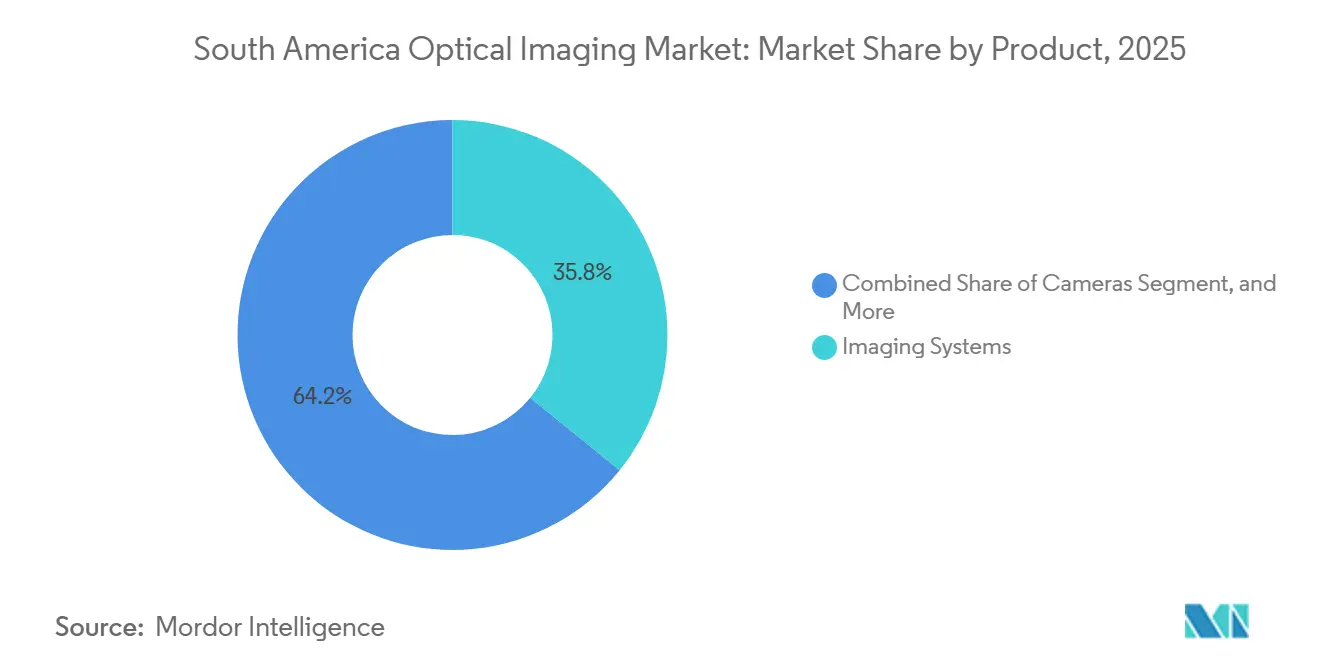
- By product, imaging systems held 35.82% of the South America optical imaging market share in 2025, while cameras are projected to expand at a 12.71% CAGR through 2031.
- By application, ophthalmology accounted for 33.14% of the market in 2025, while oncology is projected to expand at a 13.29% CAGR through 2031.
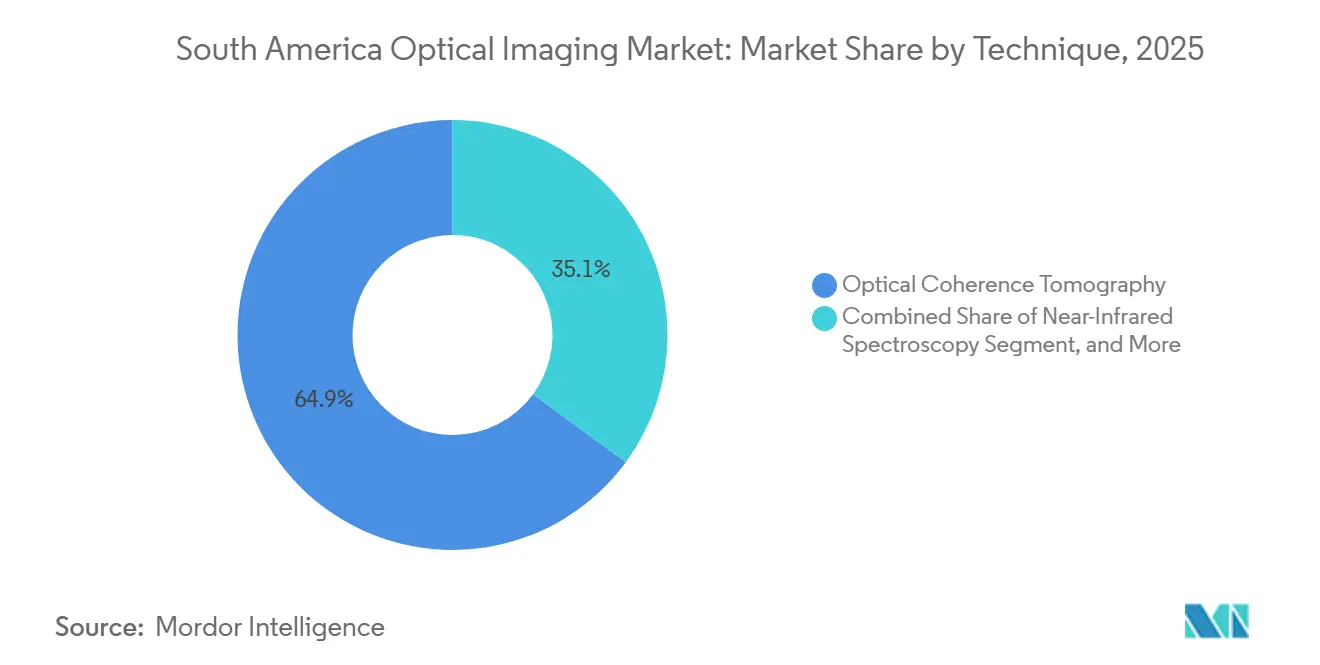
- By technique, optical coherence tomography held 64.92% of the market in 2025, while photoacoustic tomography is projected to expand at a 12.48% CAGR through 2031 in the South America optical imaging market.
- By end user, hospitals and clinics held 43.67% of the market in 2025, while research and diagnostic laboratories are projected to expand at a 12.43% CAGR through 2031.
- By geography, Brazil held 61.17% of the market in 2025, while Colombia is projected to expand at a 12.27% CAGR through 2031 in the South America optical imaging market.
Note: Market size and forecast figures in this report are generated using Mordor Intelligence’s proprietary estimation framework, updated with the latest available data and insights as of January 2026.
South America Optical Imaging Market Trends and Insights
Drivers Impact Analysis*
| Driver | (~) % Impact on CAGR Forecast | Geographic Relevance | Impact Timeline |
|---|---|---|---|
| ising Retinal Disorders and Diabetes | +2.8% | Brazil, Argentina, Chile, Peru, and Colombia | Short term (≤ 2 years) |
| Public Eye Screening Programs | +1.9% | Brazil, Colombia, and Chile | Medium term (2-4 years) |
| AI-Enabled and Multimodal Imaging Adoption | +1.7% | South America, with early use in Brazil and Argentina | Medium term (2-4 years) |
| Tele-Ophthalmology and Remote Diagnostics | +1.3% | Brazil, Peru, and Colombia | Short term (≤ 2 years) |
| Portable Imaging for Underserved Areas | +1.1% | Brazil, Peru, Argentina, Chile, and Bolivia-border communities | Medium term (2-4 years) |
| Biotechnology and Translational Research Expansion | +0.8% | Brazil, Argentina, and Chile | Long term (≥ 4 years) |
| Source: Mordor Intelligence | |||
Rising Prevalence of Retinal Disorders and Diabetes
Diabetes creates a direct demand for ophthalmic imaging because diabetic retinopathy requires regular retinal examination. A 2025 São Paulo primary-care study reported a 28.3% prevalence of diabetic retinopathy, with 65.1% of cases classified as mild nonproliferative disease. A 2025 study by the Brazilian Council of Ophthalmology, in northeastern Brazil, found that 78.1% of diabetic patients had difficulty scheduling an ophthalmology appointment, while 76.3% lacked a local public-sector ophthalmologist.[1]Rodrigo Cezar Marques et al., “Diabetic Retinopathy in Primary Healthcare in a Brazilian Municipality: A Cross-Sectional Study Using Teleophthalmology,” Health Care Science, doi.org Retinal imaging allows primary-care teams to assess patients before specialist referral and focus scarce specialist time on urgent cases. The South America optical imaging market gains when health systems reach people who have not received routine retinal screening. This favors devices and image-management tools that trained nonphysician staff can use reliably.
Expansion of Public Eye-Screening Programs
Public eye-screening programs are becoming a more regular source of procurement across South America. Mato Grosso acquired 250 Eyer2 portable retinographs in December 2025, distributed 70 devices to 69 municipalities, and trained 100 primary-care professionals. Brazil's public health system expanded retinograph procurement in June 2026 to support diabetic retinopathy screening in primary care centers. Portable devices create demand from facilities without space, electrical infrastructure, or budgets for complete imaging suites. ANVISA safety and performance requirements influence product specifications and favor suppliers with established registrations. The South America optical imaging market benefits when retinal imaging becomes part of population-level prevention rather than only hospital capital spending.
Adoption of AI-Enabled and Multimodal Imaging
Artificial intelligence improves the output of imaging services where specialist capacity is limited. The Escola Paulista de Medicina project combined portable retinographs with Eyermap's artificial intelligence, reducing specialist review time from 20 days to 9 days. Heidelberg Engineering reported in 2025 that Eye2Gene used SPECTRALIS multimodal imaging to predict gene candidates associated with inherited retinal disease. A 2024 study at a Santiago public hospital reported 100% sensitivity and 84% specificity for detecting sight-threatening diabetic retinopathy using EyeArt. These applications support screening without matching each increase in image volume with an equal increase in specialist staffing. The South America optical imaging market benefits when software is embedded in clinical workflows rather than treated as a separate purchase.
Growth of Tele-Ophthalmology and Remote Diagnostics
Tele-ophthalmology extends imaging services to Amazon communities, Andean areas, and large inland regions. A Fiocruz IdeiaSUS program screened 1,290 patients between June 2025 and March 2026 using portable retinographs and remote artificial intelligence-assisted analysis. The cost per case detected fell from BRL 70.82 (USD 12.00) to BRL 50.64 (USD 8.58), while diagnosis time declined from 83 days to 1.3 days. A 2024 Brazilian Amazon study found retinal findings in 37.4% of people screened using smartphone-based fundus cameras and telemedicine-based readings. Each equipped care site can create future requirements for maintenance, replacement, and data management. The opportunity is strongest when equipment, training, connectivity, and clinical referral pathways are implemented together.
Restraints Impact Analysis*
| Restraint | (~) % Impact on CAGR Forecast | Geographic Relevance | Impact Timeline |
|---|---|---|---|
| High Acquisition and Total Ownership Cost | -1.8% | Brazil, Argentina, and Peru | Medium term (2-4 years) |
| Import Dependence, Tariffs, and Currency Volatility | -1.4% | Brazil, Argentina, and Peru | Short term (≤ 2 years) |
| Uneven Service, Calibration, and Training Coverage | -0.9% | Brazil, Peru, Argentina, and Colombia | Long term (≥ 4 years) |
| Long Public Hospital Replacement Cycles | -0.7% | Brazil, Argentina, and Colombia | Long term (≥ 4 years) |
| Source: Mordor Intelligence | |||
High Acquisition and Total Cost of Ownership
Premium platforms, including swept-source optical coherence tomography, hyperspectral imaging, and multimodal retinal systems, cost USD 50,000 to more than USD 150,000 per unit. These prices can exceed the authority of district-level hospitals and extend public procurement cycles. Factory service, calibration, software licensing, and operator training add material costs over a 5-7 year device life. These costs can reach 1.5-2.0 times the original purchase price. The burden concentrates high-acuity equipment in referral centers and private hospital groups. Smaller facilities may opt for portable systems with lower upfront costs, thereby reducing revenue per unit for premium equipment suppliers.
Import Dependence, Tariffs, and Currency Volatility
South America depends heavily on imported optical coherence tomography engines, hyperspectral sensors, and precision optics. Brazil imported USD 4.7 billion worth of medical equipment under NCM 9018 in 2025. Optical imaging devices require ANVISA import licensing and INMETRO electrical safety certification, and new models may face 12-24-month approval timelines.[2]“Medical Devices,” Agência Nacional de Vigilância Sanitária, gov.br Equipment commonly priced in USD or EUR becomes more expensive in local currency when the Brazilian real or Argentine peso depreciates. Suppliers may also limit flexible financing in markets with currency controls. These conditions delay high-specification purchases and increase the appeal of lower-cost portable systems, while maintaining the need for reliable service and calibration.
*Our forecasts treat driver/restraint impacts as directional, not additive. The impact forecasts reflect baseline growth, mix effects, and variable interactions.
Segment Analysis
By Product: Imaging Systems Lead While Portable Cameras Drive Demand
Imaging systems commanded 35.82% of the South America optical imaging market share in 2025. The South America optical imaging market includes optical coherence tomography, confocal scanning laser ophthalmoscopes, tabletop fundus cameras, and spectral imaging platforms. Hospitals, oncology centers, and universities use these systems for specialist clinical and research work. Their clinical breadth supports demand across ophthalmology, cardiology, and laboratory applications. Their higher cost makes service coverage, trained staff, and stable budgets important purchasing conditions.
Cameras are projected to expand at a 12.71% CAGR through 2031 within the South America optical imaging market. Mato Grosso's 2025 purchase of 250 Eyer2 retinographs shows the role of public tele-ophthalmology procurement. Portable formats serve sites with limited space, electrical infrastructure, and capital budgets. Software supports recurring revenue through diabetic retinopathy grading and glaucoma monitoring. Suppliers with existing registrations and distributor networks have an advantage in government tenders.



By Application: Ophthalmology Leads While Oncology Advances
Ophthalmology accounted for 33.14% of the South America optical imaging market in 2025. Optical coherence tomography and fundus imaging are established tools for eye care and diabetic retinopathy screening. Dentistry and dermatology are secondary applications for near-infrared spectroscopy and optical coherence tomography. Cardiology uses coronary optical coherence tomography during interventional procedures, with Abbott Laboratories offering the Ilumien PCI platform. Neurology remains more research-focused because reimbursement pathways are limited.
Oncology is projected to expand at a 13.29% CAGR through 2031. Photoacoustic tomography and hyperspectral imaging support noninvasive tumor characterization and intraoperative margin assessment. In the South America optical imaging market, these methods can map angiogenesis, hypoxia gradients, and oxygen saturation without ionizing radiation or contrast agents. University infrastructure funded through FAPESP and CONICET supports biotechnology and research demand. Petrobras and Unicamp also use hyperspectral scanning for pre-salt core analysis, adding nonmedical demand.
By Technique: Optical Coherence Tomography Leads While Photoacoustic Tomography Accelerates/
Optical coherence tomography held 64.92% of the demand by technique in 2025. Its position reflects long clinical use, reimbursement acceptance, and application across ophthalmology, cardiology, and dentistry. Swept-source systems enable deeper tissue penetration and faster scanning. Heidelberg Engineering received FDA 510(k) clearance in June 2026 for a SPECTRALIS update with 250 kHz angiography scan speed. Faster acquisition can reduce motion artifacts and enable wider-field angiography in one acquisition.
Photoacoustic tomography is projected to expand at a 12.48% CAGR through 2031. It is moving from early research toward clinical evaluation in oncology and neurology centers. Its nonionizing and noncontrast profile suits outpatient diagnostic settings. Near-infrared spectroscopy and hyperspectral imaging also support mining, industrial inspection, research, and food safety and quality control. The South America optical imaging market encompasses techniques beyond ophthalmic devices, such as those used in industrial and research settings.
By End User: Hospitals Lead While Research Laboratories Accelerate
Hospitals and clinics held 43.67% of end-user demand in 2025. They house many high-acuity systems used by ophthalmology, oncology, and cardiology services. Private multispecialty hospital groups are also expanding diagnostic capacity across the South America optical imaging market. Diagnostic imaging centers prioritize throughput, service uptime, and reimbursement compatibility. Within the South America optical imaging market, this often favors proven mid-tier systems with established ANVISA registration.
Research and diagnostic laboratories are projected to expand at a 12.43% CAGR through 2031. FAPESP, CONICET, and ANID grants support optical instrumentation at universities and translational research institutes. Bruker installed a LUMOS II ILIM infrared laser imaging microscope at Universidade Federal do ABC in December 2025 and completed another installation at Universidade Federal do Rio Grande do Norte in January 2026. These investments build trained user bases that can influence later hospital specifications. Industrial inspection and veterinary diagnostics have lower demand in Brazil's agribusiness and mining sectors.
Geography Analysis
Brazil held 61.17% of regional demand in 2025. Its scale reflects procurement by private hospital chains, SUS hospitals, state health secretariats, and research institutions. Mato Grosso's purchase of 250 portable retinographs shows how state programs support primary-care imaging. ANVISA registration requirements shape access to imported devices, while agro-industrial and oil-and-gas uses diversify demand.
Colombia is projected to expand at a 12.27% CAGR through 2031. Healthcare expansion in isolated areas is increasing the demand for basic diagnostic capability. Subsidized insurance coverage and diabetic retinopathy screening support the deployment of fundus cameras in primary care. Public tenders issued through SECOP in 2026 indicate continuing institutional demand. The South America optical imaging market size in Colombia remains below Brazil's, but public access and technology adoption support faster expansion.
Argentina, Chile, and Peru contribute to the South America optical imaging market through research and public health pathways. Argentina benefits from CONICET institutes and demand from aging populations in Buenos Aires and Córdoba. Chile has evaluated artificial intelligence-assisted screening for diabetic retinopathy at a public hospital in Santiago. Pontificia Universidad Católica del Perú is developing optical coherence tomography elastography for early keratoconus detection
Competitive Landscape
The South America optical imaging market is moderately fragmented, with the presence of Carl Zeiss Meditec AG, Topcon Corporation, Heidelberg Engineering GmbH, and NIDEK CO., LTD., all of which have established positions in hospital ophthalmology. Their portfolios, distributor relationships, and specialist familiarity support access to clinical accounts. Carl Zeiss Meditec reported Americas revenue of EUR 579 million (USD 645 million) in fiscal year 2024/25, compared with EUR 533 million (USD 594 million) in the previous year.[3]“Annual Report Carl Zeiss Meditec AG FY 2024/25,” Carl Zeiss Meditec AG, zeiss.com
\Leading suppliers are expanding beyond device sales through software and workflow tools. Heidelberg Engineering uses HEYEX 2 AppWay and Eye2Gene to add applications to its imaging environment. Topcon offers the Harmony artificial intelligence Marketplace and received FDA clearance for OMNIA in November 2025. Suppliers also invest in early regulatory filings and local clinical education in Portuguese and Spanish. ANVISA's 2026 accelerated evaluation call may favor firms with established local regulatory teams.
Competitive openings in the South America optical imaging market remain in primary-care screening and specialized hyperspectral imaging. Portable instruments attract competitors in countries where public programs require lower purchase costs and easier deployment in geographically dispersed care networks. Heidelberg Engineering introduced its Heidelberg RCM corneal confocal microscopy system in August 2026. Research-grade products serve universities, but affordable field-deployable hyperspectral imaging for oncology has limited regional use.
South America Optical Imaging Industry Leaders
Carl Zeiss Meditec AG
Topcon Corporation
Heidelberg Engineering GmbH
NIDEK CO., LTD.
Canon Inc.
- *Disclaimer: Major Players sorted in no particular order

Recent Industry Developments
- August 2026: ANVISA launched Call 5/2026 (Edital de Chamamento 5/2026), inviting developers of innovative Class III and IV medical devices to participate in an accelerated regulatory evaluation program. The initiative creates a structured fast-track pathway for novel optical imaging modalities seeking ANVISA approval in Brazil, directly reducing the time-to-market disadvantage that has historically slowed advanced imaging technology diffusion in the region.
- August 2026: Heidelberg Engineering debuted the Heidelberg RCM (corneal confocal microscopy) at the European Society of Cataract and Refractive Surgeons (ESCRS) Congress 2026 in London. The system enables non-invasive, cellular-level microscopic imaging of the cornea and marks the company's return to in vivo anterior segment imaging, market availability by country is to be announced separately.
- June 2026: Heidelberg Engineering received FDA 510(k) clearance for the latest SPECTRALIS software release, which introduces 250 kHz scan speed for OCT angiography, the platform's fastest acquisition rate, alongside an expanded Green Autofluorescence (AF) Module for improved macular visualization. Commercial launch in the second half of 2026 will directly benefit South American accounts upgrading existing SPECTRALIS systems.
- June 2026: Brazil's SUS expanded its retinograph procurement program, distributing additional portable fundus cameras to primary care centers to accelerate diabetic retinopathy screening. The expansion, supported by the Brazilian Society of Diabetes (SBD), is part of an ongoing artificial intelligence-assisted tele-screening study comparing autonomous artificial intelligence grading with specialist interpretation across the same patient cohort.


South America Optical Imaging Market Report Scope
The South America Optical Imaging Market refers to the market for optical imaging technologies, systems, components, and associated software used to capture, visualize, analyze, and interpret biological tissues, cells, organs, and other samples through light-based imaging techniques. The market includes revenues generated from the sale and deployment of optical imaging systems, cameras, illumination systems, lenses, and software, as well as their use across clinical, diagnostic, research, and biotechnology applications.
The South America Optical Imaging Market Report is Segmented by Product (Imaging Systems, Cameras, Illumination Systems, Lenses, and Software), Application (Ophthalmology, Dentistry, Dermatology, Cardiology, Neurology, Oncology, Biotechnology and Research, and Other Applications), Technique (Optical Coherence Tomography, Near-Infrared Spectroscopy, Hyperspectral Imaging, and Photoacoustic Tomography), End-User (Hospitals and Clinics, Diagnostic Imaging Centers, Research and Diagnostic Laboratories, and Other End-Users), and Geography (Brazil, Argentina, Colombia, and Rest of South America). The Market Forecasts are Provided in Terms of Value (USD).
By Product
| Imaging Systems | Optical Imaging Systems |
| Spectral Imaging Systems | |
| Cameras | |
| Illumination Systems | |
| Lenses | |
| Software |
By Application
| Ophthalmology |
| Dentistry |
| Dermatology |
| Cardiology |
| Neurology |
| Oncology |
| Biotechnology and Research |
| Other Applications |
By Technique
| Optical Coherence Tomography |
| Near-Infrared Spectroscopy |
| Hyperspectral Imaging |
| Photoacoustic Tomography |
By End-User
| Hospitals and Clinics |
| Diagnostic Imaging Centres |
| Research and Diagnostic Laboratories |
| Other End-Users |
By Geography
| Brazil |
| Argentina |
| Colombia |
| Rest of South America |
| By Product | Imaging Systems | Optical Imaging Systems |
| Spectral Imaging Systems | ||
| Cameras | ||
| Illumination Systems | ||
| Lenses | ||
| Software | ||
| By Application | Ophthalmology | |
| Dentistry | ||
| Dermatology | ||
| Cardiology | ||
| Neurology | ||
| Oncology | ||
| Biotechnology and Research | ||
| Other Applications | ||
| By Technique | Optical Coherence Tomography | |
| Near-Infrared Spectroscopy | ||
| Hyperspectral Imaging | ||
| Photoacoustic Tomography | ||
| By End-User | Hospitals and Clinics | |
| Diagnostic Imaging Centres | ||
| Research and Diagnostic Laboratories | ||
| Other End-Users | ||
| By Geography | Brazil | |
| Argentina | ||
| Colombia | ||
| Rest of South America |


Key Questions Answered in the Report
What is the South America optical imaging market size?
It is estimated at USD 141.07 million in 2026 and is forecast to reach USD 245.42 million by 2031 at an 11.71% CAGR.
What is driving demand for optical imaging in South America?
Diabetes screening, public eye-care programs, portable retinal cameras, artificial intelligence software, and tele-ophthalmology are supporting demand.
Which product category leads regional demand?
Imaging systems led with 35.82% share in 2025, while cameras are projected to expand at a 12.71% CAGR through 2031.
Which application is expanding fastest?
Oncology is projected to expand at a 13.29% CAGR through 2031, supported by photoacoustic tomography and hyperspectral imaging.
Which country leads optical imaging demand in South America?
Brazil held 61.17% of regional demand in 2025, supported by SUS procurement, private hospitals, research institutions, and tele-ophthalmology programs.
What limits adoption of optical imaging systems in the region?
High equipment and service costs, import dependence, currency volatility, training gaps, and lengthy public replacement cycles can limit adoption.
Page last updated on:





