
South America Mobile Homes Market Size and Share
Market Overview
| Study Period | 2021 - 2032 |
|---|---|
| Forecast Data Period | 2027 - 2032 |
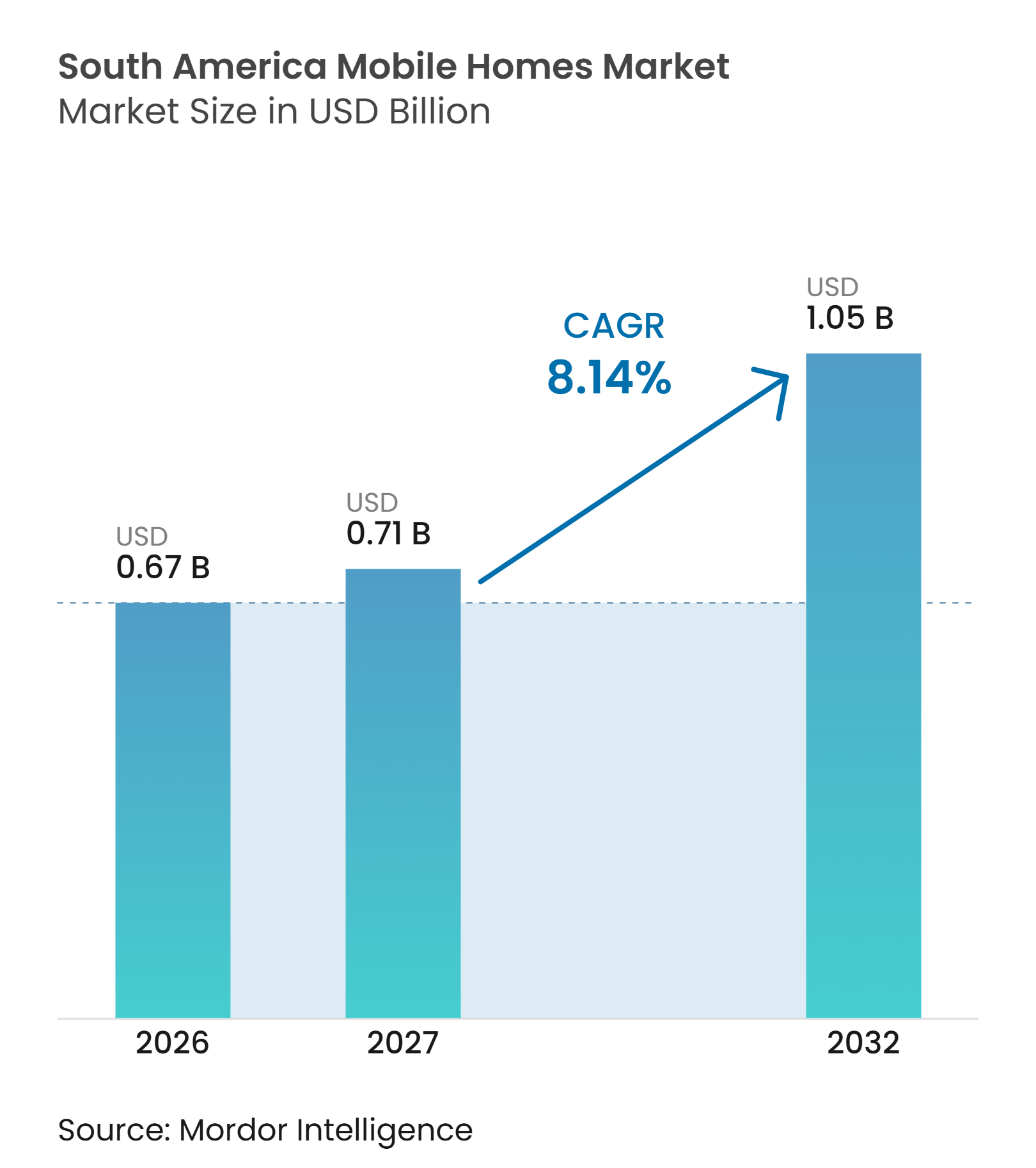
| Base Year Market Size (2026) | USD 0.67 Billion |
| Market Size (2027) | USD 0.71 Billion |
| Market Size (2032) | USD 1.05 Billion |
| Growth Rate (2027 - 2032) | 8.14 % |
| Market Concentration | Low |
Major Players *Disclaimer: Major Players sorted in no particular order Image © Mordor Intelligence. Reuse requires attribution under CC BY 4.0. | |
South America Mobile Homes Market Analysis by Mordor Intelligence
The South America mobile homes market was valued at USD 0.67 billion in 2026 and is projected to reach USD 0.71 billion in 2027 and USD 1.05 billion by 2032, registering a CAGR of 8.14% during the 2027–2032 forecast period.
Persistent housing shortages in Brazil, Colombia, and Argentina keep demand focused on homes that can be produced under controlled conditions and installed quickly. Brazil provides the largest volume base because its housing programs and local timber supply chain support industrialized construction. Chile offers a more mature manufacturing base for residential projects, remote workforce camps, and hospitality uses. Colombia has the strongest forecast growth, although limits on new housing subsidies may weigh on entry-level demand. Across the South American mobile homes market, manufacturers are focusing on reliable delivery schedules, compliant designs, and cost control as buyers place greater weight on project certainty.
Key Report Takeaways
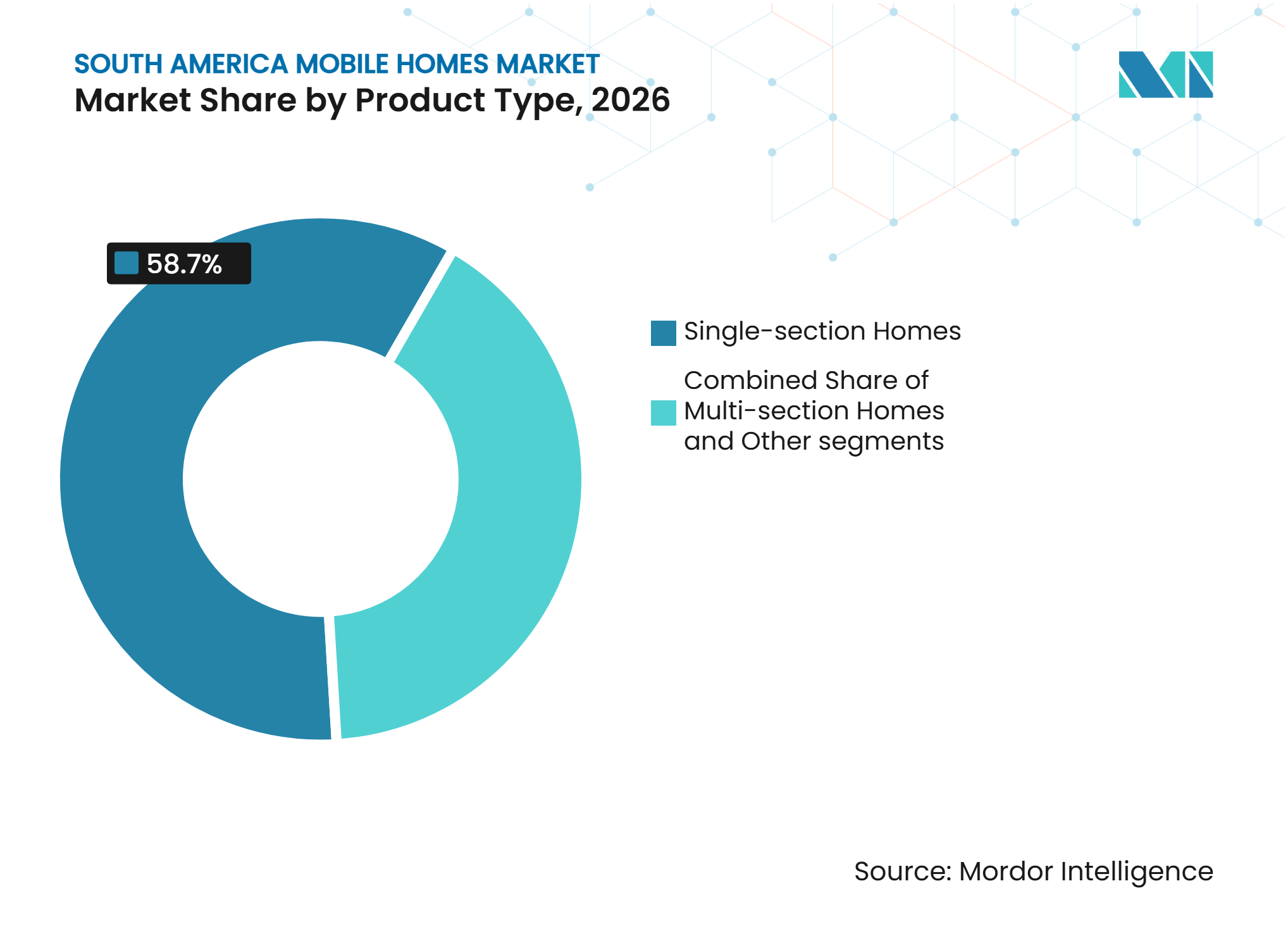
- By product type, single-section homes held 58.70% of the South America mobile homes market share in 2026, while the other categories are projected to grow at a CAGR of 10.08% through 2032.
- By material, timber-based construction accounted for 48.90% of the South America mobile homes market size in 2026, while composite and other materials are forecast to expand at a CAGR of 9.72% through 2032.
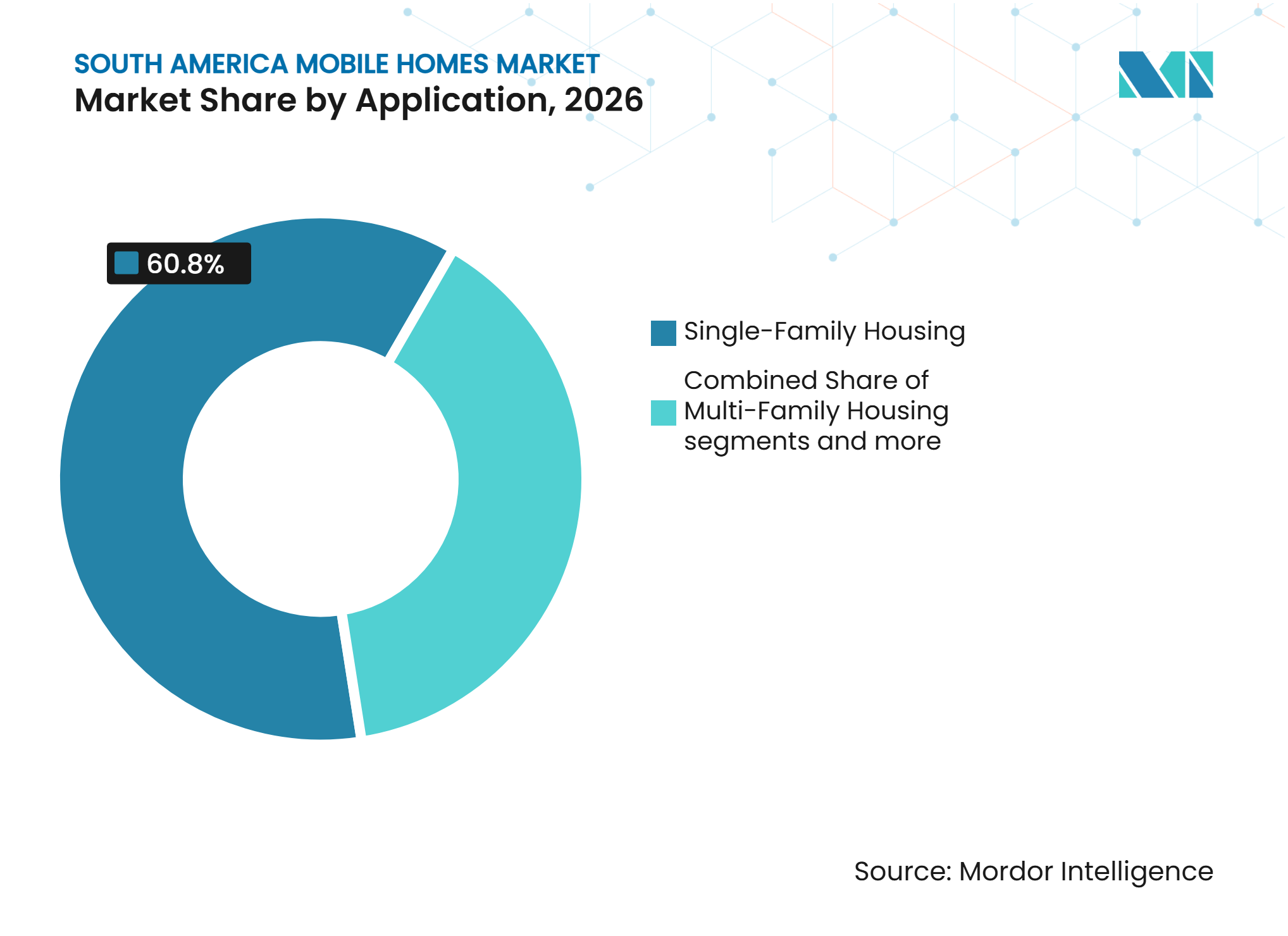
- By application, single-family housing captured 60.80% of the South America mobile homes market share in 2026, while the other categories are projected to grow at a CAGR of 10.24% through 2032.
- By geography, Brazil held 46.50% of the South America mobile homes market size in 2026, while Colombia is forecast to grow at a CAGR of 9.81% through 2032.
Note: Market numbers in this report are based on Mordor Intelligence's proprietary estimation framework, which combines nine months of actuals with Q4 projections for base year 2026.
Market Trends and Insights
Drivers Impact Analysis of South America Mobile Homes Market*
| Drivers | (~) % Impact on CAGR Forecast | Geographic Relevance | Impact Timeline |
|---|---|---|---|
| Affordable Housing Demand Drives Mobile Home Adoption | +2.3% | Brazil, Colombia, Argentina, Chile | Short term (≤ 2 years) |
| Persistent Housing Shortages Increase Demand for Factory-Built Homes | +1.7% | Brazil, Colombia, Argentina | Medium term (2-4 years) |
| Faster Construction and Cost Predictability Support Market Growth | +1.4% | Brazil, Chile, Colombia | Short term (≤ 2 years) |
| Public and Social Housing Programs Boost Mobile Home Deployment | +1.2% | Brazil, Chile | Medium term (2-4 years) |
| Cross-Border Standardization of Modular Systems Improves Market Expansion | +0.7% | Brazil, Chile, Colombia | Long term (≥ 4 years) |
| Tourism, Mining, and Remote-Site Accommodation Increase Demand | +0.6% | Argentina, Chile, Brazil | Medium term (2-4 years) |
| Source: Mordor Intelligence | |||
Affordable Housing Demand Drives Mobile Home Adoption
Housing affordability remains the primary driver of demand for the South American mobile homes market. The CAF reported in 2024 that the regional quantitative housing deficit affected more than 23 million people, while the qualitative deficit affected another 46 million people[1]. These shortfalls leave many households with limited access to conventional new construction. Factory-built homes can provide a more predictable delivery route when standardized designs and controlled production are available. The opportunity is strongest in lower-cost urban and peri-urban housing, where demand is linked to basic supply gaps rather than discretionary purchases. This makes affordability an important driver of stable demand in the South America mobile homes market.
Persistent Housing Shortages Increase Demand for Factory-Built Homes
Brazil ended 2024 with a housing deficit of 5.77 million units, even after a second consecutive annual decline in the deficit[2]. The same IPEA assessment found that more than 16.3 million Brazilian families experienced at least one housing inadequacy, and estimated the cost of remediation at USD 53.6 billion. Such conditions support the use of factory-built systems that can add units without depending entirely on long on-site construction cycles. Lightweight modular formats can also be practical on irregular peri-urban plots where infrastructure links are incomplete. Brazil’s Ministry of Cities included wood-frame industrialized construction in the Minha Casa, Minha Vida program framework in 2025, which recognized the role of industrialized methods in reducing the housing gap. The South America mobile homes market, therefore, benefits from a need for additional housing that conventional delivery methods alone have struggled to meet.
Faster Construction and Cost Predictability Support Market Growth
Delivery speed is a practical advantage for developers, public agencies, and employers who need housing in defined timeframes. In February 2025, a 60-apartment industrialized residential complex in Lo Espejo, Chile, was assembled in 42 days[3]. Controlled production helps reduce exposure to weather delays and uneven site conditions. It also allows buyers to establish material requirements before installation begins. This can lower planning risk when project funding or public delivery commitments have fixed schedules. These factors reinforce the position of the South America mobile homes market, where speed and dependable handover dates matter as much as unit cost.
Public and Social Housing Programs Boost Mobile Home Deployment
Public housing programs provide an important route to scale for modular suppliers. Brazil’s 2025 policy changes enabled industrialized wood-frame systems to participate in Minha Casa, Minha Vida, a federal affordable-housing program. Brazil’s Chamber of Deputies also approved a proposal supporting program financing for homes made with certified timber from planted forests. In Chile, industrialized housing certification supports public procurement of qualified designs. These programs give manufacturers a clearer basis for planning capacity and developing compliant product lines, while also encouraging suppliers to strengthen documentation, certification, and quality-control processes before bidding for public work.
Restraints Impact Analysis of South America Mobile Homes Market*
| Restraints | (~) % Impact on CAGR Forecast | Geographic Relevance | Impact Timeline |
|---|---|---|---|
| Zoning, Permitting, and Land-Use Uncertainty Delay Development | -1.1% | Brazil, Argentina, Colombia | Short term (≤ 2 years) |
| Consumer Acceptance and Financing Challenges Limit Growth | -0.8% | Argentina, Brazil, Colombia | Medium term (2-4 years) |
| Transportation, Crane Access, and Utility Constraints Increase Costs | -0.6% | Argentina, Rest of South America | Medium term (2-4 years) |
| Currency Volatility and Imported Components Raise Costs | -0.5% | Argentina, Colombia | Long term (≥ 4 years) |
| Source: Mordor Intelligence | |||
Zoning, Permitting, and Land-Use Uncertainty Delay Project Development
Municipal regulations can delay projects in the South American mobile home market, even when manufacturing capacity is available. Regulatory treatment of mobile dwellings can vary because municipal rules do not always address permanent occupancy in the same way. In Brazil, the regulatory framework for modular coordination and timber fire safety has continued to develop. Fire safety requirements for timber and hybrid structures require project-specific compliance planning. Requirements still differ across cities and can extend approval times. This limits the delivery advantage that factory-built housing is intended to offer.
Consumer Acceptance and Financing Challenges Limit Market Growth
Many buyers still see mobile homes as temporary rather than long-term housing. This view can limit adoption among households that associate homeownership with masonry structures. Financing is also harder when a unit is treated as personal property instead of real estate. Buyers may then depend on shorter repayment periods and higher-cost credit. Better product standards and financing options are needed to expand demand beyond the most price-sensitive buyers and show households that factory-built homes can provide lasting quality, predictable upkeep, and suitable living conditions.
*Our forecasts treat driver/restraint impacts as directional, not additive. The impact forecasts reflect baseline growth, mix effects, and variable interactions.
South America Mobile Homes Market Segment Analysis
By Product Type:
Single-Section Units Support Core Housing DemandSingle-section homes held 58.70% of revenue in 2026, the largest product share in the South America mobile homes market. Their compact design suits affordable housing programs and smaller homes in rural and peri-urban areas. A single unit can usually be transported in one shipment, which reduces transport complexity. The format also helps manufacturers use repeatable layouts and manage costs. These features make single-section homes the clearest fit for high-volume residential delivery, because developers can use familiar plans across several sites and reduce the design variation that can slow production or complicate procurement.
Multi-section homes serve buyers seeking larger floor areas and more customized layouts. They require additional transport coordination and site assembly, which can restrict demand where access is difficult. The other category, including volumetric, panelized, and container-based homes, is forecast to grow at a CAGR of 10.08% through 2032. Hospitality operators use these formats for cabins and eco-lodges, while mining and energy companies use them for workforce housing. Their specialized use cases support growth above the wider South America mobile homes market, as project sponsors often value the ability to mobilize accommodation quickly and adapt units to a specific operational setting.



By Material:
Timber-Based Construction Holds the Largest ShareTimber-based construction accounted for 48.90% of revenue in 2026, the largest material share in the South America mobile homes market. Brazil’s planted-forest supply chain and engineered-wood manufacturing base support this position. Industrialized wood-frame systems can be designed for repeatable residential applications. Brazil’s affordable-housing framework now offers a clearer route for eligible wood-frame units. Timber remains suitable where local supply, standard designs, and residential affordability are priorities, while manufacturers can also use controlled production to improve material use, construction consistency, and installation planning.
Steel and concrete retain defined roles in industrial, mining, and multi-family projects. Composite and other materials are forecast to grow at a CAGR of 9.72% through 2032. Structural insulated panels, cross-laminated timber, and hybrid systems can improve thermal performance and reduce maintenance needs. These materials are useful in colder southern areas and energy-intensive hospitality locations. Technical compliance and fire safety planning remain important for wider public-sector use, because public buyers need confidence that new materials and hybrid systems meet performance expectations throughout the design and installation process.
By Application:
Single-Family Housing Remains the Largest Use CaseSingle-family housing accounted for a 60.80% share of market revenue in 2026, the largest application share in the South America mobile homes market. Brazil’s affordable-housing program and Colombia’s lower-cost housing demand support this position. Standardized ground-level homes are easier to produce at volume than complex building formats. They also help developers work within defined unit budgets and approval requirements. This makes single-family housing the central application for regional suppliers, particularly when public programs and private developers require repeatable homes with clear specifications, known floor areas, and manageable installation requirements.
Multi-family, commercial, hospitality, and institutional projects broaden the customer base. The others category is forecast to expand at a CAGR of 10.24% through 2032. It includes workforce housing, disaster-relief units, student housing, senior accommodation, and container-based units. Tecno Fast opened an automated facility in Puerto Varas after investing USD 15 million, with capacity for 400 modules each year. The investment shows how industrial accommodation demand can support larger modular projects, because employers often need a supplier that can manufacture units at scale, plan delivery to remote sites, and provide dependable post-installation support.

Geography Analysis
Brazil
Brazil held 46.50% of regional revenue in 2026, the largest South America mobile homes market share. The country combines a major housing need, public housing support, and a developed base of timber and modular suppliers. Brazil’s industrialized housing framework provides an important demand channel for compliant manufacturers. Tecverde moved its production facility to Ipeúna, São Paulo, in 2025 to improve supplier access and produce both wood-frame and steel-frame systems. Brazil’s scale makes it the most important market for standardized residential delivery. At the same time, its supplier base gives companies a stronger platform to test product lines, develop local partnerships, and compete for public housing opportunities.
Colombia
Colombia is forecast to grow at a CAGR of 9.81% through 2032, the fastest country rate in the region. Urban housing demand supports expansion in Bogotá, Medellín, Cali, and Bucaramanga. Financing availability and buyer confidence will influence how quickly lower-cost modular housing expands. Suppliers have an opportunity to support demand through clear quality standards and designs suited to urban sites. The suspension of new Mi Casa Ya allocations creates pressure in lower price ranges. Still, private housing activity continues to support demand where suppliers can provide clear pricing, appropriate financing options, and designs that meet urban site conditions.
Argentina, Chile, and Rest of South America
Argentina has strong housing need but faces currency and import-related cost pressure. Workforce accommodation near Vaca Muerta and Andean mining areas supports demand beyond the consumer segment. Chile has a more established industrial manufacturing base and demand from mining, tourism, and public housing projects. In May 2026, Cintac opened an expanded modular facility in Colina, Chile, with almost 80,000 square meters of production area. Across the rest of the region, transport planning, local sourcing, and certified designs will shape project viability, since each project must account for local climate, road conditions, labor availability, approval processes, and the needs of the end user.
Competitive Landscape
Market Concentration
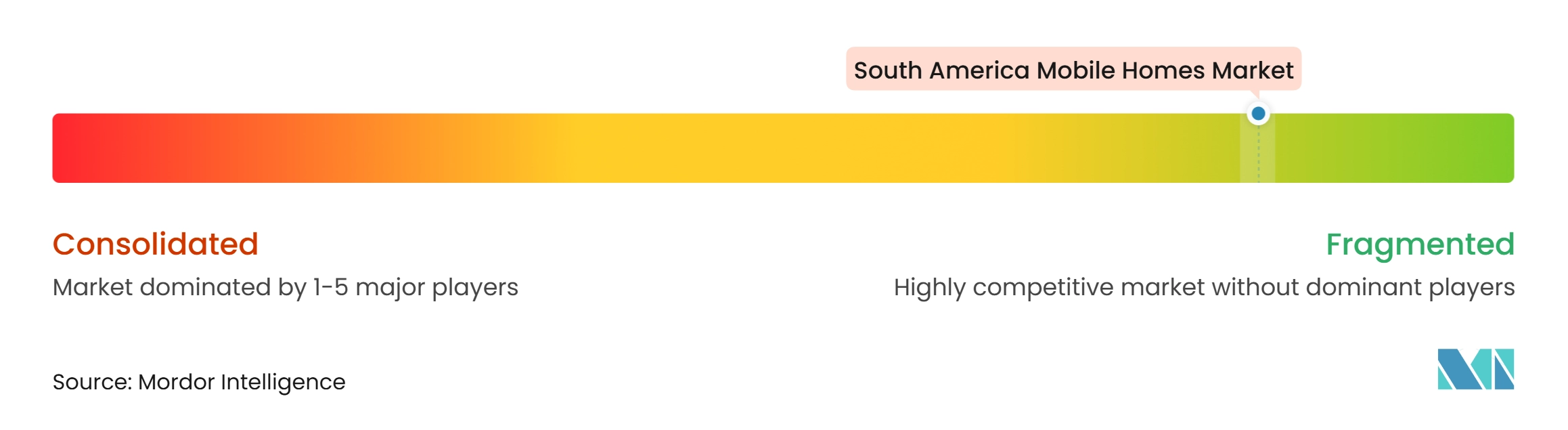
The South America mobile homes market is fragmented, with Brazil and Chile hosting the largest groups of local manufacturers. Brazil includes established wood-frame builders, social-housing contractors, and modular construction companies. Chile has a smaller group of established producers with experience in housing, mining camps, and industrial facilities. Competition depends on delivered cost, regulatory compliance, manufacturing reliability, and installation capability. Companies that can serve both public housing and industrial projects have a broader demand base and may be better able to use their factories consistently when residential procurement and project-based industrial demand do not follow the same schedule.
Suppliers are investing in capacity and production technology to improve their competitive position. Tecno Fast plans to invest USD 350 million through 2029 in its rental fleet and production technology. Its Puerto Varas facility adds automated production for southern Chile and industrial clients. Tecverde’s move to São Paulo improves access to suppliers and supports both timber and steel product lines. These actions show that location, capacity, and material flexibility are central parts of competition, because they influence how quickly a supplier can respond to large orders, manage transport distance, and adapt to customer requirements.
Larger projects favor companies that can manage design, manufacturing, transport, installation, and ongoing support. Public contracts also favor firms with approved designs and a record of reliable delivery. Opportunities remain in mid-rise modular housing, workforce camps, and energy-equipped units for remote locations. However, these projects require technical certification, working capital, and operational experience. Competition remains strongest among companies that can convert factory capacity into reliably delivered projects, rather than those that only offer a product concept.
South America Mobile Homes Industry Leaders
-
Brasmerc Group Companies
-
Casas Brazil
-
Habitar Modular
-
Tecverde Engenharia S.A.
-
Brasil ao Cubo
- *Disclaimer: Major Players sorted in no particular order
South America Mobile Homes Market Companies Covered in this Report
- Brasmerc Group Companies
- Casas Brazil
- Habitar Modular
- Tecverde Engenharia S.A.
- Brasil ao Cubo
- Modularis
- Opus Construtech
- Mova Modular
- Modulun Engenharia
- Minha Casa Box
- ModularFlex
- Tecno Fast S.A.
- Constructora Premodular
- Constructora Modular
- Casas América
- NÓMADE Modular
- Bautec Modular
- Smart House Brasil
- Hormipresa Chile
- Tecno House Argentina
Recent Industry Developments in South America Mobile Homes Market
- July 2026: Chile’s Ministry of Housing and Urban Planning launched the Lomas del Valle I project in La Serena. The project will deliver 514 industrialized homes and will use the country’s standard industrialized housing program.
- May 2026: Cintac opened its expanded Modular Chacabuco Plant in Colina, Chile. The site has almost 80,000 square meters of production space and serves mining, energy, and social housing customers.
- March 2026: PREPAT showcased its modular housing technology using cellular concrete in Comodoro Rivadavia. The system emphasizes thermal insulation, moisture resistance, and faster construction. The company indicated that two-bedroom housing units could be completed in approximately 45 days, targeting local housing shortages and reconstruction requirements.
South America Mobile Homes Market Report Scope
The South America Mobile Homes Market Report is Segmented by Product Type (Single-Section Homes, Multi-Section Homes, and Others), by Material (Timber-Based Construction, Steel-Based Construction and More), by Application (Single-Family Housing, Multi-Family Hosuing, and More), and by Country (Brazil, Argentina, Colombia, Chile, and Rest of South America). The Market Forecasts are Provided in Terms of Value (USD).
Segmentation Overview
| Single-Section Homes |
| Multi-Section Homes |
| Others (Volumetric Modular Homes, Panelized Mobile Homes, and Container-based Mobile Homes) |
| Timber-Based Construction |
| Steel-Based Construction |
| Concrete-Based Construction |
| Composite and Other Materials |
| Single-Family Housing |
| Multi-Family Housing |
| Commercial, Hospitality, and Institutional Buildings |
| Others (Disaster Relief and Temporary Housing, Student and Senior Housing, Workforce Housing, and Container-based Mobile Homes) |
| Brazil |
| Argentina |
| Colombia |
| Chile |
| Rest of South America |
| By Product Type | Single-Section Homes |
| Multi-Section Homes | |
| Others (Volumetric Modular Homes, Panelized Mobile Homes, and Container-based Mobile Homes) | |
| By Material | Timber-Based Construction |
| Steel-Based Construction | |
| Concrete-Based Construction | |
| Composite and Other Materials | |
| By Application | Single-Family Housing |
| Multi-Family Housing | |
| Commercial, Hospitality, and Institutional Buildings | |
| Others (Disaster Relief and Temporary Housing, Student and Senior Housing, Workforce Housing, and Container-based Mobile Homes) | |
| By Country | Brazil |
| Argentina | |
| Colombia | |
| Chile | |
| Rest of South America |
Key Questions Answered in the Report
What is driving demand for mobile homes in South America?
Housing shortages, affordability needs, public housing programs, and industrial accommodation demand are supporting growth. Factory-built homes are relevant where buyers require standardized designs, more predictable construction schedules, and a practical option for sites where conventional building takes longer.
How large is the South America mobile homes market?
It is valued at USD 0.67 billion in 2026 and is forecast to reach USD 1.05 billion by 2032 at an 8.14% CAGR. The outlook is supported by residential housing demand, public procurement, and project-based accommodation needs in mining, energy, and remote locations.
Which product type holds the largest share?
Single-section homes lead with 58.70% revenue share in 2026 because they fit standardized and lower-cost housing requirements. Their smaller format, simpler transport needs, and repeatable layouts make them suitable for high-volume projects where cost and installation planning are important.
Which country is growing fastest?
Colombia is forecast to record the fastest growth, with a CAGR of 9.81% through 2032. Urban housing demand supports this outlook, although financing availability, buyer confidence, and the pace of private procurement will influence the actual rate of adoption.
What are the main constraints on adoption?
Permitting, financing, consumer perceptions, transport limits, and imported component costs can delay or raise project costs. Developers need to assess site access, utility connections, land-use approvals, and the complete installed cost before choosing a factory-built solution.
Which application is growing fastest?
Other segments like workforce housing, disaster relief, student and senior accommodation, and container-based units are part of the fastest-growing application category, at a 10.24% CAGR.