
Market Overview
| Study Period | 2020 - 2031 |
|---|---|
| Forecast Data Period | 2026 - 2031 |
| Base Year Market Size (2025) | USD 1.98 Billion |
| Market Size (2026) | USD 2.15 Billion |
| Market Size (2031) | USD 3.25 Billion |
| Growth Rate (2026 - 2031) | 8.61 % |
| Market Concentration | Low |
Major Players *Disclaimer: Major Players sorted in no particular order Image © Mordor Intelligence. Reuse requires attribution under CC BY 4.0. | |
South America Manufactured Homes Market Analysis by Mordor Intelligence
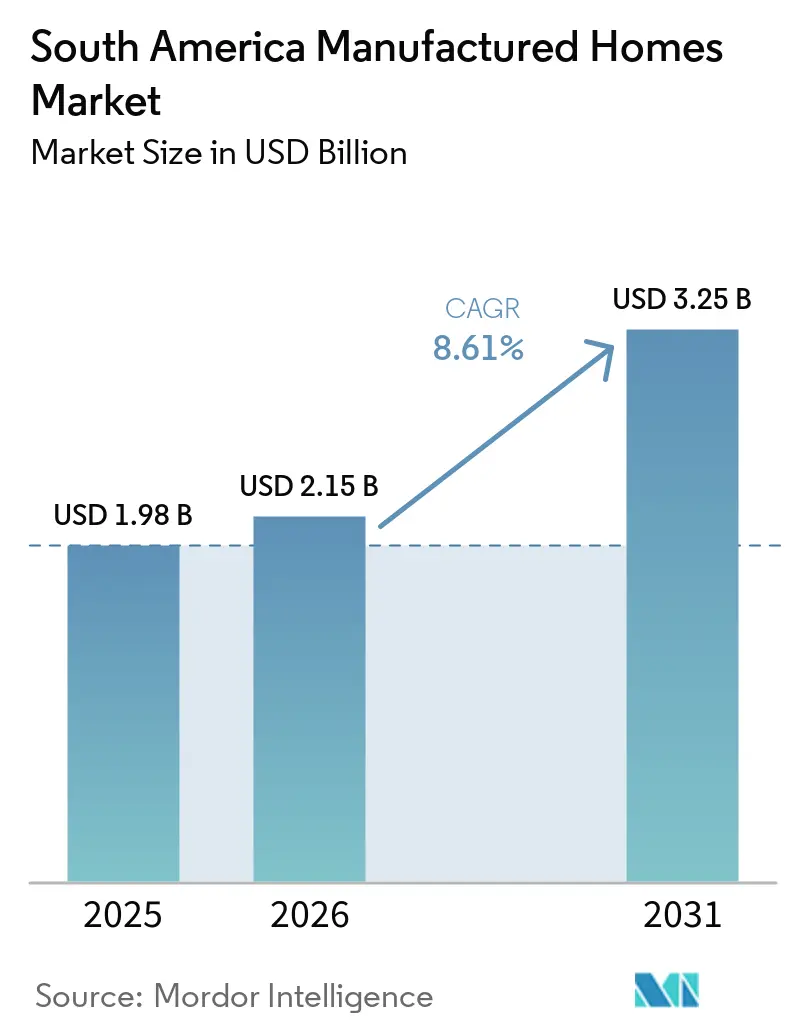
The South America Manufactured Homes Market size is expected to increase from USD 1.98 billion in 2025 to USD 2.15 billion in 2026 and reach USD 3.25 billion by 2031, growing at a CAGR of 8.61% over 2026-2031.
A regional housing shortfall of 58 million units supports demand for faster and more standardized housing delivery, especially where homes need upgrading rather than full replacement. Public housing programs in Brazil, Chile, and Colombia are giving manufacturers access to larger project pipelines and more predictable order volumes. Factory production can shorten on-site work and place more quality checks before delivery, but permitting, transport, and site preparation still affect delivery schedules and total costs. Companies that secure certifications, expand local production, and build installation networks are better placed to serve public procurement and private buyers. The South America manufactured homes market is also moving toward multi-unit, climate-adapted, and finance-supported formats as cities grow and disaster recovery needs continue.
Key Report Takeaways
- By structure type, single-section homes held a 58.00% share of the South America manufactured homes market size in 2025, while multi-section homes are forecast to grow at a 9.40% CAGR through 2031.
- By application, single-family units held an 85.00% share of the South America manufactured homes market share in 2025, while multifamily units are forecast to grow at a 10.50% CAGR through 2031.
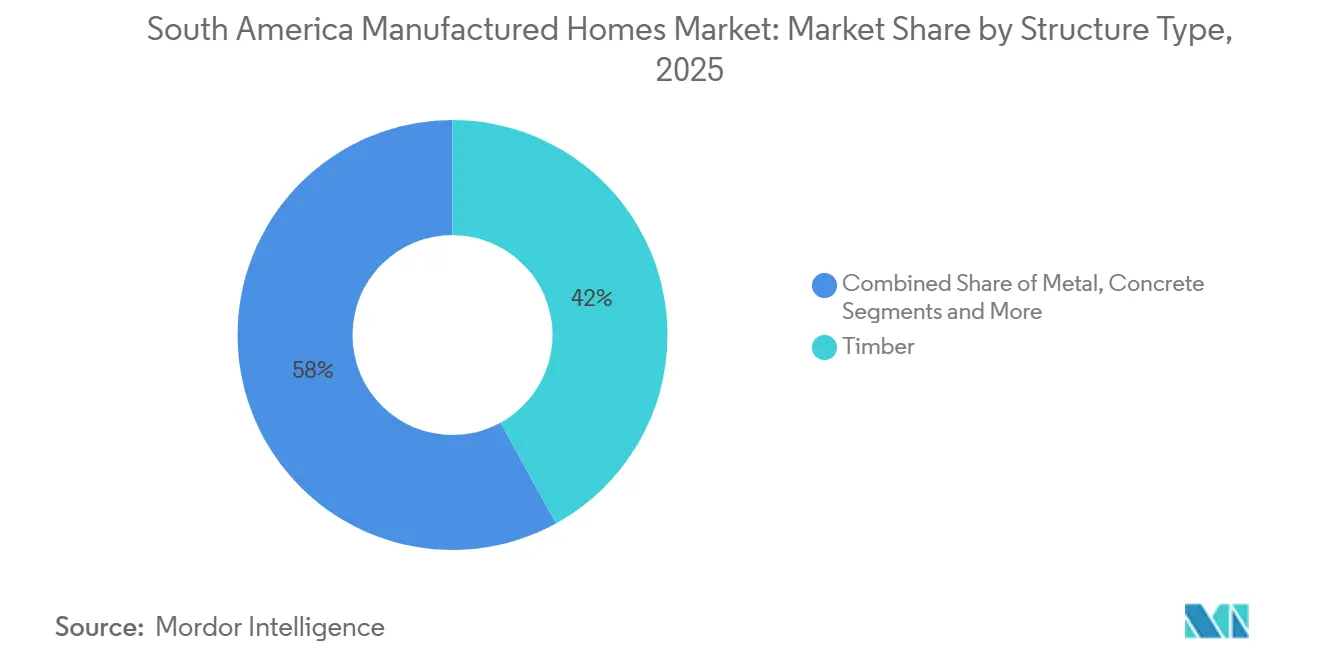
- By material, timber held a 42.00% share of the South America manufactured homes market in 2025, while metal is forecast to grow at a 10.20% CAGR in the South America manufactured homes market through 2031.
- By country, Brazil held a 38.00% share of the South America manufactured homes market in 2025, while Colombia is forecast to grow at a 10.10% CAGR in the South America manufactured homes market through 2031.
Note: Market size and forecast figures in this report are generated using Mordor Intelligence’s proprietary estimation framework, updated with the latest available data and insights as of January 2026.
Market Trends and Insights
Drivers Impact Analysis of South America Manufactured Homes Market*
| Drivers | (~) % Impact on CAGR Forecast | Geographic Relevance | Impact Timeline |
|---|---|---|---|
| Housing Deficits and Public Housing Programs Drive Manufactured Home Demand | +2.5% | Brazil, Colombia, Chile, Argentina | Short term (≤ 2 years) |
| Lower Factory-to-Foundation Costs Improve Housing Affordability | +1.8% | Brazil, Chile, Colombia | Short term (≤ 2 years) |
| Urban Infill and Peri-Urban Expansion Increase Manufactured Home Adoption | +1.4% | Brazil, Colombia, Chile | Medium term (2-4 years) |
| Climate-Resilient and Disaster-Recovery Housing Supports Market Demand | +1.1% | Brazil, Colombia, Chile | Short term (≤ 2 years) |
| Industrialization of Residential Construction Accelerates Factory-Built Housing | +0.9% | Brazil, Chile, Argentina | Medium term (2-4 years) |
| Digital Financing and Sales Platforms Improve Manufactured Home Accessibility | +0.6% | Brazil, Colombia | Long term (≥ 4 years) |
| Source: Mordor Intelligence | |||
Housing Deficits and Public Housing Programs Drive Manufactured Home Demand
Government procurement remains an important demand channel for the South America manufactured homes market because public programs can aggregate demand across many municipalities. Brazil contracted 2 million Minha Casa, Minha Vida units by the end of 2025 and intended to contract a further 1 million units through the end of 2026. In June 2026, Novo PAC allocated USD 1.9 billion for 85,000 Minha Casa, Minha Vida Rural, and Entidades units across 884 municipalities[1]. Updated financing rules, effective January 2, 2026, allow off-site industrialized production to participate in program disbursements, bringing factory production into the same funding process. This change gives producers access to a program that had previously favored work completed at the construction site and makes factory capacity more relevant to housing delivery plans.
Lower Factory-To-Foundation Costs Improve Housing Affordability
The cost case for factory-built homes depends on repeatable designs, nearby supply chains, efficient installation, and predictable site conditions. The United States International Trade Administration reported that documented Brazilian modular projects were delivered 30% to 50% faster than conventional construction[2]. Brazilian wood-frame producers use pine and eucalyptus supplies from Paraná, Santa Catarina, Rio Grande do Sul, and Minas Gerais, which supports a local material base. Some producers state that on-site assembly can be completed in fewer than 10 days when foundations and utilities are ready[3]. Within the South America manufactured homes market, transport, final site work, and uneven local infrastructure can reduce the savings outside core service areas.
Urban Infill and Peri-Urban Expansion Increase Manufactured Home Adoption
Housing demand is moving into peri-urban areas and secondary cities, where land may be available, but skilled construction labor is less accessible. Centralized factories can serve these areas when road access, local crews, and installation capacity are in place. Colombia had 577,000 homes in development in 2026, representing USD 49 billion in pipeline value, according to Cámara Colombiana de la Construcción. São Paulo’s housing agency previously sought credentials for industrialized off-site construction covering 15,000 residential units and 100,000 m² of nonresidential modules. In the South America manufactured homes market, these procurement formats give certified suppliers a clearer route into urban infill work and favor systems that can be repeated across many sites.
Climate-Resilient and Disaster-Recovery Housing Supports Market Demand
Disaster recovery is creating a recurring use case for manufactured homes in several South American countries. Following floods in Rio Grande do Sul during 2024, the state contracted 500 modular steel and fiberglass-concrete homes for affected households. Chile also began a prefabricated steel-module residential project in Viña del Mar in 2025 after the February 2024 fire. These projects show that industrialized systems can be used for permanent recovery housing rather than temporary shelter alone. The South America manufactured homes market can benefit when public agencies incorporate standardized, climate-adapted designs into recovery plans and retain suppliers that can deliver quickly after emergencies.
Restraints Impact Analysis of South America Manufactured Homes Market*
| Restraints | (~) % Impact on CAGR Forecast | Geographic Relevance | Impact Timeline |
|---|---|---|---|
| Fragmented Certification and Municipal Approvals Delay Project Delivery | -0.8% | Brazil, Colombia, Argentina, Chile | Medium term (2-4 years) |
| Transport, Crane, and Site-Readiness Costs Increase Installation Expenses | -0.6% | Brazil, Argentina, Rest of South America | Medium term (2-4 years) |
| Low Resale Liquidity and Consumer Trust Issues Limit Adoption | -0.5% | Brazil, Argentina, Colombia | Long term (≥ 4 years) |
| Imported Components and Currency Volatility Increase Manufacturing Costs | -0.4% | Argentina, Colombia, Rest of South America | Short term (≤ 2 years) |
| Source: Mordor Intelligence | |||
Fragmented Certification and Municipal Approvals Delay Project Delivery
Regulatory fragmentation is a material constraint on project schedules in the South America manufactured homes market. Brazil’s decentralized approvals can require separate technical reviews across states and municipalities, even when a supplier is using a repeatable system. Factory-built structures may also face requirements that conventional buildings do not encounter, particularly where officials have limited familiarity with modular systems. Chile’s Vivienda Industrialized Tipo process is more structured, but each system still needs technical approval before broad deployment. Manufacturers operating across borders, therefore, need to manage certification as a core delivery requirement and build approval time into project planning.
Transport, Crane, and Site-Readiness Costs Increase Installation Expenses
Transport and installation costs rise when sites are far from production facilities or lack basic readiness. Rural areas in Brazil’s North and Northeast, Colombia’s Pacific coast, and Andean locations can require more complex delivery arrangements. Flood recovery projects in Rio Grande do Sul required transport coordination, crane use, and utility work across several municipalities, rather than only factory production. These costs sit outside the factory price and can limit the affordability benefit for buyers in remote areas. Producers need local installation partners, practical factory locations, and early site assessments to protect project economics.
*Our forecasts treat driver/restraint impacts as directional, not additive. The impact forecasts reflect baseline growth, mix effects, and variable interactions.
South America Manufactured Homes Market Segment Analysis
By Structure Type:
Single-Section Homes Remain the Procurement BaselineSingle-section homes held 58.00% of the South America manufactured homes market size in 2025. They fit single-family public housing programs that require repeatable plans, lower unit costs, and rapid installation. Their compact format also helps public agencies use established templates without redesigning each project. Minha Casa, Minha Vida templates and similar social housing programs have reinforced this format’s role in government procurement. Single-section designs are easier for agencies to review because they involve fewer connections, simpler site layouts, and familiar construction arrangements. Their wide use has made them the operating baseline for many established suppliers.
Multi-section homes are forecast to grow at a 9.40% CAGR through 2031. These systems can support larger units and denser developments where land costs limit the use of detached homes. They require more detailed coordination between modules, foundations, and building services than single-section formats. Brazil’s off-site financing reform gives volumetric modules a clearer path to program payments and makes them more suitable for formal housing pipelines. Brasil ao Cubo plans an 8-story modular apartment tower in Tubarão under Minha Casa, Minha Vida, using steel and engineered materials. In the South America manufactured homes market, other structure types, including expandable modules and emergency units, remain linked mainly to disaster-response procurement.

By Application:
Single-Family Demand Leads While Multifamily Formats ExpandSingle-family homes represented 85.00% of regional revenue in 2025. This position reflects subsidy eligibility rules and the dominant role of household-level social housing across the region. Individual homes are also practical in rural and edge-of-city developments where land availability supports lower-density layouts. Colombia’s housing subsidies, Brazil’s Minha Casa, Minha Vida program, and Chile’s Fondo Solidario de Elección de Vivienda have supported this application. The TECHO Foundation’s 2025 resilient housing program also focused on single-family units across 6 Latin American countries. The format remains central where governments seek to deliver permanent housing at scale.
Multifamily applications are forecast to grow at a 10.50% CAGR through 2031. Densification in São Paulo, Bogotá, and Santiago is increasing the need for more homes on limited urban land. This setting increases interest in systems that can combine repeatable modules with taller and more compact building layouts. São Paulo’s housing agency targeted equal volumes of vertical multifamily and horizontal single-family units through its industrialized off-site construction work. CMC Modular’s Alma Maraú project also showed that modular multifamily development can serve higher-value residential applications. The South America manufactured homes market can therefore develop beyond detached social housing, although suppliers need more complex certified designs.
By Material:
Timber Holds Scale While Metal Gains Production DepthTimber accounted for 42.00% of the South America manufactured homes market share in 2025. Brazil’s established pine and eucalyptus supply chains give wood-frame producers access to locally available materials. Timber construction has a strong base in Paraná, Santa Catarina, Rio Grande do Sul, and Minas Gerais, where suppliers can link factories with plantation-based inputs. The inclusion of wood-frame off-site construction in the Minha Casa, Minha Vida financing model improved program access for this material. Tecverde moved its factory from Paraná to Ipeúna, São Paulo, in 2025 to improve its logistics and proximity to demand.
Metal is forecast to grow at a 10.20% CAGR through 2031. Steel-frame systems suit automated welding, handling, and standardized module production. Opus Construtech invested USD 10.5 million in a Betim factory that uses 10 robots for welding, manipulation, and transport. Metal modules are also being used in certified Chilean social housing projects, which expands their role beyond industrial accommodation. This material gives the South America manufactured homes market another route to repeatable, higher-volume factory output. Concrete remains a smaller application, with particular relevance to disaster-response panels and similar permanent recovery solutions.
Geography Analysis
Brazil Manufactured Homes Market
Brazil’s 38.00% South America manufactured homes market share in 2025 reflects the scale of its social housing system and domestic production base. Novo PAC allocated USD 1.9 billion in June 2026 for 85,000 new rural and entity-category Minha Casa, Minha Vida units across 884 municipalities. The January 2026 reform expanded off-site production’s access to program disbursements and removed a prior funding barrier for factory work. This gives certified producers a route into public housing locations where on-site delivery can be slow, labor availability can vary, and weather can affect conventional construction. The opportunity is strongest for firms that can coordinate transport, foundations, utility connections, and local installation teams across distant regions.
Colombia and Chile Manufactured Homes Market
Colombia is forecast to grow at a 10.10% CAGR through 2031, supported by an active housing development pipeline and reconstruction needs. The country’s construction sector represented 3.6% of gross domestic product in 2025, according to Cámara Colombiana de la Construcción. Chile has a more formal industrialized-housing approval process through its Vivienda Industrializada Tipo system, which gives suppliers a defined route to technical review. This provides a clearer framework for suppliers, although certification requirements can still extend product launch timelines and require system-specific documentation. Both countries offer room for companies that can meet local technical, seismic, climate, and delivery needs.
South America Manufactured Homes Market
Argentina has a 3.24-million-unit housing deficit, but economic instability and import restrictions affect project financing and component supply. Peru’s Fondo Mivivienda mortgage volumes increased 8.4% in the first quarter of 2026 from the same period in 2025. Paraguay and Ecuador have significant housing deficits, but they need stronger installation, servicing, lender participation, and finance networks before large-scale factory-built delivery can develop. The wider South America manufactured homes market, therefore, has longer-term demand, while Brazil, Colombia, and Chile remain the more practical current operating locations.
Competitive Landscape
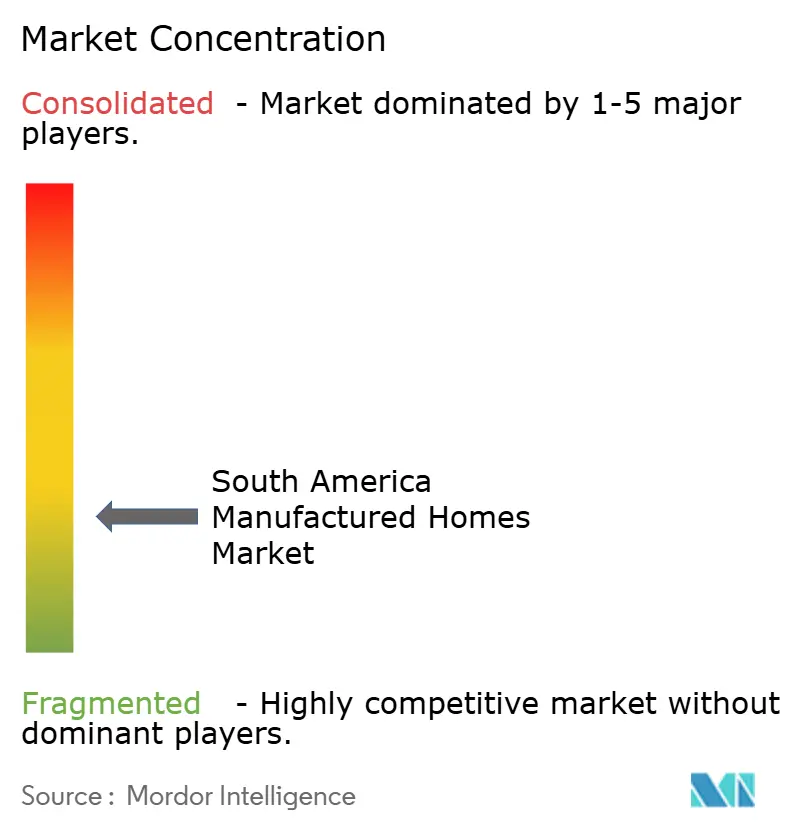
The South America manufactured homes market is fragmented, although Brazil is developing stronger scale advantages. Opus Construtech operates across 16 Brazilian states and has produced more than 20,000 modules, giving it a broader operating footprint than many smaller specialist producers. Its USD 10.5 million Betim facility uses 10 robots and shows how automation can raise production consistency, improve handling, and support greater output. Tecverde Engenharia S.A. has completed more than 9,000 residential units and combines a wood-frame base with a broader material approach. These companies benefit from local production, public-program knowledge, accumulated delivery experience, and familiarity with local approval processes.
Players are also directing resources toward denser formats and improved factory reach. Brasil ao Cubo plans an 8-story modular apartment project in Tubarão and has stated plans for a new Southeast factory by 2028. Tecverde Engenharia S.A.’s 2025 move to Ipeúna was intended to improve delivery logistics in the São Paulo corridor. ATCO Ltd. identified Chile as a priority geography while reporting growth in permanent modular projects across several jurisdictions. In the South America manufactured homes market, these actions show that companies are competing through capacity, location, approvals, logistics, and the ability to serve public contracts.
Open opportunities include multifamily projects above 3 stories, direct sales supported by suitable financing, and disaster recovery networks beyond Brazil’s industrial Southeast. Homelend’s USD 9.1 million financing structure illustrates early private-capital support for factory-built homes and the need for funding models that fit off-site delivery. Technical standard harmonization will remain important because early approvals can shorten the time to project delivery and reduce the need for separate local interpretation. Competition is likely to remain dispersed while most suppliers specialize by material, geography, or project type.
South America Manufactured Homes Industry Leaders
-
Opus Construtech
-
Promet
-
Arquimet
-
Tecverde Engenharia S.A.
-
Casas Brazil
- *Disclaimer: Major Players sorted in no particular order
South America Manufactured Homes Market Companies Covered in this Report
- Opus Construtech
- Promet
- Arquimet
- Tecverde Engenharia S.A.
- Casas Brazil
- BIX
- Oztra Construções Modulares
- Módulo Sequência
- CMC Modular
- Impacto Modular
- ConectSteel
- Sistema Construtivo Modular Fischer
- Lévi Modular
- VIVIR Constructora
- TERPA Soluciones Constructivas
- ALGECO
- ATCO Ltd.
- Brasil ao Cubo
- Modularis
- PPA Modular
Recent Industry Developments in South America Manufactured Homes Market
- August 2026: Grupo Argos and Fundación Grupo Argos unveiled Casa Pacífico, an elevated rural housing prototype adapted to Chocó’s humid, rainy climate, under the Adopta un Hogar program targeting 1,000 homes. Casa para Mí was producing 3 homes per day, with capacity targeted at 6 per day.
- June 2026: Brazil’s Novo PAC allocated USD 1.9 billion for about 85,000 Minha Casa, Minha Vida homes, including 50,000 rural and 35,025 Entidades units, expanding housing delivery across underserved municipalities.
- March 2026: SteelCorp and InstaCasa formed a strategic partnership to integrate industrialized manufactured homes, land, and financing into a single offering for Brazil's affordable housing market. The model is designed to leverage InstaCasa's network of 300+ loteadoras, with factory-built homes offered through developer sales channels and linked to financing options, creating a scalable route for industrialized homes into the Brazilian housing market.
South America Manufactured Homes Market Report Scope
Segmentation Overview
By Structure Type
| Single-Section Homes |
| Multi-Section Homes |
| Other Types |
By Application
| Single Family |
| Multi Family |
By Material
| Timber |
| Metal |
| Concrete |
| Others |
By Country
| Brazil |
| Argentina |
| Colombia |
| Chile |
| Rest of South America |
| By Structure Type | Single-Section Homes |
| Multi-Section Homes | |
| Other Types | |
| By Application | Single Family |
| Multi Family | |
| By Material | Timber |
| Metal | |
| Concrete | |
| Others | |
| By Country | Brazil |
| Argentina | |
| Colombia | |
| Chile | |
| Rest of South America |
Key Questions Answered in the Report
What is the forecast for South America's manufactured homes?
The South America manufactured homes market is forecast to grow from USD 2.15 billion in 2026 to USD 3.25 billion by 2031, at an 8.61% CAGR. Public housing programs, industrialized delivery, and demand for faster housing solutions support growth.
Which structure type leads manufactured home demand in South America?
Single-section homes led with 58.00% revenue share in 2025 because they fit standardized single-family public housing programs. Their simple formats also align with repeatable procurement templates and quicker site installation.
Which application is growing fastest for factory-built homes in South America?
Multifamily applications are forecast to grow at a 10.50% CAGR through 2031 as urban density increases in major cities. The South America manufactured homes market is expanding into more compact housing formats where land is constrained.
Why is Brazil important for factory-built housing suppliers?
Brazil held 38.00% of regional revenue in 2025 and expanded off-site construction access within Minha Casa, Minha Vida financing. It also combines a large social housing system with an established domestic production base.
What material is growing fastest in South America's manufactured housing?
Metal is forecast to grow at a 10.20% CAGR through 2031 because steel-frame systems support automated and standardized production. The material is suited to repeatable modules and can support larger certified housing projects.
What limits the wider adoption of manufactured homes in South America?
Separate approvals, installation costs, limited resale confidence, and exposure to imported-component costs remain key constraints. Addressing these issues requires local delivery capacity, stable financing, and reliable certification processes.