
Market Overview
| Study Period | 2024 - 2031 |
|---|---|
| Forecast Data Period | 2026 - 2031 |
| Base Year Market Size (2025) | USD 215.80 Million |
| Market Size (2026) | USD 235.45 Million |
| Market Size (2031) | USD 372.40 Million |
| Growth Rate (2026 - 2031) | 9.62 % |
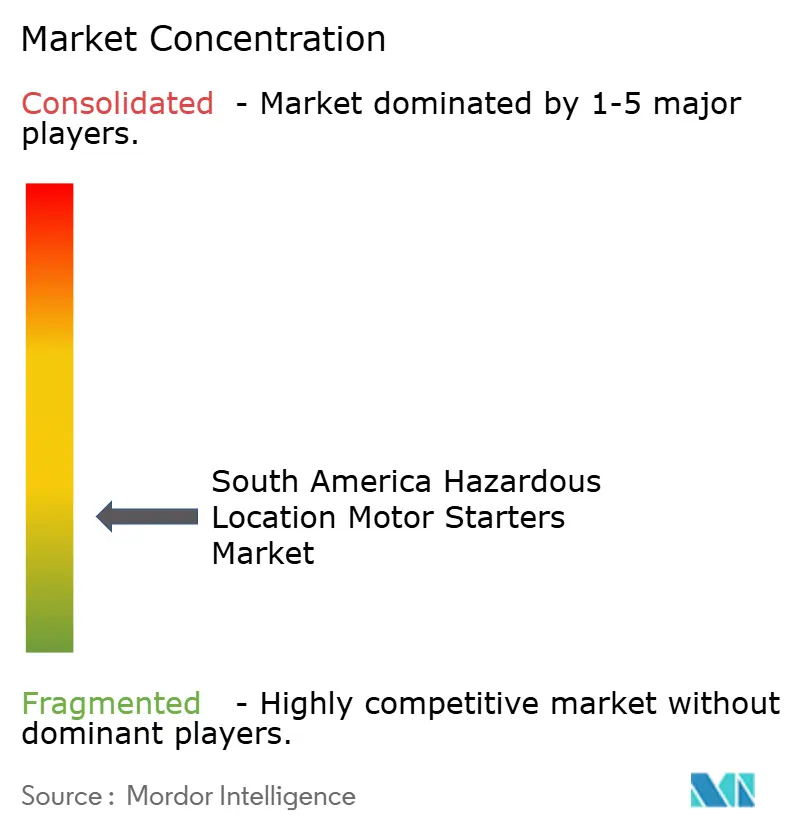
| Market Concentration | Low |
Major Players *Disclaimer: Major Players sorted in no particular order Image © Mordor Intelligence. Reuse requires attribution under CC BY 4.0. | |
South America Hazardous Location Motor Starters Market Analysis by Mordor Intelligence
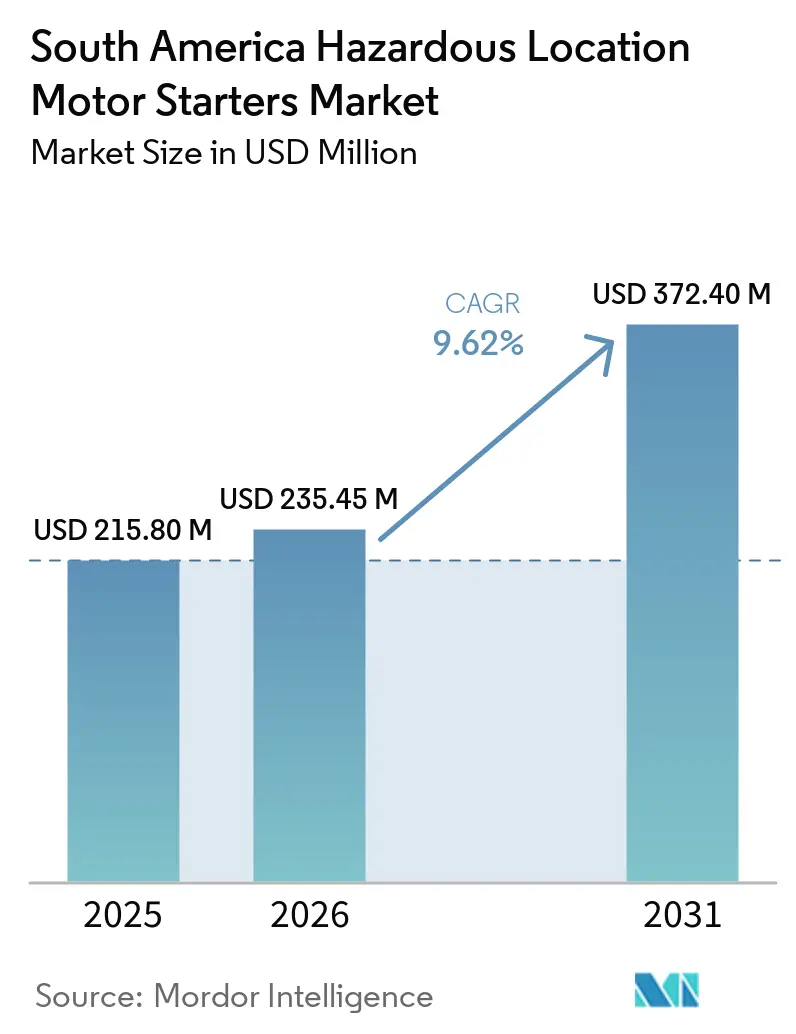
The South America Hazardous Location Motor Starters Market size was valued at USD 215.80 million in 2025 and is estimated to grow from USD 235.45 million in 2026 to reach USD 372.40 million by 2031, at a CAGR of 9.62% during the forecast period (2026-2031).
In South America, offshore oil and gas investments, mining capacity additions, and stricter safety requirements are driving demand for certified motor control equipment in hazardous locations. The South America hazardous area motor starters market serves a diverse industrial base, including pre-salt oil production, hard-rock mining, refining, petrochemicals, and grain processing. This industry mix supports demand across multiple classified environments rather than depending on a single end-use activity. Procurement activities increasingly favor suppliers that offer local certification, inventory availability, and field-service capabilities, as certified assemblies may require extended delivery lead times. These conditions support frame agreements and retrofit opportunities across established industrial facilities.
Key Report Takeaways
- By starter type, low-voltage motor starters held 50% of the 2025 regional total, while other starter types are projected to expand at an 11.5% CAGR through 2031.
- By protection and control technology, thermal-magnetic protection accounted for 40% of the 2025 technology segment, while solid-state motor control is projected to expand at a 13.8% CAGR through 2031.
- By voltage, up to 1 kV commanded 80% of the South America hazardous area motor starters market size in 2025, while above 1 kV is projected to expand at a 12.5% CAGR through 2031.
- By application, oil refineries accounted for 25% of the South America hazardous area motor starters market size in 2025, while grain elevators are projected to expand at an 11.5% CAGR through 2031.
- By geography, Brazil held 60% of the South America hazardous area motor starters market share in 2025 and is projected to expand at a 10.2% CAGR through 2031.
Note: Market size and forecast figures in this report are generated using Mordor Intelligence’s proprietary estimation framework, updated with the latest available data and insights as of January 2026.
South America Hazardous Location Motor Starters Market Trends and Insights
Drivers Impact Analysis*
| Driver | (~) % Impact on CAGR Forecast | Geographic Relevance | Impact Timeline |
|---|---|---|---|
| Offshore Oil and Gas Development in Brazil | 3.10% | Brazil, including the Santos, Campos, and Sergipe-Alagoas basins | Long term (≥ 4 years) |
| Mining and Mineral Processing Expansion | 2.40% | Brazil, Argentina, and Colombia | Medium term (2-4 years) |
| Thermal Overload and Motor Protection Demand | 1.70% | South America, with concentration in Brazil and Argentina | Short term (≤ 2 years) |
| Industrial Automation and Connected Motor Control | 1.20% | Brazil, including the São Paulo industrial belt, and Colombia | Medium term (2-4 years) |
| Replacement of Legacy Starters in Aging Facilities | 0.80% | Brazil and Colombia | Short term (≤ 2 years) |
| Local Qualification of Certified Starter Assemblies | 0.50% | Brazil, including Manaus, Macaé, and Vitória | Medium term (2-4 years) |
| Source: Mordor Intelligence | |||
Offshore Oil and Gas Development in Brazil
Petrobras has allocated USD 69.2 billion to exploration and production under its 2026-2030 business plan. This allocation represents the company’s largest upstream capital program, with 62% of spending directed toward pre-salt fields. Petrobras plans to complete 11 FPSOs at Búzios by 2027, supporting demand for certified equipment on production platforms. Each large FPSO requires motor-driven compressors, seawater lift pumps, and injection modules that operate in gas-hazardous areas. These applications require motor starters suitable for Zone 1 or Zone 2 environments and compliant with Brazilian certification requirements. Consequently, the South America hazardous area motor starters market is expected to benefit as offshore projects progress from planning to equipment procurement[1]Petrobras, “Petrobras Approves Business Plan 2026-2030,” Petrobras Institutional News, agencia.petrobras.com.br.. Petrobras is expected to approve the final investment decision for the Sergipe Deepwater project in April 2026, committing USD 5 billion to develop two FPSOs with a combined production capacity of 240,000 barrels per day. The project will open an offshore development area in northeastern Brazil, where certified supplier infrastructure remains less developed. This development is expected to increase the value of vendors that can supply pre-approved assemblies within project schedules. WEG and Siemens maintain certification pipelines that cover IECEx and INMETRO requirements, strengthening their ability to address this demand. Petrobras also plans to connect 75 wells in Espírito Santo through 2030. These connections will increase demand for certified motor-control packages in onshore and shallow-water gas-hazardous environments.
Mining and Mineral Processing Expansion
Mining investment is expected to support demand for hazardous-area equipment in dust-prone processing environments. Vale Base Metals is expected to proceed with the Coarse Particle Flotation project at Salobo in Pará in August 2026. The project is projected to add 6 million tonnes of annual ore-processing capacity, increasing total capacity to 42 million tonnes per year when operations begin in the first half of 2028. New conveyors, mills, pumps, and related processing circuits will require reliable motor control in combustible-dust environments. As processing capacity expands, this equipment demand is expected to support the South America hazardous area motor starters market[2]Vale Base Metals, “Vale Base Metals to Proceed with Coarse Particle Flotation at Salobo Increasing and Accelerating Projected Copper Production,” Vale Base Metals, prnewswire.com.. Argentina’s Filo del Sol and Josemaría projects are also expected to move toward larger capital deployment in 2026. Vicuña Corp is projected to invest USD 400 million in 2025 and target a further USD 800 million in 2026. The planned concentrator infrastructure will require motor starters for milling, pumping, conveying, and ventilation applications. These operations can create Zone 21 combustible-dust conditions within mineral-processing facilities. The International Energy Agency expects South America to refine 20% of the key energy minerals extracted in the region by 2025. The agency estimates that stronger regional refining could generate USD 185 billion to USD 220 billion in potential economic value by 2035, indicating the potential for additional processing infrastructure and associated demand for certified motor-control equipment.
Thermal Overload and Motor Protection Demand
Demand for thermal overload protection reflects growing safety concerns at facilities that operate motor-driven equipment. In 2025, a grain-storage cooperative in Arroio Grande, Rio Grande do Sul, is expected to experience two silo fires within three months. A peer-reviewed review of combustible-dust hazards in Brazilian agro-industrial facilities examines comparable risks related to electrical sparking and grain dust. These events are expected to increase attention on the importance of appropriate motor-control protection in dust-hazardous areas. Insurance requirements for grain-storage facilities are also expected to become more stringent when operators cannot verify certified Ex motor-starting equipment. This trend is likely to strengthen replacement demand for equipment that meets classified-area requirements. São Paulo State Military Fire Brigade Instruction IT 27/2025 is scheduled to take effect in March 2025. The instruction will establish explosion-isolation and fire-protection requirements for grain and seed storage silos, including requirements for dust-zone conditions in elevator shafts and conveyor-drive areas. Thermal-magnetic protection is expected to account for 40% of the technology segment in 2025 because it provides an economical protection solution for many legacy circuits. It will remain relevant for single-phase and three-phase motors that require practical overcurrent protection. ABNT NBR IEC 60079-0 and ABNT NBR IEC 60079-31 establish relevant protection standards for these applications.
Industrial Automation and Connected Motor Control
Connected motor control is gaining attention in offshore and mining applications that require real-time operating data. FPSO operators and mining automation teams use motor-health data to monitor equipment that supports continuous operations. Eaton plans to introduce the S711 soft starter series in Brazil in January 2026. The product will provide current control for motors ranging from 12 A to 500 A and will include connectivity features. It will offer an upgrade path for operators replacing direct-on-line starters in industrial applications. This development provides the South America hazardous area motor starters market with an additional route to modernization beyond routine equipment replacement. A 2026 study of motor soft-start technology is expected to find that adaptive control and load recognition can limit starting current to 1.5 to 3 times full-load amperes. Under the study’s comparison, direct-on-line starters can draw 6 to 8 times full-load amperes. Lower starting current reduces mechanical and thermal stress on couplings and bearings, which is particularly relevant for high-inertia pumps and other loads used in mining and offshore operations. Stable starting behavior also helps limit voltage dips that could affect nearby safety-critical systems. Suppliers that offer certification for digitally enabled Ex equipment can differentiate themselves from vendors that provide only conventional hardware.
Restraints Impact Analysis*
| Restraint | (~) % Impact on CAGR Forecast | Geographic Relevance | Impact Timeline |
|---|---|---|---|
| High Cost of Certified Hazardous-Area Equipment | -3.20% | South America, with acute effects in Argentina and Colombia | Long term (≥ 4 years) |
| Limited Awareness of Correct Hazardous-Area Installation | -2.00% | Rest of South America and Colombia | Medium term (2-4 years) |
| Long Replacement Cycles for Legacy Direct-On-Line Starters | -1.40% | Brazil and Argentina | Long term (≥ 4 years) |
| Limited Expertise for Digital Starter Retrofits | -0.90% | Brazil and Rest of South America | Medium term (2-4 years) |
| Source: Mordor Intelligence | |||
High Cost of Certified Hazardous-Area Equipment
Ex-certified motor starters can cost three to five times more than non-certified equipment with similar power ratings. Operators in Argentina and Colombia often struggle to absorb this premium when currencies weaken, and import financing remains constrained. INMETRO assessment requirements further increase manufacturing and compliance costs. Manufacturers must engage accredited certification bodies, complete factory audits, and maintain approved designs through ongoing surveillance activities. These requirements are reflected in equipment prices. The resulting price gap can slow replacement activity across grain storage, chemical warehousing, and coal-preparation facilities. The restraint is particularly pronounced when imported equipment faces tariffs or limited access to foreign currency. In Argentina, these conditions can increase the landed cost of European and North American Ex assemblies by 15% to 30% above list prices. As a result, buyers may have limited practical options, primarily locally produced products and a smaller pool of qualified panel builders. WEG’s regional manufacturing presence is significant in this context, as it can reduce dependence on imported assemblies. Smaller operators may continue using non-certified alternatives when they cannot justify the required expenditure. Long procurement cycles also limit end users’ ability to respond quickly following a regulatory review or safety incident.
Limited Awareness of Correct Hazardous-Area Installation
Brazil is scheduled to revise NR-10 on May 29, 2026, representing the standard’s first comprehensive revision in 22 years. The revision is expected to emphasize the appropriate selection, installation, inspection, and maintenance of electrical equipment in classified areas. Outside major industrial centers, plant maintenance teams may lack up-to-date area-classification studies. Procurement staff, rather than electrical specialists, may select protection methods. Inspection intervals for Ex motor starters may also exceed those specified under ABNT NBR IEC 60079-17. These practices can delay demand, as facilities may not identify the need for certified equipment until an incident or audit occurs. This issue represents both a safety concern and a barrier to market development. Facilities with unclassified or incorrectly classified areas may not specify Ex-rated motor-control equipment. Brazil accredited new Ex testing laboratories in 2024 under the ABNT NBR IEC 60079 and ABNT NBR ISO/IEC 80079 series. This additional testing capacity addresses the need for greater conformity-assessment capacity. However, equipment availability may improve before qualified field personnel and inspection teams become widely available. Therefore, the South America hazardous-area motor starters market will depend on technical training as well as product supply.
*Our forecasts treat driver/restraint impacts as directional, not additive. The impact forecasts reflect baseline growth, mix effects, and variable interactions.
Segment Analysis
By Starter Type: Low-Voltage Starters Support Broad Installed Demand
Low-voltage motor starters are projected to hold 50% of the segment in 2025, reflecting the extensive installed base of motors rated below 1 kV. These starters are widely used in oil refineries, chemical plants, grain operations, and other processing facilities. Their market position is supported by the long-standing use of IEC 60947 contactors and thermal overload relays. Local panel builders can assemble these configurations at costs suitable for standard projects and obtain INMETRO certification for relevant assembly designs. Full-voltage starters, including direct-on-line and reversing configurations, remain suitable for auxiliary loads where low cost is a primary consideration. Manual motor starters also remain relevant in older platforms, water-injection systems, and maintenance-focused utility applications that do not always require remote control. Other starter types, including solid-state soft starters, autotransformer starters, and star-delta hybrid configurations, are projected to expand at a CAGR of 11.5% through 2031. WEG’s SSW900 reflects the shift toward equipment designed for demanding motor-starting applications and more controlled pump and fan operations[3]Zhang et al., “Motor Soft-Start Technology: Intelligent Control, Wide Bandwidth Applications, and Energy Efficiency Optimization,” Energies, mdpi.com.
By Protection and Control Technology: Solid-State Control Builds on a Large Thermal-Magnetic Base
Thermal-magnetic protection is projected to account for 40% of the technology segment in 2025 and remain the largest category. Its position reflects lower unit costs, an established INMETRO certification pathway, and broad suitability for existing motor circuits. Many industrial plants in South America continue to operate legacy motor systems with protection arrangements familiar to maintenance personnel. Consequently, thermal-magnetic equipment remains a practical option for replacement and maintenance activities. Flameproof and explosion-proof enclosures compliant with ABNT NBR IEC 60079-1 remain standard protection solutions for direct-on-line starters used in Zone 1 refinery and petrochemical applications. Electronic overload protection is gaining adoption where operators require precise trip curves and remote diagnostic capabilities, particularly in mining applications. Solid-state motor control is projected to expand at a CAGR of 13.8% through 2031. A technical study scheduled for 2026 is expected to report that silicon carbide and gallium nitride devices can reduce switching losses by 80% compared with legacy silicon devices and operate at frequencies of up to 100 kHz. ABB is expected to introduce an ATEX- and IECEx-certified IE6 SynRM Increased Safety motor in May 2026 and states that it can provide up to 60% lower energy losses than common IE3 induction motors. These developments increase the importance of compatible, low-disturbance starter systems for high-efficiency motor platforms.
By Voltage: Up to 1 kV Remains the Largest Category
The up to 1 kV category is projected to account for 80% of the voltage segment in 2025. The South America hazardous area motor starters market size for this category reflects the extensive use of low-voltage motors across refinery pumps, grain-elevator systems, and processing lines. These motors support standard duties across a broad range of installed applications, many of which already accept conventional starter designs. This installed base preserves the category’s leading position. The category’s share may decline gradually as major capital projects adopt larger motor packages. The above 1 kV category is projected to expand at a CAGR of 12.5% through 2031. Large-bore seawater injection pumps and gas re-injection compressors on FPSOs commonly operate between 3.3 kV and 6.6 kV, while primary crushers and ball mills also require higher-voltage systems. Medium-voltage solid-state starters can limit inrush current and reduce thermal stress on windings in high-inertia applications. IEC 60947-4-2 and IECEx requirements are important for this equipment, while Eaton’s AmpGard and Siemens’ SIMOCODE product lines have established certification portfolios.
By Application: Grain Elevators Are Increasing Their Use of Certified Equipment
Oil refineries are projected to account for 25% of the application segment in 2025. Petrobras plans refinery upgrades that target an additional 320,000 barrels per day of installed capacity by 2030 without developing new greenfield plants. Refinery projects require motor starters for pumps, compressors, fans, and process equipment operating in areas where gas-risk classifications are common. The South America hazardous area motor starters market therefore maintains a strong connection to refinery maintenance and modernization programs. Petrochemical facilities and oil rigs represent another substantial demand pool, supported by offshore construction and coastal processing activity. Chemical storage facilities use Zone 2-rated starters for tank-farm transfer pumps and ventilation fans. Coal-preparation plants in Colombia and southern Brazil require flameproof and dust-ignition-proof equipment for specific applications. Grain elevators are projected to expand at a CAGR of 11.5% through 2031. Silo fires during 2025 are expected to increase attention to ignition risks associated with motor-starting contacts in combustible-dust environments. The IT 27/2025 requirements in São Paulo are expected to support a replacement cycle for non-Ex-rated starters used in grain-handling equipment.
Geography Analysis
Brazil accounted for 60% of the regional total in 2025 and is projected to expand at a 10.2% CAGR through 2031. Brazil’s share of the South America hazardous area motor starters market reflects demand from offshore oil production, refinery modernization, mining activity, and agricultural infrastructure. Petrobras’ offshore program represents a major source of demand for certified platform equipment, while refinery modernization supports maintenance and retrofit activities. Agricultural infrastructure in Mato Grosso, Pará, and Rio Grande do Sul also contributes to demand[4]Petrobras, “Petrobras Approves Business Plan 2026-2030,” Petrobras Institutional News, agencia.petrobras.com.br. INMETRO Portaria No. 115/2022 requires certification for Ex electrical equipment used in classified areas in Brazil. This requirement can extend approval timelines for suppliers without qualified product lines while favoring OEMs with local certification and service capabilities. The May 2026 revision to NR-10 introduces inspection and documentation requirements for installed Ex equipment, supporting verification and retrofit demand alongside new installations. Argentina is moving toward larger mining capital investments as the Filo del Sol and Josemaría projects advance. Vicuña Corp targeted USD 800 million in 2026 after investing USD 400 million in 2025. A large concentrator would require certified starters for pumps, mills, conveyors, and ventilation equipment. Colombia requires replacement equipment for wellhead pumping and produced-water applications. Peru and Chile add mining-related volumes, although currency conditions, infrastructure constraints, and certification requirements limit adoption in smaller economies.
Competitive Landscape
The South America hazardous-area motor starters market is moderately concentrated. Eaton, ABB, Schneider Electric, Siemens, and WEG are frequently specified for offshore, refinery, and mining projects, supported by their broad portfolios of certified hazardous-area electrical equipment. WEG benefits from its regional manufacturing presence and the availability of INMETRO-qualified products. Long-term supply agreements, local certifications, and established service infrastructure further strengthen the positions of incumbent suppliers. Digital service capabilities are emerging as an important competitive differentiator. Suppliers are integrating motor health monitoring, overload analytics, and remote diagnostic functions into certified equipment. ABB’s planned May 2026 launch of its ATEX- and IECEx-certified IE6 SynRM Increased Safety motor reflects the shift toward compatible, high-efficiency electrical systems. ABB positions the motor as delivering up to 60% lower energy losses than IE3 induction motors. R. STAHL and BARTEC continue to serve as specialized suppliers of certified control stations and terminal enclosures for Zone 1 applications.
Grain elevators represent an underdeveloped opportunity for suppliers of cost-engineered certified starters. São Paulo’s IT 27/2025 requirements are expected to increase demand for equipment designed for grain-handling motors rated below 22 kW. Mining districts in Argentina and Peru often procure starters rated above 1 kV on a project-by-project basis, while Brazilian panel builders qualify individual assemblies under INMETRO Modelo de Certificação 5. ABNT NBR IEC 60079-14 and ABNT NBR IEC 60079-17 establish key vendor requirements for refinery and mining projects.
South America Hazardous Location Motor Starters Industry Leaders
WEG S.A.
Schneider Electric SE
ABB Ltd
Eaton Corporation plc
Siemens AG
- *Disclaimer: Major Players sorted in no particular order


Recent Industry Developments
- August 2026: ale Base Metals is expected to confirm its decision to proceed with the Coarse Particle Flotation project at the Salobo Copper Complex in Pará, Brazil. The project is expected to add 6 million tonnes of annual ore-processing capacity and increase total throughput to 42 million tonnes per year by the first half of 2028. It will introduce classified-zone motor-starter procurement across conveyor and milling circuits.
- May 2026: ABB is expected to become the first manufacturer to receive ATEX and IECEx certification for an IE6-class hyper-efficiency motor based on magnet-free synchronous reluctance technology. The certification is expected to cover motor ratings from 110 kW to 315 kW for Zone 1 and Zone 2 hazardous areas. The launch is likely to increase focus on compatible starter specifications across oil, gas, and chemical applications.
- May 2026: Brazil's Ministry of Labor is expected to publish the revised NR-10/2026 standard. The revision is expected to require conformity certification and area-classification compatibility for Ex motor starters installed in Brazilian classified zones. The requirement will support new installations and retrofit projects involving legacy equipment.
- April 2026: Petrobras is expected to approve the final investment decision for the Sergipe Deepwater SEAP I project. The company is expected to commit USD 5 billion to two SBM-built FPSOs with a combined production capacity of 240,000 barrels per day. The project will require INMETRO-certified Ex motor starters for platform topside systems.
- February 2026: Vicuña Corp, a joint venture between BHP and Lundin Mining, is expected to disclose plans to invest USD 800 million in the Filo del Sol and Josemaría copper projects in Argentina during 2026. This investment would be double the USD 400 million deployed in 2025. The projects are advancing toward a final investment decision for the USD 18 billion mining district.


South America Hazardous Location Motor Starters Market Report Scope
The South America Hazardous Area Motor Starters Report is Segmented by Starter Type (Low-Voltage, Full-Voltage, Manual, Others), Protection and Control Technology, Voltage (Up to 1 kV, Above 1 kV), Application (Oil Refineries, Petrochemical, Chemical Storage, Coal Prep, Grain Elevators, Others), and Geography (Brazil, Argentina, Colombia, Rest of South America). The Market Forecasts are Provided in Terms of Value (USD).
By Starter Type
| Low-Voltage Motor Starters |
| Full-Voltage Motor Starters |
| Manual Motor Starters |
| Other Starter Types |
by Protection and Control Technology
| Thermal-Magnetic Protection |
| Electronic Overload Protection |
| Solid-State Motor Control |
| Flameproof and Explosion-Proof Enclosures |
| Other Protection and Control Technology |
Market Size and Growth Forecasts by Voltage
| Up to 1 kV |
| Above 1 kV |
By Application
| Oil Refineries |
| Petrochemical Facilities and Oil Rigs |
| Chemical Storage and Handling Facilities |
| Coal Preparation Plants |
| Grain Elevators |
| Other Applications |
Market Size and Growth Forecasts by Country
| Brazil |
| Argentina |
| Colombia |
| Rest of South America |
| By Starter Type | Low-Voltage Motor Starters |
| Full-Voltage Motor Starters | |
| Manual Motor Starters | |
| Other Starter Types | |
| by Protection and Control Technology | Thermal-Magnetic Protection |
| Electronic Overload Protection | |
| Solid-State Motor Control | |
| Flameproof and Explosion-Proof Enclosures | |
| Other Protection and Control Technology | |
| Market Size and Growth Forecasts by Voltage | Up to 1 kV |
| Above 1 kV | |
| By Application | Oil Refineries |
| Petrochemical Facilities and Oil Rigs | |
| Chemical Storage and Handling Facilities | |
| Coal Preparation Plants | |
| Grain Elevators | |
| Other Applications | |
| Market Size and Growth Forecasts by Country | Brazil |
| Argentina | |
| Colombia | |
| Rest of South America |


Key Questions Answered in the Report
What is the size of the South America hazardous area motor starters market?
The market was valued at USD 215.8 million in 2025, is estimated at USD 235.45 million in 2026, and is forecast to reach USD 372.4 million by 2031.
What CAGR is projected for hazardous area motor starters in South America?
The regional total is projected to expand at a 9.62% CAGR from 2026 to 2031.
Which starter type held the largest share in 2025?
Low-voltage motor starters held 50% of the 2025 starter-type segment because sub-1 kV motors are widely installed across regional processing operations.
Which technology is expected to expand fastest through 2031?
Solid-state motor control is projected to expand at a 13.8% CAGR through 2031 as operators seek controlled starting and reduced arcing risk.
Why are grain elevators becoming more important for certified motor-control equipment?
Grain elevators are projected to expand at an 11.5% CAGR through 2031 as safety requirements and concern about combustible-dust risks support replacement demand.
Which country leads regional demand?
Brazil held 60% of the regional total in 2025 and is projected to expand at a 10.2% CAGR through 2031, supported by offshore, refining, mining, and agricultural activity.
Page last updated on:





