
Market Overview
| Study Period | 2019 - 2031 |
|---|---|
| Forecast Data Period | 2026 - 2031 |
| Base Year Market Size (2025) | USD 1.89 Billion |
| Market Size (2026) | USD 2.08 Billion |
| Market Size (2031) | USD 3.08 Billion |
| Growth Rate (2026 - 2031) | 8.17 % |
| Market Concentration | High |
Major Players *Disclaimer: Major Players sorted in no particular order Image © Mordor Intelligence. Reuse requires attribution under CC BY 4.0. | |
South America General Aviation Market Analysis by Mordor Intelligence
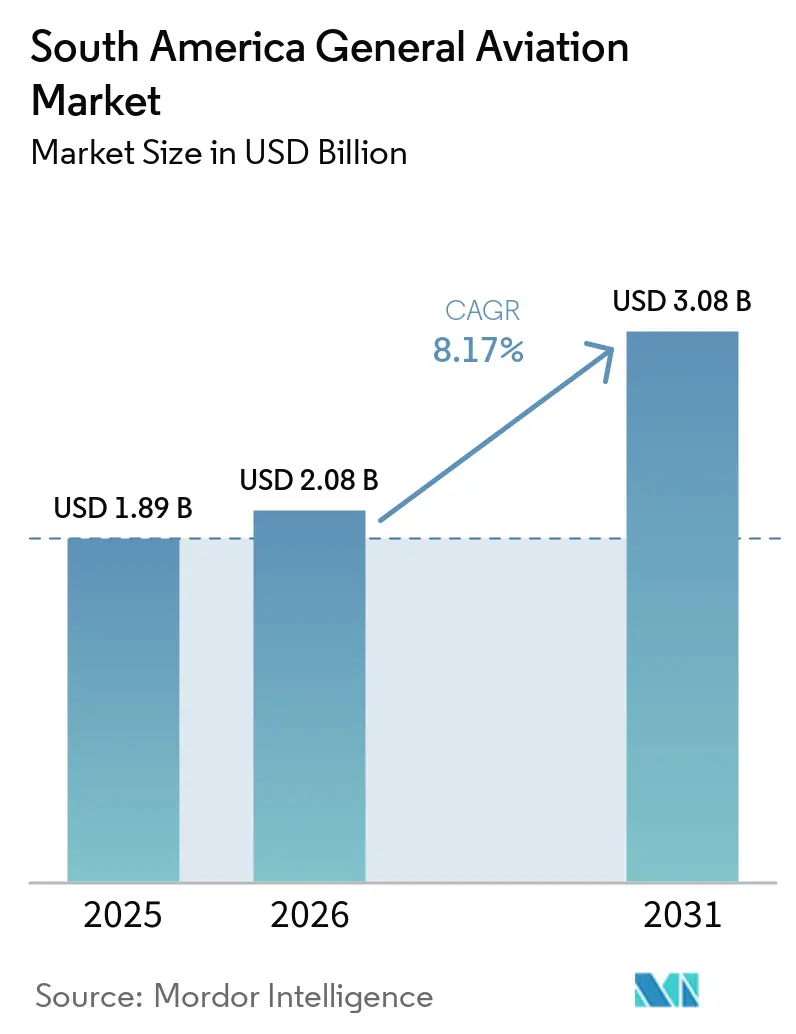
The South America general aviation market size was valued at USD 1.89 billion in 2025, and is forecast to grow from USD 2.08 billion in 2026 to reach USD 3.08 billion by 2031, at an 8.17% CAGR during the forecast period (2026-2031). The market serves regions where distance, terrain, and limited ground links make aircraft an essential mode of transport. Corporate travel, remote operations, agricultural work, and emergency access across the continent support demand. Brazil remains the core commercial base, while regulatory change in Argentina may widen operating opportunities. Aircraft replacement and new service models are broadening demand beyond traditional business flying. Constraints in maintenance capacity, parts supply, financing, and airport access still limit how quickly operators can add aircraft.
Key Report Takeaways
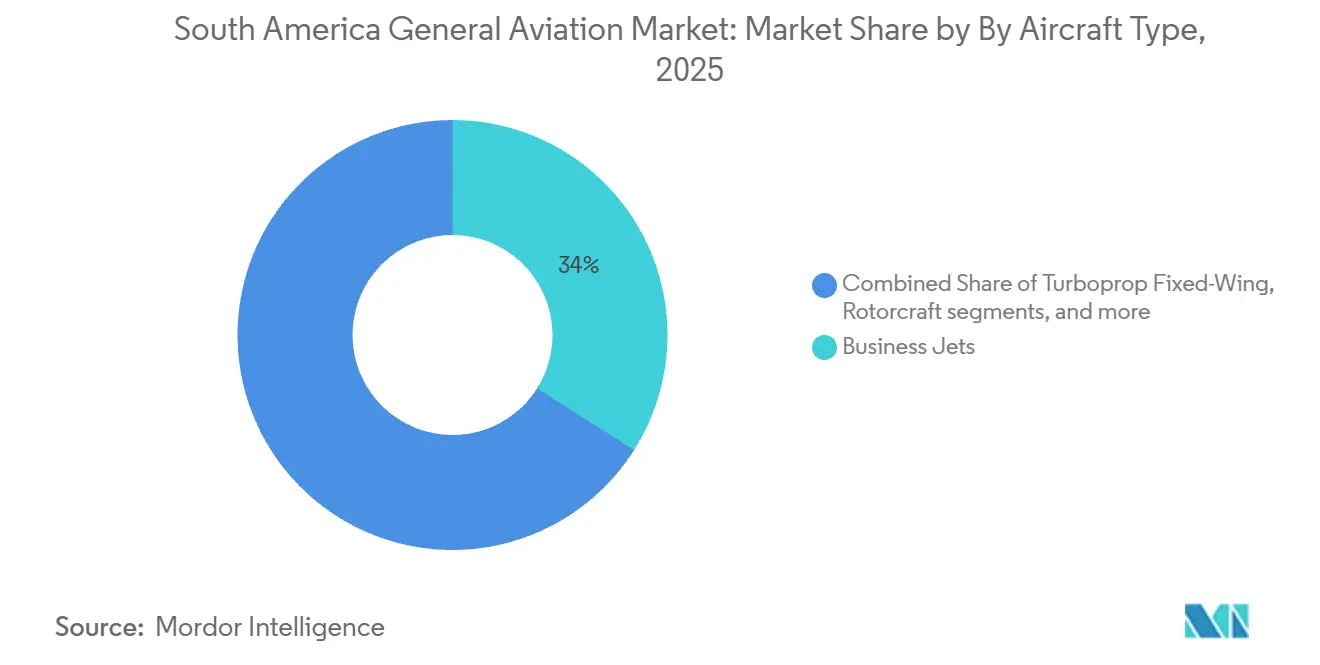
- By aircraft type, business jets held 33.98% of the South America general aviation market share in 2025, while AAM eVTOLs are forecast to grow at a 10.85% CAGR through 2031.
- By propulsion type, conventional piston/turbine aircraft held 65.98% of the South America general aviation market share in 2025, while hybrid-electric platforms are forecast to grow at a 12.29% CAGR through 2031.
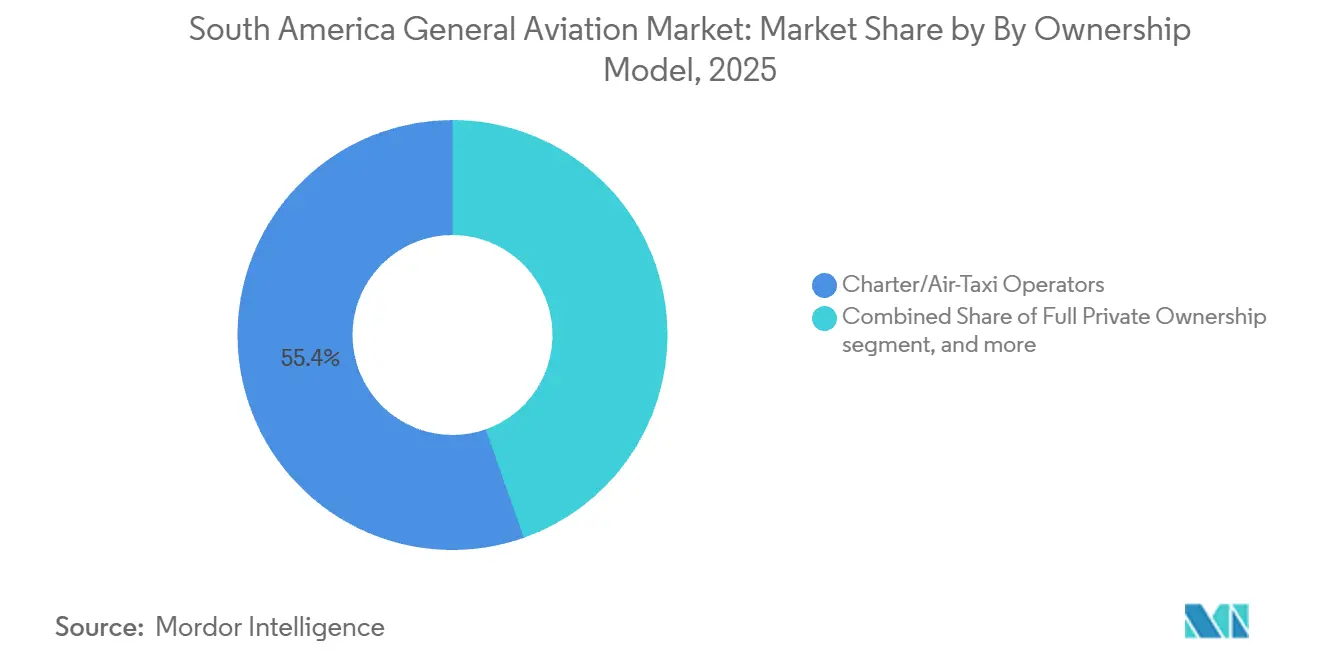
- By ownership model, charter/air-taxi operators held 55.39% of the South America general aviation market share in 2025, while full private ownership is forecast to grow at a 10.44% CAGR through 2031.
- By end-user application, business/corporate transport held 47.38% of the South America general aviation market share in 2025, while emergency medical/air-ambulance is forecast to grow at a 10.35% CAGR through 2031.
- By geography, Brazil held 42.18% of the South America general aviation market share in 2025, while Argentina is forecast to grow at a 9.99% CAGR through 2031.
Note: Market size and forecast figures in this report are generated using Mordor Intelligence’s proprietary estimation framework, updated with the latest available data and insights as of January 2026.
Market Trends and Insights
Drivers Impact Analysis of South America General Aviation Market*
| Driver | (~) % Impact on CAGR Forecast | Geographic Relevance | Impact Timeline |
|---|---|---|---|
| Growth in corporate and private aviation | +2.20% | Brazil, Argentina, Chile | Medium term (2-4 years) |
| Remote-area connectivity requirements | +1.80% | Brazil, Peru, Colombia, Venezuela, Rest of South America | Short term (≤ 2 years) |
| Fleet renewal and demand for more efficient aircraft | +1.50% | Brazil, Argentina, Chile | Medium term (2-4 years) |
| Agribusiness, mining, and offshore energy operations | +1.30% | Brazil, Argentina, Colombia, Peru | Medium term (2-4 years) |
| Expansion of fractional ownership and on-demand charter models | +1.10% | Brazil, Argentina, Chile | Medium term (2-4 years) |
| Rising aeromedical and emergency-response requirements | +0.80% | Brazil, Peru, Colombia, Rest of South America | Long term (≥ 4 years) |
| Source: Mordor Intelligence | |||
Remote-Area Connectivity Requirements
The South America general aviation market depends on aircraft, where terrain and long travel distances restrict ground transport. The Amazon basin, Andean corridor, Chaco lowlands, and Patagonian steppe create persistent requirements for point-to-point air access. In 2025, Paraguay’s SETAM resumed CASA 212 services linking Asunción with remote Chaco settlements after a 60-day maintenance interruption. The service-connected communities, including Bahía Negra and Fuerte Olimpo, where aviation supports basic mobility. Oil, mining, and agribusiness operators in interior locations also rely on aircraft because there are few practical ground alternatives. The region’s urban population pattern does not remove this need, since economic activity extends well beyond routes that can support scheduled airline service.
Growth in Corporate and Private Aviation
Brazil’s executive aviation fleet reached 1,193 aircraft in May 2026, up from 906 aircraft in May 2024.[1] Airbus Corporate Jets reported 1,103 business jets in Brazil in June 2025, placing the country second behind the US and ahead of Mexico. Registrations during the first half of 2025 included 39 light jets, 17 midsize jets, and 6 heavy jets. These additions indicate growing demand for longer-range aircraft and larger cabins among Brazilian corporate users. The South America general aviation market also benefits as private flying becomes a business travel option in second-tier Brazilian cities. Chile and Colombia offer related growth opportunities as corporate activity and cross-border travel increase.
Fleet Renewal and Demand for More Efficient Aircraft
Airbus Corporate Jets reported that the South America and Caribbean business jet fleet averaged 24.5 years in early 2025, compared with a global average of 18.1 years. Brazil’s fleet average was 18.4 years, indicating that replacement activity has begun earlier there than across the wider region. Textron Aviation represented 40% of competitive turbine aircraft deliveries in South America in 2024.[2] The first Cessna Citation Longitude order in Brazil was announced at LABACE 2025, with delivery scheduled for 2026. Bombardier presented the Global 8000 in São Paulo in May 2026, showing active interest in ultra-long-range replacement demand. Connectivity upgrades approved for Gulfstream, Textron, and Bombardier aircraft also add a practical reason to modernize fleets.
Agribusiness, Mining, and Offshore Energy Operations
Agricultural aviation provides a stable operating base for the South America general aviation market, especially in Brazil. Brazil ended 2025 with 2,866 registered manned agricultural aircraft, while the national aviation registry recorded 2,722 agricultural aircraft in operation. Agricultural operators are concentrated in regions that account for most of Brazil's grain and fruit production. Mato Grosso alone had 749 agricultural aircraft, reflecting the importance of aviation to large-area farming. Helicopter demand from mining in Chile, Peru, and Colombia adds a separate source of mission activity. Offshore energy activity in Brazil also supports the use of turbine helicopters in the Santos and Campos basins.
Restraints Impact Analysis of South America General Aviation Market*
| Restraint | (~) % Impact on CAGR Forecast | Geographic Relevance | Impact Timeline |
|---|---|---|---|
| Inadequate regional airports, heliports, and MRO facilities | -1.40% | Rest of South America, Venezuela, Peru, Colombia | Short term (≤ 2 years) |
| High fuel, maintenance, insurance, and airport costs | -1.20% | Brazil, Argentina, Chile | Medium term (2-4 years) |
| Economic volatility, currency risk, and financing constraints | -0.90% | Argentina, Venezuela, Brazil | Short term (≤ 2 years) |
| Aircraft-part lead times and pilot availability constraints | -0.70% | Global impact, acute in South America | Medium term (2-4 years) |
| Source: Mordor Intelligence | |||
Inadequate Regional Airports, Heliports, and MRO Facilities
Limited infrastructure is a material constraint on the South America general aviation market, particularly for operators outside major cities. Certified maintenance capacity is concentrated around São Paulo, Buenos Aires, and Santiago. Operators in smaller markets may need to ferry aircraft to North American facilities for heavy maintenance. This increases maintenance costs and reduces the time that aircraft are available for service. Aviasur expanded its Santiago maintenance center from 5,500 square meters to 7,100 square meters at the end of 2024. The increase supports regional demand, but available capacity remains limited for Chilean and Argentine operators.
High Fuel, Maintenance, Insurance, and Airport Costs
Operating costs remain high for operators serving remote South American routes. Fuel distribution is concentrated in Brazil’s coastal and major inland hubs, adding fuel-stop, handling, and navigation costs on interior missions. These variable costs can account for 30% to 40% of total trip costs on remote routes. Parts lead times and supply chain constraints also delay fleet additions despite sustained user demand. Insurance capacity for complex offshore, Andean, and Amazonian operations is limited, which raises ownership costs. Airport fees and slot restrictions at major hubs can divert charter traffic to secondary airports that are less prepared to handle modern turbine aircraft.
*Our forecasts treat driver/restraint impacts as directional, not additive. The impact forecasts reflect baseline growth, mix effects, and variable interactions.
South America General Aviation Market Segment Analysis
By Aircraft Type:
Business Jets Lead, eVTOLs Reshape the Fleet HorizonBusiness jets held 33.98% of the South America general aviation market share in 2025, making them the largest aircraft segment. Their comparatively lower acquisition cost and shorter runway needs suit Brazil’s broad secondary-airport network. Brazil’s executive jet fleet reached 1,193 aircraft in May 2026, rising 31.7% from 906 aircraft in May 2024. Midsize and large jets are gaining relevance as companies seek more range for regional and transatlantic missions. The six heavy aircraft registrations recorded in the first half of 2025 point to demand moving into larger cabin classes.
Turboprops remain important for agricultural work and access to remote communities. Brazil’s turboprop business aviation fleet grew 23% between May 2024 and May 2026. Piston aircraft remained the largest absolute fleet category in Brazil, totaling 6,170 aircraft in May 2026. Rotorcraft support offshore energy, emergency medical work, and urban charter operations, while turbine helicopters grew 19% in Brazil over the same period. The South America general aviation market size for eVTOL and AAM vehicles is forecast to grow at a 10.85% CAGR through 2031. Eve targets certification by Brazil’s ANAC in 2028 and signed a binding framework with Revo for up to 50 eVTOL aircraft.

By Propulsion Type:
Turbines Command Today, Hybrid Engines Target TomorrowConventional piston/turbine aircraft held 65.98% of the South America general aviation market share in 2025. The installed fleet relies on piston trainers, agricultural turboprops, and turbofan business jets that have established maintenance and operating practices. This base limits the prospect of rapid near-term replacement by alternative propulsion systems. Brazil had 6,170 piston aircraft in May 2026, many of which served training and utility work. All-electric aircraft remain at an early stage of commercial development. The US Government Accountability Office reported in 2026 that the FAA was still evaluating certification issues for electric aircraft.
Hybrid-electric propulsion is forecast to grow at a 12.29% CAGR through 2031. The FAA approved the G-1 Issue Paper for Ampaire’s AMP-H570 hybrid-electric propulsion system in March 2025. Electra’s EL9 program proceeded with its G-1 Issue Paper process in July 2026 after a Part 23 type-certification application in November 2025. Hybrid aircraft could serve regional routes of 300-600 km, where battery-only range may remain insufficient. These routes may support lower operating costs than conventional turbines where passenger demand is thin. The South America general aviation market is likely to follow FAA and EASA certification precedents as Brazil and Argentina develop their own pathways.
By Ownership Model:
Charter Leads Access Economics, Private Ownership AcceleratesCharter/air-taxi operators accounted for 55.39% of the South America general aviation market size in 2025. Charter access avoids the full burden of capital, crew, maintenance, and administration associated with direct aircraft ownership. This model is especially relevant in Brazil, where import duties, regulatory fees, and local financing conditions can raise acquisition costs. Fractional programs offer a middle option between on-demand charter and full ownership. Avantto operated 45 aircraft across Brazil, using this model to provide availability without full capital exposure. Government and special-mission operators also provide a stable demand for turboprops and helicopters used in surveillance, environmental monitoring, and border missions.
Full private ownership is forecast to grow at a 10.44% CAGR between 2026 and 2031. Brazil’s RBAC-91K Shared Property Administrator rules formalized the structures for shared aircraft property. Private registrations are growing alongside operator-owned fleets as corporate users seek greater control over availability. Brazil has added nearly 600 executive aviation aircraft per year over the preceding 3.50 years, according to ABAG data. The executive jet sub-fleet recorded 17% year-on-year growth in November 2025. Training institutions maintain demand for piston aircraft and entry-level turboprops as pilot certification activity expands.
By End-User Application:
Corporate Travel Anchors Demand, Aeromedical Drives GrowthBusiness/corporate transport accounted for 47.38% of the South America general aviation market share in 2025. Brazil’s business aviation flight operations across 100 major airports increased 16% between 2023 and 2025. Companies use aircraft to reduce travel time between cities where road distances are long and scheduled service is limited. Corporate demand strengthened as travel budgets recovered in Brazil and Chile through 2024 and 2025. Personal flying, pilot training, and special missions accounted for the remainder of the demand. Government procurement in Colombia, Peru, and Brazil supports special-mission flying for security and environmental monitoring.
Emergency medical/air-ambulance services are forecast to grow at a 10.35% CAGR through 2031. The segment addresses the lack of timely access to healthcare in the continent’s interior. Brasil Vida operates intensive care services in seven Brazilian cities and is accredited by the International Assistance Group for aeromedical operations. Vittal provides aeromedical services in Argentina and neighboring countries. Medevac operates six medical transport aircraft configurations in Peru under BARS aviation safety certification. Insurers, health systems, and employers with remote workforces increasingly treat air-medical capacity as an essential service.
Geography Analysis
Brazil General Aviation Market
Brazil held 42.18% of the South America general aviation market share in 2025. The country had 11,362 executive aviation aircraft in May 2026, up 20.10% from 9,460 aircraft in May 2022. Its business jet fleet was the world’s second largest at 1,103 aircraft in 2025. The jet fleet grew 31.70% from May 2024 to May 2026, while turbine helicopters and turboprops rose 19% and 23%, respectively. Brazil’s fleet age of 18.40 years points to ongoing replacement demand. Bombardier’s Global 8000 appeared at the Catarina Aviation Show in May 2026, while Textron’s SkyCourier Combi received Brazilian certification in June 2025.
Argentina General Aviation Market
Argentina is forecast to grow at a 9.99% CAGR through 2031. Its 2026 regulatory reforms removed night-VFR flight plan requirements and enabled certain single-pilot Part 135 charter operations. The measures also removed the 900-flight-hour requirement for first-class commercial pilot licensing. These changes may reduce administrative burdens for smaller operators and new pilots. EHang and Argentina’s FAdeA signed a 2025 memorandum to advance certification, manufacturing, and support for the EH216-S in Argentina and South America. Chile, Colombia, and Peru contribute demand through mining helicopters, aeromedical networks, and remote charter missions.
South America General Aviation Market
Venezuela, Peru, and the Rest of South America form a diverse group of operating environments. Venezuela has legacy helicopter, agricultural, and charter capacity, though fuel constraints, weak new-aircraft inflows, and an aging fleet limit utilization. Peru, Bolivia, Ecuador, Uruguay, and Paraguay support aeromedical, agricultural, and remote-connectivity missions. Paraguay’s resumed SETAM service illustrates how public-service links depend on general aviation in remote Chaco communities. The SkyCourier’s gravel-kit configuration is suited to unpaved runway operations and received its first South American delivery to a Brazilian Amazon operator. These examples provide a practical model for secondary locations in Peru and Bolivia.
Competitive Landscape
The South America general aviation market has a concentrated OEM tier led by Embraer S.A., Textron Aviation Inc., Bombardier Inc., Airbus SE, and General Dynamics Corporation (Gulfstream). Brazil is the principal commercial center, even though aircraft operate across a wide geography. After-sales support is central to competition because certified maintenance options are limited. Bombardier works with MAGA Aviation at Catarina Airport in São Paulo as an authorized service facility for Global, Challenger, and Learjet aircraft. Helibras benefits from local production and established relationships in civil and public-service rotorcraft operations.
Companies are also differentiating themselves through specialized product and service offerings. Honda Aircraft serves the light-jet category, Piper has an established trainer offering, and Sikorsky addresses search-and-rescue helicopter requirements. These positions reduce direct competition across some aircraft applications. Embraer filed a 2025 patent related to the integration of hybrid-electric propulsion in regional aircraft architectures. This move shows that established manufacturers are pursuing new propulsion opportunities. The South America general aviation market, therefore, includes both aircraft sales competition and a long-term contest to control service access. Operators place high value on dependable maintenance support because aircraft downtime can disrupt remote and time-sensitive missions.
The AAM field is developing a separate competitive layer. Eve reported USD 641 million in total liquidity at the end of 2025 and signed a binding USD 250 million framework agreement with Revo for up to 50 eVTOL aircraft in June 2025.[3] Aeromot’s 2025 distribution agreement with Volocopter covers distribution, maintenance, pilot training, and operations in Brazil. EHang’s agreement with FAdeA supports a similar entry path in Argentina. Avantto and Líder Aviação compete through fractional ownership products and operating networks rather than aircraft manufacturing. Aeromedical services in Peru, Bolivia, and Ecuador, plus agricultural turboprop replacement in Argentina and Paraguay, remain areas where local relationships can shape market access.
South America General Aviation Industry Leaders
-
Embraer S.A.
-
Textron Aviation Inc.
-
Bombardier Inc.
-
Airbus SE
-
Gulfstream Aerospace Corporation (General Dynamics Corporation)
- *Disclaimer: Major Players sorted in no particular order

South America General Aviation Market Companies Covered in this Report
- Embraer S.A.
- Textron Aviation Inc.
- Bombardier Inc.
- Airbus SE
- Leonardo S.p.A.
- Gulfstream Aerospace Corporation (General Dynamics Corporation)
- Dassault Aviation SA
- Pilatus Aircraft Ltd.
- Piper Aircraft, Inc.
- Honda Aircraft Company (Honda Motor Co., Ltd.)
- Avantto
- Robinson Helicopter Company, Inc.
- Líder Aviação
- Voar Aviation
- Sete Táxi Aéreo
Recent Industry Developments in South America General Aviation Market
- May 2026: Bombardier showcased its Global 8000 business jet at the Catarina Aviation Show in São Paulo, marking the aircraft's South American debut. The aircraft features an 8,000-nm range, a 2,691-foot cabin altitude, and access to a wider range of airports. The event formed part of Bombardier's strategy to strengthen its position in the Brazilian and broader South America business aviation market, with the Global 8000 displayed alongside the Global 6500 and Challenger 3500.
- March 2026: Eve Air Mobility conducted a flight of its full-scale eVTOL engineering prototype at Embraer's test facility in Gavião Peixoto, Brazil, in the presence of Brazilian government officials, including President Luiz Inácio Lula da Silva. The milestone advances Eve's flight-test campaign toward the certification of its eVTOL aircraft.
South America General Aviation Market Report Scope
This report analyzes the South America general aviation market, covering the acquisition, delivery, operation, and aftermarket support of aircraft used for business, private, charter, training, recreational, emergency, and special-mission applications. The study includes business jets, turboprop fixed-wing aircraft, piston fixed-wing aircraft, rotorcraft, and eVTOL/advanced air mobility vehicles, encompassing both new and pre-owned aircraft, as well as associated MRO, avionics, engines, connectivity, and other aviation services.
The market is segmented by aircraft type, propulsion type, ownership model, end-user application, and geography. By aircraft type, the study covers business jets, turboprop fixed-wing aircraft, piston fixed-wing aircraft, rotorcraft, and advanced air mobility eVTOLs. By propulsion type, it covers conventional piston/turbine, hybrid-electric, and all-electric. By ownership model, it covers full private ownership, fractional ownership, charter/air-taxi operators, training and academic institutions, and government/special-mission operators. By application, it covers business/corporate transport, personal and leisure flying, special mission, emergency medical/air ambulance, and pilot training. The report also covers the market sizes and forecasts for the South America general aviation market in major countries across the region. For each segment, the market size is provided in terms of value (USD).
Segmentation Overview
By Aircraft Type
| Business Jets | Large Jet |
| Mid-Size Jet | |
| Light/Very-Light Jet | |
| Turboprop Fixed-Wing | |
| Piston Fixed-Wing | |
| Rotorcraft | |
| Advanced Air Mobility eVTOLs |
By Propulsion Type
| Conventional Piston/Turbine |
| Hybrid-Electric |
| All-Electric |
By Ownership Model
| Full Private Ownership |
| Fractional Ownership |
| Charter/Air-Taxi Operators |
| Training and Academic Institutions |
| Government and Special-Mission Operators |
By End-User Application
| Business/Corporate Transport |
| Personal and Leisure Flying |
| Special Mission (ISR, Surveillance, Law Enforcement) |
| Emergency Medical/Air-Ambulance |
| Pilot Training |
By Geography
| Brazil |
| Argentina |
| Chile |
| Colombia |
| Venezuela |
| Peru |
| Rest of South America |
| By Aircraft Type | Business Jets | Large Jet |
| Mid-Size Jet | ||
| Light/Very-Light Jet | ||
| Turboprop Fixed-Wing | ||
| Piston Fixed-Wing | ||
| Rotorcraft | ||
| Advanced Air Mobility eVTOLs | ||
| By Propulsion Type | Conventional Piston/Turbine | |
| Hybrid-Electric | ||
| All-Electric | ||
| By Ownership Model | Full Private Ownership | |
| Fractional Ownership | ||
| Charter/Air-Taxi Operators | ||
| Training and Academic Institutions | ||
| Government and Special-Mission Operators | ||
| By End-User Application | Business/Corporate Transport | |
| Personal and Leisure Flying | ||
| Special Mission (ISR, Surveillance, Law Enforcement) | ||
| Emergency Medical/Air-Ambulance | ||
| Pilot Training | ||
| By Geography | Brazil | |
| Argentina | ||
| Chile | ||
| Colombia | ||
| Venezuela | ||
| Peru | ||
| Rest of South America |
Key Questions Answered in the Report
What is the forecast growth rate for South America general aviation through 2031?
The South America general aviation market is forecast to grow at a 8.17% CAGR from 2026 to 2031, reaching USD 3.08 billion by 2031.
Which aircraft category has the largest share in South America?
Business jets led aircraft type demand with a 33.98% share in 2025.
Which propulsion technology is expected to grow fastest?
Hybrid-electric propulsion is forecast to record a 12.29% CAGR through 2031.
Why is Brazil important for business aviation?
Brazil held 42.18% of regional demand in 2025 and had 1,193 executive aviation aircraft in May 2026.
What ownership model is most common for general aviation users?
Charter/air-taxi operators led with a 55.39% share in 2025, reflecting the appeal of aircraft access without full ownership costs.
Which application is growing fastest?
Emergency medical/air-ambulance services are forecast to grow at a 10.35% CAGR through 2031, supported by remote healthcare access needs.