
Market Overview
| Study Period | 2021 - 2031 |
|---|---|
| Forecast Data Period | 2026 - 2031 |
| Base Year Market Size (2025) | USD 450 Million |
| Market Size (2026) | USD 485.15 Million |
| Market Size (2031) | USD 706.82 Million |
| Growth Rate (2026 - 2031) | 7.81 % |
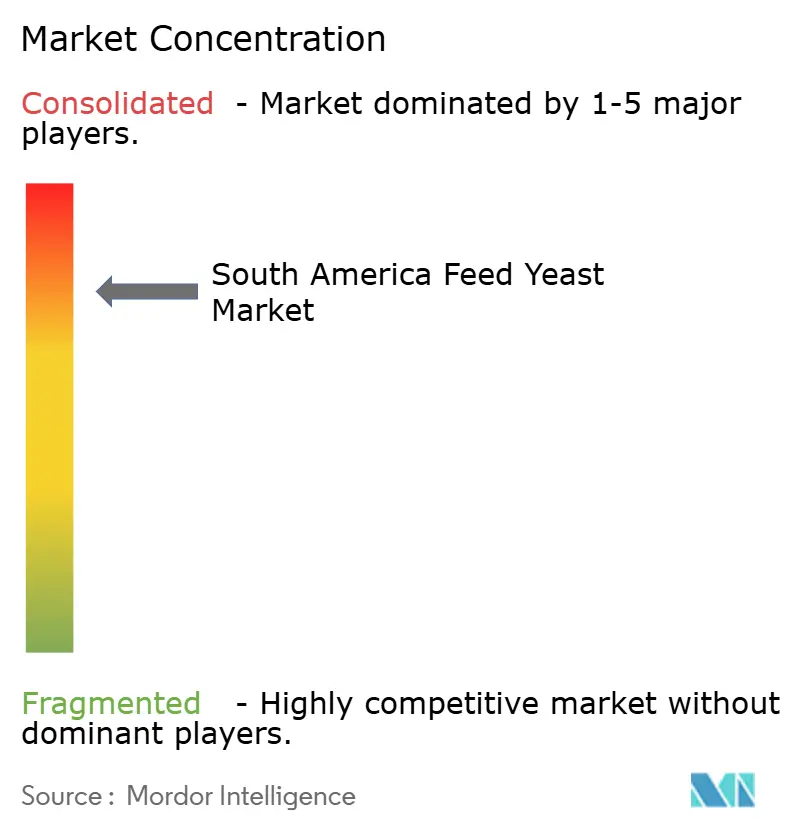
| Market Concentration | High |
Major Players *Disclaimer: Major Players sorted in no particular order Image © Mordor Intelligence. Reuse requires attribution under CC BY 4.0. | |
South America Feed Yeast Market Analysis by Mordor Intelligence
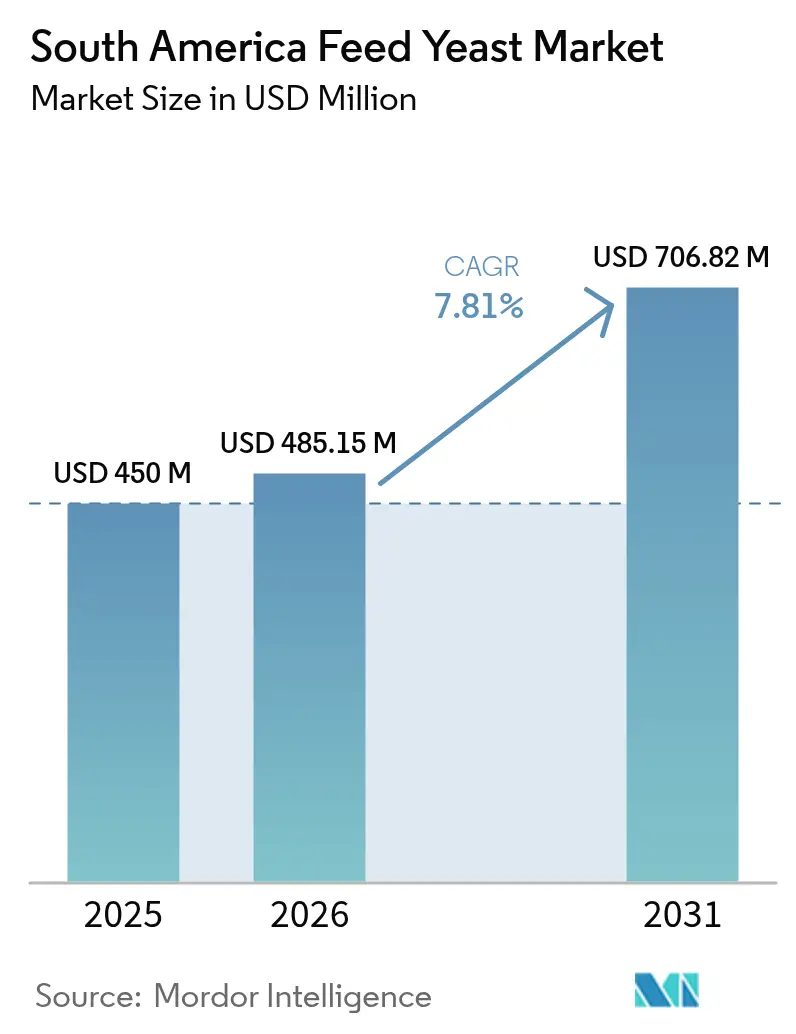
South American feed yeast market size in 2026 is estimated at USD 485.15 million, growing from 2025 value of USD 450 million with 2031 projections showing USD 706.82 million, growing at 7.81% CAGR over 2026-2031. The rise comes as regulators curb antibiotic growth promoters, prompting livestock producers to switch to natural additives that protect animal health and export eligibility. Brazil leads growth thanks to plentiful sugarcane-ethanol sidestreams that cut production costs, a mature poultry export complex, and extensive fermentation know-how[1]. Demand also benefits from the rapid scaling of aquaculture in Peru, regulatory convergence across MERCOSUR, and retailer pressure for traceable, ESG-aligned feed inputs. Nonetheless, the South American feed yeast market faces cost volatility tied to molasses and corn syrup, capital-intensive drying facilities, and freight bottlenecks at Amazonian and Plata ports that can disrupt just-in-time deliveries.
Key Report Takeaways
- By product type, live cell yeast held 42.10% of the South America feed yeast market share in 2025, while yeast derivatives are forecast to grow at a 10.79% CAGR through 2031.
- By form, instant yeast commanded 45.60% of the South America feed yeast market size in 2025; liquid slurry formats will post the fastest 11.27% CAGR between 2026-2031.
- By animal type, poultry dominated with a 36.60% share in 2025; aquaculture is set to expand at a 9.65% CAGR to 2031.
- By functional objective, Gut health and immunity commanded 46.50% of the South America feed yeast market size in 2025; Heat-stress mitigation will post the fastest 11.07% CAGR between 2026-2031.
- By geography, Brazil accounted for 53.60% revenue share in 2025, and Peru will register the quickest 9.75% CAGR over the forecast period.
- The top five suppliers controlled 66.40% regional share in 2025, with Lallemand Animal Nutrition leading at 18.20%, ADM follows at 15.70%, Cargill commands 12.80% via feed mill co-locations, DSM-Firmenich owns 11.30% after capacity upgrades, and Nutreco rounds out the group at 7.90%.
Note: Market size and forecast figures in this report are generated using Mordor Intelligence’s proprietary estimation framework, updated with the latest available data and insights as of 2026.
Market Trends and Insights
Drivers Impact Analysis of South America Feed Yeast Market*
| Driver | (~) % Impact on CAGR Forecast | Geographic Relevance | Impact Timeline |
|---|---|---|---|
| Growing livestock production volumes | +1.8% | Brazil, Argentina, Colombia | Medium term (2-4 years) |
| Poultry-export boom from Brazil and Chile | +1.2% | Brazil, Chile | Short term (≤ 2 years) |
| Ban on antibiotic growth promoters (AGPs) | +1.5% | Brazil, Argentina, Chile, Colombia | Medium term (2-4 years) |
| Sustainability push toward natural additives | +0.9% | Brazil, Chile, Colombia | Long term (≥ 4 years) |
| Sugarcane-ethanol sidestreams enabling low-cost single-cell yeast | +1.3% | Brazil, Colombia | Short term (≤ 2 years) |
| Blockchain feed-traceability mandates by meat packers | +0.6% | Brazil, Argentina, Chile | Long term (≥ 4 years) |
| Source: Mordor Intelligence | |||
Growing Livestock Production Volumes
South America’s share of global animal protein output keeps climbing. Between 2000 and 2018 regional poultry tonnage more than doubled, while pork output rose 64.3%. Brazil alone now consumes 2,539 million bushels of corn annually for feed, underscoring the scale at which producers are searching for efficiency boosters. National feed associations forecast further expansion in 2025, with chicken exports from Brazil projected to rise by 1.9%. Those volumes amplify interest in yeast supplements that improve gut integrity and feed conversion. The South American feed yeast market, therefore, gains a structural demand floor as herd and flock sizes climb.
Poultry-Export Boom from Brazil and Chile
Export-driven integrators must satisfy residue-free protocols set by buyers in the United States and the European Union[2]. Chile’s vertically integrated firms, such as Agrosuper, also chase premium export niches that reward natural feed profiles. As Brazil’s grain output stays on a record-setting path, companies lock in raw material security to capitalize on shifting U.S.–China trade flows. In this premium channel, yeast commands higher margins than synthetic growth promoters, reinforcing the growth outlook for the South American feed yeast market.
Ban on Antibiotic Growth Promoters (AGPs)
Four of the five largest meat-producing countries in South America have outlawed or tightly restricted antibiotic growth promoters deemed critical for human medicine. Brazil is drafting residue-monitoring rules that heighten scrutiny of antibiotic use in animal protein supply chains. As probiotics, phytogenics, and prebiotics dominate 65% of alternative-additive research, yeast is firmly positioned as a proven probiotic option. These regulatory tailwinds underpin sustained adoption in the South American feed yeast market.
Sustainability Push Toward Natural Additives
Supermarkets and food service groups impose sustainability metrics linked to regenerative agriculture, favoring feed ingredients that recycle biomass and lower carbon footprints. South American additive rules, rooted in Codex standards yet adapted for local botanicals, give yeast products regulatory flexibility. Brazilian miller-cum-ethanol producer Tereos highlights carbon-saving fermentation routes that resonate with ESG-oriented buyers. Such narratives strengthen brand value for suppliers in the South American feed yeast industry.
Restraints Impact Analysis of South America Feed Yeast Market*
| Restraint | (~) % Impact on CAGR Forecast | Geographic Relevance | Impact Timeline |
|---|---|---|---|
| High upfront fermentation and drying CAPEX | -1.1% | Brazil, Argentina, Colombia | Medium term (2-4 years) |
| Volatile molasses and corn syrup pricing | -0.8% | Brazil, Argentina, Peru | Short term (≤ 2 years) |
| Competition from bacterial probiotics and enzymes | -0.7% | Brazil, Chile, Colombia | Medium term (2-4 years) |
| Logistics chokepoints at Amazonian and Plata ports | -0.5% | Brazil, Argentina, Peru | Short term (≤ 2 years) |
| Source: Mordor Intelligence | |||
High Upfront Fermentation and Drying CAPEX
Greenfield yeast plants that meet GMP standards cost tens of millions of USD. DSM-Firmenich’s facility in Sete Lagoas illustrates the capital hurdle newcomers must clear. Port upgrade needs to add further spending as 58 Brazilian terminals require dredging for post-Panamax traffic. These factors deter entrants and preserve incumbent power within the South American feed yeast market.
Volatile Molasses and Corn Syrup Pricing
Corn traded near BRL 60.75 (USD 11.06) per sack in 2024 amid climatic setbacks and farmer stockholding. Ethanol plants now consume 722 million bushels of Brazilian corn, siphoning supply from additive producers farmdocdaily.illinois.edu. Molasses prices likewise swing with global sugar cycles, compressing margins for yeast makers locked into long-term contracts.
*Our forecasts treat driver/restraint impacts as directional, not additive. The impact forecasts reflect baseline growth, mix effects, and variable interactions.
South America Feed Yeast Market Segment Analysis
By Product Type:
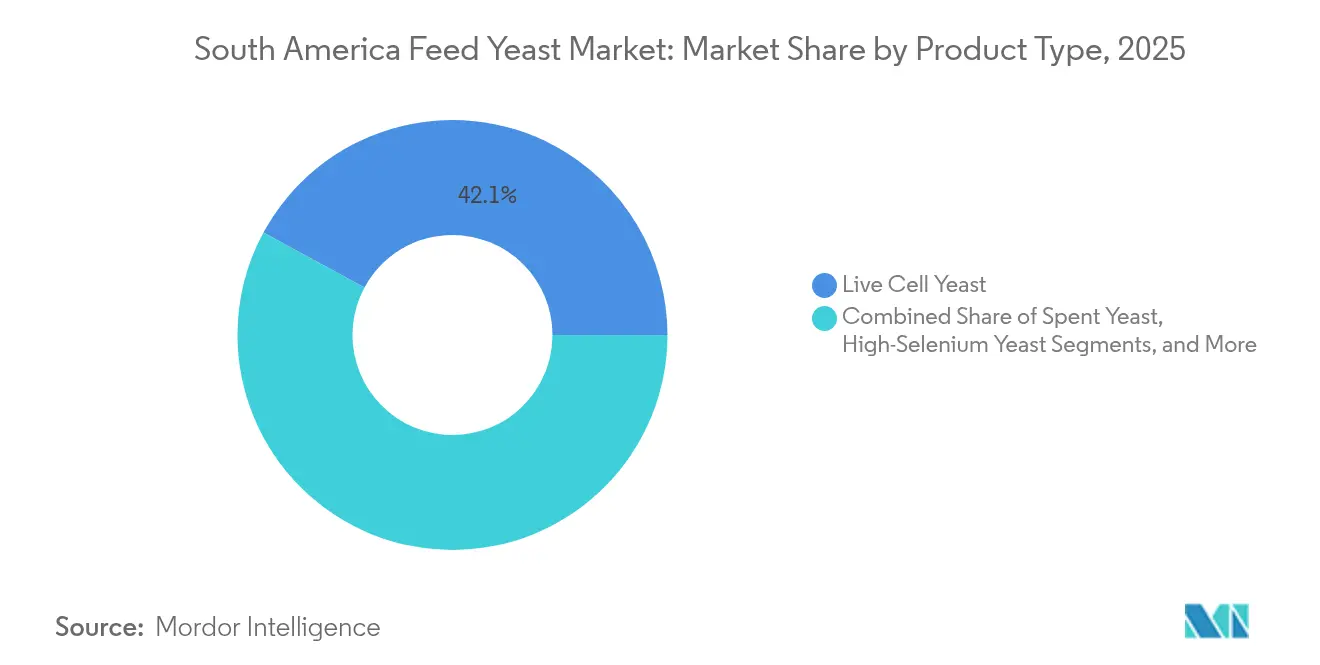
Live Cell Dominance Faces Derivative ChallengeLive cell yeast generated the largest slice of the South American feed yeast market size in 2025, accounting for 42.10% of sales. Producers favor its proven benefits in rumen fermentation and pathogen exclusion. Yeast derivatives, though still a smaller base, are accelerating at a 10.79% CAGR thanks to Beta-glucan-rich fractions that bind aflatoxin B1 and improve villus height in broilers. In 2025, spent brewer’s yeast supplied a 28.30% share, leveraged by low input costs, while dry inactive formats provided a 15.70% share, mainly to aquafeed.
Looking ahead, high-selenium yeast is gaining traction, growing 9.38% annually as integrators bundle micronutrient delivery with probiotic action. Modified Beta-D-glucans now capture zearalenone and T-2 toxin efficiently. Suppliers responding with multi-functional derivatives can capture premium niches and reinforce conversion to value-added SKUs in the South American feed yeast market.

By Form:
Instant Products Lead Amid Liquid InnovationInstant yeast maintained 45.60% of 2025 revenue due to ease of batching and long shelf life. The segment anchors baseline demand for feed premixes across Brazil and Argentina. Liquid slurry is the star performer, forecast to expand 11.27% annually through 2031 as automated mills seek micro-dosing accuracy without dust loss. Active wet yeast still holds a 24.80% share for high-viability uses, though chilled logistics limit its reach to nearby farms.
Liquid’s momentum stems from stabilizers that extend viability beyond 90 days, and findings that liquid Saccharomyces boulardii reduces heat-stress markers in finishing pigs. Suppliers that master aseptic packaging and cold chain distribution can tap the fast-growing channel inside the South American feed yeast market.
By Animal Type:
Poultry Leadership Amid Aquaculture SurgePoultry used 36.60% of regional shares in 2025 as exporters implement antibiotic-free regimens demanded by Europe and the United States. Yeast improves feed conversion, immunity, and carcass yield, cementing its role in broiler integrator protocols. Aquaculture, led by Peru’s booming fishmeal sector, will post a 9.65% CAGR to 2031 as cage farming expands beyond anchovy stocks.
Ruminants capture a 26.70% share through rumen pH stabilization, methane moderation, and milk-yield uplift. Swine contributes 18.10%, wherein trials show a 25.52% gain in ADG under heat stress after yeast culture inclusion. Pet food is the emerging frontier, climbing 7.78% annually as urban owners seek functional treats with beta-glucans.

By Functional Objective:
Gut Health Drives Multi-Benefit DemandGut health solutions dominate at 46.50% shares in 2025 due to the orders as the antibiotic ban tightens. Formulators bundle mannooligosaccharides and beta-glucans to block pathogens while sparing beneficial flora. Growth-performance boosters remain central, especially in Brazil, where a 1-point FCR gain lifts exporter margins. Mycotoxin binding has surged, given recurring aflatoxin events; yeast beta-glucans showed strong sequestration of Fusarium toxins in recent broiler studies.
Heat-stress mitigation is gaining urgency as average barn temperatures climb at 11.07% CAGR. Yeast fermentate reduced vaginal temperature in feedlot heifers during summer spells. Multi-benefit additives that combine these functions command price premiums, lifting average selling prices in the South American feed yeast market across most channels.
Geography Analysis
Brazil Feed Yeast Market
Brazil anchored 53.60% of the South American feed yeast market revenue in 2025 due to unmatched supplies of molasses, vinasse, and corn ethanol sidestreams that lower the cost of goods. Record sugarcane crushing of 713 million metric tons and 35.3 billion L of ethanol output created abundant fermentation feedstock. Domestic feed compounders produced 2% more tonnage in 2024, and chicken exports are forecast to climb 1.9% in 2025. Brazil’s blockchain pilots, such as BovChain, further raise traceability norms, reinforcing demand for certified yeast inputs.
Argentina Feed Yeast Market
Argentina captured a 17.20% share and is on track for a 7.52% CAGR. Beef exporters benefit from pastured systems and new nutrition regulations that favor natural additives. Harmonization under MERCOSUR eases cross-border trade, though Plata river port congestion can hinder peak-season deliveries. Competition policy enforcement adds oversight yet supports a level playing field for yeast suppliers.
Peru Feed Yeast Market
Peru is set for the region’s fastest 9.75% CAGR on the back of aquaculture stimulus programs and restored tax incentives. The nation already hosts the world’s biggest fishmeal complex, so as it shifts toward high-value farmed fish, soluble yeast proteins and liquid slurry formats gain traction. Government institutes also promote pasture upgrades that complement ruminant yeast usage.
Regulatory Landscape
Feed yeast and yeast-derivative additives in South America sit within broader animal feed and additive registration regimes, with market access anchored by national competent authorities. In Brazil, the Ministry of Agriculture and Livestock (MAPA), through its inspection and control structure for livestock inputs, requires registration/cadastre of feed establishments and registration of products/additives, supported by technical rules such as Instrucoes Normativas governing additive safety and authorized ingredients/additives (including IN No. 13/2004 as amended and IN No. 03/2021). MAPA also maintains and publishes official lists of approved raw materials/additives and registered entities, with an updated list referenced as published on 2026-06-12, making documentation control and dossier upkeep a practical gating factor for suppliers.
Argentina applies mandatory registration requirements for firms, establishments, and products involved in manufacturing and trade of animal feed via SENASA, and it moved toward a consolidated framework for animal nutrition with Resolution SENASA 1415/24 effective from December 2024. Alongside national rules, regional convergence efforts are visible through the Feedlatina and IICA partnership (noted in July 2025), which promotes harmonization of regulatory procedures to reduce technical barriers. This is relevant for multinational yeast suppliers managing multi-country registrations and maintaining labeling and claims consistency across MERCOSUR-linked trade flows.
Competitive Landscape
Oligopolistic characteristics define the South American feed yeast market: the top five companies hold a 67% share. Lallemand Animal Nutrition leads with 18.5%, leveraging proprietary strains and regional production lines. ADM follows at 16.0%, integrating yeast with its vast grain network. Cargill commands 13.0% via feed mill co-locations, while DSM-Firmenich owns 11.5% after capacity upgrades. Nutreco rounds out the group at 8.0%, bundling yeast into Trouw premixes.
Strategically, incumbents pursue vertical integration: Lesaffre’s 70% stake in Biorigin secured low-cost Brazilian capacity and direct access to cane-based substrates. DSM-Firmenich simultaneously divested non-core yeast extracts to sharpen the focus on high-growth animal nutrition. Emerging players differentiate through thermotolerant strains or waste-stream substrates, though high capex and regulatory registrations remain barriers. The competitive narrative is shifting from price to proven functional performance, with companies sponsoring farm-scale trials to quantify FCR savings and health outcomes.
Technology partnerships also matter: cloud-enabled monitoring tools integrate yeast inclusion data with performance dashboards, deepening supplier-integrator ties. M&A activity Phibro buying Zoetis’ medicated feed additives or Innovad securing Oligo Basics shows the quest for broader portfolios and localized service teams. Such moves reinforce the moderate concentration profile of the South American feed yeast industry.
South America Feed Yeast Industry Leaders
-
Archer Daniels Midland Company
-
Cargill, Incorporated
-
Lallemand Inc.
-
dsm-firmenich AG
-
Nutreco N.V. (SHV Holdings)
- *Disclaimer: Major Players sorted in no particular order
South America Feed Yeast Market Companies Covered in this Report
- Archer Daniels Midland Company
- Cargill, Incorporated
- Lallemand Inc.
- dsm-firmenich AG
- Nutreco N.V. (SHV Holdings)
- Alltech, Inc.
- Lesaffre et Compagnie S.A.
- Kemin Industries, Inc.
- ICC Brazil
- Evonik Industries AG
- Provita Supplements S.A.S
Market Opportunities and Future Outlook
A near-term opportunity is emerging where antibiotic-reduction policies intersect with the scaling of industrial animal nutrition manufacturing in Brazil, as integrators increasingly tie additive purchasing to measurable performance and traceability outcomes. Brazil provides concrete capacity anchors: dsm-firmenich inaugurated an animal nutrition factory in Sete Lagoas, Minas Gerais in October 2024 with 100,000 tons per year of capacity for cattle supplements, and ADM opened a 7,500 square meter premix and additives facility in Apucarana, Parana in June 2026 with about 40,000 tons per year of installed capacity. These investments expand local blending and segregation capabilities that can support higher-throughput incorporation of yeast, MOS, and beta-glucan derivatives into premixes for poultry, swine, and ruminants.
Regulatory and industry initiatives also open room for differentiated yeast solutions framed around compliance-led value. Brazil MAPA issued Ordinance No. SDA/MAPA 1617 in July 2026 aligned with antimicrobial reduction trends and the use of natural alternatives, reinforcing demand pull for yeast-based gut health and immunonutrition programs that can be documented for residue and export-aligned protocols. Cross-border selling conditions are also improving as Feedlatina and IICA work on procedural harmonization, while Argentina continues to formalize and simplify compliance via SENASA Resolution 1415/24, creating a clearer pathway for suppliers managing registrations and technical dossiers across multiple South American markets.
Recent Industry Developments in South America Feed Yeast Market
- June 2026: ADM opened a new animal nutrition premix and additives facility in Apucarana, Parana, Brazil, with roughly 40,000 tons per year of installed capacity. The site expands local supply of premixes where yeast and yeast derivatives are commonly formulated, supporting shorter lead times and improved segregation/traceability for export-oriented customers.
- June 2025: Lesaffre and Zilor finalized a joint venture around Biorigin, with Lesaffre taking a 70% stake, to advance yeast-derived solutions for food and feed markets. The deal strengthens local Brazilian production and application development for functional yeast derivatives, increasing competitive intensity for differentiated MOS and beta-glucan offerings in the region.
- October 2024: dsm-firmenich inaugurated a 40,000 square meter animal nutrition factory in Sete Lagoas, Minas Gerais, Brazil, with 100,000 tons of annual production capacity for beef and dairy cattle supplements. The added regional manufacturing scale supports broader distribution of yeast-enabled nutrition programs and raises the bar for quality systems and product consistency in high-volume channels.
South America Feed Yeast Market Report Scope and Research Methodology
Market Definition and Coverage
This market is defined as the value of yeast-based ingredients sold for use in animal feed across South America, where they are used to support digestion, health, and overall feed efficiency in livestock and aquaculture.
Scope exclusions: This sizing excludes yeast used for human food, beverages, and industrial fermentation that is not sold into animal feed use.
Segments Covered in This Report
- By Product Type
- Live Cell Yeast
- Spent Yeast
- Dry/Inactive Yeast
- Yeast Derivatives (Beta-glucan, MOS, etc.)
- High-Selenium Yeast
- Others
- By Form
- Active (Wet)
- Instant
- Fresh Cake
- Liquid Slurry
- By Animal Type
- Ruminant
- Poultry
- Swine
- Aquaculture
- Companion Animals (Pets)
- By Functional Objective
- Gut Health and Immunity
- Growth Performance
- Mycotoxin Binding
- Heat-Stress Mitigation
- Others
- By Geography
- Brazil
- Argentina
- Chile
- Peru
- Colombia
- Rest of South America
Data Sources, Market Sizing, and Validation
Desk Research
Desk work was used to build the structure of the model and to anchor demand drivers that explain feed yeast consumption across Brazil, Argentina, Peru, and the rest of the region. We reviewed public agriculture and livestock statistics such as FAOSTAT, national agriculture ministries and statistics offices, and trade data from UN Comtrade to understand feed ingredient flows and local supply patterns.
To translate these signals into a practical market model, we also used sources such as industry and feed association publications, peer-reviewed animal nutrition papers, and customs or port updates when logistics conditions were changing. Company filings, investor decks, and reputable press were used to cross-check capacity additions, product positioning, and route to market. A paid subscription source for company financials and news intelligence was used selectively to confirm timelines and the revenue context. These desk sources are illustrative only, and many other public references were also used to collect, validate, and clarify data points during the work.
Primary Interviews and Surveys
We speak with feed mill buyers, animal nutrition specialists, distributors, regulators, and yeast producers in South American markets. Their input clarifies how feed manufacturers use yeast products, how pricing varies by country and channel, where supply gaps occur, and which country-level assumptions need adjustment when public data is incomplete.
Distribution of primary research fieldwork respondents
| Company type | Respondent position |
|---|---|
| Top tier: 28% | CXOs: 18% |
| Mid tier: 47% | Functional/Unit leaders: 30% |
| Smaller Players: 25% | Managers: 52% |
Market-Sizing & Forecasting
Sizing starts from a top-down demand pool reconstruction, where regional livestock output and feed production are translated into an addressable set of diets that typically use yeast additives. Penetration and inclusion rate assumptions are then used to arrive at consumption value. To keep totals grounded, we corroborated the results with selective bottom-up approximations, such as sampled price per ton ranges by form, and a supplier and channel roll-up check for key countries.
A few inputs that mattered in this market included animal population and production trends by species, compound feed output by major producing countries, yeast inclusion practices for ruminants and poultry (especially during stress periods), pricing spreads between live yeast, spent yeast, and derivatives, and currency and import dependence that can shift delivered costs. When a datapoint could not be built directly for a smaller country, we filled the gap using proxy ratios from similar production systems, then normalized using local trade and feed output indicators.
Forecasts were produced using scenario analysis supported by short-run trend smoothing. Livestock production expectations and feed output outlook set the base path, while adoption and pricing assumptions are adjusted based on what industry experts said was realistic for the next few years. The output is checked for logical movement across forms and animal types, so growth does not exceed what feed volumes and practical inclusion rates can support.
Data Validation & Update Cycle
Validation is handled through triangulation across independent signals, so model totals are compared against feed production trends, trade flows, and price direction checks gathered during interviews. If a country-level number looks unusual, the assumption is reviewed, the math is rechecked, and the relevant expert is contacted again when needed before the internal review is closed.
Each report is refreshed annually, and interim updates are made when a material event changes supply, pricing, or demand expectations in the region. Before delivery, a final analyst pass is completed so the published view reflects the latest available public data and recent market developments.
Mordor Intelligence's South America Feed Yeast Market Sizing Compared With Other Published Estimates
Published market sizes for South America feed yeast often do not line up, even when the titles look similar, because coverage and measurement choices are not consistent across sources. The most common differences come from what is counted as feed yeast, what year is used as the base, and how pricing and exchange rates are handled when converting to USD.
Pet food yeast and nutritional yeast sold into human supplement channels are outside Mordor Intelligence's scope, which is one reason our 2026 value can sit below estimates that blend in broader yeast uses across the region. Differences also show up when one source applies an aggressive adoption curve for yeast derivatives in poultry and swine, or when it uses a single regional average price instead of country-level price spreads by form and import mix. Timing differences for currency conversion can then shift the USD total.
Benchmark comparison
| Source | Market Size | Gaps in Research Methodology |
|---|---|---|
| Mordor Intelligence | USD 485.15 M (2026) | |
| Regional Consultancy A | USD 610.00 M (2024) | Uses an earlier base year and appears to include a wider yeast set by type and application, including pet food aligned demand, which lifts the value versus a feed-only addressable pool. |
| Trade Journal B | USD 520.00 M (2026) | Relies on broad regional averages for pricing and uptake, with limited visibility into country level form mix and import driven delivered cost differences, which can compress or inflate totals depending on the assumed price curve. |
Looking across the three figures, the spread is mainly explained by category inclusion and by how prices and adoption are translated from livestock and feed indicators into USD value. By keeping inputs tied to observable feed volumes, realistic inclusion practices, and country level pricing checks, the final number stays traceable and can be repeated when new data points are added.
Key Questions Answered in the Report
What is the current value of the South America feed yeast market?
The South American feed yeast market is valued at USD 485.15 million in 2026 and is projected to reach USD 706.82 million by 2031.
Which country leads regional demand?
Brazil commands 53.60% of revenue owing to abundant sugarcane-ethanol by-products and a dominant poultry export sector.
Which product segment is growing fastest?
Yeast derivatives are set to expand at a 10.79% CAGR between 2026 and 2031 due to strong mycotoxin-binding performance.
How strict are antibiotic regulations in South America?
Four of the five largest meat-producing nations have banned critically important antibiotic growth promoters, boosting yeast adoption.