
South America Feed Pigments Market Size and Share
Market Overview
| Study Period | 2021 - 2031 |
|---|---|
| Forecast Data Period | 2026 - 2031 |
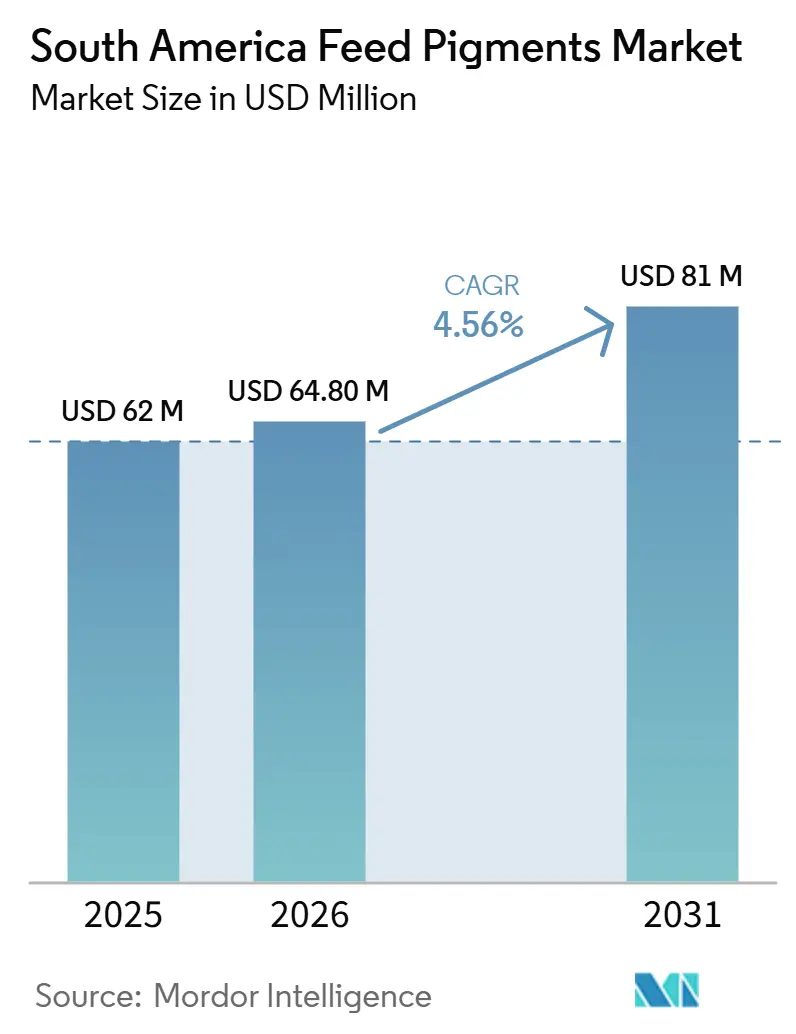
| Base Year Market Size (2025) | USD 62 Million |
| Market Size (2026) | USD 64.80 Million |
| Market Size (2031) | USD 81 Million |
| Growth Rate (2026 - 2031) | 4.56 % |
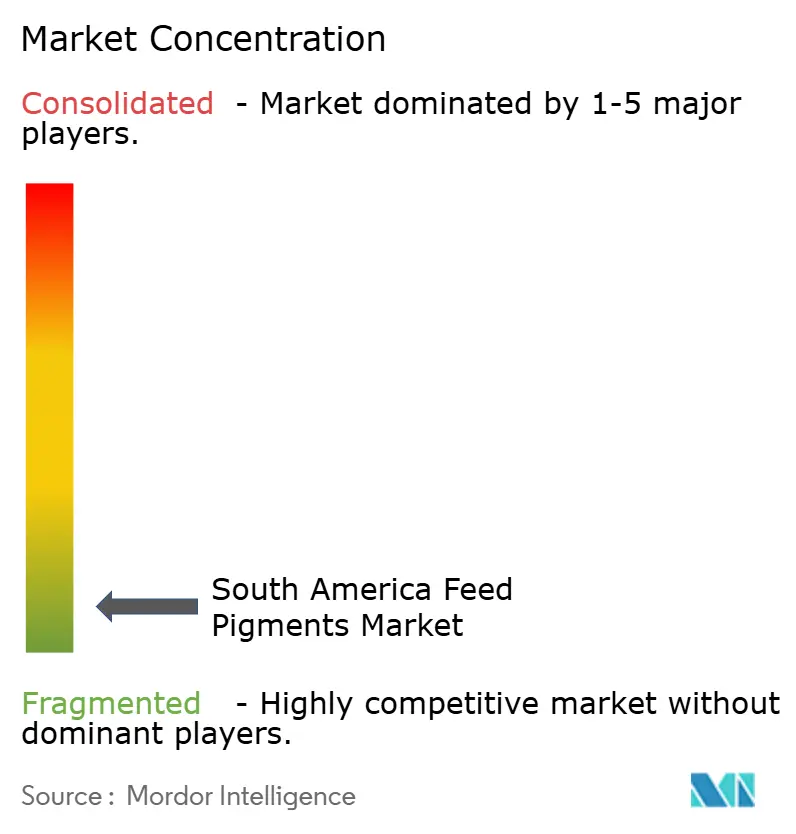
| Market Concentration | Low |
Major Players *Disclaimer: Major Players sorted in no particular order Image © Mordor Intelligence. Reuse requires attribution under CC BY 4.0. | |
South America Feed Pigments Market Analysis by Mordor Intelligence
The South America feed pigments market size was valued at USD 62.0 million in 2025 and estimated to grow from USD 64.8 million in 2026 to reach USD 81.0 million by 2031, at a CAGR of 4.56% during the forecast period 2026 to 2031. Brazil remains the primary volume driver, as the Associação Brasileira de Proteína Animal (ABPA) 2026 Annual Report recorded 5,324,000 metric tons of chicken meat exports in 2025 across 153 destination markets[1]Source: Associação Brasileira de Proteína Animal, “Relatório Anual ABPA 2026,” ABPA, abpa-br.org, linking pigment consumption closely to export-quality requirements rather than to discretionary feed formulation. Chile serves as the main value center, with the Servicio Nacional de Pesca y Acuicultura 2025 Official Statistics reporting 810,892 metric tons of Atlantic salmon production and the Subsecretaría de Pesca y Acuicultura 2025 sectoral report confirming total aquaculture harvest of 1,525,400 metric tons, sustaining strong demand for astaxanthin in salmon farming. Regulatory developments are also influencing the South America feed pigments market, as the European Commission’s 2025 canthaxanthin rule has heightened compliance requirements in poultry supply chains, while Chile’s 2024 and 2025 feed additive regulations have strengthened documentation standards for imported inputs. In addition, aquaculture expansion across Brazil, Peru, and Ecuador is creating further opportunities, with the Peixe BR 2026 yearbook, Peru’s Sanipes 2026 export update, and Ecuador’s Cámara Nacional de Acuacultura statistics highlighting the continued growth of export-oriented protein industries and the increasing need for structured feed quality programs. Competition in the South America feed pigments market remains fragmented, and suppliers are responding through technical differentiation, local manufacturing investments, and portfolio repositioning, as reflected in Archer-Daniels-Midland Company’s 2026 Brazil premix plant launch, Corbion N.V.’s 2025 natural astaxanthin partnership, and dsm-firmenich AG’s 2026 separation of its Animal Nutrition and Health business.
Key Report Takeaways
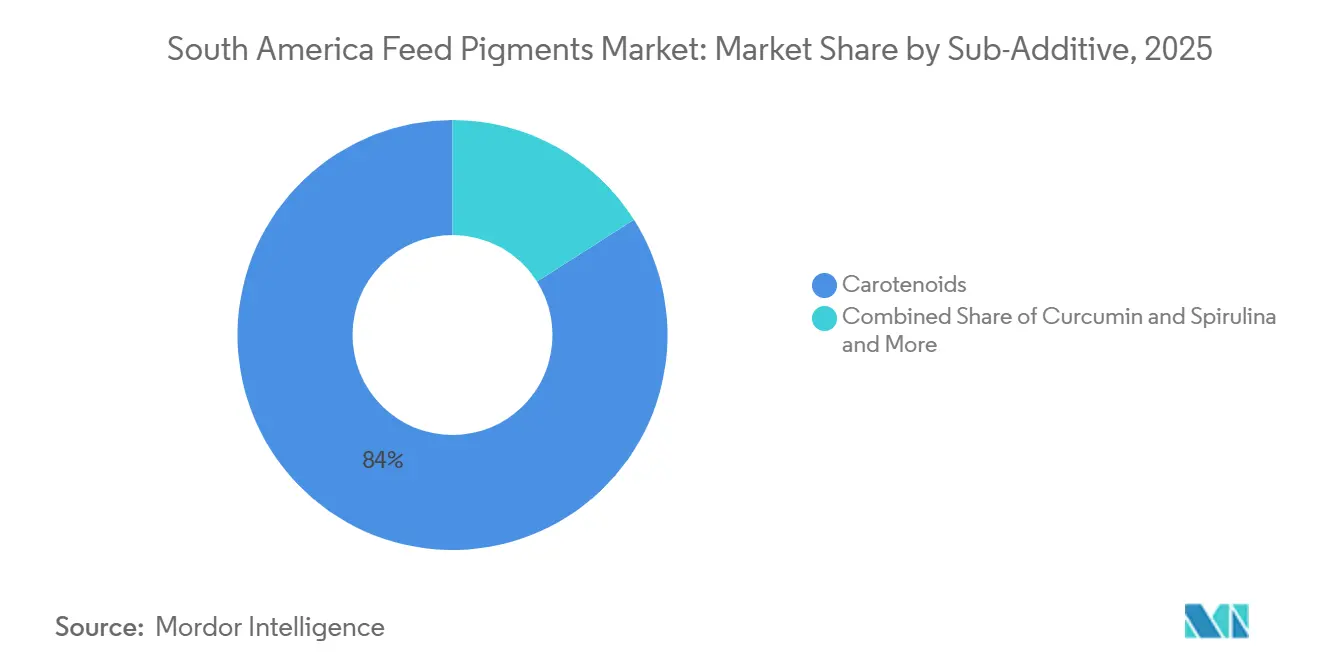
- By sub-additive, carotenoids held 84% of the South America feed pigments market share in 2025 market size, while curcumin and spirulina are projected to expand at a 7.8% CAGR through 2031.
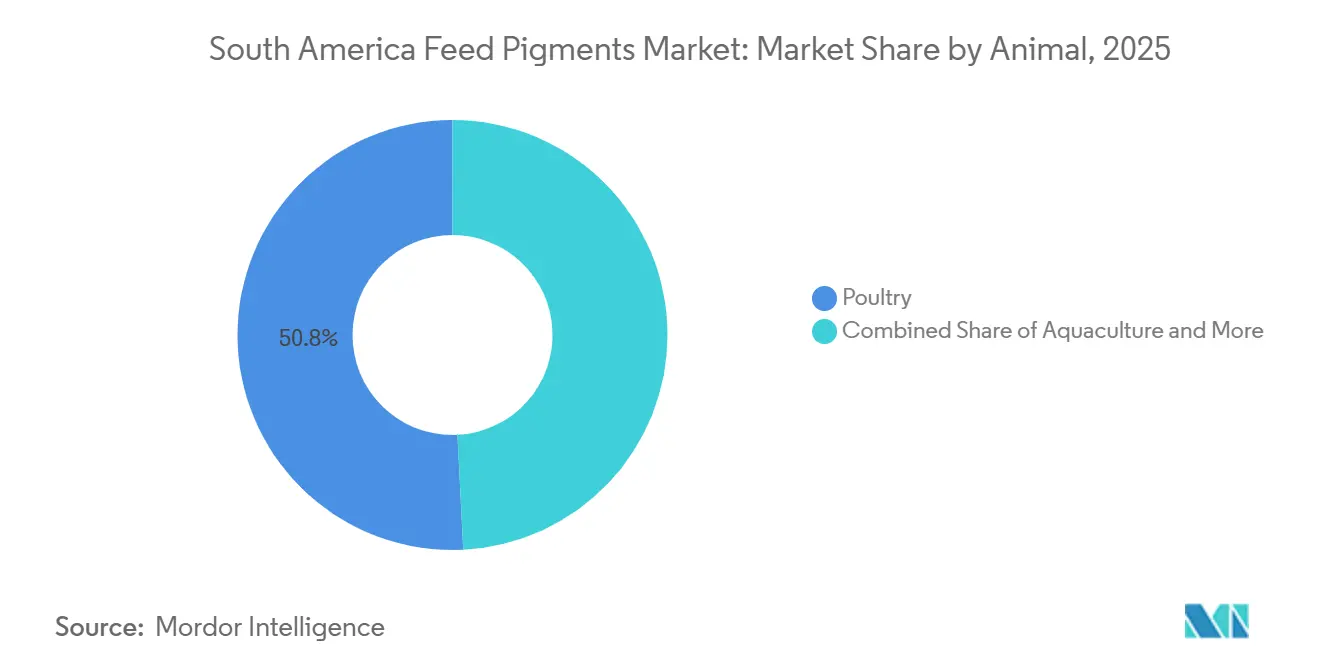
- By animal, poultry accounted for 50.8% of the South America feed pigments market size in 2025, while aquaculture recorded the highest projected CAGR at 6% through 2031.
- By geography, Brazil held 56.1% of the South America feed pigments market share in 2025, while Chile is forecast to advance at a 5.3% CAGR through 2031.
Note: Market size and forecast figures in this report are generated using Mordor Intelligence’s proprietary estimation framework, updated with the latest available data and insights as of January 2026.
South America Feed Pigments Market Trends and Insights
Drivers Impact Analysis*
| Driver | (~) % Impact on CAGR Forecast | Geographic Relevance | Impact Timeline |
|---|---|---|---|
| Export-grade poultry color standards | +1.2% | Strongest in Brazil, with secondary relevance in Colombia and Peru as export-oriented poultry systems formalize quality standards | Short term (≤ 2 years) |
| Brazil poultry production resilience | +0.9% | Brazil, especially Paraná, Santa Catarina, and Rio Grande do Sul | Short term (≤ 2 years) |
| Chile salmon pigmentation economics | +0.8% | Chile, centered in Los Lagos, Aysén, and Magallanes | Medium term (2-4 years) |
| Aquaculture expansion in Brazil and the Andean shrimp corridor | +0.7% | Brazil, Peru, and Ecuador, with growing relevance for Colombia | Medium term (2-4 years) |
| Plant-protein aquafeed reformulation raising pigment optimization needs | +0.5% | Chile first, then Brazil aquaculture | Medium term (2-4 years) |
| Natural pigment migration in premium animal protein programs | +0.4% | Brazil, Chile, and export-oriented aquaculture channels | Long term (≥ 4 years) |
| Source: Mordor Intelligence | |||
Export-Grade Poultry Color Standards
Brazil’s poultry export industry provides a strong demand base for the south america feed pigments market, product appearance and color consistency remain important quality attributes in international trade. The Associação Brasileira de Proteína Animal (ABPA) 2026 Annual Report identified Japan as the largest individual destination, importing 402,900 metric tons of chicken meat in 2025, which reinforces the importance of maintaining visual quality in premium poultry shipments. Supporting this trend, a 2025 study published in TERNAK TROPIKA Journal of Tropical Animal Production found that canthaxanthin supplementation improved egg yolk pigmentation scores and production efficiency[2]Source: B. M. Atmosmara et al., “Carotenoid Supplementation in Poultry Nutrition, Canthaxanthin’s Role in Improving Egg Yolk Pigmentation and Production Efficiency,” TERNAK TROPIKA Journal of Tropical Animal Production, doi.org, underlining the technical importance of carotenoid pigments in poultry nutrition. As a result, the South America feed pigments market remains closely aligned with the requirements of export-oriented poultry systems, where pigmentation supports product quality and market acceptance rather than serving solely as a feed cost consideration.
Brazil Poultry Production Resilience
Brazil’s poultry industry remained resilient despite the first documented avian influenza outbreak in a commercial flock in May 2025, helping preserve the demand foundation of the South America feed pigments market. The Associação Brasileira de Proteína Animal (ABPA) 2026 Annual Report recorded chicken meat production of 15,289,000 metric tons in 2025 and the slaughter of 5.706 billion birds, based on Ministry of Agriculture, Livestock and Food Supply (MAPA) operational data. The same report projects production to increase to 15,600,000 metric tons in 2026, indicating that pigment demand continues to be supported by the scale of the poultry industry rather than by an exceptional rise in output. According to MAPA data cited in the Associação Brasileira de Proteína Animal 2026 Annual Report, Paraná accounted for 38.9% of national chicken slaughter, underscoring the concentration of poultry-linked pigment demand within a single state. The South America feed pigments market is also benefiting from a gradual shift toward natural carotenoid blends in export-oriented production systems, as residue management requirements become more important following the European Commission’s 2025 canthaxanthin rule.
Chile Salmon Pigmentation Economics
Chile provides the South America feed pigments market with a high-value aquaculture demand base, as pigmentation is an essential component of salmonid feed programs rather than a discretionary input. According to Sernapesca's 2026 statistics, Chile's total fish harvest reached 1.146 million metric tons in 2025, representing a 14.9% increase from 2024, while Atlantic salmon production totaled 810,892 metric tons. The Subsecretaría de Pesca y Acuicultura (Subpesca), in its 2025 sectoral report, also confirmed that total aquaculture harvest amounted to 1,525,400 metric tons, highlighting the scale of production supporting pigment consumption. Furthermore, a 2025 Aquaculture Nutrition study by Ytrestøyl and coauthors at Nofima found that plant-protein diets reduced astaxanthin retention in Atlantic salmon muscle and increased liver accumulation of idoxanthin, while adequate phospholipid levels remained important for digestibility. These findings are increasing the commercial importance of formulation precision in the South America feed pigments market as feed formulations continue to shift toward greater use of plant-based ingredients.
Aquaculture Expansion in Brazil and The Andean Shrimp Corridor
Aquaculture expansion is broadening the demand base of the South America feed pigments market beyond its traditional dependence on poultry. The Associação Brasileira da Piscicultura (Peixe BR), in its 2026 yearbook, reported that Brazil produced 1,011,540 metric tons of farmed fish in 2025, with tilapia accounting for 707,495 metric tons and registering growth of 6.83% over 2024. Supporting this trend, a 2025 study published in Fishes by Brum and coauthors highlighted the growing use of functional feed ingredients, including carotenoid-active compounds, in health management programs for Brazilian aquaculture. In Peru, the Instituto Nacional de Calidad (INACAL) approved an updated technical standard for trout feed in December 2025, while the Servicio Nacional de Sanidad e Inocuidad en Pesca y Acuicultura (Sanipes) reported trout exports of 4,300 metric tons valued at USD 34 million in 2025, with Japan, the United States, and Canada serving as the main destinations. Pigment demand is associated with appearance and quality standards in export-oriented shrimp production. These developments are expanding the application scope of the South America feed pigments market and increasing the importance of pigments across diverse aquaculture value chains.
Restraints Impact Analysis*
| Restraint | (~) % Impact on CAGR Forecast | Geographic Relevance | Impact Timeline |
|---|---|---|---|
| Synthetic carotenoid supply and price volatility | -1.20% | South America wide, with the strongest effect in Chile and Brazil | Short term (≤ 2 years) |
| Product authorization and usage-limit complexity | -0.80% | Brazil , Chile , and Argentina. | Medium term (2-4 years) |
| High-inclusion plant diets reducing astaxanthin deposition efficiency | -0.60% | Chile, with secondary relevance in Brazil aquaculture | Medium term (2-4 years) |
| Pigment losses during storage, oxidation, and pelleting | -0.50% | South America wide | Short term (≤ 2 years) |
| Source: Mordor Intelligence | |||
Synthetic Carotenoid Supply and Price Volatility
A concentrated global supply structure remains a key constraint for the South America feed pigments market, as synthetic astaxanthin and canthaxanthin production is controlled by a relatively small group of manufacturers. Major supply anchors include BASF SE, Zhejiang NHU Co., and the Animal Nutrition and Health (ANH) business of dsm-firmenich AG, leaving South American buyers vulnerable to fluctuations in global availability and pricing. In February 2026, dsm-firmenich announced that it had agreed to divest its ANH business to CVC Capital Partners for EUR 2.2 billion (USD 2.6 billion), while retaining a 20% equity stake, reflecting ongoing structural changes within the industry. The South America feed pigments market also faces slower adoption of natural astaxanthin, as naturally derived alternatives remain significantly more expensive than synthetic products in large-scale poultry and aquafeed applications. As a result, feed manufacturers face greater procurement uncertainty, particularly in markets where currency depreciation increases the cost of imported inputs and complicates long-term purchasing strategies.
Product Authorization and Usage-Limit Complexity
Regulatory complexity remains a practical constraint on the expansion of the South America feed pigments market. In Chile, SAG Resolution 7.525/2024 replaced the 2006 list of authorized feed additives by introducing maximum inclusion limits and labeling requirements, while aligning the regulatory framework with Codex Alimentarius, European Union, and Mercosur standards. In addition, SAG Resolution 6.944/2024 introduced contamination-control verification requirements that affect feed ingredient imports supplied to Chilean feed mills. Brazil's Ministry of Agriculture and Livestock (MAPA) maintains separate approval procedures for novel feed additive variants, preventing suppliers from relying on a single market authorization for regional commercialization. As a result, companies seeking to introduce new fermentation-derived pigment products across the South America feed pigments market face higher compliance costs, longer approval timelines, and greater complexity in executing region-wide expansion strategies.
*Our forecasts treat driver/restraint impacts as directional, not additive. The impact forecasts reflect baseline growth, mix effects, and variable interactions.
Segment Analysis
By Sub-Additive: Carotenoids remain the core value pool while natural alternatives gather pace
Carotenoids accounted for 84.0% of the South America feed pigments market share in 2025, maintaining their position as the dominant revenue-generating category. Demand remains concentrated in this segment because astaxanthin is an essential component of salmonid diets, while xanthophylls and canthaxanthin are widely used to maintain yolk and skin color consistency in poultry production. BASF SE’s Lucantin Pink portfolio illustrates the importance of formulation and application design[3]Source: BASF SE, “Lucantin Pink, Astaxanthin for Fish and Crustaceans,” BASF Animal Nutrition, basf.com, as the company positions the product as a microencapsulated astaxanthin solution for fish and crustaceans, suitable for post-extrusion applications. Strong salmonid harvest volumes reported in Sernapesca’s 2025 official statistics further reinforce the scale-driven demand base for carotenoids in Chile. In addition, Alltech Coppens noted in its 2025 technical guidance that feed conversion ratio, astaxanthin concentration, and overall diet composition all influence fillet coloration, highlighting that pigment performance depends on broader feed formulation rather than dosage alone. This technical complexity strengthens the position of established suppliers and supports pricing power and customer retention in the South America feed pigments market.
Curcumin and spirulina are projected to register a CAGR of 7.8% through 2031, making them the fastest-growing sub-additive category in the South America feed pigments market. A 2024 study published in BMC Veterinary Research reported that supplementation with Spirulina platensis at 5 grams per kilogram improved antioxidant capacity, immune response, and feed efficiency in Nile tilapia. These findings are expanding the role of natural pigments beyond appearance, supporting their adoption in premium and residue-sensitive production systems where performance attributes are becoming increasingly important.



By Animal: Poultry leads volume demand while aquaculture lifts value per ton
Poultry accounted for 50.8% of the South America feed pigments market in 2025, making it the largest animal segment. Demand is supported by Brazil’s highly integrated broiler and layer industries, where maintaining consistent pigmentation is essential across large production cycles serving export markets such as Japan, the Gulf Cooperation Council (GCC), and the European Union (EU). A 2025 study published in TERNAK TROPIKA Journal of Tropical Animal Production reinforced the continued importance of canthaxanthin supplementation in laying hens, reporting improvements in egg yolk pigmentation scores and production efficiency. Although ruminants and swine account for smaller shares, they continue to provide steady demand in premium dairy, beef, and pork systems where color attributes and oxidative stability contribute to product quality and market differentiation.
Aquaculture is projected to register a CAGR of 6.0% through 2031, making it the fastest-growing animal segment in the South America feed pigments market. Chile’s salmon industry represents the largest source of pigment value within aquaculture, while Ecuador’s shrimp sector provides another high-intensity application where coloration directly influences commercial acceptance. In August 2025, Corbion N.V. and Kuehnle AgroSystems announced a strategic partnership to develop natural astaxanthin derived from non-genetically modified organism (non-GMO) heterotrophic algae for aquaculture and nutraceutical applications, with a focus on enhancing fat solubility, oxidation stability, and bioavailability. Expanding aquaculture output and the growing complexity of feed formulations are reshaping value creation within the South America feed pigments market and strengthening the role of technically advanced pigment solutions.
Geography Analysis
Brazil accounted for 56.1% of the South America feed pigments market share in 2025, maintaining its position as the largest country-level contributor to the South America feed pigments market. Paraná, Santa Catarina, and Rio Grande do Sul remain the core centers of poultry-related pigment consumption, while the northeastern states are gaining importance through expanding shrimp and fish farming activities. Kemin Industries, Inc. further strengthened its regional presence in 2024 by opening an innovation center and a second spray dryer facility in Vargeão, Santa Catarina, enhancing local supply capabilities and technical support. These factors reinforce Brazil’s role as the primary operational hub for the South America feed pigments market across both established poultry applications and emerging aquaculture segments.
Chile is projected to register a CAGR of 5.3% through 2031, making it the fastest-growing country in the South America feed pigments market. SAG Resolutions 7.525/2024 and 6.944/2024 have increased documentation and compliance requirements for feed ingredient suppliers, creating a market environment that favors established companies with approved products and strong regulatory capabilities.
Peru, Colombia, Ecuador, and other South American countries represent the next layer of growth opportunities within the South America feed pigments market. INACAL trout feed standard has strengthened quality requirements for feed inputs. Ecuador's Cámara Nacional de Acuacultura reported shrimp exports of 1.4 million metric tons in 2025, reflecting growth of 15.1% and creating a significant demand base for pigments across the regional aquaculture cluster. Argentina possesses a substantial livestock industry, although currency volatility continues to limit pigment spending intensity relative to the scale of its poultry and livestock production.
Competitive Landscape
The South America feed pigments market remains fragmented, with leading participants including dsm-firmenich AG, BASF SE, Kemin Industries, Inc., EW Nutrition GmbH, and Archer-Daniels-Midland Company. Competition is driven more by technical support capabilities, regulatory approvals, and application-specific formulation expertise than by active ingredient pricing alone. Kemin Industries, Inc. maintains a strong local position in Brazil through its Vargeão facility, which enables faster service and closer support for poultry and aquaculture customers in the southern region. BASF SE also holds a differentiated position through its Lucantin carotenoid portfolio, particularly in aquaculture applications tailored for fish and crustacean species. As a result, competition in the South America feed pigments market is closely linked to technical capabilities and regulatory readiness.
A significant strategic development occurred in June 2026 when Archer-Daniels-Midland Company announced the establishment of a new premix and feed additives plant in Apucarana, Paraná, with an installed capacity of 40,000 metric tons per year and production capability of up to 10 metric tons per hour. The investment strengthens the company's local manufacturing base and enhances its ability to serve poultry, livestock, and aquaculture customers throughout Brazil. Another notable development came in February 2026, when dsm-firmenich AG agreed to divest its Animal Nutrition and Health business to CVC Capital Partners, with the transaction to be completed through the creation of two Swiss entities by the end of 2026. This portfolio restructuring is particularly relevant because established pigment brands such as CAROPHYLL Pink remain important components of salmon and shrimp feed programs.
Technology-driven developments are also reshaping the competitive landscape. In August 2025, Corbion N.V. and Kuehnle AgroSystems entered into a strategic partnership to commercialize fermentation-derived natural astaxanthin for aquaculture applications. Corbion further strengthened its regional presence in May 2025 by joining the Sustainable Shrimp Partnership (SSP), providing access to a collaborative platform closely connected to the South American shrimp industry. Consequently, the South America feed pigments market is witnessing the simultaneous emergence of capacity-driven and innovation-driven competition, favoring companies that can combine reliable supply, technical expertise, and strong regional regulatory execution.
South America Feed Pigments Industry Leaders
dsm-firmenich AG
BASF SE
Kemin Industries, Inc.
EW Nutrition GmbH
Archer-Daniels-Midland Company
- *Disclaimer: Major Players sorted in no particular order

Recent Industry Developments
- June 2026: Archer-Daniels-Midland Company opened a new premix plant in Paraná, Brazil, increasing local additive supply and strengthening production support for the South America feed pigments market.
- August 2025: Corbion N.V. and Kuehnle AgroSystems partnered on algae-derived natural astaxanthin, supporting future pigment applications in salmonid and crustacean feed programs across regional aquaculture.
- May 2025: Salmofood and Cooke Aquaculture advanced organic salmon feed in Chile, opening a premium channel for natural pigmentation inputs under certified aquaculture production standards.


South America Feed Pigments Market Report Scope
Feed pigments are functional additives that standardize and enhance animal product coloration. The South America feed pigments market report is segmented by sub-additive (carotenoids, curcumin, and spirulina), by animal (aquaculture, poultry, and more), and by geography (Brazil, Argentina, Chile, and more). The market forecasts are provided in terms of value in USD and volume (metric tons).
| Carotenoids |
| Curcumin and Spirulina |
| Aquaculture | Fish |
| Shrimp | |
| Other Aquaculture Species | |
| Poultry | Broiler |
| Layer | |
| Other Poultry Birds | |
| Ruminants | Beef Cattle |
| Dairy Cattle | |
| Other Ruminants | |
| Swine | |
| Other Animals |
| Brazil |
| Argentina |
| Chile |
| Colombia |
| Peru |
| Rest of South America |
| By Sub-Additive | Carotenoids | |
| Curcumin and Spirulina | ||
| By Animal | Aquaculture | Fish |
| Shrimp | ||
| Other Aquaculture Species | ||
| Poultry | Broiler | |
| Layer | ||
| Other Poultry Birds | ||
| Ruminants | Beef Cattle | |
| Dairy Cattle | ||
| Other Ruminants | ||
| Swine | ||
| Other Animals | ||
| By Country | Brazil | |
| Argentina | ||
| Chile | ||
| Colombia | ||
| Peru | ||
| Rest of South America | ||


Key Questions Answered in the Report
What is the 2031 value forecast for South America feed pigments?
The South America feed pigments market is forecast to reach USD 81.0 million by 2031, rising at a 4.56% CAGR from 2026 to 2031.
Which country leads regional demand?
Brazil led with 56.1% share in 2025 because of its large poultry export base and growing aquaculture production.
Which segment is growing the fastest by animal type?
Aquaculture is the fastest-growing animal segment, with a projected 6.0% CAGR through 2031, supported by salmon and shrimp feed demand.
What is driving growth in Chile?
Chile is growing fastest at 5.3% CAGR because salmonid harvest volumes remain strong and pigmentation is a required feed input in those systems.
Page last updated on:





