
Market Overview
| Study Period | 2020 - 2032 |
|---|---|
| Forecast Data Period | 2027 - 2032 |
| Base Year Market Size (2026) | USD 601.40 Million |
| Market Size (2027) | USD 633.16 Million |
| Market Size (2032) | USD 818.92 Million |
| Growth Rate (2027 - 2032) | 5.28 % |
| Market Concentration | Low |
Major Players *Disclaimer: Major Players sorted in no particular order Image © Mordor Intelligence. Reuse requires attribution under CC BY 4.0. | |
South America Feed Palatability Enhancers Market Analysis by Mordor Intelligence
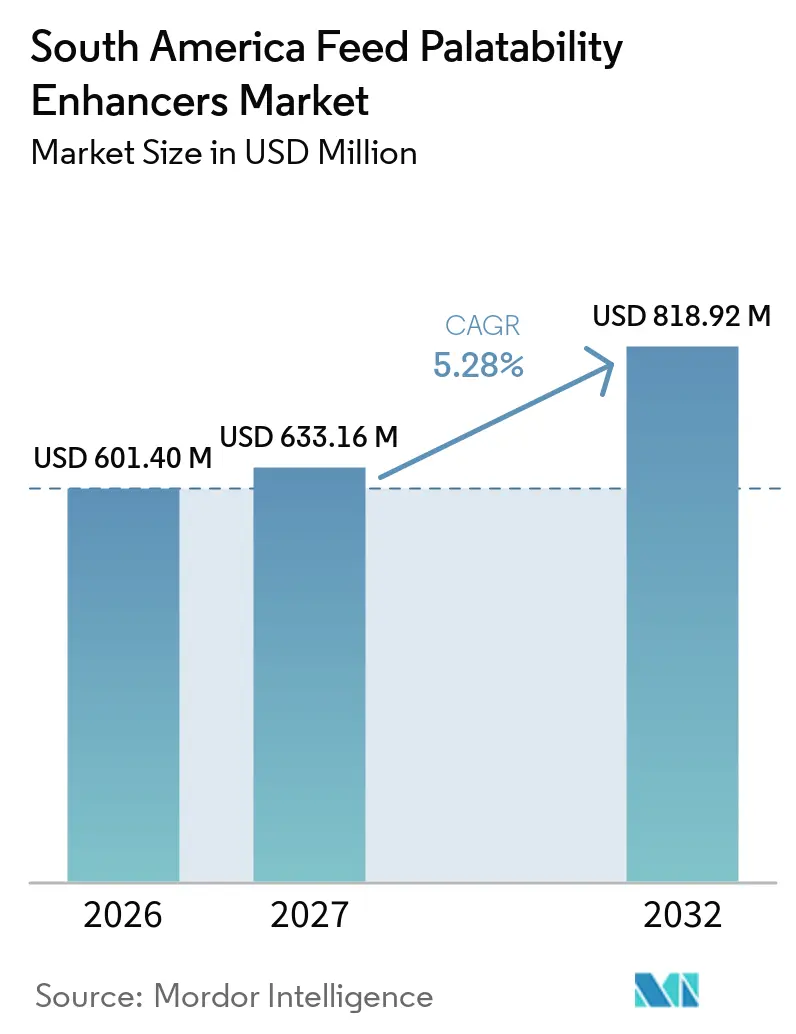
The South America feed palatability enhancers market size was valued at USD 601.40 million in 2026 and is estimated at USD 633.16 million in 2027. The market is forecast to grow at a CAGR of 5.28% from 2027 to 2032, reaching USD 818.92 million by 2032.
South America represents a crucial market for palatability enhancer development and implementation. The expansion of the palatability enhancer market stems from the ongoing modernization of livestock production systems throughout South America, with Brazil and Argentina leading this transformation. The Alltech Survey reports that commercial feed production achieved 167.9 million metric tons in 2024, demonstrating a 2.2% year-over-year increase. The shift toward intensive production methods necessitates enhanced feed efficiency and consumption, strengthening the market demand for palatability enhancers. Research published in the Journal of Animal Science and Technology in 2024 revealed that palatability enhancers improved feed intake substantially - 8-12% in swine and 5-7% in poultry within South American production environments, delivering measurable economic value for producers operating in competitive markets with constrained profit margins.
The palatability enhancer market shows strong innovation activity, with research investments focusing on region-specific formulations adapted to local feed ingredients and production conditions. For instance, in 2023, ADM launched two products under its SUCRAM range, an in-feed sweetening solution for livestock species in South America. The company's global feed additives business, Pancosma, developed SUCRAM M'I Sweet and SUCRAM Specifeek as sweeteners to improve feed palatability for young animals, particularly weanling pigs.
South American markets demonstrate increasing demand for animal products from production systems that minimize or eliminate antibiotic growth promoters and synthetic performance enhancers. This transition has created significant opportunities for palatability enhancer manufacturers, as their products help maintain production efficiency while supporting reduced antimicrobial use.
Note: Market numbers in this report are based on Mordor Intelligence's proprietary estimation framework, which combines nine months of actuals with Q4 projections for base year 2026.
Market Trends and Insights
The Poultry Segment Dominates the Consumption of Feed Palatability Enhancers.
The feed palatability enhancer market in South America is predominantly driven by the poultry industry. The region's poultry sector has undergone a significant transformation, transitioning from small-scale operations to sophisticated integrated production systems over the past two decades. According to the USDA Foreign Agricultural Services, Brazil's chicken meat production reached 15.4 million metric tons in 2024, accounting for 15% of global production. The country's poultry sector utilizes approximately 44.5 million tons of commercial feed annually, as reported by Alltech Survey, establishing a robust market for palatability enhancers and specialty feed ingredients.
The adoption of alternative feed ingredients in South American poultry diets has directly increased the demand for palatability enhancers. Poultry nutritionists have expanded their use of alternative ingredients such as wheat bran, rice by-products, cassava meal, and diverse oilseed meals beyond soybean meal due to fluctuating commodity prices and supply limitations. According to research from Argentina's National Institute of Agricultural Technology (INTA), these alternative ingredients introduce specific palatability challenges, including bitter compounds, inconsistent texture profiles, and reduced aroma appeal. These challenges have accelerated the adoption of feed palatability enhancers in poultry diets, with continued growth anticipated throughout the forecast period.

Brazil Leads the South America Market
Brazil maintains its leadership in South America's feed palatability enhancer market through its extensive livestock production operations, modern feed manufacturing facilities, well-developed research infrastructure, and strategic presence in global agricultural trade networks. According to the Alltech Agri-Food Outlook, Brazil manufactured 79.7 million metric tons of animal feed in 2024, constituting 45.5% of South America's total feed production. The output distribution includes 43.7 million metric tons for poultry, 21.1 million metric tons for swine, 11.7 million metric tons for cattle, and 2.1 million metric tons for other species, including aquaculture.
Brazil's position as a major global meat exporter generates substantial demand for palatability enhancer innovations. According to the ITC Trade Map, Brazil exported 292.9 thousand metric tons of bovine meat in 2024, representing a 106.2% increase compared to 2022. The export-oriented market structure necessitates improvements in production efficiency and product quality, with palatability enhancers contributing significantly to these requirements.
Brazil's self-sufficiency in key feed ingredients provides cost advantages in palatability enhancer usage. As the world's second-largest soybean producer and a major corn producer, Brazil maintains stable access to primary feed ingredients essential for livestock diets. The stable ingredient supply allows nutritionists to optimize feed formulations effectively, resulting in measurable returns on palatability enhancer investments and increased adoption across commercial operations, thereby stimulating market growth.

Competitive Landscape
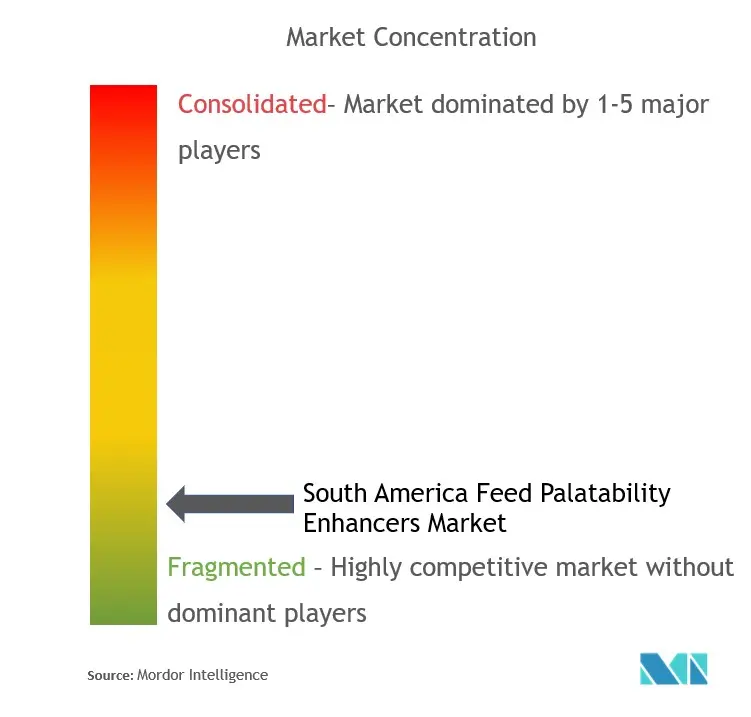
The South America feed palatability enhancers market is fragmented, with several international players and smaller companies competing in the market. Key players include Associated British Foods plc (ABF), Kerry Group plc, Symrise AG, BlueStar Adisseo Company, and ADM. These companies pursue strategic initiatives, including mergers and acquisitions, collaborations, and investments in product development and research, to strengthen their market presence and expand their product portfolios.
South America Feed Palatability Enhancers Industry Leaders
-
Associated British Foods plc (ABF)
-
Kerry Group plc
-
Symrise AG
-
BlueStar Adisseo Company
-
ADM
- *Disclaimer: Major Players sorted in no particular order
South America Feed Palatability Enhancers Market Companies Covered in this Report
- Associated British Foods plc (ABF)
- Kerry Group plc
- Symrise AG
- BlueStar Adisseo Company
- Elanco Animal Health
- ADM
- Kent Nutrition Group
- Kemin Industries, Inc.
Read Analysis of South America Feed Palatability Enhancers Companies
Recent Industry Developments in South America Feed Palatability Enhancers Market
- January 2024: Phytobiotics Futterzusatzstoffe GmbH introduced nine smart flavors formulated to enhance livestock feed palatability. These additions aim to address specific taste preferences of different farm animals while improving animal health and production efficiency.
- January 2023: ADM strengthened its livestock feed portfolio by introducing two products in its SUCRAM range, an in-feed sweetening solution for livestock species. Through its global feed additives business, Pancosma, the company developed SUCRAM M'I Sweet and SUCRAM Specifeek to improve feed palatability, specifically targeting young animals with a focus on weanling pigs.
- September 2023: Symrise opened a pet food palatants facility in Chapéco, Brazil. The plant produces palatants for cat and dog food. With 10,000 square meters of infrastructure, the facility is Latin America's largest and Symrise's biggest site for pet food ingredients worldwide.
South America Feed Palatability Enhancers Market Report Scope
Feed palatability enhancers and modifiers are feed additives used in animal feed to mask the unpleasant taste caused by the high concentration of synthetic additives, antibiotics, vitamins, and nutrients. The South America Feed Palatability Enhancers Market is Segmented by Type (Flavors, Sweeteners, and Aroma Enhancers), Animal Type (Ruminants, Poultry, Swine, Aquaculture, and Other Animal Types), and Geography (Brazil, Argentina, and Rest of South America). The report offers the market size and forecasts in terms of volume (Metric Tons) and value (USD) for all the above segments.
Segmentation Overview
By Type
| Flavors |
| Sweeteners |
| Aroma Enhancers |
By Animal Type
| Ruminants |
| Poultry |
| Swine |
| Aquaculture |
| Other Animal Types |
By Geography
| Brazil |
| Argentina |
| Rest of South America |
| By Type | Flavors |
| Sweeteners | |
| Aroma Enhancers | |
| By Animal Type | Ruminants |
| Poultry | |
| Swine | |
| Aquaculture | |
| Other Animal Types | |
| By Geography | Brazil |
| Argentina | |
| Rest of South America |
Key Questions Answered in the Report
How big is the South America feed palatability enhancers market?
The South America feed palatability enhancers market was valued at USD 601.40 million in 2026 and is forecast to grow from USD 633.16 million in 2027 to USD 818.92 million by 2032, at a CAGR of 5.28% from 2027 to 2032.
What is the current South America feed palatability enhancers market size?
The South America feed palatability enhancers market is valued at USD 633.16 million in 2027.
Which animal type dominates the South America feed palatability enhancers market?
Associated British Foods plc (ABF), Kerry Group plc, Symrise AG, BlueStar Adisseo Company, and ADM are the major companies operating in the South America feed palatability enhancers market.
Which animal type dominates the South America feed palatability enhancers market?
Poultry is the dominant animal-type segment in the South America feed palatability enhancers market, supported by Brazil's large-scale poultry production and growing demand for feed efficiency in commercial livestock systems.