
Market Overview
| Study Period | 2019 - 2031 |
|---|---|
| Forecast Data Period | 2026 - 2031 |
| Base Year Market Size (2025) | USD 0.92 Billion |
| Market Size (2026) | USD 0.98 Billion |
| Market Size (2031) | USD 1.32 Billion |
| Growth Rate (2026 - 2031) | 6.14 % |
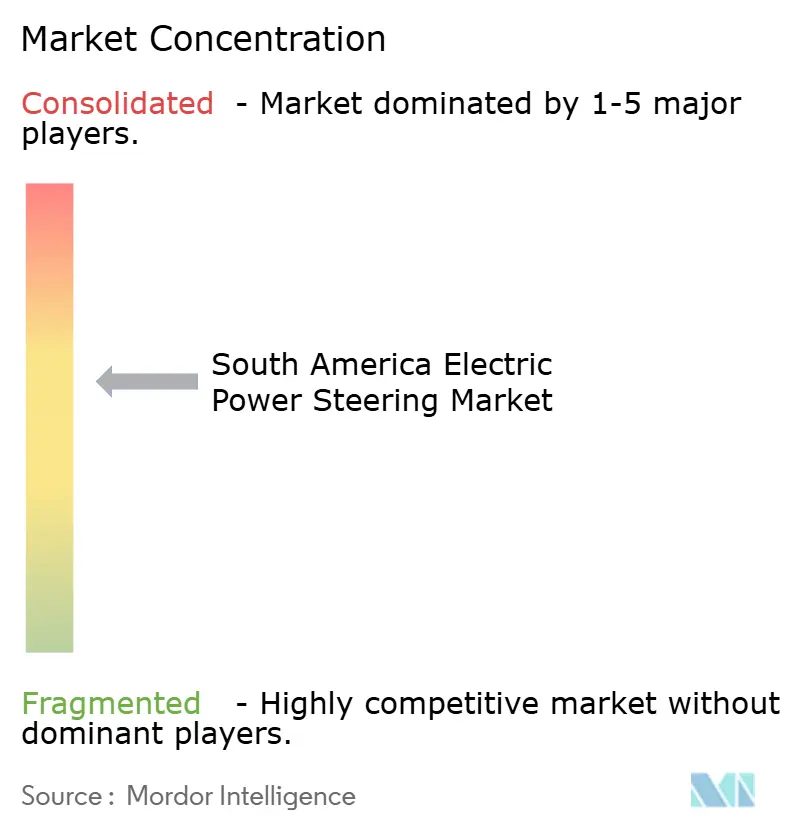
| Market Concentration | Medium |
Major Players *Disclaimer: Major Players sorted in no particular order Image © Mordor Intelligence. Reuse requires attribution under CC BY 4.0. | |
South America Electric Power Steering Market Analysis by Mordor Intelligence
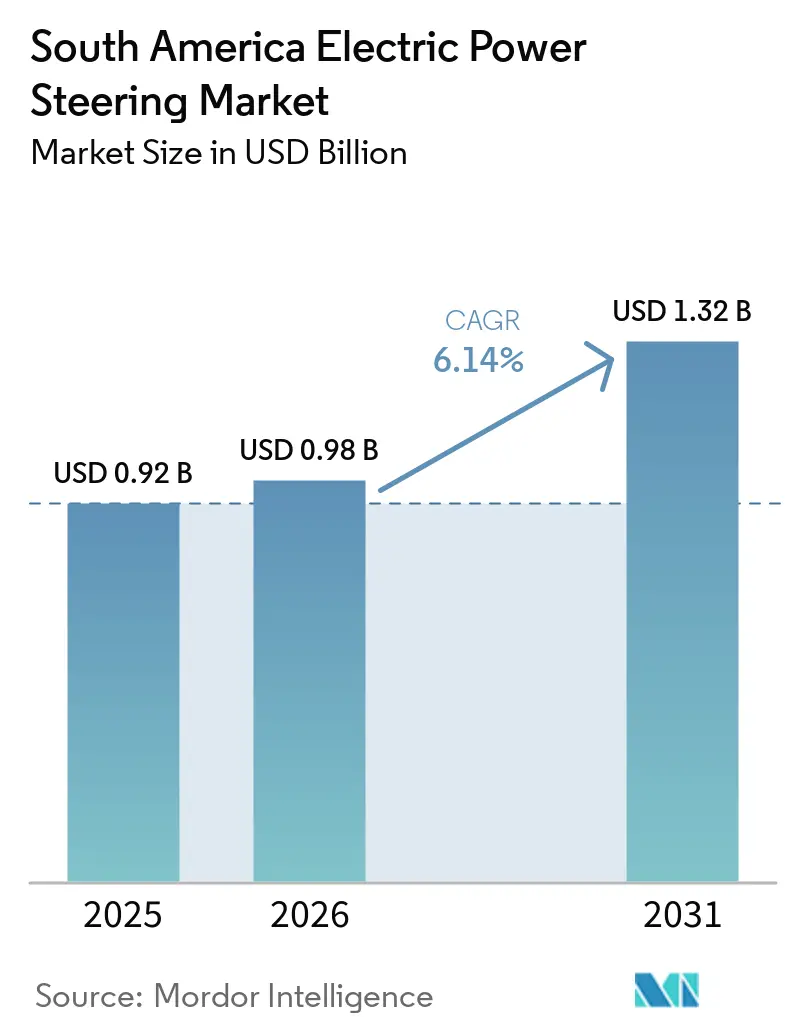
The South America Electric Power Steering Market was valued at USD 0.92 billion in 2025 and is projected to grow from USD 0.98 billion in 2026 to USD 1.32 billion by 2031, at a CAGR of 6.14% during the forecast period (2026-2031). Electrified and hybrid vehicle launches are moving electric power steering from an optional feature to a standard platform requirement for regional passenger vehicles, especially compact models. Regional electric-car sales exceeded 350,000 units in 2025, rising 75% from 2024, and plug-in hybrids accounted for a substantial part of registrations [1]. Tighter fuel-efficiency, emissions, and safety requirements are encouraging automakers to favor steering systems that support lower energy use, driver-assistance functions, and electronically managed vehicle controls. Investment commitments in Brazil are expanding the base of locally assembled platforms that require electric power steering and support local supplier participation. Suppliers in the South American electric power steering market are also competing on software calibration, sensor capability, local production, supply reliability, and the ability to support future steer-by-wire programs.
Key Report Takeaways
- By type, the column EPS segment held 63.37% of the South American electric power steering market share in 2025 and is projected to grow at a 7.11% CAGR through 2031.
- By component type, steering rack and column assemblies accounted for 58.71% of the South American electric power steering market share in 2025, while sensors are forecast to expand at a 7.16% CAGR through 2031.
- By vehicle type, passenger cars held 78.83% of the South American electric power steering market share in 2025 and are projected to grow at a 7.24% CAGR through 2031.
- By country, Brazil held 47.61% of the South American electric power steering market share in 2025 and is projected to grow at a 7.28% CAGR through 2031.
Note: Market size and forecast figures in this report are generated using Mordor Intelligence’s proprietary estimation framework, updated with the latest available data and insights as of January 2026.
Market Trends and Insights
Drivers Impact Analysis of South America Electric Power Steering Market*
| Driver | % Impact on CAGR Forecast | Geographic Relevance | Impact Timeline |
|---|---|---|---|
| Platform Electrification & Hybrid EV Proliferation | 1.8% | Brazil; spill-over to Colombia and Chile | Medium term (2–4 years) |
| Mandatory ADAS Integration | 1.1% | Brazil (CONTRAN mandate 2026–2029), South America NCAP influence across the region | Short to medium term (≤ 4 years) |
| Stringent Carbon Emission & Fuel Efficiency Mandates | 0.9% | Brazil (PROCONVE L8, MOVER), Chile (LDV fuel economy standards) | Medium term (2–4 years) |
| Tariff Reductions and Government Manufacturing Incentives | 0.7% | Brazil (IPI reduction, MOVER), Chile (EV import exemptions) | Short term (≤ 2 years) |
| OEM Supply Chain Localization & Plant Investments | 0.6% | Brazil | Medium term (2–4 years) |
| Software-Defined Calibration and Steer-By-Wire Readiness | 0.4% | Brazil (premium segment) | Long term (≥ 4 years) |
| Source: Mordor Intelligence | |||
Platform Electrification and Hybrid EV Proliferation
Electric-car sales in South America exceeded 350,000 units in 2025, up 75% from 2024. Brazil accounted for the majority of that increase, with plug-in hybrids making up a large share of regional registrations. Plug-in hybrid platforms require full electric power steering systems while keeping familiar vehicle architectures and conventional body layouts. This makes their adoption less dependent on entirely new battery-electric platform cycles, which can take longer to design and industrialize. The electrified light-duty fleet in South America and the Caribbean reached 837,014 vehicles in the first quarter of 2026 and is expected to exceed 1 million by the end of 2026 [2]. The larger installed fleet supports replacement demand and provides the South American electric power steering market with original-equipment demand, aftermarket demand, and a broader set of vehicle owners familiar with electronically assisted steering.
Mandatory ADAS Integration
Brazil requires new vehicle model codes registered from January 2026 to meet driver-assistance performance requirements, including automatic emergency braking, and mandates full fleet coverage from January 2029 [3]. Automatic emergency braking and lane-support functions depend on reliable steering torque and position information, particularly when corrective steering inputs are needed. A sensor-capable electric power steering assembly, therefore, becomes a required component for vehicles designed to meet these functions. A proposal in Brazil's Chamber of Deputies would include automatic emergency braking in the national traffic code, strengthening the policy basis for automakers' planning. Brazilian universities and research institutes are developing radar sensors for automatic braking, which may strengthen domestic capability before the 2029 deadline. South NCAP's 2025 protocol evaluates active-safety performance, supports voluntary adoption in countries without comparable mandates, and broadens the technical requirements that suppliers in the South American electric power steering market must meet.
Carbon Emission and Fuel-Efficiency Mandates
Brazil's PROCONVE L8 standards took effect in January 2025, tightening passenger-car emissions limits. The rules encourage powertrain and vehicle-efficiency measures that support the use of electric rather than hydraulic steering in new models. Chile has binding light-duty fuel-economy requirements intended to improve importer compliance and accelerate the adoption of zero-emission vehicles. Together, these requirements make hydraulic steering less attractive for high-volume new-model certification and fleet-efficiency planning. The South American electric power steering market benefits from EPS, which reduces the continuous engine load associated with hydraulic pumps and aligns with the electronic architecture used in hybrid and driver-assistance vehicles.
OEM Supply-Chain Localization and Plant Investment
Automaker investments in Brazil are increasing the addressable volume for local steering suppliers and component manufacturers. Stellantis has committed substantial investment to South America over the medium term and plans to launch a broad range of products featuring bio-hybrid and electrification technologies. Under this program, its Goiana facility in Pernambuco received significant investment. Kia is also investing substantially in its Pesquería plant to produce the EV3 over the coming years, starting with a meaningful share of local content and planning to increase this share. These programs incorporate steering specifications into vehicle platforms for multi-year production cycles, linking suppliers to a predictable sequence of product launch decisions. Production decisions support the South American electric power steering market, as manufacturers find it difficult to reverse once they establish a vehicle’s chassis, steering architecture, and approved component set.
Restraints Impact Analysis of South America Electric Power Steering Market*
| Restraint | % Impact on CAGR Forecast | Geographic Relevance | Impact Timeline |
|---|---|---|---|
| Substantially Higher Unit Costs Over Conventional Hydraulics | -1.0% | Broad South America; most acute in Argentina, Colombia, and the commercial vehicle segments | Short to medium term (2–4 years) |
| Semiconductor and Raw Material Supply-Chain Volatility | -0.8% | Global exposure; acute effects in Brazil production hubs | Short term (≤ 2 years) |
| Sensor Failures and Lost "Steering Feel" Perceptions | -0.4% | Brazil (premium/semi-premium segment) | Medium term (2–4 years) |
| Cybersecurity Vulnerabilities in Electronically Actuated Columns | -0.3% | Brazil (software-defined vehicle adoption) | Long term (≥ 4 years) |
| Source: Mordor Intelligence | |||
Higher Unit Costs Than Conventional Hydraulics
The price difference between electric and hydraulic steering remains important in price-sensitive vehicle categories across the region. The constraint is strongest in commercial vehicles, where high steering loads can preserve the upfront cost advantage of hydraulic systems. Die-casting improvements, automated assembly, and integrated electronic control units are reducing EPS production costs, but savings are not evenly distributed among suppliers. Companies with in-house motor and control-unit development can absorb cost pressure more easily than smaller manufacturers without comparable vertical integration. Brazil's large passenger-vehicle base shows how higher volumes can support wider adoption, but Colombia, Argentina, and smaller markets have not reached a similar scale. In those markets and heavier vehicle applications, the South American electric power steering market faces fleet buyers who may prioritize purchase cost over the efficiency, packaging, and driving benefits of EPS.
Semiconductor and Raw-Material Supply-Chain Volatility
Electric power steering relies on qualified power-management integrated circuits and motor-control microprocessors that are not easily substituted during vehicle production. Supply disruption can limit vehicle output because automotive components require lengthy validation before a replacement is approved. The shift toward 800-volt electrical architecture adds specialized silicon-carbide components to the sourcing challenge and increases the importance of qualified capacity. South American production remains exposed because core semiconductor content is imported, and regional vehicle plants must manage extended qualification lead times. This exposure is most pronounced in Brazil, where plants depend on predictable deliveries for domestic programs and export programs. Multi-source component strategies and proximity to local production can reduce delivery risk in the South American electric power steering market. However, they do not eliminate dependence on the global electronics supply.
*Our forecasts treat driver/restraint impacts as directional, not additive. The impact forecasts reflect baseline growth, mix effects, and variable interactions.
South America Electric Power Steering Market Segment Analysis
By Type:
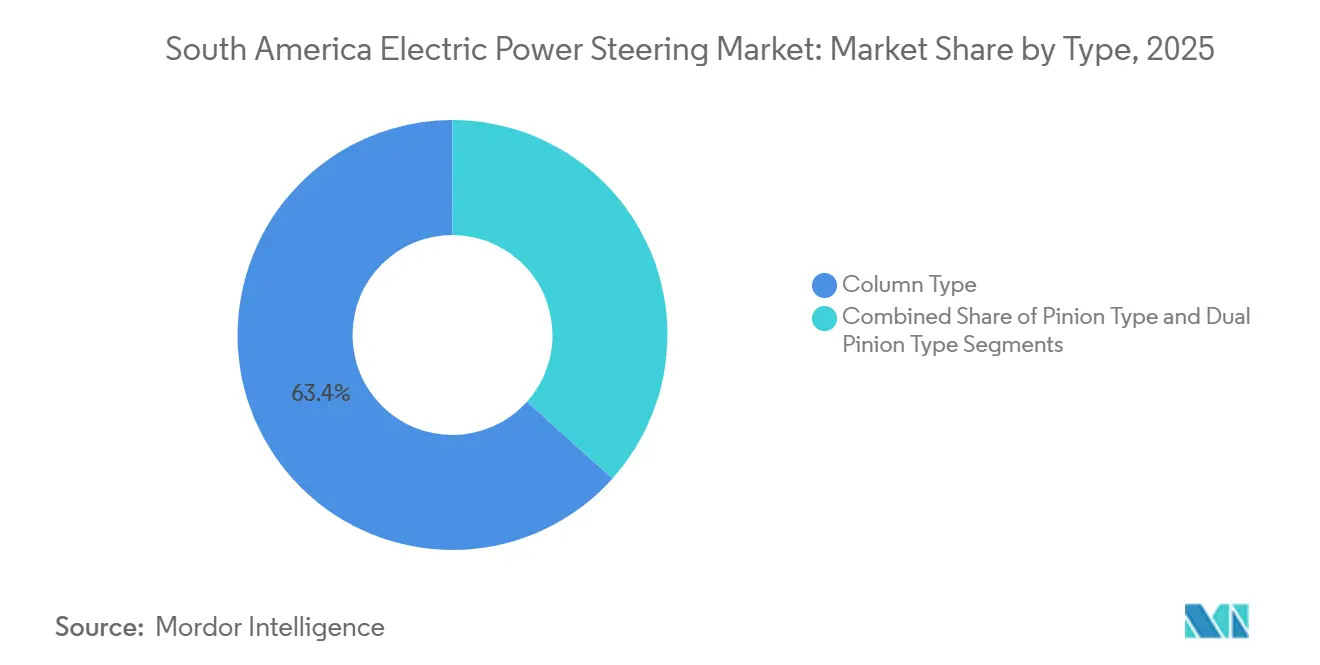
Column EPS Leads Regional Volume and GrowthColumn EPS represented 63.37% of the South America electric power steering market in 2025 and is projected to expand at a 7.11% CAGR through 2031. It is the preferred format in the region's compact and subcompact passenger-car fleet, which defines much of the region's automotive volume. The system places the motor and assist mechanism directly on the steering column. This arrangement uses less space in smaller engine bays, reduces installation complexity, and suits vehicle programs with tight cost targets. It also provides a cost-performance balance that supports high-volume passenger-vehicle programs without requiring extensive chassis changes. The South American electric power steering industry continues to rely on this configuration as electrification reaches mass-market models and suppliers seek scalable local production.
Pinion and dual-pinion systems are gaining use in SUVs and newer electric-vehicle platforms that need higher assist torque, more direct steering response, and more precise handling. Their layout can also support later progress toward steer-by-wire systems by aligning with the functional redundancy used in advanced steering designs.

By Component Type:
Rack and Column Assemblies Anchor Revenue as Sensors Grow FastestSteering rack and column assemblies accounted for 58.71% of the South American electric power steering market in 2025. They are the highest-value physical elements in an EPS system because they combine the mechanical steering path with integrated electric assistance. Their production combines precision-machined mechanical parts, high-strength bearings, and coupling mechanisms that must work reliably over the vehicle lifecycle. Automakers require extensive qualification before approving these assemblies for volume production, particularly when the design is tied to a specific chassis layout. Once chassis geometry is fixed, existing suppliers are difficult to replace during a vehicle program. This gives the South American electric power steering industry a durable revenue base in rack-and-column assemblies through established relationships with automakers.
Sensors are forecast to grow at a 7.16% CAGR through 2031, the highest rate among component groups. Torque and position sensors connect driver input with steering assistance and driver-assistance control functions. Their required accuracy rises as Level 2+ systems become more common and vehicle makers need more dependable feedback from the steering system. Each compliant vehicle needs torque and position sensing within the steering assembly, raising sensor content as safety functions become standard. JTEKT's investment in EPS control software for over-the-air steering-parameter updates adds a software layer to the use of sensor data. ISO 26262 functional-safety requirements can limit the qualified supplier pool, reducing price-only competition and strengthening the role of certified capability in the South American electric power steering market.
By Vehicle Type:
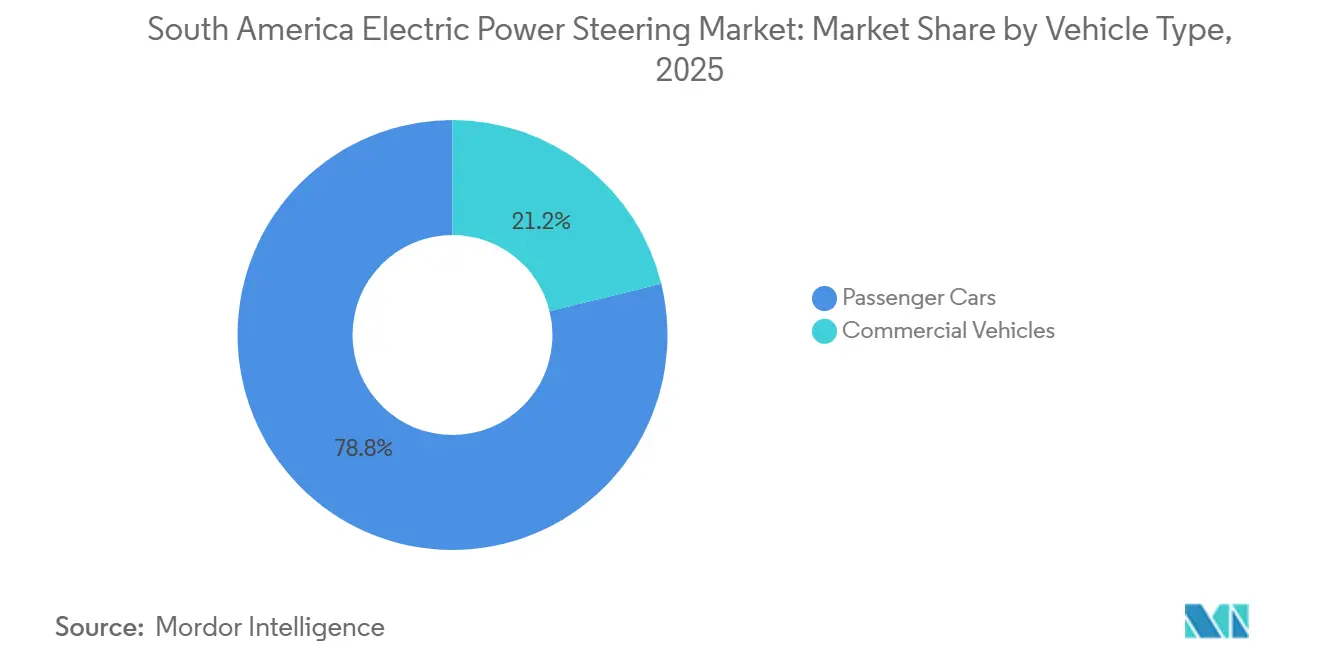
Passenger Cars Set Demand While Commercial Vehicles Depend on PolicyPassenger cars accounted for 78.83% of the South American electric power steering market in 2025 and are projected to register a CAGR of 7.24% through 2031. Concurrent vehicle launches in Brazil support this segment, particularly among mass-market models and emerging hybrid nameplates. These vehicles commonly use column-type EPS, as it suits compact vehicle architectures and balances system cost with steering assistance. Argentina’s vehicle market recovery in 2025 also increased passenger car volumes across the regional vehicle base. Consequently, passenger cars remain central to unit demand across supplier programs and the replacement market. This broad passenger car base provides the South American electric power steering market with a growth avenue beyond premium models, where electric steering systems gained earlier acceptance.
Commercial vehicles account for the remaining demand but follow a different adoption path than passenger vehicles. Hydraulic systems remain viable in trucks and heavy utility vehicles that require high assist torque, particularly when buyers prioritize upfront costs. For fleet operators, the lower acquisition cost of hydraulic systems can outweigh the energy-efficiency and control benefits of EPS. However, Chile's electric bus deployment presents a clear opportunity, as electrified bus platforms typically integrate EPS into their chassis packages. Municipal fleet electrification mandates and green procurement policies are more likely to drive commercial EPS demand than conventional fleet replacement cycles. Consequently, commercial vehicle growth depends more heavily on public policy, vehicle electrification programs, and municipal purchasing decisions than passenger vehicle growth.
Geography Analysis
Brazil Electric Power Steering Market
Brazil held 47.61% of the South American electric power steering market in 2025 and is projected to grow at a 7.28% CAGR through 2031. The country combines regulation, automaker investment, and established local steering production within the region's largest vehicle manufacturing base. The MOVER program links fiscal incentives to performance and driver-assistance requirements, encouraging the local assembly of vehicles with EPS.
South America Electric Power Steering Market
Stellantis is implementing its EUR 5.6 billion (USD 6 billion) South American investment program through 2030, which supports the launch of electrified platforms in Brazil. Local manufacturing proximity is becoming more important in new contract bids because production support, logistics, and component availability affect supplier decisions.
Argentina, Colombia, and Chile broaden the South American electric power steering market and reduce reliance on a single national vehicle cycle. Argentina's Decree 196/2025 incorporated autonomous vehicles into national traffic law, pointing toward greater relevance for driver-assistance-ready steering systems. Colombia's expanding hybrid and electric vehicle mix supports higher EPS fitment across new passenger-car sales and widens the customer base for regional suppliers. Chile's binding fuel-economy standards support vehicle efficiency, while its electric bus fleet strengthens the case for EPS in commercial applications. These countries do not yet match Brazil's manufacturing scale, local supplier base, or volume of announced vehicle programs. However, their regulatory and fleet developments offer several avenues for demand growth in the South American electric power steering market.
Competitive Landscape
The South American electric power steering market is moderately consolidated, with global Tier-1 suppliers possessing established technical and manufacturing capabilities. JTEKT, ZF, Nexteer, Bosch, and NSK supply major vehicle platforms across the region and compete for nominations at the vehicle-design stage. Hubei Henglong and China Automotive Systems are increasing their presence through Brazilian manufacturing and local contract execution. Competition depends on established platform relationships, software capability, local production capacity, and the ability to meet automaker qualification requirements. Vehicle programs can provide suppliers with demand visibility for 6-10 years after nomination, making these decisions important for planning production capacity. This makes early design participation important in supplier selection and strengthens the position of firms already approved by major automakers.
In June 2025, Thyssenkrupp Presta Steering partnered with L&T Technology Services to establish a software hub for safety-critical steering software. These developments demonstrate that software development, functional safety, and system calibration influence steering procurement alongside traditional manufacturing performance. They also increase entry barriers for smaller suppliers that primarily compete on mechanical production costs or lack validated digital capabilities. Therefore, the South American electric power steering market favors suppliers that combine hardware execution, sensor integration, and digital control capabilities.
The clearest opportunities are sensor-integrated EPS for Brazil's 2026-2029 driver-assistance transition and commercial-vehicle systems for electric-bus programs. NSK made NSK Steering & Control a wholly owned subsidiary in May 2025, centralizing its steering business capacity. Nexteer reported USD 3.3 billion in customer bookings in the first half of 2026, and 43% came from new or conquest awards. This shows that incumbent suppliers can lose programs when competitors provide steer-by-wire readiness, high-output column EPS, competitive pricing, and credible production support. Bosch's predictive steering work and JTEKT's over-the-air parameter updates demonstrate how software features can differentiate suppliers' offerings in the South American electric power steering market.
South America Electric Power Steering Industry Leaders
-
Robert Bosch GmbH
-
NSK Ltd.
-
ZF Friedrichshafen AG
-
JTEKT Corporation
-
Nexteer Automotive Group Ltd
- *Disclaimer: Major Players sorted in no particular order
South America Electric Power Steering Market Companies Covered in this Report
- Hubei Henglong Auto System Group
- Denso Corporation
- GKN PLC
- JTEKT Corporation
- Mitsubishi Electric Corporation
- Nexteer Automotive
- NSK Ltd
- Robert Bosch GmbH
- Thyssenkrupp Presta AG
- ZF Friedrichshafen AG
Recent Industry Developments in South America Electric Power Steering Market
- July 2026: Stellantis announced plans to begin producing vehicles from the Chinese brand Leapmotor at its Goiana plant in Pernambuco, Brazil, in November 2026. This initiative will introduce a new electric vehicle platform to Brazil’s OEM production base, creating immediate EPS integration requirements for the domestic supply chain during platform development.
- June 2026: General Motors increased its investment in Brazil by BRL 3.5 billion (USD 680 million), bringing its total committed capital expenditure to BRL 10.5 billion (USD 2 billion) through 2028. The expanded program supports the launch of plug-in hybrids and the accelerated rollout of EVs. It also adds production of the Captiva SUV to the Ceará assembly line, alongside the Spark EV.
South America Electric Power Steering Market Report Scope
The South American automotive EPS market includes Type (Column Type, Pinion Type, and Dual Pinion Type), Component Type (Steering Rack/Column, Sensor, Steering Motor, and Other Components), Vehicle Type (Passenger Cars and Commercial Vehicles), and Countries (Brazil, Argentina, Chile, Colombia, and the Rest of South America). The Market Forecasts are Provided in Terms of Value in USD and Volume in Units.
Segmentation Overview
By Type
| Column Type |
| Pinion Type |
| Dual Pinion Type |
By Component Type
| Steering Rack/Column |
| Sensor |
| Steering Motor |
| Other Components |
By Vehicle Type
| Passenger Cars |
| Commercial Vehicles |
By Country
| Brazil |
| Argentina |
| Chile |
| Colombia |
| Rest of South America |
| By Type | Column Type |
| Pinion Type | |
| Dual Pinion Type | |
| By Component Type | Steering Rack/Column |
| Sensor | |
| Steering Motor | |
| Other Components | |
| By Vehicle Type | Passenger Cars |
| Commercial Vehicles | |
| By Country | Brazil |
| Argentina | |
| Chile | |
| Colombia | |
| Rest of South America |
Key Questions Answered in the Report
What is the projected value of the South American electric power steering market by 2031?
The South American electric power steering market is expected to reach USD 1.32 billion by 2031, rising at a 6.14% CAGR from 2026 as electrified and hybrid vehicle programs expand. The outlook also reflects broader use of steering systems that can support safety functions, lower energy use, and ongoing replacement demand from the installed fleet.
Which electric power steering type leads demand in South America?
Column EPS led with 63.37% of demand in 2025 and is expected to grow at a 7.11% CAGR through 2031. It remains suited to the compact passenger vehicles that account for much of the regional volume.
Why are hybrid vehicles important for electric power steering demand?
Plug-in hybrid platforms require full EPS systems, and electric-car sales in the region rose 75% in 2025. Their familiar vehicle architecture can also support faster deployment than entirely new battery-electric platforms.
Which component is growing fastest in electric power steering systems?
Sensors are projected to grow at a 7.16% CAGR through 2031 because driver-assistance functions require precise torque and position sensing within each system. Their importance increases as vehicle programs incorporate more active-safety functions and electronically controlled steering responses.
Which country is the largest regional demand center for EPS?
Brazil held 47.61% of regional demand in 2025 and is projected to grow at a 7.28% CAGR through 2031. Brazil supports the South American electric power steering market through local vehicle production, policy support, a growing electrified fleet, and substantial investment in new platform launches.
What limits electric power steering adoption in commercial vehicles?
Higher upfront costs and high torque needs can keep hydraulic steering competitive, unless fleet electrification and public procurement policies support EPS. This constraint is strongest where fleet operators place the greatest weight on initial purchase costs and where the operational benefits of electric steering are difficult to convert into immediate savings.