
South America Data Center Water Management Market Size and Share
Market Overview
| Study Period | 2021 - 2032 |
|---|---|
| Forecast Data Period | 2027 - 2032 |
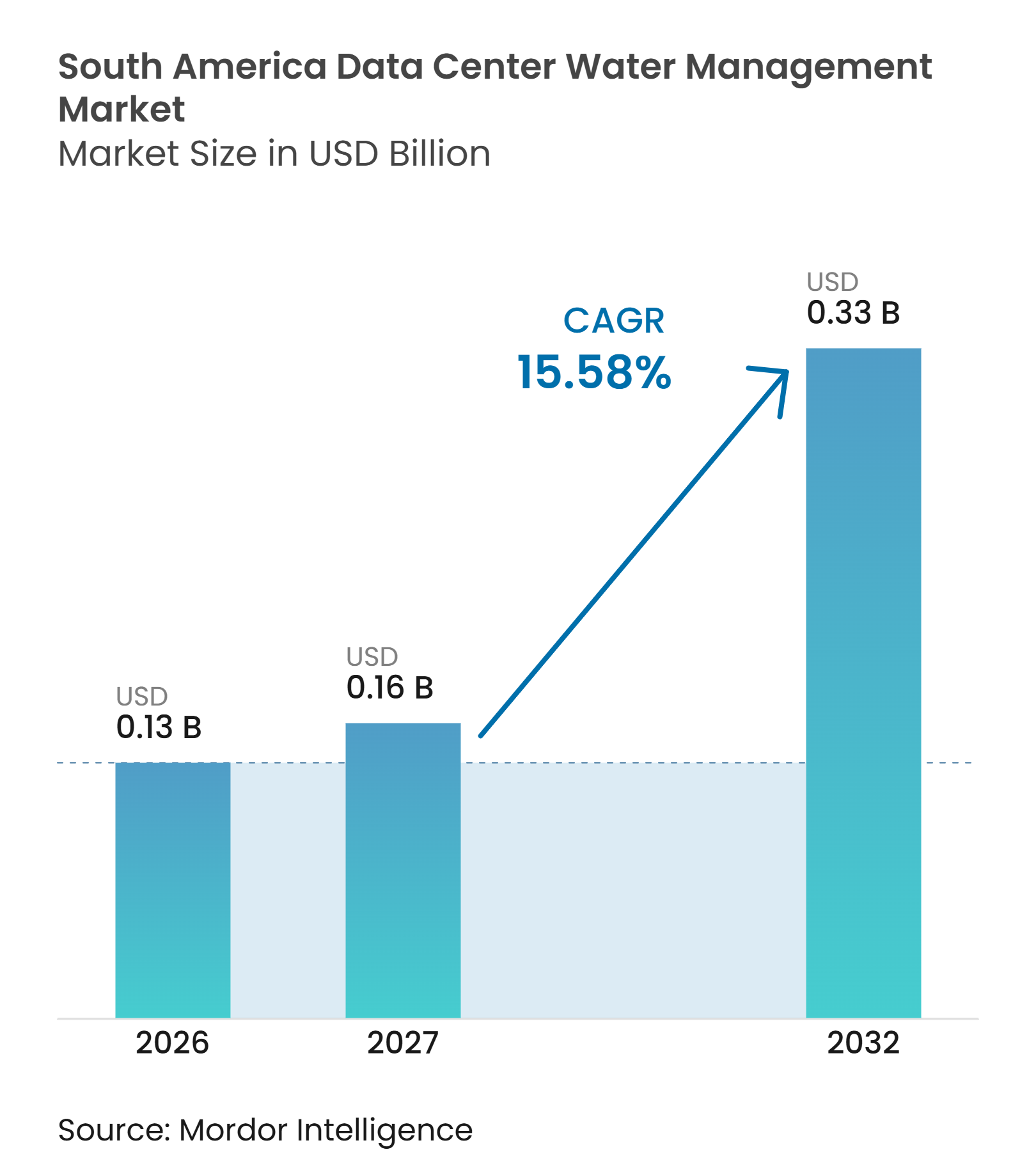
| Base Year Market Size (2026) | USD 0.13 Billion |
| Market Size (2027) | USD 0.16 Billion |
| Market Size (2032) | USD 0.33 Billion |
| Growth Rate (2027 - 2032) | 15.58 % |
| Market Concentration | Low |
Major Players *Disclaimer: Major Players sorted in no particular order Image © Mordor Intelligence. Reuse requires attribution under CC BY 4.0. | |
South America Data Center Water Management Market Analysis by Mordor Intelligence
The South America data center water management market size was valued at USD 0.13 billion in 2026 and is estimated to expand to USD 0.33 billion by 2032, at a CAGR of 15.58% during the forecast period (2027-2032). The South America data center water management market is being shaped by larger AI workloads, which require more precise cooling, water treatment, and monitoring systems. Operators are placing closed-loop cooling and direct-to-chip liquid cooling within core facility design rather than treating water equipment as a secondary utility. Water reuse, metering, and quality analytics are becoming more important where drought risk, permit requirements, and local concerns affect site approvals. The South America data center water management market also gives providers an opportunity to combine equipment, software, and ongoing services into longer customer relationships. Brazil remains the principal demand center, while Chile and Peru make water availability and non-potable supply central to project planning.
Key Report Takeaways
- By solution type, Water Monitoring and Metering Systems held 20.98% of the South America data center water management market share in 2026, while Water Recycling and Reuse Management Systems are projected to expand at a CAGR of 16.16% through 2032.
- By water management application, Cooling System Water Management accounted for 29.97% of the South America data center water management market size in 2026, while Water Consumption Reporting and Optimization is expected to expand at a CAGR of 15.88% through 2032.By deployment model, Integrated and Hybrid Systems held 39.88% share in 2026 and are projected to expand at a CAGR of 15.72% through 2032.
- By service type, System Installation and Integration accounted for 29.11% share in 2026, while Managed Water Management Services are projected to expand at a CAGR of 15.97% through 2032.
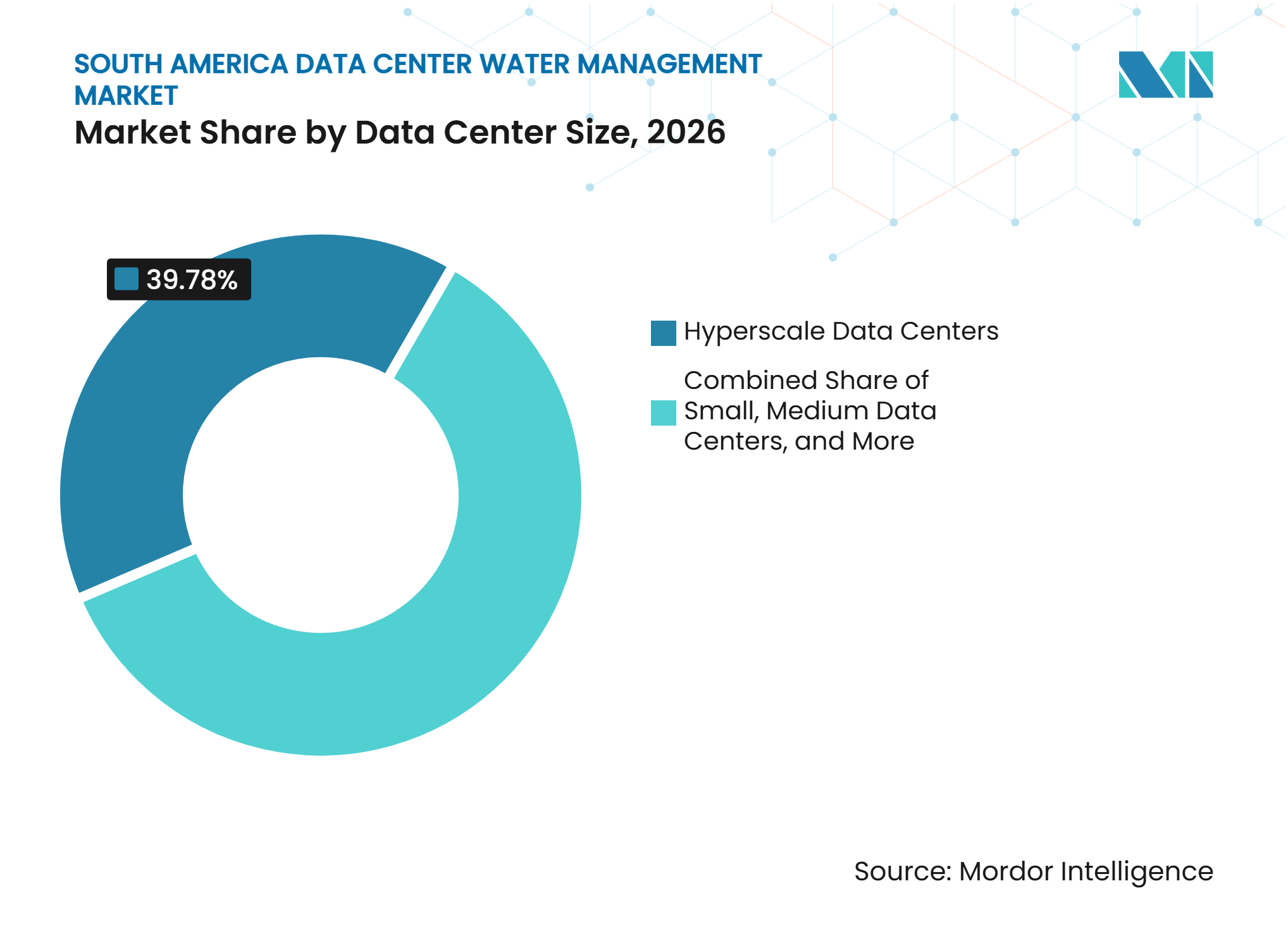
- By data center size, Hyperscale Data Centers held 39.78% share in 2026 and are expected to expand at a CAGR of 16.18% through 2032.
- By data center type, Cloud Service Providers accounted for 38.88% share in 2026, while Enterprise and Edge Data Centers are projected to expand at a CAGR of 15.22% through 2032.
- By geography, Brazil held 59.21% share in 2026, while Peru is expected to expand at a CAGR of 15.31% through 2032.
Note: Market numbers in this report are based on Mordor Intelligence's proprietary estimation framework, which combines nine months of actuals with Q4 projections for base year 2026.
Market Trends and Insights
Drivers Impact Analysis of South America Data Center Water Management Market*
| Driver | (~) % Impact on CAGR Forecast | Geographic Relevance | Impact Timeline |
|---|---|---|---|
| AI, Cloud, and 5G Infrastructure Expansion | +4.2% | Brazil, Chile, Colombia, regional | Short term (≤ 2 years) |
| Liquid-Cooled AI Racks and High-Density Computing | +3.5% | Brazil, Chile, major hyperscale hubs | Short term (≤ 2 years) |
| Growth of Colocation Campuses in Brazil and Chile | +2.6% | Brazil and Chile | Short term (≤ 2 years) |
| Expansion of Municipal Reclaimed-Water Infrastructure | +1.9% | Brazil, Chile, and Colombia | Medium term (2-4 years) |
| Sustainability Reporting and Water-Efficiency Requirements | +1.6% | Brazil, Chile, regional | Medium term (2-4 years) |
| Coastal Data Centers and Seawater-Based Cooling Opportunities | +0.7% | Chile, Peru, and Brazil | Long term (≥ 4 years) |
| Source: Mordor Intelligence | |||
AI, Cloud, and 5G Infrastructure Expansion
South America is receiving new cloud and AI infrastructure commitments that increase the need for water monitoring, metering, and quality control during construction and operation. AWS confirmed a USD 4 billion investment for its first cloud region in Chile in May 2025, with 3 availability zones planned for the country.[1] Alibaba also announced a second cloud region in Brazil during 2025, adding to demand from large computing facilities. AI inference workloads operate continuously, which reduces the load variation that previously supported oversized cooling reserves. This operating pattern requires more accurate water-system design and increases the value of continuous measurement in the South America data center water management market. ISO 14046 water-footprint assessments are increasingly included in hyperscale procurement processes, which supports recurring demand for monitoring and reporting software.
Liquid-Cooled AI Racks and High-Density Computing
Direct-to-chip liquid cooling can capture up to 95% of processor heat and can reduce evaporative losses by 90% when compared with legacy open-circuit chiller systems. Elea Data Centers partnered with Vertiv to deploy liquid cooling for its São Paulo AI sites as part of a USD 300 million first-phase investment.[2] Equinix completed the ST expansion in Santiago, using a closed-loop liquid cooling circuit that recycles process water. Closed-loop systems need very high feedwater quality, with conductivity below 1 microsiemens per centimeter needed to limit fouling. This requirement supports recurring roles for inline quality monitoring and flow-control suppliers. Closed-loop systems used by regional operators also support compliance with Brazil's REDATA water-use effectiveness requirements.
Growth of Colocation Campuses in Brazil and Chile
New colocation campuses create continuing demand for treatment plants, sensors, automated dosing equipment, and maintenance services in the South America data center water management market. Multi-tenant facilities face a shared incentive to meet the strictest water requirements of their tenants. This can raise the water-management specification for an entire campus rather than a single customer loop. ODATA stated that it uses closed-loop water systems without evaporative towers at nearly all its South American facilities. Elea reported a water-use effectiveness index of 0.07 L/kWh in its 2024 Sustainability Report, showing how chilled-water design can reduce water use in tropical locations. These reported outcomes create a higher reference point for competitors serving enterprise tenants in the South America data center water management market.
Expansion of Municipal Reclaimed-Water Infrastructure
Data center operators in water-stressed locations are increasingly considering municipal wastewater treatment plants as a source of cooling water. Chile treats more than 60% of household wastewater safely but reuses 20%, leaving a potential supply base that could be used as treatment and conveyance systems improve. AWS began a 10-year partnership with Aganova in Brazil during 2025 to use acoustic leak detection on São Paulo's water network. The program targets 210 million liters of annual water savings and supports AWS's water-positive commitment for 2030. Veolia and Amazon announced modular reclaimed-water cooling systems in April 2026, with a first facility expected to reuse more than 83 million gallons of potable water each year.[3] Brazil's proposed PL 5.003/2025 could further encourage the use of non-potable water sources, including treated wastewater.
Restraints Impact Analysis of South America Data Center Water Management Market*
| Restraint | (~) % Impact on CAGR Forecast | Geographic Relevance | Impact Timeline |
|---|---|---|---|
| Drought, Water Allocation Restrictions, and Withdrawal Permits | -1.4% | Chile, Peru, and Argentina | Short term (≤ 2 years) |
| Community Opposition and Environmental Litigation | -1.1% | Chile and Brazil | Short term (≤ 2 years) |
| High Capital Cost of Closed-Loop and High-Purity Water Systems | -0.8% | Brazil, Chile, and Colombia | Medium term (2-4 years) |
| Fragmented Water Governance and Limited WUE Disclosure | -0.6% | Regional, especially Peru, Argentina, and the Rest of South America | Long term (≥ 4 years) |
| Source: Mordor Intelligence | |||
Drought, Water Allocation Restrictions, and Withdrawal Permits
Chile's drought conditions have made water withdrawal permits a contested part of data center planning. Peru's grid operators stated in August 2025 that intensifying drought cycles were increasing scrutiny of cooling-water use and were raising the importance of seawater, direct-air cooling, and recycled-water systems. Chile's environmental assessment process requires climate-adjusted water-impact modeling for data center projects. Operators that cannot demonstrate water-neutral performance can face longer approval processes. These conditions make closed-loop cooling and real-time water-use effectiveness monitoring necessary specifications in water-stressed parts of the South America data center water management market. They also favor solutions that document water use clearly for regulators and local communities.
Community Opposition and Environmental Litigation
Community concerns about data center water use have become an enforceable project risk in Chile. A February 2024 environmental court order challenged Google's original Cerrillos cooling plan, which proposed extracting 169 liters of water per second from the Santiago aquifer. Google later abandoned its 2020 permit and redesigned the project with water-saving technologies. Communities near proposed sites in interior São Paulo are also seeking water-use disclosures before municipal approvals. Chile announced a voluntary data center water disclosure framework in July 2025, while environmental organizations continued to seek binding requirements. These conditions encourage operators to deploy monitoring and reporting systems during project planning rather than after construction.
*Our forecasts treat driver/restraint impacts as directional, not additive. The impact forecasts reflect baseline growth, mix effects, and variable interactions.
South America Data Center Water Management Market Segment Analysis
By Solution Type:
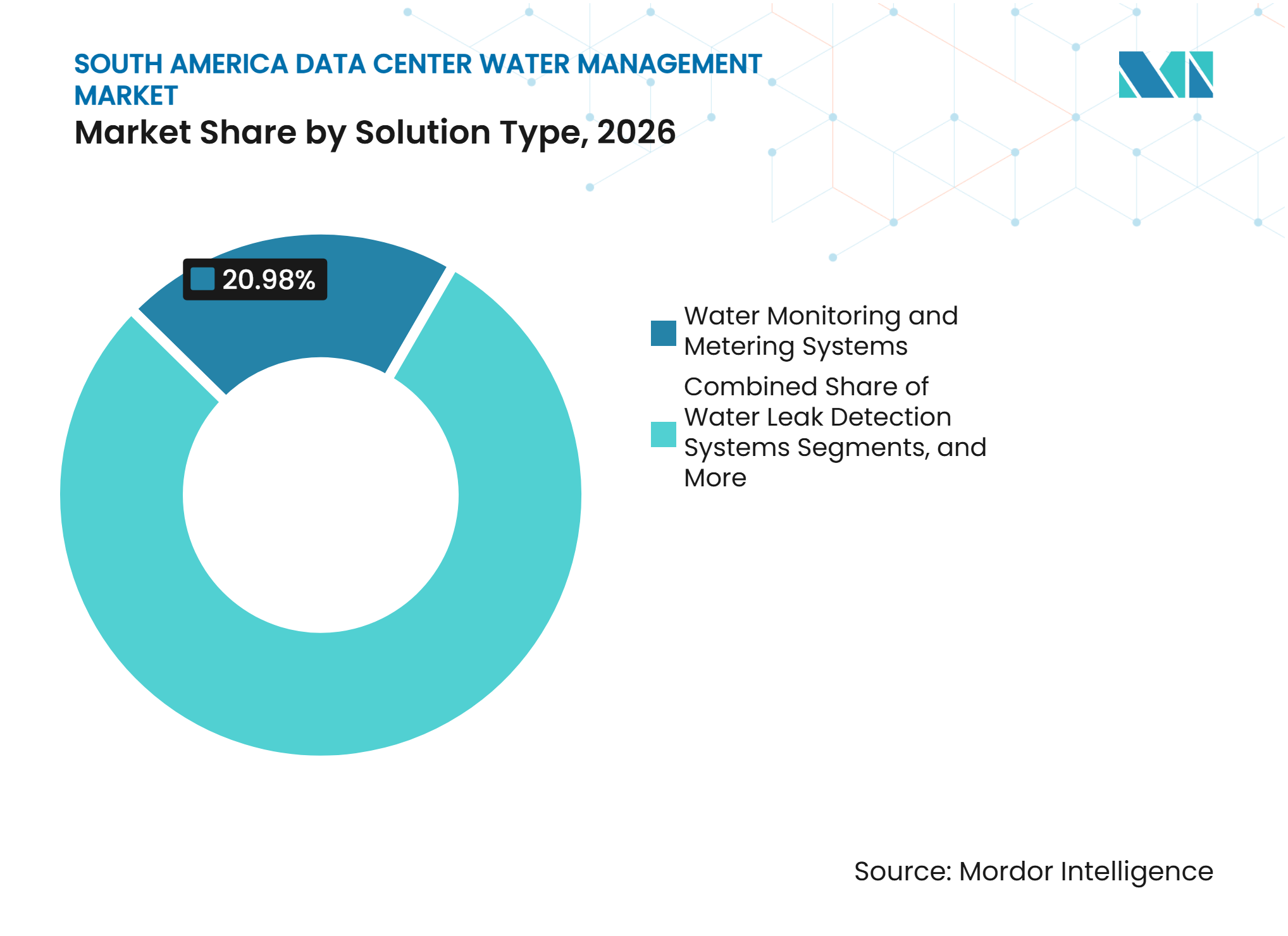
Metering Leads, Recycling and Reuse AccelerateWater Monitoring and Metering Systems held 20.98% of the South America data center water management market share in 2026. Continuous metering provides the operating data needed for water-use effectiveness documentation and day-to-day control. It also gives operators a clearer record of water consumption across cooling equipment, treatment stages, and distribution networks. Water Recycling and Reuse Management Systems are projected to expand at a CAGR of 16.16% through 2032. Their adoption is supported by reclaimed-water programs in São Paulo and Santiago and by water-footprint commitments in corporate sustainability reports. This segment benefits when operators seek non-potable sources that reduce dependence on local freshwater supplies.
Water Leak Detection Systems have a role beyond preventing water loss. Small leaks in high-purity closed-loop systems can cause material downtime risks and can disrupt thermal control. Watts Water Technologies introduced its Nexa platform in 2025, combining flow, temperature, pressure, and leak monitoring with failure prediction. The platform positions system reliability, rather than equipment cost, as the basis for vendor competition. Water Treatment and Quality Monitoring Systems remain necessary where operators use recycled water or protect sensitive liquid-cooling loops. Water Management Software and Analytics complete the solution set through cloud-based platforms that can compare water-use effectiveness across multiple facilities.



By Water Management Application:
Cooling Holds the Largest Role, Reporting ExpandsCooling System Water Management accounted for 29.97% of the South America data center water management market size in 2026. Cooling remains the main focus because it directly determines the volume, quality, and circulation pattern of water within a facility. Elea's 2024 Sustainability Report recorded a water-use effectiveness index of 0.07 L/kWh, below its 2026 target of 0.20 L/kWh. The result illustrates the role of closed-loop chilled-water architecture in limiting operational water use. In the South America data center water management market, cooling applications also drive demand for treatment, measurement, and leak-detection equipment.
Water Consumption Reporting and Optimization is expected to expand at a CAGR of 15.88% through 2032. Operators face more pressure to report water performance under sustainability reporting practices and from stakeholders reviewing water stewardship. Wastewater Management is also relevant because humidification systems can create gray-water streams subject to state effluent standards in Brazil. Water Supply and Distribution Management is especially complex in Chile, where a campus may draw from both concessionaires and private well rights. Leak Prevention and Detection is important for colocation campuses where separate tenant loops meet shared distribution headers. These applications make data quality and operating visibility central to service delivery in the South America data center water management market.
By Deployment Model:
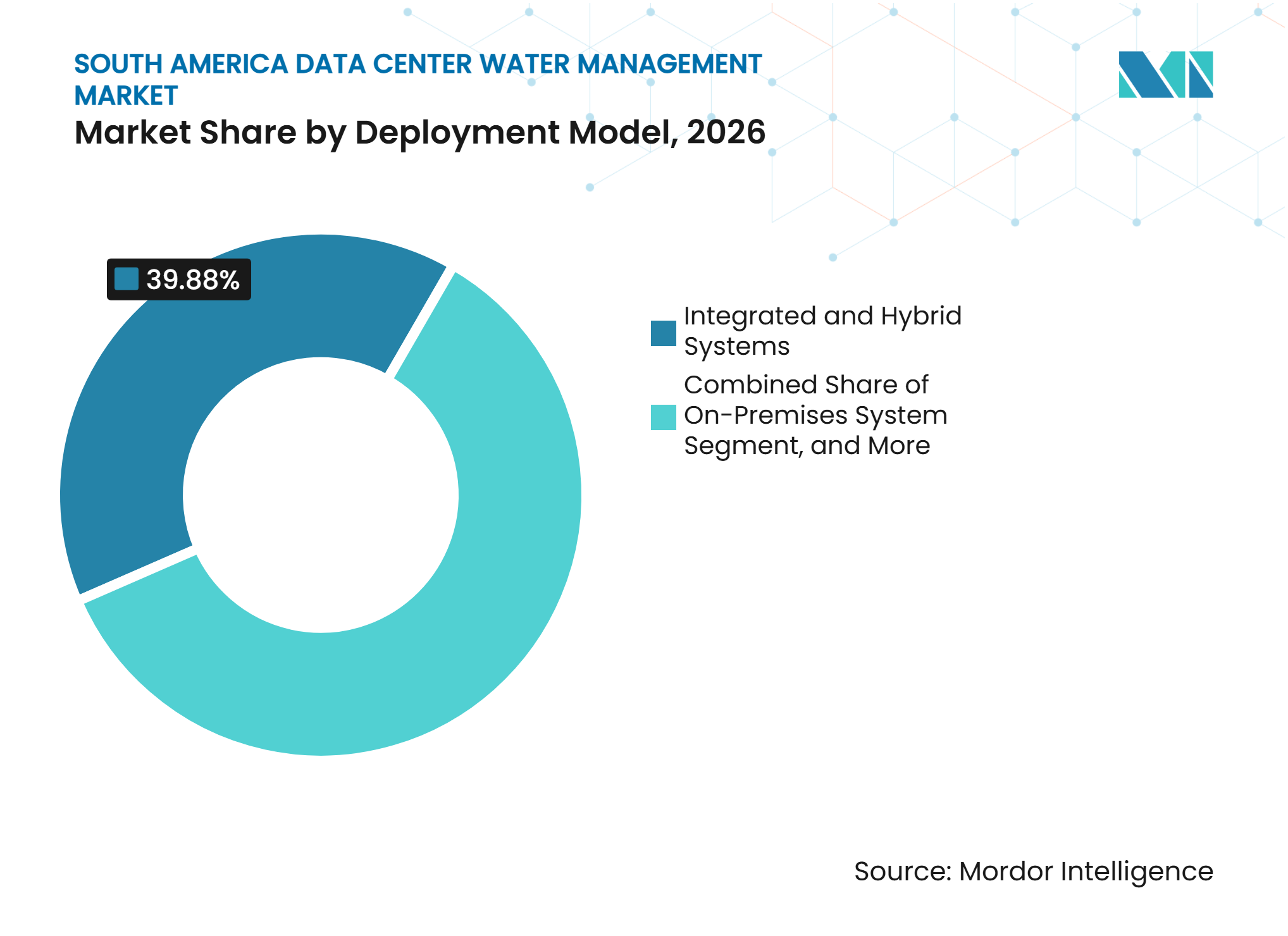
Integrated and Hybrid Systems Retain LeadershipIntegrated and Hybrid Systems held 39.88% share in 2026 and are projected to expand at a CAGR of 15.72% through 2032. This combination of leading share and fastest expansion indicates that operators are still adding hybrid control capability to their facilities. Many campuses use legacy on-premises supervisory control and data acquisition systems alongside cloud-native analytics dashboards. Hybrid systems provide the middleware needed to connect these environments without requiring a full replacement of installed infrastructure. ODATA described closed-loop water management using hybrid control architectures at nearly all of its regional sites. This points to hybrid integration as an established facility design choice rather than a short transition.
Cloud-Based Systems appeal to new entrants and smaller colocation operators that do not have large internal water engineering teams. Software-as-a-service delivery can reduce upfront spending and reduce the need for specialist on-site instrumentation knowledge. Cloud platforms also support centralized comparison of water performance at more than 1 facility. On-Premises Systems continue to serve government and institutional facilities with strict preferences for local operational control. These facilities can be slower to accept cloud-connected monitoring because of continuity and governance requirements. The South America data center water management industry therefore needs deployment options that serve both new digital facilities and established institutional sites.

By Service Type:
Installation Leads, Managed Services AdvanceSystem Installation and Integration held 29.11% share in 2026. The segment reflects the backlog of new construction and retrofit work that replaces legacy evaporative cooling circuits with closed-loop configurations. Installation includes chiller-plant engineering, filtration skids, water treatment equipment, chemical dosing, and control integration. These requirements create a high-value initial project for vendors with engineering capability. They also put installation providers in a strong position to offer monitoring and maintenance after commissioning. This link between project work and ongoing services supports longer customer relationships in the South America data center water management market.
Managed Water Management Services are projected to expand at a CAGR of 15.97% through 2032. Facility managers often have experience in heating, ventilation, air conditioning, or electrical operations but may have limited water chemistry training. Ecolab's Water Track IQ model uses sensors and centralized analytics to provide optimization recommendations without requiring continual on-site specialist expertise. This managed-service format can help operators translate water data into routine operating changes. Water Auditing and Efficiency Consulting is also relevant when companies prepare green-finance documentation. Monitoring and Maintenance provides the continuing revenue layer between major engineering projects.
By Data Center Size:
Hyperscale Facilities Lead and Continue to ExpandHyperscale Data Centers held 39.78% share in 2026 and are projected to expand at a CAGR of 16.18% through 2032. These facilities concentrate AI infrastructure investment in sites exceeding 50 MW. A 2026 peer-reviewed study estimated the annual water footprint of São Paulo's AI data center cluster at 16.1 million cubic meters. The study attributed 46.3% of that footprint to indirect hydropower-linked consumption. At this scale, water management is an important operating and planning consideration.
Large Data Centers in the 10-50 MW range need standardized treatment skids and metering packages. They are large enough to require professional water management but may not justify fully customized engineering. Medium Data Centers are moving from open-circuit to closed-loop cooling as colocation customers increase sustainability requirements. This creates retrofit opportunities over 2027-2030. Small Data Centers and edge nodes increasingly use modular treatment systems integrated with containerized cooling units. These units are relevant in tier-2 Brazilian cities and Andean capitals, where hyperscale investment is more limited.
By Data Center Type:
Cloud Providers Set the Reference, Enterprise and Edge Sites ExpandCloud Service Providers accounted for 38.88% share in 2026. AWS, Google, and Microsoft have an outsized role in defining water-management specifications for the wider data center ecosystem. Their scale creates demand for rigorous treatment, monitoring, reporting, and reuse practices across supplier networks. Microsoft reported a 25% reduction in data center water-use intensity from its 2022 baseline in its 2025 Environmental Sustainability Report. The company is targeting a 40% reduction by 2030, which can influence procurement expectations at its South American sites.
Enterprise and Edge Data Centers are projected to expand at a CAGR of 15.22% through 2032. Enterprises are bringing more AI inference activity into their own operations, while edge locations support logistics, financial services, and public-sector digital programs. Colocation providers compete on water-use effectiveness and reclaimed-water sourcing, which are increasingly included in enterprise service-level discussions. Government-run facilities often use older evaporative systems and may have a performance gap relative to cloud facilities. That gap creates retrofit opportunities for suppliers of closed-loop cooling, metering, and treatment services. The segment broadens demand beyond the largest cloud operators.
Geography Analysis
Brazil held 59.21% of regional revenue in 2026. São Paulo is the region's main hyperscale center and remains the principal location for new water-management spending. The Cambridge Prisms: Water study estimated that indirect hydropower-linked consumption represented 46.3% of the annual water footprint of São Paulo's AI data center cluster. This linkage makes closed-loop cooling and hydropower-adjusted water accounting important for large sites. Brazil enacted Law 15,504 in September 2026, which ties REDATA tax incentives to a water-use effectiveness ceiling of 0.05 L/kWh. The rule supports demand for auditable monitoring and reporting systems in the South America data center water management market.
Chile held the second-largest regional position in 2026. AWS announced an investment in Chile for its cloud region, planned with availability zones. Water availability remains a core concern because projects must address drought exposure and climate-adjusted impact assessment requirements. Equinix expanded its ST2 site in Santiago during April 2025 with a closed-loop circuit that recycles 90% of process water and uses renewable electricity. EdgeConneX worked with Kilimo on water replenishment in the Río Maipo watershed, showing how water-positive commitments can be incorporated into local project planning.
Peru is projected to expand at a CAGR of 15.31% through 2032, the fastest pace among the geographic segments. Colombia, Argentina, Peru, and the Rest of South America account for the remaining regional revenue in 2026. Colombia's highland climate can support free-cooling strategies that reduce water demand. ODATA stated that its Bogotá site uses the local cool climate to operate without cooling towers. Argentina's ARSAT facility and private operators in Buenos Aires provide a smaller, policy-sensitive base of demand. Cirion launched its LIM2 site in Lima during the second half of 2026, equipping the facility for liquid cooling. Peru's coastal development path makes seawater and reclaimed-water options more relevant as drought concerns continue.
Competitive Landscape
Market Concentration
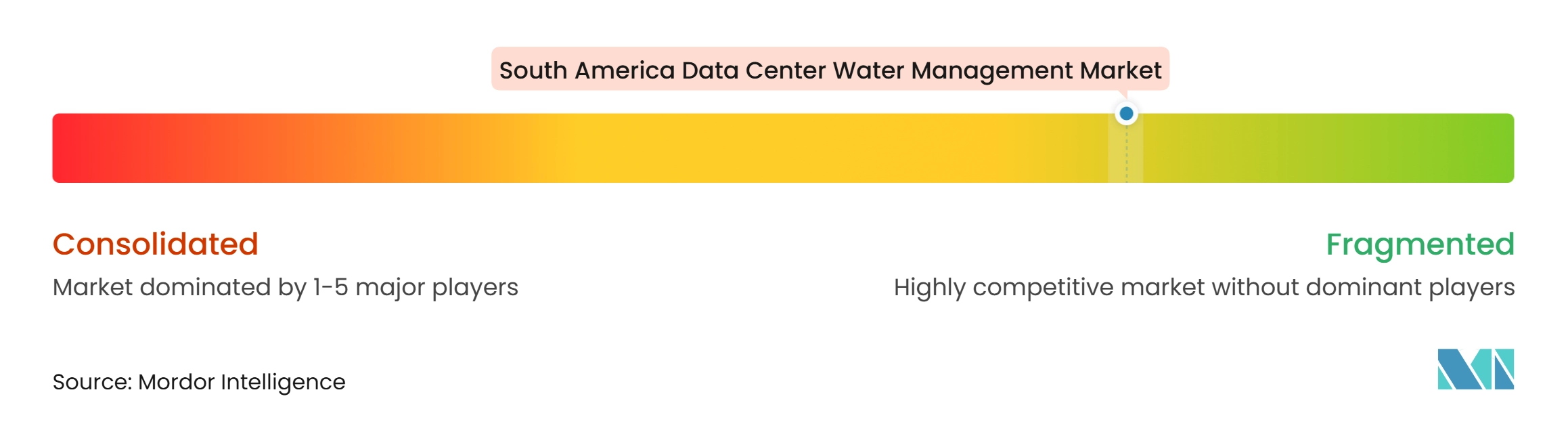
The South America data center water management market is fragmented among solution providers but more concentrated among large hyperscale operators. This structure creates 2 competitive layers, with major cloud companies embedding water capabilities within site design and specialist vendors serving colocation and enterprise facilities. ODATA completed USD 1.02 billion in sustainability-certified financing in October 2026, with proceeds supporting its DeltaFlow liquid-cooling program. The financing links water efficiency with access to capital and supports near-zero operational water consumption at South American sites. Veolia offers modular water treatment through its Data Center Resource 360 program, while Xylem provides equipment and services across liquid cooling, filtration, monitoring, and reuse. Their broad offerings make it harder for smaller suppliers to match the full service range.
Johnson Controls introduced the YORK YDAM magnetic-bearing centrifugal chiller in 2025. The system can provide up to 3.5 MW of cooling without cooling-tower water consumption. It can eliminate up to 9 million gallons of annual cooling-tower water use in typical deployments. Ecolab's 3D TRASAR platform uses more than 100,000 connected devices globally and supports remote water-system monitoring from hubs in Brazil and Chile. These approaches shift vendor competition toward water reduction, uptime, and operating visibility. They also support benchmarking of water-use effectiveness across peer facilities.
Opportunities remain in managed water services for mid-sized colocation operators and reclaimed-water integration for sites in Brazil and Chile. Grupo Opersan has developed capabilities in gray-water reuse and rainwater harvesting for data center locations in the São Paulo region. Operators that can document water-use effectiveness below 0.05 L/kWh through closed-loop systems, reclaimed water, or analytics are better placed to compete for new projects and recurring contracts. Brazil's REDATA framework makes auditable performance especially important for projects seeking tax incentives. Hyperscalers will continue to set performance expectations, while service providers compete on their ability to implement those standards across multiple customer sites. The South America data center water management market therefore rewards broad technical capability and credible operating data.
South America Data Center Water Management Industry Leaders
-
Veolia Environnement S.A.
-
Xylem Inc.
-
Ecolab Inc.
-
Johnson Controls International plc
-
Watts Water Technologies, Inc.
- *Disclaimer: Major Players sorted in no particular order
South America Data Center Water Management Market Companies Covered in this Report
- Microsoft Corporation
- Google LLC
- Amazon Web Services, Inc.
- Equinix, Inc.
- Digital Realty Trust, Inc.
- Scala Data Centers S.A.
- HostDime Global Corp.
- Lumen Technologies, Inc.
- ODATA S.A.
- Verizon Communications Inc.
- DC Matrix Internet LTDA
- Cirion Technologies Holdings LLC
- EdgeConneX, Inc.
- CyrusOne LLC
- Elea Digital S.A.
- Meta Platforms, Inc.
- Oracle America, Inc.
- International Business Machines Corporation
- Huawei Technologies Co., Ltd.
- TIVIT Tecnologia da Informação S.A.
- Algar Tecnologia e Consultoria S.A.
- EdgeUno, Inc.
- Kyndryl, Inc.
- ARSAT S.A.
- Ascenty Data Centers e Telecomunicações S.A.
- Veolia Environnement S.A.
- Xylem Inc.
- Ecolab Inc.
- Watts Water Technologies, Inc.
- Johnson Controls International plc
- Hach Company
Recent Industry Developments in South America Data Center Water Management Market
- September 2026: Brazil enacted Law 15,504/2026, REDATA, establishing a special tax regime that suspends PIS/Cofins, IPI, and import duties on ICT equipment for data centers that meet a maximum WUE index of 0.05 L/kWh, measured annually and disclosed in public sustainability reports. The law codifies closed-loop cooling as the operating standard for new Brazilian data center construction.
- September 2026: Mongabay reported that a planned 1 GW AI data center by Atlas in Paracatu, Minas Gerais, is projected to consume up to 1.2 million liters of water per day to meet REDATA's WUE benchmark. The projected use is equivalent to 1 month's water supply for the city's population and has prompted scrutiny of REDATA's scope and enforcement mechanisms.
- April 2026: Veolia announced a partnership with Amazon to develop reclaimed-water cooling systems using modular containerized treatment units that convert municipal wastewater effluent into high-quality cooling water. The first facility is expected to reuse more than 83 million gallons of potable water annually, with the design intended for global replication, including South American Amazon sites.
- September 2025: ODATA closed USD 1.02 billion in sustainability-certified financing, the largest green-finance deal for a South American data center, provided by a consortium including BNP Paribas, Deutsche Bank, MUFG, and Natixis. Proceeds fund DeltaFlow liquid cooling deployment targeting near-zero operational water consumption across South American sites, bringing total ODATA financing to USD 2.25 billion.
South America Data Center Water Management Market Report Scope
The South America Data Center Water Management Market comprises technologies and services that help data center operators monitor, manage, conserve, and optimize water use across facility operations. It focuses on improving water efficiency, reducing wastage, supporting sustainable cooling practices, ensuring water quality, and meeting environmental compliance requirements. The market enables organizations to enhance operational resilience, lower resource consumption, and achieve sustainability goals through advanced monitoring, automation, analytics, and water conservation strategies, supporting the growing demand for environmentally responsible and resource-efficient digital infrastructure.
The South America Data Center Water Management Market Report is Segmented by Solution Type (Water Monitoring and Metering Systems, Water Leak Detection Systems, Water Usage Optimization and Control Systems,Water Recycling and Reuse Management Systems,Water Treatment and Quality Monitoring Systems, and Water Management Software and Analytics), Water Management Application (Cooling System Water Management, Water Supply and Distribution Management, Wastewater Management, Water Recycling and Reuse, Leak Prevention and Detection, and Water Consumption Reporting and Optimization), Deployment Model (On-Premises Systems, Cloud-Based Systems, and Integrated and Hybrid Systems), Service Type (System Installation and Integration, Monitoring and Maintenance, Water Auditing and Efficiency Consulting, and Managed Water Management Services), Data Center Size (Small, Medium, Large, and Hyperscale), Data Center Type (Colocation, Cloud Service Providers (CSPs), Enterprise and Edge, and Government and Institutional Data Centers), and Geography (Brazil, Chile, Colombia, Argentina, Peru, and Rest of South America). The Market Forecasts are Provided in Terms of Value (USD).
Segmentation Overview
| Water Monitoring and Metering Systems |
| Water Leak Detection Systems |
| Water Usage Optimization and Control Systems |
| Water Recycling and Reuse Management Systems |
| Water Treatment and Quality Monitoring Systems |
| Water Management Software and Analytics |
| Cooling System Water Management |
| Water Supply and Distribution Management |
| Wastewater Management |
| Water Recycling and Reuse |
| Leak Prevention and Detection |
| Water Consumption Reporting and Optimization |
| On-Premises Systems |
| Cloud-Based Systems |
| Integrated and Hybrid Systems |
| System Installation and Integration |
| Monitoring and Maintenance |
| Water Auditing and Efficiency Consulting |
| Managed Water Management Services |
| Small Data Centers |
| Medium Data Centers |
| Large Data Centers |
| Hyperscale Data Centers |
| Colocation |
| Cloud Service Providers |
| Enterprise and Edge |
| Government and Institutional Data Centers |
| Brazil |
| Chile |
| Colombia |
| Argentina |
| Peru |
| Rest of South America |
| By Solution Type | Water Monitoring and Metering Systems |
| Water Leak Detection Systems | |
| Water Usage Optimization and Control Systems | |
| Water Recycling and Reuse Management Systems | |
| Water Treatment and Quality Monitoring Systems | |
| Water Management Software and Analytics | |
| By Water Management Application | Cooling System Water Management |
| Water Supply and Distribution Management | |
| Wastewater Management | |
| Water Recycling and Reuse | |
| Leak Prevention and Detection | |
| Water Consumption Reporting and Optimization | |
| By Deployment Model | On-Premises Systems |
| Cloud-Based Systems | |
| Integrated and Hybrid Systems | |
| By Service Type | System Installation and Integration |
| Monitoring and Maintenance | |
| Water Auditing and Efficiency Consulting | |
| Managed Water Management Services | |
| By Data Center Size | Small Data Centers |
| Medium Data Centers | |
| Large Data Centers | |
| Hyperscale Data Centers | |
| By Data Center Type | Colocation |
| Cloud Service Providers | |
| Enterprise and Edge | |
| Government and Institutional Data Centers | |
| By Geography | Brazil |
| Chile | |
| Colombia | |
| Argentina | |
| Peru | |
| Rest of South America |
Key Questions Answered in the Report
What is the projected size of the South America data center water management market?
The market is valued at USD 0.13 billion in 2026 and is projected to reach USD 0.33 billion by 2032, at a CAGR of 15.58% during 2027-2032.
Which solution category is expected to expand fastest?
Water Recycling and Reuse Management Systems are projected to expand at a CAGR of 16.16% through 2032 as operators seek non-potable water sources.
Why is liquid cooling important for South American data centers?
Liquid cooling helps manage high-density AI computing and can reduce evaporative losses compared with legacy open-circuit chiller systems.
Which country has the largest regional share?
Brazil held 59.21% share in 2026, supported by its large concentration of cloud and hyperscale infrastructure in São Paulo.
What is driving water monitoring demand at data centers?
Operators need accurate monitoring for water-use effectiveness reporting, regulatory compliance, leak detection, and operation of closed-loop cooling systems.
Which data center type is expanding most rapidly?
Enterprise and Edge Data Centers are projected to expand at a CAGR of 15.22% through 2032, supported by more distributed AI and digital-service workloads.