
South America Data Center Switchgear Market Size and Share
Market Overview
| Study Period | 2021 - 2032 |
|---|---|
| Forecast Data Period | 2027 - 2032 |
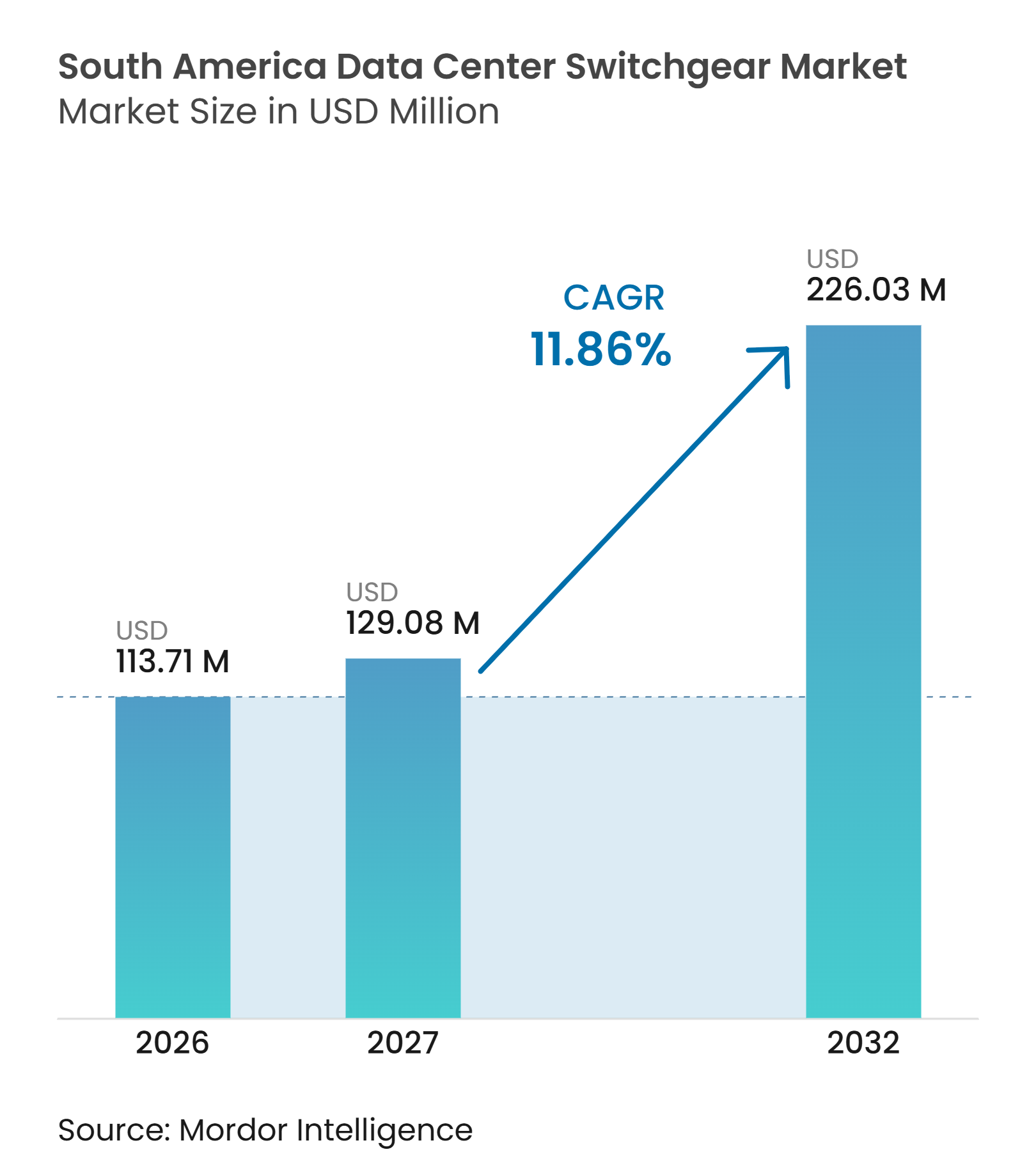
| Base Year Market Size (2026) | USD 113.71 Million |
| Market Size (2027) | USD 129.08 Million |
| Market Size (2032) | USD 226.03 Million |
| Growth Rate (2027 - 2032) | 11.86 % |
| Market Concentration | Medium |
Major Players *Disclaimer: Major Players sorted in no particular order Image © Mordor Intelligence. Reuse requires attribution under CC BY 4.0. | |
South America Data Center Switchgear Market Analysis by Mordor Intelligence
The South America data center switchgear market size was valued at USD 113.71 million in 2026 and estimated to grow from USD 129.08 million in 2027 to reach USD 226.03 million by 2032, at a CAGR of 11.86% during the forecast period (2027-2032). The South America data center switchgear market is being shaped by larger hyperscale and colocation projects, higher rack power needs from AI workloads, and rules that encourage in-region digital infrastructure. Brazil remains the primary demand center, while Chile is attracting new projects supported by public planning and renewable power resources. Higher rack densities are increasing demand for medium-voltage equipment, which reduces copper use and supports large campus designs. Grid congestion, equipment availability, and the cost of specialized equipment can delay project schedules, but brownfield locations with existing connections offer a practical route for some developers. These conditions favor suppliers that can provide tested equipment, local technical assistance, and systems that can be installed in stages as campus capacity is added.
Key Report Takeaways
- By voltage level, low voltage held 41.30% of the South America data center switchgear market share in 2026, while medium voltage is projected to expand at a 12.71% CAGR through 2032.
- By insulation type, air-insulated switchgear accounted for 51.44% of the South America data center switchgear market share in 2026, while gas-insulated switchgear is expected to advance at a 13.67% CAGR through 2032.
- By installation type, indoor switchgear commanded 72.45% of revenue in 2026, while outdoor switchgear is projected to record a 12.51% CAGR through 2032.
- By configuration, withdrawable switchgear held 46.51% of revenue in 2026, while modular switchgear is expected to expand at a 13.49% CAGR through 2032.
- By data center size, hyperscale facilities accounted for 47.31% of the South America data center switchgear market share in 2026 and are projected to register a 13.21% CAGR through 2032.
- By data center type, colocation providers held 49.91% of revenue in 2026, while cloud service providers are expected to expand at a 12.93% CAGR through 2032.
- By geography, Brazil accounted for 56.18% of revenue in 2026, while Chile is projected to record a 13.17% CAGR through 2032.
Note: Market numbers in this report are based on Mordor Intelligence's proprietary estimation framework, which combines nine months of actuals with Q4 projections for base year 2026.
Market Trends and Insights
Drivers Impact Analysis of South America Data Center Switchgear Market*
| Driver | (~) % Impact on CAGR Forecast | Geographic Relevance | Impact Timeline |
|---|---|---|---|
| Expansion of Hyperscale and Colocation Data Centers | +3.5% | Brazil core, Chile accelerating, Argentina and Rest of South America emerging | Short term (≤ 2 years) |
| AI Workloads Increasing Rack-Level Power Density | +3.0% | Global, with greatest need in São Paulo and Santiago campuses | Short term (≤ 2 years) |
| Renewable-Energy Procurement for Data Center Campuses | +1.5% | Brazil dominant, Chile strong, Argentina nascent | Medium term (2-4 years) |
| Data Center Localization and Digitalization Policies | +1.2% | Brazil under REDATA and Chile under the National Data Center Plan | Medium term (2-4 years) |
| Brownfield Data Center Development Using Existing Grid Connections | +0.8% | Brazil and Chile, with spillover to Argentina | Medium term (2-4 years) |
| Digital Substation Monitoring for Predictive Maintenance | +0.5% | Brazil and Chile as early adopter locations | Long term (≥ 4 years) |
| Source: Mordor Intelligence | |||
Expansion of Hyperscale and Colocation Data Centers
The expansion of hyperscale and colocation capacity is creating larger and more predictable equipment orders in the South America data center switchgear market. Operators increasingly procure electrical systems early because the grid connection, substation, and building design must be coordinated. Large campuses require dedicated protection, control, and interconnection equipment rather than only the electrical rooms used by smaller facilities. Brazil’s REDATA program improves the economics of qualifying data center investments and reduces certain obligations for projects in the North, Northeast, and Central-West regions. This policy support can encourage projects in cities outside São Paulo, where new high-voltage connections will require additional switchgear. The South America data center switchgear market, therefore, benefits when development moves from individual sites to coordinated regional campus programs.
AI Workloads Increasing Rack-Level Power Density
AI computing is raising the power requirement of individual racks and changing the electrical design of new campuses. Schneider Electric reported that liquid-cooled AI systems require detailed planning around power density, grid limits, and cooling design. Higher-density deployments make conventional low-voltage layouts less suitable for large facilities. ABB describes medium-voltage architectures as a way to support AI data centers with lower distribution losses and less copper in high-capacity designs. This shift raises the technical specification for breakers, protection systems, and fault management. It also favors suppliers that can combine medium-voltage equipment with digital monitoring and service capabilities.
Renewable-Energy Procurement for Data Center Campuses
Renewable power procurement is an important factor for new data center campuses in Brazil and Chile. Dedicated generation, storage, and campus power purchase structures require protection and switching equipment at several points between the energy source and the data center busbar. Chile’s first mobile digital high-voltage substation, implemented by Hitachi Energy, shows how high-voltage capacity can be deployed in a more flexible form for changing power needs. Renewable generation is often distant from major computing centers, so transmission-side equipment remains important even when campuses purchase clean power. The arrangement adds equipment needs beyond the internal distribution system. It also supports demand for systems that can manage variable generation and integrate storage.
Data Center Localization and Digitalization Policies
Digital localization policies are making in-country capacity more relevant to cloud providers and public-sector users. Brazil enacted REDATA in September 2026, suspending specified taxes on qualifying information and communications technology equipment through 2031. The policy includes requirements related to domestic capacity and research and development commitments. Such requirements can turn infrastructure planning into a compliance issue rather than a discretionary expansion decision. Chile’s public digital transformation agenda also supports government cloud services and related infrastructure needs. These policies create a clearer basis for medium-voltage procurement in projects serving sovereign and regulated workloads.
Restraints Impact Analysis of South America Data Center Switchgear Market*
| Restraint | (~) % Impact on CAGR Forecast | Geographic Relevance | Impact Timeline |
|---|---|---|---|
| High Switchgear and Medium-Voltage Interconnection Costs | -1.2% | Brazil and Chile most exposed, Argentina limited by scale | Short term (≤ 2 years) |
| Grid Congestion and Extended Connection Timelines | -0.8% | Brazil with São Paulo critical, Chile with Santiago grid limits | Medium term (2-4 years) |
| Transformer and Switchgear Supply-Chain Lead Times | -0.5% | Global, with greater pressure on GIS and custom medium-voltage assemblies in South America | Medium term (2-4 years) |
| Limited Availability of Certified Installation and Service Technicians | -0.3% | Most acute in secondary Brazilian cities and the Rest of South America | Long term (≥ 4 years) |
| Source: Mordor Intelligence | |||
High Switchgear and Medium-Voltage Interconnection Costs
Medium-voltage equipment for data center use must meet high reliability, arc protection, and service requirements. These specifications raise the project cost relative to standard commercial electrical installations. IEC 62271 is the relevant international standard family for high-voltage and medium-voltage switchgear and controlgear.[1] Global developers may also require arc-flash practices aligned with NFPA 70E, which narrows the pool of acceptable equipment and installation providers. Smaller operators have less capacity to spread these costs across several large campuses. The cost burden can defer modernization at enterprise and edge facilities within the South America data center switchgear market.
Grid Congestion and Extended Connection Timelines
Grid access can delay a project even when the data center developer has completed site planning and equipment procurement. Brazil’s national electricity planning agenda identifies the need to coordinate data center demand with transmission development and access to energy. This issue is especially important in established demand centers where network capacity is constrained. Developers may seek industrial sites with existing electrical connections to shorten the time to energization. That choice can raise acquisition and conversion costs, but it can avoid a longer connection process. The South America data center switchgear market is affected because equipment delivery and installation are often tied to the final grid-access schedule.
*Our forecasts treat driver/restraint impacts as directional, not additive. The impact forecasts reflect baseline growth, mix effects, and variable interactions.
South America Data Center Switchgear Market Segment Analysis
By Voltage Level:
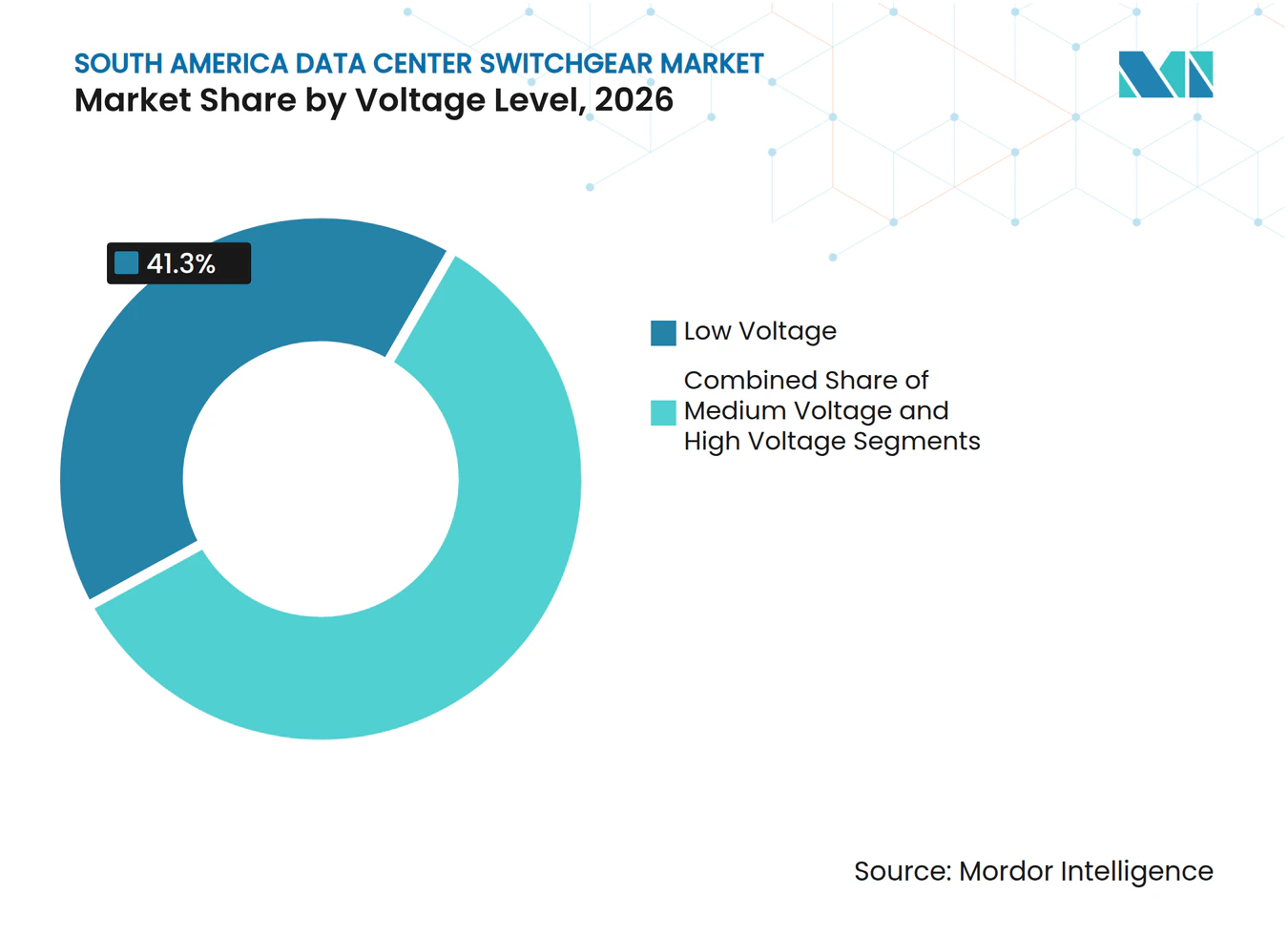
Medium-Voltage Architecture Gains Ground in AI CampusesLow-voltage held 41.30% of the South America data center switchgear market share in 2026, supported by enterprise facilities and legacy colocation sites that use conventional 480 V distribution. Low-voltage equipment remains suitable for brownfield upgrades and edge sites where existing electrical rooms constrain redesign options. Medium voltage is projected to expand at a 12.71% CAGR through 2032 as large campuses adopt 6-35 kV distribution. ABB identifies medium-voltage distribution as an important architecture for high-capacity AI data centers because it can reduce distribution losses and copper use.[2] The change is greatest in new facilities where developers can design the electrical system around higher rack density. Existing sites may retain low-voltage systems when replacement costs outweigh the efficiency benefit.
High-voltage equipment becomes more relevant when a large campus connects directly to a transmission or sub-transmission network. These projects require equipment that coordinates the utility connection, transformer, and medium-voltage distribution system. IEC 62271 requirements apply across high-voltage and medium-voltage equipment and help define acceptable performance and testing practices. The compliance requirement favors suppliers with tested products, local service teams, and engineering support. The South America data center switchgear market size for medium-voltage systems is therefore supported by both new AI campuses and the need to improve larger existing sites. Suppliers also face demand for digital monitoring that can support preventive maintenance and faster fault response. These systems can help operators identify abnormal conditions before they become a wider service issue. The need for coordinated protection settings also increases the value of detailed engineering during project design.



By Insulation Type:
GIS Captures Premium Campuses as SF₆ Rules DevelopAir-insulated switchgear accounted for 51.44% of the South America data center switchgear market share in 2026 because it has an established installed base and a lower initial cost. It remains practical for brownfield retrofits and projects where land availability allows larger electrical rooms or yards. Gas-insulated switchgear is projected to record a 13.67% CAGR through 2032, supported by its compact footprint in dense campus locations. Compact equipment can be particularly useful where land costs or room constraints limit the space available for a substation. The faster expansion of GIS reflects the need to fit higher electrical capacity into limited sites. It also supports designs that place critical electrical systems closer to high-load buildings.
Environmental considerations are changing the product discussion within the insulation segment. Suppliers are developing alternatives to sulfur hexafluoride, written as SF6, for applications where customers want to reduce future regulatory exposure. Schneider Electric’s AirSeT platform is designed around a gas-free interruption and insulation approach for medium-voltage equipment. This direction gives developers more choice when selecting equipment for long-lived projects. Vacuum and solid-dielectric equipment continue to serve modular substations and edge upgrades where standardized equipment can simplify installation. The South America data center switchgear market gains from this transition as operators replace or specify equipment based on both performance and environmental requirements. Equipment selection also depends on service access and the practical space available at the site. These factors can lead developers to assess lifecycle considerations alongside the initial purchase decision.
By Installation Type:
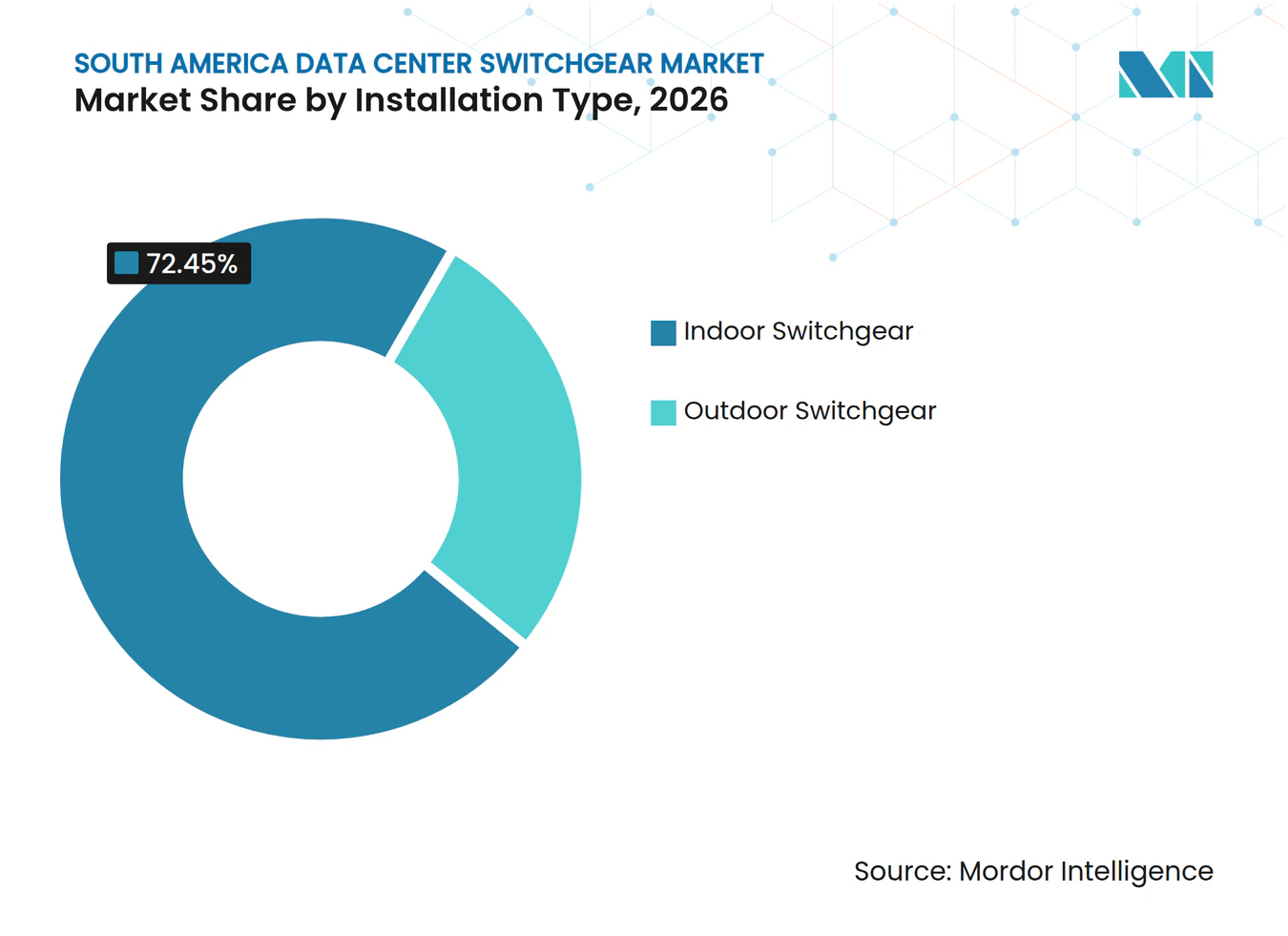
Indoor Switchgear Remains the Core Choice as Outdoor Sites ExpandIndoor switchgear commanded 72.45% of revenue in 2026 because colocation and enterprise facilities commonly locate electrical equipment in controlled rooms. This arrangement protects equipment from weather and supports planned maintenance in a secure setting. Indoor systems are well-suited to urban facilities with compact building layouts and established electrical rooms. IEC 62271-200 provides requirements for metal-enclosed alternating current switchgear and controlgear, which is relevant to indoor medium-voltage applications. Indoor designs also align with the operating needs of multi-tenant facilities that require dependable access for maintenance teams. This installed base sustains demand for replacement panels, breakers, and digital upgrades.
Outdoor switchgear is projected to expand at a 12.51% CAGR through 2032 as multi-building campuses use dedicated yards and direct utility connections. Outdoor systems can be economical where campuses have adequate land and require a large transformer or high-voltage interconnection equipment. They are also relevant when developers convert industrial sites that already include external electrical infrastructure. Weather protection, surge coordination, and suitable isolation practices add to the design requirement. WEG offers an integrated portfolio that includes substations, switchgear, generators, automation, and other equipment used in data center power systems.[3] Local technical support can be a meaningful advantage for outdoor installations located beyond major metropolitan areas. The final design must balance access for maintenance against protection from site conditions. This is particularly relevant where high-capacity connections and data center buildings are developed in separate phases.

By Configuration:
Modular Systems Support Phased Capacity AdditionsWithdrawable switchgear held 46.51% of revenue in 2026 because draw-out breaker arrangements support maintenance without taking the whole lineup out of service. This function is valuable for facilities that target Tier III or Tier IV operating practices. Fixed-mounted equipment remains appropriate for smaller sites where initial cost is the primary concern. Modular switchgear is projected to record a 13.49% CAGR through 2032 as large campuses add capacity in phases. Standardized modules help developers coordinate electrical construction with staggered building schedules. They can also reduce the amount of on-site assembly required during expansion.
Factory-assembled modular systems are well aligned with AI campus construction because power requirements can change as computing capacity is added. Schneider Electric states that software-defined medium-voltage switchgear can reduce deployment time and control wiring in selected applications. Digital designs can also simplify the integration of protection, control, and asset monitoring. Draw-out systems help operators replace breakers during planned maintenance, which supports uptime in multi-tenant facilities. The South America data center switchgear market benefits when operators prioritize systems that can be expanded without rebuilding an entire substation. This preference is strongest where grid access approval and construction timing require phased energization. Standard layouts can make it easier to replicate the electrical design across several buildings. They also allow the operator to align procurement with actual capacity commitments from customers.
By Data Center Size:
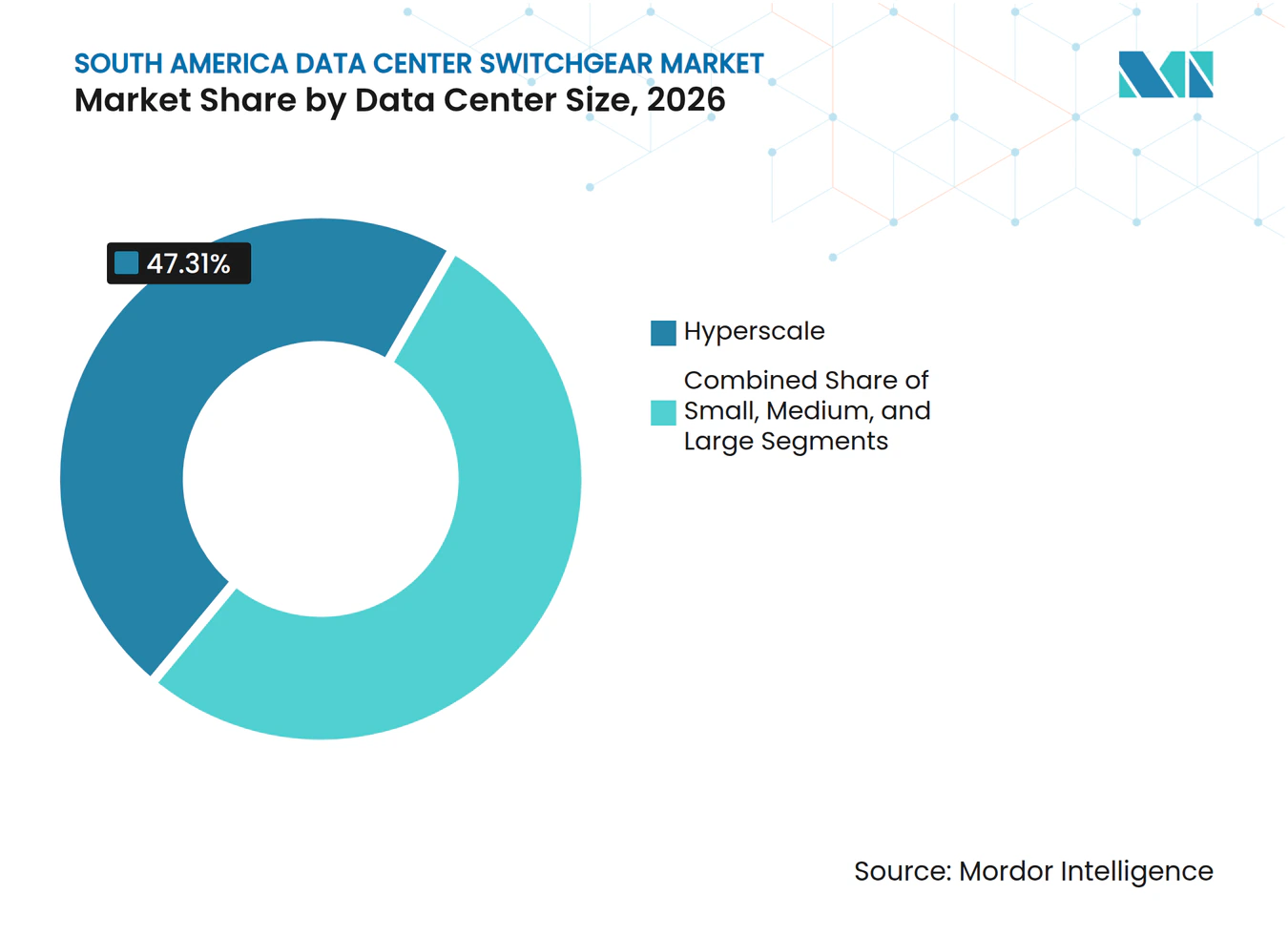
Hyperscale Facilities Combine Scale and Faster ExpansionHyperscale facilities accounted for 47.31% of the South America data center switchgear market size in 2026 and are projected to expand at a 13.21% CAGR through 2032. These facilities require large electrical systems that combine utility interconnection, transformers, medium-voltage distribution, backup power, and monitoring. Their scale gives manufacturers visibility over larger orders and can support framework supply arrangements. Hyperscale operators are also more likely to select equipment that can handle AI-driven load concentration and phased capacity additions. Hitachi Energy announced a collaboration with RT-One for high-voltage electrical systems and grid connections for AI data center campuses in Uberlândia and Maringá. The example shows how large campuses require power infrastructure to be planned with the data center rather than added later.
Large facilities also benefit from sovereign cloud and government digitalization projects, though their equipment needs are smaller than those of hyperscale campuses. Medium and small sites remain important for regional services, but they often face tighter capital limits and may extend the life of existing electrical systems. The continued shift toward colocation can reduce the number of self-operated small facilities while increasing demand at larger shared campuses. This changes the mix of orders toward higher-capacity, better-integrated systems. The South America data center switchgear market is therefore increasingly shaped by projects that need dedicated substations and direct coordination with utilities. Manufacturers that can offer engineering, equipment, commissioning, and service have a stronger position in this segment. Large projects also require a clear approach to redundancy, protection coordination, and long-term maintenance. These requirements can affect equipment selection before the campus reaches full operating capacity.
By Data Center Type:
Colocation Leads Revenue While CSP Demand Changes ProcurementColocation providers held 49.91% of revenue in 2026, making them the largest data center type in the South America data center switchgear market. These operators serve enterprises moving workloads out of private server rooms and can also host cloud providers during early regional expansion. Their sites require dependable electrical distribution because power availability is a central part of the service offered to tenants. Indoor switchgear, withdrawable breakers, redundancy, and service access are important procurement factors for this group. Colocation facilities also create ongoing replacement and upgrade demand as tenants increase rack density. This makes the segment a steady source of demand even when a new hyperscale campus is delayed.
Cloud service providers are projected to advance at a 12.93% CAGR through 2032 as they build and operate more owned regional infrastructure. Owned facilities change procurement because equipment is increasingly purchased through global framework agreements and technical standards. Brazil’s REDATA policy can improve the economics of qualifying data center equipment and modernization projects. Enterprise and edge facilities still present a replacement opportunity where older low-voltage systems cannot support modern hybrid-cloud power needs. The segment mix favors suppliers that can address both standardized global specifications and local installation requirements. It also raises the importance of service capability after equipment is installed. Colocation operators continue to require flexible equipment because tenant requirements can change over the life of a facility. This keeps dependable service access and maintenance planning central to procurement decisions.
Geography Analysis
Brazil
Brazil accounted for 56.18% of the South America data center switchgear market share in 2026. The country has the region’s deepest project pipeline and the broadest base of data center operators, cloud providers, and electrical equipment suppliers. REDATA was enacted in September 2026 and suspends PIS/Pasep, COFINS, IPI, and import taxes on qualifying information and communications technology equipment. The program can support development outside São Paulo, while Brazil’s energy agenda is increasingly focused on aligning data center demand with transmission access. IEC 62271 compliance and NFPA 70E-aligned arc-flash practices influence equipment specifications for critical facilities
Chile
Chile is projected to record a 13.17% CAGR through 2032, the highest country rate in the South America data center switchgear market. The country combines digital infrastructure policy, renewable energy potential, and international connectivity. Its public digital transformation framework supports the use of digital services across the state and creates a clearer setting for cloud infrastructure. Hitachi Energy implemented Chile’s first mobile digital high-voltage substation in May 2026, using a 69 kV GIS arrangement in a transportable format.[4] The project shows a method for adding switching capacity where campus construction proceeds more quickly than permanent network reinforcement.
Argentina and the Rest of South America
Argentina and the Rest of South America have a smaller installed base, but they offer selective opportunities for modernization and new edge capacity. The South America data center switchgear market size in these countries is supported by cloud demand, renewable resources, and industrial sites that can be converted for digital infrastructure. Direct high-voltage connections will be important for large campuses because they require dedicated protection and switching equipment. Local service availability can constrain secondary-city projects, favoring suppliers with regional engineering teams.
Competitive Landscape
Market Concentration
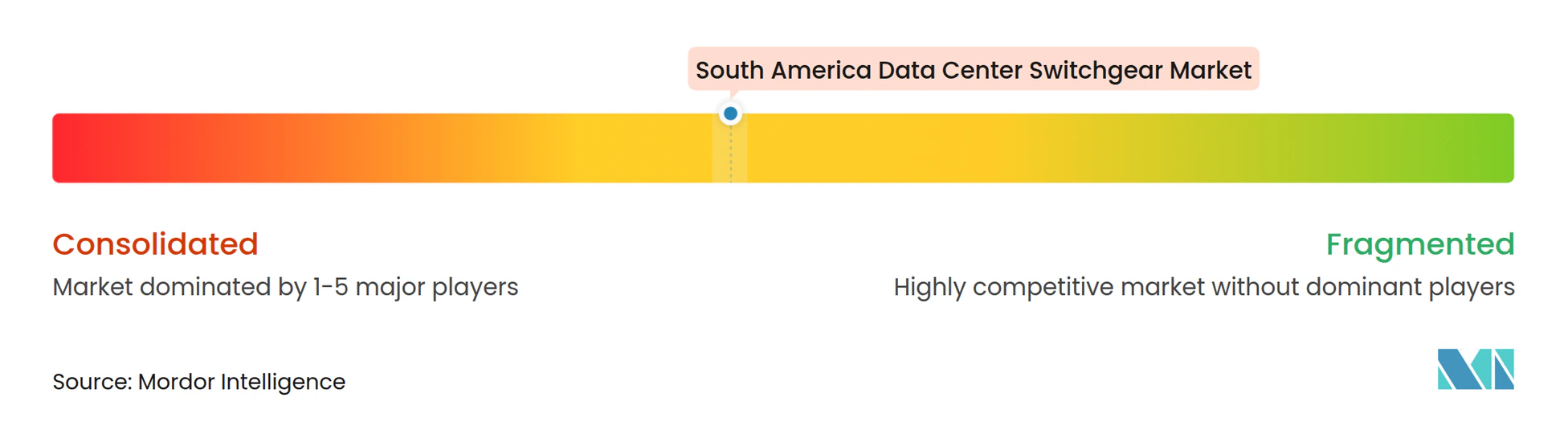
The South America data center switchgear market is moderately consolidated around global electrical equipment suppliers with strong engineering, service, and project-delivery capabilities. Schneider Electric, ABB, Siemens, Siemens Energy, Eaton, Hitachi Energy, and WEG compete across medium-voltage systems, power distribution, substations, and digital controls. Their position is supported by the technical requirements of hyperscale projects and the need for tested, reliable equipment. IEC 62271 requirements and arc-flash expectations aligned with NFPA 70E also favor experienced suppliers. Regional integrators remain relevant where permitting, installation, and utility coordination are central to the project.
Eaton and Siemens Energy announced a joint approach in June 2025 that combines power generation technology with Eaton’s electrical distribution equipment for new data center capacity. The move shows how suppliers are responding to grid constraints through integrated power systems rather than standalone switchgear sales. Schneider Electric is advancing software-defined medium-voltage equipment to simplify deployment and reduce control wiring in selected projects. ABB is positioning medium-voltage architecture for AI data centers where power density, distribution efficiency, and protection coordination are critical. These moves increase the importance of software, engineering, and service in supplier selection.
Hitachi Energy’s mobile digital high-voltage substation in Chile is an example of an alternative approach to grid interconnection that can shorten deployment for suitable projects. WEG offers an integrated portfolio for data center power applications that includes switchgear, substations, generators, automation, and related equipment. Competition will increasingly depend on compact GIS, modular systems, SF6-free alternatives, and digital maintenance capabilities. Demanding specifications and local execution requirements limit the practical number of suppliers that can compete for major projects.
South America Data Center Switchgear Industry Leaders
-
Schneider Electric SE
-
Vertiv Holdings Co
-
Hitachi Energy Ltd.
-
WEG S.A.
-
Mitsubishi Electric Corporation
- *Disclaimer: Major Players sorted in no particular order
South America Data Center Switchgear Market Companies Covered in this Report
- Schneider Electric SE
- ABB Ltd.
- Siemens AG
- Eaton Corporation plc
- Vertiv Holdings Co
- Mitsubishi Electric Corporation
- Hitachi Energy Ltd.
- WEG S.A.
- Siemens Energy AG
- EFACEC Power Solutions SGPS, S.A.
- Powell Industries, Inc.
- Legrand SA
- Delta Electronics, Inc.
- Socomec Group S.A.
- Huawei Technologies Co., Ltd.
- GE Vernova
- Hyundai Electric and Energy Systems
- Fuji Electric Co., Ltd.
- Rittal GmbH & Co. KG
- Ascenty Data Centers
Recent Industry Developments in South America Data Center Switchgear Market
- October 2026: Schneider Electric launched MCSeT with EvoPacT, an air-insulated medium-voltage switchgear system rated up to 24 kV, in Argentina. The system combines an EvoPacT HVX vacuum circuit breaker with digital monitoring for industrial sites, critical infrastructure, and data centers.
- September 2026: Brazil's President Lula enacted the REDATA law on September 15, 2026, suspending PIS/Pasep, COFINS, IPI, and import taxes on ICT equipment for qualifying data center projects through 2031, with obligations reduced by 20% for projects in the North, Nordeste, and Centro-Oeste regions. The law directly expands the addressable switchgear procurement market in secondary Brazilian cities by improving project economics for campuses outside the São Paulo hub.
- May 2026: Hitachi Energy implemented Chile's first mobile digital high-voltage substation (Grid-eXpand™) with 69 kV GIS equipment on a transportable trailer, enabling data center HV switching capacity without fixed substation construction timelines and demonstrating a deployment model that compresses energization by up to 18 months.
- January 2026: Hitachi Energy announced a collaboration with RT-One to provide high-voltage electrical systems and grid connections for campuses in Uberlândia (100 MW, scalable to 400 MW) and Maringá (200 MW), backed by BRL 15 billion (USD 3 billion), positioning Brazil as a global hub for AI and sovereign-cloud infrastructure.
South America Data Center Switchgear Market Report Scope
The South America data center switchgear market comprises the regional supply, deployment, and maintenance of switchgears designed to protect, isolate, and control power infrastructure within data facilities. Driven by increasing cloud adoption and localization of digital services, this market focuses on ensuring electrical safety, operational continuity, and load management for colocation and enterprise data centers across major regional hubs like Brazil, Argentina, and Chile.
The South America Switchgear Market Report is Segmented by Voltage Level (Low Voltage, Medium Voltage, and High Voltage), Insulation Type (Air-Insulated Switchgear, Gas-Insulated Switchgear, and Other Insulation Technologies), Installation Type (Indoor Switchgear and Outdoor Switchgear), Configuration (Fixed-Mounted Switchgear, Withdrawable Switchgear, and Modular Switchgear), Data Center Size (Small, Medium, Large, and Hyperscale), Data Center Type (Colocation, Cloud Service Providers [CSPs], and Enterprise / Edge), and Country (Brazil, Argentina, Chile, and Rest of South America). The Market Forecasts are Provided in Terms of Value (USD).
Segmentation Overview
| Low Voltage |
| Medium Voltage |
| High Voltage |
| Air-Insulated Switchgear |
| Gas-Insulated Switchgear |
| Other Insulation Technologies |
| Indoor Switchgear |
| Outdoor Switchgear |
| Fixed-Mounted Switchgear |
| Withdrawable Switchgear |
| Modular Switchgear |
| Small |
| Medium |
| Large |
| Hyperscale |
| Colocation |
| Cloud Service Providers (CSPs) |
| Enterprise / Edge |
| Brazil |
| Argentina |
| Chile |
| Rest of South America |
| By Voltage Level | Low Voltage |
| Medium Voltage | |
| High Voltage | |
| By Insulation Type | Air-Insulated Switchgear |
| Gas-Insulated Switchgear | |
| Other Insulation Technologies | |
| By Installation Type | Indoor Switchgear |
| Outdoor Switchgear | |
| By Configuration | Fixed-Mounted Switchgear |
| Withdrawable Switchgear | |
| Modular Switchgear | |
| By Data Center Size | Small |
| Medium | |
| Large | |
| Hyperscale | |
| By Data Center Type | Colocation |
| Cloud Service Providers (CSPs) | |
| Enterprise / Edge | |
| By Country | Brazil |
| Argentina | |
| Chile | |
| Rest of South America |
Key Questions Answered in the Report
What is the size of the South America data center switchgear market?
The South America data center switchgear market is estimated at USD 129.08 million in 2027 and is forecast to reach USD 226.03 million by 2032 at an 11.86% CAGR. The estimate covers equipment used for the distribution, protection, and control of power in data center facilities. The forecast reflects new campus construction, electrical upgrades, and the need for equipment that supports dependable operations. It also reflects the changing design needs of large digital facilities in the region. Procurement includes equipment for protection, monitoring, isolation, and the internal power distribution network.
What is driving demand for data center switchgear in South America?
Larger hyperscale and colocation campuses, AI-related rack density, renewable power integration, and digital localization policies are increasing equipment needs. These factors require developers to plan the utility connection and internal electrical system together. They also increase the need for equipment that can support higher loads, phased construction, and routine maintenance. The mix of drivers varies by site, but power availability remains central to each project. Developers must also account for land availability, connection timing, and local service support.
Which voltage level is expanding fastest in South America?
Medium voltage is projected to expand at a 12.71% CAGR through 2032 as high-capacity campuses adopt 6-35 kV distribution. It is increasingly relevant when operators need to manage large power loads with lower distribution losses. This arrangement is most useful in new large facilities where the electrical architecture can be designed around higher rack-density requirements. It can also support a clearer separation between utility interconnection and internal distribution. The final design depends on facility scale, site conditions, and the selected resilience standard.
Which country leads regional demand?
Brazil held 56.18% of revenue in 2026, supported by its larger data center base and the REDATA policy. The policy supports qualifying equipment investments and can improve the economics of projects outside established hubs. Its importance extends to equipment planning because developers must coordinate tax benefits, site location, and the timing of electrical installation. Brazil also provides the widest regional base for large-scale power infrastructure planning. Its secondary cities can create additional demand when projects secure suitable grid connections.
Why is gas-insulated switchgear becoming more relevant?
GIS is projected to record a 13.67% CAGR through 2032 because its compact footprint suits dense high-capacity campus designs. Its smaller physical footprint can help developers fit electrical capacity into constrained locations. The selection also reflects the importance of safety, equipment layout, environmental preferences, and access for future servicing. It is most relevant where space and dependable equipment operation are both central design requirements. Operators also evaluate the technology against their long-term maintenance and compliance approach.
How do grid constraints affect new data center projects?
Delayed connections can postpone equipment installation, leading some developers to consider sites with existing electrical infrastructure. Developers must align switchgear procurement with the final schedule for grid access and energization. This makes early coordination with utilities, equipment suppliers, and site engineers important for managing cost and delivery risk. A dependable connection plan is necessary before a large campus can begin normal operation. Brownfield options can be useful when an existing industrial connection is technically suitable. The decision also requires developers to assess the condition, capacity, protection systems, and upgrade requirements of the existing connection before committing to the site.