
South America Data Center Sustainable Cooling Market Size and Share
Market Overview
| Study Period | 2021 - 2032 |
|---|---|
| Forecast Data Period | 2027 - 2032 |
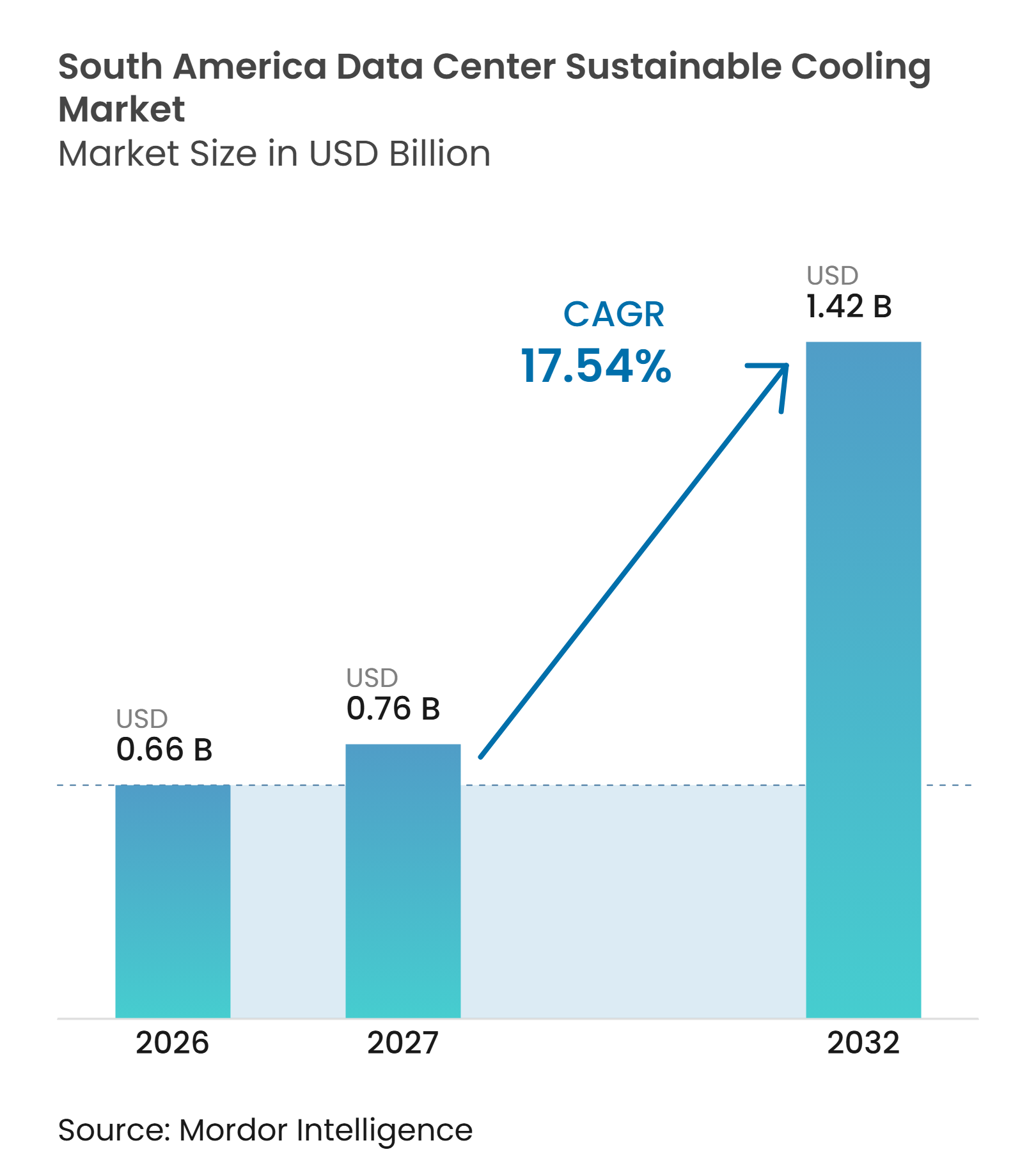
| Base Year Market Size (2026) | USD 0.66 Billion |
| Market Size (2027) | USD 0.76 Billion |
| Market Size (2032) | USD 1.42 Billion |
| Growth Rate (2027 - 2032) | 17.54 % |
| Market Concentration | Medium |
Major Players *Disclaimer: Major Players sorted in no particular order Image © Mordor Intelligence. Reuse requires attribution under CC BY 4.0. | |
South America Data Center Sustainable Cooling Market Analysis by Mordor Intelligence
The South America data center sustainable cooling market size is valued at USD 0.66 billion in 2026 and is projected to reach USD 1.42 billion by 2032, expanding at a CAGR of 13.29% during 2027-2032. Demand is shifting because AI servers place more heat inside each rack than conventional air systems can manage, making the original air-only approach less suitable for new compute halls. This makes liquid and hybrid systems more relevant in new facilities and in selected upgrades to existing campuses, where operators must preserve existing service commitments while increasing thermal capacity. Renewable electricity in several South American markets supports the case for reducing cooling energy use, especially where operators also face sustainability requirements and want to limit operating exposure as IT loads rise. Rules on water use, energy efficiency, and environmental reporting are making cooling design part of project compliance rather than a secondary equipment choice, particularly when tax eligibility, customer procurement requirements, or documented management standards are involved. Suppliers with local service coverage, scalable cooling equipment, and documented environmental performance are better placed to compete for large projects because delivery support, maintenance capability, and the ability to meet facility-wide performance targets all influence buyer decisions, especially when operators must deliver capacity on time while protecting contractual service commitments and long-term operating efficiency requirements.
Key Report Takeaways
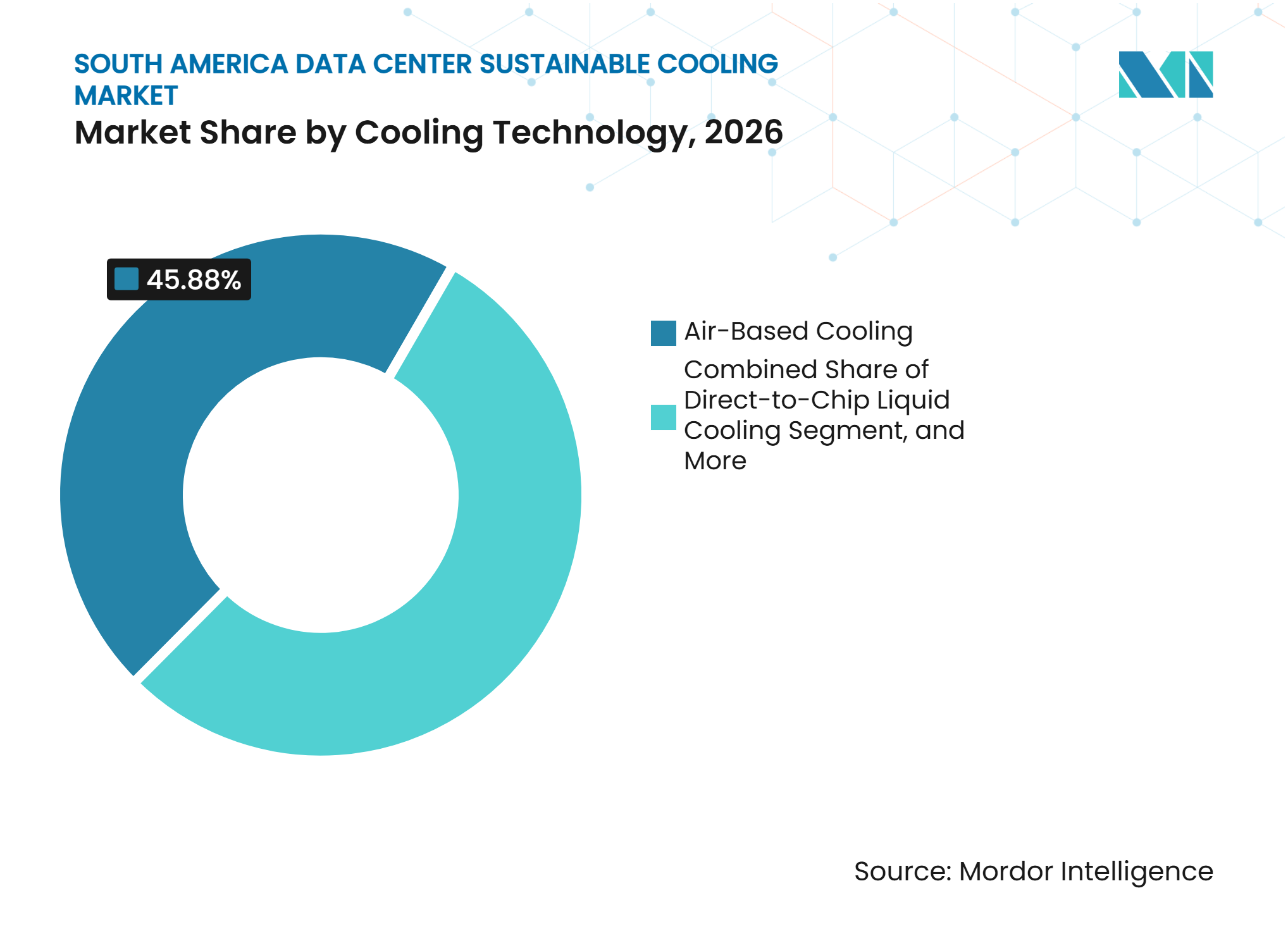
- By cooling technology, air-based cooling held 45.88% of the South America data center sustainable cooling market share in 2026, while direct-to-chip liquid cooling is the fastest-expanding technology segment.
- By heat rejection technology, air-cooled systems held 45.21% of the regional market share in 2026, while hybrid heat rejection systems are projected to expand at a 13.74% CAGR through 2032.
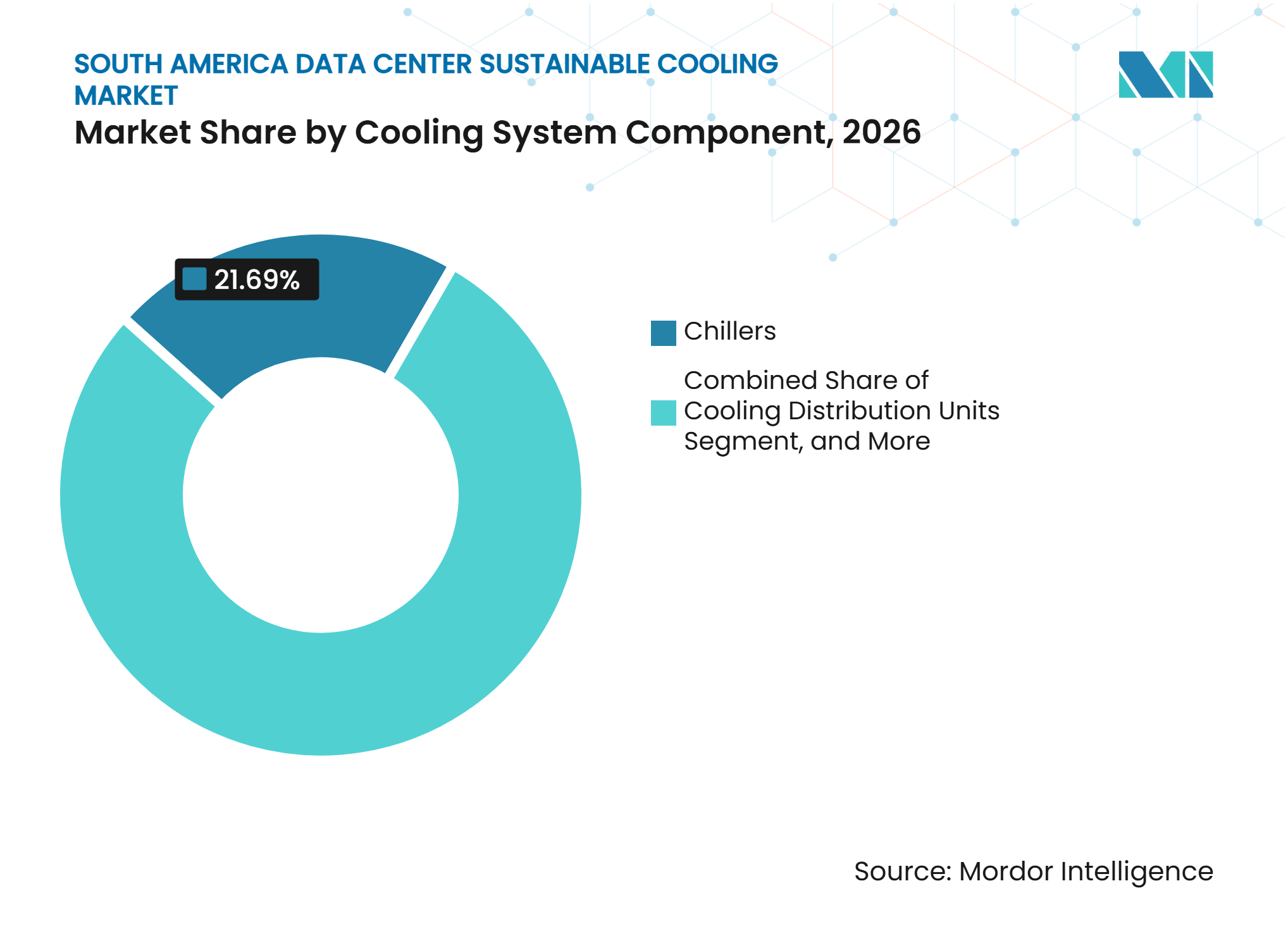
- By cooling system component, chillers held 21.69% of the South America data center sustainable cooling market share in 2026, while cooling distribution units are projected to expand at a 13.83% CAGR through 2032.
- By sustainability approach, energy-efficient cooling held 37.87% of the segmentation in 2026, while heat recovery-enabled cooling is projected to expand at a 13.72% CAGR through 2032.
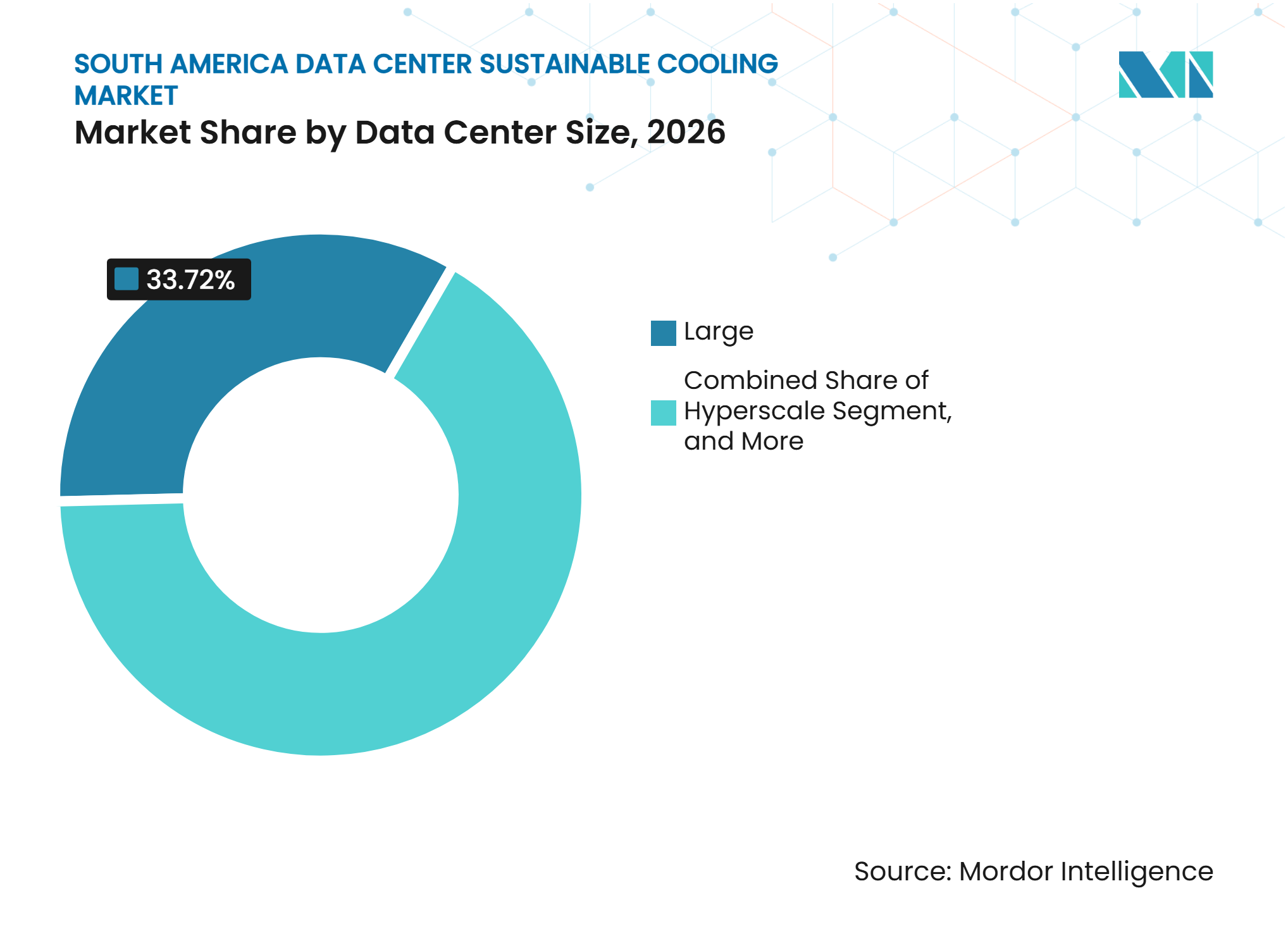
- By data center size, large data centers held 33.72% of the segmentation in 2026, while hyperscale facilities are projected to expand at a 13.69% CAGR through 2032.
- By data center type, colocation operators held 45.77% of the segmentation in 2026, while cloud service providers are projected to expand at a 13.91% CAGR through 2032.
- By geography, Brazil held 55.82% of the regional market share in 2026, while Chile is projected to expand at a 13.96% CAGR through 2032.
Note: Market numbers in this report are based on Mordor Intelligence's proprietary estimation framework, which combines nine months of actuals with Q4 projections for base year 2026.
Market Trends and Insights
Drivers Impact Analysis of South America Data Center Sustainable Cooling Market*
| Driver | (~) % Impact on CAGR Forecast | Geographic Relevance | Impact Timeline |
|---|---|---|---|
| Hyperscale and AI Workload Expansion | +4.1% | Brazil, Chile, Colombia | Short term (≤ 2 years) |
| Cloud, Colocation, and Digital Infrastructure Investment | +3.0% | Brazil, Chile, Argentina | Short term (≤ 2 years) |
| Energy-Efficiency and Sustainability Mandates | +2.2% | Brazil, Chile, Colombia | Medium term (2-4 years) |
| Digitalization, 5G, and Edge Computing Deployment | +1.6% | Brazil, Colombia, Peru | Medium term (2-4 years) |
| Brownfield Liquid-Cooling Retrofit Demand | +1.1% | Brazil, Chile | Medium term (2-4 years) |
| Local Manufacturing and Service-Capability Expansion | +0.7% | Brazil, Southern Cone | Long term (≥ 4 years) |
| Source: Mordor Intelligence | |||
Hyperscale and AI Workload Expansion Redefines Regional Thermal Architecture
AI platforms are changing how regional operators plan cooling capacity because rack heat loads are increasing beyond the practical range of conventional room air systems. Elea Data Centers agreed with Vertiv to deploy cooling distribution units for AI workloads in São Paulo as part of its first-phase investment program. The deployment provides a regional example of liquid cooling being designed into the facility rather than added after capacity constraints emerge. AWS is also building its South America Chile Region across 3 availability zones with independent supporting infrastructure. These developments make equipment selection more closely tied to server roadmaps and future rack density than to the original building specification. They also require owners to consider distribution units, piping, heat exchangers, controls, and service arrangements at the same time as server selection. Operators that standardize scalable liquid cooling can reduce the need to operate separate cooling designs through successive hardware changes.
Cloud, Colocation, and Digital Infrastructure Investment Raises the Efficiency Floor
Large investment programs are raising the performance threshold for cooling systems across South America. Equinix confirmed more than USD 420 million of regional investment for 2025-2026, including USD 270 million in Brazil and USD 42 million for the ST2 second phase in Chile. Ascenty allocated USD 1 billion across 13 projects during 2026. Each new hyperscale or large colocation project makes lower power and water use more visible in commercial procurement. It also creates a clear operating example for customers that compare capacity availability, resilience, energy use, and water performance across potential facilities. Colocation operators that serve enterprise customers face greater pressure to align their equipment choices with the standards expected by large cloud tenants. This creates demand for cooling systems that can perform efficiently while still supporting incremental expansion.[1]
Energy-Efficiency and Sustainability Mandates Drive Compliance-Led Procurement
Brazil enacted REDATA in September 2026, linking tax eligibility for qualifying data center services to a WUE limit of 0.05 L/kWh and 100% renewable or clean electricity sourcing. The requirements increase the value of closed-loop, liquid, and low-water cooling options for operators planning new facilities. They also increase the cost of retaining legacy evaporative equipment when it cannot support the required water performance. Environmental management and energy management credentials are becoming more important in procurement documentation. ISO 14046 water-footprint assessment methods and ISO 50001 energy management practices give operators a structure for documenting water and energy performance. These requirements can shape early decisions on site layout, technology selection, monitoring systems, water-reuse equipment, and the evidence needed for ongoing reporting. The South America data center sustainable cooling market therefore increasingly rewards systems that support auditable compliance as well as thermal performance.[2]
Digitalization, 5G, and Edge Computing Deployment Extends Cooling Demand to Secondary Markets
5G deployment and wider cloud adoption are extending computing demand beyond established data center clusters. Facilities in secondary cities must match cooling designs to local water conditions, power availability, and available technical support. Cirion Technologies’ LIM2 data center in Lima illustrates the spread of large-scale capacity into a market with locally specific resource constraints. Smaller edge facilities can face higher redundancy costs per kilowatt than major campuses. At the same time, AI inference workloads can produce heat levels that older air systems were not designed to handle. Operators therefore need designs that are appropriately sized for smaller sites without compromising the redundancy, monitoring, and maintenance practices needed for business-critical workloads. Modular air-cooled, adiabatic, and hybrid systems can help operators expand capacity while limiting water use and construction complexity.
Restraints Impact Analysis of South America Data Center Sustainable Cooling Market*
| Restraint | (~) % Impact on CAGR Forecast | Geographic Relevance | Impact Timeline |
|---|---|---|---|
| High Upfront Cost of Advanced Cooling Systems | -0.8% | All markets, most acute in secondary cities | Short term (≤ 2 years) |
| Cooling-System Energy Consumption | -0.5% | Brazil, Chile | Medium term (2-4 years) |
| Water, Grid, and Site-Specific Infrastructure Constraints | -0.4% | Chile, Peru | Long term (≥ 4 years) |
| Limited Availability of Skilled Liquid-Cooling Service Personnel | -0.3% | Regional, most acute outside São Paulo | Long term (≥ 4 years) |
| Source: Mordor Intelligence | |||
High Capital Intensity of Advanced Cooling Creates Procurement Friction
Moving from air cooling to direct-to-chip or immersion cooling significantly increases the upfront cost of a 20 MW AI-ready facility. The added requirement is more difficult for mid-sized colocation companies that serve regional enterprise customers. Fixed debt-service structures can also make investment decisions more sensitive to financing conditions. Many operators are responding with phased hybrid deployment, keeping air systems for standard compute areas and adding liquid cooling for denser AI racks. This reduces initial capital exposure but creates an operational need to maintain 2 cooling systems. The resulting complexity can limit the full efficiency benefits available from a single, integrated plant design.
Operational Energy Draw of Cooling Infrastructure Creates a Competing Efficiency Demand
Cooling can account for 30% to 40% of energy use in conventionally designed regional data centers. This creates a difficult operating balance when AI racks require more heat removal but tenant contracts also require strong power-use performance. Scala Data Centers maintains a PUE ceiling of 1.45 across its portfolio, while Tecto Data Centers’ Mega Lobster facility operated at a PUE of 1.5 at commissioning. Liquid systems can reduce energy use for heat transfer, but pumps, heat exchangers, and cooling distribution units also add electrical demand. Operators must therefore optimize the whole system rather than evaluate individual components in isolation. The need for trained personnel increases where equipment combines liquid loops, controls software, and water-management requirements.[3]
*Our forecasts treat driver/restraint impacts as directional, not additive. The impact forecasts reflect baseline growth, mix effects, and variable interactions.
South America Data Center Sustainable Cooling Market Segment Analysis
By Cooling Technology:
Liquid Precision Accelerates Against an Air-Dominant Installed BaseAir-based cooling held 45.88% of the cooling technology segmentation in 2026. Its position reflects the broad installed base of computer room air-conditioning systems and in-row equipment at established enterprise and colocation facilities. Brazil and Chile have many campuses that were built around air-side distribution before high-density AI deployments became common. These systems continue to serve conventional computing loads and residual room heat in mixed cooling environments. Evaporative and adiabatic systems remain relevant where ambient conditions support their use. Free cooling and economizer designs also provide options where local climate conditions permit a lower mechanical cooling load. The South America data center sustainable cooling market share held by air-based equipment therefore reflects installed infrastructure as much as current procurement preference.
Direct-to-chip liquid cooling is the fastest-expanding cooling technology as operators prepare for denser AI hardware. Elea’s São Paulo deployment with Vertiv provides a visible example of cooling distribution units being deployed for this workload. Immersion cooling and rear-door heat exchangers serve more specialized high-performance computing and retrofit needs. Liquid systems can remove heat close to the source, which reduces pressure on room-level air systems. The technology choice also affects piping, water treatment, monitoring, maintenance, and staff training requirements. Operators are likely to use hybrid designs while they transition between existing air-cooled capacity and newer liquid-cooled racks. Vendors that can support these mixed environments have an advantage in campuses that cannot replace their full cooling plant at once.



By Heat Rejection Technology:
Hybrid Systems Lead Growth Against Air-Cooled IncumbencyAir-cooled systems held 45.21% of the heat rejection technology segmentation in 2026. Their installed base is particularly broad across Brazil’s interior cities and Chile’s secondary markets. These systems are familiar to local operators and can avoid dependence on continuous water use. Water-cooled systems remain important at larger campuses in São Paulo and Santiago, where chilled-water plants support higher capacity requirements. Santiago’s local water constraints are steering new design choices toward closed-loop glycol alternatives. The South America data center sustainable cooling market size for air-cooled heat rejection remains supported by existing facility layouts and service familiarity.
Hybrid heat rejection systems are projected to expand at a 13.74% CAGR through 2032. They combine methods such as adiabatic pre-cooling, dry cooling, free-side economizing, and mechanical refrigeration. This gives operators more flexibility to manage the balance between electricity demand and water use as conditions change. ODATA’s BG02 and BG03 campuses in Tenjo incorporated Delta Cube technology to support rack densities of 50 kW. The project shows how hybrid heat rejection can be built into a hyperscale site from the design stage. Vendors are also developing low-global-warming-potential refrigerant products for high-density applications. Airedale by Modine’s TurboChill DCS uses R1234ze, which has a global warming potential of 1.37.
By Cooling System Component:
Cooling Distribution Units Lead New Deployments as Chillers Anchor the Installed BaseChillers held 21.69% of the cooling system component segmentation in 2026. They remain central to chilled-water plants at established Tier 3 and Tier 4 campuses in São Paulo, Santiago, Bogotá, and Buenos Aires. Cooling towers support many water-cooled hydronic plants, while pumps and fluid distribution equipment connect the main plant to downstream circuits. Heat exchangers are required in both air-side and liquid-cooled architectures. Fans and air-handling equipment still perform essential distribution functions in air-based systems. Component selection increasingly considers energy ratings, operational noise, water consumption, reliability, and maintenance needs. Chillers retain a central role because the regional installed base depends on them for large-scale heat removal.
Cooling distribution units are projected to expand at a 13.83% CAGR through 2032. Their demand tracks the adoption of direct-to-chip liquid cooling because each liquid-cooled rack deployment requires managed coolant distribution. CDUs provide the interface between facility water systems and rack-level loops. This role makes them important for preventing leaks, maintaining temperatures, and monitoring system performance. Motivair by Schneider Electric introduced the MCDU-70 in January 2026 with 2.5 MW base capacity that can scale to 10 MW. Its integration with EcoStruxure software shows the increasing importance of monitoring and controls alongside physical cooling equipment. The South America data center sustainable cooling market size for components is shifting toward systems that can expand with rising rack power rather than require full replacement.

By Sustainability Approach:
Energy-Efficient Cooling Leads as Heat Recovery Gains Strategic ValueEnergy-efficient cooling held 37.87% of the sustainability approach segmentation in 2026. The category includes free-cooling economizers, variable-speed chillers, and variable-frequency-drive upgrades used throughout the existing facility base. These measures address the direct power cost of operating cooling equipment. Water-efficient cooling is gaining greater relevance where regulatory and local resource conditions favor low-water designs. Elea Data Centers reported a network-average WUE of 0.014 L/kWh through its use of liquid cooling and water-reuse systems. This level sits below REDATA’s 0.05 L/kWh tax-eligibility threshold. Low-global-warming-potential refrigerants also form part of sustainability planning in new high-density systems.
Heat recovery-enabled cooling is projected to expand at a 13.72% CAGR through 2032. AI-scale facilities can produce tens of megawatts of waste heat that would otherwise be rejected from the site. Recovery systems can direct that heat to district heating or industrial processes where a practical local off-take exists. This changes the role of cooling from heat disposal to energy management. The opportunity depends on nearby demand, site configuration, and municipal infrastructure. ISO 50001 provides a formal management framework for documenting energy performance in procurement and compliance processes. Heat recovery therefore has strategic value where operators can coordinate facility design with local energy users.
By Data Center Size:
Hyperscale Drives Growth While Large Facilities Anchor ShareLarge data centers accounted for 33.72% of the data center size segment in 2026. The category includes established Tier 3 and Tier 4 colocation facilities in São Paulo, Santiago, Bogotá, and Buenos Aires. These campuses often use diverse cooling portfolios because they expanded through several construction phases. A site may combine chillers, dry coolers, in-row air systems, and newer liquid-cooling overlays. Medium facilities continue to serve enterprise and financial-sector customers with more stable density profiles. Small data centers support edge computing and fintech requirements in secondary cities. The South America data center sustainable cooling market share held by large sites shows the continuing importance of the existing regional colocation estate.
Hyperscale data centers are projected to expand at a 13.69% CAGR through 2032. New projects create demand for cooling systems capable of supporting large compute halls, higher rack densities, and committed efficiency targets. ODATA’s BG03 facility in Colombia is expected to reach 120 MW and become the country’s largest data center when commissioned. Scala Data Centers ended 2025 with more than 56 MW in operation and a BRL 4.7 billion (USD 840.5 million) annual capital expenditure program. Hyperscale facilities typically embed PUE and WUE requirements in operating commitments. This makes cooling performance a continuing operational obligation rather than a feature considered only at project launch. The scale of these projects also creates opportunities for suppliers to standardize equipment and services across multiple phases.
By Data Center Type:
Colocation Scale Anchors Demand as Cloud Providers Set Efficiency BenchmarksColocation operators held 45.77% of the data center type segmentation in 2026. They provide the link between major cloud tenants and enterprise customers needing regional capacity. Ascenty, Scala Data Centers, Equinix, and Cirion Technologies operate multicampus networks across a broad range of tenant power requirements. These facilities need cooling equipment that can serve standard enterprise racks and higher-density installations. Their portfolios include campuses with capacity from hundreds of kilowatts to tens of megawatts per tenant. Enterprise and edge facilities represent other important demand pools. Enterprise sites are increasingly connecting cooling procurement with Scope 2 emissions accounting under the GHG Protocol.
Cloud service providers are projected to expand at a 13.91% CAGR through 2032. AWS reported a PUE of 1.14 and a WUE of 0.09 L/kWh for its Brazil Region in 2025. These benchmarks create pressure on colocation operators seeking cloud wholesale business. They also influence supplier development of new cooling equipment for dense, large-scale facilities. Cloud investment is most concentrated in Brazil and Chile, where large reference projects can speed the adoption of new designs. Enterprise customers may move more gradually because their investment decisions follow separate capital cycles. The result is a regional market where leading facilities adopt advanced cooling earlier while smaller sites continue to rely on staged upgrades.
Geography Analysis
Brazil: Regulatory Anchor and Regional Majority
Brazil held 55.82% of the South America data center sustainable cooling market share in 2026. Its role reflects more than 750 MW of installed colocation capacity and a large renewable electricity base. REDATA connects federal tax eligibility with a WUE limit of 0.05 L/kWh and 100% renewable or clean electricity sourcing. This makes cooling design central to facility planning for qualifying operators. The US International Trade Administration stated that electricity demand for data centers in Brazil could increase from 707 MW in 2023 to 13.2 GW by 2035. That outlook increases the need to scale cooling capacity without weakening power or water performance. Elea’s 0.014 L/kWh network-average WUE shows the role that water reuse and liquid cooling can play in this environment. São Paulo remains the largest new-capacity center, while Fortaleza is attractive for cable connectivity and lower energy and land costs.
Chile: Southern Cone Growth Center and Liquid-Cooling Proving Ground
Chile is projected to expand at a 13.96% CAGR through 2032, the highest rate in the region. The country is a digital gateway for the Southern Cone and has a major hyperscale project pipeline. AWS is developing 3 availability zones in Huechuraba, Padre Hurtado, and Lampa for its South America Chile Region. Independent supporting infrastructure across these zones is expected to create a high-efficiency reference for procurement. Santiago’s water conditions make low-water cooling and closed-loop glycol systems important in new designs. Equinix committed USD 42 million to the second phase of its ST2 expansion in Pudahuel. This expands the city’s role as a digital interconnection center while increasing demand for reliable cooling capacity. Water stewardship, adiabatic pre-cooling, and hybrid designs are likely to remain central to site design in this geography.
Colombia, Argentina, and Peru: Diverse Drivers and Converging Compliance Needs
Colombia, Argentina, Peru, and other South American markets represent the next stage of sustainable cooling adoption. Bogotá is Colombia’s leading cluster, supported by the Tenjo free trade zone and large projects such as ODATA’s BG02 and BG03 campuses. The facilities have a combined planned capacity of 144 MW, with BG03 designed at 120 MW. Compliance factors increasingly favor closed-loop cooling in large projects, which can increase demand for water-efficient equipment. Argentina’s Buenos Aires free trade zone is also developing as a data center location. Vertiv’s partnership with Grupo Datco expands access to direct-to-chip cooling, high-capacity free-cooling plants, and rear-door heat exchangers in Argentina and Chile. Peru faces more scrutiny of water use as Lima capacity expands, which makes site-specific cooling selection especially important. Operators across these markets can benefit from modular designs that respond to local power, water, and service constraints.
Competitive Landscape
Market Concentration
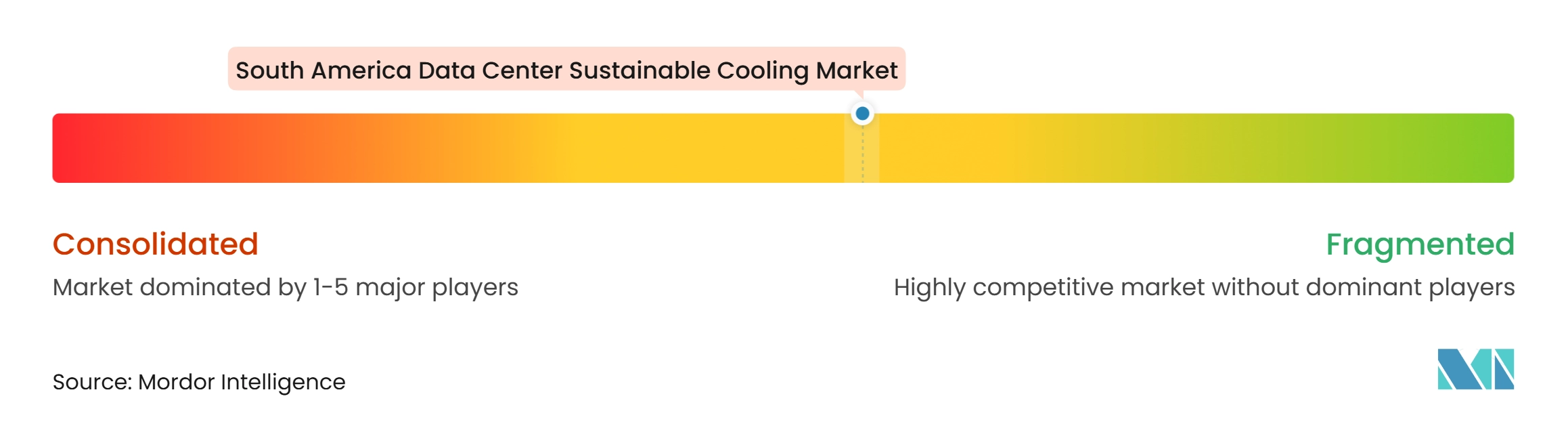
The South America data center sustainable cooling market has a two-tier competitive structure. Global infrastructure vendors have established service networks across air-cooled, chilled-water, and hybrid systems. Vertiv, Schneider Electric, STULZ, Johnson Controls, Carrier Global, and Trane Technologies hold established positions in these systems. Their product portfolios extend from rack-level cooling distribution units to campus-scale chiller plants. Local service capacity is important because delivery time, installation support, and ongoing maintenance can affect procurement decisions. Vertiv expanded regional channel coverage through an April 2026 distribution agreement with MAXID for Brazil, Peru, Chile, Argentina, Paraguay, Uruguay, and Bolivia. The agreement supports access to modular cooling and power equipment for AI and high-performance computing applications.
Schneider Electric strengthened its liquid cooling portfolio by acquiring a controlling interest in Motivair in February 2025. The acquisition added cooling distribution units, rear-door heat exchangers, and direct-to-chip capabilities. It enables the company to compete across air, hybrid, and liquid cooling requirements. Motivair’s MCDU-70, launched in January 2026, offers 2.5 MW of base capacity and can scale to 10 MW. The product connects physical cooling infrastructure with EcoStruxure monitoring software. This reflects a shift toward systems that can be expanded as AI racks become denser. ISO 14001 and ISO 50001 credentials are also becoming more relevant in hyperscale procurement, favoring vendors that can document environmental and energy management capabilities.
Specialist vendors including CoolIT Systems, LiquidStack, Submer Technologies, Iceotope Technologies, and Asperitas compete in direct-to-chip and immersion cooling. Their strongest opportunity is in AI-focused deployments and brownfield sites that need liquid-cooling overlays without full replacement of the existing plant. Submer created data center design and construction and AI-as-a-Service business units in February 2025. The move extends its role from component supply toward integrated facility support. Modine secured USD 180 million in new cooling orders during February 2025, reflecting demand from AI and high-performance computing customers. Its TurboChill DCS product uses low-global-warming-potential R1234ze refrigerant for direct liquid cooling applications. The competitive field remains diverse because both large vendors and specialists address different cooling requirements.
South America Data Center Sustainable Cooling Industry Leaders
-
Scala Data Centers
-
ODATA
-
Ascenty
-
Elea Digital
-
Equinix, Inc.
- *Disclaimer: Major Players sorted in no particular order
South America Data Center Sustainable Cooling Market Companies Covered in this Report
- Vertiv Holdings Co
- Schneider Electric SE
- STULZ GmbH
- Rittal GmbH & Co. KG
- Johnson Controls International plc
- Munters Group AB
- Daikin Industries, Ltd.
- Mitsubishi Electric Corporation
- Alfa Laval AB
- Carrier Global Corporation
- Trane Technologies plc
- Modine Manufacturing Company
- Motivair Corporation
- CoolIT Systems Inc.
- LiquidStack Inc.
- Submer Technologies S.L.
- Iceotope Technologies Limited
- Green Revolution Cooling, Inc.
- Asperitas B.V.
- Scala Data Centers
- ODATA
- Ascenty
- Elea Digital
- Equinix, Inc.
- Cirion Technologies
- Gtd
- EdgeUno
Recent Industry Developments in South America Data Center Sustainable Cooling Market
- September 2026: Brazil enacted REDATA (Special Tax Regime for Data Center Services), requiring qualifying operators to achieve WUE ≤ 0.05 L/kWh and source 100% electricity from renewable or clean sources, converting sustainable cooling from a differentiator to a legal compliance requirement for operators seeking federal tax benefits.
- May 2026: Equinix confirmed over USD 420 million in South America investments for 2025-2026, with Brazil receiving USD 270 million and Chile USD 42 million for the ST2 second-phase expansion, describing South America as its fastest-growing and most dynamic region globally.
- April 2026: Vertiv established a distribution agreement with MAXID covering Brazil and 6 South American countries for modular and scalable cooling and power solutions, consolidating inventory in Brazil and Uruguay to reduce transit times and improve access for AI and HPC cooling applications.
- January 2026: Motivair by Schneider Electric launched the MCDU-70 coolant distribution unit with a 2.5 MW base capacity scalable to 10 MW, integrated with EcoStruxure software, targeting scalable CDU infrastructure for growing AI rack deployments.
South America Data Center Sustainable Cooling Market Report Scope
The South America Data Center Sustainable Cooling Market refers to the regional market for energy-efficient, low-carbon, and water-conscious cooling technologies, systems, and services designed to manage thermal loads in data centers across South America while minimizing environmental impact, covering liquid cooling (direct-to-chip, immersion, rear-door heat exchangers), free/air-side economization, evaporative and adiabatic cooling, low-GWP refrigerant chillers, waste-heat recovery, AI-driven thermal optimization, and water-efficient closed-loop systems.
The South America Data Center Sustainable Cooling Market Report is Segmented by Cooling Technology (Air-Based Cooling, Direct-to-Chip Liquid Cooling, Immersion Cooling, Rear-Door Heat Exchangers, Evaporative and Adiabatic Cooling, Free Cooling and Economizer Systems, and Other Sustainable Cooling Technologies), Heat Rejection Technology (Air-Cooled Systems, Water-Cooled Systems, Evaporative Heat Rejection, Dry Coolers, and Hybrid Heat Rejection Systems), Cooling System Component (Cooling Distribution Units, Chillers, Cooling Towers, Heat Exchangers, Pumps and Fluid Distribution Systems, Fans and Air Handling Equipment, and Cooling Controls and Monitoring Systems), Sustainability Approach (Energy-Efficient Cooling, Water-Efficient Cooling, Low-Global-Warming-Potential Refrigerant Solutions, Heat Recovery-Enabled Cooling, and Integrated Cooling Optimization and Controls), Data Center Size (Small, Medium, Large, and Hyperscale), Data Center Type (Colocation, Cloud Service Providers, and Enterprise and Edge), and Geography (Brazil, Argentina, Chile, Colombia, Peru, and Rest of South America). The Market Forecasts Are Provided in Terms of Value (USD).
Segmentation Overview
| Air-Based Cooling |
| Direct-to-Chip Liquid Cooling |
| Immersion Cooling |
| Rear-Door Heat Exchangers |
| Evaporative and Adiabatic Cooling |
| Free Cooling and Economizer Systems |
| Other Sustainable Cooling Technologies |
| Air-Cooled Systems |
| Water-Cooled Systems |
| Evaporative Heat Rejection |
| Dry Coolers |
| Hybrid Heat Rejection Systems |
| Cooling Distribution Units |
| Chillers |
| Cooling Towers |
| Heat Exchangers |
| Pumps and Fluid Distribution Systems |
| Fans and Air Handling Equipment |
| Cooling Controls and Monitoring Systems |
| Energy-Efficient Cooling |
| Water-Efficient Cooling |
| Low-Global-Warming-Potential Refrigerant Solutions |
| Heat Recovery-Enabled Cooling |
| Integrated Cooling Optimization and Controls |
| Small |
| Medium |
| Large |
| Hyperscale |
| Colocation |
| Cloud Service Providers |
| Enterprise and Edge |
| Brazil |
| Argentina |
| Chile |
| Colombia |
| Peru |
| Rest of South America |
| By Cooling Technology | Air-Based Cooling |
| Direct-to-Chip Liquid Cooling | |
| Immersion Cooling | |
| Rear-Door Heat Exchangers | |
| Evaporative and Adiabatic Cooling | |
| Free Cooling and Economizer Systems | |
| Other Sustainable Cooling Technologies | |
| By Heat Rejection Technology | Air-Cooled Systems |
| Water-Cooled Systems | |
| Evaporative Heat Rejection | |
| Dry Coolers | |
| Hybrid Heat Rejection Systems | |
| By Cooling System Component | Cooling Distribution Units |
| Chillers | |
| Cooling Towers | |
| Heat Exchangers | |
| Pumps and Fluid Distribution Systems | |
| Fans and Air Handling Equipment | |
| Cooling Controls and Monitoring Systems | |
| By Sustainability Approach | Energy-Efficient Cooling |
| Water-Efficient Cooling | |
| Low-Global-Warming-Potential Refrigerant Solutions | |
| Heat Recovery-Enabled Cooling | |
| Integrated Cooling Optimization and Controls | |
| By Data Center Size | Small |
| Medium | |
| Large | |
| Hyperscale | |
| By Data Center Type | Colocation |
| Cloud Service Providers | |
| Enterprise and Edge | |
| By South America | Brazil |
| Argentina | |
| Chile | |
| Colombia | |
| Peru | |
| Rest of South America |
Key Questions Answered in the Report
What is the South America data center sustainable cooling market size?
The South America data center sustainable cooling market size is USD 0.66 billion in 2026 and is projected to reach USD 1.42 billion by 2032, at a 13.29% CAGR during 2027-2032. The outlook reflects the wider use of liquid and hybrid cooling as facilities prepare for higher-density computing workloads.
What is driving demand for sustainable data center cooling in South America?
AI workloads, hyperscale construction, water-efficiency rules, renewable electricity sourcing, and expansion of cloud and colocation capacity are driving demand. These factors make cooling efficiency, water use, and the ability to support future rack densities central considerations for facility owners.
Which cooling technology has the largest share in South America?
Air-based cooling leads the cooling technology segmentation with 45.88% share in 2026 because of its broad installed base in existing facilities. It remains useful for conventional workloads and for managing room-level heat in hybrid sites, even as liquid cooling becomes more important for dense AI racks.
Which component is expanding fastest in sustainable cooling systems?
Cooling distribution units are projected to expand at a 13.83% CAGR through 2032 as direct-to-chip liquid cooling deployments increase. These units manage the connection between facility water systems and rack-level circuits, making them important for thermal control, monitoring, and scalable expansion.
Which South American country leads sustainable data center cooling demand?
Brazil holds 55.82% share in 2026, supported by installed colocation capacity, renewable power availability, and REDATA requirements. Its scale and regulatory setting make efficient, low-water cooling a priority for operators that want to qualify for federal tax benefits.
Why is liquid cooling becoming important for data centers?
Liquid cooling supports dense AI racks and can reduce dependence on conventional room air systems, especially in new hyperscale and retrofit projects. It is commonly introduced with cooling distribution units, pumps, heat exchangers, and control systems that require coordinated design and ongoing specialist maintenance.