
South America Data Center Security Services Market Size and Share
Market Overview
| Study Period | 2021 - 2032 |
|---|---|
| Forecast Data Period | 2027 - 2032 |
| Base Year Market Size (2026) | USD 251.32 Million |
| Market Size (2027) | USD 291.11 Million |
| Market Size (2032) | USD 561.23 Million |
| Growth Rate (2027 - 2032) | 14.03 % |
| Market Concentration | Medium |
Major Players *Disclaimer: Major Players sorted in no particular order Image © Mordor Intelligence. Reuse requires attribution under CC BY 4.0. | |
South America Data Center Security Services Market Analysis by Mordor Intelligence
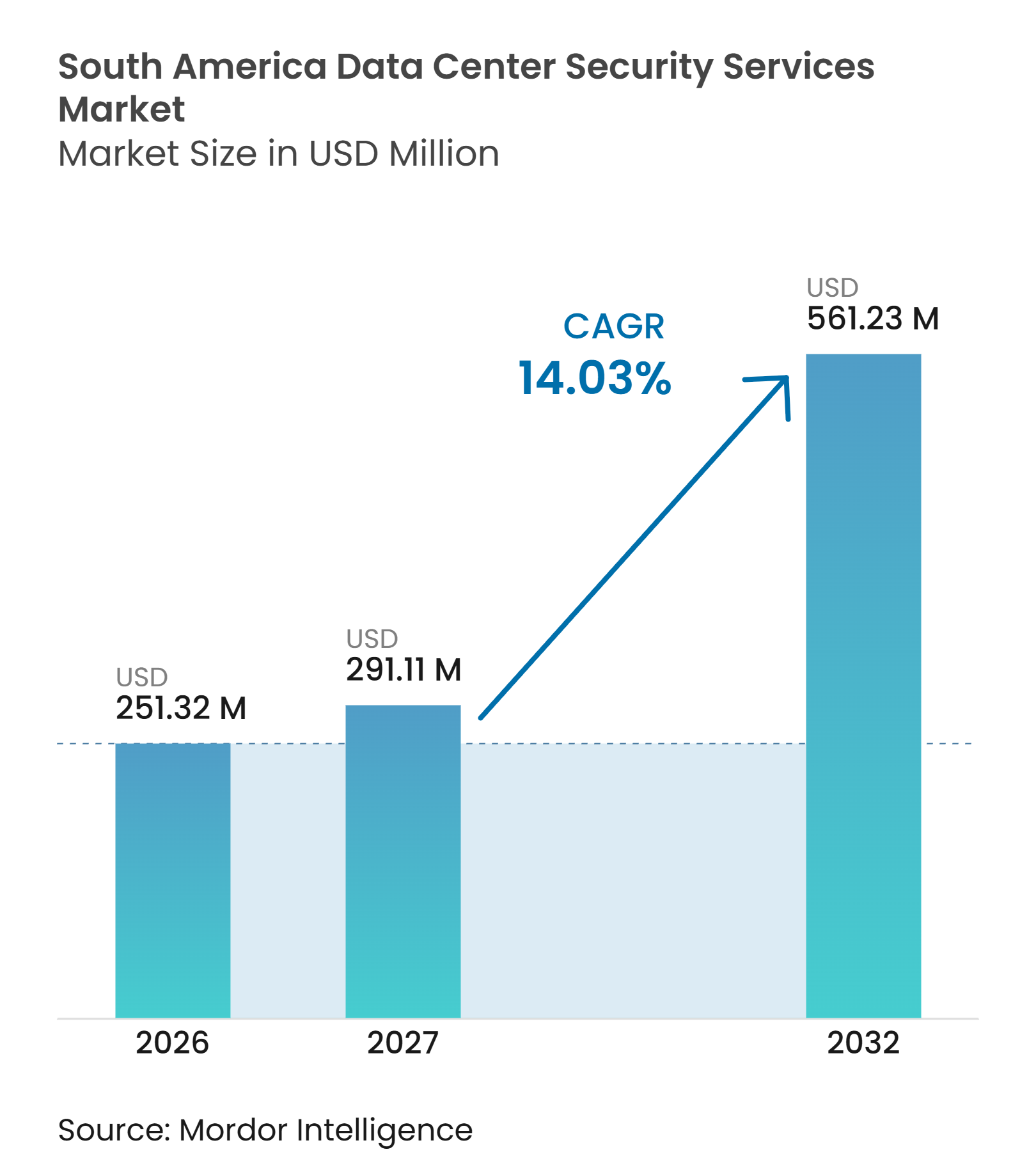
The South America data center security services market size is expected to grow from USD 251.32 million in 2026 to USD 291.11 million in 2027, and is forecast to reach USD 561.23 million by 2032, at a 14.03% CAGR over 2027-2032. Capacity additions in Brazil and Chile are increasing the need for guarding, access control, surveillance, and security operations center services. Compliance requirements in Brazil make security spending a continuing operating requirement rather than a discretionary response to construction cycles. Data center operators are also moving toward integrated contracts as multi-site operations make separate facility-level arrangements harder to govern. Suppliers that combine physical security, remote monitoring, and documented compliance controls are better placed to serve this demand.
Key Report Takeaways
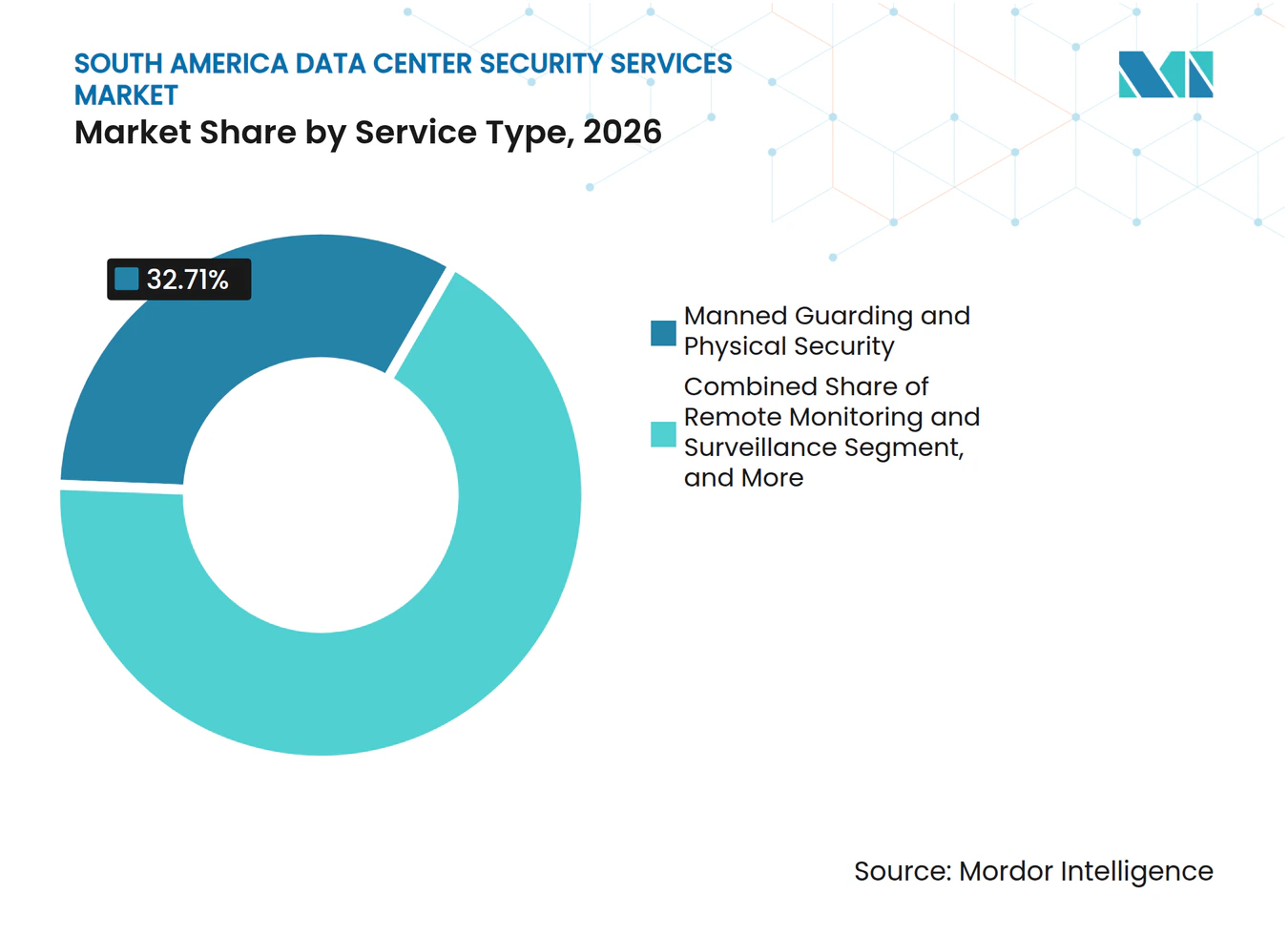
- By service type, Manned Guarding and Physical Security held 32.71% of the South America data center security services market share in 2026, while Security Operations Center Services is projected to expand at a 15.26% CAGR through 2032.
- By service delivery model, On-Site Security Services accounted for 46.28% of the South America data center security services market share in 2026, while Remote and Centralized Security Services are expected to expand at a 16.92% CAGR through 2032.
- By contract type, Dedicated Site-Level Contracts held 38.74% of the market in 2026, while Managed Service Agreements are projected to expand at a 16.39% CAGR through 2032.
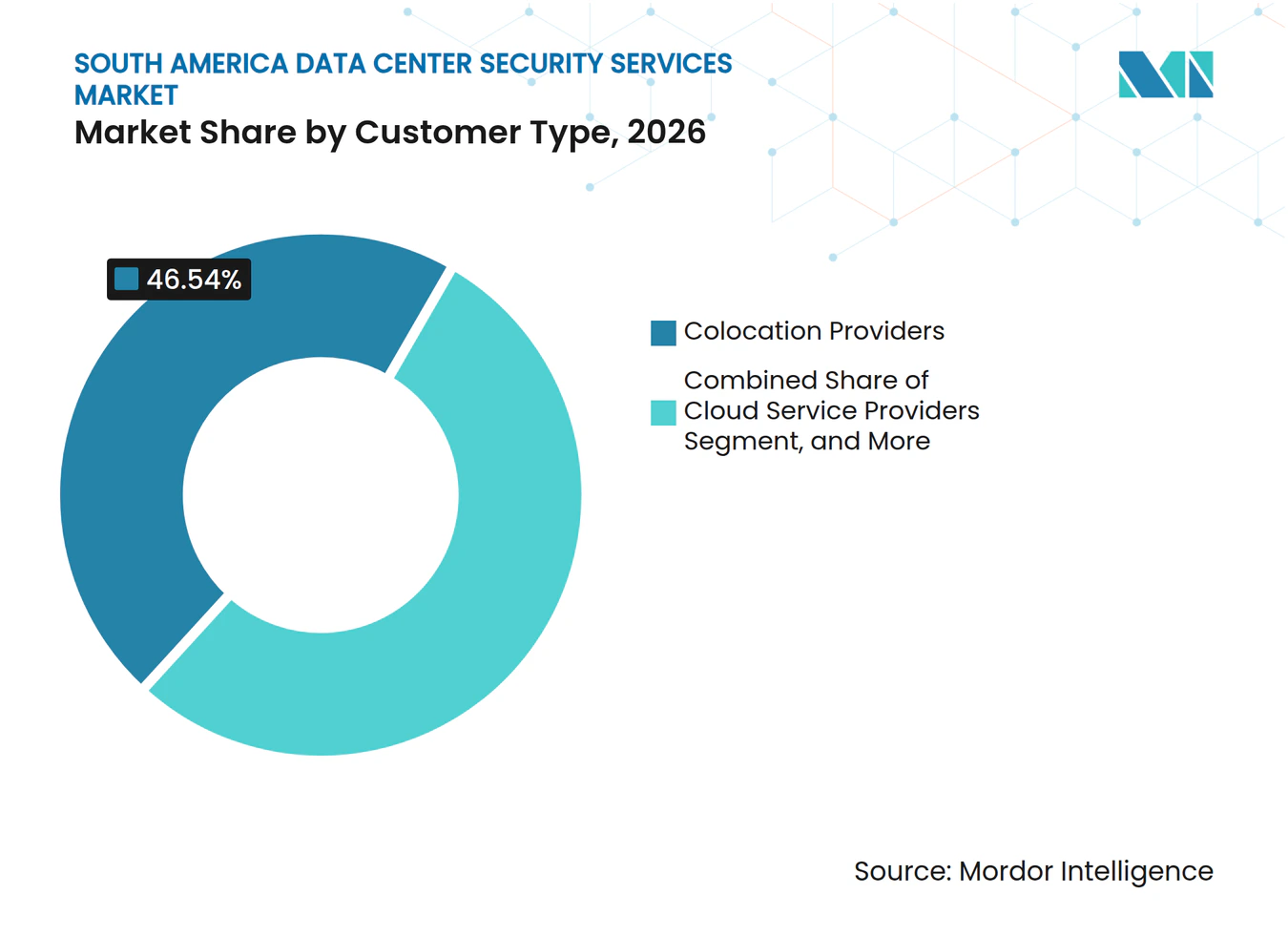
- By customer type, Colocation Providers accounted for 46.54% of the market in 2026, while Cloud Service Providers are expected to expand at a 15.59% CAGR through 2032.
- By data center size, Medium Data Centers held 38.94% of the market in 2026, while Large Data Centers are projected to expand at a 17.27% CAGR through 2032.
- By country, Brazil accounted for 37.64% of the market in 2026, while Argentina is expected to expand at a 16.96% CAGR through 2032.
Note: Market numbers in this report are based on Mordor Intelligence's proprietary estimation framework, which combines nine months of actuals with Q4 projections for base year 2026.
Market Trends and Insights
Drivers Impact Analysis of South America Data Center Security Services Market*
| Driver | (~) % Impact on CAGR Forecast | Geographic Relevance | Impact Timeline |
|---|---|---|---|
| Hyperscale and Colocation Capacity Expansion | +3.5% | Brazil and Chile primary, Argentina emerging | Short term (≤ 2 years) |
| Cloud Migration and Hybrid Workload Growth | +3.0% | Brazil primary, Chile, Argentina | Medium term (2-4 years) |
| Data Protection and Critical Infrastructure Compliance | +2.5% | Brazil national enforcement, Chile and Argentina evolving frameworks | Medium term (2-4 years) |
| Rising Cyber-Physical Attack Surface | +2.0% | South America-wide, concentrated in Brazil and Chile hyperscale corridors | Short term (≤ 2 years) |
| Portuguese- and Spanish-Language Managed Security Demand | +1.5% | Brazil Portuguese, Argentina and Chile Spanish | Medium term (2-4 years) |
| Security Automation for Power-Constrained Edge Facilities | +1.0% | Brazil and Argentina grid constraints, Chile transmission bottlenecks | Long term (≥ 4 years) |
| Source: Mordor Intelligence | |||
Hyperscale and Colocation Capacity Expansion Is the Primary Demand Multiplier
The South America data center security services market is gaining demand as larger facilities require more than perimeter protection. A campus with several buildings needs separate access zones, visitor processes, camera coverage, and incident records. This requirement makes the security scope rise faster than the number of sites. Chile had 120 MW of data center capacity under construction in mid-2026, which supported additional demand for security infrastructure and operating services. Operators also need consistent procedures across availability zones, which favors providers that can manage on-site and remote functions under one agreement. Argentina’s pipeline of projects under investor review adds another route for demand as facilities move from planning to commissioning.
Cloud Migration and Hybrid Workload Growth Disaggregates the Security Perimeter
Cloud Service Providers are projected to expand at a 15.59% CAGR through 2032, making distributed cloud architecture a major source of demand in the South America data center security services market. A cloud region that spans multiple availability zones must protect each location while applying common access and incident-control rules. This operating model makes centralized monitoring more practical than building a fully staffed security team at every site. Managed Service Agreements are projected to expand at a 16.39% CAGR because they place multi-site accountability with one provider. The U.S. International Trade Administration identifies cloud computing, cybersecurity, and digital infrastructure as active areas of Brazil’s information and communications technology environment.[1] Providers with ISO/IEC 27001-aligned processes can reduce the qualification burden for cloud customers that require documented controls.
Data Protection and Critical Infrastructure Compliance Creates Durable Demand
Brazil’s requirements give the South America data center security services market a source of demand that is not limited to new construction. Anatel’s Resolution 780 placed data centers integrated with telecommunications networks within the country’s conformity assessment framework.[2] The framework addresses physical security, cybersecurity, energy efficiency, and operational continuity prior to a covered facility entering service. Existing facilities have 3 years to adapt to the requirements. Data controllers also need security controls that can be documented and reviewed when incidents are reported under Brazil’s data protection law. These obligations shorten the procurement decision-making process for operators approaching a conformity review.
Rising Cyber-Physical Attack Surface Drives Converged Security Demand
The South America data center security services market is increasingly shaped by the connection between physical systems and cyber risk. Power, cooling, surveillance, access control, and building management systems can create operational exposure when they are not monitored together. Ascenty deployed Claroty’s xDome platform across 40 data centers during 2026 to integrate cyber-physical security controls. The company reported a 50% improvement in cybersecurity maturity through an assessment aligned with NIST SP 800-82. This direction supports a single service-level agreement that can connect unusual badge activity or video events with network indicators. It also makes it harder for providers focused solely on guards or cybersecurity to address the full operating requirements.
Restraints Impact Analysis of South America Data Center Security Services Market*
| Restraint | (~) % Impact on CAGR Forecast | Geographic Relevance | Impact Timeline |
|---|---|---|---|
| High Integration and Retrofit Costs | -2.5% | Brazil large legacy infrastructure base, Argentina | Medium term (2-4 years) |
| Shortage of Certified Security Professionals | -2.0% | South America-wide, most acute outside São Paulo and Santiago | Long term (≥ 4 years) |
| Currency Volatility and Budget Uncertainty | -1.5% | Argentina most severe, Brazil BRL volatility versus USD-denominated contracts | Short term (≤ 2 years) |
| Fragmented Data Protection and Cybersecurity Requirements | -1.0% | Cross-border operations spanning Brazil, Argentina, and Chile | Long term (≥ 4 years) |
| Source: Mordor Intelligence | |||
High Integration and Retrofit Costs Constrain Legacy Operators
The South America data center security services market faces a cost barrier where older facilities need to integrate physical and cyber controls. Some mid-generation sites continue to use non-IP surveillance, legacy access readers, and building systems that were not designed for current operational technology security requirements. Replacing this equipment can require hardware upgrades rather than a software subscription. These expenses can be difficult for mid-tier operators to fit within annual budgets. Johnson Controls promoted multi-year transitions from retrofits to managed service arrangements for regional partners in May 2025.[3] The approach can spread costs over time, but it does not remove the need to meet compliance deadlines.
Shortage of Certified Security Professionals Limits Service Delivery Capacity
The limited supply of qualified personnel restricts the expansion of the South America data center security services market, particularly for on-site delivery. Operators need staff who understand physical controls, network risk, and industrial systems. The shortage is more visible outside São Paulo, Santiago, and Buenos Aires, where the pool of experienced personnel is smaller. Fortinet expanded its Brazilian team by more than 20% in 2025, increasing competition for certified cybersecurity talent. Remote operations centers and automation can improve coverage where local staffing is difficult. Even so, automation cannot fully replace the local response capacity required by many colocation and enterprise clients.
*Our forecasts treat driver/restraint impacts as directional, not additive. The impact forecasts reflect baseline growth, mix effects, and variable interactions.
South America Data Center Security Services Market Segment Analysis
By Service Type:
Guard Incumbency Accelerates the SOC TransitionManned Guarding and Physical Security held 32.71% of the South America data center security services market share in 2026. The position reflects staffing requirements in high-security facilities and the need for a record of physical access. Manned personnel remain responsible for site entry, visitor handling, patrols, and incident response. Securitas Technology formed a partnership with Rohde and Schwarz in September 2025 to incorporate AI-based millimeter-wave personnel screening into data center security protocols.[4] The arrangement shows how physical guarding is adding technology rather than being displaced by it.
Security Operations Center Services are projected to expand at a 15.26% CAGR through 2032. Guards, cameras, badge readers, and other physical systems create operating data that can be reviewed in a centralized security operations center. Operators are using this data with network alerts to identify incidents earlier and establish a more complete record. Remote Monitoring and Surveillance, Risk Assessment, Access Control and Visitor Management, and System Maintenance serve different stages of the facility security lifecycle. The combined need for these services is moving procurement away from isolated product purchases and toward managed engagements. The South America data center security services industry therefore favors suppliers that can link physical response with continuous monitoring.



By Service Delivery Model:
Talent Scarcity Rebalances Delivery EconomicsOn-Site Security Services accounted for 46.28% of the South America data center security services market share in 2026. Tier III and Tier IV colocation facilities often require personnel at the site to meet customer commitments and protect critical areas. Local teams also provide direct support for visitor management, maintenance access, and emergency response. On-site coverage remains important where enterprise customers expect visible physical control. Brazil’s conformity assessment rules reinforce the need for documented physical controls at covered facilities. This supports a continued role for local service teams.
Remote and Centralized Security Services are expected to expand at a 16.92% CAGR through 2032. This model enables a provider to support several facilities through a common monitoring platform and standardized procedures. NextStream launched its IC2 Intelligent Command Center in São Paulo in November 2025 to centralize the management of 10 data centers across 5 countries through a trilingual platform. The model is useful where a complete on-site team at every facility would be too costly or difficult to staff. Hybrid Security Services combine a reduced on-site presence with a remote operations backbone. This format gives mid-sized 5-20 MW operators physical coverage while managing labor costs.
By Contract Type:
Managed Service Agreements Reshape Revenue StructuringDedicated Site-Level Contracts held 38.74% of the market in 2026. These contracts remain common because many operators historically bought security services for each campus through a fixed scope. The format can suit a single facility with stable requirements and an established local security team. It becomes less efficient when an operator opens new locations or expands across borders. Separate contracts can also produce inconsistent reporting and access-control practices. The South America data center security services market is, therefore, moving beyond the dedicated site format where networks become more complex.
Managed Service Agreements are projected to expand at a 16.39% CAGR through 2032. Under this approach, a single accountable vendor can manage guarding, remote monitoring, security operations center services, and maintenance through a single set of service-level agreements. Convergint Technologies presented integrated access control, video surveillance, and perimeter protection for data center operators at DCD Connect South America 2026. Multi-Site and Regional Contracts offer an intermediate option for operators building toward a full managed model. Integrated Security Service Contracts also support harmonized processes for facilities operating across Brazil, Chile, and Argentina. A unified invoice and common compliance documentation can become selection factors for customers with multiple campuses.
By Customer Type:
Colocation Density Drives Revenue ConcentrationColocation Providers accounted for 46.54% of the market in 2026. A single colocation campus may serve enterprise, cloud, and public-sector customers that each require separate access areas and audit records. This customer density increases the complexity of visitor management, incident documentation, and physical access control. It also creates a large role for guarding and surveillance because each tenant expects protection from other users of the facility. Data protection requirements strengthen the need to document controls before an incident occurs.
Cloud Service Providers are expected to expand at a 15.59% CAGR through 2032. Their new regional facilities need security architecture from commissioning rather than a retrofit of existing systems. Multi-availability-zone designs also require common rules across several sites. Enterprise and Edge Data Center Operators face many of the same requirements, but have smaller security teams. These customers can use video analytics, anomaly alerts, and remote access management to manage staffing needs. Genetec offers its Security Center platform to unify security data and operations, which is relevant to operators seeking a managed model.

By Data Center Size:
Large Campus Commissioning Redefines Security ScopeMedium Data Centers held 38.94% of the market in 2026. This group includes many operating colocation campuses in São Paulo, Santiago, and Buenos Aires with a 5-20 MW power envelope. These facilities need layered access control and surveillance, but usually do not operate a dedicated security operations center at every site. They are well-suited to hybrid delivery models that combine site teams with centralized monitoring. Medium-sized operators also face pressure to provide enterprise-grade documentation without the budgets of hyperscale sites. This makes flexible managed contracts relevant to the South America data center security services market.
Large Data Centers are projected to expand at a 17.27% CAGR through 2032. A campus above 20 MW may need multi-ring access control, automated visitor management, a dedicated on-site security presence, and tenant identity integration. These requirements span several service types and can produce higher security services revenue per MW than smaller locations. Small Data Centers, including telecom-grade edge nodes, usually require more limited surveillance and access management contracts. Hyperscale facilities above 100 MW often retain core physical security functions while using specialized partners for security operations center support and compliance preparation. The expansion of large, multi-building campuses also supports the shift toward managed agreements because separate site contracts can create governance gaps.
Geography Analysis
Brazil
Brazil held 37.64% of the South America data center security services market share in 2026. It also hosted 37.2% of South American data centers, based on United Nations Development Program data. The country’s largest facilities are concentrated in the São Paulo, Campinas, and Rio de Janeiro corridors. Anatel’s requirements make certified controls and documented audit trails especially important for facilities connected to telecommunications networks. Government rules for classified information also require hosting in Brazil and appropriate security conditions for private cloud environments.
Argentina
Argentina is expected to expand at a 16.96% CAGR through 2032. Its smaller installed base creates room for purpose-built facilities that can use modern security architecture from commissioning. The Cámara Argentina de Centros de Datos was established in October 2026 with founding members including Kyndryl, Cirion, Claro, Telecom Argentina, and Sencinet. Its formation indicates a more organized approach to energy, sustainability, institutional relations, and talent needs. Chile remains an important comparison point because it had 255 MW of operating capacity and 120 MW under construction in mid-2026. Its more established procurement practices make managed agreements relevant for regional operators expanding into Argentina.
Rest of South America
The Rest of South America includes Colombia, Peru, Uruguay, and smaller markets. Brazil, Chile, and Argentina together hosted 58% of the region’s data centers, leaving a meaningful group of facilities outside the three largest locations. Regional colocation providers are seeking cross-border redundancy, which raises the need for consistent security procedures across countries. These markets are moving from informal site arrangements toward structured managed contracts as data center operations formalize. Providers that establish ISO/IEC 27001-aligned controls and bilingual security operations can support this transition. The South America data center security services market can therefore benefit as regional capacity extends beyond its largest hubs.
Competitive Landscape
Market Concentration
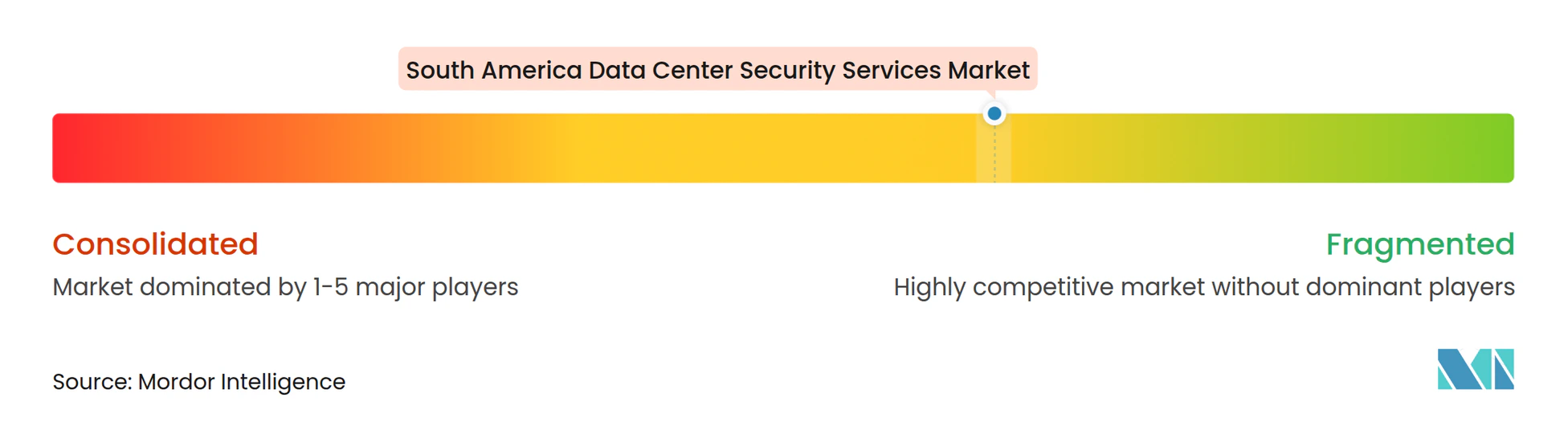
The South America data center security services market is moderately fragmented. Global physical security integrators such as Securitas Technology, Johnson Controls, Honeywell, and Convergint Technologies compete in the guarding, access control, and surveillance sectors. Access and identity specialists, including ASSA ABLOY, dormakaba, Allegion, and Suprema, maintain positions in hardware and credential systems. Cybersecurity-led providers such as Fortinet, Palo Alto Networks, CrowdStrike, IBM, ISH Tecnologia, and Stefanini provide managed detection and network security services. No provider holds a clear regional lead across both physical and cybersecurity service capabilities. This leaves room for vendors that can manage a unified security operations center under one service-level agreement.
Securitas Technology’s September 2025 partnership with Rohde and Schwarz brought AI-based millimeter-wave screening into commercial data center entry processes. Ascenty’s 2026 deployment of Claroty xDome across 40 data centers showed another route to integrated cyber-physical monitoring. Palo Alto Networks expanded its Unit 42 managed services activity in Brazil in 2026, positioning the country as a South American hub for autonomous security operations center capabilities. These moves show that physical security providers and cyber-native suppliers are approaching the same converged service opportunity from different starting points.
Compliance is an important competitive filter because covered operators need controls that can be reviewed and documented. Providers without ISO/IEC 27001-aligned processes and credible audit records face a weaker position in government-adjacent opportunities. Local providers can also benefit from Portuguese and Spanish language capability and knowledge of national requirements. Competition is likely to focus on zero-trust physical access, behavioral video analytics, and building-system anomaly detection. These capabilities can help suppliers show a direct connection between site security and operational resilience.
South America Data Center Security Services Industry Leaders
-
Axis Communications AB
-
Hangzhou Hikvision Digital Technology Co., Ltd.
-
Securitas Technology
-
Genetec Inc.
-
Bosch Sicherheitssysteme GmbH
- *Disclaimer: Major Players sorted in no particular order
South America Data Center Security Services Market Companies Covered in this Report
- Axis Communications AB
- Hangzhou Hikvision Digital Technology Co., Ltd.
- Securitas Technology
- Genetec Inc.
- Bosch Sicherheitssysteme GmbH
- Johnson Controls International
- Honeywell International Inc.
- Siemens AG
- Schneider Electric SE
- ABB Ltd.
- Convergint Technologies LLC
- ASSA ABLOY AB
- dormakaba Holding AG
- Allegion plc
- Suprema Inc.
- Cisco Systems, Inc.
- IBM Corporation
- Check Point Software Technologies Ltd.
- Fortinet, Inc.
- Palo Alto Networks, Inc.
- Trend Micro Incorporated
- CrowdStrike Holdings, Inc.
- Telefónica S.A.
- Kyndryl Inc.
- Stefanini Participações S.A.
- ISH Tecnologia S.A.
Recent Industry Developments in South America Data Center Security Services Market
- October 2026: Brazil’s GSI/PR issued Normative Instruction No. 8/2025, permitting reserved and secret government information in private cloud environments for the first time, subject to mandatory hosting within Brazilian territory and strict physical security and audit certification under Decree No. 7.845/2012.
- September 2026: Convergint Technologies sponsored DCD Connect South America 2026, promoting integrated access control, video surveillance, and perimeter protection as a unified managed offering for South American data center operators. The company simultaneously announced an upcoming presence at DCD Brasil in São Paulo, formalizing its South America regional expansion.
- September 2026: Johnson Controls showcased AI-enabled security at GSX 2026, including managed SOC services for centralized monitoring and incident response, and Proactive Video Solutions combining intelligent analytics with expert human monitoring.
- March 2026: Johnson Controls reinforced its data center and mission-critical security leadership at ISC West 2026, launching C•CURE IQ 3.2 with built-in video management and standardized incident workflows, alongside hardware updates spanning PowerSeries Neo 5, IQ Panel 5, Kantech EntraPass 9.10, and exacqVision 26.0.
South America Data Center Security Services Market Report Scope
The South America data center security services market includes revenue from security services deployed in data centers across Brazil, Argentina, Chile, and other South American countries. Growth is supported by colocation expansion, digital transformation, rising awareness of security threats, and increasing demand for manned guarding, remote monitoring, and managed security services.
The South America Data Center Security Services Market Report is Segmented by Service Type (Manned Guarding and Physical Security, Remote Monitoring and Surveillance, Security Operations Center Services, Security Risk Assessment and Consulting, Access Control and Visitor Management Services, and Security System Maintenance and Support), Service Delivery Model (On-Site Security Services, Remote and Centralized Security Services, and Hybrid Security Services), Contract Type (Dedicated Site-Level Contracts, Multi-Site and Regional Contracts, Integrated Security Service Contracts, and Managed Service Agreements), Customer Type (Colocation Providers, Cloud Service Providers (CSPs), and Enterprise / Edge Data Center Operators), Data Center Size (Small, Medium, Large, and Hyperscale), and Country (Brazil, Argentina, Chile, and Rest of South America). The Market Forecasts are Provided in Terms of Value (USD).
Segmentation Overview
| Manned Guarding and Physical Security |
| Remote Monitoring and Surveillance |
| Security Operations Center Services |
| Security Risk Assessment and Consulting |
| Access Control and Visitor Management Services |
| Security System Maintenance and Support |
| On-Site Security Services |
| Remote and Centralized Security Services |
| Hybrid Security Services |
| Dedicated Site-Level Contracts |
| Multi-Site and Regional Contracts |
| Integrated Security Service Contracts |
| Managed Service Agreements |
| Colocation Providers |
| Cloud Service Providers (CSPs) |
| Enterprise / Edge Data Center Operators |
| Small |
| Medium |
| Large |
| Hyperscale |
| Brazil |
| Argentina |
| Chile |
| Rest of South America |
| By Service Type | Manned Guarding and Physical Security |
| Remote Monitoring and Surveillance | |
| Security Operations Center Services | |
| Security Risk Assessment and Consulting | |
| Access Control and Visitor Management Services | |
| Security System Maintenance and Support | |
| By Service Delivery Model | On-Site Security Services |
| Remote and Centralized Security Services | |
| Hybrid Security Services | |
| By Contract Type | Dedicated Site-Level Contracts |
| Multi-Site and Regional Contracts | |
| Integrated Security Service Contracts | |
| Managed Service Agreements | |
| By Customer Type | Colocation Providers |
| Cloud Service Providers (CSPs) | |
| Enterprise / Edge Data Center Operators | |
| By Data Center Size | Small |
| Medium | |
| Large | |
| Hyperscale | |
| By Country | Brazil |
| Argentina | |
| Chile | |
| Rest of South America |
Key Questions Answered in the Report
What is the South America data center security services market size?
The South America data center security services market size is expected to grow from USD 251.32 million in 2026 to USD 291.11 million in 2027, and is forecast to reach USD 561.23 million by 2032, at a 14.03% CAGR over 2027-2032.
Which service category holds the largest share?
Manned Guarding and Physical Security holds the largest service type share at 32.71% in 2026.
Which delivery model is expected to expand fastest?
Remote and Centralized Security Services is expected to expand at a 16.92% CAGR through 2032.
Why are managed service agreements becoming more important?
Multi-site operators use them to obtain common security procedures, service-level agreements, reporting, and vendor accountability.
Which country leads regional demand?
Brazil accounts for 37.64% of the market in 2026, supported by its large data center base and compliance requirements.
What is driving demand for converged security operations?
Operators are connecting physical access, surveillance, building systems, and network alerts to manage cyber-physical risk through coordinated monitoring.