
South America Data Center Renewable Energy Market Size and Share
Market Overview
| Study Period | 2021 - 2032 |
|---|---|
| Forecast Data Period | 2027 - 2032 |
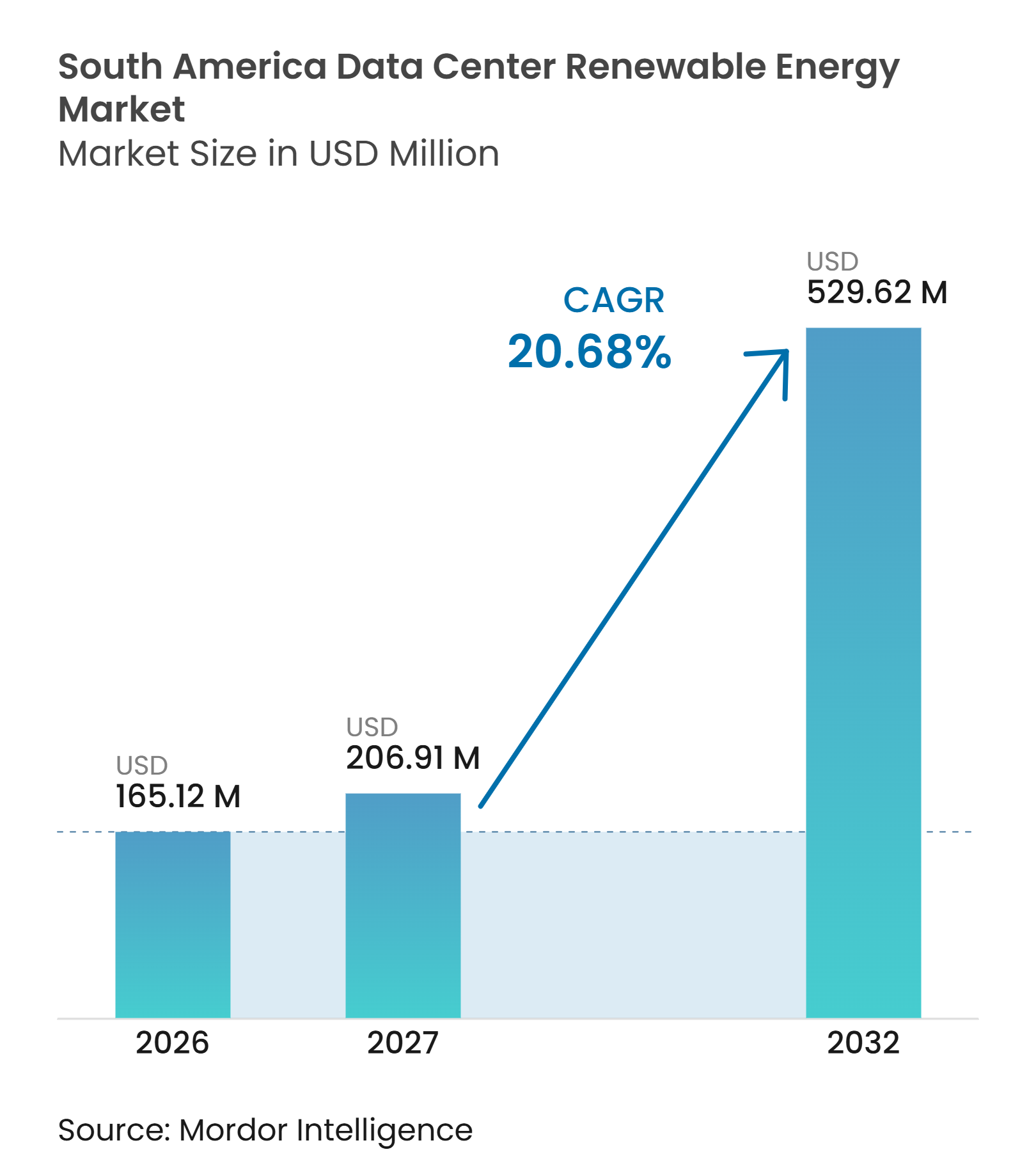
| Base Year Market Size (2026) | USD 165.12 Million |
| Market Size (2027) | USD 206.91 Million |
| Market Size (2032) | USD 529.62 Million |
| Growth Rate (2027 - 2032) | 20.68 % |
| Market Concentration | Medium |
Major Players *Disclaimer: Major Players sorted in no particular order Image © Mordor Intelligence. Reuse requires attribution under CC BY 4.0. | |
South America Data Center Renewable Energy Market Analysis by Mordor Intelligence
The South America data center renewable energy market size was valued at USD 165.12 million in 2026 and is estimated to expand from USD 206.91 million in 2027 to reach USD 529.62 million by 2032, at a CAGR of 20.68% during the forecast period (2027-2032). By volume, the market is estimated at 2,540 GWh in 2026, 3,183 GWh in 2027, and 7,575 GWh by 2032, at a CAGR of 18.89% during 2027-2032. AI workloads and new hyperscale campuses are increasing the need for large, dependable renewable power contracts across the region. Brazil’s expanding connection requests and Chile’s planned data center capacity point to a shift from standard grid supply toward dedicated renewable arrangements. The region’s hydroelectric base, solar resources, and wind corridors give operators several paths to secure cleaner electricity. Developers are responding with longer contracts, self-production structures, and projects that combine generation with storage. Grid limits and variable renewable output remain important constraints, so the South America data center renewable energy market increasingly favors contracts that include firming capacity and clear delivery terms.
Key Report Takeaways
- Among renewable energy sources, hydropower accounted for 37.99% of the South America data center renewable energy market share in 2026, while solar power is projected to expand at a 21.88% CAGR through 2032.
- By procurement model, off-site physical PPAs held 45.94% of the market in 2026, while storage and firming services are projected to expand at a 21.67% CAGR through 2032.
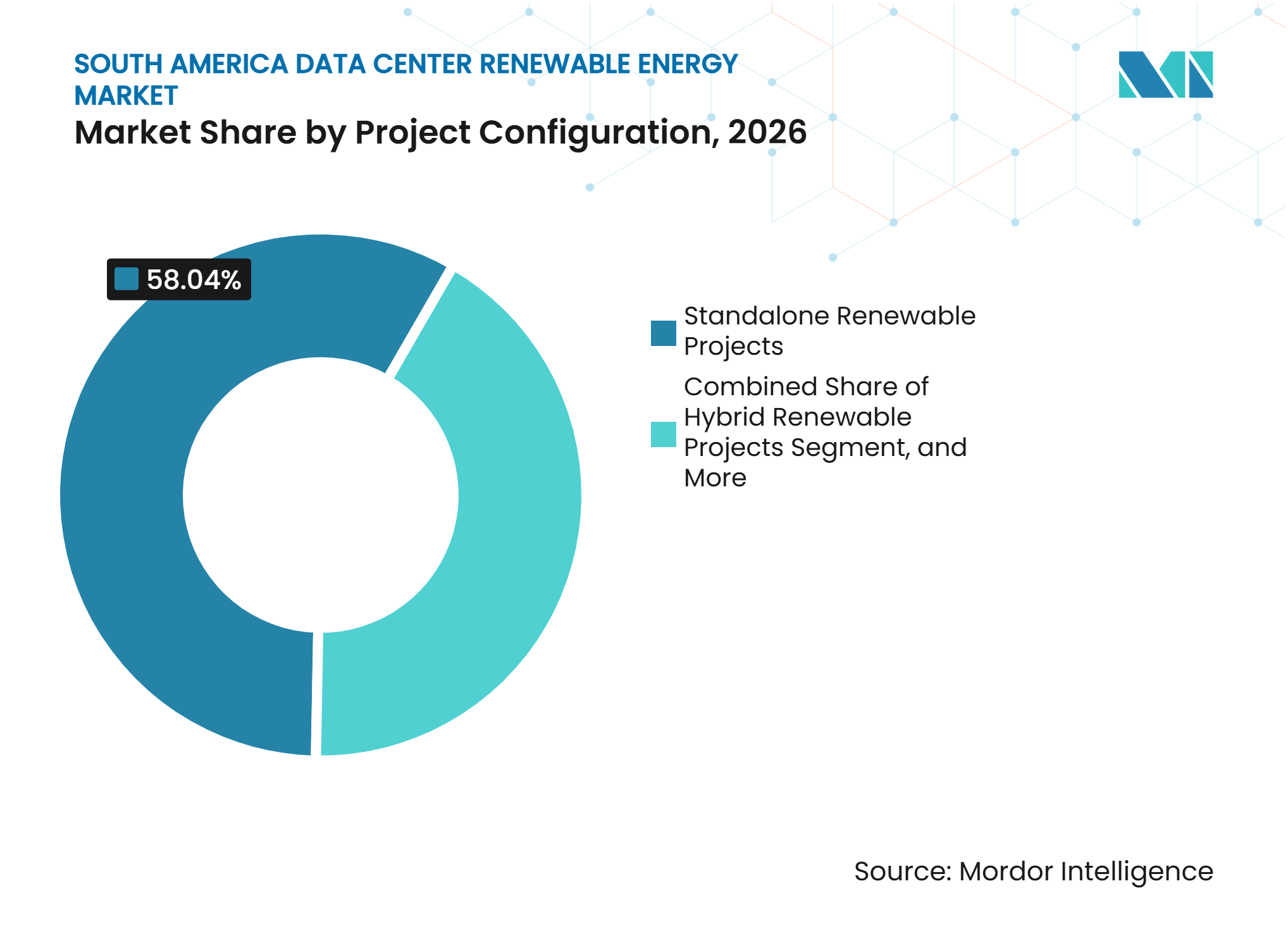
- By project configuration, standalone renewable projects held 58.04% of the market in 2026 of the South America data center renewable energy market, while renewable projects with battery storage are projected to expand at a 21.46% CAGR through 2032
- By contract duration, long-term contracts accounted for 62.02% of the market in 2026, and the segment is expected to grow at a CAGR of 22.23% by 2032.
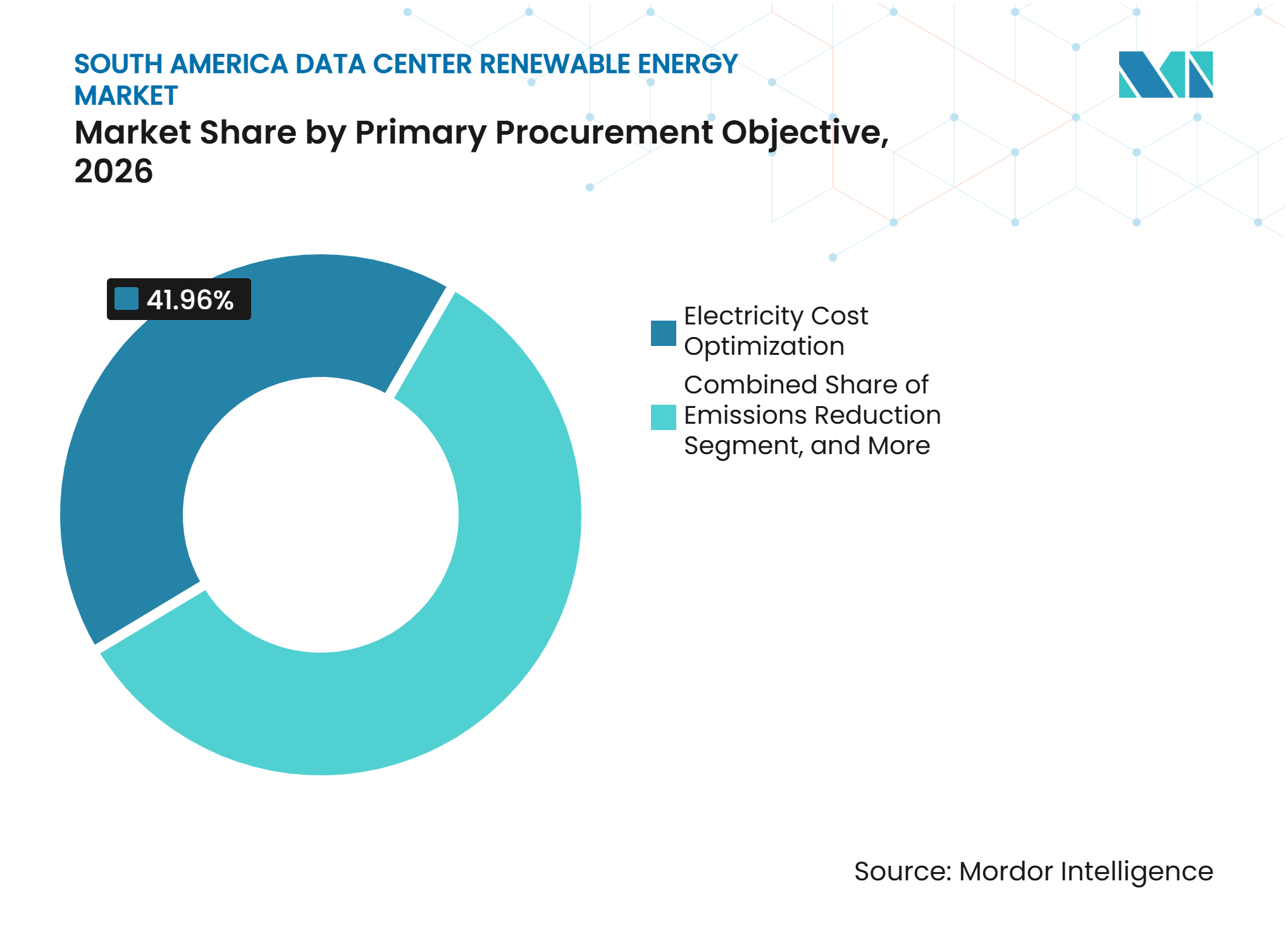
- By primary procurement objective, electricity cost optimization held 41.96% of the market in 2026, while renewable energy matching is projected to expand at a 21.36% CAGR through 2032.
- By data center size, hyperscale data centers accounted for 45.94% of the market in 2026 and are projected to grow at a 21.41% CAGR through 2032.
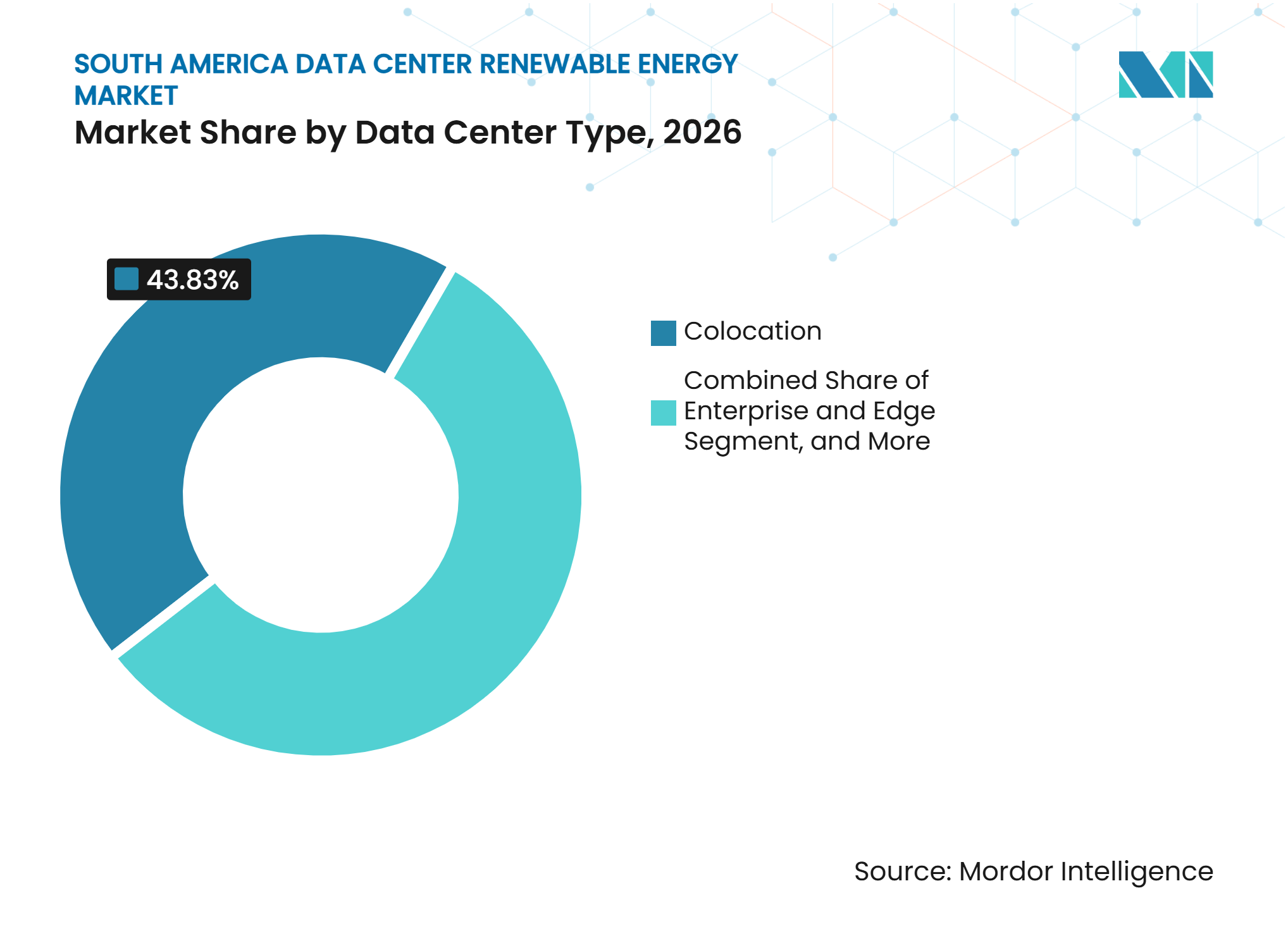
- By data center type, colocation facilities held 43.83% of the market in 2026, while cloud service providers are projected to expand at a 21.18% CAGR through 2032.
- By geography, Brazil held 62.02% of the market in 2026, while Chile is projected to expand at a 21.54% CAGR through 2032.
Note: Market numbers in this report are based on Mordor Intelligence's proprietary estimation framework, which combines nine months of actuals with Q4 projections for base year 2026.
Market Trends and Insights
Drivers Impact Analysis of South America Data Center Renewable Energy Market*
| Driver | (~) % Impact on CAGR Forecast | Geographic Relevance | Impact Timeline |
|---|---|---|---|
| Rising Hyperscale and AI Data Center Power Demand | +8.5% | Brazil and Chile, with spillover to Colombia and Argentina | Short term (≤ 2 years) |
| Expansion of Corporate Renewable PPAs and Self-Production | +5.0% | Brazil and Chile, expanding to Colombia and Argentina | Medium term (2-4 years) |
| Abundant Solar, Wind, and Hydropower Resources | +3.0% | Brazil, Chile, Argentina, and Colombia | Long term (≥ 4 years) |
| Data Sovereignty and Regional Cloud Infrastructure Expansion | +2.5% | Brazil, Chile, and Colombia | Medium term (2-4 years) |
| Renewable Energy Cost Predictability and Decarbonization Requirements | +1.5% | Chile, Brazil, and Argentina | Medium term (2-4 years) |
| Strategic Connectivity and Technology Hub Development | +0.8% | Brazil, Chile, and Colombia | Long term (≥ 4 years) |
| Source: Mordor Intelligence | |||
Rising Hyperscale and AI Data Center Power Demand
Brazil’s data center energy demand reached 770 MW in 2025, and announced projects could lift demand to 13.2 GW by 2035. This demand profile is changing how the South America data center renewable energy market is supplied, as AI campuses require far more power than conventional enterprise facilities. Chile’s grid coordinator expects data center demand to rise from 325 MW in 2025 to 1,360 MW by 2032. Large campuses also require dependable delivery at all hours, which makes a simple renewable certificate less useful than a physical supply arrangement. The Omnia agreement with Casa dos Ventos showed how long-term wind supply and ownership interests can be combined for a large Brazilian data center project.
Expansion of Corporate Renewable PPAs and Self-Production
Corporate PPAs and self-production arrangements are becoming central to project design in Brazil and Chile. Atlas Renewable Energy received BRL 1 billion (USD 179 million) in financing for the Draco Solar Complex, which will deliver 710 GWh of power annually to V.tal and Tecto Data Centers. This structure links the new generation directly to demand for digital infrastructure rather than relying solely on merchant power sales. Brazil’s REDATA framework also makes renewable sourcing relevant to data center tax benefits. These arrangements give operators greater visibility over long-term electricity costs and energy attributes. They also make renewable developers long-term infrastructure partners rather than only electricity suppliers.
Abundant Solar, Wind, and Hydropower Resources
South America’s resource base supports the expansion of the South America data center renewable energy market across several power technologies. IRENA expects solar photovoltaic capacity in the region to rise from 50 GW in 2023 to 133 GW by 2030, while wind capacity is expected to increase from 40 GW to 77 GW. Brazil’s hydroelectric system provides a reliable renewable energy supply, while Chile offers very strong solar resources and Argentina has large wind potential. This diversity can reduce reliance on a single generation profile. Statkraft opened solar and hybrid plants in Brazil during 2025, adding 340 MWp of capacity to its portfolio. Storage and transmission investment will determine how effectively these resources serve large data center loads.
Data Sovereignty and Regional Cloud Infrastructure Expansion
Brazil’s Normative Instruction No. 8/2025 requires classified government data to be hosted in certified data centers located within the country. This requirement supports domestic cloud capacity and increases the need for local power supply. Chile’s PDATA guide identifies traceable renewable PPAs and I-REC certificates as relevant features for data center investment.[1] Microsoft launched its Chile Central cloud region in 2025, with renewable energy supplied through contracts with AES Andes. These policies and investments integrate data location, compliance, and electricity procurement into a single planning process. They can encourage operators to secure renewable supply early in a project’s development cycle.
Restraints Impact Analysis of South America Data Center Renewable Energy Market*
| Restraint | (~) % Impact on CAGR Forecast | Geographic Relevance | Impact Timeline |
|---|---|---|---|
| Grid Congestion and Renewable Transmission Bottlenecks | -3.5% | Brazil, Chile, and Argentina | Short term (≤ 2 years) |
| Intermittency Risk for Mission-Critical Loads | -1.5% | Brazil and Chile | Medium term (2-4 years) |
| Fragmented Renewable Energy Regulation Across Countries | -0.8% | Colombia, Argentina, and the rest of South America | Medium term (2-4 years) |
| Limited Availability of Long-Duration Storage and Firming Capacity | -0.5% | Brazil, Chile, and Colombia | Long term (≥ 4 years) |
| Source: Mordor Intelligence | |||
Grid Congestion and Renewable Transmission Bottlenecks
Transmission shortfalls limit the pace at which renewable capacity can be delivered to major data center clusters. The World Economic Forum reported that renewable curtailment in South America reached 53,000 GWh in 2024, with economic losses estimated at USD 7 billion. In Chile, new transmission is needed to move northern solar generation to demand centers around Santiago. The Kimal-Lo Aguirre high-voltage line is therefore important for the South America data center renewable energy market. The Inter-American Development Bank has also identified grid planning and investment as necessary to improve reliability and the integration of renewables in the region. Operators are addressing this issue through dedicated connections, self-production, and storage-backed contracts.
Intermittency Risk for Mission-Critical Loads
Data centers need uninterrupted electricity, but solar and wind output varies by time of day and weather conditions. IRENA states that uncertain water availability means hydropower systems will need complementary backup resources over time.[2] Chile’s solar-heavy north and Brazil’s renewable-rich northeast need storage, firm generation, or grid services to support round-the-clock workloads. Brazil’s Ministry of Mines and Energy began consultations in 2025 for storage procurement rules. The policy direction is encouraging, but long-duration storage remains limited across the region. This limitation complicates achieving hourly renewable matching for mission-critical facilities.
*Our forecasts treat driver/restraint impacts as directional, not additive. The impact forecasts reflect baseline growth, mix effects, and variable interactions.
South America Data Center Renewable Energy Market Segment Analysis
By Renewable Energy Source:
Hydro Anchors Supply While Solar ScalesHydropower held 37.99% of the South America data center renewable energy market share in 2026. Brazil and Colombia have established hydroelectric fleets that can provide renewable baseload power for digital infrastructure. Brazil’s installed power capacity was 219 GW, with renewable sources accounting for 77% of that capacity. This power mix supports hydro-backed PPAs for operators seeking renewable credentials without immediate storage investment. Wind energy is also an important source in Brazil’s northeast, where Scala Data Centers began receiving supply from Serena Energia’s Assuruá 4 and Ventos da Bahia 3 projects in 2025.
Solar power is projected to expand at a 21.88% CAGR through 2032 as dedicated solar projects become more practical for data center supply. Chile’s renewable system included 9,031 MW of solar and 4,517 MW of wind capacity by late 2025. Atlas’s Draco project illustrates how solar capacity can be connected to specific data center buyers under a structured contract. Geothermal, biomass, and biogas remain smaller sources, although they can add diversity in locations with suitable resources. IRENA’s capacity outlook suggests that solar and wind will provide an expanding project pipeline through 2030.



By Procurement Model:
Off-Site PPAs Lead While Firming Services ExpandOff-site physical PPAs held 45.94% of the South America data center renewable energy market in 2026. These agreements allow operators to secure energy and related attributes from larger renewable plants without owning on-site generation. They can also provide a clearer link between data center consumption and new renewable construction. Atlas and ODATA signed a 2025 agreement to supply I-REC-certifiable renewable energy to ODATA’s ST01 campus in Santiago. On-site generation remains relevant for smaller facilities and locations where grid independence has a high value. Financial PPAs, renewable certificates, and utility green programs offer other routes for organizations that cannot commit to a direct physical contract.
Storage and firming services are projected to expand at a 21.67% CAGR through 2032. They address the difference between when renewable power is generated and when a data center needs electricity. Chile is developing hybrid contract models that pair renewable energy supply with battery storage, while Brazil is establishing rules for storage procurement. These services are likely to become more common as operators pursue hourly rather than annual matching. Regulatory influence from ANEEL in Brazil and the Comisión Nacional de Energía in Chile will shape how batteries participate in power and ancillary-service arrangements.
By Project Configuration:
Standalone Assets Lead While Storage-Backed Projects Gain GroundStandalone renewable projects held 58.04% of the South America data center renewable energy market share in 2026. Their established financing structures and simpler development pathways make them attractive for initial renewable procurement. Dedicated wind and solar plants can provide substantial volumes under long-term supply agreements. Hybrid projects combine more than one renewable source, which can improve the shape of delivered generation. This model is relevant in Chile, where solar output in the north can complement wind resources from other areas. The configuration can also support more credible reporting of a facility’s power supply profile.
Renewable projects with battery storage are projected to expand at a 21.46% CAGR through 2032. Their adoption reflects higher curtailment risk, transmission limits, and customer expectations for cleaner electricity at all hours. Trina Storage secured 1,203 MWh of battery contracts in Chile and Argentina in January 2026, including a 722 MWh project in the Atacama region. These installations provide a practical path to shift solar output into later hours. Brazil’s storage consultations show that national rules are beginning to recognize batteries' system role. The South America data center renewable energy market will need more projects of this kind as high-load campuses expand.

By Contract Duration:
Long-Term Agreements Shape Project FinancingLong-term contracts held 62.02% of the market in 2026. Ten- to 20-year agreements provide renewable developers with a more reliable revenue base and data center operators with greater cost visibility. The Omnia and Casa dos Ventos agreement covered 20 years of supply for a ByteDance data center project in Ceará. Long commitments suit hyperscalers because their facilities have long operating lives and large electricity requirements. They can also support financing for dedicated generation and grid infrastructure. Shorter contracts remain useful when operators are awaiting approvals or want to defer a long-term procurement decision.
I-REC certification has become an important supporting mechanism for long-duration renewable arrangements across countries with different local rules. It helps operators document renewable electricity claims for customers, investors, and regulators. Chile’s PDATA guide identifies traceable green PPAs or I-REC certificates as part of its positioning for data center investment. Certification does not solve physical delivery limits, but it improves traceability for contracted supply. Long-term contracting is therefore increasingly paired with a defined certificate strategy. This approach also improves the consistency of renewable claims across regional operations.
By Primary Procurement Objective:
Cost Optimization Leads While Renewable Matching AdvancesElectricity cost optimization held 41.96% of the South America data center renewable energy market share in 2026. Operators use renewable PPAs to seek more stable pricing than short-term grid purchases can provide. Chile’s investment guide describes a system with deep renewable penetration and several options for certified supply. This creates an economic reason to align energy procurement with emissions targets. Emissions reduction is also a major objective for global cloud companies operating regional facilities. Supply security has gained importance where grid connection capacity is constrained.
Renewable energy matching is projected to expand at a 21.36% CAGR through 2032. This objective seeks to align electricity use more closely with renewable generation over time. Annual renewable certificates can support claims, but they do not by themselves address hourly operating needs. Storage-backed PPAs and self-production structures offer a more direct way to manage this requirement. The approach requires better data, storage, and contract design than standard renewable procurement. It also creates opportunities for suppliers that can combine generation, batteries, and verified delivery arrangements.
By Data Center Size:
Hyperscale Facilities Set Demand PatternsHyperscale data centers accounted for 45.94% of the market in 2026 and are projected to grow at a 21.41% CAGR through 2032. Their large, stable loads can support new renewable plants that need a committed buyer. Microsoft, Google, and Amazon Web Services can procure power volumes that shape the development of entire projects. Microsoft’s Chile Central region was supported by renewable contracts with AES Andes. Large data centers also use utility programs and bilateral contracts where a dedicated project is not needed. Smaller and medium-sized facilities more often use certificates or green tariffs because their individual loads offer less leverage in renewable project negotiations.
AI training and inference workloads are increasing the appeal of hyperscale campuses with dedicated energy arrangements. Scala’s planned AI City in Rio Grande do Sul targets 1.8 GW of demand by 2033. Such projects require early coordination with generators, transmission providers, and regulators. Their scale encourages developers to structure wind and solar complexes around anchor customers. It also increases the value of storage and firming capacity at the project level. As a result, hyperscale procurement choices are influencing the broader South America data center renewable energy market.
By Data Center Type:
Colocation Remains Important While Cloud Providers ExpandColocation facilities held 43.83% of the market in 2026. These facilities serve multiple enterprise and cloud customers and need reliable power alongside dense network connectivity. Equinix announced a self-production partnership with Auren Energia in 2026 for renewable power from 2 wind farms in Brazil’s northeast. This example shows that colocation operators can use direct renewable structures rather than relying only on utility tariffs. Enterprise and edge facilities remain relevant for regulated sectors and latency-sensitive workloads. Their procurement models are typically smaller and more location-specific.
Cloud service providers are projected to expand at a 21.18% CAGR through 2032. Amazon Web Services confirmed a USD 4 billion investment in Chile in 2025 for cloud infrastructure, scheduled to begin operations in the second half of 2026. Large cloud providers can integrate campus planning with renewable contracts and long-term capacity needs. Their capital commitments also encourage generators to develop larger projects. The self-production model can give these providers more control over price, power attributes, and curtailment exposure. This makes them an important source of demand for integrated energy solutions.
Geography Analysis
Brazil
Brazil held 62.02% of the South America data center renewable energy market share in 2026. Its 219 GW installed capacity included 77% renewable sources, while data center demand reached 770 MW in 2025. REDATA gives operators a financial reason to plan for 100% renewable supply. Equinix, Scala, Atlas, and Casa dos Ventos have used arrangements that connect generation directly with data center demand. Storage regulation led by the Ministry of Mines and Energy and ANEEL will influence how quickly dedicated supply can provide round-the-clock reliability.
Chile
Chile is projected to expand at a 21.54% CAGR through 2032, making it the fastest-growing regional market in the South America data center renewable energy market. The PDATA guide promotes traceable renewable procurement and records 9,031 MW of solar capacity and 4,517 MW of wind capacity by late 2025. Microsoft launched Chile Central in 2025, and AWS announced a USD 4 billion cloud infrastructure investment for the country. Transmission capacity between northern renewable resources and Santiago-area demand remains the main operational constraint. The Comisión Nacional de Energía and the grid coordinator will influence connection timing and the role of storage in supply contracts.
Colombia, Argentina, and the Rest of South America
Colombia is strengthening its position through new capacity in Bogotá and Cundinamarca and a growing renewable energy supply. Enel Colombia completed the 267 MWdc Guayepo III Solar Park and is developing the 256 MW Atlantic Solar Park. Argentina’s AlmaGBA program awarded nearly 700 MW of battery capacity in 2025, creating a stronger basis for future firm renewable supply. Peru, Uruguay, and Paraguay have lower data center density, but IRENA identifies SIESUR and SINEA as initiatives that could strengthen regional energy cooperation.
Competitive Landscape
Market Concentration
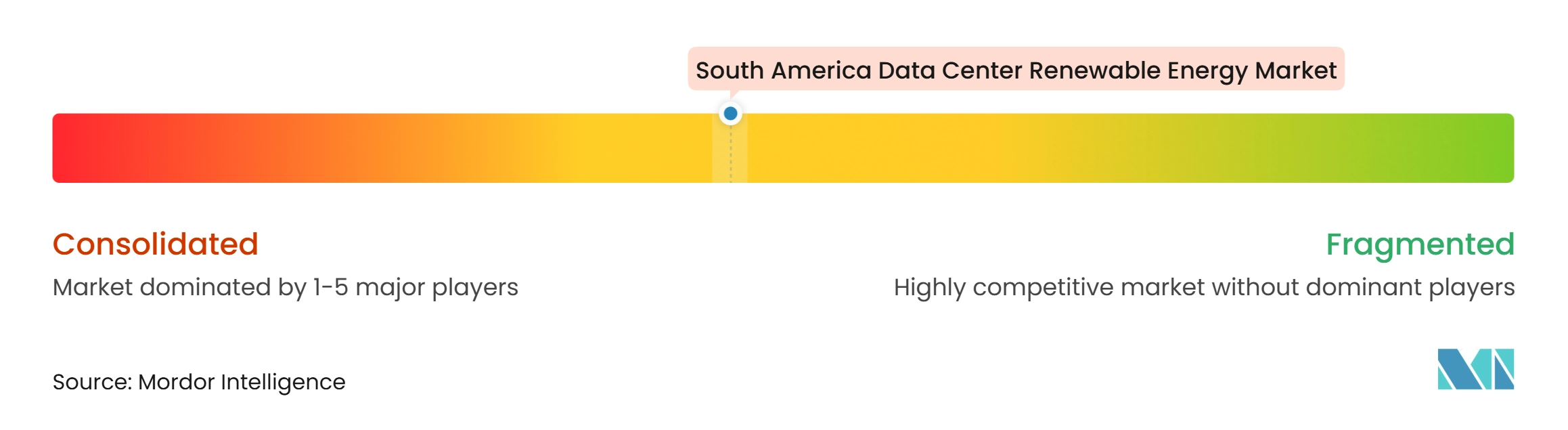
The South America data center renewable energy market is moderately concentrated and is served by companies with different roles in renewable generation, data center operations, cloud services, and storage. Renewable suppliers include Atlas Renewable Energy, Casa dos Ventos, Serena Energia, AES Andes, Statkraft, and ENGIE Brasil Energia. Major demand-side participants include Microsoft, Amazon Web Services, Google, Equinix, Scala Data Centers, and ODATA. Competition increasingly centers on the ability to provide renewable electricity with a clear delivery arrangement, not just a certificate. Developers with capabilities in generation, storage, grid access, and long-term contracting have a stronger position.
Equinix moved toward self-production through its 2026 partnership with Auren Energia.[3] Statkraft’s 2025 opening of solar and hybrid plants in Brazil added storage-relevant experience to the competitive field. Atlas also structured its Draco Solar Complex to supply identified data center customers. These moves show a shift toward integrated generation and supply structures. They also raise the importance of technical execution, environmental permits, and transmission access.
Storage can broaden competition because the regional regulatory framework is still developing. Brazil’s public consultations on storage procurement create an opening for companies that can combine batteries with renewable generation. Chile’s solar resources and its need for more reliable delivery likewise support hybrid development. Operators with established relationships with hyperscalers and colocation providers may gain early access to larger contracts.
South America Data Center Renewable Energy Industry Leaders
-
Amazon Web Services, Inc.
-
Google LLC
-
Microsoft Corporation
-
Meta Platforms, Inc.
-
Equinix, Inc.
- *Disclaimer: Major Players sorted in no particular order
South America Data Center Renewable Energy Market Companies Covered in this Report
- Atlas Renewable Energy
- Enel Américas S.A.
- ENGIE Energía Chile S.A.
- ENGIE Brasil Energia S.A.
- AES Andes S.A.
- Auren Energia S.A.
- Casa dos Ventos Energias Renováveis S.A.
- Serena Energia S.A.
- Brookfield Asset Management Ltd.
- Digital Realty Trust, Inc.
- Equinix, Inc.
- Scala Data Centers S.A.
- Aligned Data Centers
- ODATA, an Aligned Data Centers Company
- V.tal S.A.
- Tecto Data Centers
- Microsoft Corporation
- Amazon Web Services, Inc.
- Google LLC
- Central Puerto S.A.
- Genneia S.A.
- Statkraft AS
- Matrix Renewables
Recent Industry Developments in South America Data Center Renewable Energy Market
- May 2026: Omnia, the data center platform of Brazil's Patria Investments, signed a USD 2 billion, 20-year energy supply agreement with Casa dos Ventos to power a data center being built for ByteDance at the Pecem port complex in Ceará, Brazil. Energy will be sourced from the 630 MW Ibiapaba wind complex and the Dom Inocencio wind farm, structured as a self-production model that grants Omnia an equity stake in Casa dos Ventos' generating assets.
- March 2026: Ascenty completed a partnership with Casa dos Ventos valued at over USD 500 million, combining a long-term PPA with direct equity ownership in a portfolio of wind and solar projects in Brazil, characterized by technical advisor DNV as South America's largest renewable energy self-generation contract for data centers at that date.
- March 2026: Equinix announced a self-production renewable energy partnership with Auren Energia in Brazil, with both companies co-owning stakes in 2 wind farms in Brazil's northeast operated by women-only workforce teams. Supply commenced in 2026, covering a substantial portion of Equinix's Brazilian energy requirements under a long-term agreement.
- March 2026: YPF Luz signed a wind-and-solar PPA to supply a data center in Buenos Aires, Argentina, adding Argentina to the growing list of South American markets where data center operators are formalizing long-term renewable energy contracts and extending the PPA model beyond the region's 2 primary data center hubs.
South America Data Center Renewable Energy Market Report Scope
The South America Data Center Renewable Energy Market refers to the market for renewable electricity generation, procurement, and supply solutions used to meet the power requirements of data centers across South America. It encompasses renewable energy generated through solar, wind, hydropower, geothermal, biomass, and biogas sources, either through on-site generation or third-party procurement arrangements, including physical and virtual power purchase agreements (PPAs), utility green power programs, and renewable energy certificates (RECs) and Guarantees of Origin.
The South America Data Center Renewable Energy Market Report is Segmented by Renewable Energy Source (Solar Power, Wind Power, Hydropower, Geothermal Power, Biomass and Biogas Power, and Other Renewable Sources), Procurement Model (On-Site Renewable Generation, Off-Site Physical PPAs, Virtual or Financial PPAs, Utility Green Power Programs, and Renewable Energy Certificates and Guarantees of Origin), Project Configuration (Standalone Renewable Projects, Hybrid Renewable Projects, Renewable Projects with Battery Storage, and Renewable Projects with Other Firming Solutions), Contract Duration (Short-Term Contracts, Medium-Term Contracts, and Long-Term Contracts), Primary Procurement Objective (Electricity Cost Optimization, Emissions Reduction, Renewable Energy Matching, and Long-Term Supply Security), Data Center Size (Small, Medium, Large, and Hyperscale), Data Center Type (Colocation, Cloud Service Providers, and Enterprise and Edge), and Geography (Brazil, Chile, Colombia, Argentina, and Rest of South America). The Market Forecasts are Provided in Terms of Value (USD), and Volume (MWh/GWh).
Segmentation Overview
| Solar Power |
| Wind Power |
| Hydropower |
| Geothermal Power |
| Biomass and Biogas Power |
| Other Renewable Sources |
| On-Site Renewable Generation |
| Off-Site Physical PPAs |
| Virtual or Financial PPAs |
| Utility Green Power Programs |
| Renewable Energy Certificates and Guarantees of Origin |
| Standalone Renewable Projects |
| Hybrid Renewable Projects |
| Renewable Projects with Battery Storage |
| Renewable Projects with Other Firming Solutions |
| Short-Term Contracts |
| Medium-Term Contracts |
| Long-Term Contracts |
| Electricity Cost Optimization |
| Emissions Reduction |
| Renewable Energy Matching |
| Long-Term Supply Security |
| Small |
| Medium |
| Large |
| Hyperscale |
| Colocation |
| Cloud Service Providers (CSPs) |
| Enterprise and Edge |
| Brazil |
| Chile |
| Colombia |
| Argentina |
| Rest of South America |
| By Renewable Energy Source | Solar Power |
| Wind Power | |
| Hydropower | |
| Geothermal Power | |
| Biomass and Biogas Power | |
| Other Renewable Sources | |
| By Procurement Model | On-Site Renewable Generation |
| Off-Site Physical PPAs | |
| Virtual or Financial PPAs | |
| Utility Green Power Programs | |
| Renewable Energy Certificates and Guarantees of Origin | |
| By Project Configuration | Standalone Renewable Projects |
| Hybrid Renewable Projects | |
| Renewable Projects with Battery Storage | |
| Renewable Projects with Other Firming Solutions | |
| By Contract Duration | Short-Term Contracts |
| Medium-Term Contracts | |
| Long-Term Contracts | |
| By Primary Procurement Objective | Electricity Cost Optimization |
| Emissions Reduction | |
| Renewable Energy Matching | |
| Long-Term Supply Security | |
| By Data Center Size | Small |
| Medium | |
| Large | |
| Hyperscale | |
| By Data Center Type | Colocation |
| Cloud Service Providers (CSPs) | |
| Enterprise and Edge | |
| By Geography | Brazil |
| Chile | |
| Colombia | |
| Argentina | |
| Rest of South America |
Key Questions Answered in the Report
What is the South America data center renewable energy market size?
The South America data center renewable energy market size is USD 165.12 million in 2026 and is forecast to reach USD 529.62 million by 2032 at a 20.68% CAGR.
What is driving renewable power procurement for data centers in South America?
AI workloads, hyperscale expansion, renewable sourcing requirements, and the need for more predictable electricity costs are driving demand.
Which renewable source has the largest role in data center supply?
Hydropower held 37.99% of the market in 2026, supported by Brazil and Colombia’s established hydroelectric fleets.
Why are battery-backed renewable projects becoming more relevant?
They help manage variable solar and wind output, grid congestion, and the need for dependable power at all hours.
Which country leads regional renewable procurement for data centers?
Brazil held 62.02% of the market in 2026, supported by its renewable-heavy grid and REDATA incentives.
Which country is expected to expand the fastest through 2032?
Chile is projected to expand at a 21.54% CAGR through 2032, supported by solar resources, cloud investment, and renewable procurement structures.