
South America Data Center On-Site Power Generation Market Size and Share
Market Overview
| Study Period | 2021 - 2032 |
|---|---|
| Forecast Data Period | 2027 - 2032 |
| Base Year Market Size (2026) | USD 418.59 Million |
| Market Size (2027) | USD 478.25 Million |
| Market Size (2032) | USD 838.75 Million |
| Growth Rate (2027 - 2032) | 11.89 % |
| Market Concentration | Medium |
Major Players *Disclaimer: Major Players sorted in no particular order Image © Mordor Intelligence. Reuse requires attribution under CC BY 4.0. | |
South America Data Center On-Site Power Generation Market Analysis by Mordor Intelligence
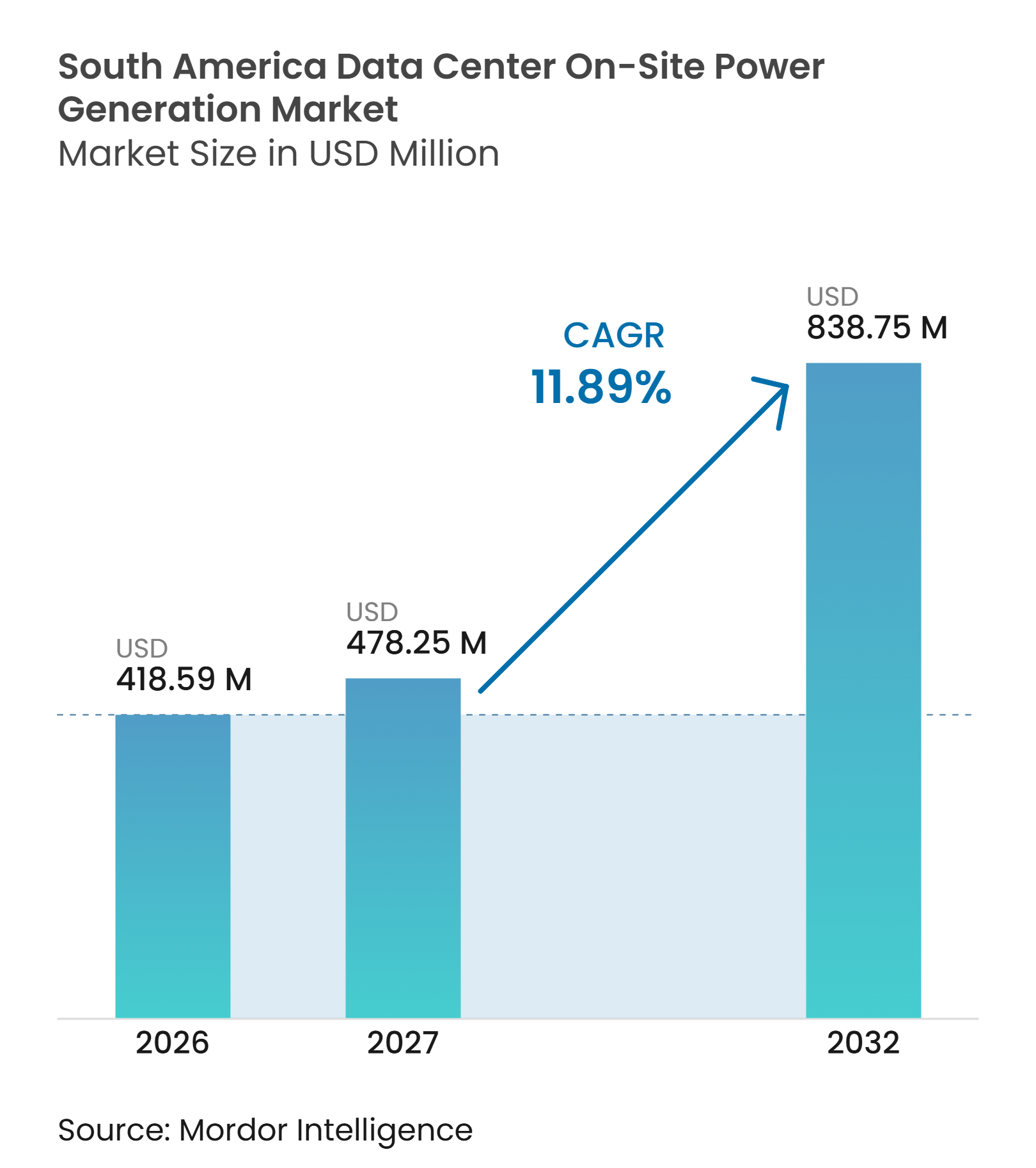
The South America Data Center On-Site Power Generation Market size was valued at USD 418.59 million in 2026 and is estimated to grow from USD 478.25 million in 2027 to reach USD 838.75 million by 2032, at a CAGR of 11.89% during the forecast period (2027-2032). In terms of installed base, the market was valued at 1.51 million megawatt in 2026 and is expected to grow from 1.73 million megawatt in 2027 to 3.12 million megawatt by 2032, at a CAGR of 12.03% during the forecast period (2027-2032), which indicates that demand for equipment capacity is advancing slightly faster than market value. Higher-density AI computing is increasing the need for dependable power at individual sites, especially where grid supply cannot support the full load without interruption. Grid connection delays are also making bridging power, standby systems, and behind-the-meter configurations more important during construction and commissioning. The South America data center on-site power generation market therefore remains tied to data center construction activity, electricity access, emissions compliance, and the ability of suppliers to deliver equipment quickly. These conditions favor suppliers that can combine reliable equipment, responsive local support, and designs that can be expanded as each new data hall enters service.
Key Report Takeaways
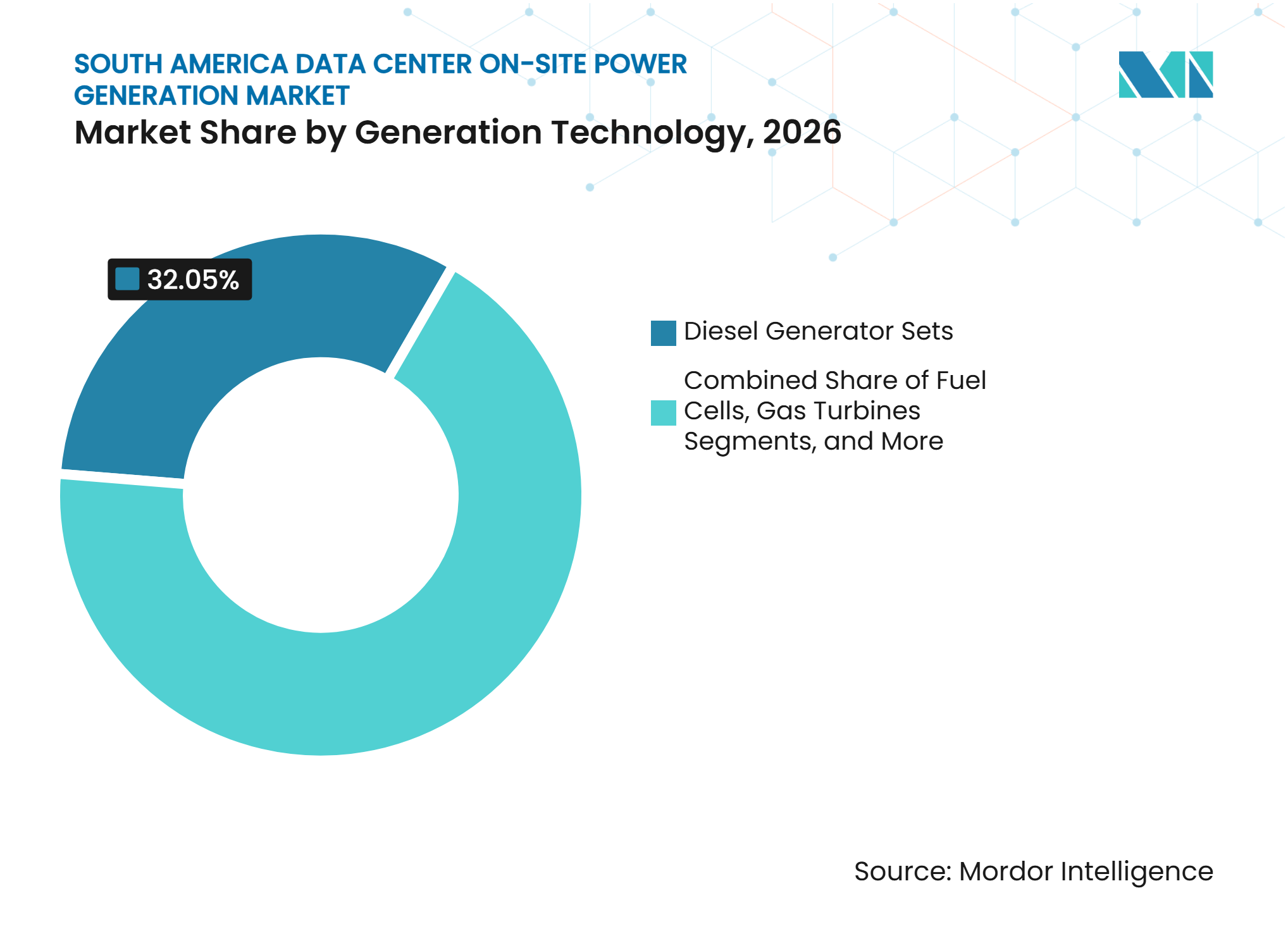
- By generation technology, diesel generator sets held 32.05% of the South America data center on-site power generation market share in 2026, while fuel cells are projected to record the highest CAGR of 13.09% through 2032.
- By installed generation capacity, the 1-5 MW range accounted for 34.28% in 2026 in the South America data center on-site power generation market, while the above 20 MW range is expected to expand at a 12.67% CAGR through 2032.
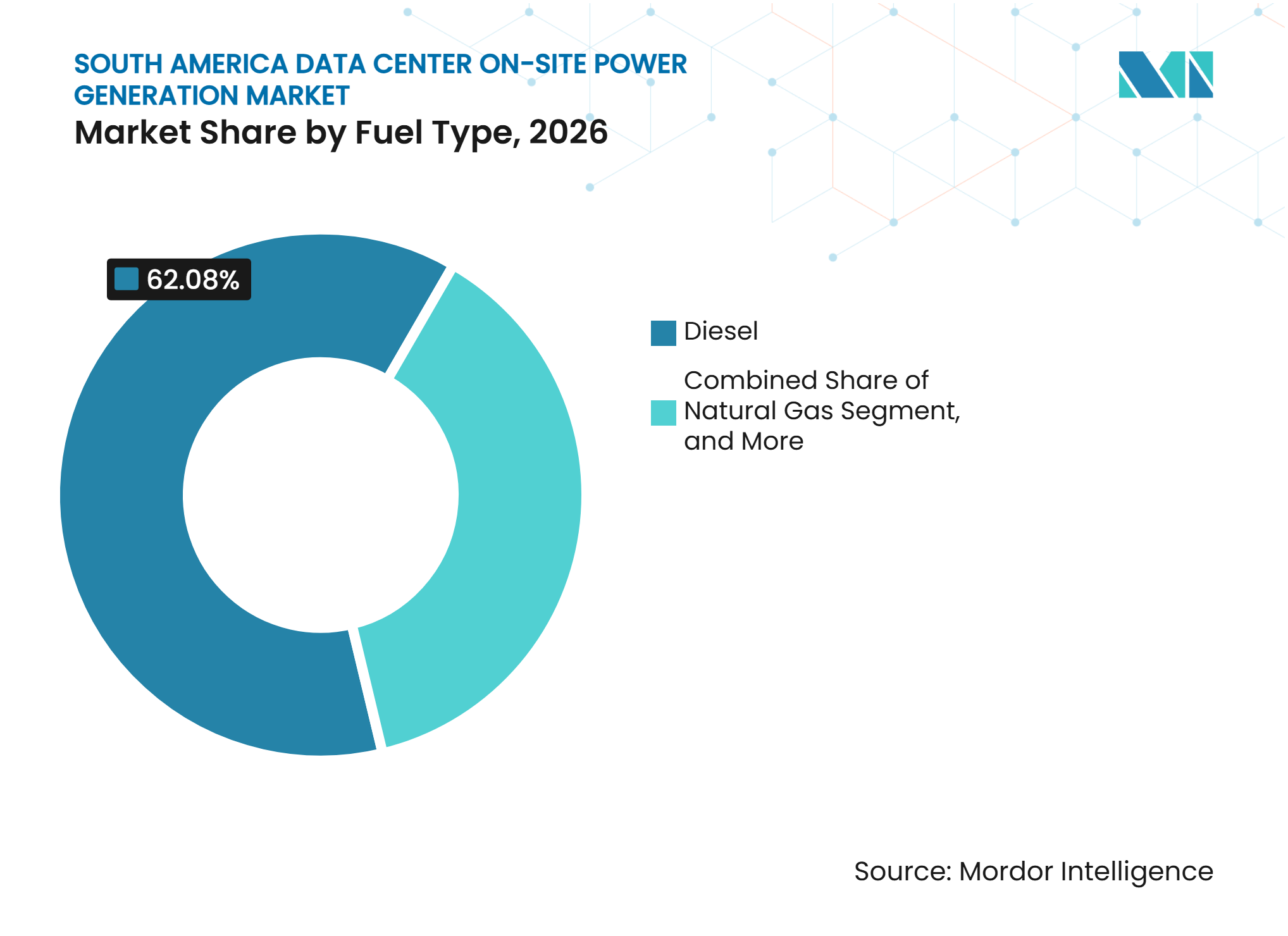
- By fuel type, diesel represented 62.08% in 2026, while hydrogen and hydrogen blends are projected to advance at a 13.88% CAGR through 2032.
- By application, emergency backup power held 58.14% of the application segment in 2026, while temporary and bridge power is expected to expand at a 12.46% CAGR through 2032.
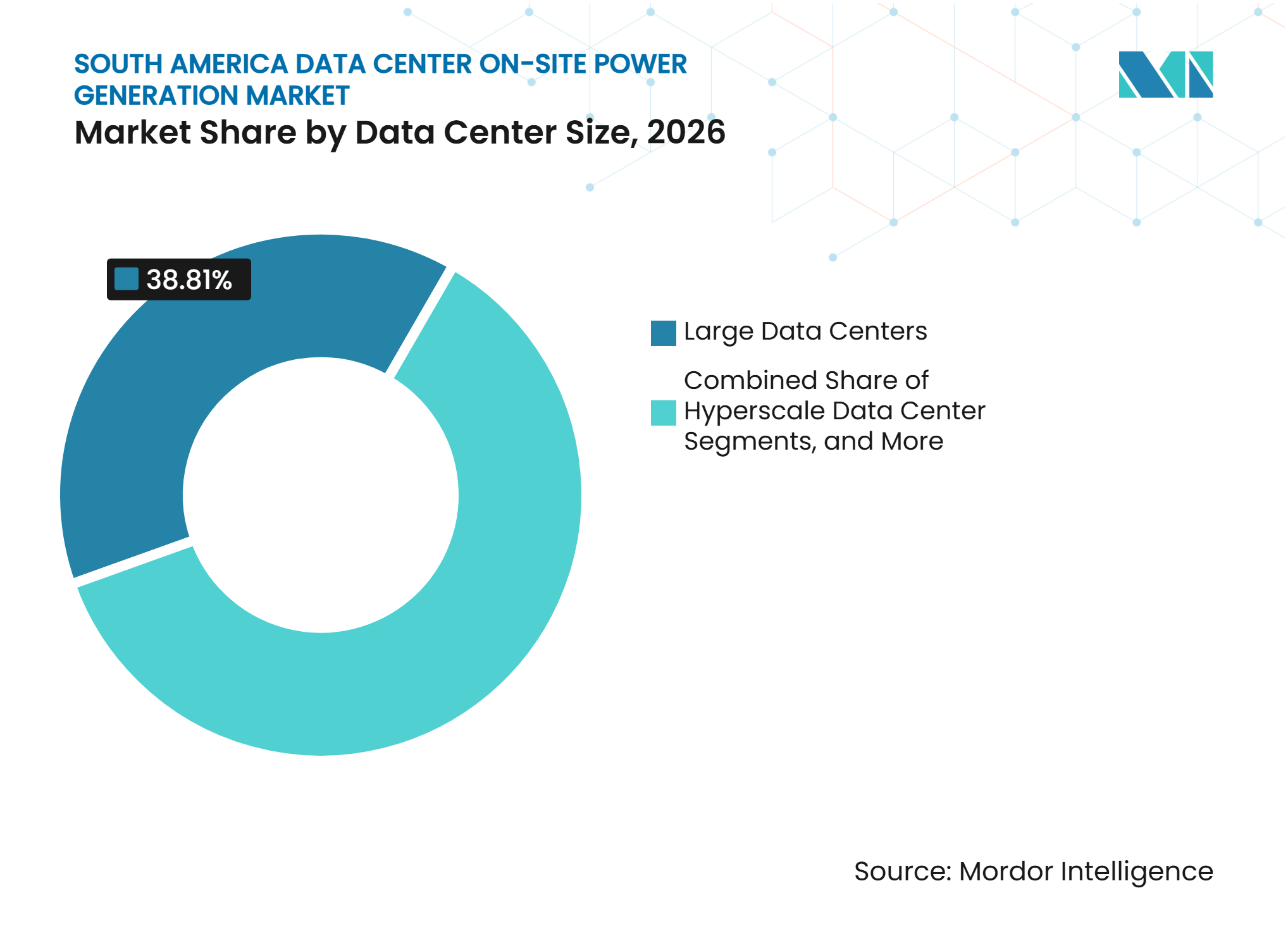
- By data center size, large facilities accounted for 38.81% in 2026, while hyperscale facilities are projected to record a 12.62% CAGR through 2032.
- By data center type, colocation providers held 43.73% in 2026, while cloud service providers are expected to expand at a 12.48% CAGR through 2032.
- By geography, Brazil represented 71.02% in 2026, while Colombia is projected to grow at a 12.77% CAGR through 2032.
Note: Market numbers in this report are based on Mordor Intelligence's proprietary estimation framework, which combines nine months of actuals with Q4 projections for base year 2026.
Market Trends and Insights
Drivers Impact Analysis of South America Data Center On-Site Power Generation Market*
| Driver | (~) % Impact on CAGR Forecast | Geographic Relevance | Impact Timeline |
|---|---|---|---|
| Artificial Intelligence Workloads Increase High-Density Data Center Power Demand | +4.4% | Global, concentrated in Brazil and Chile | Short term (≤ 2 years) |
| Grid-Connection Delays Create Demand for Bridging and Behind-the-Meter Power | +2.8% | Brazil, Chile | Short term (≤ 2 years) |
| Hyperscale and Colocation Expansion Raises Critical Backup Requirements | +2.1% | Brazil, Chile, Colombia | Medium term (2-4 years) |
| South America’s Renewable Electricity Base Supports Hybrid and Low-Carbon On-Site Power | +1.1% | Brazil, Chile, Colombia, Uruguay | Medium term (2-4 years) |
| Brazil’s HVO-Ready Generator Deployments Create a Transition-Fuel Pathway | +0.7% | Brazil | Long term (≥ 4 years) |
| Modular Prime Power Supports Phased Data Center Energization | +0.5% | South America | Medium term (2-4 years) |
| Source: Mordor Intelligence | |||
Artificial Intelligence Workloads Increase High-Density Data Center Power Demand
AI training and inference workloads are increasing the power requirement of new facilities across the South America data center on-site power generation market. AI-configured racks can exceed 100-150 kW per rack, compared with 5-10 kW in a standard enterprise facility, which raises the amount of standby capacity needed to protect IT loads. Brazil’s AI-linked data center energy demand could reach 13.2 GW by 2035, compared with 707 MW in 2023, placing added pressure on both utility connections and local backup systems.[1] The combined capacity pipeline in Brazil, Chile, and Colombia is expanding the number of sites that require power systems before full grid access is secured. A short interruption can disrupt valuable computing work, so operators are retaining redundant generator arrangements even when their electricity purchasing strategy relies on renewable power. This operating requirement keeps resilience equipment central to the South America data center on-site power generation market, particularly when high-density racks make each loss of power more costly for a facility operator.
Grid-Connection Delays Create Demand for Bridging and Behind-the-Meter Power
Grid connection delays are creating a direct procurement need for temporary and site-based generation equipment. More than 32 data center projects were awaiting approval from Brazil’s national grid operator in 2025, and some projects faced limits because of substation capacity concerns. Developers can use diesel generator sets or temporary gas turbines to commission systems and complete early operating tests while waiting for connection approval. This allows construction schedules to move forward, but it raises the importance of equipment availability, rental fleets, and field service capability. In Argentina, planned projects using wind, solar, and gas-fired prime power point to a separate path for sites built outside conventional grid supply. The South America data center on-site power generation market benefits when developers treat interconnection risk as a core project constraint rather than a short-term delay that can be resolved without equipment already available at the site.
Hyperscale and Colocation Expansion Raises Critical Backup Requirements
New hyperscale and colocation facilities require more backup generation because their service commitments depend on continuous availability. Equinix confirmed cumulative investment of more than USD 419 million across Brazil, Chile, and Colombia during 2025 and 2026.[2] Large campuses commonly use Tier III or Tier IV operating designs that require N+1 backup arrangements, while some hyperscalers apply 2N configurations. These configurations increase installed generator count for each MW of IT capacity. Cummins projected that more than 200 generator sets totaling 500 MW would operate in Brazil’s data center segment by the end of 2025, showing the scale of procurement associated with these projects. As operators add halls in stages, the South America data center on-site power generation market can receive recurring equipment orders rather than a single order at project launch, which supports follow-on sales of controls, fuel systems, and maintenance services.
South America’s Renewable Electricity Base Supports Hybrid and Low-Carbon On-Site Power
South America’s electricity mix supports the use of hybrid on-site systems where operators seek lower emissions without reducing reliability. Hydropower is important in Brazil, Colombia, and Paraguay, while solar and wind have a larger role in Chile. Brazil generated more than 80% of its electricity from renewable sources, allowing local generation to function mainly as a resilience layer rather than a substitute for a high-emissions grid. Chile’s National Data Center Plan aims to triple installed capacity by 2030 with USD 2.5 billion in investment, supporting the use of renewable procurement with local systems for balancing and backup.[3] Hydrogen could eventually provide long-duration on-site fuel because of the region’s renewable resources, although storage and distribution infrastructure is still limited. These conditions support a gradual shift in the South America data center on-site power generation market toward mixed fuel and storage configurations, without removing the immediate requirement for proven standby capacity.
Restraints Impact Analysis of South America Data Center On-Site Power Generation Market*
| Restraint | (~) % Impact on CAGR Forecast | Geographic Relevance | Impact Timeline |
|---|---|---|---|
| High Fuel and Operating Costs for Extended Standby Runtime | -1.5% | South America | Short term (≤ 2 years) |
| Emissions and Environmental Compliance Pressure on Diesel Fleets | -1.0% | Brazil, Chile | Medium term (2-4 years) |
| HVO Supply and Cost Constraints Limit Near-Term Fuel Switching | -0.8% | Brazil | Medium term (2-4 years) |
| Transmission Congestion and Site-Level Interconnection Bottlenecks Complicate Scaling | -0.7% | Brazil, Chile | Short term (≤ 2 years) |
| Source: Mordor Intelligence | |||
High Fuel and Operating Costs for Extended Standby Runtime
Fuel and operating costs constrain the use of local power where systems run for extended periods. Diesel prices in Brazil and Chile can change with global crude prices, import duties, and local refinery conditions, which makes operating budgets harder to forecast. Tier III facilities commonly maintain 24-48 hours of fuel autonomy, which creates a significant fuel inventory requirement at large sites. Prime and continuous applications incur a higher cost per MWh than standby arrangements, making grid supply or natural gas more attractive where they are available. HVO cost three times more than conventional diesel during a Brazilian trial, limiting wider fuel switching despite technical suitability. The South America data center on-site power generation market must therefore balance resilience needs with cost control, especially at facilities that may run before a grid connection is available and cannot easily limit generator runtime.
Emissions and Environmental Compliance Pressure on Diesel Fleets
Stricter emissions requirements increase the cost of adding and operating diesel generator fleets. Brazil’s CONAMA Resolutions 382 and 436 establish limits for stationary-source emissions and require environmental licensing for larger generator systems. São Paulo’s Portaria 009/2024 adds local compliance considerations for diesel equipment. Industry association ABIMAQ proposed adjustments to the local rules in 2025 because of concerns over technical implementation and possible retroactive penalties. Replacing older equipment with Tier IV units can reduce NOx and particulate emissions, but it also requires higher initial spending. Environmental compliance will encourage suppliers in the South America data center on-site power generation market to offer cleaner engines, alternative fuels, and integrated monitoring systems that help operators document equipment performance.
*Our forecasts treat driver/restraint impacts as directional, not additive. The impact forecasts reflect baseline growth, mix effects, and variable interactions.
South America Data Center On-Site Power Generation Market Segment Analysis
By Generation Technology:
Diesel Holds the Largest Position While Fuel Cells Gain GroundDiesel generator sets held 32.05% of the South America data center on-site power generation market share in 2026. Their established supply chain and fit with Tier III and Tier IV backup designs have made them the standard option at many colocation and hyperscale sites. Containerized units in the 3-3.5 MW range can be factory tested and installed with limited site assembly, which helps developers work within compressed construction schedules. Diesel also remains familiar to operators, fuel suppliers, and maintenance teams across major Brazilian markets. These practical advantages continue to support the South America data center on-site power generation industry despite greater attention to lower-emissions options.
Fuel cells are projected to record the highest CAGR of 13.09% through 2032. Bloom Energy and Brookfield launched a USD 5 billion deployment partnership for fuel-cell technology at AI data centers in October 2025. Solid oxide fuel cells can operate with natural gas, biogas, or hydrogen and can provide high availability for intensive computing loads. Bloom Energy also stated that it is increasing manufacturing capacity toward 2 GW per year by the end of 2026. Microturbines and hybrid systems have a narrower role at edge and enterprise facilities where space, noise, or permitting conditions favor compact equipment.



By Installed Generation Capacity:
Midrange Units Lead While Large Campuses ExpandThe 1-5 MW range accounted for 34.28% of the South America data center on-site power generation market size in 2026. This range fits the typical large colocation campus, where several 2-3.5 MW units can be combined for N+1 or 2N resilience. Modular units allow operators to add capacity as each data hall opens. Tank-integrated designs can also reduce civil works at urban sites where space is limited. Below 1 MW systems continue to serve smaller and edge facilities in secondary cities, while the above 5-20 MW range supports larger campuses with parallel generator layouts.
The above 20 MW range is projected to expand at a 12.67% CAGR through 2032. Demand is linked to hyperscale campuses designed with generator farms rather than stand-alone backup units. Microsoft committed USD 2.7 billion to Brazil, while AWS committed USD 1.8 billion by 2027, supporting demand for larger campus-scale power packages. Suppliers are responding with packages that combine 40-80 modular units under automated paralleling controls. At this scale, vendors must demonstrate site-level reliability, controls capability, and service capacity, not only individual engine specifications.
By Fuel Type:
Diesel Leads While Hydrogen Blends Present a Longer-Term OptionDiesel held 62.08% of the fuel type segment in 2026. It remains widely available and works with the backup architectures already used at data center sites. Brazil’s commercial diesel contains B10-B15 biodiesel blends, which provides a limited emissions benefit without requiring major changes to existing equipment. Natural gas is the second-largest fuel category in areas where piped supply is accessible, notably parts of Argentina and Colombia. Natural gas engines can reduce NOx emissions compared with diesel, which gives them a role where local fuel supply and permitting conditions allow their use.
Hydrogen and hydrogen blends are projected to advance at a 13.88% CAGR through 2032. BNDES received proposals totaling USD 13 billion for hydrogen and data center projects in Northeast Brazil in September 2025, indicating future links between local hydrogen supply and data center power needs. Hydrogen Europe placed commercial hydrogen-powered data center generation in the 2029-2032 period because long-duration storage infrastructure remains underdeveloped. Renewable fuels and biogas also offer options for operators that are seeking to reduce diesel use. Cummins enabled HVO use at a 60 MW hyperscale site in Brazil during 2025, which showed that the fuel can be used in a large local deployment when supply is available.

By Application:
Emergency Backup Power Is the Main Use Case While Bridge Power ExpandsEmergency backup power accounted for 58.14% of the application segment in 2026. Every Tier II and higher data center needs backup generation, which makes this application the foundation of equipment demand. Transmission congestion and voltage instability mean that backup systems can be exercised more often than at facilities with more mature grid access. Prime power has a different role at constrained locations where local generation partly or fully replaces utility supply. Continuous power remains limited to selected cryptocurrency and high-performance computing sites with unusual availability requirements.
Temporary and bridge power is projected to expand at a 12.46% CAGR through 2032. The segment serves data center commissioning when sites are ready for testing but grid connections are still pending. Brazil had 32 data center projects awaiting grid approval in 2025, creating recurring demand for systems that can support construction-phase tests and early operations. Aggreko invested USD 5 million in a South America fleet for data center commissioning, load testing, and temporary supply during 2025. Its delivery of 15 MW for a hyperscale commissioning project within 24 hours shows why response time is now a key supplier requirement.
By Data Center Size:
Large Facilities Lead While Hyperscale Facilities Drive Future DemandLarge data centers, with 5-20 MW of IT load, held 38.81% of the segment in 2026. They represent a substantial part of the operating colocation and cloud facility base in Brazil, Chile, and Colombia. These sites commonly use 1-5 MW diesel packages arranged in N+1 or 2N designs. Their procurement processes are well established, so price, commissioning speed, and after-sales service often determine vendor selection. Medium and small facilities continue to rely on standard diesel backup systems in secondary cities and enterprise locations.
Hyperscale facilities are projected to record the highest CAGR of 12.62% through 2032. Commitments from Microsoft, AWS, Scala, Ascenty, and ODATA are supporting the development of new campus capacity across South America. Operators often open 20-50 MW of capacity at a time while designing a campus for more than 500 MW. This staged approach creates demand for new generation equipment throughout the development period. It also gives suppliers a more predictable order pattern than a single announcement for the full campus capacity would imply.
By Data Center Type:
Colocation Providers Lead While Cloud Service Providers AccelerateColocation providers held 43.73% of the segment in 2026. Carrier-neutral facilities operated by companies such as Ascenty, ODATA, Scala, Equinix, and Cirion form much of the regional infrastructure used for cloud deployments. Each added data hall can trigger a defined order for generators, transfer equipment, and redundancy controls. This supports repeatable equipment procurement cycles for the South America data center on-site power generation market. Enterprise and edge sites remain relevant because deployments in secondary cities and Andean markets require smaller standby systems.
Cloud service providers are projected to expand at a 12.48% CAGR through 2032. These buyers are increasingly investing in owned capacity that requires on-site systems designed to their technical specifications. ODATA secured USD 1.02 billion in green financing to expand its sustainable data center platform during 2025. Schneider Electric serves around 22% of South American data centers with advanced power management platforms, according to the source material. Data sovereignty requirements and expanding AI capacity are expected to maintain demand for integrated power and cooling systems beyond 2032.
Geography Analysis
Brazil accounted for 71.02% of the South America data center on-site power generation market size in 2026. The country had around 800 MW of operational data center capacity and substantial announced hyperscale and colocation commitments. Data center energy demand was 770 MW in 2025 and could reach 13.2 GW by 2035. Brazil’s 32 projects awaiting grid approval during 2025 increased the need for bridging systems at new facilities. CONAMA Resolutions 382 and 436, together with São Paulo’s Portaria 009/2024, are also moving the equipment base toward cleaner, more compliant units.
Chile had 166 MW of installed data center capacity in 2025, representing 15% of South American capacity. Its national plan targets a threefold increase in installed capacity by 2030, backed by significant investment. Colombia is projected to record the fastest geographic CAGR of 12.77% through 2032. Its cloud adoption was expanding by 25% annually, and investment commitments included Equinix’s BG2 expansion in Bogotá and IFX Networks’ infrastructure program.
Argentina is becoming more relevant due to projects that use dedicated gas and renewable energy generation. OpenAI and Sur Energy signed a letter of intent in October 2025 for a project in Argentina involving up to USD 25 billion and 500 MW of AI computing capacity. Green Capital’s Atlas GigaHub plan for 3,000 MW of IT capacity points to the potential use of off-grid gas and renewable prime power. GTD invested USD 13 million in 2026 for the second phase of its Lurín development toward 20 MW, while Cirion commissioned its LIM2 facility in the same area. Uruguay, Paraguay, Ecuador, and Bolivia had smaller positions, although Paraguay’s hydroelectric surplus and Uruguay’s renewable grid provide a basis for specialized projects.
Competitive Landscape
Market Concentration
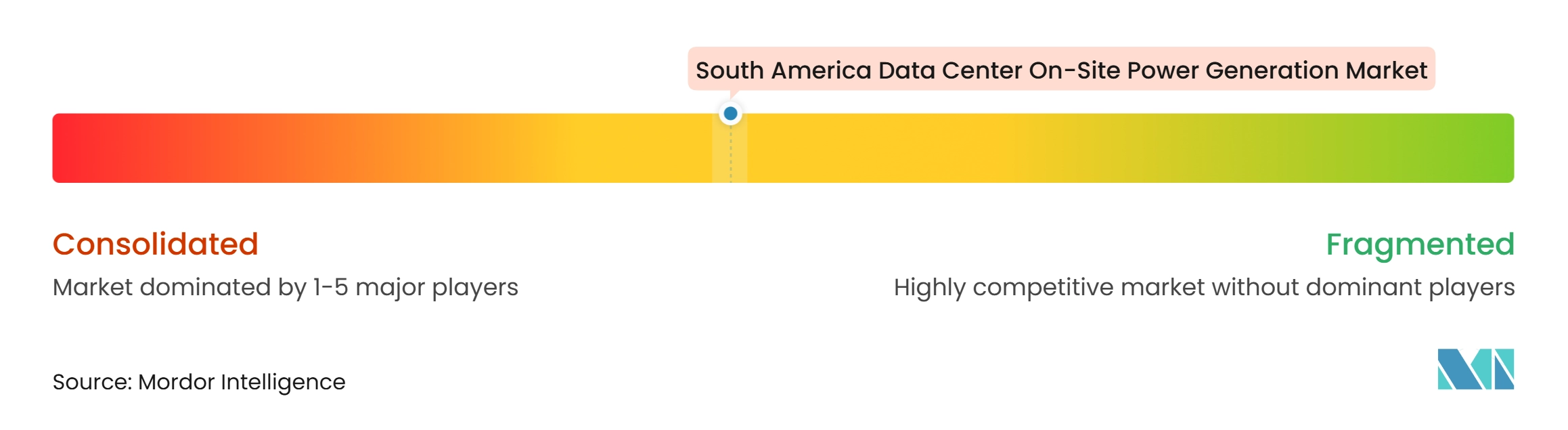
The South America data center on-site power generation market is moderately concentrated among large equipment manufacturers and more fragmented in temporary power, commissioning, and service work. Caterpillar and Cummins are leading suppliers of high-capacity diesel and gas generator systems above 2 MW. Atlas Copco, Wärtsilä, and INNIO Group compete in gas engine and gas turbine applications that serve prime and continuous power needs. The South America data center on-site power generation market is also attracting fuel-cell suppliers that address high-availability requirements with lower direct emissions.
Suppliers are responding to developer demand for shorter construction schedules with containerized and pre-tested equipment. Cummins 3 MW and 3.5 MW enclosures can reduce civil construction timelines by up to 25%, according to the source material. Bloom Energy expanded its agreement with Equinix beyond 100 MW across 19 data centers in February 2025, which provided a reference for wider fuel-cell deployment. Brookfield and Bloom Energy then launched a USD 5 billion global partnership for solid oxide fuel cell deployment at AI data centers in October 2025. These moves increase the competitive pressure on conventional suppliers to offer lower-emissions solutions without compromising availability.
Service intensity is becoming as important as equipment specifications in the South America data center on-site power generation market. Aggreko’s dedicated regional fleet supports commissioning, load testing, and temporary supply, which gives it a recurring service role. WEG uses domestic manufacturing to compete on sub-2 MW units for medium-scale colocation and enterprise sites. Vertiv and Grupo Datco formed a partnership in Argentina and Chile in October 2025 to strengthen service support for AI and high-performance computing facilities. A full-turnkey model that combines generators, battery storage, renewable input controls, and ongoing service remains an open opportunity because no supplier currently leads that offering across the region.
South America Data Center On-Site Power Generation Industry Leaders
-
Caterpillar Inc.
-
Cummins Inc.
-
Aggreko plc
-
Rolls-Royce Holdings plc
-
Wärtsilä Corporation
- *Disclaimer: Major Players sorted in no particular order
South America Data Center On-Site Power Generation Market Companies Covered in this Report
- Aggreko plc
- Atlas Copco AB
- Caterpillar Inc.
- Cummins Inc.
- Rolls-Royce Holdings plc
- Generac Power Systems, Inc.
- Mitsubishi Heavy Industries, Ltd.
- Wärtsilä Corporation
- Baker Hughes Company
- Bloom Energy Corporation
- FuelCell Energy, Inc.
- INNIO Group Holding GmbH
- Rehlko, LLC
- ABB Ltd.
- Schneider Electric SE
- Vertiv Holdings Co
- WEG S.A.
- Scala Data Centers S.A.
- Ascenty Data Centers e Telecomunicações S.A.
- ODATA Serviços de Tecnologia Ltda.
- Digital Realty Trust, Inc.
- Equinix, Inc.
- Huawei Digital Power Technologies Co., Ltd.
- Solatio Energia
Recent Industry Developments in South America Data Center On-Site Power Generation Market
- October 2026: Schneider Electric demonstrated NVIDIA GB200- and GB300-compatible power architectures for AI data centers at Data Center World Brasil, deepening its integration with South American hyperscaler procurement specifications.
- May 2026: Equinix confirmed cumulative investments exceeding USD 419 million in South American markets between 2025 and 2026, including USD 270 million in Brazil, USD 42 million in Chile, and USD 28 million in Colombia, with each commitment requiring facility-level on-site backup generation procurement.
- October 2025: Brookfield and Bloom Energy launched a USD 5 billion global solid oxide fuel cell deployment partnership for AI data centers, with AI factory designs already under development globally and South American markets included in the strategic rollout scope.
- October 2025: Vertiv and Grupo Datco announced a strategic distribution partnership in Argentina and Chile, targeting AI and high-performance computing data centers across the Southern Cone and strengthening the regional service infrastructure for critical power equipment.
South America Data Center On-Site Power Generation Market Report Scope
The South America Data Center On-Site Power Generation Market comprises solutions that enable data centers to generate electricity within or adjacent to their facilities to ensure a reliable, resilient, and uninterrupted power supply. These systems support operational continuity by reducing dependence on external grids, mitigating the risk of power outages, and addressing the growing energy demands of digital infrastructure. The market includes technologies designed for backup, primary, and continuous power generation, helping operators enhance energy security, optimize operational efficiency, support sustainability objectives, and meet the increasing power requirements of modern, high-density computing environments.
The South America Data Center On-Site Power Generation Market Report is Segmented by Generation Technology (Diesel Generator Sets, Natural Gas Generator Sets, Gas Turbines, Reciprocating Gas Engines, Fuel Cells, and Other Generation Technologies), Installed Generation Capacity (Below 1 MW, 1–5 MW, 5–20 MW, and Above 20 MW), Fuel Type (Diesel, Natural Gas, Renewable Fuels and Biogas, Hydrogen and Hydrogen Blends, and Other Fuel Types), Application (Emergency Backup Power, Prime Power, Continuous Power, and Temporary and Bridge Power), Data Center Size (Small, Medium, Large, and Hyperscale), Data Center Type (Colocation, Cloud Service Providers, and Enterprise and Edge), and Geography (Brazil, Chile, Colombia, Argentina, Peru, and Rest of South America). The Market Forecasts are Provided in Terms of Value (USD) and Volume (MW).
Segmentation Overview
| Diesel Generator Sets |
| Natural Gas Generator Sets |
| Gas Turbines |
| Reciprocating Gas Engines |
| Fuel Cells |
| Other Generation Technologies |
| Below 1 MW |
| 1-5 MW |
| Above 5-20 MW |
| Above 20 MW |
| Diesel |
| Natural Gas |
| Renewable Fuels and Biogas |
| Hydrogen and Hydrogen Blends |
| Other Fuels |
| Emergency Backup Power |
| Prime Power |
| Continuous Power |
| Temporary and Bridge Power |
| Small |
| Medium |
| Large |
| Hyperscale |
| Colocation |
| Cloud Service Providers (CSPs) |
| Enterprise and Edge |
| Brazil |
| Chile |
| Colombia |
| Argentina |
| Peru |
| Rest of South America |
| By Generation Technology | Diesel Generator Sets |
| Natural Gas Generator Sets | |
| Gas Turbines | |
| Reciprocating Gas Engines | |
| Fuel Cells | |
| Other Generation Technologies | |
| By Installed Generation Capacity | Below 1 MW |
| 1-5 MW | |
| Above 5-20 MW | |
| Above 20 MW | |
| By Fuel Type | Diesel |
| Natural Gas | |
| Renewable Fuels and Biogas | |
| Hydrogen and Hydrogen Blends | |
| Other Fuels | |
| By Application | Emergency Backup Power |
| Prime Power | |
| Continuous Power | |
| Temporary and Bridge Power | |
| By Data Center Size | Small |
| Medium | |
| Large | |
| Hyperscale | |
| By Data Center Type | Colocation |
| Cloud Service Providers (CSPs) | |
| Enterprise and Edge | |
| By Geography | Brazil |
| Chile | |
| Colombia | |
| Argentina | |
| Peru | |
| Rest of South America |
Key Questions Answered in the Report
What is the South America data center on-site power generation market size?
The market was valued at USD 418.59 million in 2026 and is projected to reach USD 838.75 million by 2032, growing at a CAGR of 11.89%. Installed generation capacity was 1,500 MW in 2026 and is expected to expand to 3,000 MW by 2032. Growth is driven by rising deployment of generation equipment, control systems, and installation services across new and expanding data center facilities.
What is driving demand for on-site power at South American data centers?
Demand is being fueled by increasing AI workloads, grid connection delays, and the need for highly resilient backup power systems. AI-driven infrastructure requires substantially higher power densities, while bridging power solutions help operators commission facilities before full utility connections become available.
Which generation technology leads the South America data center on-site power generation market?
Diesel generator sets accounted for the largest share at 32.05% in 2026. Their leadership is supported by established deployment practices, broad equipment availability, mature fuel logistics, and compatibility with Tier III and Tier IV data center reliability requirements. Fuel cells are expected to record the fastest growth through 2032.
Which fuel category is expected to expand fastest through 2032?
Hydrogen and hydrogen blends are forecast to grow at a 13.88% CAGR through 2032. Although infrastructure for production, transport, and storage remains limited, growing interest in lower-emission power solutions supports long-term adoption. Diesel continues to dominate due to its widespread availability and compatibility with existing backup-power architectures.
Which country holds the largest regional position?
Brazil led the market with a 71.02% share in 2026. Its strong position is supported by a large data center project pipeline, grid-connection constraints that increase demand for temporary and bridging power, and ongoing investments in colocation and hyperscale facilities.