
South America Data Center Insurance Market Size and Share
Market Overview
| Study Period | 2021 - 2032 |
|---|---|
| Forecast Data Period | 2027 - 2032 |
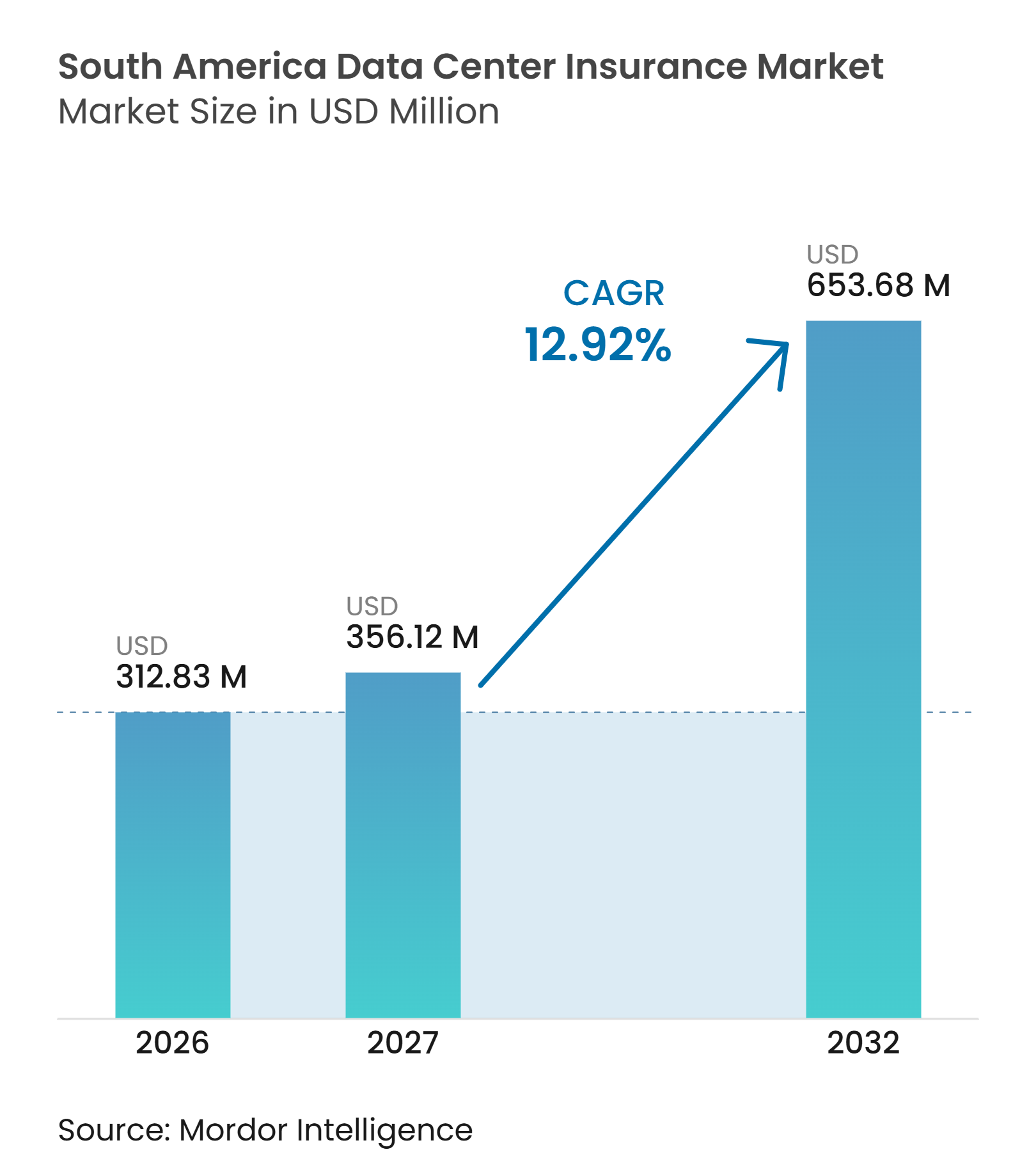
| Base Year Market Size (2026) | USD 312.83 Million |
| Market Size (2027) | USD 356.12 Million |
| Market Size (2032) | USD 653.68 Million |
| Growth Rate (2027 - 2032) | 12.92 % |
| Market Concentration | Medium |
Major Players *Disclaimer: Major Players sorted in no particular order Image © Mordor Intelligence. Reuse requires attribution under CC BY 4.0. | |
South America Data Center Insurance Market Analysis by Mordor Intelligence
The South America data center insurance market size was valued at USD 312.83 million in 2026 and is estimated to grow to USD 653.68 million by 2032, at a CAGR of 12.92% during the forecast period 2027-2032. Construction activity is increasing the amount of equipment, buildings, and critical systems that must be insured, especially in Brazil and Chile. AI workloads are also increasing asset density within facilities, thereby increasing the insured value at individual campuses. Insurers are responding with programs that combine property, cyber, business interruption, engineering, and liability coverage. This approach is becoming more important because power, cooling, connectivity, and digital controls increasingly create related losses. The South America data center insurance market is therefore expanding through larger and more complex programs rather than through policy volume alone.
Key Report Takeaways
- By insurance type, Property Damage Insurance held 38.46% of the South America data center insurance market share in 2026, while Cyber Insurance is projected to expand at a 13.81% CAGR through 2032.
- By coverage structure, Combined Property and Business Interruption Policies held 37.83% share in 2026, while Parametric Insurance is projected to expand at a 13.43% CAGR through 2032.
- By risk exposure, Power Supply Disruption accounted for 23.42% share in 2026, while Cyber-Related Operational Disruption is projected to expand at a 13.62% CAGR through 2032.
- By policyholder, Data Center Owners and Operators held 39.43% share in 2026, while Colocation Providers are projected to expand at a 13.27% CAGR through 2032.
- By insurance distribution channel, Insurance Brokers and Consultants accounted for 58.67% share in 2026, while Reinsurance-Supported Insurance Programs are projected to expand at a 13.83% CAGR through 2032.
- By data center size, Large Data Centers held 37.24% share in 2026, while Hyperscale Data Centers are projected to expand at a 13.63% CAGR through 2032.
- By data center type, Colocation Data Centers accounted for 45.87% share in 2026, while Cloud Service Providers are projected to expand at a 13.74% CAGR through 2032.
- By geography, Brazil held 61.32% share in 2026, while Chile is projected to expand at a 13.93% CAGR through 2032.
Note: Market numbers in this report are based on Mordor Intelligence's proprietary estimation framework, which combines nine months of actuals with Q4 projections for base year 2026.
Market Trends and Insights
Drivers Impact Analysis of South America Data Center Insurance Market*
| Driver | (~) % Impact on CAGR Forecast | Geographic Relevance | Impact Timeline |
|---|---|---|---|
| Expansion of AI and Cloud Data Center Capacity | +3.8% | Global, concentrated in Brazil and Chile | Medium term (2-4 years) |
| Rising Business Interruption and Uptime-Liability Exposure | +2.6% | Brazil, Colombia, Chile | Short term (≤ 2 years) |
| Increasing Cyber-Physical Interdependence of Data Centers | +2.1% | Brazil, Argentina, Colombia | Short term (≤ 2 years) |
| Growth of Integrated Construction-to-Operations Insurance Programs | +1.4% | Brazil, Chile, Peru | Medium term (2-4 years) |
| Data Localization and Sovereign Infrastructure Requirements | +0.8% | Brazil, Colombia, Argentina | Long term (≥ 4 years) |
| Renewable-Power and Water-Efficiency Requirements Driving Risk Engineering | +0.5% | Brazil, Chile | Long term (≥ 4 years) |
| Source: Mordor Intelligence | |||
Expansion of AI and Cloud Data Center Capacity
Brazil delivered 106 MW of new data center capacity in the first half of 2026 and is expected to add another 134 MW by December. New facilities require coverage for buildings, electrical systems, cooling assets, and imported computing equipment. The REDATA program lowered import taxes on selected data center equipment, while grid connection applications increased by 6.4 GW within 60 days of the policy's publication.[1] Higher equipment density raises per-megawatt values and makes fire, heat, and electrical failure more material underwriting considerations. In Chile, capacity growth and tighter vacancy levels are creating a similar need for construction and operating coverage. The South America data center insurance market benefits as pre-leased campuses move from planning into construction and operations.
Rising Business Interruption and Uptime-Liability Exposure
Data center operators increasingly face revenue loss when grid connections, cooling systems, or network services fail. Construction schedules have shortened to 15-18 months from a traditional 24-30 months, making the commissioning period more exposed to overlapping construction and operating risks. A completed site can remain unable to earn revenue when a grid connection is delayed, even when physical damage is limited. Imported equipment can also lengthen repair periods because replacement parts may travel through international supply chains. Brazilian data breach costs reached BRL 7.19 million (USD 1.25 million) in 2025, although this figure excludes contractual SLA penalties and reputation-related losses. The South America data center insurance market is consequently seeing greater demand for delay-in-startup and tailored business interruption wording.
Increasing Cyber-Physical Interdependence of Data Centers
Power management, cooling, and building control systems are increasingly connected to digital networks. A cyberattack on a building management system can cause physical damage or disrupt services, even when a conventional property policy includes an exclusion for cyber-originated loss. Brazil's BCB Resolution 498/2025 requires qualifying technology service providers that support critical financial infrastructure to maintain dedicated cyber insurance. This coverage design makes cyber risk a direct part of engineering and property underwriting rather than a separate purchase.
Growth of Integrated Construction-to-Operations Insurance Programs
Construction and operation often overlap as power, cooling, and connectivity systems come online in completed modules while work continues nearby. That overlap can leave uncertainty between builders' risk policies and operational property programs. Zurich expanded Data Center Project Guard to Brazil in June 2026, bringing contractors' all-risk, delay-in-startup, and transition cover into one structure. Lenders and institutional investors are also treating integrated coverage as a project-finance requirement for large campuses. This favors insurers with engineering teams capable of assessing risk during construction and at handover. The South America data center insurance market, therefore, offers an advantage to carriers that can maintain continuity from early works through operations.
Restraints Impact Analysis of South America Data Center Insurance Market*
| Restraint | (~) % Impact on CAGR Forecast | Geographic Relevance | Impact Timeline |
|---|---|---|---|
| Limited Local Capacity for High-Value and Systemic Risks | -1.8% | Brazil, Chile, Colombia | Short term (≤ 2 years) |
| Grid Instability and Electricity-Tariff Volatility | -1.3% | Brazil, Argentina, Colombia | Medium term (2-4 years) |
| Ambiguous Triggering of Non-Damage Business Interruption and Cyber-Physical Losses | -0.6% | Brazil, Chile, Colombia | Medium term (2-4 years) |
| Water Stress, Environmental Approvals, and Site Constraints | -0.5% | Brazil, Chile, Peru | Long term (≥ 4 years) |
| Source: Mordor Intelligence | |||
Limited Local Capacity for High-Value and Systemic Risks
Hyperscale campuses require limits that many local primary insurers cannot retain on their own. Operators must therefore obtain capacity from international carriers and reinsurers. This can increase placement complexity and make pricing more sensitive to global reinsurance conditions. Smaller insurers may also lack the specialist engineering resources needed to evaluate complex power, cooling, and fire exposures. The result is a narrow pool of carriers for the largest facilities, particularly where several high-value projects sit in the same power region. This limits the pace at which the South America data center insurance market can serve the highest-value projects.
Grid Instability and Electricity-Tariff Volatility
Grid reliability remains a central concern outside Brazil's established southeastern markets. Delayed connections can leave a fitted facility idle and produce business interruption losses that do not clearly fit within a construction or property program. Argentina's regulated and frequently revised electricity pricing also complicates long-term income projections. Operators are adding microgrids, solar systems, and battery storage to improve resilience. These assets create new failure modes and may need behind-the-meter endorsements when energy systems are operated by third parties. Water availability and environmental approvals add further constraints in Chile, Peru, and parts of Brazil, where cooling choices and site permits affect both project delivery and risk engineering.
*Our forecasts treat driver/restraint impacts as directional, not additive. The impact forecasts reflect baseline growth, mix effects, and variable interactions.
South America Data Center Insurance Market Segment Analysis
By Insurance Type:
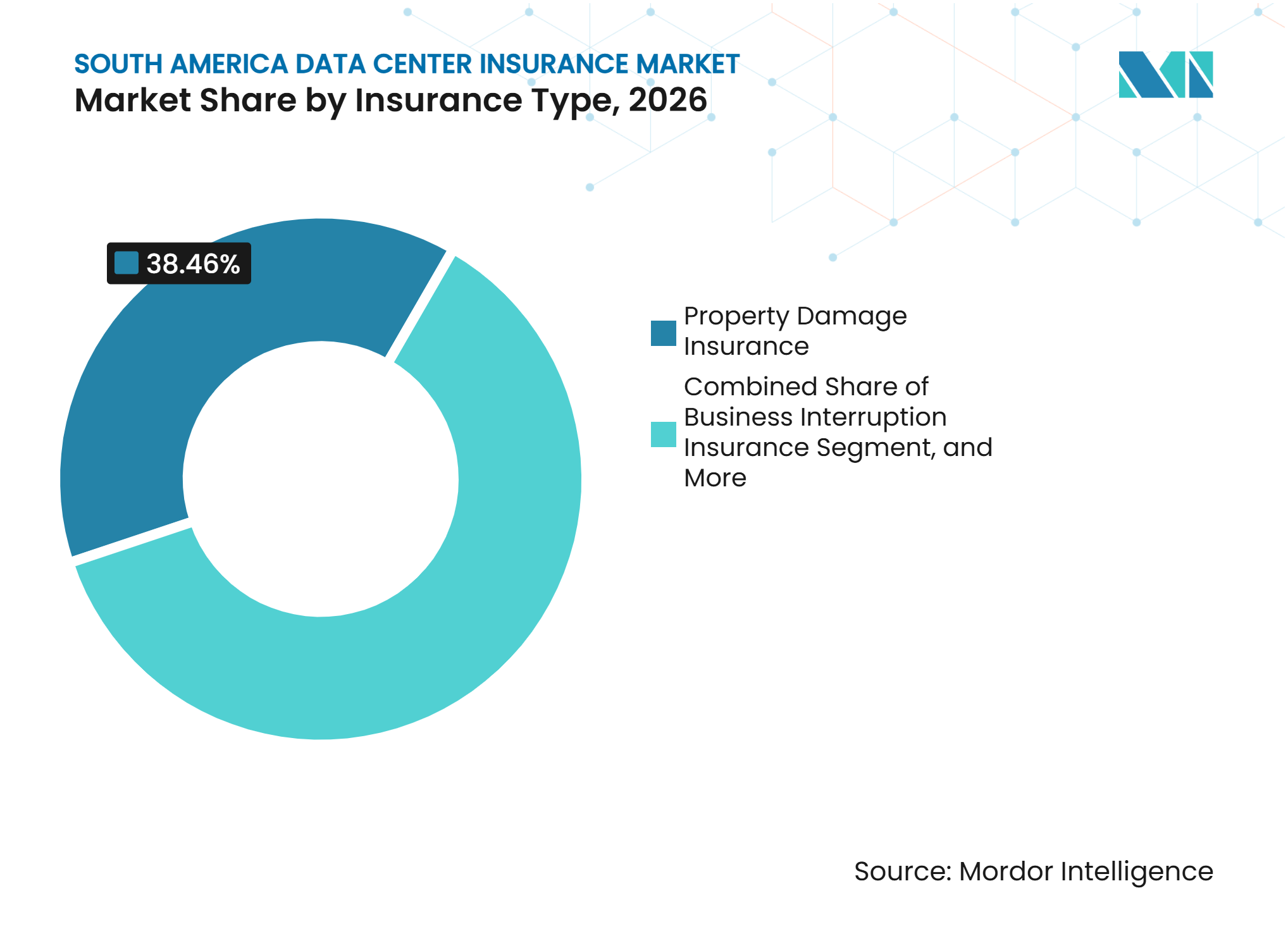
Property and Cyber Define Coverage DemandProperty Damage Insurance held 38.46% of the South America data center insurance market share in 2026. The category reflects the physical exposures created by active construction, commissioning work, and high-value electrical infrastructure. Buildings, substations, generators, UPS systems, cooling equipment, and server halls create a broad base of insured assets. Brazil's current construction pipeline strengthens this demand because every completed facility adds property that must be protected. Property programs also support lenders that require evidence of protection before releasing project funding, and their engineering surveys create documentation that can be used throughout a facility’s operating life. The South America data center insurance market also benefits when construction policies are designed to transition seamlessly into operating property cover. Larger campuses create higher total insured values and greater accumulation exposure for carriers.
Cyber Insurance is projected to grow at a 13.81% CAGR through 2032. Mandatory cyber coverage for financial infrastructure providers gives this segment a compliance-driven foundation in Brazil. The wider exposure is also increasing because operational technology is connected to management software and external networks. Business Interruption Insurance remains important where an outage affects customer contracts and service availability. Equipment Breakdown Insurance addresses failures in cooling, generators, and electrical systems. Natural Catastrophe, construction all-risk, and third-party liability cover broaden the South America data center insurance market as operators face more varied loss scenarios.



By Coverage Structure:
Parametric Products Gain Practical UseCombined Property and Business Interruption Policies accounted for 37.83% of the South America data center insurance market in 2026. They respond to the common situation in which a power event damages equipment and halts revenue generation simultaneously. A single coordinated policy can reduce disputes over which insurer responds to each part of a loss. This structure is useful for large campuses with high fixed costs and customer uptime commitments. It also aligns property assessment with the operational consequences of a prolonged outage. Combined programs remain the standard option for many larger operators.
Parametric Insurance is projected to expand at a 13.43% CAGR through 2032. These products pay when a defined event threshold is reached, such as a voltage drop or a specified temperature level, which can give operators clearer timing for cash-flow planning after an outage. The South America data center insurance market can use this model where contractual service losses do not depend on proving physical damage. The approach can address service losses that occur without qualifying physical damage. Real-time power-quality data and building sensors make triggers more precise and can reduce basis risk. Standalone and package policies continue to serve smaller operators that cannot access complex integrated programs. Captive and self-insurance arrangements are most relevant for global hyperscalers that retain routine losses and transfer only higher-severity events.
By Risk Exposure:
Power and Cyber Risks Shape UnderwritingPower Supply Disruption accounted for 23.42% of the South America data center insurance market share in 2026. Transmission constraints and rapid capacity additions raise concern across several national markets. Underwriters must consider backup generation, battery systems, interconnection arrangements, and utility reliability. A disruption can affect equipment performance and customer service obligations at the same time. The exposure is particularly material where the local grid has not been developed for dense data center clusters. Power risk also affects how reinsurers evaluate accumulation across a portfolio.
Cyber-Related Operational Disruption is projected to expand at a 13.62% CAGR through 2032. Internet-connected infrastructure provides a path for a digital attack to affect cooling or power systems. Fire and explosion risks remain material when battery systems and high-density computing equipment increase thermal loads. Flooding and water damage are relevant in northern Brazil and parts of Colombia. Earthquake endorsements are important in Chile, Colombia, and Peru due to their regional seismic conditions. Supply chain disruption is another growing source of exposure as connectivity and energy providers become essential to a facility's ability to serve customers.
By Policyholder:
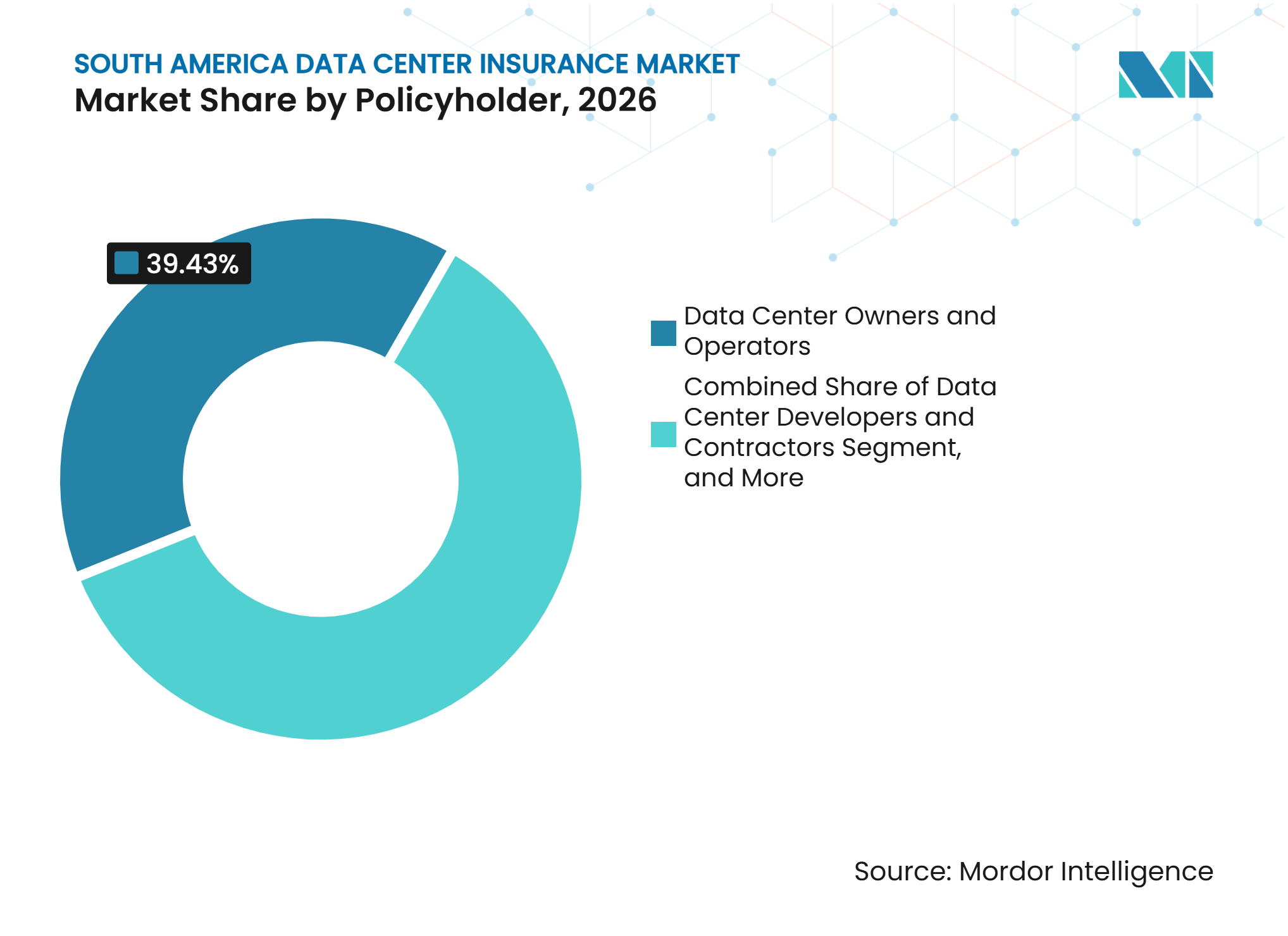
Operators Lead While Colocation ExpandsData Center Owners and Operators held 39.43% share in 2026. They directly own or manage the facilities, equipment, and contractual obligations that create property and liability exposures. Domestic operators and regional subsidiaries of global cloud providers often follow different risk-financing practices. International treasury standards can require higher insurance limits and broader program structures. This group has the longest history of formal insurance purchasing in the region. Their procurement practices support a stable demand for multi-line coverage.
Colocation Providers are projected to expand at a 13.27% CAGR through 2032. Their multi-tenant operating model creates concurrent exposure when a service interruption affects several customers. They may face tenant claims, contingent business interruption, and SLA-related liabilities that are less visible in a single-user site. Cloud Service Providers often use global insurance structures and may self-insure some property risk. Developers and contractors need coverage while new sites are built and commissioned. Equipment and service providers also create downstream professional indemnity and product liability demand as the data center ecosystem expands.

By Insurance Distribution Channel:
Specialist Brokers Retain InfluenceInsurance Brokers and Consultants accounted for a 58.67% share in 2026. Their position reflects the difficulty of placing large programs across property, cyber, engineering, liability, and reinsurance markets, particularly when an operator needs local policy issuance alongside international capacity. The South America data center insurance market relies on this coordination because a single program can involve several carriers, jurisdictions, and technical reviews. Specialist brokers can aggregate capacity from international insurers and help operators develop risk information for underwriting. They also assist with engineering reviews, loss modeling, and wording negotiations. These capabilities are especially relevant for hyperscale campuses. The broker-led structure remains a key feature of the South America data center insurance market.
Reinsurance-Supported Insurance Programs are projected to expand at a 13.83% CAGR through 2032. Primary carriers use reinsurance to manage the accumulation of high values at large facilities. Direct Insurance remains more common for smaller enterprise sites with conventional commercial property needs. Managing General Agents and specialist underwriting agencies can bring international capacity into markets where global carriers have limited local presence. Their role may be more relevant in Argentina and Peru. The distribution system will continue to depend on risk information moving effectively between operators, brokers, primary insurers, and reinsurers.
By Data Center Size:
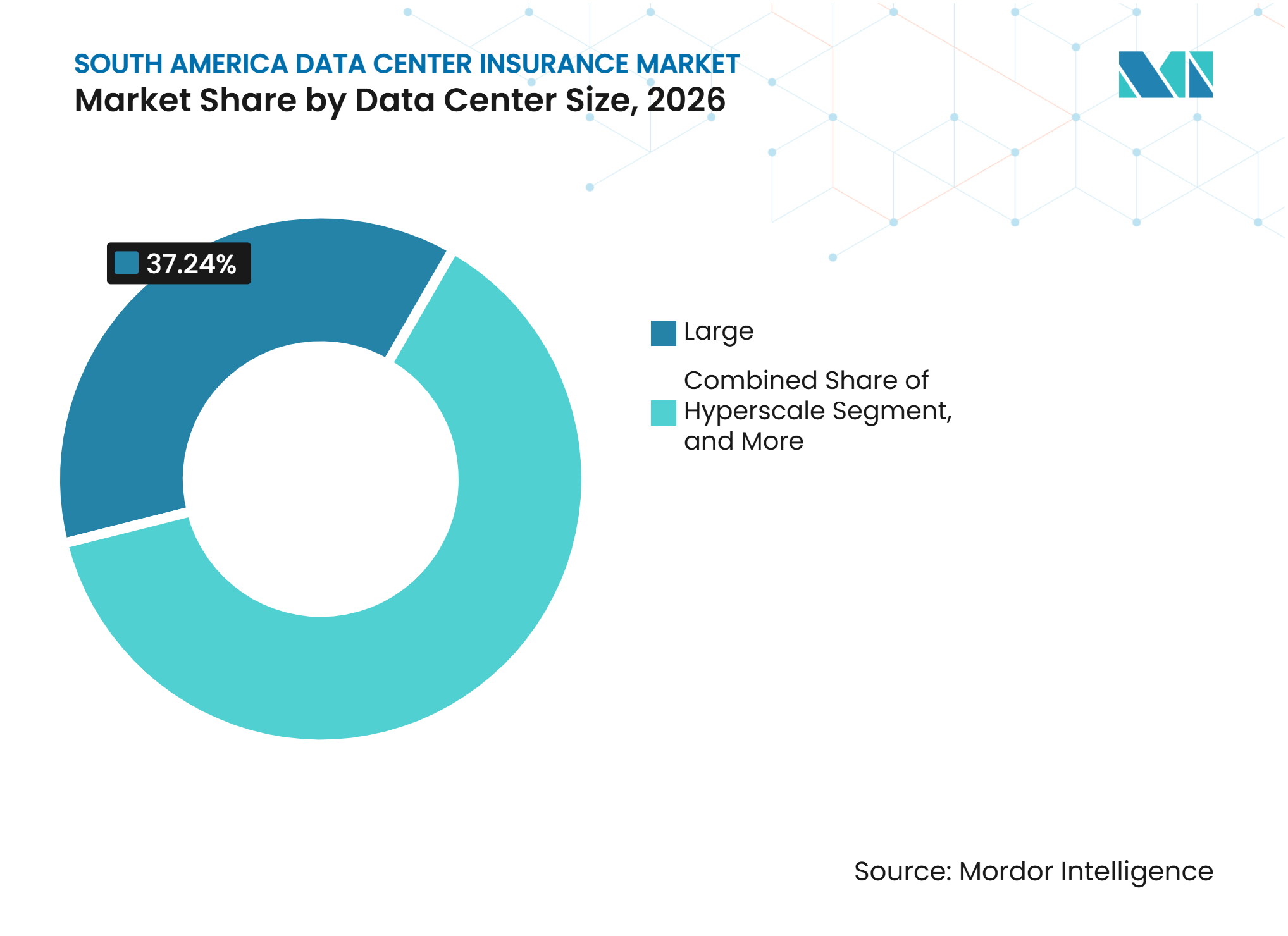
Large Sites Lead, Hyperscale ExpandsLarge Data Centers held a 37.24% market share in 2026. Existing corporate and colocation facilities in São Paulo, Rio de Janeiro, Santiago, and Bogotá provide an established base for insurance demand. These sites have substantial physical assets but usually remain within the capacity range of more insurers than the largest campuses. They require property, equipment, liability, and business interruption programs suited to local operating conditions. Their geographic distribution also allows carriers to diversify exposures across several cities. Large facilities remain central to premium volume in the regional portfolio.
Hyperscale Data Centers are projected to expand at a 13.63% CAGR through 2032. AI campuses can concentrate USD 5 billion to USD 20 billion in assets at a single location. This creates insured values that demand meaningful reinsurance support and careful accumulation control. The Fortaleza and Ceará corridor had 227 MW under construction in mid-2026, indicating a shift in high-value concentration beyond São Paulo. Uptime Institute Tier IV requirements can reduce outage frequency through redundancy, although failures may carry higher reinstatement costs. GPU-dense configurations also increase cooling and thermal risks, necessitating updated engineering assessments.
By Data Center Type:
Colocation Anchors the PortfolioColocation Data Centers accounted for 45.87% of the South America data center insurance market share in 2026. Third-party-operated infrastructure remains a common route for global providers entering the region. This model concentrates property ownership and insurance purchasing with a limited group of regional operators. AXA Brazil had 218 data center installations, accounting for 50% of South America's total.[2] Colocation operators must address concurrent tenant exposure and shared infrastructure risk. Their programs often require property, cyber, liability, and business interruption coverage to be coordinated.
Cloud Service Providers are projected to expand at a 13.74% CAGR through 2032. Dedicated cloud regions are growing in Brazil, Chile, and Colombia as demand for digital services increases. Enterprise sites are losing share as organizations move workloads to cloud and colocation facilities. Edge sites are expanding with 5G adoption and the need for lower-latency processing outside major cities. Modular construction can speed cloud-campus delivery but creates logistics and coordination exposures during installation. The shift toward large cloud and colocation buyers may improve their negotiating leverage on policy deductibles, attachments, and sub-limits.
Geography Analysis
Brazil: Regional Depth and Regulatory Momentum
Brazil held 61.32% of the South America data center insurance market share in 2026. The country delivered 106 MW in the first half of 2026 and was expected to add 134 MW by December, with 56% of capacity under construction already pre-leased. REDATA reduced import taxes on specified data center equipment and supported a rapid increase in grid-connection applications. BCB Resolution 498/2025 also makes dedicated cyber insurance relevant for qualifying financial technology service providers. Brazil's renewable power mix supports sustainability goals for hyperscalers, but it does not remove the need to assess connection reliability and local transmission limits. Tecto Data Centers announced a USD 2 billion program in April 2026 to develop 5 new facilities in Brazil through 2028. These investments expand the insured asset base while increasing the need for international reinsurance capacity. Insurers must evaluate asset concentration, external power dependencies, and the period during which equipment is installed but the site is not yet fully operational. This makes local engineering knowledge as important as balance-sheet capacity for major placements.
Chile: Growth With Seismic and Water Considerations
Chile is projected to expand at a 13.93% CAGR through 2032. The National Data Center Plan identified 30 projects in development through 2028 and placed USD 2.931 billion of projects under active construction. Seismic risk makes earthquake endorsements and reinsurance attachment design central to local program placement. Water use, environmental approvals, and cooling resilience also influence site selection and risk engineering. Chile's planning framework and large-project pipeline create a clear opportunity for insurers that can combine catastrophe expertise with data center engineering. Ascenty opened its third Chilean facility in September 2025, investing USD 114 million, and announced plans for 2 further campuses with a combined capacity of 150 MW and USD 1 billion in planned investment. These projects increase the importance of construction, earthquake, and operational continuity clauses being aligned before capacity is commissioned.
Colombia, Argentina, Peru, and Other South American Markets: Diverse Risk Profiles
Colombia's data center sector is expected to build on USD 450 million of investment recorded in 2025, with fintech and cloud demand increasing the need for cyber and business interruption cover. Argentina has 85 MW of installed capacity, but electricity price controls and tariff revisions complicate financial projections and income protection programs. Peru is at an earlier stage of development, although seismic exposure and imported equipment remain relevant underwriting issues as project sizes increase. Uruguay, Ecuador, Bolivia, and other markets are developing hybrid and colocation services in response to nearshoring demand. S&P Global stated that Brazil accounts for 50% of South America's installed data center capacity, leaving the other 50% dispersed across several national markets.[3] This distribution requires insurers to price distinct grid, regulatory, catastrophe, and contractual conditions within regional programs. Local compliance factors and country-specific policy wording will remain important as operators spread workloads beyond the largest hubs. Emerging locations can offer operators alternative land, energy, and connectivity options, but insurers must assess the maturity of utilities, emergency response, supply chains, and regulatory administration in each location. Regional programs may be more efficient when they preserve common coverage standards while retaining country-specific endorsements for catastrophe, grid, and legal conditions.
Competitive Landscape
Market Concentration
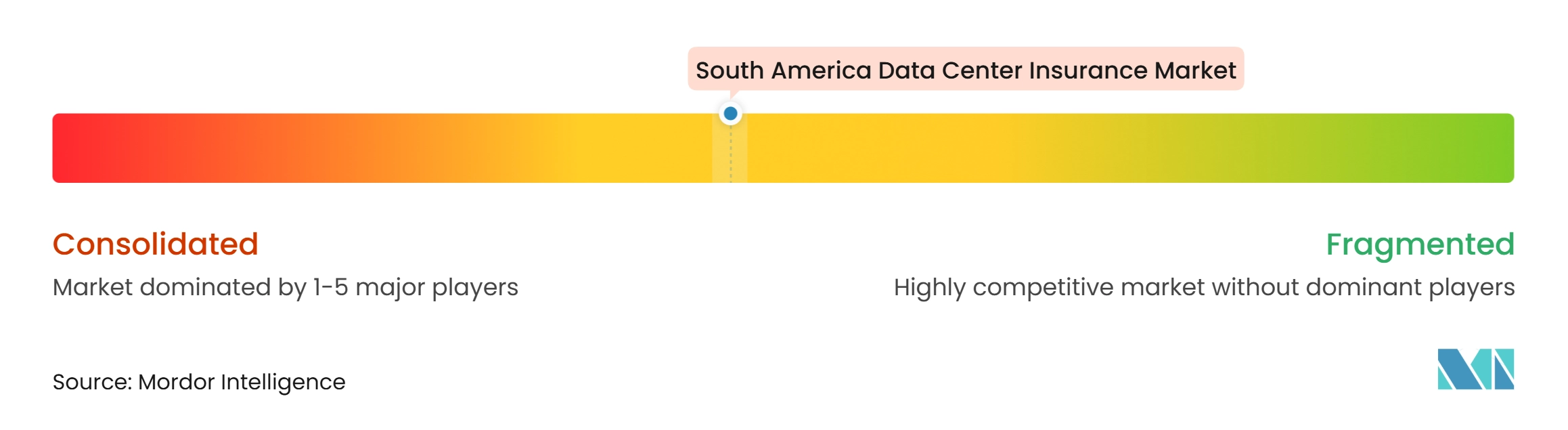
The South America data center insurance market is moderately concentrated in the largest campus tier. Global carriers with strong capital positions, engineering resources, and multi-line capabilities compete for complex hyperscale mandates. Regional insurers can participate more widely in mid-market and enterprise programs. Competitive differentiation increasingly depends on the ability to coordinate property, engineering, cyber, business interruption, and liability coverage. This approach helps address losses that cross traditional policy boundaries. It also creates a barrier for insurers that lack specialist risk engineering capacity.
Zurich expanded its Data Centre Project Guard offering to Brazil in June 2026, combining construction and transition-to-operations cover. AXA Brazil launched an integrated data center solution in September 2026 with engineering, property, cyber, transport, liability, errors and omissions, and warranty coverage. FM Global is preparing to launch as a direct insurer in Brazil in July 2026 and has identified data centers as a primary growth segment. These moves show that carriers are targeting specialized risk design rather than relying only on standard commercial property policies. Zurich’s expansion followed its underwriting of more than 245 data center construction projects in the United States in 2025, providing experience that may inform its approach in Brazil. AXA’s acceptance criteria also place energy and water-efficiency certification and clean energy use at the center of underwriting discussions. These conditions show how technical performance and sustainability standards are becoming part of placement decisions. Parametric cover for SLA-related events and explicit cyber-property wording remain areas where policy design can develop further.
Reinsurers remain important because their capacity determines the limits primary insurers can provide on concentrated assets. Underwriters are also starting to use power-quality data, thermal monitoring, and IoT sensor information in risk selection. These tools can improve visibility into cooling, electrical, and operational conditions before a claim occurs. Better monitoring can help carriers identify weak points in backup power, thermal management, and maintenance practices earlier. It can also support more focused risk-improvement recommendations for operators that want to protect service availability. These capabilities may be particularly useful where regional claims history remains limited for newly built AI-focused facilities. The South America data center insurance market is likely to favor carriers that combine these data tools with local underwriting and global reinsurance access. Domestic insurers may remain important partners on primary layers and local regulatory requirements.
South America Data Center Insurance Industry Leaders
-
Zurich Insurance Company Ltd
-
Allianz SE
-
AXA S.A.
-
Chubb Limited
-
American International Group, Inc.
- *Disclaimer: Major Players sorted in no particular order
South America Data Center Insurance Market Companies Covered in this Report
- Zurich Insurance Company Ltd
- Allianz SE
- AXA S.A.
- Chubb Limited
- American International Group, Inc.
- Marsh LLC
- Willis Towers Watson Public Limited Company
- Aon plc
- Munich Reinsurance Company
- Swiss Re AG
- SCOR SE
- MAPFRE, S.A.
- HDI Global SE
- QBE Insurance Group Limited
- Tokio Marine Holdings, Inc.
- Sompo Holdings, Inc.
- The Travelers Indemnity Company
- Liberty Mutual Insurance Company
- Berkshire Hathaway Specialty Insurance Company
- Lloyd’s
Recent Industry Developments in South America Data Center Insurance Market
- September 2026: AXA Brazil launched an integrated data center insurance solution combining engineering, property, cyber, transport, liability, errors and omissions, and warranty lines into a single framework, with acceptance criteria that require energy and water efficiency certification and exclusive use of clean energy. The launch cited 218 data center installations in Brazil representing 50% of South America's total and the anticipated scaling of national capacity toward 4.6 GW under the REDATA program. The structure specifically included physical property damage caused by a cyberattack, making the cyber-physical link an explicit coverage feature rather than an implied extension.
- July 2026: FM Global prepared to launch as a direct insurer in Brazil, designating data centers as its primary growth segment. The company served 80 data center groups globally and was conducting discussions on multiple large-scale Brazilian projects, using its engineering and loss-prevention model to differentiate against traditional property carriers. The planned move highlighted the interest of global engineering-led insurers in risk prevention and direct access to Brazil’s expanding digital infrastructure portfolio.
- June 2026: Zurich Insurance Group expanded Data Centre Project Guard, a construction-to-operation integrated insurance program, to Brazil, Germany, Italy, the Nordics, and Spain, following the underwriting of more than 245 data center construction projects in the United States in 2025. The program combined contractors’ all-risk protection with delay-in-startup and transitional operational cover, addressing the period when construction and operational responsibilities may overlap.
- May 2026: Aon published its 2026 Global Construction Insurance and Surety Market Report, identifying digital infrastructure investment as the primary driver reshaping insurance subscription priorities in South America. The report described reinsurance capacity in the region as sufficient but increasingly selective.
South America Data Center Insurance Market Report Scope
The South America data center insurance market covers insurance products designed to protect data center operators, owners, and service providers against risks such as property damage, equipment failure, business interruption, cyber incidents, and liability claims.
The South America Data Center Insurance Market Report is Segmented by Insurance Types (Property Damage Insurance, Business Interruption Insurance, Equipment Breakdown Insurance, Cyber Insurance, Natural Catastrophe Insurance, General and Third-Party Liability Insurance, Construction and Erection All-Risk Insurance, and Other Insurance Types), Coverage Structure (Standalone Policies, Combined Property and Business Interruption Policies, Package Policies, Parametric Insurance, and Captive and Self-Insurance Arrangements), Risk Exposure (Fire and Explosion, Electrical and Mechanical Equipment Failure, Power Supply Disruption, Flooding and Water Damage, Windstorms and Severe Weather, Earthquakes and Other Geophysical Hazards, Cyber-Related Operational Disruption, and Third-Party and Supply Chain Disruption), Policyholder (Data Center Owners and Operators, Colocation Providers, Cloud Service Providers, Data Center Developers and Contractors, and Data Center Equipment and Service Providers), Insurance Distribution Channel (Direct Insurance, Insurance Brokers and Consultants, Managing General Agents and Specialist Underwriting Agencies, and Reinsurance-Supported Insurance Programs), Data Center Size (Small, Medium, Large, and Hyperscale), Data Center Type (Colocation, Cloud Service Providers (CSPs), and Enterprise and Edge), and Geography (Brazil, Chile, Colombia, Argentina, Peru, and Rest of South America). The Market Forecasts are Provided in Terms of Value (USD).
Segmentation Overview
| Property Damage Insurance |
| Business Interruption Insurance |
| Equipment Breakdown Insurance |
| Cyber Insurance |
| Natural Catastrophe Insurance |
| General and Third-Party Liability Insurance |
| Construction and Erection All-Risk Insurance |
| Other Insurance Types |
| Standalone Policies |
| Combined Property and Business Interruption Policies |
| Package Policies |
| Parametric Insurance |
| Captive and Self-Insurance Arrangements |
| Fire and Explosion |
| Electrical and Mechanical Equipment Failure |
| Power Supply Disruption |
| Flooding and Water Damage |
| Windstorms and Severe Weather |
| Earthquakes and Other Geophysical Hazards |
| Cyber-Related Operational Disruption |
| Third-Party and Supply Chain Disruption |
| Data Center Owners and Operators |
| Colocation Providers |
| Cloud Service Providers |
| Data Center Developers and Contractors |
| Data Center Equipment and Service Providers |
| Direct Insurance |
| Insurance Brokers and Consultants |
| Managing General Agents and Specialist Underwriting Agencies |
| Reinsurance-Supported Insurance Programs |
| Small |
| Medium |
| Large |
| Hyperscale |
| Colocation |
| Cloud Service Providers (CSPs) |
| Enterprise and Edge |
| Brazil |
| Chile |
| Colombia |
| Argentina |
| Peru |
| Rest of South America |
| By Insurance Type | Property Damage Insurance |
| Business Interruption Insurance | |
| Equipment Breakdown Insurance | |
| Cyber Insurance | |
| Natural Catastrophe Insurance | |
| General and Third-Party Liability Insurance | |
| Construction and Erection All-Risk Insurance | |
| Other Insurance Types | |
| By Coverage Structure | Standalone Policies |
| Combined Property and Business Interruption Policies | |
| Package Policies | |
| Parametric Insurance | |
| Captive and Self-Insurance Arrangements | |
| By Risk Exposure | Fire and Explosion |
| Electrical and Mechanical Equipment Failure | |
| Power Supply Disruption | |
| Flooding and Water Damage | |
| Windstorms and Severe Weather | |
| Earthquakes and Other Geophysical Hazards | |
| Cyber-Related Operational Disruption | |
| Third-Party and Supply Chain Disruption | |
| By Policyholder | Data Center Owners and Operators |
| Colocation Providers | |
| Cloud Service Providers | |
| Data Center Developers and Contractors | |
| Data Center Equipment and Service Providers | |
| By Insurance Distribution Channel | Direct Insurance |
| Insurance Brokers and Consultants | |
| Managing General Agents and Specialist Underwriting Agencies | |
| Reinsurance-Supported Insurance Programs | |
| By Data Center Size | Small |
| Medium | |
| Large | |
| Hyperscale | |
| By Data Center Type | Colocation |
| Cloud Service Providers (CSPs) | |
| Enterprise and Edge | |
| By Geography | Brazil |
| Chile | |
| Colombia | |
| Argentina | |
| Peru | |
| Rest of South America |
Key Questions Answered in the Report
What is the size of the South America data center insurance market?
The South America data center insurance market was valued at USD 312.83 million in 2026 and is forecast to reach USD 653.68 million by 2032, at a 12.92% CAGR.
Which insurance type has the largest share in South America data centers?
Property Damage Insurance led with 38.46% share in 2026 because construction and operating sites contain high-value physical assets.
Why is cyber coverage expanding for data center operators?
Cyber Insurance is projected to grow at a 13.81% CAGR through 2032 as connected operating systems create physical and service interruption exposures.
What is driving demand for integrated data center insurance programs?
Overlapping construction and operations, combined with property, cyber, and business interruption risks, are increasing demand for coordinated policies.
Which country leads regional demand for data center insurance?
Brazil held 61.32% share in 2026, supported by new capacity delivery, REDATA, and extensive construction activity.
Why is Chile important for insurers serving digital infrastructure?
Chile is projected to grow at a 13.93% CAGR through 2032, while its seismic conditions require specialized catastrophe and reinsurance structures.