
South America Data Center Grid Infrastructure and Interconnection Market Size and Share
Market Overview
| Study Period | 2021 - 2032 |
|---|---|
| Forecast Data Period | 2027 - 2032 |
| Base Year Market Size (2026) | USD 1.56 Billion |
| Market Size (2027) | USD 1.93 Billion |
| Market Size (2032) | USD 3.79 Billion |
| Growth Rate (2027 - 2032) | 14.45 % |
| Market Concentration | Medium |
Major Players *Disclaimer: Major Players sorted in no particular order Image © Mordor Intelligence. Reuse requires attribution under CC BY 4.0. | |
South America Data Center Grid Infrastructure and Interconnection Market Analysis by Mordor Intelligence
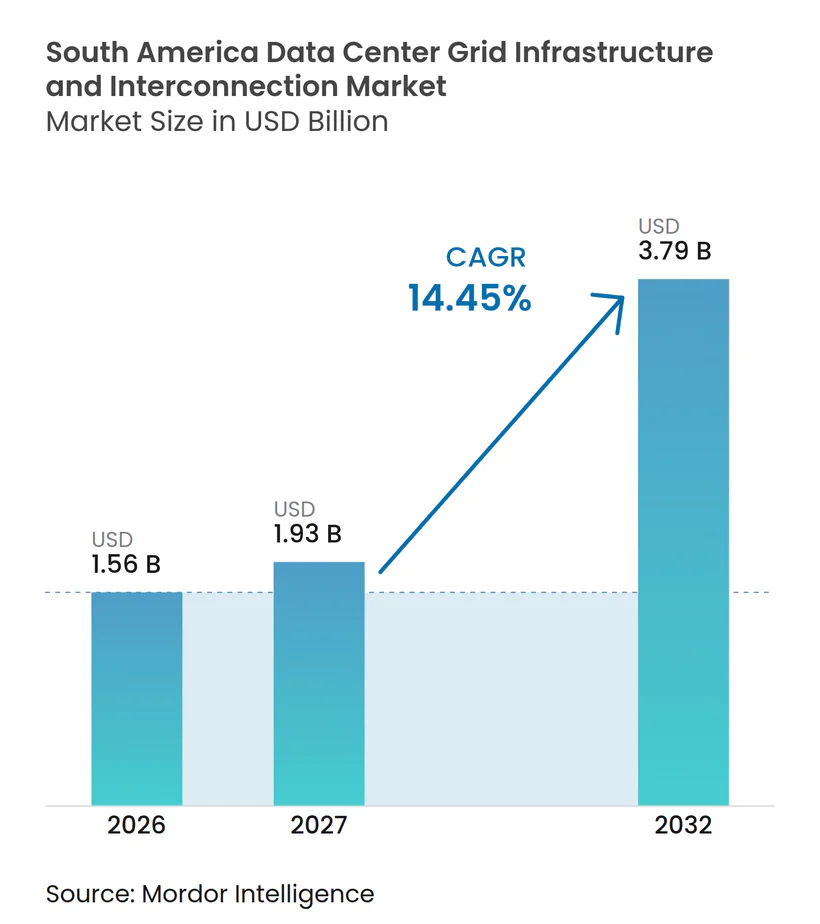
The South America data center grid infrastructure and interconnection market was valued at USD 1.56 million in 2026 and estimated to expand from USD 1.93 million in 2027 to reach USD 3.79 million by 2032, at a CAGR of 14.45% during the forecast period (2027-2032). The South America data center grid infrastructure and interconnection market is being shaped by hyperscale construction, cloud-region investment, and AI-focused campuses that need large and dependable power connections. Grid access is becoming a central project decision because a completed facility cannot operate at its planned capacity without an available connection. Long-term power purchase agreements and dedicated substation arrangements are also moving earlier in project planning. This places greater value on sites that can secure transmission access before competing campuses enter the connection process. The South America data center grid infrastructure and interconnection market therefore depends on the pace at which utilities, regulators, and developers can coordinate new capacity.
Key Report Takeaways
- By interconnection project type, New Grid Connections held 35.31% of the South America data center grid infrastructure and interconnection market share in 2026, while Dedicated Transmission Infrastructure is projected to expand at a 17.74% CAGR through 2032.
- By infrastructure component, Substations and Switchyards accounted for 29.48% of the South America data center grid infrastructure and interconnection market size in 2026, while Grid Connection, Control, and Monitoring Systems are projected to expand at a 17.92% CAGR through 2032.
- By voltage level, High Voltage connections held 54.93% revenue share in 2026, while Extra-High Voltage connections are projected to expand at a 17.51% CAGR through 2032.
- By data center size, Hyperscale data centers held 41.16% revenue share in 2026 and are projected to expand at a 17.69% CAGR through 2032.
- By data center type, Cloud Service Providers held 39.77% revenue share in 2026 and are projected to expand at a 17.57% CAGR through 2032.
- By geography, Brazil held 79.43% revenue share in 2026, while Chile is projected to expand at a 17.96% CAGR through 2032.
Note: Market numbers in this report are based on Mordor Intelligence's proprietary estimation framework, which combines nine months of actuals with Q4 projections for base year 2026.
Market Trends and Insights
Drivers Impact Analysis of South America Data Center Grid Infrastructure and Interconnection Market*
| Driver | (~) % Impact on CAGR Forecast | Geographic Relevance | Impact Timeline |
|---|---|---|---|
| Accelerating Hyperscale and AI Data Center Load Growth | +4.2% | Brazil, Chile, Colombia | Short term (≤ 2 years) |
| Expansion of Cloud and Colocation Capacity in Brazil and Chile | +3.0% | Brazil, Chile | Short term (≤ 2 years) |
| Increasing Demand for Dedicated High-Voltage Grid Connections | +2.5% | Brazil, Chile, Colombia | Medium term (2-4 years) |
| Renewable Energy Procurement and Green Data Center Commitments | +1.8% | Brazil, Chile, Argentina | Medium term (2-4 years) |
| National Data Center Strategies and Digital Infrastructure Investment | +1.4% | Brazil, Chile, Colombia | Medium term (2-4 years) |
| Shared Grid-Access Infrastructure Across Data Center Campuses | +0.7% | Brazil, Chile | Long term (≥ 4 years) |
| Source: Mordor Intelligence | |||
Accelerating Hyperscale and Artificial Intelligence Data Center Load Growth
AI training and inference workloads are changing the scale of connections required by large facilities. Brazil's EPE reported 38 GW of grid-access assessment requests by mid-2026, with 7.1 GW linked to committed investment.[1] Requests have clustered near high-voltage connection points in São Paulo and Rio Grande do Sul. This pattern makes access to individual nodes more important than a broad national capacity figure. Scala received authorization in May 2025 for a 5 GW ramp-up connection for its AI City project in Eldorado do Sul. The project targets 4.75 GW of IT capacity, which shows why early connection rights can shape the South America data center grid infrastructure and interconnection market.
Expansion of Cloud and Colocation Capacity in Brazil and Chile
Cloud and colocation investments are adding new demand to the South America data center grid infrastructure and interconnection market. AWS is investing USD 4 billion in its first cloud region in Chile, with operations targeted for the second half of 2026. Microsoft committed USD 2.7 billion to expansion in Brazil, while AWS committed USD 1.8 billion in Brazil by 2027. These projects require new substations and high-voltage connections with different requirements than conventional commercial loads. Ascenty also planned USD 1 billion of 2026 capital expenditure across 13 development projects, including the 47 MW SPO05 campus in Greater São Paulo. Established sites are not always able to accommodate this demand, so new campuses are extending into areas with available transmission headroom.
Increasing Demand for Dedicated High-Voltage Grid Connections
Dedicated high-voltage connections are becoming increasingly important for facilities with IT loads above 50 MW. They offer a more direct path to the reliability standards expected by large cloud customers. In September 2026, ANEEL authorized Scala AI City to access Brazil's high-voltage basic grid at 525 kV through sectioning of the Guaíba line. This arrangement shows that regulatory processes are adapting to very large data center loads. ODATA filed for a 220 kV line between the Bacatá and Navarra substations in Colombia in January 2026, with a projected investment of COP 237 billion (USD 60 million). Brazil's first 2026 PNAST access season allocated 228 MW to 3 data center projects, reinforcing that connection-ready capacity has become scarce.
Renewable Energy Procurement and Green Data Center Commitments
Renewable procurement is influencing how projects are planned within the South America data center grid infrastructure and interconnection market. Ascenty and Casa dos Ventos signed a USD 500 million renewable-energy self-production agreement in January 2026 for an average of 110 MW from a 1.5 GW wind and solar portfolio. The technical review covered grid interconnection plans, technology suitability, and permitting status. Casa dos Ventos and Omnia Data Centers signed a USD 2 billion, 20-year agreement in May 2026 for an average of 300 MW from the Ibiapaba wind complex. Atlas Renewable Energy has supplied I-REC-certified renewable power to ODATA's operations in Chile since January 2025. These agreements link clean-power procurement with connection planning and operating requirements.
Restraints Impact Analysis of South America Data Center Grid Infrastructure and Interconnection Market*
| Restraint | (~) % Impact on CAGR Forecast | Geographic Relevance | Impact Timeline |
|---|---|---|---|
| Limited Transmission Availability Around Data Center Clusters | -1.5% | Brazil, Chile | Short term (≤ 2 years) |
| Long Grid Access, Licensing, and Network Reinforcement Approvals | -1.2% | Brazil, Chile, Colombia | Medium term (2-4 years) |
| Water Stress and Renewable Curtailment Risk | -0.7% | Brazil, Chile, Colombia | Long term (≥ 4 years) |
| High Upfront Cost and Execution Risk for Dedicated Infrastructure | -0.6% | Brazil, Chile, Colombia | Medium term (2-4 years) |
| Source: Mordor Intelligence | |||
Limited Transmission Availability Around Established Data Center Clusters
Transmission availability near established clusters directly constrains the South America data center grid infrastructure and interconnection market. Brazil's data center electricity demand is expected to double between 2026 and 2031, rising from 2% to 4%-5% of national consumption. Transmission projects can take 7 years, while data center projects can be delivered within 18 months. Renewable plants in Brazil's northeast are distant from the main demand centers in São Paulo and Rio de Janeiro. The remaining capacity at key substation nodes is consequently under pressure from multiple operators simultaneously. The PNAST access season may improve allocation discipline, but its qualification requirements can be harder for mid-scale operators to meet.
Long Approval Cycles for Grid Access, Environmental Licensing, and Network Reinforcement
Approval cycles create a planning challenge for projects across the South America data center grid infrastructure and interconnection market. Scala reported a 24-month period between the Ministry of Mines and Energy's assessment and energization at its Tamboré campus. Chile's environmental evaluation service issued a dedicated data center criterion in February 2026 that covers groundwater, climate impacts, and contingency planning. Colombia approved the BG03 Navarra-Bacatá project in September 2026, including a 1,037-meter line, 4 towers, 2 gantries, and a 230/34.5 kV substation for a 50 MW connection. These requirements can improve project governance, but they add steps before energization. Developers with established regulatory and engineering resources are better positioned to manage this timing risk.
*Our forecasts treat driver/restraint impacts as directional, not additive. The impact forecasts reflect baseline growth, mix effects, and variable interactions.
South America Data Center Grid Infrastructure and Interconnection Market Segment Analysis
By Interconnection Project Type:
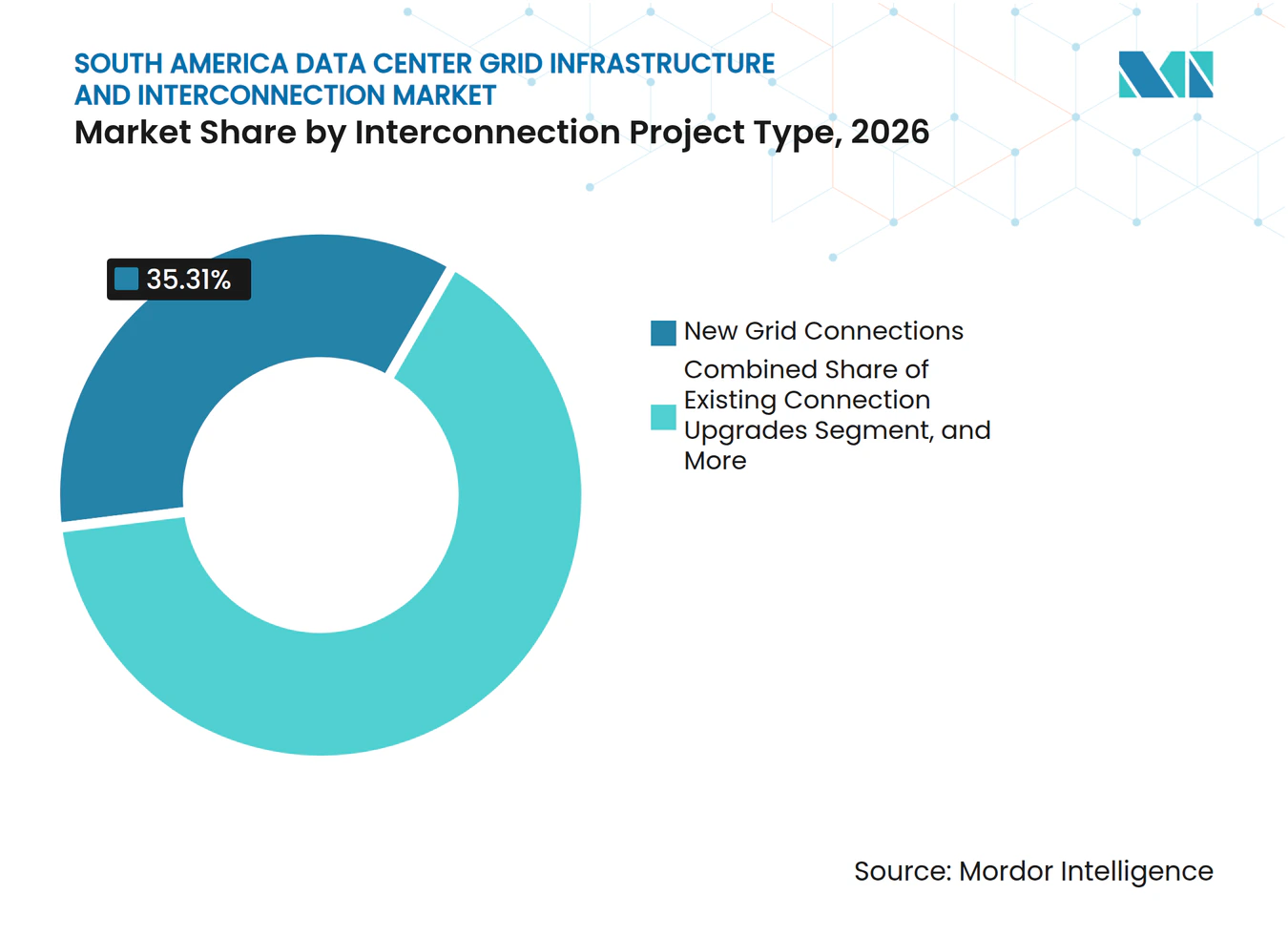
New Connections Lead While Dedicated Lines AccelerateNew Grid Connections held 35.31% of the South America data center grid infrastructure and interconnection market share in 2026. The segment reflects greenfield hyperscale and cloud campuses that need new transmission access points. Large volumes of access applications filed in 2025 and 2026 support near-term demand for these projects. New connections often require voltage levels beyond what distribution systems can serve efficiently. Existing Connection Upgrades are also important as legacy facilities raise their load ceilings for AI workloads. Substation and Grid Interconnection Upgrades can be easier to advance because they build on already licensed sites.
Dedicated Transmission Infrastructure is projected to expand at a 17.74% CAGR through 2032. The segment includes owned or long-term-leased corridors designed to reduce reliance on shared access points. Scala AI City's 525 kV arrangement shows the scale of infrastructure that can be required for a campus-level project. Conecta Infra committed USD 350 million to deploy more than 6,000 km of underground fiber-duct network across Argentina, Chile, and Brazil by 2028. The project illustrates how power and network connectivity must be planned together. At campuses above 100 MW, dedicated infrastructure can lower the per-MW access cost and reduce shared-access reliability exposure.



By Infrastructure Component:
Substations Anchor Capital Spend as Control Systems ScaleSubstations and Switchyards accounted for 29.48% of the South America data center grid infrastructure and interconnection market size in 2026. They form the physical interface between a national transmission system and a data center campus. The Scala and ENGIE Brasil dedicated substation in Barueri involved USD 80 million of investment and 560 MVA of capacity. Siemens Energy also contracted to supply a 300 MW GIS substation and 2 150 MVA transformers for Terranova in Campinas. The contract exceeded BRL 100 million (USD 18.6 million) and used 440/34.5 kV equipment. Urban campuses are increasingly using gas-insulated switchgear because land limits can constrain conventional designs.
Grid Connection, Control, and Monitoring Systems are projected to expand at a 17.92% CAGR through 2032. Each new connection needs systems that support dispatch, visibility, and grid-operation requirements. Regulatory requirements increasingly make real-time operational data a condition of access. Hitachi Energy's January 2026 agreement with RT-One included grid automation, network integration, and SCADA architecture. The agreement also addressed interoperability with the national interconnected system. Power transformers, transmission lines, cables, and protection systems remain important, although they are frequently procured as part of larger substation packages.
By Voltage Level:
High Voltage Dominates as Extra-High Voltage ScalesHigh Voltage connections held 54.93% of the South America data center grid infrastructure and interconnection market share in 2026. This segment represents operational facilities connected at 110 kV to 500 kV. ODATA received authorization to connect SP06 A and SP06 B via a 230 kV busbar at the Cabreúva substation. The combined capacity for the projects is 126 MW. High Voltage remains suited to large facilities that need direct transmission access without the complexity of a national backbone connection. Low and medium-voltage connections continue to serve small facilities and edge deployments through distribution concessionaires.
Extra-High Voltage connections are projected to expand at a 17.51% CAGR through 2032. The segment includes connections at 525 kV and above for projects that exceed conventional high-voltage capacity. ANEEL's authorization for Scala AI City's 525 kV connection established a formal precedent for this approach in Brazil. Such projects require coordination with national transmission planning agencies. The process can extend development timelines, but it provides longer-term access rights. It also reduces the saturation risk associated with heavily used substation nodes. The South America data center grid infrastructure and interconnection market will need more EHV capability if several gigawatt-scale campuses proceed.
By Data Center Size:
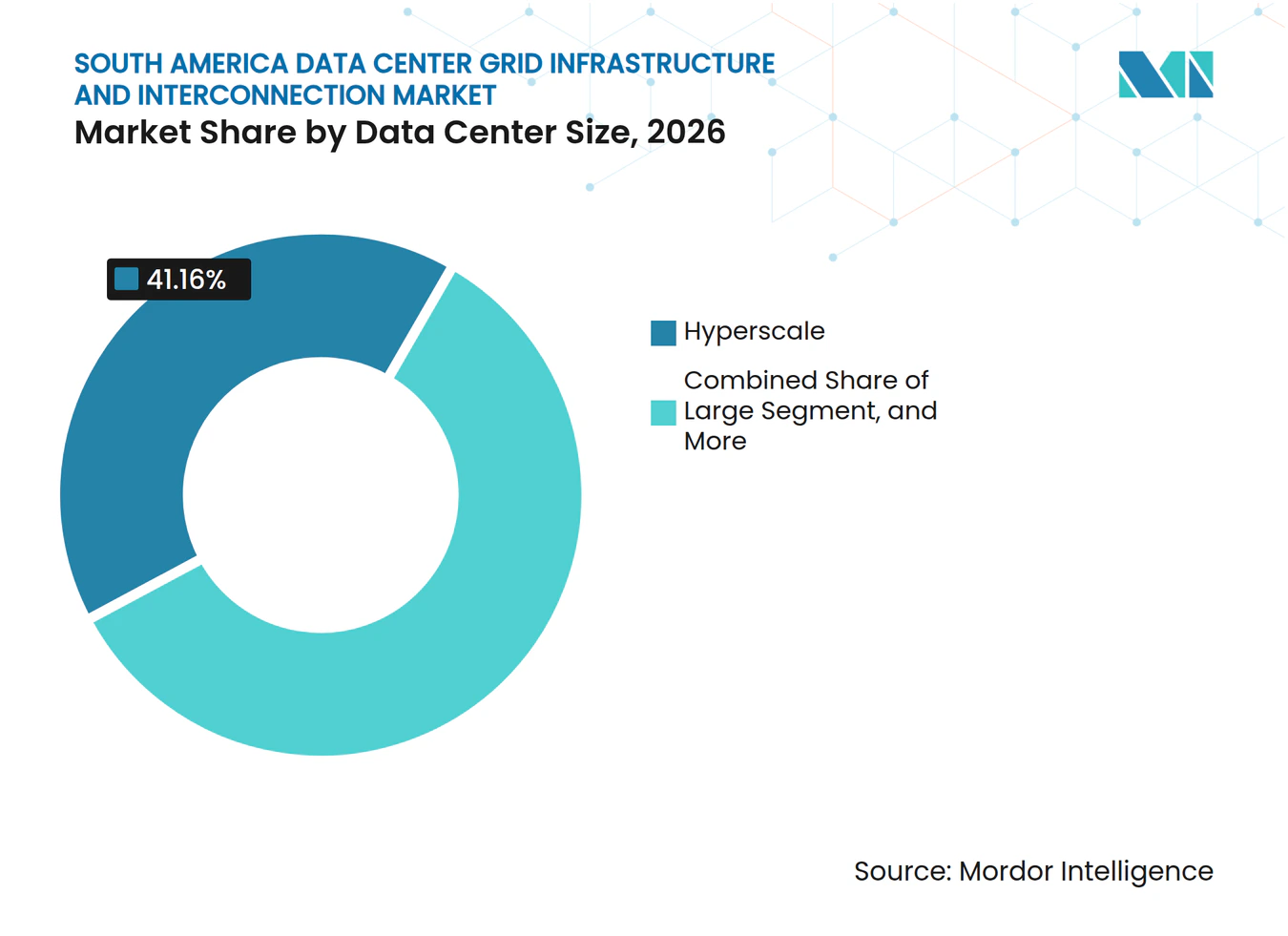
Hyperscale Leads Share and Projected ExpansionHyperscale data centers held 41.16% of the South America data center grid infrastructure and interconnection market share in 2026. They are also projected to expand at a 17.69% CAGR through 2032. This reflects AI projects that require multiple large connection packages at different stages of construction. RT-One has an AI platform with an initial 100 MW phase in Uberlândia and up to 200 MW in Maringá. Scala AI City's target of 4.75 GW also creates a long sequence of staged grid requirements. These facilities are setting the scale and technical specifications for many new interconnection projects.
Large data centers form the next tier and commonly use 220 kV to 330 kV access shared across campus phases. Small and Medium facilities have less ability to justify the cost of dedicated substations. At the same time, urban distribution networks are becoming more congested in São Paulo, Santiago, and Bogotá. Medium-sized facilities may therefore face greater exposure to allocation decisions under PNAST access seasons. ISO 50001 certification is increasingly relevant to energy management practices and grid monitoring specifications. The standard can support more consistent operational processes at facilities that need to demonstrate energy management capability. Size, therefore, affects both the type of connection selected and a developer's ability to manage its cost.

By Data Center Type:
Cloud Service Providers Anchor DemandCloud Service Providers held 39.77% of the South America data center grid infrastructure and interconnection market share in 2026. They are projected to expand at a 17.57% CAGR through 2032. AWS, Microsoft, and Google are pursuing large regional capacity expansions that require dedicated high-voltage infrastructure. Their investment cycles often begin with power and transmission planning before a facility reaches final buildout. Cloud providers can treat connection costs as long-lived fixed infrastructure rather than a shared service expense. This supports higher-voltage specifications and a quicker commitment to specialized engineering work.
Colocation providers represent the second-largest data center type in the South America data center grid infrastructure and interconnection market. Equinix confirmed more than USD 419 million of South America investment across 2025 and 2026, including USD 270 million in Brazil and USD 42 million in Chile. This expansion creates demand across several locations rather than at a single large campus. Enterprise and Edge data centers serve another connection profile through medium-voltage distribution systems. These deployments support local AI inference and telecom points of presence where dedicated substations are impractical. Their need for reliable access still informs regional utility planning.
Geography Analysis
Brazil held 79.43% of the South America data center grid infrastructure and interconnection market share in 2026. The first 2026 PNAST access season received 367 applications requesting more than 20 GW of connections. Thirty-eight of the 43 selected applications were data center projects, totaling 7,040 MW and BRL 159 billion (USD 28.5 billion) of estimated investment. Brazil's EPE is assessing transmission solutions that could support up to 4 GW of new data center load in Ceará and Piauí through 2032. Lei 15.504, known as REDATA, links eligibility conditions to renewable or low-emission electricity and a water-usage effectiveness ceiling of 0.05 liters per kWh. Eletrobras CGT Eletrosul's Guaíba transmission line is central to Scala AI City's direct-access arrangement.
Chile is projected to expand at a 17.96% CAGR through 2032. The Coordinador Eléctrico Nacional forecast data center electricity demand of 642 MW in 2027, 963 MW in 2028, and 1,381 MW in 2030, compared with 325 MW in 2025. Chile's National Data Center Plan was issued in December 2024 and was followed by a MinCiencia investment guide in 2026.[2] The guide provides operators with a clearer route to engage with the grid coordinator and the energy ministry. AWS's USD 4 billion cloud-region investment adds a major new source of demand. Scala's Nova Lampa substation is part of its USD 328 million Chile expansion, demonstrating that dedicated-access designs are extending beyond Brazil.
Colombia is an emerging location for dedicated grid infrastructure beyond Brazil and Chile. ODATA has committed USD 1.3 billion across the BG02 and BG03 projects in Cundinamarca. Its Navarra-Bacatá line and 230/34.5 kV substation have a 50 MW assigned connection capacity. Equinix invested USD 28 million to expand its BG2 Bogotá data center in the first quarter of 2026 and acquired land for further development. Argentina has around 73 MW of operational capacity, but proposals such as the October 2025 OpenAI and Sur Energy letter of intent for up to 500 MW show the possible scale of future demand. Peru's Cirion LIM2 facility in Lurín is a 20 MW high-density node with liquid-cooling capability. Ecuador, Uruguay, and Paraguay remain at an earlier stage, with no publicly documented hyperscale-grade interconnection projects as of October 2026.
Competitive Landscape
Market Concentration
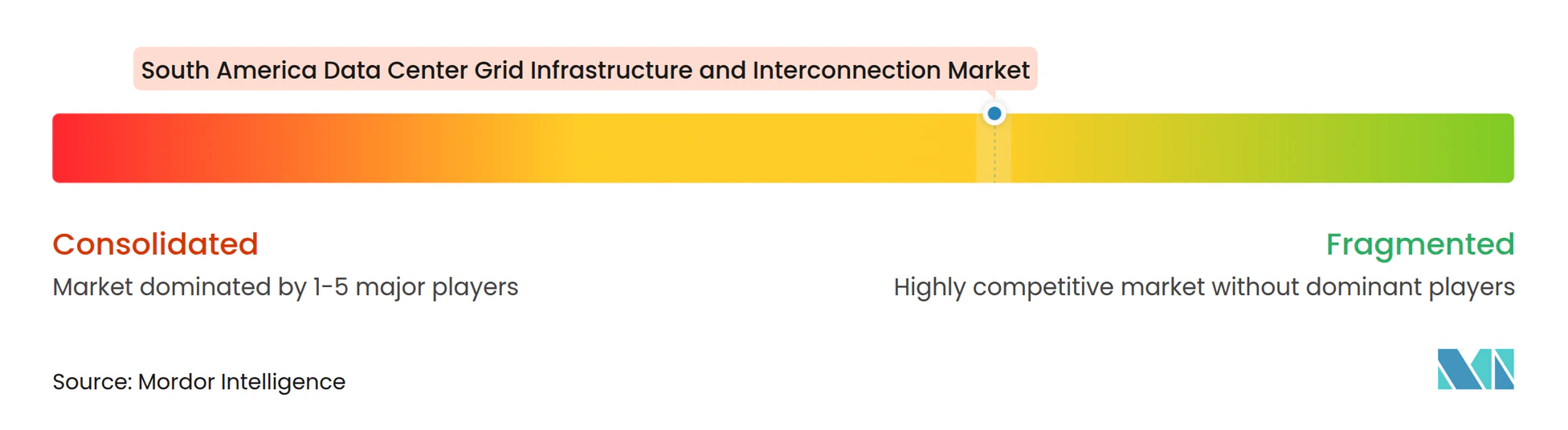
The South America data center grid infrastructure and interconnection market is moderately fragmented among operators and more concentrated among electrical infrastructure suppliers. Hitachi Energy, Siemens Energy, and Schneider Electric have all supplied major projects in Brazil during 2025 and 2026. Hitachi Energy is providing high-voltage electrical systems and grid automation for RT-One campuses in Uberlândia and Maringá.[3] Siemens Energy agreed to provide a 300 MW GIS substation and 2 150 MVA transformers for Terranova in Campinas. Schneider Electric manufactures prefabricated power modules at its Blumenau plant for large campus deployments. Multiple projects running simultaneously may put pressure on equipment lead times and specialized engineering capacity.
Transmission operators ISA Energia Brasil and Eletrobras CGT Eletrosul control access points that are important to many new projects. Their concession rights make them central to delivery, even though they do not compete as equipment suppliers. Scala addressed this constraint with a bespoke 525 kV connection via transmission-line sectioning at Eldorado do Sul. This arrangement provides a campus-specific entry point to the backbone grid. Suppliers with experience in IEC 61850 automation can also have an advantage because standards-compliant communications are becoming a key part of substation design. Smaller colocation providers have fewer options for negotiating dedicated arrangements or funding network modifications. The South America data center grid infrastructure and interconnection market, therefore, has room for grid-integration specialists who can serve projects in the 20-100 MW range.
The competitive environment favors firms that can combine equipment supply, grid automation, and project execution. Hitachi Energy's agreement with RT-One combines high-voltage systems, automation, and national-grid integration. Siemens Energy's Terranova contract combines GIS technology and power transformers within a single dedicated substation scope. Equinix is expanding across Brazil and Chile, creating a distributed procurement pattern rather than a single-project approach. These examples show how suppliers and operators are responding to the need for integrated delivery. The ability to secure grid access and complete infrastructure on schedule is likely to remain a major competitive factor.
South America Data Center Grid Infrastructure and Interconnection Industry Leaders
-
ISA Energia Brasil S.A.
-
Scala Data Centers S.A.
-
Ascenty Data Centers e Telecomunicacoes SA
-
ODATA Data Centers S.A.
-
Axia Energia
- *Disclaimer: Major Players sorted in no particular order
South America Data Center Grid Infrastructure and Interconnection Market Companies Covered in this Report
- ISA Energia Brasil S.A.
- Axia Energia
- Scala Data Centers S.A.
- Ascenty Data Centers e Telecomunicacoes SA
- ODATA Data Centers S.A.
- Tecto Data Centers S.A.
- CloudHQ LLC
- Equinix, Inc.
- Digital Realty Trust, Inc.
- Cirion Technologies, LLC
- EdgeConneX Inc.
- SONDA S.A.
- Telefónica S.A.
- Claro S.A.
- Kyndryl, Inc.
- KIO Networks, S.A. de C.V.
- InterNexa S.A.
- Entel S.A.
- TIVIT Terceirização de Processos, Serviços e Tecnologia S.A.
- Google LLC
- Amazon Web Services, Inc.
- Microsoft Corporation
- Huawei Technologies Co., Ltd.
- Siemens Energy AG
- Schneider Electric SE
- Hitachi Energy Ltd.
Recent Industry Developments in South America Data Center Grid Infrastructure and Interconnection Market
- September 2026: ANEEL issued Despacho 3.506 on September 3, 2026, authorizing Scala Data Centers direct access to Brazil's high-voltage basic grid at 525 kV via sectioning of the Guaíba 3-Nova Santa Rita line operated by Eletrobras CGT Eletrosul, enabling Scala AI City's connection to the national interconnected system and establishing a regulatory precedent for extra-high-voltage data center access in South America.
- September 2026: Brazil enacted Lei 15.504, REDATA, creating tax incentives for IT equipment imports into qualifying data center facilities subject to conditions including renewable or low-emission electricity and a WUE ceiling of 0.05 liters per kWh, the first federal framework explicitly linking grid connection eligibility to sustainability performance standards in the region.
- May 2026: Equinix confirmed over USD 419 million in South America investments spanning 2025-2026, including USD 270 million in Brazil and USD 42 million in Chile, with concurrent expansion at multiple São Paulo, Rio de Janeiro, and Santiago sites, confirming South America as its fastest-growing and most dynamic regional market.
- March 2026: Conecta Infra launched with a USD 350 million commitment to deploy more than 6,000 km of underground fiber-duct network connecting South America's major data center hubs across Argentina, Chile, and Brazil by 2028, addressing the high-capacity connectivity bottleneck between regional data hubs with a carrier-neutral, independent infrastructure model.
South America Data Center Grid Infrastructure and Interconnection Market Report Scope
The South America Data Center Grid Infrastructure and Interconnection Market comprises the infrastructure, equipment, and systems required to connect data centers to the electrical grid and ensure reliable, efficient, and high-capacity power delivery across the region. The market includes new grid connections, upgrades to existing connections, dedicated transmission infrastructure, substations and switchyards, power transformers, transmission lines and cables, switchgear and protection systems, and grid connection, control, and monitoring systems.
The South America Data Center Grid Infrastructure and Interconnection Market Report is Segmented by Interconnection Project Type (New Grid Connections, Existing Connection Upgrades, Dedicated Transmission Infrastructure, and Substation and Grid Interconnection Upgrades), Infrastructure Component (Substations and Switchyards, Power Transformers, Transmission Lines and Cables, Switchgear and Protection Systems, and Grid Connection, Control and Monitoring Systems), Voltage Level (Low and Medium Voltage, High Voltage, and Extra-High Voltage), Data Center Size (Small, Medium, Large, and Hyperscale), Data Center Type (Colocation, Cloud Service Providers [CSPs], and Enterprise and Edge), and Geography (Brazil, Chile, Colombia, Argentina, Peru, and Rest of South America). The Market Forecasts are Provided in Terms of Value (USD).
Segmentation Overview
| New Grid Connections |
| Existing Connection Upgrades |
| Dedicated Transmission Infrastructure |
| Substation and Grid Interconnection Upgrades |
| Substations and Switchyards |
| Power Transformers |
| Transmission Lines and Cables |
| Switchgear and Protection Systems |
| Grid Connection, Control, and Monitoring Systems |
| Low and Medium Voltage |
| High Voltage |
| Extra-High Voltage |
| Small |
| Medium |
| Large |
| Hyperscale |
| Colocation |
| Cloud Service Providers (CSPs) |
| Enterprise and Edge |
| Brazil |
| Chile |
| Colombia |
| Argentina |
| Peru |
| Rest of South America |
| By Interconnection Project Type | New Grid Connections |
| Existing Connection Upgrades | |
| Dedicated Transmission Infrastructure | |
| Substation and Grid Interconnection Upgrades | |
| By Infrastructure Component | Substations and Switchyards |
| Power Transformers | |
| Transmission Lines and Cables | |
| Switchgear and Protection Systems | |
| Grid Connection, Control, and Monitoring Systems | |
| By Voltage Level | Low and Medium Voltage |
| High Voltage | |
| Extra-High Voltage | |
| By Data Center Size | Small |
| Medium | |
| Large | |
| Hyperscale | |
| By Data Center Type | Colocation |
| Cloud Service Providers (CSPs) | |
| Enterprise and Edge | |
| By Geography | Brazil |
| Chile | |
| Colombia | |
| Argentina | |
| Peru | |
| Rest of South America |
Key Questions Answered in the Report
What is the size of the South America data center grid infrastructure and interconnection market?
The South America data center grid infrastructure and interconnection market was valued at USD 1.56 million in 2026. It is estimated at USD 1.93 million in 2027 and is projected to reach USD 3.79 million by 2032, with a 14.45% CAGR over 2027-2032. The estimate covers the infrastructure and services needed to establish and operate data center grid connections across the region. It does not represent the value of the data center facilities themselves. The outlook reflects expected spending on connections, substations, transmission-related infrastructure, and grid control systems needed for new data center capacity.
What is driving demand for data center grid connections in South America?
Hyperscale construction, cloud-region investment, and AI workloads are increasing demand for high-capacity grid access. These developments require new substations, high-voltage connections, monitoring systems, and coordinated transmission planning. The underlying challenge is that new data center capacity can be built faster than major transmission reinforcements. Projects therefore increasingly assess available grid headroom and connection rights before committing to construction schedules. Long-term renewable-power contracts also matter because they can be considered alongside grid access, environmental compliance, and operating requirements.
Which country leads data center grid infrastructure activity in South America?
Brazil held 79.43% share in 2026. Its lead reflects a large installed data center base, extensive access applications, the PNAST allocation process, and large-scale projects that need direct high-voltage access. The country also has active national planning work for future data center loads in Ceará and Piauí. Its importance means that Brazilian approvals and transmission availability can affect regional project timing. Large projects in São Paulo and Rio Grande do Sul demonstrate why available capacity at specific grid nodes can be as important as broad national electricity supply.
Which grid connection type is expanding fastest through 2032?
Dedicated Transmission Infrastructure is projected to expand at a 17.74% CAGR through 2032. It is used where very large campuses need greater control over transmission access and reduced reliance on shared connection points. This approach can include purpose-built lines, substation arrangements, and long-term access structures. It becomes more relevant when conventional distribution access cannot deliver the required scale, reliability, or timetable. The model is particularly relevant for projects that need staged additions of capacity over several years rather than a single conventional distribution connection.
Why are dedicated substations important for large data centers?
Dedicated substations provide a direct interface with the transmission system and can support strict uptime requirements. They also help operators manage high loads where local distribution networks lack sufficient available capacity. The arrangement can reduce exposure to congestion at shared nodes. It can also align equipment, automation, and protection systems with a campus's planned power profile and staged construction requirements. The Barueri and Campinas projects show that these assets can require specialized GIS equipment, transformers, monitoring systems, and detailed coordination with the transmission network.
Which South American country has the fastest projected expansion through 2032?
Chile is projected to expand at a 17.96% CAGR through 2032. Cloud investment, a defined national planning framework, and rising electricity demand from data centers are increasing the need for new grid infrastructure. The national investment guide helps operators coordinate with relevant public institutions. Dedicated projects such as the Nova Lampa substation also show that large campuses are moving toward direct infrastructure solutions. Demand is forecast to increase from 325 MW in 2025 to 1,381 MW in 2030, which makes new transmission access and clear approval processes important.