
South America Data Center Disaster Resilience and Business Continuity Market Size and Share
Market Overview
| Study Period | 2021 - 2032 |
|---|---|
| Forecast Data Period | 2027 - 2032 |
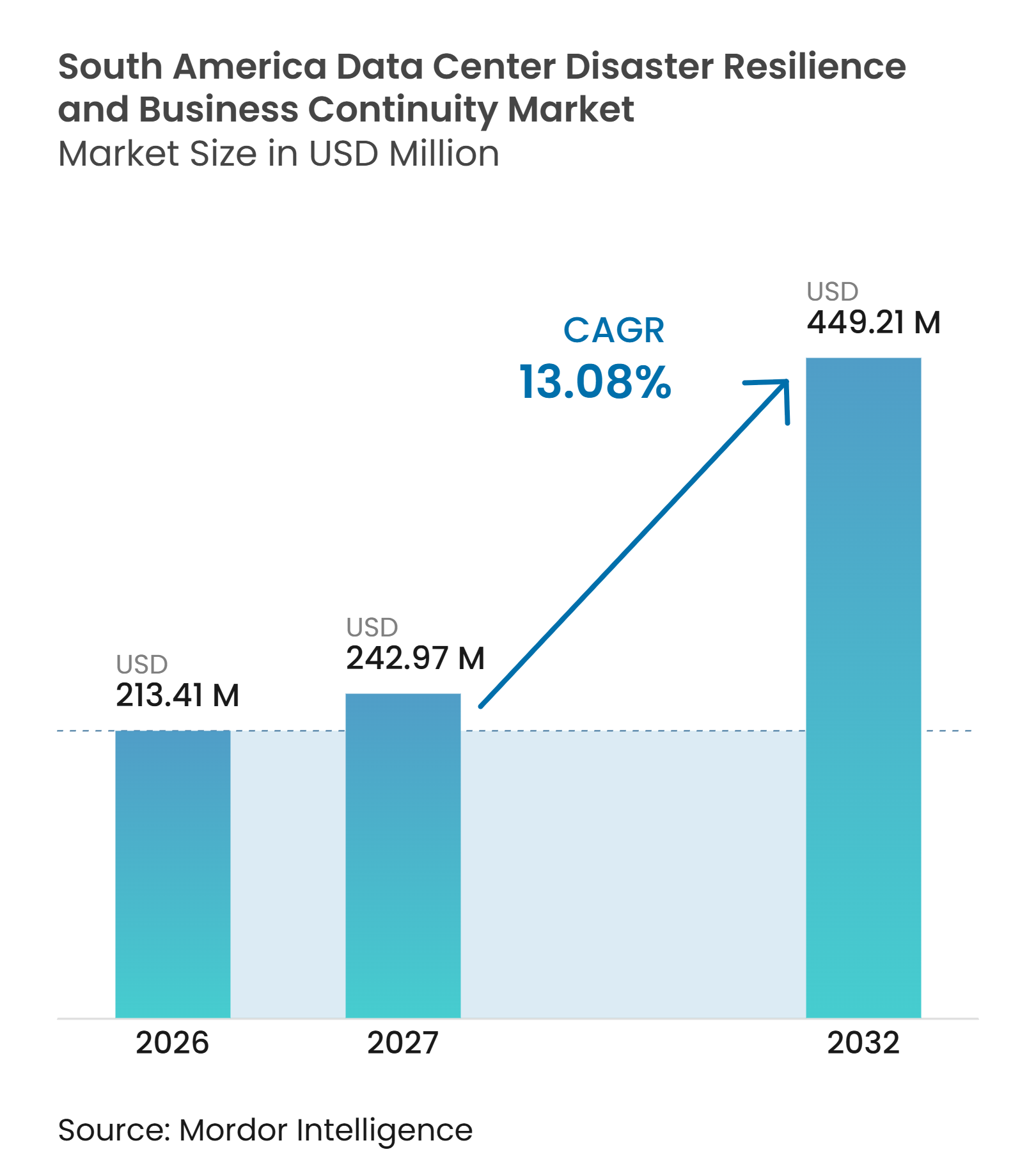
| Base Year Market Size (2026) | USD 213.41 Million |
| Market Size (2027) | USD 242.97 Million |
| Market Size (2032) | USD 449.21 Million |
| Growth Rate (2027 - 2032) | 13.08 % |
| Market Concentration | Medium |
Major Players *Disclaimer: Major Players sorted in no particular order Image © Mordor Intelligence. Reuse requires attribution under CC BY 4.0. | |
South America Data Center Disaster Resilience and Business Continuity Market Analysis by Mordor Intelligence
The South America data center disaster resilience and business continuity market size was valued at USD 213.41 million in 2026 and is estimated to expand from USD 242.97 million in 2027 to reach USD 449.21 million by 2032, at a CAGR of 13.08% during the forecast period, 2027-2032. Demand is shifting from backup products to tested recovery programs that cover business impact analysis, dependency mapping, crisis coordination, and recovery execution. New cloud regions and colocation capacity are increasing the number of critical workloads that need a documented recovery path. Cyber incidents and stricter data protection rules are also moving continuity spending earlier in enterprise technology budgets. Global vendors are strengthening local channels, while colocation providers are adding managed resilience services to their customer contracts.
Key Report Takeaways
- By component, services held 41.64% of the South America data center disaster resilience and business continuity market share in 2026, while software and platforms are projected to expand at a CAGR of 13.48% through 2032.
- By deployment mode, cloud accounted for 46.83% of the South America data center disaster resilience and business continuity market share in 2026 and is expected to expand at a CAGR of 13.46% through 2032.
- By data center type, cloud service providers held 35.59% of the South America data center disaster resilience and business continuity market share in 2026 and are projected to expand at a CAGR of 13.63% through 2032.
- By end-user industry, IT and telecommunications accounted for 22.13% of the South America data center disaster resilience and business continuity market share in 2026, while BFSI is projected to expand at a CAGR of 14.53% through 2032.
- By geography, Brazil held 66.21% of the South America data center disaster resilience and business continuity market share in 2026, while Argentina is projected to expand at a CAGR of 13.77% through 2032.
Note: Market numbers in this report are based on Mordor Intelligence's proprietary estimation framework, which combines nine months of actuals with Q4 projections for base year 2026.
Market Trends and Insights
Drivers Impact Analysis of South America Data Center Disaster Resilience and Business Continuity Market*
| Driver | (~) % Impact on CAGR Forecast | Geographic Relevance | Impact Timeline |
|---|---|---|---|
| Rising Cloud and Hybrid IT Adoption | +3.5% | Regional, with concentrated gains in Brazil and Chile | Medium term (2-4 years) |
| Increasing Cyberattacks and Ransomware Exposure | +3.0% | Brazil, Argentina, and Chile | Short term (≤ 2 years) |
| Growing Regulatory and Data-Protection Obligations | +2.0% | Brazil and Chile | Medium term (2-4 years) |
| Expansion of Hyperscale and Colocation Data Centers | +1.5% | Brazil and Chile, with spillover to Argentina | Medium term (2-4 years) |
| Rising Demand for Automated Recovery Orchestration | +1.5% | Regional, especially multicloud environments | Long term (≥ 4 years) |
| Critical Infrastructure Concentration in Power-Constrained Metros | +1.0% | Brazil and Argentina | Medium term (2-4 years) |
| Source: Mordor Intelligence | |||
Rising Cloud and Hybrid IT Adoption
Cloud adoption is increasing the number of workloads that require an independently tested recovery path, including applications that now rely on managed databases, identity services, and shared connectivity rather than a single internal technology stack. IBM reported that Brazilian organizations moving IBM Power workloads to cloud environments are using cross-region recovery configurations for production systems. Hybrid estates retain older on-premises systems alongside cloud services, making recovery sequencing and dependency mapping more difficult, as a recovery can fail if a linked application or interface is unavailable. This complexity complicates implementation and supports the demand for continuity management platforms that can provide business and technical teams with a shared view of recovery steps. The South America data center disaster resilience and business continuity market benefits as recovery design becomes part of cloud migration planning rather than a later procurement decision.
Increasing Cyberattacks and Ransomware Exposure
Ransomware and configuration failures can disrupt operations even when core applications remain available, because recovery systems, credentials, records, and communication channels may also be affected. Recorded Future identified 452 ransomware incidents across South America in 2025, including 128 incidents in Brazil and 63 in Argentina. A 2025 incident involving a Brazilian healthcare software provider exposed 94,000 patient records after weaknesses in cloud configuration were exploited. These events increase scrutiny of backup integrity, recovery access controls, crisis response procedures, and the ability to restore systems without allowing an attacker to re-enter the environment. The South America data center disaster resilience and business continuity market, therefore, gains from a shift from periodic verification toward continuous recovery readiness.
Growing Regulatory and Data-Protection Obligations
Brazil's data protection authority established rules for international data transfers under Resolution CD/ANPD No. 19/2024. Organizations operating cloud recovery environments must understand data flows and breach response responsibilities. Brazil's REDATA proposal also identifies disaster recovery and business continuity as exceptions within proposed domestic storage requirements for sensitive data.[1] Chile changed its environmental permitting thresholds in 2025, supporting the development of additional data center capacity. These compliance factors make documented and testable recovery arrangements more relevant in the South America data center disaster resilience and business continuity market.
Expansion of Hyperscale and Colocation Data Centers
Large facilities concentrate critical workloads and increase the cost of a site-level interruption, particularly when a tenant uses the facility for production systems that support many business customers. Scala Data Centers secured USD 328 million in July 2025 to fund 3 hyperscale facilities and a power substation in Chile. Operators are responding by deploying preconfigured resilience tools that connect to hyperscaler application programming interfaces and can be activated within the same environment as the hosted workload. These offerings can increase contract value by combining infrastructure, monitoring, and recovery services, and by clarifying the division of responsibilities among the operator, provider, and tenant. The expansion of these sites broadens the addressable market for South America data center disaster resilience and business continuity.
Restraints Impact Analysis of South America Data Center Disaster Resilience and Business Continuity Market*
| Restraint | (~) % Impact on CAGR Forecast | Geographic Relevance | Impact Timeline |
|---|---|---|---|
| High Implementation and Integration Costs | -1.8% | Regional, most pronounced in Brazil and Argentina mid-market firms | Medium term (2-4 years) |
| Shortage of Specialized Resilience and Data Center Personnel | -1.5% | Brazil, Chile, and Argentina | Medium term (2-4 years) |
| Fragmented Cloud, Legacy, and On-Premises Recovery Environments | -1.2% | Regional multivendor hybrid estates | Medium term (2-4 years) |
| Limited Availability of Disaster-Recovery-Ready Secondary Sites | -0.8% | Markets outside Tier-1 metros | Long term (≥ 4 years) |
| Source: Mordor Intelligence | |||
High Implementation and Integration Costs
Integrated platforms require licenses, professional services, testing, and recurring program management. Organizations that moved workloads without building recovery capabilities may incur separate acquisition and back-migration testing costs. The World Economic Forum reported that 51% of employers in South America prioritize public funding for reskilling, which indicates limited internal capacity for major technology programs. Rubrik and Cognizant introduced a business resilience-as-a-service model in 2025 to reduce upfront spending. Sales cycles can still be longer, where buyers need local implementation partners and budget approval.
Shortage of Specialized Resilience and Data Center Personnel
The constraint is strongest in roles that combine business impact analysis, cloud operations, and failover engineering. Brazil has a projected annual shortage of 106,000 digital technology professionals, according to Brasscom's report, as cited in the draft. Chile's National Employment Service identified 6,000 unfilled information technology positions in January 2025. This gap raises the value of managed continuity services and automated recovery tools. It can also limit a client's ability to supervise a provider during a live recovery event.
*Our forecasts treat driver/restraint impacts as directional, not additive. The impact forecasts reflect baseline growth, mix effects, and variable interactions.
South America Data Center Disaster Resilience and Business Continuity Market Segment Analysis
By Component:
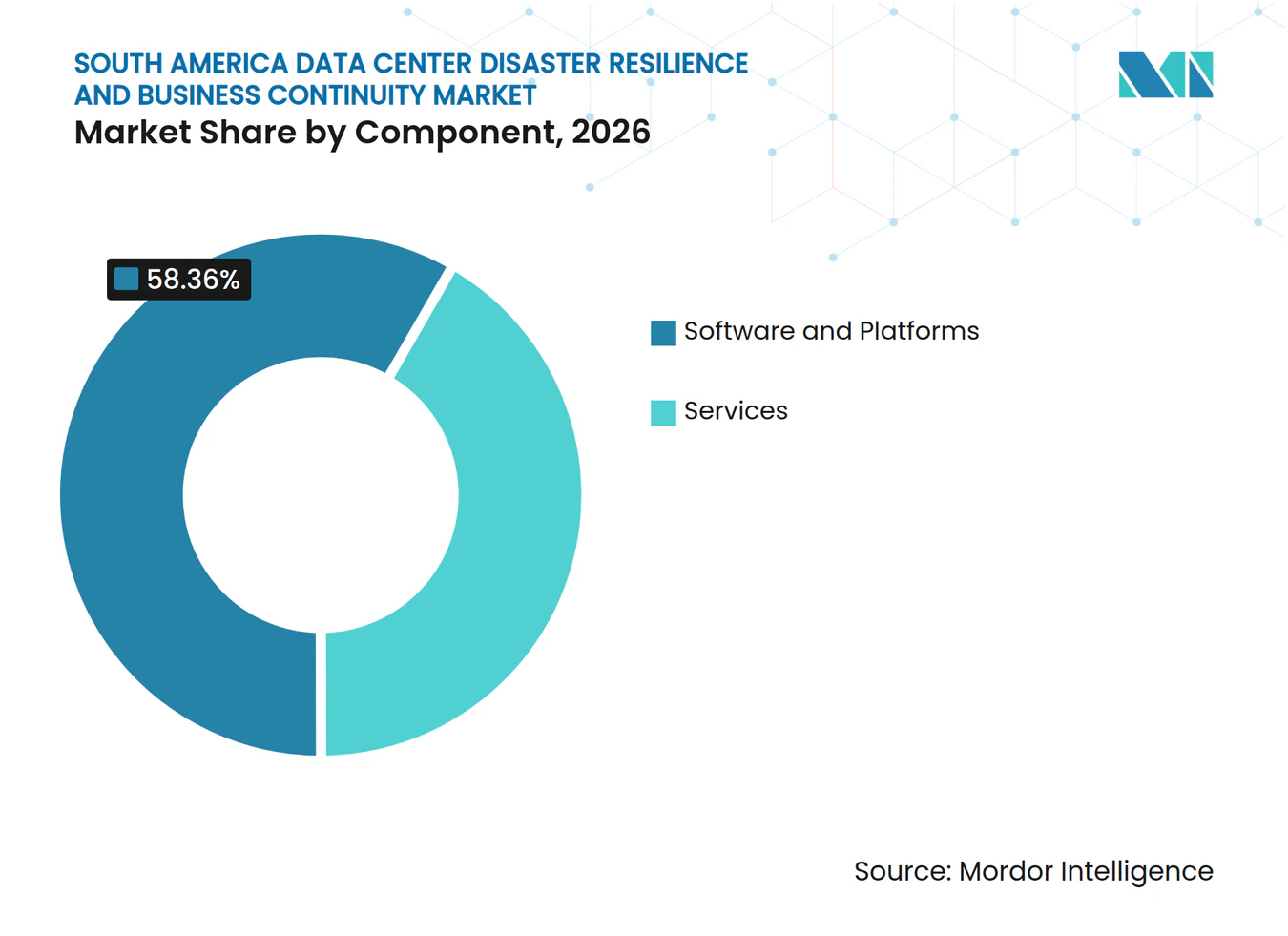
Services Lead While Software and Platforms ScaleServices held 41.64% of the South America data center disaster resilience and business continuity market share in 2026, reflecting a shortage of internal teams capable of managing technical recovery and organization-wide continuity responsibilities. Advisory, business impact analysis, and resilience assessments commonly begin the enterprise relationship by identifying critical processes, application dependencies, recovery priorities, and accountable decision makers. These assignments are often followed by continuity planning, crisis response design, recovery exercises, and updates to procedures after a test or operational incident. Managed continuity programs suit banking and telecommunications customers that face recurring reviews and need documented evidence for internal risk teams, customers, and supervisory bodies. Testing, simulation, and training are gaining importance as organizations need evidence that plans work in practice across technical, operational, and communications functions.
Service providers also benefit from the integration burden created by cloud, on-premises, and colocation recovery environments, particularly where legacy applications depend on systems managed by more than 1 infrastructure provider. Commvault and Hitachi Vantara described their Brazilian alliance as a model for integrated regional delivery. Software and platforms are projected to expand at a CAGR of 13.48% through 2032 as buyers seek fewer disconnected tools and clearer oversight of recovery obligations. These platforms integrate business impact analysis, dependency mapping, recovery planning, crisis coordination, audit records, and testing workflows into a single governance process. Veeam introduced its Data Cloud platform capabilities in 2026 to support unified data protection and governance needs.


By Deployment Mode:
Cloud Leads as Distributed Recovery Becomes More RelevantCloud accounted for 46.83% of the South America data center disaster resilience and business continuity market share in 2026. It is projected to expand at a CAGR of 13.46% through 2032. Cloud recovery can provide consumption-based pricing for organizations that could not support large upfront deployments, while allowing capacity to be activated when a recovery event or a formal test requires it. It also allows recovery workloads to be placed outside the primary application's location, which improves options when a local disruption affects facilities, power, or connectivity. This matters in Chile, where primary and secondary sites have often been located within the same seismic area, potentially resulting in insufficient geographic separation.
Oracle Database@Azure became available in Brazil Southeast in January 2026, adding a paired cloud option for Brazilian workloads and illustrating the increasing availability of coordinated multicloud recovery architectures. On-premises deployment remains relevant for government entities and financial institutions with localization obligations, established internal controls, and workloads that cannot readily be moved. Brazil's Institutional Security Office issued a 2025 cloud computing rule for classified information. Hybrid configurations keep sensitive systems locally hosted while using cloud zones for recovery, thereby meeting operating and compliance needs. They also require careful segmentation, orchestration, runbooks, and testing to ensure that failover does not expose data or interrupt dependent applications.
By Data Center Type:
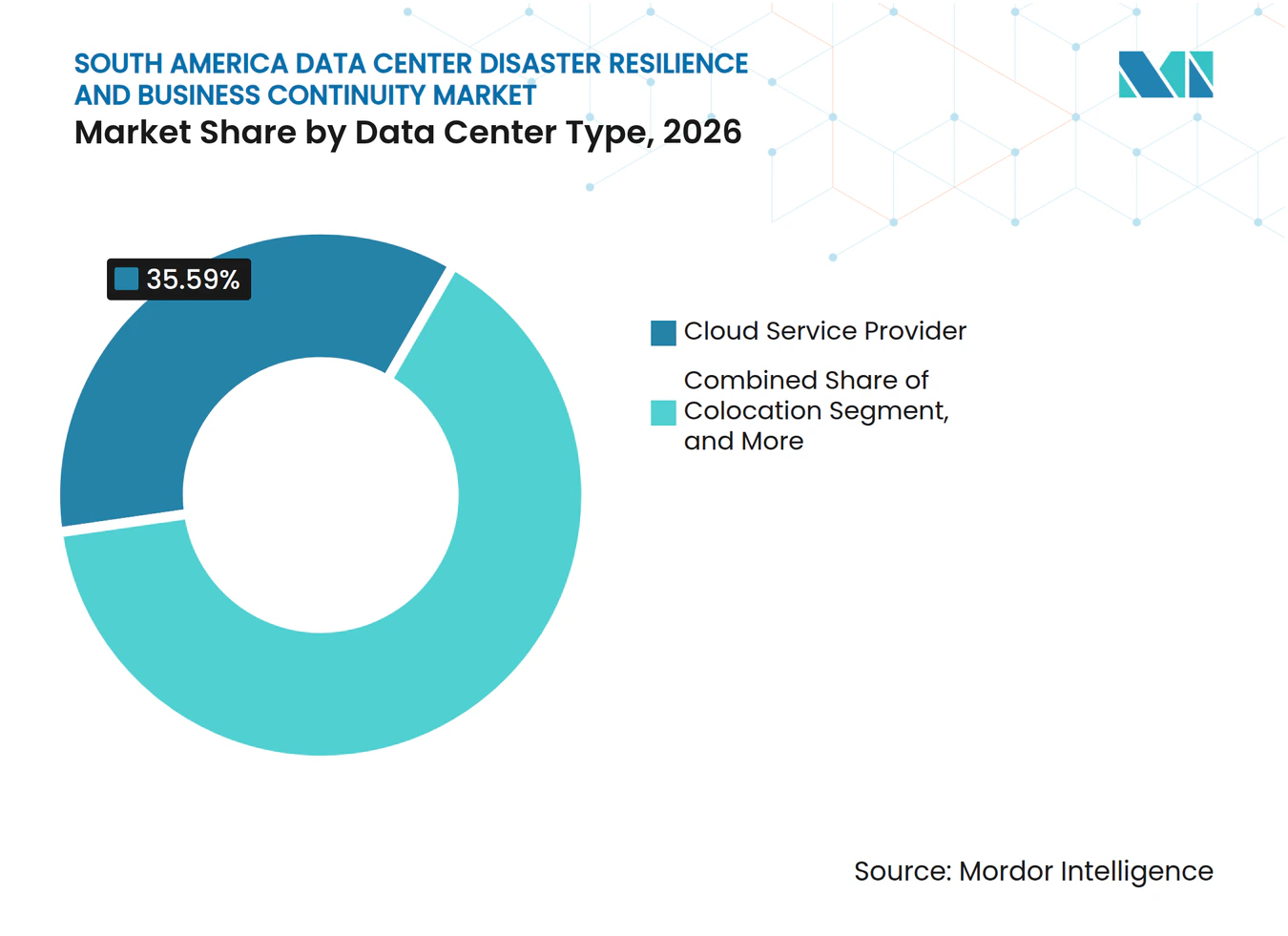
Cloud Service Providers Combine Scale and MomentumCloud service providers held 35.59% of the South America data center disaster resilience and business continuity market share in 2026. They are projected to expand at a CAGR of 13.63% through 2032. Additional cloud regions from AWS, Microsoft, Google, and Oracle are changing how enterprises obtain recovery capacity, especially for systems that need a second availability zone but cannot justify a dedicated physical site. Oracle secured a cloud disaster recovery agreement with Grupo Sada in 2025. This example shows how cloud zones can replace dedicated secondary infrastructure for some workloads while retaining technical controls, service commitments, and repeatable recovery processes.
Recovery is increasingly treated as part of the primary cloud contract rather than a wholly separate purchase, particularly when customers use managed databases, storage, and application services. This can increase adoption of resilience platforms available through cloud marketplaces and simplify procurement for existing cloud customers. Colocation sites remain important because they connect multiple cloud providers in carrier-neutral facilities and provide enterprises with a neutral location for multicloud recovery arrangements. Equinix stated that Brazil remains a priority country and that it has 8 operational data centers there, with a 9th under construction in 2025. Enterprise and edge locations can provide local contingency capacity where latency, data processing needs, and grid reliability are operational concerns.


By End-User Industry:
IT and Telecommunications Lead While BFSI AcceleratesIT and telecommunications accounted for 22.13% of the South America data center disaster resilience and business continuity market share in 2026. The sector is both a major data center customer and an integrator of recovery services for other enterprises, making its own operating practices influential across the broader technology ecosystem. SONDA deployed an AIOps platform in 2026 that autonomously resolved more than 60% of routine infrastructure incidents. This illustrates the move toward automated responses at the infrastructure layer, where faster identification of recurring issues can free up staff time for complex recovery decisions. Healthcare is also becoming a more urgent buyer category after the 2025 Brazilian healthcare data exposure highlighted the potential impact of cloud configuration failures.
BFSI is projected to expand at a CAGR of 14.53% through 2032. Financial institutions are placing greater weight on testing, simulations, demonstrated recovery outcomes, and the ability to restore systems without compromising sensitive records. IBM described a South American bank's use of IBM Cloud Power Virtual Server for cross-regional disaster recovery in 2025. ISO 22301 is increasingly relevant in procurement because it establishes a recognized business continuity management framework. Government, manufacturing, retail, energy, and utilities have different recovery priorities but face the same need to manage critical application dependencies, internal responsibilities, and communication requirements during disruption.
Geography Analysis
Brazil: Scale, Regulation, and Distributed Capacity
Brazil held 66.21% of the South America data center disaster resilience and business continuity market share in 2026. Its position reflects the scale of its digital economy, its concentration of enterprise workloads, and a comparatively developed regulatory environment for data handling. The South America data center disaster resilience and business continuity market size in Brazil is supported by capacity expansion beyond the São Paulo corridor, which increases the practical options for distributed recovery design. Brazil's data protection authority oversees the LGPD framework, while the Institutional Security Office sets rules for cloud processing of classified data. IBM's São Paulo multizone cloud service gives enterprises an additional route for cross-region recovery planning and can help clients keep recovery arrangements aligned with local operating requirements.
Argentina: New Hyperscale Commitments Change Recovery Requirements
Argentina is projected to expand at a CAGR of 13.77% through 2032. OpenAI and Sur Energy signed a letter of intent in October 2025 for a USD 25 billion, 500 MW Patagonia data center project under the RIGI incentive program. Facilities of this size require formal recovery designs, multiple recovery paths, managed continuity programs, and clear testing responsibilities across infrastructure, software, and operations teams. Cirion expanded its BUE1 carrier-neutral site in Buenos Aires by more than 2 MW in August 2025.[2] The expansion supports demand from AI-intensive and high-availability workloads that require low-latency connectivity and credible recovery arrangements as customers expand production deployments.
Chile, Uruguay, and Other South American Markets: Resilience Beyond Core Hubs
Chile's seismic exposure gives geographic separation a central role in recovery design, as an event affecting one metropolitan area can test both application availability and the readiness of connected service providers. Scala's 2025 financing for 3 hyperscale facilities and a power substation shows that new capacity is being built with supporting power infrastructure. Chile's environmental permitting adjustments can support additional capacity, while resilience buyers need to avoid locating both primary and recovery systems within a single metropolitan grid. Uruguay and other South American markets remain less mature, but digital government programs, secondary-city investment, and emerging cloud commitments can create later demand for managed recovery services.
Competitive Landscape
Market Concentration
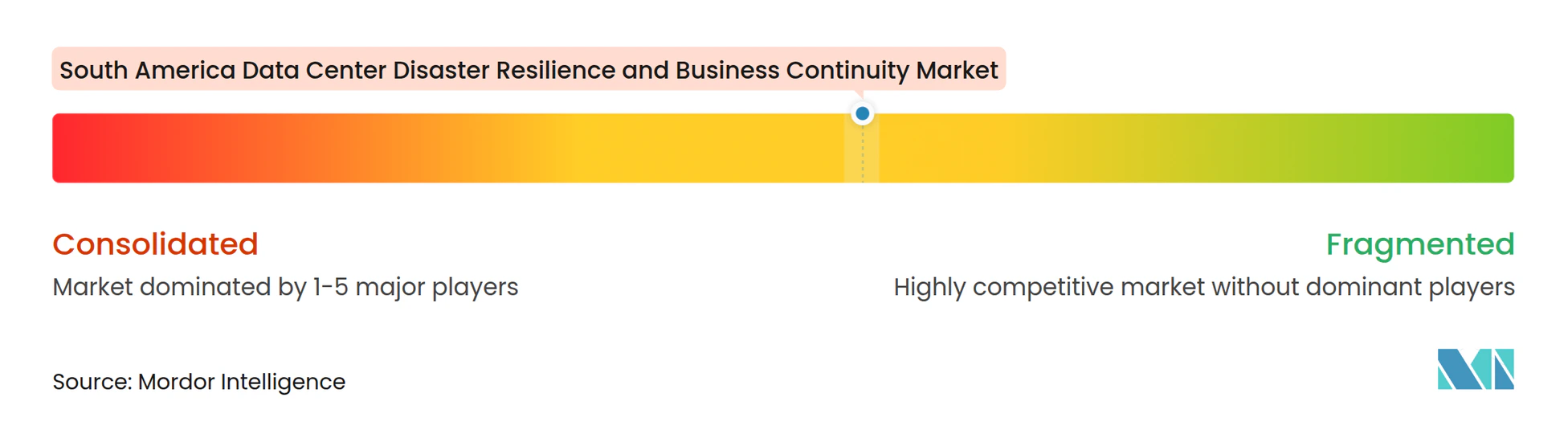
The South America data center disaster resilience and business continuity market is moderately fragmented. IBM, Veeam, Commvault, Rubrik, and Cohesity compete on software platforms, partner networks, cloud marketplace access, and their ability to support customers across diverse technology environments. Ascenty, Scala, Equinix, and Cirion compete through colocation capacity, redundancy features, renewable power arrangements, and interconnection options. The market concentration score is 4 out of 10 because no combined share for the leading companies is provided, and the presence of numerous global vendors and regional infrastructure providers indicates a dispersed supplier base. Competition is strongest in integrated services that combine software, managed support, testing, local delivery, and documented compliance support for regulated clients.
Commvault expanded its Brazil channel relationship with Ingram Micro in November 2025, strengthening access to enterprise and government customers through a local distribution route. Veeam completed its acquisition of Securiti AI for USD 1.725 billion in December 2025.[3]The acquisition added data security posture management, privacy governance, and artificial intelligence governance capabilities to its resilience offering, which aligns data recovery decisions more closely with security and compliance teams. Rubrik and Cognizant launched a business resilience-as-a-service partnership in October 2025. This model targets buyers who need ransomware recovery without a large initial license commitment and may suit organizations that prefer predictable operating spending.
Everbridge, ServiceNow, and Ekatra launched an emergency event management solution in December 2025. Automated recovery orchestration is becoming a competitive differentiator as buyers seek faster, more repeatable responses and less dependence on manual runbooks during time-sensitive incidents. A 2026 peer-reviewed study reported a cloud-native prototype with a restoration time objective below 3 minutes and a continuity point objective below 5 seconds. Providers that combine automation with local support, compliance expertise, and credible implementation services can address gaps in areas outside the largest regional hubs, where enterprises may have fewer specialist resources.
South America Data Center Disaster Resilience and Business Continuity Industry Leaders
-
International Business Machines Corporation
-
Microsoft Corporation
-
Amazon Web Services, Inc.
-
Equinix, Inc.
-
Ascenty Data Centers e Telecomunicações S.A.
- *Disclaimer: Major Players sorted in no particular order
South America Data Center Disaster Resilience and Business Continuity Market Companies Covered in this Report
- International Business Machines Corporation
- Microsoft Corporation
- Amazon Web Services, Inc.
- Google LLC
- Oracle Corporation
- Cisco Systems, Inc.
- Hewlett Packard Enterprise Company
- Veeam Software Group GmbH
- Commvault Systems, Inc.
- Dell Technologies Inc.
- Rubrik, Inc.
- Cohesity, Inc.
- Zerto Ltd.
- Equinix, Inc.
- Ascenty Data Centers e Telecomunicações S.A.
- Scala Data Centers S.A.
- ODATA Serviços de Tecnologia Ltda.
- Cirion Technologies, LLC
- Elea Data Centers S.A.
- Lumen Technologies, Inc.
- ServiceNow, Inc.
- Everbridge, Inc.
- Fusion Risk Management, Inc.
- Riskonnect, Inc.
- MetricStream, Inc.
Recent Industry Developments in South America Data Center Disaster Resilience and Business Continuity Market
- October 2026: Colliers published a market survey identifying a pipeline of 8 data center projects in Chile totaling 367.8 MW and USD 1.616 billion in investment through 2031. Projects led by Amazon, Google, Microsoft, Scala, and Equinix are concentrated in Santiago's Quilicura, Huechuraba, and Lampa corridors. The scale of committed capacity implies a corresponding expansion in disaster resilience procurement as hyperscale tenants mandate provider-grade recovery commitments embedded in lease agreements.
- August 2026: Ascenty initiated a search for a USD 1 billion minority investor to fund the ongoing data center expansion in São Paulo state, following the May 2026 announcement of a USD 1.2 billion investment plan for 4 AI-focused facilities including Sumaré 3, the first South American data center designed from the ground up for hyperscale AI workloads, with 60 MW of its 90 MW initial capacity already contracted to a single global technology client. The concentration risk inherent in single-tenant hyperscale facilities is a direct driver of site-level disaster resilience spending.
- May 2026: Veeam launched the DataAI Command Platform, integrating data protection, governance, identity management, and AI application support into a unified interface. The platform built upon Veeam's December 2025 acquisition of Securiti AI for USD 1.725 billion, which added data security posture management and AI governance capabilities directly relevant to LGPD compliance workflows in Brazil.
- March 2026: Conecta Infra announced a USD 350 million phased investment to build subsea fiber infrastructure linking South America's major data center hubs through 2028. The project improves interconnectivity between primary and recovery sites across Brazil, Chile, and Argentina, reducing latency in replication paths and strengthening the physical layer of regional disaster resilience architectures.
South America Data Center Disaster Resilience and Business Continuity Market Report Scope
The South America Data Center Disaster Resilience and Business Continuity Market encompasses solutions and services that help organizations protect critical data, maintain IT operations, and recover business processes during disruptions such as cyberattacks, power outages, and system failures.
The South America Data Center Disaster Resilience and Business Continuity Market Report is Segmented by Component (Software and Platforms, and Services), Deployment Mode (Cloud, On-Premises, and Hybrid), Data Center Type (Cloud Service Provider, Colocation, and Enterprise and Edge), End User Industry (BFSI, IT and Telecom, Government and Public Administration, Healthcare and Life Sciences, Manufacturing, Energy and Utilities, and Other End User Industries), and Geography (Brazil, Chile, Argentina, and Rest of South America). The Market Forecasts are Provided in Terms of Value (USD).
Segmentation Overview
| Software and Platforms | Integrated Continuity and Resilience Management Platforms |
| Standalone Business Impact Analysis and Dependency Mapping Software | |
| Standalone Continuity Planning and Documentation Software | |
| Standalone Crisis Response and Incident Coordination Software | |
| Others (Standalone Resilience Exercise and Testing Management Software, etc) | |
| Services | Advisory, Business Impact Analysis, and Resilience Assessment Services |
| Continuity and Crisis Response Plan Development Services | |
| Software Implementation and Systems Integration Services | |
| Resilience Testing, Simulation, and Training Services | |
| Managed Continuity Program Services |
| Cloud |
| On-Premises |
| Hybrid |
| Cloud Service Provider |
| Colocation |
| Enterprise and Edge |
| IT and Telecommunications |
| Banking, Financial Services, and Insurance |
| Government and Public Administration |
| Healthcare and Life Sciences |
| Manufacturing |
| Retail and E-Commerce |
| Energy and Utilities |
| Other Industries |
| Brazil |
| Chile |
| Argentina |
| Rest of South America |
| By Component | Software and Platforms | Integrated Continuity and Resilience Management Platforms |
| Standalone Business Impact Analysis and Dependency Mapping Software | ||
| Standalone Continuity Planning and Documentation Software | ||
| Standalone Crisis Response and Incident Coordination Software | ||
| Others (Standalone Resilience Exercise and Testing Management Software, etc) | ||
| Services | Advisory, Business Impact Analysis, and Resilience Assessment Services | |
| Continuity and Crisis Response Plan Development Services | ||
| Software Implementation and Systems Integration Services | ||
| Resilience Testing, Simulation, and Training Services | ||
| Managed Continuity Program Services | ||
| By Deployment Mode | Cloud | |
| On-Premises | ||
| Hybrid | ||
| By Data Center Type | Cloud Service Provider | |
| Colocation | ||
| Enterprise and Edge | ||
| By End User Industry | IT and Telecommunications | |
| Banking, Financial Services, and Insurance | ||
| Government and Public Administration | ||
| Healthcare and Life Sciences | ||
| Manufacturing | ||
| Retail and E-Commerce | ||
| Energy and Utilities | ||
| Other Industries | ||
| By Geography | Brazil | |
| Chile | ||
| Argentina | ||
| Rest of South America | ||
Key Questions Answered in the Report
What is the South America data center disaster resilience and business continuity market size?
The market was valued at USD 213.41 million in 2026 and is estimated to reach USD 449.21 million by 2032 at a CAGR of 13.08%.
Which component leads spending on data center resilience in South America?
Services led with 41.64% share in 2026 because enterprises need advisory, implementation, testing, and managed continuity support.
Why is cloud deployment important for recovery planning?
Cloud held 46.83% share in 2026 and can place recovery workloads away from the primary application location.
Which end-user sector has the fastest projected expansion?
BFSI is projected to expand at a CAGR of 14.53% through 2032 as financial institutions increase recovery testing and compliance activity.
Which country leads regional demand for disaster resilience services?
Brazil held 66.21% share in 2026, supported by its large digital economy, cloud infrastructure, and data protection requirements.
What is the main barrier to wider adoption of continuity platforms?
High implementation, integration, testing, and specialist staffing costs can delay decisions, especially among mid-market organizations.