
South America Data Center Disaster Recovery Infrastructure Market Size and Share
Market Overview
| Study Period | 2021 - 2032 |
|---|---|
| Forecast Data Period | 2027 - 2032 |
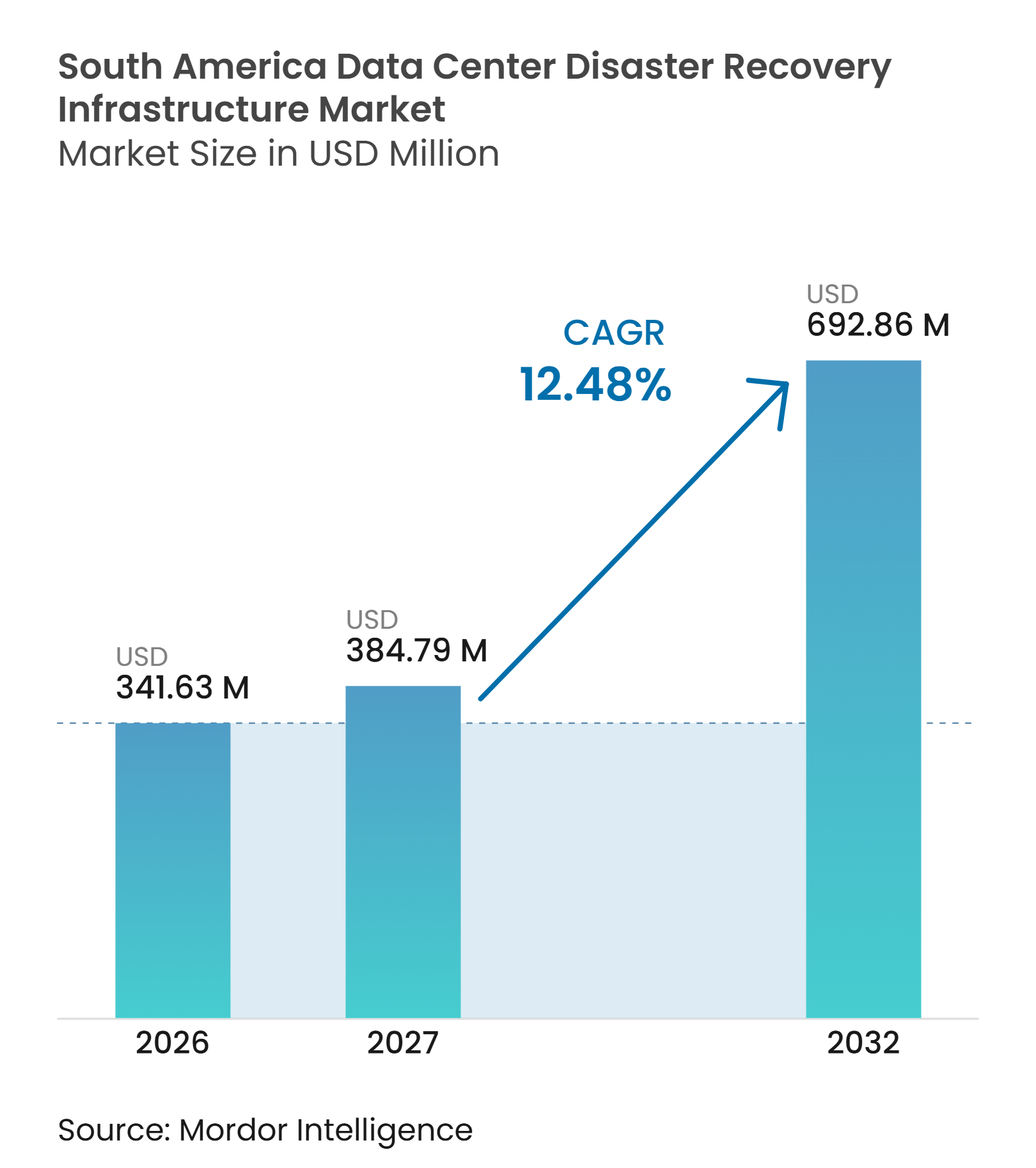
| Base Year Market Size (2026) | USD 341.63 Million |
| Market Size (2027) | USD 384.79 Million |
| Market Size (2032) | USD 692.86 Million |
| Growth Rate (2027 - 2032) | 12.48 % |
| Market Concentration | Medium |
Major Players *Disclaimer: Major Players sorted in no particular order Image © Mordor Intelligence. Reuse requires attribution under CC BY 4.0. | |
South America Data Center Disaster Recovery Infrastructure Market Analysis by Mordor Intelligence
The South America data center disaster recovery infrastructure market size is projected to expand from USD 341.63 million in 2026 to USD 692.86 million by 2032, registering a CAGR of 12.48% from 2027 and 2032. Demand is rising as enterprises protect larger digital estates from ransomware, service interruptions, and site-level disruptions. New cloud regions and colocation facilities increase the number of production workloads that require tested recovery arrangements. Regulatory attention in financial services also moves recovery planning from a technology preference to an operating requirement. Providers that combine local hosting, network diversity, and managed testing are positioned to address this need. The South America data center disaster recovery infrastructure market is therefore shifting toward recovery environments that can be tested regularly and activated with less manual intervention.
Key Report Takeaways
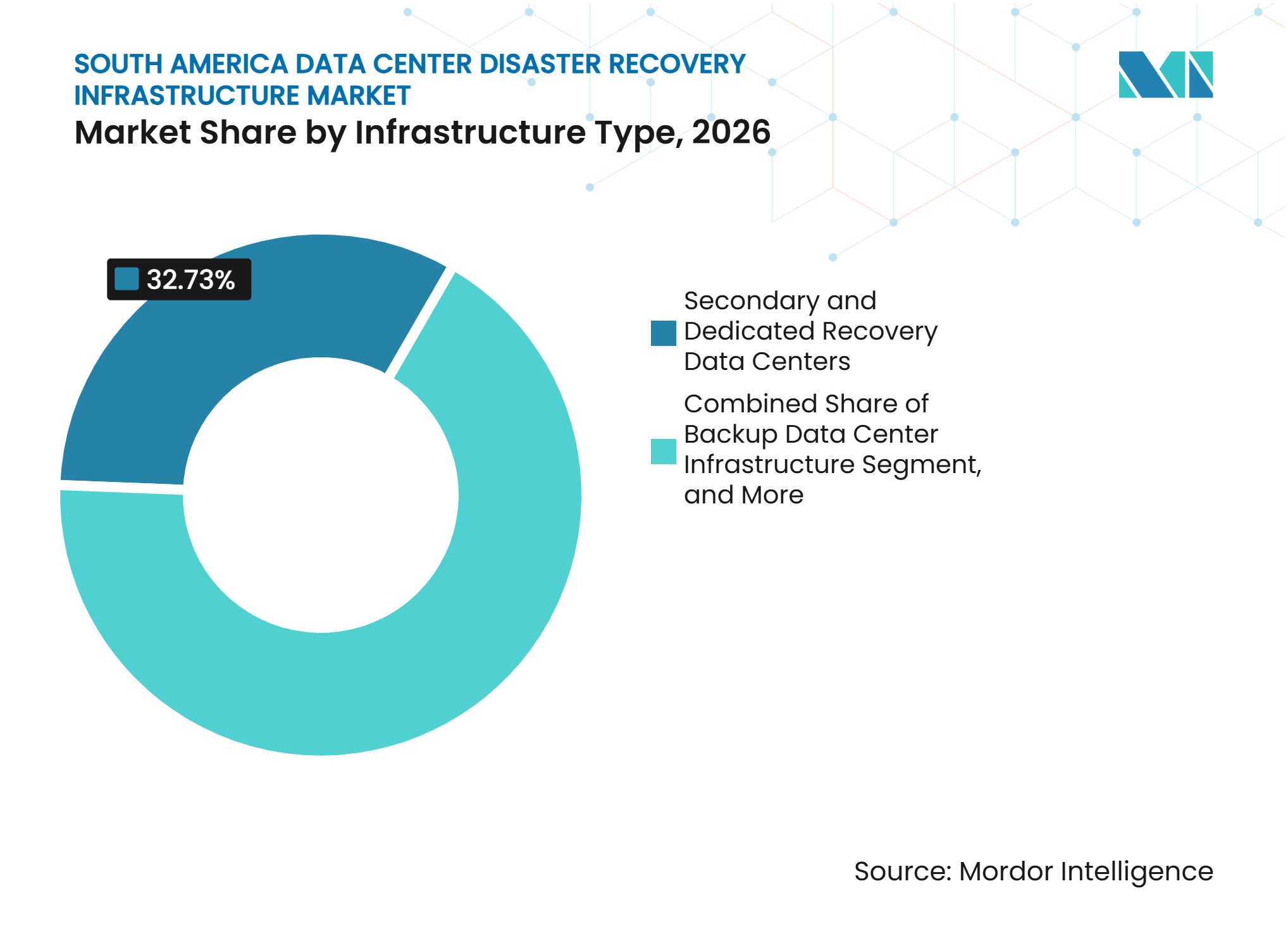
- By infrastructure type, Secondary and Dedicated Recovery Data Centers held 32.73% of the South America data center disaster recovery infrastructure market share in 2026, while Cloud-Based Disaster Recovery Infrastructure is projected to expand at a 13.41% CAGR through 2032.
- By deployment model, On-Premises Disaster Recovery held 35.68% of the South America data center disaster recovery infrastructure market share in 2026, while Disaster Recovery-as-a-Service is projected to grow at a 13.52% CAGR through 2032.
- By recovery architecture, Active-Passive architectures accounted for 29.42% of revenue in 2026, while Continuous Data Replication is projected to advance at a 13.38% CAGR through 2032.
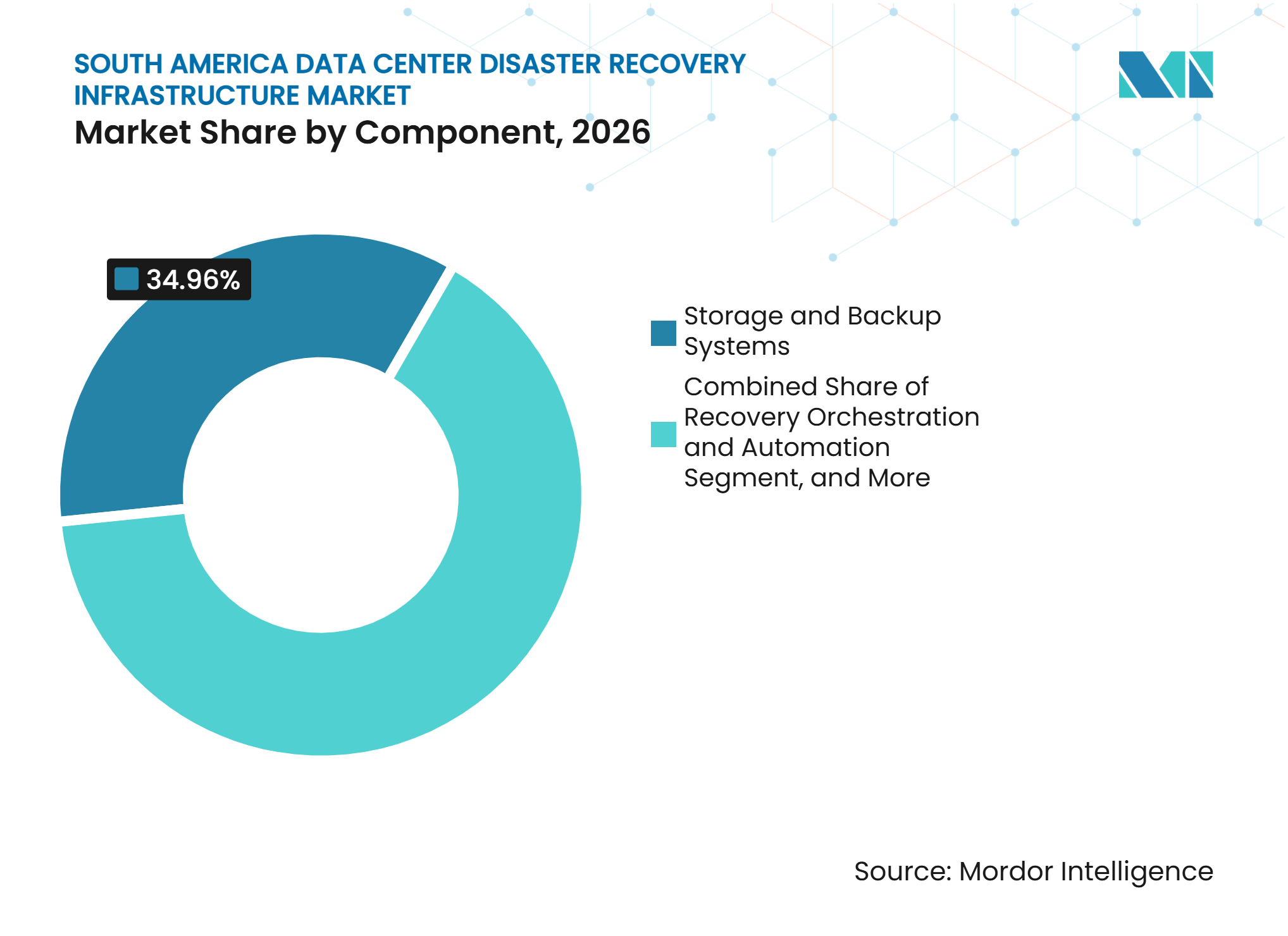
- By component, Storage and Backup Systems held 34.96% of revenue in 2026, while Recovery Orchestration and Automation is projected to expand at a 13.46% CAGR through 2032.
- By application, Critical Business Application Recovery accounted for 38.84% of revenue in 2026, while Cloud-Native Application Recovery is projected to grow at a 13.56% CAGR through 2032.
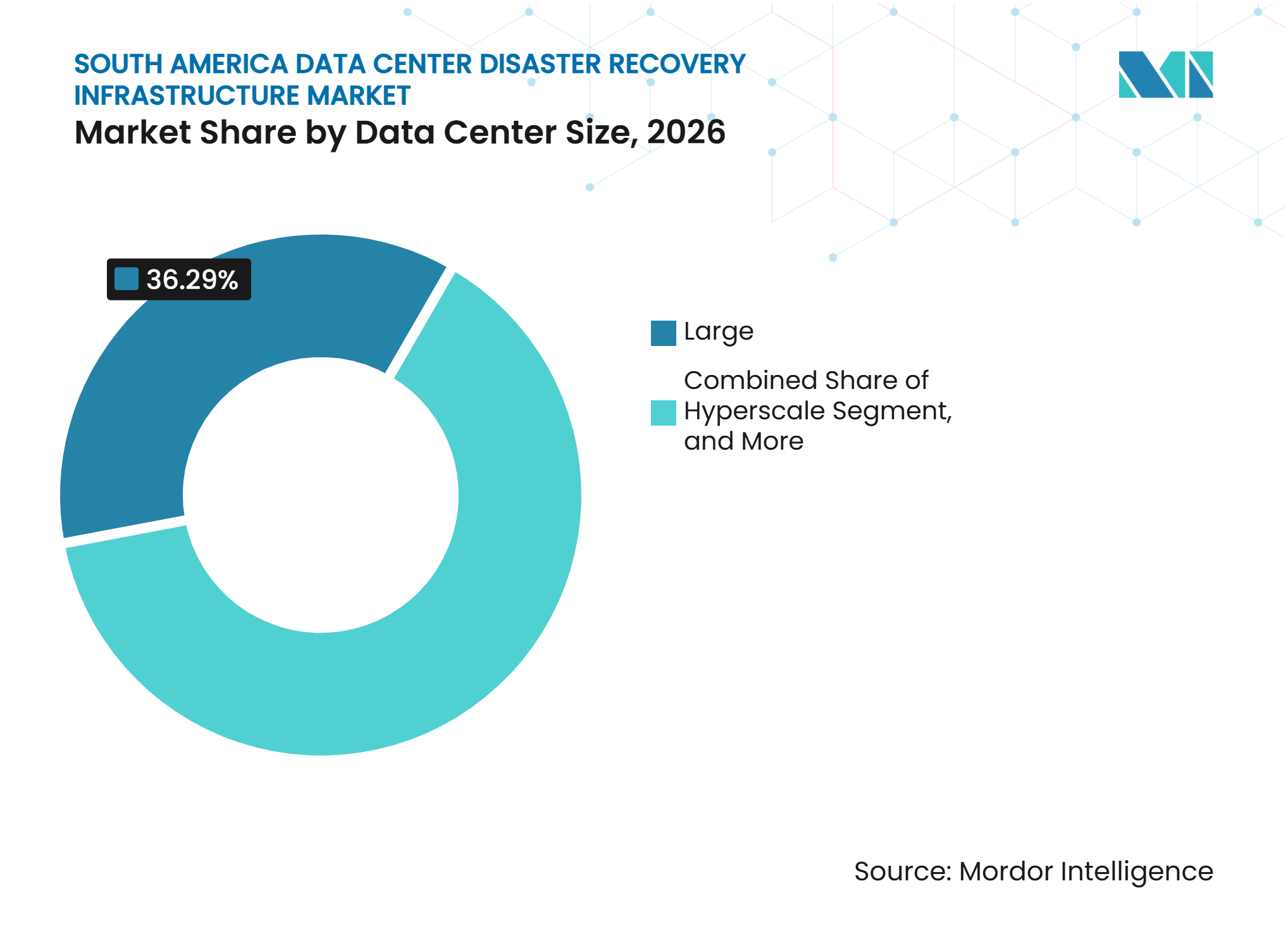
- By data center size, Large Data Centers held 36.29% of revenue in 2026, while Hyperscale Data Centers are projected to expand at a 13.42% CAGR through 2032.
- By data center type, Colocation Data Centers accounted for 45.37% of revenue in 2026, while Cloud Service Providers are projected to grow at a 13.48% CAGR through 2032.
- By geography, Brazil held 56.53% of revenue in 2026, while Argentina is projected to expand at a 13.54% CAGR through 2032.
Note: Market numbers in this report are based on Mordor Intelligence's proprietary estimation framework, which combines nine months of actuals with Q4 projections for base year 2026.
Market Trends and Insights
Drivers Impact Analysis of South America Data Center Disaster Recovery Infrastructure Market*
| Driver | (~) % Impact on CAGR Forecast | Geographic Relevance | Impact Timeline |
|---|---|---|---|
| Ransomware and Cyberattack Exposure | +3.2% | Brazil, Argentina, Colombia, with spillover to Chile and Peru | Short term (≤ 2 years) |
| Hybrid and Multicloud Recovery Needs | +2.8% | Brazil, expanding to Chile, Colombia, and Argentina | Medium term (2-4 years) |
| Regulatory and Audit Requirements | +2.1% | Brazil financial and government sectors, and Chile | Short term (≤ 2 years) |
| Hyperscale and Colocation Capacity Growth | +1.8% | Brazil and Chile | Medium term (2-4 years) |
| Seismic and Grid-Correlation Risk | +0.9% | Chile and Brazil | Long term (≥ 4 years) |
| Supplier and Cloud Recovery Testing Gaps | +0.7% | Brazil, Colombia, Chile, and secondary cities | Medium term (2-4 years) |
| Source: Mordor Intelligence | |||
Ransomware and Cyberattack Exposure
Dragos reported 64 industrial ransomware incidents in South America in the second quarter of 2026, with Brazil and Argentina representing half of the recorded volume.[1] Financial services, retail, and professional services face particular exposure as Qilin, Akira, and SafePay target business data and operational systems. These conditions push organizations to use immutable backups and live-tested recovery environments rather than relying solely on passive copies. The South America data center disaster recovery infrastructure market benefits when boards require evidence that a critical system can be restored before an attack occurs.
Cloud Migration and Hybrid-Multicloud Adoption
Brazilian enterprises are spreading workloads across cloud platforms, local facilities, and colocation sites. This mix can improve flexibility, but it complicates recovery because applications and data must be restored in the right sequence across different environments. ISG reported that Brazilian organizations were moving some AI training workloads to colocation facilities to control operating costs and governance requirements. Kyndryl completed RIMAC's cloud modernization program in July 2026, moving core transactional systems to Oracle Cloud Infrastructure within a multicloud environment and reducing processing times by up to 80%. This approach creates a need for orchestration that can coordinate recovery across cloud zones and co-located equipment. The South America data center disaster recovery infrastructure market is supported by providers that can manage these mixed environments without forcing customers into a single platform.
Regulatory and Audit Pressure for Verifiable Recovery
Financial institutions in Brazil face more formal oversight of cybersecurity and recovery. The U.S. International Trade Administration states that Brazil's GSI/PR Normative Instruction No. 8/2025 requires classified government information to remain in Brazilian territory. Data localization makes local recovery sites and in-country cloud zones more important for public-sector workloads and their suppliers. Annual testing and documented evidence of recovery also increase demand for monitoring, failover management, and recovery reporting tools. These requirements give senior management a direct view of operational resilience rather than leaving it within technical teams. The South America data center disaster recovery infrastructure market gains a more stable demand base when testing and documentation become recurring operating activities.
Hyperscale and Colocation Capacity Growth
New production capacity creates a corresponding need to protect workloads and data. Equinix stated in May 2026 that it was advancing data center expansion across South America, including Brazil and Chile. Multi-campus operators can offer customers physical separation between primary and recovery equipment while keeping network connections short and manageable. This model can be more practical than building a wholly owned secondary site for each enterprise. It is especially relevant to financial institutions and large corporate tenants that need documented service levels. The South America data center disaster recovery infrastructure market also benefits from colocation providers that can offer capacity, interconnection, and recovery testing in one operating arrangement.
Restraints Impact Analysis of South America Data Center Disaster Recovery Infrastructure Market*
| Restraint | (~) % Impact on CAGR Forecast | Geographic Relevance | Impact Timeline |
|---|---|---|---|
| High Cost of Dedicated Recovery Capacity | -1.5% | Colombia, Peru, and Rest of South America, with Brazil partly mitigated by incentives | Medium term (2-4 years) |
| Shortage of Resilience and Recovery Talent | -1.0% | Brazil secondary cities, Chile outside Santiago, Colombia, Peru, and Argentina | Long term (≥ 4 years) |
| Cross-Border Data Transfer and Sovereignty Complexity | -0.7% | Brazil, Colombia, and Chile | Medium term (2-4 years) |
| Power, Connectivity, and Fiber-Route Concentration | -0.5% | Chile, Brazil, and Rest of South America | Long term (≥ 4 years) |
| Source: Mordor Intelligence | |||
High Upfront Cost of Dedicated Recovery Capacity
Dedicated secondary sites require duplicate capacity for compute, storage, power, and cooling. These environments may operate at 30-50% of primary-site scale while remaining lightly used between tests. That model competes directly with primary modernization budgets in Colombia, Peru, and Chile. Subscription-based disaster recovery services reduce the need for large capital outlays and make enterprise-grade recovery more accessible to mid-sized companies. The tradeoff is reliance on provider service levels, available capacity, and a third party's operational controls. The South America data center disaster recovery infrastructure market therefore sees stronger interest in managed recovery services, even where regulated customers retain some dedicated capacity.
Shortage of Specialized Resilience and Recovery Talent
Resilience programs require staff who can design recovery plans, run tests, document results, and improve procedures after each exercise. Uptime Institute's 2025 survey found workforce gaps above 30% in data center operations and electrical and mechanical roles among its global respondents. The shortfall is more difficult in secondary cities, where facility growth can outpace relevant technical training. Organizations with limited specialist capacity may defer testing, even after purchasing backup and replication tools. That delay can widen the gap between stated recovery objectives and real operational readiness. Managed providers can address some of this gap, but customers still need internal owners who understand the applications and approval process.
*Our forecasts treat driver/restraint impacts as directional, not additive. The impact forecasts reflect baseline growth, mix effects, and variable interactions.
South America Data Center Disaster Recovery Infrastructure Market Segment Analysis
By Infrastructure Type:
Secondary Sites Anchor Spending as Cloud Recovery ExpandsSecondary and Dedicated Recovery Data Centers accounted for 32.73% of the South America data center disaster recovery infrastructure market in 2026. Financial institutions and large energy companies use separate facilities to protect systems that cannot tolerate a prolonged outage. These sites support air-gapped recovery and physical distance from the main operating environment. Backup Data Center Infrastructure and Replication and Data Protection Infrastructure provide baseline protection for companies that still operate much of their technology locally. Failover and Recovery Orchestration Infrastructure is becoming more important as teams replace manual runbooks with repeatable workflows. Network and Connectivity Infrastructure also matters because a recovery site has limited value if the route between sites fails during an incident.
Cloud-Based Disaster Recovery Infrastructure is projected to grow at a 13.41% CAGR through 2032. AWS is commissioning a cloud region in Chile, backed by a USD 4 billion commitment in the country, which will add another location for geographically separated recovery arrangements. Logicalis and Nutanix also expanded their partnership in 2026 to deliver hybrid multicloud infrastructure and recovery capabilities across the region. The mix of cloud and colocation capacity makes the South America data center disaster recovery infrastructure market less dependent on dedicated enterprise facilities. Customers increasingly need designs that connect cloud services to local systems without weakening data control. The strongest offerings combine rapid cloud recovery with governance, testing, and connectivity suitable for regulated applications.



By Deployment Model:
On-Premises Recovery Leads While DRaaS Broadens AccessOn-premises disaster recovery accounted for 35.68% of revenue in 2026. Public-sector organizations and their suppliers often use this model, in which data residency and direct operational control are central requirements. Brazil's government data rules reinforce the need to keep certain classified information within the country. On-premises environments can also support organizations that operate legacy core systems with complex dependencies. However, the model requires capital, facility capacity, and staff who can maintain and test the recovery estate.
Disaster Recovery-as-a-Service is projected to expand at a 13.52% CAGR through 2032. The service model helps mid-sized companies in Colombia, Peru, and other smaller markets use recovery capabilities without owning a second site. Oi Soluções added Veeam Backup and Restore to its AWS-integrated cloud portfolio in January 2025 for organizations operating hybrid and multicloud environments.[2] Colocation-based and hybrid recovery remain relevant where customers want local capacity but prefer a provider to run part of the environment. The South America data center disaster recovery infrastructure market favors service providers that can clearly explain service levels, recovery testing responsibilities, and data location. DRaaS does not remove governance responsibility, but it can reduce the cost and staffing burden of maintaining a secondary site.
By Recovery Architecture:
Active-Passive Remains the Practical BaselineActive-Passive architectures accounted for 29.42% of revenue in 2026. The model maintains a standby environment that can take over when the primary system is unavailable. It is widely used for ERP platforms and core banking systems where recovery point objectives can be met through scheduled replication. Organizations can control costs because they do not need continuous synchronization for every workload. Active-Active systems serve use cases that require near-continuous availability, particularly in financial market infrastructure and telecommunications. Warm standby, cold standby, and backup-and-restore designs continue to support less critical applications with different cost and recovery priorities.
Continuous Data Replication is projected to expand at a 13.38% CAGR through 2032. Technologies such as NetApp SnapMirror Synchronous and Oracle OCI Full Stack Disaster Recovery support low-latency data protection for organizations with demanding recovery requirements. More frequent testing also encourages enterprises to choose architectures that reduce manual steps. Backup and restore remain relevant because clean recovery points are essential after ransomware incidents. Commvault introduced its Cloud Unity platform in August 2025 with resilience operations automation, threat scanning, and cross-platform failover orchestration. The South America data center disaster recovery infrastructure market is moving toward architectures that can protect both traditional systems and cloud-based workloads under a common recovery plan.
By Component:
Storage Systems Lead While Automation Gains MomentumStorage and Backup Systems accounted for 34.96% of component revenue in 2026. Large financial institutions and energy operators continue to rely on established SAN, NAS, Oracle, SAP, and mainframe environments. These environments require application-aware backup tools and reliable media management. Compute and Server Infrastructure is often purchased with Data Replication Software when customers deploy dedicated standby clusters. Network and Connectivity Systems are also essential because recovery performance depends on diverse routes between primary and secondary sites. The component mix reflects the need to protect data, restore infrastructure, and reconnect users in a controlled sequence.
Recovery Orchestration and Automation is projected to grow at a 13.46% CAGR through 2032. Automation can reduce manual runbook work in hybrid environments where application dependencies change frequently. It can also document test results for audit and internal review. Commvault's Cloud Unity combines resilience operations automation with cross-platform orchestration across cloud and security tools. Monitoring, Testing, and Failover Management tools become increasingly important when recovery testing becomes a recurring activity rather than a yearly event. The South America data center disaster recovery infrastructure market places increasing emphasis on these tools because an available backup is not the same as a verified recovery process.

By Application:
Critical Systems Lead as Cloud-Native Workloads AccelerateCritical Business Application Recovery accounted for 38.84% of revenue in 2026. ERP, core banking, and operational technology applications remain central because their disruption can stop customer service, payments, or production. Database and Data Platform Recovery is also important for Oracle, SQL Server, and SAP HANA environments that need application-consistent snapshots and log protection. Virtual Machine and Workload Recovery supports the large installed base of virtualized systems in enterprise facilities and colocation sites. Enterprise IT Recovery is increasingly important as hybrid work makes collaboration platforms part of daily operations. These applications require clear recovery priorities so teams restore the most critical services first.
Cloud-Native Application Recovery is projected to expand at a 13.56% CAGR through 2032. Containerized and microservices-based workloads require recovery procedures that understand distributed application dependencies. Traditional virtual-machine snapshots cannot always restore a cloud-native application in the required order. Commvault's resilience operations approach illustrates how vendors are extending recovery automation across containers, virtual machines, and cloud services. Telecommunications and media providers also need high-availability recovery because service interruptions can trigger contractual penalties. The South America data center disaster recovery infrastructure market is expected to reward vendors that can protect these modern applications without separating them from the rest of the enterprise recovery plan.
By Data Center Size:
Large Facilities Lead While Hyperscale Capacity GrowsLarge Data Centers held 36.29% of revenue in 2026. These facilities offer the tenant density, service-level governance, and testing conditions that support formal disaster recovery programs. Operators can provide dedicated cross-connects and scheduled testing windows for enterprise customers. Medium-sized data centers remain important in cities such as Curitiba, Córdoba, and Concepción, where customers want recovery capacity close to their operating locations. Small facilities continue to support edge and distributed use cases in areas with limited carrier-neutral supply. Each size category addresses a different balance between proximity, capacity, and operating control.
Hyperscale Data Centers are projected to expand at a 13.42% CAGR through 2032. Cloud providers can reserve recovery capacity near production regions rather than wait for a separate greenfield project. This approach can be useful where permitting, grid access, and local construction timelines limit the speed of new capacity. Equinix's Chile expansion added 425 cabinets and liquid-cooling capabilities to support higher-density workloads in 2025. Larger facilities and hyperscale capacity are likely to support more shared recovery services. The South America data center disaster recovery infrastructure market can use these facilities to provide customers with scale without requiring each organization to build a separate recovery campus.
By Data Center Type:
Colocation Leads as Cloud Providers Reshape Recovery EconomicsColocation Data Centers accounted for 45.37% of revenue in 2026. Carrier-neutral sites let enterprises separate primary and recovery equipment while retaining direct connections between locations. They also support customers that need to choose among several network providers. ISO 27001-certified operating environments can be useful for organizations that need evidence of information security controls. Multi-campus portfolios allow customers to place recovery capacity in another site without managing property, power, and cooling themselves. This model is particularly suited to regulated tenants that want physical separation alongside contractual service commitments.
Cloud Service Providers are projected to grow at a 13.48% CAGR through 2032. Cloud regions in São Paulo and Rio de Janeiro give customers operational pricing options for multiregion replication and recovery. Kyndryl's work with RIMAC demonstrated that core transactional systems in Peru can be modernized on Oracle Cloud Infrastructure as part of a multicloud operating model. AWS's planned Chile region can further diversify recovery locations for customers that previously relied on Brazil-based cloud zones. The South America data center disaster recovery infrastructure market is likely to see continued competition between cloud-native tools and specialized recovery platforms. Customers will continue to choose among them based on workload type, data residency, cost, and testability.
Geography Analysis
Brazil
Brazil held 56.53% of the South America data center disaster recovery infrastructure market share in 2026. The country combines the region's deepest financial-services base with the largest concentration of data center capacity. Local recovery environments are especially important for workloads subject to Brazilian data residency requirements. The U.S. International Trade Administration identifies the GSI/PR Normative Instruction No. 8/2025 as a restriction on keeping classified government data outside Brazil. This compliance factor supports domestic capacity, locally operated cloud services, and recovery plans that document location controls. Brazil also faces material ransomware exposure, which increases demand for clean recovery points, isolated backups, and tested failover procedures. Expansion by colocation providers gives large enterprises more options to separate production and recovery systems within the country.
Argentina
Argentina is projected to grow at a 13.54% CAGR through 2032. Its recovery demand starts from a smaller operating base than Brazil, but organizations can use existing data center capacity and established grid connections for secondary environments. Ransomware incidents are strengthening the case for formal recovery testing among enterprises that have seen peers disrupted. Argentina's technology ecosystem and national AI ambitions may draw further cloud infrastructure evaluation. That interest could support more local options for backup, replication, and managed recovery. Energy availability is also relevant to hyperscale location planning and can influence the cost of operating recovery workloads. The South America data center disaster recovery infrastructure market size in Argentina can expand as customers move from basic backup practices to fully tested recovery services.
Chile, Colombia, Peru, and Rest of South America
Chile combines a concentrated Santiago data center cluster with a significant earthquake risk profile. TIS deployed friction pendulum seismic isolators across 3 Santiago data center projects in 2025, showing how seismic engineering is becoming part of facility resilience planning. Colombia is developing as a secondary regional node, while Peru is adopting cloud-linked recovery for financial and insurance workloads. Kyndryl's RIMAC program demonstrates this movement in Peru through a multicloud deployment for core transactional systems. Smaller markets, including Ecuador, Bolivia, Paraguay, and Uruguay, often depend on cloud-based backup and carrier connectivity because local sovereign capacity remains limited. Cirion restored Venezuela's international connectivity after the June 2026 earthquake-related cable failure, underscoring the importance of route diversity for regional recovery plans.[3] The South America data center disaster recovery infrastructure market must therefore address different conditions, ranging from seismic protection to cross-border connectivity and local hosting constraints.
Competitive Landscape
Market Concentration
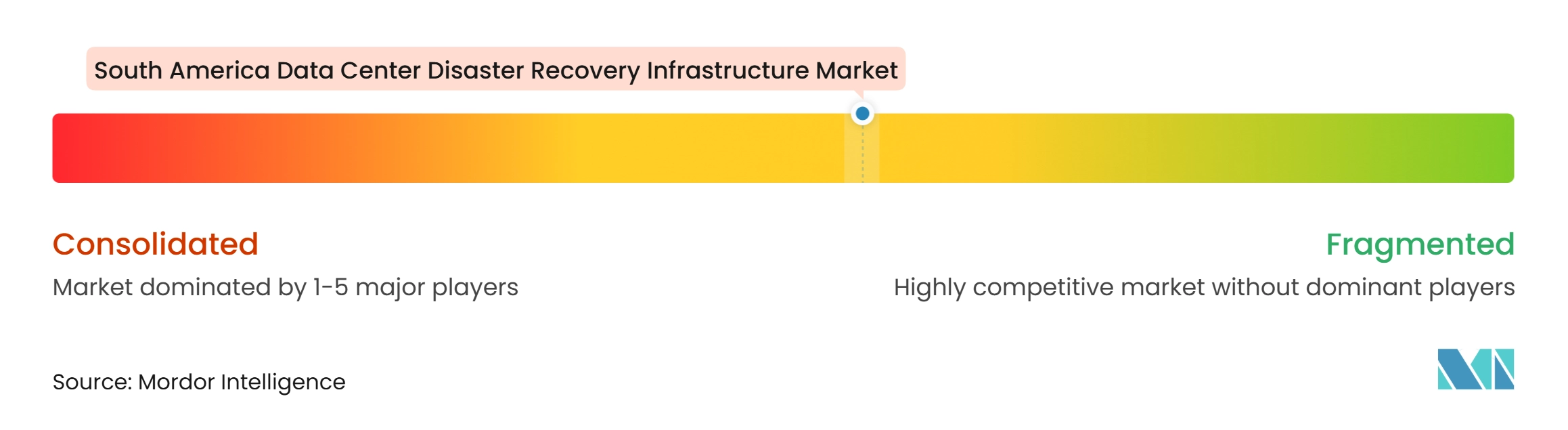
The South America data center disaster recovery infrastructure market includes global cloud and software providers as well as regional colocation and connectivity operators. IBM, Microsoft, Amazon Web Services, Oracle, Cisco, and Google compete through integrated cloud and managed recovery services. Ascenty, Scala Data Centers, ODATA, Equinix, Elea Data Centers, and Cirion Technologies compete through facility coverage, interconnection, and local operating capability. The market is moderately concentrated in colocation capacity, while the replication, orchestration, and testing software layer remains more dispersed. This structure gives enterprise customers a choice between broad cloud platforms and providers that can deliver local physical infrastructure. It also leaves room for managed recovery services for mid-sized customers in Colombia and Peru, as well as in smaller national markets.
Equinix has expanded regional data center capacity and added liquid cooling at its Santiago ST2 facility.[4] Cirion restored a damaged subsea cable system near Venezuela within 29 days following the June 2026 earthquake, while maintaining more than 60% of customer services via alternative routes. These actions show that physical capacity and network response capability can differentiate regional operators. Commvault introduced Cloud Unity to combine resilience operations automation, threat scanning, and cross-platform failover. The move reflects a wider focus on recovery tools that help customers test and automate complex environments. Oi Soluções also integrated Veeam Backup and Restore with AWS in Brazil, reinforcing demand for service-led hybrid recovery.
Cloud-native disaster recovery services are placing pressure on vendors that historically focused on backup products. Customers increasingly expect immutable copies, threat detection, recovery orchestration, and documented test results in the same offer. Regional telecommunications companies can use their fiber assets to bundle connectivity with managed recovery services. Global providers retain advantages in cloud platform breadth, while local providers can respond to data residency, latency, and in-country support requirements.
South America Data Center Disaster Recovery Infrastructure Industry Leaders
-
International Business Machines Corporation
-
Microsoft Corporation
-
Amazon Web Services, Inc.
-
Google LLC
-
Oracle Corporation
- *Disclaimer: Major Players sorted in no particular order
South America Data Center Disaster Recovery Infrastructure Market Companies Covered in this Report
- International Business Machines Corporation
- Microsoft Corporation
- Amazon Web Services, Inc.
- Google LLC
- Oracle Corporation
- Cisco Systems, Inc.
- Hewlett Packard Enterprise Company
- Veeam Software Group GmbH
- Commvault Systems, Inc.
- Dell Technologies Inc.
- Rubrik, Inc.
- Cohesity, Inc.
- Zerto Ltd.
- Equinix, Inc.
- Ascenty Data Centers e Telecomunicações S.A.
- Scala Data Centers S.A.
- ODATA Serviços de Tecnologia Ltda.
- Cirion Technologies, LLC
- Elea Data Centers S.A.
Recent Industry Developments in South America Data Center Disaster Recovery Infrastructure Market
- August 2026: Logicalis and Nutanix announced a strengthened strategic partnership in South America, with Brazil as the primary focus, to deliver hybrid multicloud infrastructure modernization and disaster recovery as a combined offering. The joint Nutanix Cloud Platform includes software-defined storage, unified management, and disaster recovery across hybrid and multicloud environments.
- July 2026: Kyndryl and RIMAC completed the modernization of Peru's leading insurer's core transactional systems, migrating critical platforms to Oracle Cloud Infrastructure in a multicloud environment that reduced processing times by up to 80% and established a foundation for resilient hybrid recovery.
- June 2026: Cirion Technologies executed a subsea infrastructure recovery operation after a June 24, 2026 earthquake severed its cable near Venezuela's La Guaira station at a depth of 1,800 meters. The company re-established the Caracas connectivity ring within 48 hours, maintained over 60% of customer services through alternative routes, and completed full restoration within 29 days.
- March 2026: Conecta Infra announced a USD 350 million phased investment to deploy subsea fiber infrastructure across South America. The project will bridge major data center hubs across Brazil, Chile, and Argentina through 2028, significantly reducing replication latency and bolstering physical layer cross-border disaster resilience architectures.
South America Data Center Disaster Recovery Infrastructure Market Report Scope
The South America Data Center Disaster Recovery Infrastructure Market refers to the collective ecosystem of physical assets, software systems, and network facilities designed to ensure business continuity and data preservation for data centers across South American nations during disruptive events.
The South America Data Center Disaster Recovery Infrastructure Market Report is Segmented by Infrastructure Type (Secondary and Dedicated Recovery Data Centers, Backup Data Center Infrastructure, Replication and Data Protection Infrastructure, Failover and Recovery Orchestration Infrastructure, Backup Storage Infrastructure, Network and Connectivity Infrastructure for Recovery, and Cloud-Based Disaster Recovery Infrastructure), Deployment Model (On-Premises Disaster Recovery, Colocation-Based Recovery, Cloud-Based Disaster Recovery, Hybrid Disaster Recovery, and Disaster Recovery-as-a-Service (DRaaS)), Recovery Architecture (Active-Active, Active-Passive, Warm Standby, Cold Standby, Backup and Restore, and Continuous Data Replication), Component (Compute and Server Infrastructure, Storage and Backup Systems, Data Replication Software, Network and Connectivity Systems, Recovery Orchestration and Automation, and Monitoring, Testing, and Failover Management), Application (Critical Business Application Recovery, Database and Data Platform Recovery, Virtual Machine and Workload Recovery, Cloud-Native Application Recovery, Enterprise IT Recovery, and High-Availability and Continuous Service Restoration), Data Center Size (Small, Medium, Large, and Hyperscale), Data Center Type (Colocation, Cloud Service Providers (CSPs), and Enterprise and Edge), and Geography (Brazil, Chile, Argentina, Colombia, Peru, and Rest of South America). The Market Forecasts are Provided in Terms of Value (USD).
Segmentation Overview
| Secondary and Dedicated Recovery Data Centers |
| Backup Data Center Infrastructure |
| Replication and Data Protection Infrastructure |
| Failover and Recovery Orchestration Infrastructure |
| Backup Storage Infrastructure |
| Network and Connectivity Infrastructure for Recovery |
| Cloud-Based Disaster Recovery Infrastructure |
| On-Premises Disaster Recovery |
| Colocation-Based Recovery |
| Cloud-Based Disaster Recovery |
| Hybrid Disaster Recovery |
| Disaster Recovery-as-a-Service (DRaaS) |
| Active-Active |
| Active-Passive |
| Warm Standby |
| Cold Standby |
| Backup and Restore |
| Continuous Data Replication |
| Compute and Server Infrastructure |
| Storage and Backup Systems |
| Data Replication Software |
| Network and Connectivity Systems |
| Recovery Orchestration and Automation |
| Monitoring, Testing, and Failover Management |
| Critical Business Application Recovery |
| Database and Data Platform Recovery |
| Virtual Machine and Workload Recovery |
| Cloud-Native Application Recovery |
| Enterprise IT Recovery |
| High-Availability and Continuous Service Restoration |
| Small |
| Medium |
| Large |
| Hyperscale |
| Colocation |
| Cloud Service Providers (CSPs) |
| Enterprise and Edge |
| Brazil |
| Chile |
| Argentina |
| Colombia |
| Peru |
| Rest of South America |
| By Infrastructure Type | Secondary and Dedicated Recovery Data Centers |
| Backup Data Center Infrastructure | |
| Replication and Data Protection Infrastructure | |
| Failover and Recovery Orchestration Infrastructure | |
| Backup Storage Infrastructure | |
| Network and Connectivity Infrastructure for Recovery | |
| Cloud-Based Disaster Recovery Infrastructure | |
| By Deployment Model | On-Premises Disaster Recovery |
| Colocation-Based Recovery | |
| Cloud-Based Disaster Recovery | |
| Hybrid Disaster Recovery | |
| Disaster Recovery-as-a-Service (DRaaS) | |
| By Recovery Architecture | Active-Active |
| Active-Passive | |
| Warm Standby | |
| Cold Standby | |
| Backup and Restore | |
| Continuous Data Replication | |
| By Component | Compute and Server Infrastructure |
| Storage and Backup Systems | |
| Data Replication Software | |
| Network and Connectivity Systems | |
| Recovery Orchestration and Automation | |
| Monitoring, Testing, and Failover Management | |
| By Application | Critical Business Application Recovery |
| Database and Data Platform Recovery | |
| Virtual Machine and Workload Recovery | |
| Cloud-Native Application Recovery | |
| Enterprise IT Recovery | |
| High-Availability and Continuous Service Restoration | |
| By Data Center Size | Small |
| Medium | |
| Large | |
| Hyperscale | |
| By Data Center Type | Colocation |
| Cloud Service Providers (CSPs) | |
| Enterprise and Edge | |
| By Geography | Brazil |
| Chile | |
| Argentina | |
| Colombia | |
| Peru | |
| Rest of South America |
Key Questions Answered in the Report
What is the size of the South America data center disaster recovery infrastructure market?
The market is valued at USD 341.63 million in 2026 and is projected to reach USD 692.86 million by 2032, at a 12.48% CAGR from 2027 to 2032.
What is driving demand for disaster recovery infrastructure in South America?
Cyberattacks, hybrid cloud use, regulatory requirements, and new data center capacity are increasing the need for tested recovery environments.
Which infrastructure type leads regional spending?
Secondary and Dedicated Recovery Data Centers lead, holding 32.73% of revenue in 2026.
Which deployment model is growing fastest?
Disaster Recovery-as-a-Service is projected to grow at a 13.52% CAGR through 2032 as organizations seek lower-cost managed recovery options.
Which country holds the largest share of regional revenue?
Brazil leads with a 56.53% share in 2026, supported by its financial sector, data center base, and local data requirements.
Why are cloud-native applications changing recovery requirements?
Containers and microservices require recovery tools that can coordinate distributed application dependencies across cloud and local environments.