
South America Data Center Demand Response and Energy Management Market Size and Share
Market Overview
| Study Period | 2021 - 2032 |
|---|---|
| Forecast Data Period | 2027 - 2032 |
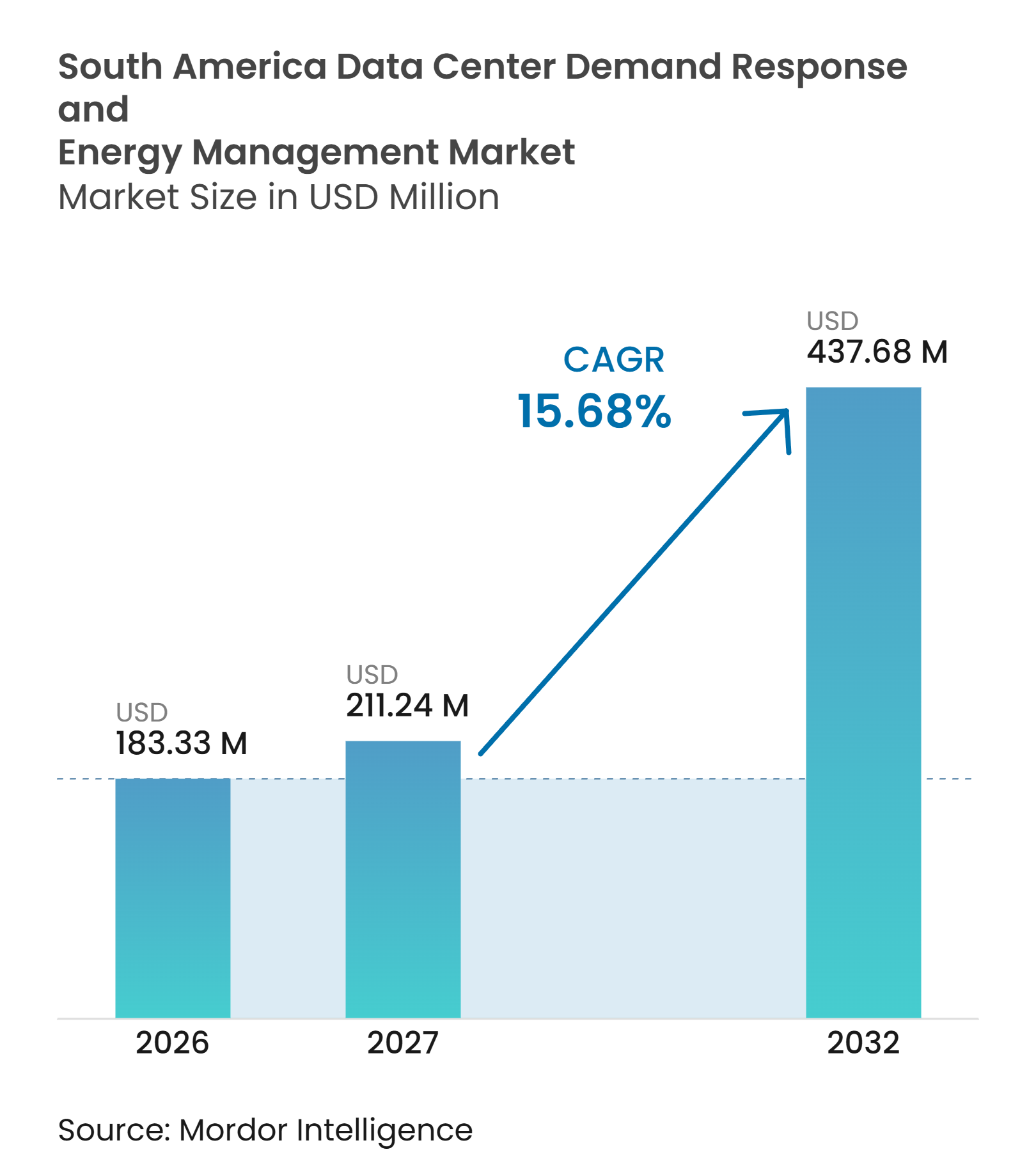
| Base Year Market Size (2026) | USD 183.33 Million |
| Market Size (2027) | USD 211.24 Million |
| Market Size (2032) | USD 437.68 Million |
| Growth Rate (2027 - 2032) | 15.68 % |
| Market Concentration | Medium |
Major Players *Disclaimer: Major Players sorted in no particular order Image © Mordor Intelligence. Reuse requires attribution under CC BY 4.0. | |
South America Data Center Demand Response and Energy Management Market Analysis by Mordor Intelligence
The South America data center demand response and energy management market size is projected to expand from USD 183.33 million in 2026 to USD 211.24 million in 2027, and to USD 437.68 million by 2032, registering a CAGR of 15.68% between 2027 and 2032. The South America data center demand response and energy management market is moving from basic energy monitoring toward systems that can adjust computing loads when grid conditions change. Artificial intelligence workloads increase rack density and place more pressure on power availability, especially at large campuses. Renewable generation brings lower-carbon power, but its daily variability makes forecasting and flexible consumption more important for operators. Utilities are also expanding metering and time-based tariff programs, which give operators more signals to manage power use. These conditions favor providers that combine software with local implementation and ongoing managed services.
Key Report Takeaways
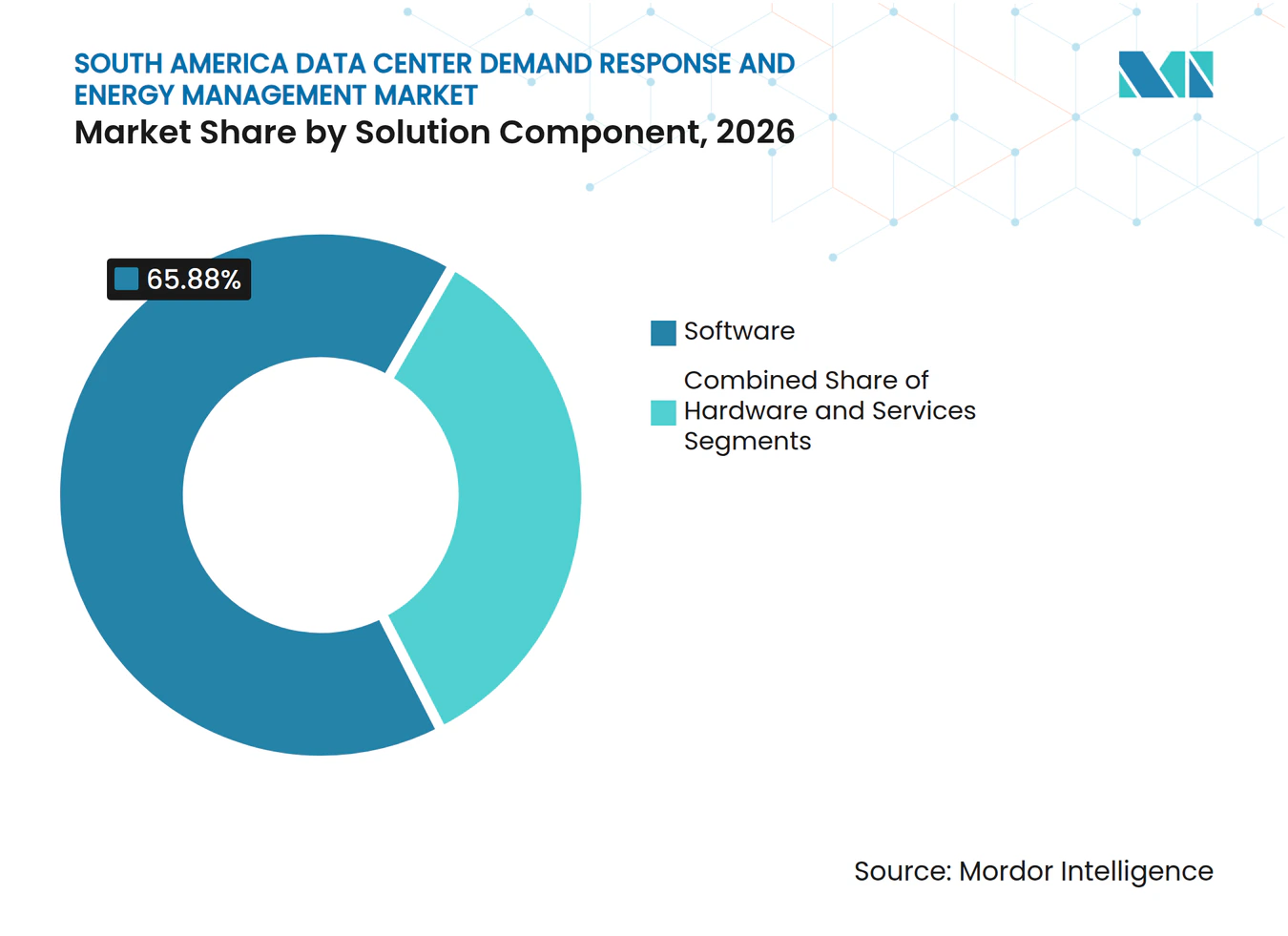
- By solution component, software held 65.88% of the South America data center demand response and energy management market in 2026, while services are projected to expand at a 17.61% CAGR through 2032.
- By software solution type, energy management software held 58.19% of the South America data center demand response and energy management market share in 2026, while energy forecasting and optimization software is projected to expand at a 17.35% CAGR through 2032.
- By demand response program type, incentive-based programs held 70.24% of the South America data center demand response and energy management market share in 2026 and are projected to expand at an 18.26% CAGR through 2032.
- By automation level, manual and non-automated solutions held 71.33% of the South America data center demand response and energy management market share in 2026, while automated and advanced demand response solutions are projected to expand at an 18.50% CAGR through 2032.
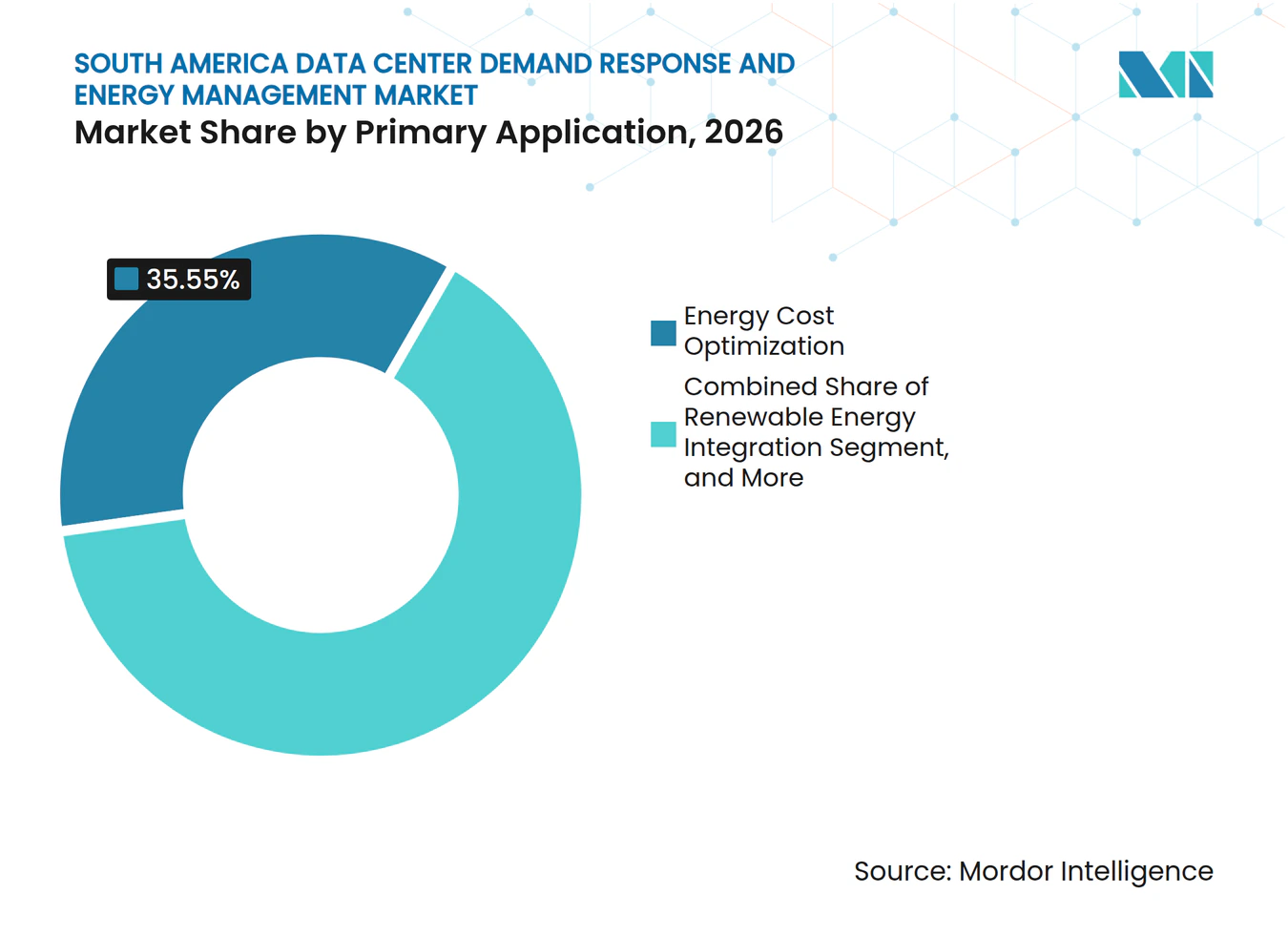
- By primary application, energy cost optimization held 35.55% of the South America data center demand response and energy management market share in 2026, while renewable energy integration is projected to expand at a 16.44% CAGR through 2032.
- By data center size, hyperscale facilities held 60.23% of the South America data center demand response and energy management market share in 2026 and are projected to expand at a 17.04% CAGR through 2032.
- By data center type, colocation held 66.14% of the South America data center demand response and energy management market share in 2026, while cloud service providers are projected to expand at a 17.90% CAGR through 2032.
- By geography, Brazil held 34.36% of the South America data center demand response and energy management market share in 2026, while Chile is projected to expand at a 16.72% CAGR through 2032.
Note: Market numbers in this report are based on Mordor Intelligence's proprietary estimation framework, which combines nine months of actuals with Q4 projections for base year 2026.
Market Trends and Insights
Drivers Impact Analysis of South America Data Center Demand Response and Energy Management Market*
| Driver | (~) % Impact on CAGR Forecast | Geographic Relevance | Impact Timeline |
|---|---|---|---|
| Artificial Intelligence and Hyperscale Workload Expansion | +4.2% | South America, concentrated in Brazil and Chile | Short term (≤ 2 years) |
| Renewable Energy Variability and Grid Flexibility Requirements | +3.0% | Brazil and Chile, with spillover to Colombia and Argentina | Medium term (2-4 years) |
| Electricity Price Volatility and Peak-Demand Charges | +2.5% | Brazil and Chile, with secondary relevance in Colombia and Peru | Medium term (2-4 years) |
| Smart-Meter and Grid-Digitalization Rollouts | +1.8% | Brazil and Chile | Medium term (2-4 years) |
| South American Data Center Interconnection Bottlenecks | +1.3% | Brazil, Chile, and Colombia | Long term (≥ 4 years) |
| Workload-Aware Flexibility for AI and High-Performance Computing | +1.5% | South America, with early use in São Paulo and Santiago | Short term (≤ 2 years) |
| Source: Mordor Intelligence | |||
Artificial Intelligence and Hyperscale Workload Expansion
Artificial intelligence training and inference workloads are placing new demands on data center power systems across the South America data center demand response and energy management market. GPU-intensive deployments can exceed 30 kW per rack, making energy management a day-to-day load-control function rather than a billing function. Larger facilities need visibility across power distribution, cooling, and uninterruptible power systems before they can respond safely to grid events. Scala Data Centers reported rack densities ranging from 24 kW to 100 kW at its Tamboré Campus, underscoring why high-density sites require tightly coordinated power operations. Schneider Electric also presented reference architectures with NVIDIA for AI-ready data centers, connecting energy controls with the design of computing infrastructure.
Renewable Energy Variability and Grid Flexibility Requirements
Renewable generation creates a strong reason for operators to make electricity use more flexible. Solar and wind output can change within the day, while data center service obligations require dependable power at all hours. This combination makes consumption forecasting, storage coordination, and workload scheduling more useful in the South America data center demand response and energy management market. A RESET Network study found that incorporating demand response into Chilean power-system planning could reduce total system costs by up to 35.7% in its modeled scenarios. Atlas Renewable Energy described battery storage as an important complement to renewable energy supply for data centers, increasing the need for platforms that coordinate energy assets rather than manage a single source.
Electricity Price Volatility and Peak-Demand Charges
Time-based electricity costs are making energy control a financial operating issue for data center owners. Operators can reduce exposure by moving eligible workloads away from expensive periods or by using stored energy during peak conditions. Peak-demand charges also make accurate measurement and early warning important for colocation providers that manage utility contracts for many tenants. These conditions support energy cost optimization, which is the largest application in the South America data center demand response and energy management market. Price-based demand response can become more practical as utilities improve metering and tariff structures. Incentive-based programs still offer a clearer commercial route, in which utilities pay for verified load reduction.
Smart-Meter and Grid-Digitalization Rollouts
Smart meters provide the granular data needed for utilities and customers to measure a demand response event. Siemens and CPFL Energia partnered in March 2025 to deploy meter data management software in São Paulo state, with a target to replace 1.6 million conventional meters by 2029. The rollout supports hourly consumption visibility, which is necessary for more precise load-control programs. The International Energy Agency includes Brazil in its Digital Demand-Driven Electricity Networks Initiative, which runs through 2027 and supports demand-side grid integration.[1] Better data exchange can also help operators prove performance to utilities while maintaining clear internal records of energy use. For the South America data center demand response and energy management market, this infrastructure reduces a major barrier to automated participation.
Restraints Impact Analysis of South America Data Center Demand Response and Energy Management Market*
| Restraint | (~) % Impact on CAGR Forecast | Geographic Relevance | Impact Timeline |
|---|---|---|---|
| Data Center Uptime and Service-Level Agreement Constraints | -2.1% | South America | Long term (≥ 4 years) |
| Fragmented Tariff and Demand-Response Market Rules | -1.8% | Brazil, Chile, Colombia, Argentina, and Peru | Medium term (2-4 years) |
| Limited Availability of Certified OT and EMS Integrators | -1.2% | South America, especially Peru, Colombia, and Argentina | Long term (≥ 4 years) |
| Cybersecurity and Interoperability Risk Across Legacy Control Systems | -0.9% | South America | Medium term (2-4 years) |
| Source: Mordor Intelligence | |||
Data Center Uptime and Service-Level Agreement Constraints
Strict uptime commitments limit the extent to which a data center can reduce load during a grid event. Colocation and hyperscale contracts often require 99.999% availability, leaving little room for actions that could affect customer services. A 2025 peer-reviewed study identified service-level commitments and quality-of-service requirements as major barriers to the use of data centers as flexible power-system resources. Batch jobs, model training queues, and deferred backups are more suitable for participation than customer-facing services. This constraint favors managed service providers that can define safe operating limits and administer response commitments for customers. It also explains why the services component is expected to expand quickly in the South America data center demand response and energy management market.
Fragmented Tariff and Demand-Response Market Rules
Regulatory conditions differ widely across Brazil, Chile, Colombia, Argentina, and Peru. This requires multi-country operators to adapt event logic, reporting formats, and tariff settings for each national market. Brazil uses regulatory sandboxes and time-based tariff pilots, while Chile has hourly signals for certain medium-voltage customers. Colombia uses a different regulatory approach, and Argentina and Peru have less developed frameworks for industrial demand flexibility. The resulting complexity raises implementation and maintenance costs for regional platform deployments. It also creates an advantage for suppliers with local utility knowledge, country-specific compliance capabilities, and delivery teams in the South America data center demand response and energy management market.
*Our forecasts treat driver/restraint impacts as directional, not additive. The impact forecasts reflect baseline growth, mix effects, and variable interactions.
South America Data Center Demand Response and Energy Management Market Segment Analysis
By Solution Component:
Software Holds the Largest Position as Services Gain GroundSoftware held 65.88% of revenue in 2026, making it the leading solution component. Energy management platforms collect operating data and turn grid signals into recommended or automated actions. They give operators visibility over distribution equipment, cooling systems, backup power, and the load available for a response event. Hardware includes meters, intelligent power distribution units, and interfaces for battery systems. High rack densities keep hardware investment relevant because each added AI deployment requires accurate local power measurement. Software, therefore, remains the control layer that connects equipment data with commercial and operational decisions.
Services are projected to expand at a 17.61% CAGR through 2032, faster than other components. The services opportunity includes implementation, integration, commissioning, compliance support, and managed operations. This demand reflects the gap between platform capability and the operational expertise available at individual sites. Managed arrangements can help operators establish acceptable load limits without jeopardizing service commitments. Regional integrators can differentiate through familiarity with local tariffs and grid requirements. The South America data center demand response and energy management industry, therefore, has room for providers that pair software deployment with accountable operating support.



By Software Solution Type:
Energy Management Leads While Forecasting AdvancesEnergy management software held 58.19% market share in 2026. It serves as the central system for collecting consumption data and coordinating building and power-control systems. Operators use it to apply pre-set thresholds before a curtailment event or a high-cost period begins. Demand response management platforms have a more focused role in program enrollment, event handling, and utility reporting. Monitoring and analytics tools are also often delivered with metering and power hardware rather than as separate products. This broad role keeps energy management software at the center of facility operations.
Energy forecasting and optimization software is projected to expand at a 17.35% CAGR through 2032. These tools help operators anticipate demand, identify costly periods, and determine whether workloads can be rescheduled. They can also coordinate on-site storage with expected grid conditions. The South America data center demand response and energy management market size in this software area benefits from the need to integrate variable renewable output. RESET Network modeling supported the value of demand-side forecasting in system planning in Chile. As formal incentives develop, forecasting tools can give both utilities and operators a clearer basis for performance commitments.
By Demand Response Program Type:
Incentive-Based Programs Remain the Main RouteIncentive-based programs held 70.24% share in 2026, the highest among program types. These programs compensate participants for verified demand reduction during defined events. They suit utilities that need dependable capacity support and want clear contractual commitments. Large facilities can offer meaningful blocks of flexible load without the complexity of aggregating many smaller customers. This makes hyperscale campuses particularly attractive participants for utilities. Incentive-based arrangements also allow operators to assess financial returns before taking on more automated operating models.
The same program type is projected to expand at an 18.26% CAGR through 2032. Its position reflects the practical need for predictable payment structures in developing demand response markets. Price-based programs can gain relevance when meter rollouts provide hourly consumption data. They still depend on wider adoption of transparent time-of-use tariffs and stable rules. High-renewable power systems strengthen the case for paying customers to shift or reduce load when system conditions require it. The South America data center demand response and energy management market can therefore continue to rely on incentive-based contracts while pricing frameworks mature.
By Automation Level:
Manual Systems Lead Today, but Advanced Automation Expands FasterManual and non-automated solutions held 71.33% share in 2026. Many facilities still rely on periodic monitoring, operator review, and human approval before acting on a grid signal. This reflects the early stage of formal participation in demand response in several countries. Operators commonly map their available flexibility before they commit systems to automatic response. Manual processes can be suitable for infrequent events or small sites with limited technical resources. They are less suitable for rapid price signals and high-frequency operating decisions.
Automated and advanced demand response solutions are projected to expand at an 18.50% CAGR through 2032. They can connect utility signals with workload scheduling and predefined equipment settings. This reduces the time between an event notification and a safe operational response. Machine-learning-based forecasting can further improve the timing of decisions where energy prices or renewable output shift quickly. Automated tools are especially relevant for deferrable AI training, batch work, and backup activity. Their adoption will depend on dependable meter data, robust cybersecurity controls, and clear rules that protect critical customer workloads.
By Primary Application:
Cost Optimization Leads, Renewable Integration AcceleratesEnergy cost optimization accounted for 35.55% of the South America data center demand response and energy management market share in 2026. Operators use these systems to understand consumption patterns, peak-demand exposure, and the timing of controllable loads. The application is recurring because cost decisions are made throughout the year rather than only during emergencies. Peak load management and emergency load reduction serve different needs by supporting grid reliability under stressed conditions. Capacity-market participation and ancillary services remain at an earlier stage because formal market mechanisms are limited in much of the region. Together, these applications show that energy management can serve both operating-cost and grid-reliability objectives.
Renewable energy integration is projected to expand at a 16.44% CAGR through 2032. This application helps sites align consumption, storage, and procurement with changing renewable supply. In May 2026, Casa dos Ventos and Ascenty announced a self-production contract valued at more than USD 500 million, providing 110 MW of average supply from projects with more than 1.4 GW of combined installed capacity. The arrangement illustrates the operational coordination required when data centers combine long-term power contracts with variable generation. Renewable integration tools can help operators manage this complexity without treating clean power and reliability as separate objectives.

By Data Center Size:
Hyperscale Facilities Lead in Scale and ExpansionHyperscale facilities held 60.23% share in 2026. Large campuses can spread the cost of substations, cooling plants, fiber connections, and energy controls across substantial power demand. This makes the economic case for a formal demand response platform easier to establish. Centralized infrastructure also gives site operators more visibility over the load that can be adjusted safely. Large facilities have related benefits, although their operating scale is lower. Smaller and medium facilities may increasingly use service providers to join utility programs where direct participation is not practical.
Hyperscale facilities are projected to expand at a 17.04% CAGR through 2032. Their growth is tied to cloud, AI, and high-performance computing deployments that require concentrated capacity. Continued campus construction supports the ongoing demand for power-control systems. The South America data center demand response and energy management market must serve both major campuses and smaller sites that need simpler managed offerings. This creates a split between enterprise platforms for large operators and service-led models for the long tail of facilities.
By Data Center Type:
Colocation Leads, While Cloud Service Providers Expand FastestColocation held 66.14% share in 2026. Colocation operators usually manage utility contracts, peak-demand exposure, and site-wide power infrastructure on behalf of tenants. Their purchasing decisions can therefore influence energy practices across many customer workloads at once. They need tools that protect tenant service levels while helping the site respond to tariff and grid conditions. Enterprise and edge facilities have smaller load commitments and may have less room to participate in formal programs. Energy monitoring can still become more common in these facilities as commercial customers receive greater visibility into their electricity use.
Cloud service providers are projected to expand at a 17.90% CAGR through 2032. Their regional deployments raise the need for facilities that align with global sustainability and reliability commitments. Cloud platforms can schedule computing tasks over time, supporting flexible load management. However, customer-facing services still need strict protection from disruption. This makes workload classification and operational governance essential parts of demand response planning.
Geography Analysis
Brazil
Brazil accounted for 34.36% of the South America data center demand response and energy management market in 2026. The country combines the region's broadest data center base with a renewable-heavy electricity system and an expanding need for dependable power management. Grid congestion in major data center corridors makes operational flexibility increasingly valuable to large facilities. ANEEL's tariff sandbox projects provide a regulatory setting for testing more responsive pricing and demand-management approaches. Siemens and CPFL Energia are also replacing conventional meters across São Paulo state, supporting more detailed measurement for commercial consumers.[2] The Casa dos Ventos and Ascenty power agreement shows that large operators are linking renewable procurement with broader energy management requirements.
Chile
Chile is projected to expand at a 16.72% CAGR through 2032, the fastest rate among the geographic segments. Its growing hyperscale base must operate within a power system where renewable output and grid constraints shape energy planning. The national BT4.3 tariff gives certain medium-voltage consumers hourly price signals, creating a clearer commercial route for response tools than in several nearby countries. Cloud investment increases the need for a reliable supply and for detailed control over electricity demand. Demand response planning can help operators align flexible workloads with grid conditions while preserving service quality.
Colombia, Argentina, Peru, and Other Emerging Corridors
Argentina is expanding from a smaller installed base, with Cirion adding more than 2 MW of capacity and around 160 racks at BUE1 in August 2025. In Peru, the limited supply of trained technical personnel outside Lima can favor managed services for energy and operational technology systems. Cross-border fiber expansion is reducing connectivity barriers in secondary locations, thereby supporting future data center investment.
Competitive Landscape
Market Concentration
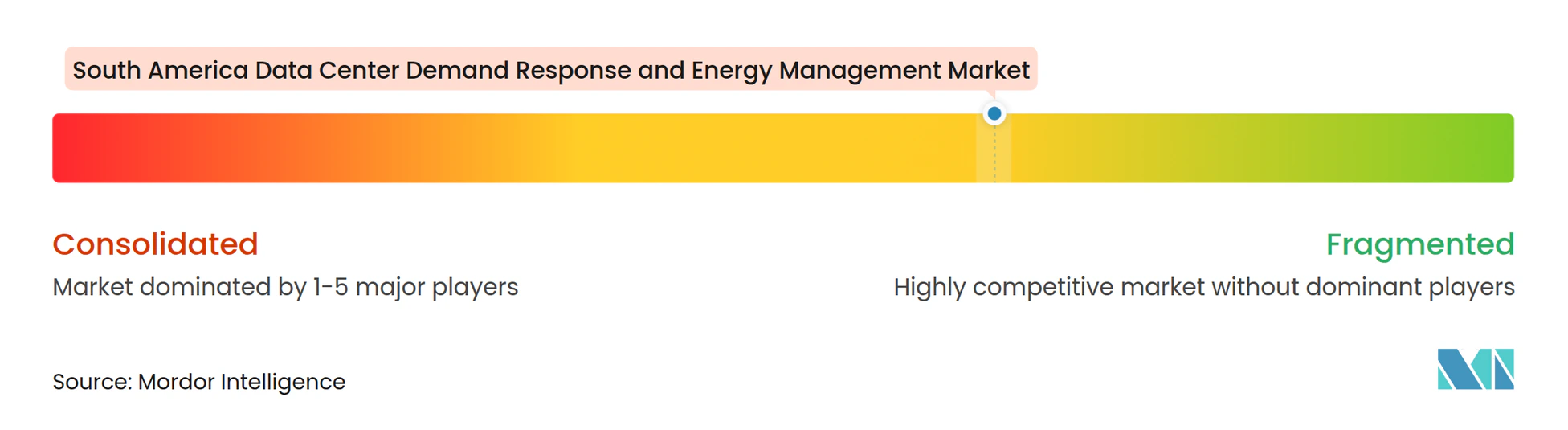
The South America data center demand response and energy management market is moderately fragmented. Global energy technology companies have strong brand recognition, established product portfolios, and relationships with large data center operators. Schneider Electric, ABB, Siemens, Honeywell, and Johnson Controls compete alongside specialist software firms and regional operational technology integrators. Large suppliers can combine energy controls, cooling management, power distribution, and service support in a broader offer. Regional providers can compete by leveraging tariff knowledge, local commissioning, and post-installation support. This structure allows different supplier types to address hyperscale campuses, colocation facilities, and smaller enterprise sites.
Schneider Electric presented its AI-era data center portfolio in São Paulo in October 2026, including EcoStruxure energy management, liquid cooling, and modular architecture.[3] The company is incorporating energy controls earlier in the design cycle to achieve AI-ready facilities. Siemens is strengthening the grid-data foundation through its meter data management work with CPFL Energia, which can make granular demand response participation more practical. Suppliers are increasingly integrating facility design, measurement, and energy-control capabilities into their broader data center offerings.
Smaller aggregators face a barrier because utilities often prefer to enter into direct agreements with large industrial customers. This can limit third-party enrollment models and requires local authorization before a platform can participate in a program. Opportunities remain in colocation facilities below 5 MW that lack the staff to manage enrollment and compliance. Multi-country operators also need configurable tools for Brazil, Chile, and Colombia, rather than a single fixed configuration. The shortage of local automation specialists and varied cybersecurity practices can favor managed service providers with regional delivery teams. The South America data center demand response and energy management market, therefore, rewards companies that combine product capability, local operating knowledge, and accountable service execution.
South America Data Center Demand Response and Energy Management Industry Leaders
-
ABB Ltd.
-
Honeywell International Inc.
-
Schneider Electric SE
-
Siemens AG
-
Eaton Corporation plc
- *Disclaimer: Major Players sorted in no particular order
South America Data Center Demand Response and Energy Management Market Companies Covered in this Report
- ABB Ltd.
- Ameresco, Inc.
- AutoGrid Systems, Inc.
- CPower Energy Management LLC
- Eaton Corporation plc
- Enel S.p.A.
- EnergyHub, Inc.
- Fluence Energy, Inc.
- General Electric Company
- GridPoint, Inc.
- Honeywell International Inc.
- Itron, Inc.
- Johnson Controls International plc
- Landis+Gyr Group AG
- NRG Energy, Inc.
- Rockwell Automation, Inc.
- Schneider Electric SE
- Siemens AG
- Stem, Inc.
- Voltus, Inc.
Recent Industry Developments in South America Data Center Demand Response and Energy Management Market
- October 2026: Schneider Electric presented its AI-era data center solution portfolio at Data Center World Brazil 2026 in São Paulo, showcasing EcoStruxure energy management, liquid cooling systems, and modular, prefabricated architectures for AI inference workloads, as well as its reference architecture partnership with NVIDIA for platforms supporting the GB200 and GB300 processor generations. This positioned Schneider Electric as a technology partner in energy management, linking EMS software capability directly to AI infrastructure design standards across the South American market.
- September 2026: ABB launched Infinitus, its direct-current (DC) power portfolio for AI data centers globally, developed in collaboration with NVIDIA, targeting 800V DC architecture for 1 MW AI server racks and supporting both native DC and hybrid AC-DC architectures. The launch represents a significant advancement in power management infrastructure, enabling automated demand-response event execution in high-density AI-grade data centers.
- May 2026: Casa dos Ventos and Ascenty announced the largest renewable energy self-production contract for data centers in South America, providing an average supply of 110 MW from two projects with a combined installed capacity of over 1.4 GW, expected to begin operations in 2027. The contract uses complementary renewable sources to enhance supply flexibility and supports Ascenty's decarbonization strategy across its 38 data centers in Brazil, Chile, Mexico, and Colombia.
- March 2026: Colombia's energy regulator, CREG, issued a resolution allowing long-term electricity contract prices to be reflected in regulated tariffs, reducing data center operators' exposure to hydropower-driven spot-market price spikes and improving the financial predictability of multi-year energy management investments.
South America Data Center Demand Response and Energy Management Market Report Scope
The South America Data Center Demand Response and Energy Management Market encompasses hardware, software, and services used to improve energy efficiency, manage electricity demand, and optimize participation in grid programs across data centers in Brazil, Chile, Colombia, Argentina, Peru, and other South American countries. The market supports data center operators in managing power costs, improving resilience, integrating renewable energy resources, participating in demand response initiatives, and addressing regional power infrastructure constraints through advanced monitoring, automation, and energy management systems.
The South America Data Center Demand Response and Energy Management Market Report is Segmented by Solution Component (Hardware, Software, and Services), Software Solution Type (Demand Response Management Platforms, Energy Management Software, Energy Monitoring and Analytics Software, and Energy Forecasting and Optimization Software), Demand Response Program Type (Price-Based Programs, and Incentive-Based Programs), Automation Level (Manual and Non-Automated Solutions, and Automated and Advanced Demand Response Solutions), Primary Application (Peak Load Management, Emergency Load Reduction, Capacity Market Participation, Ancillary Services, Energy Cost Optimization, and Renewable Energy Integration), Data Center Size (Small, Medium, Large, and Hyperscale), Data Center Type (Colocation, Cloud Service Providers [CSPs], and Enterprise and Edge), and Geography (Brazil, Chile, Colombia, Argentina, Peru, and Rest of South America). The Market Forecasts are Provided in Terms of Value (USD).
Segmentation Overview
| Hardware |
| Software |
| Services |
| Demand Response Management Platforms |
| Energy Management Software |
| Energy Monitoring and Analytics Software |
| Energy Forecasting and Optimization Software |
| Price-Based Programs |
| Incentive-Based Programs |
| Manual and Non-Automated Solutions |
| Automated and Advanced Demand Response Solutions |
| Peak Load Management |
| Emergency Load Reduction |
| Capacity Market Participation |
| Ancillary Services |
| Energy Cost Optimization |
| Renewable Energy Integration |
| Small |
| Medium |
| Large |
| Hyperscale |
| Colocation |
| Cloud Service Providers (CSPs) |
| Enterprise and Edge |
| Brazil |
| Chile |
| Colombia |
| Argentina |
| Peru |
| Rest of South America |
| By Solution Component | Hardware |
| Software | |
| Services | |
| By Software Solution Type | Demand Response Management Platforms |
| Energy Management Software | |
| Energy Monitoring and Analytics Software | |
| Energy Forecasting and Optimization Software | |
| By Demand Response Program Type | Price-Based Programs |
| Incentive-Based Programs | |
| By Automation Level | Manual and Non-Automated Solutions |
| Automated and Advanced Demand Response Solutions | |
| By Primary Application | Peak Load Management |
| Emergency Load Reduction | |
| Capacity Market Participation | |
| Ancillary Services | |
| Energy Cost Optimization | |
| Renewable Energy Integration | |
| By Data Center Size | Small |
| Medium | |
| Large | |
| Hyperscale | |
| By Data Center Type | Colocation |
| Cloud Service Providers (CSPs) | |
| Enterprise and Edge | |
| By Geography | Brazil |
| Chile | |
| Colombia | |
| Argentina | |
| Peru | |
| Rest of South America |
Key Questions Answered in the Report
What is the size of the South America data center demand response and energy management market?
The sector is projected at USD 183.33 million in 2026 and USD 211.24 million in 2027. It is expected to reach USD 437.68 million by 2032, representing a 15.68% CAGR over 2027-2032.
What is driving adoption of demand response systems in South American data centers?
AI workloads, renewable-power variability, peak-demand charges, and improved smart-meter coverage are increasing the need for flexible energy operations.
Which solution component leads the sector?
Software leads with 65.88% share in 2026 because it connects facility equipment, energy data, grid signals, and load-control decisions.
Which demand response program type has the largest share?
Incentive-based programs held 70.24% share in 2026 and are projected to expand at an 18.26% CAGR through 2032.
Why are hyperscale facilities important for energy management adoption?
Hyperscale facilities held 60.23% share in 2026 and can justify centralized power controls because of their large, concentrated loads.
Which country is expected to advance most quickly?
Chile is projected to expand at a 16.72% CAGR through 2032, supported by cloud investment, hourly pricing signals, and grid-management requirements.