
South America Data Center Counter-Drone and Airspace Security Market Size and Share
Market Overview
| Study Period | 2021 - 2032 |
|---|---|
| Forecast Data Period | 2027 - 2032 |
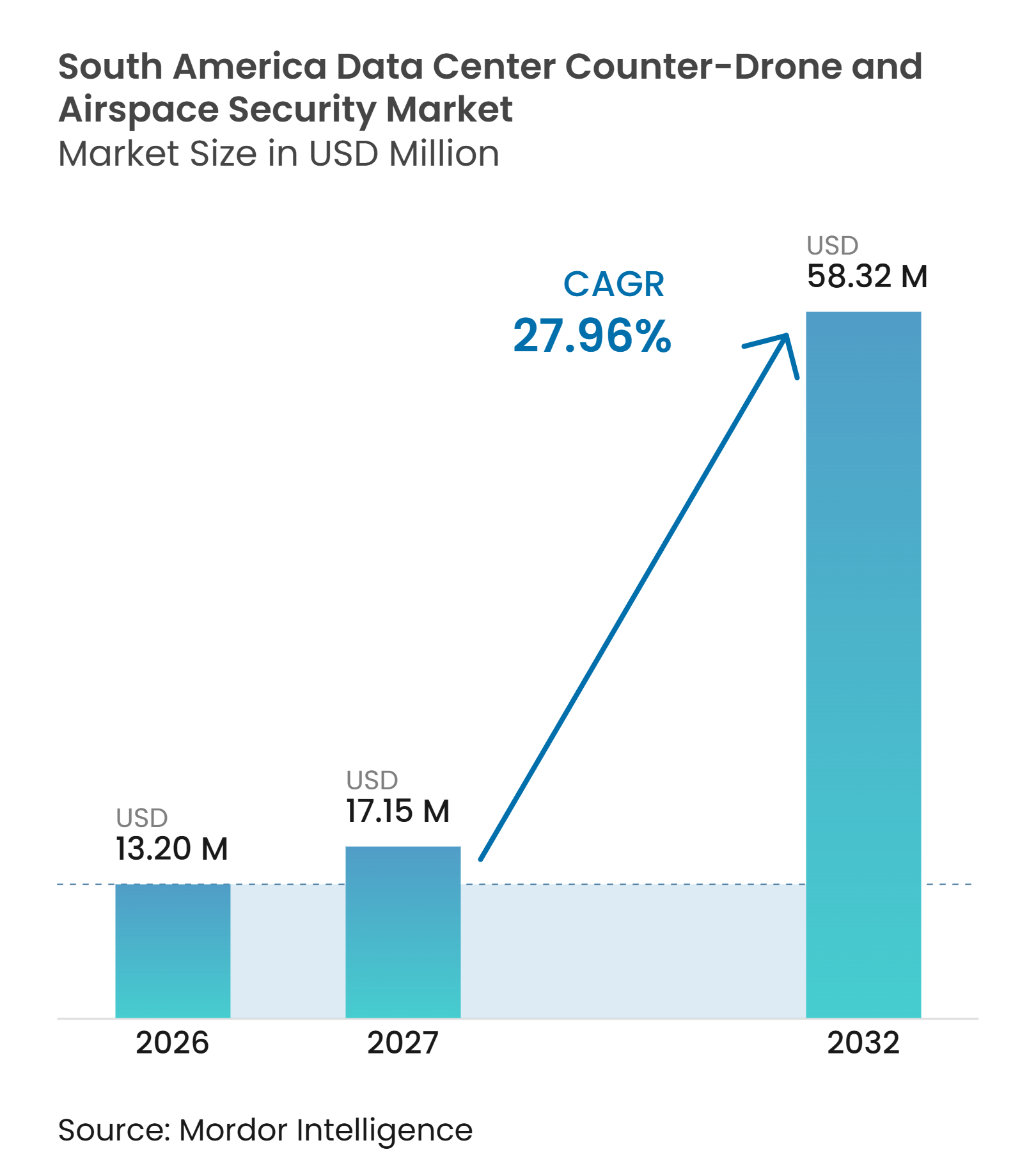
| Base Year Market Size (2026) | USD 13.20 Million |
| Market Size (2027) | USD 17.15 Million |
| Market Size (2032) | USD 58.32 Million |
| Growth Rate (2027 - 2032) | 27.96 % |
| Market Concentration | Medium |
Major Players *Disclaimer: Major Players sorted in no particular order Image © Mordor Intelligence. Reuse requires attribution under CC BY 4.0. | |
South America Data Center Counter-Drone and Airspace Security Market Analysis by Mordor Intelligence
The South America data center counter-drone and airspace security market size was valued at USD 13.20 million in 2026 and estimated to expand from USD 17.15 million in 2027 to reach USD 58.32 million by 2032, at a CAGR of 27.96% during the forecast period 2027-2032. The South America data center counter-drone and airspace security market is supported by new AI and cloud campuses that increase the number and scale of sites needing continuous airspace monitoring. Brazil is the principal demand center because it combines the region’s largest operating capacity with a large hyperscale project pipeline. The South America data center counter-drone and airspace security market also benefits from a shift away from stand-alone RF detection toward systems that combine radar, optical sensors, acoustics, and software. Regulatory limits on jamming keep much of the commercial opportunity in detection, identification, alerting, and coordination systems. Vendors are therefore pairing security hardware with software that can manage multiple facilities and provide usable alerts to small security teams.
Key Report Takeaways
- By component, hardware held 53.81% of the regional market share in 2026, while software and analytics is projected to expand at a 28.92% CAGR through 2032.
- By technology, radio frequency detection accounted for 31.82% of the market in 2026, while integrated multi-sensor systems is projected to expand at a 28.78% CAGR through 2032.
- By solution type, integrated counter-drone platforms held 28.84% of the market in 2026 and are projected to expand at a 28.86% CAGR through 2032.
- By deployment type, fixed installations accounted for 68.23% of the market in 2026, while mobile and portable systems is projected to expand at a 28.65% CAGR through 2032.
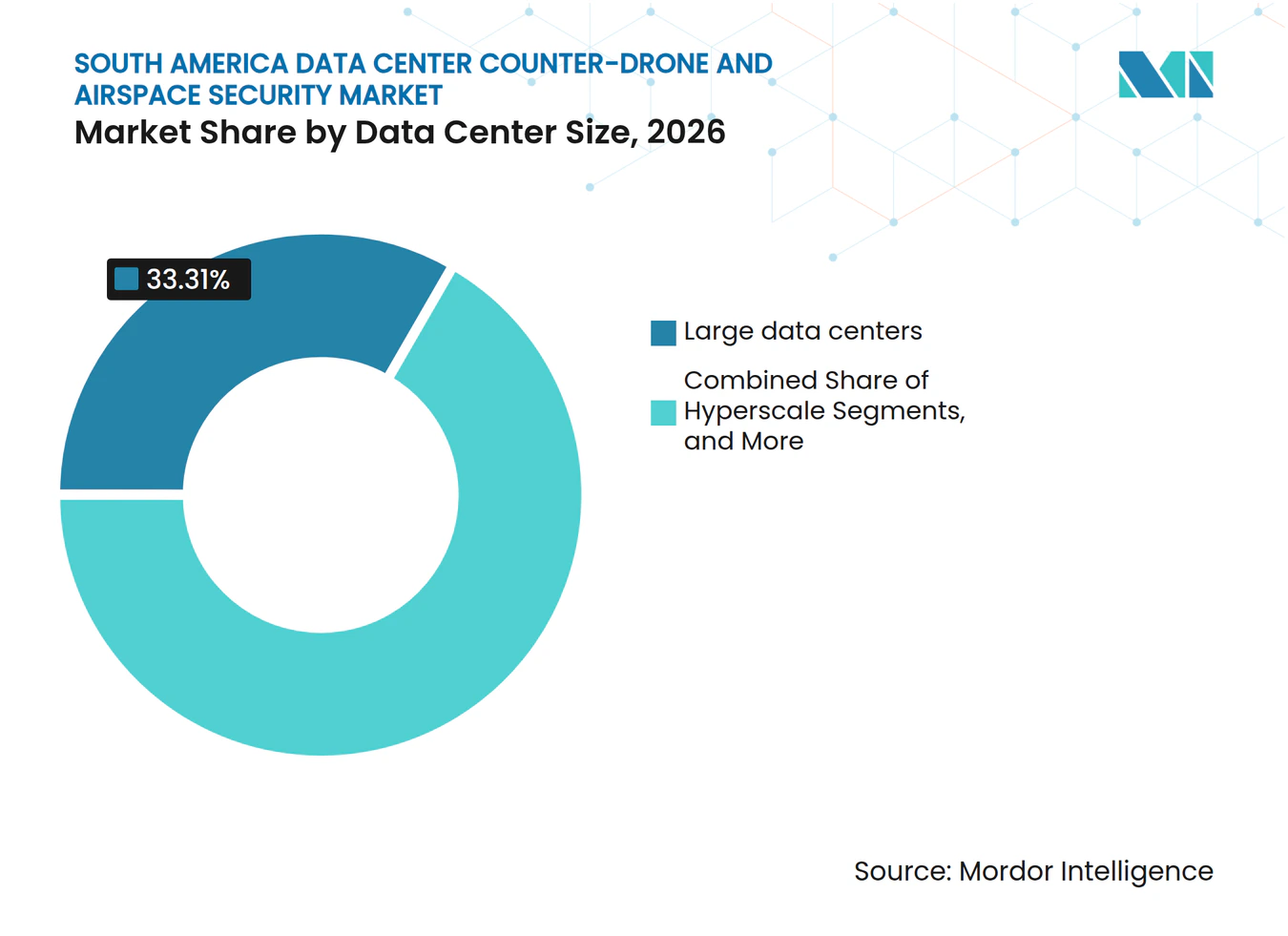
- By data center size, large data centers held 33.31% of the market in 2026, while hyperscale data centers is projected to expand at a 28.78% CAGR through 2032.
- By data center type, colocation operators accounted for 46.22% of the market in 2026, while enterprise and edge deployments is projected to expand at a 28.59% CAGR through 2032.
- By geography, Brazil held 61.24% of the market in 2026, while Rest of South America is projected to expand at a 28.62% CAGR through 2032.
Note: Market numbers in this report are based on Mordor Intelligence's proprietary estimation framework, which combines nine months of actuals with Q4 projections for base year 2026.
Market Trends and Insights
Drivers Impact Analysis of South America Data Center Counter-Drone and Airspace Security Market*
| Driver | (~) % Impact on CAGR Forecast | Geographic Relevance | Impact Timeline |
|---|---|---|---|
| Expansion of AI and Hyperscale Data Center Capacity | +8.5% | Brazil and Argentina primary, Rest of South America secondary | Long term (≥ 4 years) |
| Rising Drone Incursions Around Critical Digital Infrastructure | +7.2% | Brazil primary, Argentina and Colombia | Medium term (2-4 years) |
| Shift Toward Integrated Multi-Sensor Airspace Protection | +5.8% | Brazil hyperscale hubs and regional technology programs | Long term (≥ 4 years) |
| Security Requirements for High-Density and Edge Data Center Sites | +4.2% | Brazil and Argentina | Medium term (2-4 years) |
| Brazil-Led Regional Procurement and Technology Spillover | +2.8% | Brazil primary, Chile and Colombia spillover | Short term (≤ 2 years) |
| Demand for Portable Protection at Temporary and Multi-Site Operations | +1.8% | Brazil and Rest of South America | Short term (≤ 2 years) |
| Source: Mordor Intelligence | |||
Expansion of AI and Hyperscale Data Center Capacity
Mitsui stated that Brazil’s data center power demand could rise from 2.5 GW in 2025 to 13.2 GW by 2035 if announced projects receive grid approval.[1] Each new campus adds a fixed location that needs surveillance above its perimeter. Microsoft opened 2 AI-capable data centers in Brazil in January 2026 under a BRL 14.7 billion investment plan, equivalent to USD 2.8 billion. Scala received authorization for a 5 GW connection for its Eldorado do Sul AI City project in May 2025.[2] Large transformer yards and cooling equipment make campuses easier to identify from the air. The South America data center counter-drone and airspace security market therefore follows the physical expansion of computing infrastructure.
Rising Drone Incursions Around Critical Digital Infrastructure
A drone incident at Guarulhos Airport in August 2026 halted operations for 40 minutes, causing 20 delays, 8 cancellations, and disruption for 4,900 passengers. The episode prompted a directive to add detection and neutralization capabilities to the airport concession contract. Brazil’s security planning has also identified data centers among facilities that require aerial threat planning.[3] Criminal use of drones to disrupt surveillance at ports shows how tactics can move between critical infrastructure settings. Data center operators consequently need evidence that distinguishes harmless activity from a material threat. This requirement supports detection and response workflows across the South America data center counter-drone and airspace security market.
Shift Toward Integrated Multi-Sensor Airspace Protection
RF sensors cannot locate autonomous drones that emit no radio signal. Optical systems can lose effectiveness in low light or poor weather, while acoustic tools have limited range in noisy cities. Radar supplies continuous all-weather detection but requires visual confirmation for an operational response. Robin Radar Systems and AirMatrix introduced a system combining radar, RF, EO/IR, acoustic inputs, and an AI command layer in July 2025. Integrated architectures can reduce false alarms and simplify the work of limited security teams. This technology direction raises the value of software and sensor fusion in the South America data center counter-drone and airspace security market.
Security Requirements for High-Density and Edge Data Center Sites
Development is moving beyond core urban campuses into secondary locations where power and land constraints are less severe. DataCenterHawk identified a shift of Brazilian hyperscale activity toward Campinas and noted similar pressures in Chile and Argentina. Sites farther from major enforcement resources cannot depend on an immediate public response to an aerial event. They need reliable local detection, clear alerting, and documented escalation paths. Elea expanded physical and corporate security functions across its 9-site Brazilian portfolio in 2025 and 2026. The South America data center counter-drone and airspace security market gains from this wider security perimeter, especially where edge sites require autonomous monitoring.
Restraints Impact Analysis of South America Data Center Counter-Drone and Airspace Security Market*
| Restraint | (~) % Impact on CAGR Forecast | Geographic Relevance | Impact Timeline |
|---|---|---|---|
| Legal Limits on RF Jamming and Drone Neutralization | -1.9% | Brazil primary, Argentina and Rest of South America | Medium term (2-4 years) |
| High Cost of Integrated Detection and Mitigation Systems | -1.6% | Brazil and Argentina | Medium term (2-4 years) |
| Fragmented Procurement and Limited Specialist Workforce | -0.9% | Rest of South America primary | Short term (≤ 2 years) |
| False Positives and RF Interference in Dense Urban Environments | -0.6% | Brazil and Argentina | Short term (≤ 2 years) |
| Source: Mordor Intelligence | |||
Legal Limits on RF Jamming and Drone Neutralization
Brazil limits RF jammer use to the Armed Forces, the Presidency, and authorized public-security bodies under ANATEL rules. Act No. 9207 specified 7 permitted frequency sub-bands for eligible counter-drone blockers in August 2025. Private operators can deploy detection and alerting systems, but active neutralization requires government coordination. Argentina’s Decree 21/2025 likewise placed anti-drone acquisition in government channels. Response uncertainty limits the value of facility-owned mitigation systems. It also shifts demand in the South America data center counter-drone and airspace security market toward early detection and public-agency integration.
High Cost of Integrated Detection and Mitigation Systems
A full system combines radar, RF sensing, EO/IR cameras, command software, installation, and ongoing maintenance. This is materially more expensive than a basic RF detector. Smaller facilities may not justify the investment without a tenant requirement or regulatory mandate. Field testing before procurement can extend the cost and timing of implementation. The South America data center counter-drone and airspace security market therefore has a stronger early fit at large campuses and multi-tenant sites. Portable systems and software-led services can offer a lower-entry route for sites with more limited budgets.
*Our forecasts treat driver/restraint impacts as directional, not additive. The impact forecasts reflect baseline growth, mix effects, and variable interactions.
South America Data Center Counter-Drone and Airspace Security Market Segment Analysis
By Component:
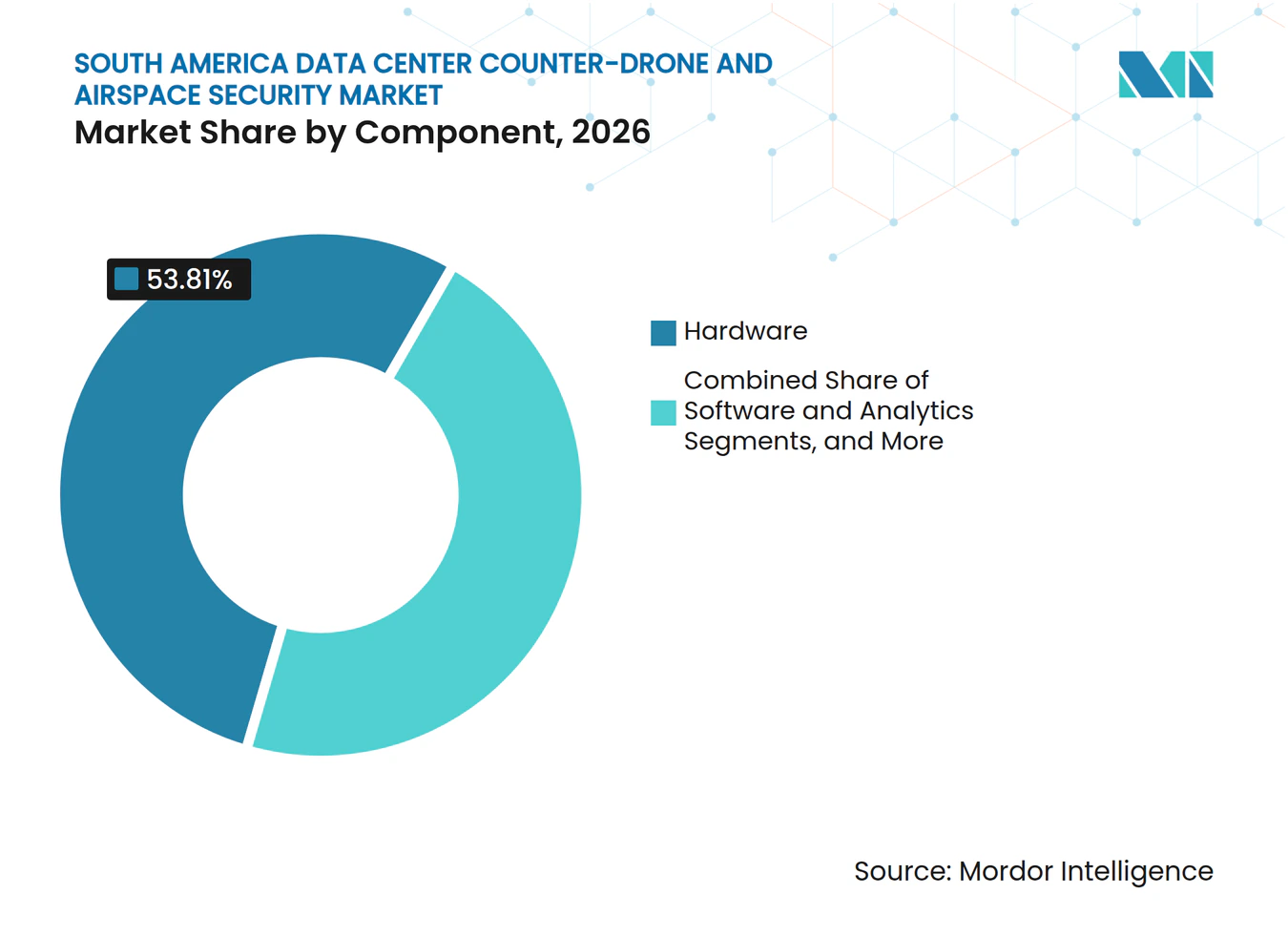
Hardware Leads While Software Reshapes Long-Term ValueHardware held 53.81% of the market in 2026, reflecting initial purchases of antennas, radar units, and cameras. Hardware establishes baseline coverage at each facility. Integration and support services provide follow-on work because every site has different layouts, sight lines, and escalation procedures. The segment’s procurement decision commonly begins with threat assessment, coverage design, and a review of local operating rules. Operators also consider how the equipment fits with existing cameras, access control, and incident procedures.
Software and analytics is projected to expand at a 28.92% CAGR through 2032. Threat classification, sensor fusion, and multi-site command functions move more value into software. Dedrone by Axon reported strong counter-drone booking momentum during fiscal 2026. The segment will require vendor support, tested workflows, and clear coordination with public authorities where active intervention is restricted. These conditions reward systems that can expand without replacing an entire site deployment.



By Technology:
RF Detection Anchors Deployments as Multi-Sensor Systems Gain ShareRadio frequency detection accounted for 31.82% of the market in 2026, making it the main entry technology. Its lower initial cost and mature procurement base support early deployments. Radar, EO/IR, and acoustic tools complement RF coverage under different operating conditions. The segment’s procurement decision commonly begins with threat assessment, coverage design, and a review of local operating rules. Operators also consider how the equipment fits with existing cameras, access control, and incident procedures.
Integrated multi-sensor systems is projected to expand at a 28.78% CAGR through 2032. ANATEL frequency requirements shape specifications for RF equipment in Brazil. Thales and Visionary Machines tested passive optical detection with radar scanning in July 2026. The segment will require vendor support, tested workflows, and clear coordination with public authorities where active intervention is restricted. These conditions reward systems that can expand without replacing an entire site deployment.
By Solution Type:
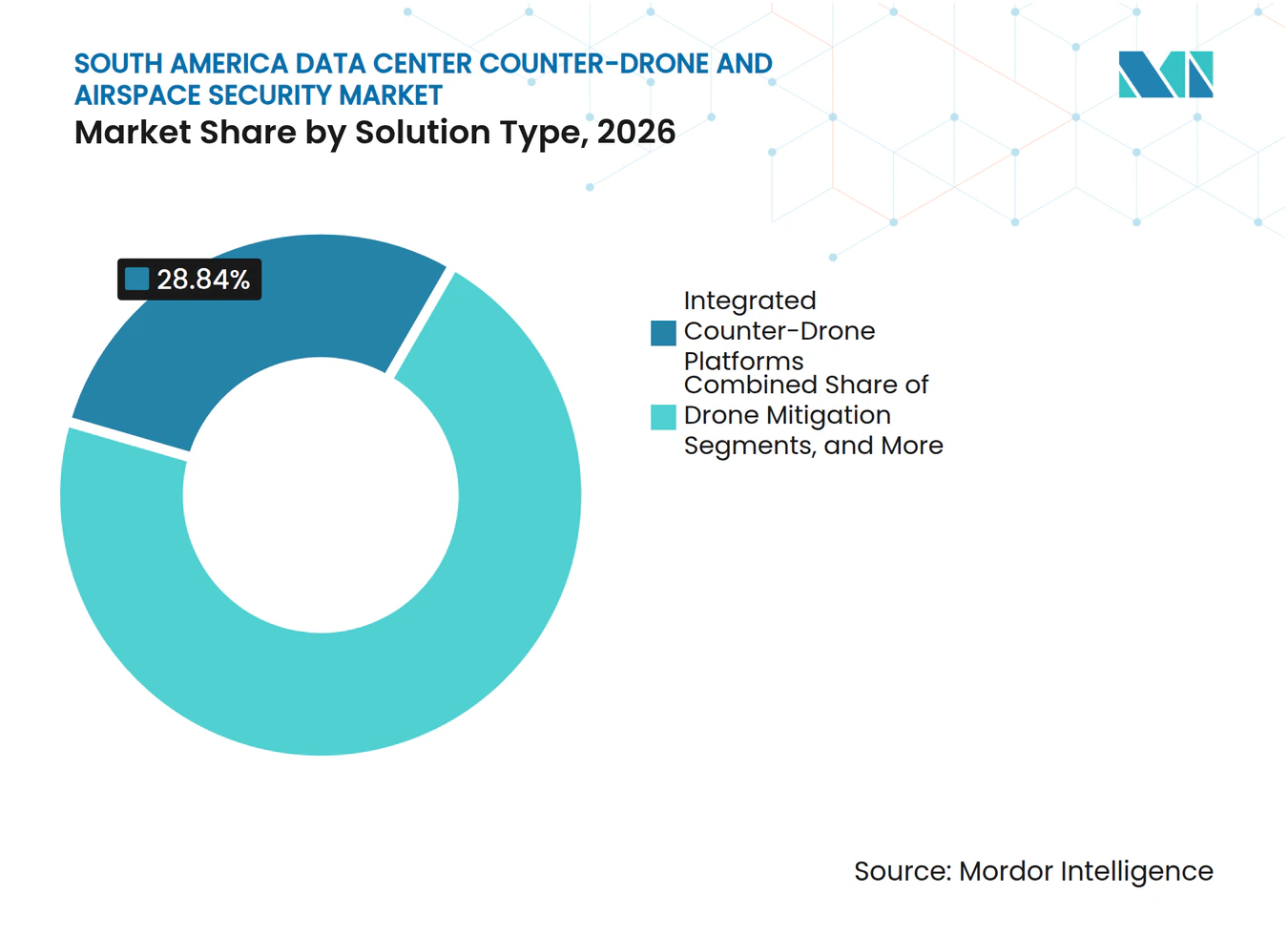
Integrated Counter-Drone Platforms Command Share and GrowthIntegrated counter-drone platforms held 28.84% of the market in 2026 and are projected to expand at a 28.86% CAGR through 2032. The category combines detection, identification, tracking, alerting, and system management in a single operating environment. Security teams prefer fewer interfaces when managing complex facilities. The segment’s procurement decision commonly begins with threat assessment, coverage design, and a review of local operating rules. Operators also consider how the equipment fits with existing cameras, access control, and incident procedures.
Detection and identification remain lower-cost starting points for operators establishing airspace awareness. Tracking and classification help teams assess a target before escalation. Active mitigation remains constrained by public-authority rules in Brazil and Argentina. This leaves an addressable role for alerting platforms within the South America data center counter-drone and airspace security market. The segment will require vendor support, tested workflows, and clear coordination with public authorities where active intervention is restricted. These conditions reward systems that can expand without replacing an entire site deployment.

By Deployment Type:
Fixed Systems Dominate While Portable Solutions Support RotationFixed installations accounted for 68.23% of the market in 2026 because major campuses require 24/7 coverage. Large sites use overlapping radar sectors and pan-tilt-zoom cameras across their perimeters. Permanent systems are suited to stable operational sites with predictable airspace needs. The segment’s procurement decision commonly begins with threat assessment, coverage design, and a review of local operating rules. Operators also consider how the equipment fits with existing cameras, access control, and incident procedures.
Mobile and portable systems is projected to expand at a 28.65% CAGR through 2032. They support temporary construction protection, coverage rotation across portfolios, and edge locations where permanent infrastructure is not economical. DroneShield disclosed USD 9.7 million in South American defense contracts for handheld and on-the-move systems in June 2025. The segment will require vendor support, tested workflows, and clear coordination with public authorities where active intervention is restricted. These conditions reward systems that can expand without replacing an entire site deployment.
By Data Center Size:
Large Sites Lead as Hyperscale Sites Define New DemandLarge data centers held 33.31% of the market in 2026 because they combine high exposure with budgets for layered systems. These sites often host tenants with strict uptime requirements. Small facilities are more likely to rely on basic detection or public-agency response protocols. The segment’s procurement decision commonly begins with threat assessment, coverage design, and a review of local operating rules. Operators also consider how the equipment fits with existing cameras, access control, and incident procedures.
Hyperscale sites is projected to expand at a 28.78% CAGR through 2032. The South America data center counter-drone and airspace security market size for hyperscale facilities is supported by Scala AI City and Rio AI City plans. Scala’s authorized 5 GW connection and Rio’s 3.2 GW target for 2032 highlight the scale of future perimeter coverage needs. The segment will require vendor support, tested workflows, and clear coordination with public authorities where active intervention is restricted. These conditions reward systems that can expand without replacing an entire site deployment.
By Data Center Type:
Colocation Leads While Edge Sites Extend the Security PerimeterColocation operators accounted for 46.22% of the market in 2026 due to their multi-tenant security obligations. Operators protect several tenants at once, so airspace safeguards can support lease discussions and service standards. Cloud providers form another major demand group as regional capacity expands. The segment’s procurement decision commonly begins with threat assessment, coverage design, and a review of local operating rules. Operators also consider how the equipment fits with existing cameras, access control, and incident procedures.
Enterprise and edge deployments is projected to expand at a 28.59% CAGR through 2032. These facilities are often farther from Tier-1 enforcement resources. The South America data center counter-drone and airspace security market share for colocation operators reflects their current scale, while edge deployments create a distinct need for local alerting and response. The segment will require vendor support, tested workflows, and clear coordination with public authorities where active intervention is restricted. These conditions reward systems that can expand without replacing an entire site deployment.
Geography Analysis
Brazil held 61.24% of the market in 2026, supported by approximately 2,100 MW of operational data center capacity and the region’s deepest hyperscale pipeline. Microsoft opened 2 AI-capable data centers in Brazil in January 2026 under its BRL 14.7 billion, USD 2.8 billion, plan. Brazil’s airport response to the Guarulhos incident shows a stronger policy focus on aerial risk at important facilities. The South America data center counter-drone and airspace security market share held by Brazil also reflects its concentration of cloud, colocation, and power-intensive projects. An airport mandate does not automatically apply to data centers, but it provides a relevant signal for infrastructure security planning.
Argentina is the second-largest national opportunity, with government procurement presently ahead of private data center deployment. The Argentine Army launched a tender for an integrated anti-drone system in October 2025. Decree 21/2025 authorized a classified Ministry of Security acquisition, citing criminal uses of drones. The proposed OpenAI and Sur Energy project is sized at up to USD 25 billion and 500 MW under the RIGI framework. If it proceeds, the project would create a large site-specific security requirement. Resolution 151/2025 requires Ministry of Defense review for radar and airspace observation installations, which creates a defined compliance route for private deployments.
Rest of South America is projected to expand at a 28.62% CAGR through 2032 as Chile, Colombia, Peru, and Uruguay draw more infrastructure investment. Chile had 624 MW of operational capacity in mid-2026, and Thales demonstrated radar-based counter-drone solutions there in April 2026. Colombia’s Navy acquired 4 DroneSentry MK2 systems in 2025 for USD 6.05 million for naval-base protection. The South America data center counter-drone and airspace security market will reach these countries as project pipelines mature and security teams seek systems suited to smaller local operating bases.
Competitive Landscape
Market Concentration
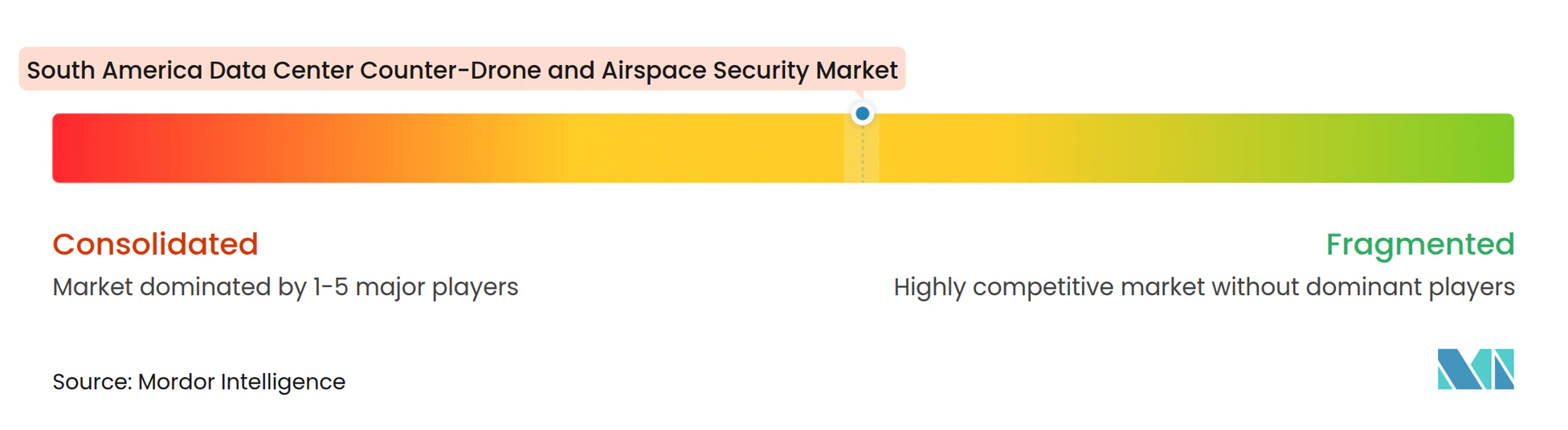
The South America data center counter-drone and airspace security market is fragmented, with no vendor holding a dominant regional position across every solution layer. Thales, RTX, Lockheed Martin, and Northrop Grumman compete strongly in government-led procurement where certifications and scale are important. Thales signed 3 memorandums of understanding at LAAD 2025 related to cybersecurity, drone systems, and public safety equipment. Lockheed Martin selected Fortem Technologies in March 2026 for a critical-infrastructure architecture combining radar, DroneHunter interceptors, and mission-management software. These moves combine established contracting capacity with specialist technology.
Specialist vendors have an advantage where enterprise buyers want faster deployment, open interfaces, and software-centered management. Regional companies including Embraer, Ares Aeroespacial e Defesa, and INVAP can address local content, procurement, and regulatory needs. INVAP displayed its SADEM modular system with RF, radar, and EO/IR sensors at Expodefensa 2025. The South America data center counter-drone and airspace security market leaves room for local integration even when a foreign vendor supplies the core technology. The key requirement is practical coordination between commercial detection systems and authorized public mitigation channels.
DroneShield launched DroneSentry-C2 Enterprise in October 2025 to manage distributed sensors through a strategic command platform with SAPIENT compatibility. Sentrycs won a multi-million-dollar contract for a national defense deployment in South America in February 2025. The award included fixed, portable, and vehicle-mounted systems and government-authorized jamming integration. Continuous monitoring software and edge-site deployments remain open areas for competitive differentiation. The reported evidence does not provide combined market shares for leading vendors, so a score cannot be based on verified concentration data.
South America Data Center Counter-Drone and Airspace Security Industry Leaders
-
DroneShield Group Pty Ltd
-
Dedrone Holdings, Inc. (Axon Enterprise, Inc.)
-
Thales Group
-
RTX Corporation
-
Rafael Advanced Defense Systems Ltd.
- *Disclaimer: Major Players sorted in no particular order
South America Data Center Counter-Drone and Airspace Security Market Companies Covered in this Report
- Dedrone Holdings, Inc. (Axon Enterprise, Inc.)
- DroneShield Group Pty Ltd
- D-Fend Solutions AD Ltd.
- CERBAIR
- Rohde & Schwarz GmbH & Co. KG
- Thales Group
- RTX Corporation
- Lockheed Martin Corporation
- Northrop Grumman Corporation
- Leonardo S.p.A.
- Saab AB
- Rheinmetall AG
- Rafael Advanced Defense Systems Ltd.
- Israel Aerospace Industries Ltd.
- Airbus SE
- The Boeing Company
- Embraer S.A.
- Ares Aeroespacial e Defesa S.A.
- Ascenty Data Centers e Telecomunicações S.A.
- Scala Data Centers Participações S.A.
- ODATA S.A.
- Equinix, Inc.
- Elea Digital S.A.
- Cirion Technologies Inc.
- Google LLC
- Microsoft Corporation
- Amazon Web Services, Inc.
Recent Industry Developments in South America Data Center Counter-Drone and Airspace Security Market
- September 2026: Brazil’s Ministry of Ports and Airports issued a formal directive to ANAC on September 11, 2026, to amend Guarulhos International Airport’s concession contract to mandate counter-drone detection and neutralization system acquisition.
- March 2026: Lockheed Martin selected Fortem Technologies to field an autonomous counter-drone architecture combining TrueView radar sensors, DroneHunter interceptors, and Lockheed’s Sanctum C-UAS Mission Management software for critical infrastructure protection deployments.
- January 2026: Microsoft opened two AI-capable data centers in Brazil as part of its BRL 14.7 billion (USD 2.8 billion) investment plan. The facilities aim to expand the company’s local cloud infrastructure capacity and support growing demand for artificial intelligence services across Brazilian businesses and public-sector organizations.
- November 2025: DroneShield secured a USD 25.3 million contract from a South American government defense customer, strengthening its presence in the region. The contract underscores demand for the company's counter-drone technology and supports its efforts to expand government defense customer relationships internationally.
South America Data Center Counter-Drone and Airspace Security Market Report Scope
The South America Data Center Counter-Drone and Airspace Security Market encompasses hardware, software, and services for detecting, identifying, tracking, monitoring, and mitigating unauthorized drones across data centers in the Brazil, Argentina, and Rest of South America. The market is Segmented by Component (Hardware, Software and Analytics, and Integration and Support Services), Technology (Radar-Based Detection, Radio Frequency Detection, Electro-Optical and Infrared Detection, Acoustic Detection, and Integrated Multi-Sensor Systems), Solution Type (Drone Detection and Identification, Drone Tracking and Classification, Airspace Monitoring and Alerting, Drone Mitigation and Response, and Integrated Counter-Drone Platforms), Deployment Type (Fixed Installations, and Mobile and Portable Systems), Data Center Size (Small, Medium, Large, and Hyperscale), Data Center Type (Colocation, Cloud Service Providers (CSPs), and Enterprise and Edge), Geography ( Brazil, Argentina, and Rest of South America). The Market Forecasts are Provided in Terms of Value (USD).
Segmentation Overview
| Hardware |
| Software and Analytics |
| Integration and Support Services |
| Radar-Based Detection |
| Radio Frequency Detection |
| Electro-Optical and Infrared Detection |
| Acoustic Detection |
| Integrated Multi-Sensor Systems |
| Drone Detection and Identification |
| Drone Tracking and Classification |
| Airspace Monitoring and Alerting |
| Drone Mitigation and Response |
| Integrated Counter-Drone Platforms |
| Fixed Installations |
| Mobile and Portable Systems |
| Small |
| Medium |
| Large |
| Hyperscale |
| Colocation |
| Cloud Service Providers |
| Enterprise and Edge |
| Brazil |
| Argentina |
| Rest of South America |
| By Component | Hardware |
| Software and Analytics | |
| Integration and Support Services | |
| By Technology | Radar-Based Detection |
| Radio Frequency Detection | |
| Electro-Optical and Infrared Detection | |
| Acoustic Detection | |
| Integrated Multi-Sensor Systems | |
| By Solution Type | Drone Detection and Identification |
| Drone Tracking and Classification | |
| Airspace Monitoring and Alerting | |
| Drone Mitigation and Response | |
| Integrated Counter-Drone Platforms | |
| By Deployment Type | Fixed Installations |
| Mobile and Portable Systems | |
| By Data Center Size | Small |
| Medium | |
| Large | |
| Hyperscale | |
| By Data Center Type | Colocation |
| Cloud Service Providers | |
| Enterprise and Edge | |
| By Geography | Brazil |
| Argentina | |
| Rest of South America |
Key Questions Answered in the Report
What is the South America data center counter-drone and airspace security market size?
It is valued at USD 13.20 million in 2026 and is estimated to reach USD 58.32 million by 2032, at a 27.96% CAGR.
Which country leads demand for data center airspace security in South America?
Brazil leads with 61.24% share in 2026, supported by its large operating base and hyperscale project pipeline.
Which technology is expected to expand fastest?
Integrated multi-sensor systems is projected to expand at a 28.78% CAGR through 2032 because it addresses gaps in single-sensor coverage.
Why are fixed systems widely used at data centers?
Fixed installations held 68.23% share in 2026 because major campuses need continuous perimeter coverage.
Can private data center operators use drone jammers in Brazil?
Private operators can deploy detection and alerting systems, but active RF jamming is restricted to eligible public authorities.
Which data center type has the strongest demand today?
Colocation operators held 46.22% share in 2026 because they manage security requirements across multiple tenants.