
South America Data Center Copper and Electrical Materials Market Size and Share
Market Overview
| Study Period | 2021 - 2032 |
|---|---|
| Forecast Data Period | 2027 - 2032 |
| Base Year Market Size (2026) | USD 0.58 Billion |
| Market Size (2027) | USD 0.64 Billion |
| Market Size (2032) | USD 0.92 Billion |
| Growth Rate (2027 - 2032) | 7.53 % |
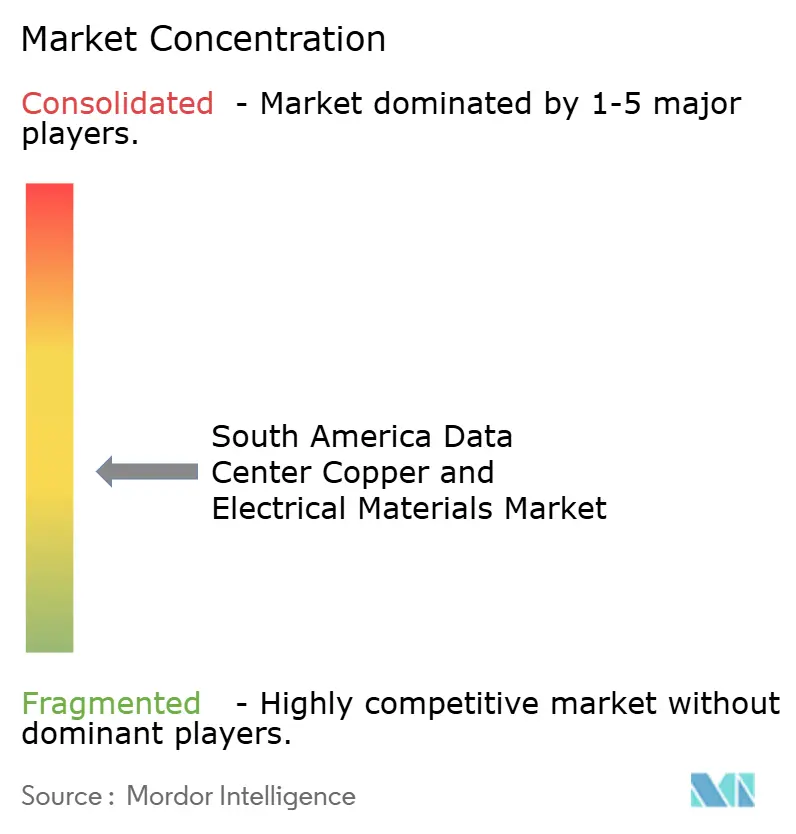
| Market Concentration | Medium |
Major Players *Disclaimer: Major Players sorted in no particular order Image © Mordor Intelligence. Reuse requires attribution under CC BY 4.0. | |
South America Data Center Copper and Electrical Materials Market Analysis by Mordor Intelligence
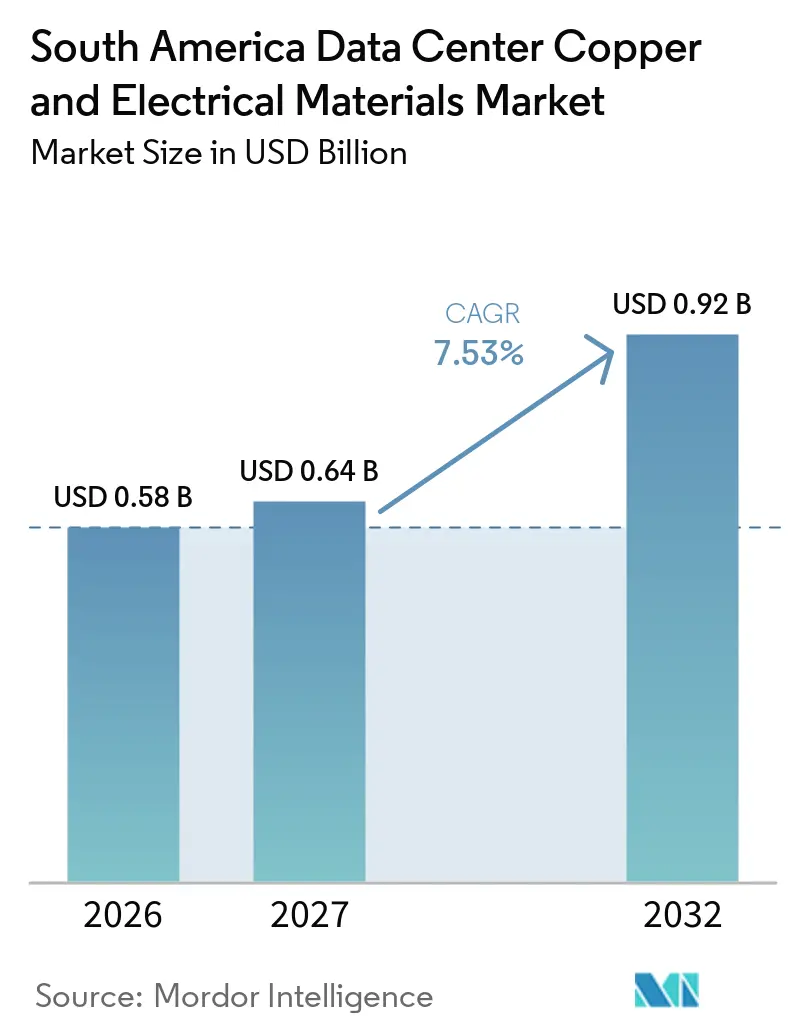
The South America data center copper and electrical materials market size was valued at USD 0.58 billion in 2026 and is estimated to expand from USD 0.64 billion in 2027 to reach USD 0.92 billion by 2032, at a CAGR of 7.53% during the forecast period 2027-2032. New hyperscale and colocation capacity is increasing demand for cables, transformers, busways, grounding systems, and distribution equipment. Higher rack loads associated with AI deployments are raising conductor and busway specifications across the power chain. Local production of transformers and cable is becoming more important because buyers need dependable lead times for critical electrical assemblies. Grid access, copper costs, specialist labor availability, and water constraints will shape the timing of projects. Suppliers that combine compliant products with factory-integrated power systems are positioned to address more of the South America data center copper and electrical materials market.
Key Report Takeaways
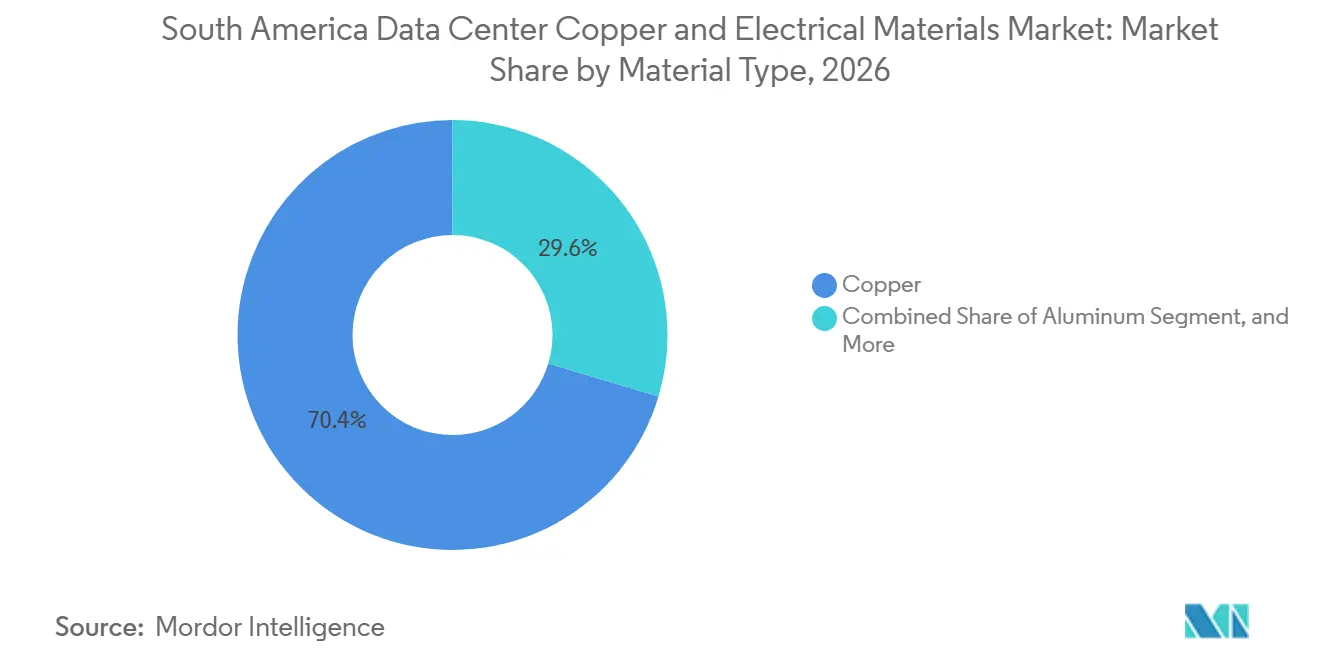
- By material type, copper held 70.38% of the South America data center copper and electrical materials market share in 2026, while aluminum is projected to expand at an 8.29% CAGR through 2032.
- By product type, electrical cables and conductors accounted for 44.21% of revenue in 2026, while busbars and busways are projected to advance at an 8.77% CAGR through 2032.
- By application, power distribution held 46.38% of revenue in 2026 and is projected to expand at a 9.22% CAGR through 2032.
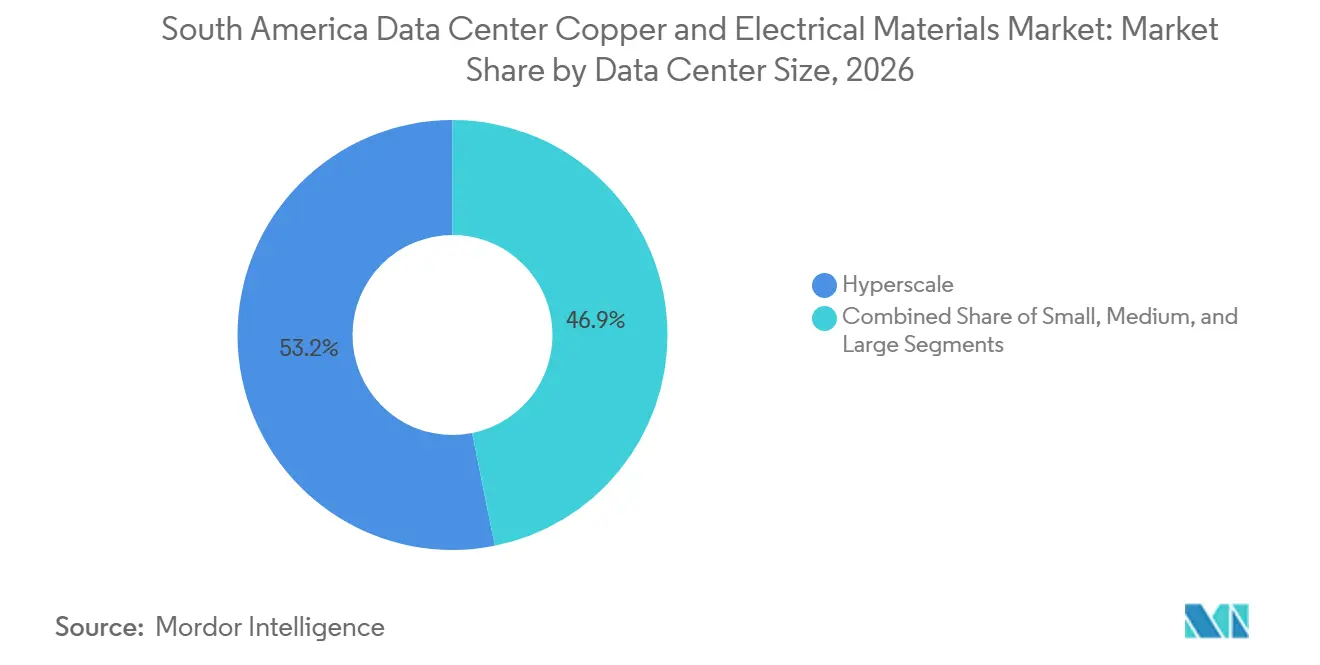
- By data center size, hyperscale facilities held 53.15% of revenue in 2026 and are projected to expand at a 9.69% CAGR through 2032.
- By data center type, colocation held 54.68% of revenue in 2026, while cloud service providers are projected to expand at a 9.94% CAGR through 2032.
- By geography, Brazil held 63.40% of the South America data center copper and electrical materials market share in 2026 and is projected to expand at a 10.32% CAGR through 2032.
Note: Market numbers in this report are based on Mordor Intelligence's proprietary estimation framework, which combines nine months of actuals with Q4 projections for base year 2026.
Market Trends and Insights
Drivers Impact Analysis of South America Data Center Copper and Electrical Materials Market*
| Driver | (~) % Impact on CAGR Forecast | Geographic Relevance | Impact Timeline |
|---|---|---|---|
| Hyperscale and Colocation Capacity Expansion | +2.5% | Brazil, Chile, Argentina | Short term (≤ 2 years) |
| AI Workloads Increasing Rack Power Density | +1.8% | South America, concentrated in Brazil and Chile | Short term (≤ 2 years) |
| Cloud-Region Localization and Data-Sovereignty Requirements | +1.1% | Brazil, Chile, Argentina | Medium term (2-4 years) |
| Renewable-Power Procurement for Data Center Campuses | +0.6% | Chile, Brazil, Argentina | Medium term (2-4 years) |
| Subsea Cable Landings and Interconnection Growth | +0.4% | Brazil, Chile, Argentina | Short term (≤ 2 years) |
| Regionalization of High-Density Copper and Aluminum Supply | +0.3% | Chile, Peru, Brazil | Long term (≥ 4 years) |
| Source: Mordor Intelligence | |||
Hyperscale and Colocation Capacity Expansion
The South America data center copper and electrical materials market is supported by large construction programs that require extensive cable, transformer, switchgear, and busway purchases. Ascenty confirmed USD 1 billion in approved 2026 investments across Brazil, Mexico, and Chile, covering 13 active development projects. These programs require procurement decisions well before facilities enter service, which favors suppliers with regional inventory and application support. WEG supplied four 12.5 MW transformers for Elea Data Centers’ 50 MW AI-focused site in São Paulo, showing the scale of individual electrical equipment orders.[1] The South America data center copper and electrical materials market gains when suppliers can provide tested equipment, installation guidance, and reliable delivery schedules.
AI Workloads Increasing Rack Power Density
AI training and inference systems are changing electrical design requirements in the South America data center copper and electrical materials market. Higher-density racks need larger conductor sections, robust busway systems, protection equipment, and carefully designed grounding paths. These requirements create demand for upgraded distribution equipment in new sites and facilities undergoing AI-related retrofits. They also raise the importance of tested connectors and precise installation practices because poor terminations can create thermal risks. Suppliers that offer integrated assemblies can reduce coordination work for operators moving to higher-density designs. Higher-density electrical systems place more value on products that are tested as a complete assembly before they reach a site.
Cloud-Region Localization and Data-Sovereignty Requirements
National data-handling requirements are encouraging cloud providers and regulated customers to place infrastructure closer to users in South America. Brazil’s LGPD framework and Chile’s Law 21.719 create compliance factors that support local capacity planning. This demand supports new projects for colocation providers, cloud operators, and enterprise facilities serving public sector and financial customers. Each project needs power distribution, backup systems, and grounding equipment before IT equipment can be installed. The South America data center copper and electrical materials market benefits when data localization moves investment from remote regions into domestic facilities. The effect is strongest in markets that combine compliance needs with reliable power, fiber, and site availability.
Renewable-Power Procurement for Data Center Campuses
Renewable energy procurement is strengthening the business case for new data center campuses in Chile and Brazil. Atlas Renewable Energy and OData agreed to supply 100% certified renewable energy to OData’s 28 MW ST01 data center in Chile under the I-REC framework. Atlas also reported BNDES financing of BRL 1 billion (USD 179 million) for the 505 MWac Draco Solar Complex in Minas Gerais, which is structured to supply data centers.[2] Renewable projects add demand for transformer windings, cable, substations, and grounding equipment in addition to the electrical fit-out inside a facility. Long-term power purchase agreements also give operators a clearer basis for committing capital to large sites. This supports the South America data center copper and electrical materials market across both power generation links and data center distribution systems.
Restraints Impact Analysis of South America Data Center Copper and Electrical Materials Market*
| Restraint | (~) % Impact on CAGR Forecast | Geographic Relevance | Impact Timeline |
|---|---|---|---|
| Copper-Price Volatility and Material Cost Pass-Through | -1.6% | South America, with acute impact on Brazil and Chile procurement | Short term (≤ 2 years) |
| Long Utility-Grid Interconnection Lead Times | -1.2% | Brazil and Argentina | Medium term (2-4 years) |
| High-Voltage Technician and Specialist Installer Shortages | -0.8% | Chile, Brazil, and South America | Medium term (2-4 years) |
| Water-Stress Restrictions on Cooling-Intensive Facilities | -0.5% | Chile and Brazil | Medium term (2-4 years) |
| Source: Mordor Intelligence | |||
Copper-Price Volatility and Material Cost Pass-Through
Copper price movements can alter project budgets because power cables, transformer windings, busbars, and grounding networks use large volumes of the metal. The International Copper Study Group documented the importance of Chile and Peru within global refined copper supply, making regional supply conditions relevant to local buyers.[3] Fixed-price construction contracts can leave developers and equipment suppliers exposed when cable or busbar input costs rise after bids are submitted. Operators may specify aluminum for suitable overhead distribution runs where applicable electrical codes allow it. This changes the mix of materials but does not remove the need for electrical distribution equipment. The South America data center copper and electrical materials market remains sensitive to this issue because procurement packages are large and delivery schedules are tightly linked to construction milestones.
Long Utility-Grid Interconnection Lead Times
Long grid-connection processes can delay data center commissioning and move electrical procurement into later periods. A rising volume of connection requests in Brazil has made utility approvals an important planning issue for developers. Data center construction can proceed faster than transmission expansion, leaving completed sites dependent on utility approvals. That mismatch affects the timing of substation, high-voltage cable, switchgear, and transformer orders. Chile also faces the need for trained line workers to support transmission expansion for new power loads. Suppliers can partly manage this risk by maintaining flexible production schedules, but project deferrals can still weaken near-term order visibility.
*Our forecasts treat driver/restraint impacts as directional, not additive. The impact forecasts reflect baseline growth, mix effects, and variable interactions.
South America Data Center Copper and Electrical Materials Market Segment Analysis
By Material Type:
Copper Retains Its Core Role While Aluminum Broadens Its UseCopper held 70.38% of the South America data center copper and electrical materials market share in 2026, reflecting its central role in high-current, safety-critical, and high-reliability applications. It is used in power cables, busbars, transformer windings, grounding systems, distribution panels, and rack-level assemblies. Its conductivity allows compact designs where electrical losses and heat control are critical. Data center operators also depend on copper in parts of the electrical chain where a change of material would require design, certification, and installation adjustments. These uses protect copper’s leading position even as material costs remain a concern for developers.
Aluminum is projected to expand at an 8.29% CAGR through 2032, mainly through overhead busways and medium-voltage feeder runs in large campus layouts. It can reduce weight and material cost on long runs where greater conductor dimensions are acceptable. This does not make aluminum a universal substitute for copper. Copper continues to serve sensitive connections, ground-fault protection, dense rack-level systems, and transformer applications requiring compact configurations. Specialty conductors and alloys have a smaller role in shielding and thermal applications, but they broaden the choice available to equipment designers.

By Product Type:
Cables Lead While Busways Support Higher-Density DesignsElectrical cables and conductors held 44.21% of revenue in 2026 because they are required from the utility entry point to the final rack power distribution unit. A greenfield facility needs cable for grid connections, substations, transformers, switchgear, distribution panels, and equipment rooms. Expansion projects also need additional cable when a facility adds halls, upgrades an existing power train, or connects new backup equipment. Local cable manufacturing can help projects manage delivery risk when construction schedules are tight. Prysmian’s Sorocaba operation provides a regional base for power cable supply, which is relevant to buyers seeking dependable availability.
Busbars and busways are projected to expand at an 8.77% CAGR through 2032 as operators use modular distribution designs for AI-ready data halls. Their modular structure can simplify capacity additions and enable flexible tap-off points as rack configurations change. Higher-density racks increase the need for reliable, well-designed distribution routes between transformers, switchgear, and IT spaces. Copper rods and strips remain important inputs for transformer and switchgear fabrication. Connectors and termination materials also require careful selection and installation because poor workmanship can compromise system reliability.
By Application:
Power Distribution Remains the Largest Electrical Demand CenterPower distribution accounted for 46.38% of the South America data center copper and electrical materials market share in 2026 and is projected to expand at a 9.22% CAGR through 2032. The application includes medium-voltage switchgear, transformers, main busbars, sub-distribution cabling, protection equipment, panels, and rack-level distribution. Every additional megawatt of IT load requires capacity through the full electrical chain, not only at the rack. WEG supplied four 12.5 MW transformers for Elea Data Centers’ 50 MW AI-focused site in São Paulo, illustrating the scale of equipment that an individual facility can require.
Power backup systems also require generator windings, uninterruptible power supply assemblies, backup transformers, and cable links to critical panels. Grid connection and electrical infrastructure cover the upstream works that link a site to the utility system, including substations, high-voltage conductors, and grounding. Delayed utility approvals can move this procurement into later periods, but they do not remove the eventual equipment need. Grounding and bonding are smaller categories, although their importance rises when facilities introduce liquid cooling and higher-density electrical systems. Suppliers that coordinate these applications as a complete project package can reduce interfaces for the operator.
By Data Center Size:
Hyperscale Facilities Set the Highest SpecificationsHyperscale facilities held 53.15% of revenue in 2026 and are projected to expand at a 9.69% CAGR through 2032. These campuses require centralized substations, ring-bus distribution, long cable routes, large transformers, and dedicated interconnect areas. Their scale means that each facility can create substantial demand for copper-intensive electrical assemblies. AI workloads add to that requirement because they increase the electrical specification per megawatt. Ascenty confirmed USD 1 billion in approved 2026 investments across Brazil, Mexico, and Chile and reported 13 active development projects.
Large facilities in the 10-60 MW range support enterprise and colocation customers and require conventional medium-voltage cable, switchgear, busways, and backup systems. They produce steadier demand even though hyperscale sites account for the highest value requirements. Medium and small facilities remain relevant for local operations, edge computing, and dedicated enterprise capacity. They generally use smaller assemblies, panelboards, cables, and busbar sections. As workloads consolidate into larger locations, their share may reduce, but they continue to create baseline demand across the South America data center copper and electrical materials market.
By Data Center Type:
Colocation Leads Revenue While Cloud Providers Set New RequirementsColocation held 54.68% of revenue in 2026 because multi-tenant facilities need separate metering, redundant feeds, isolated grounding arrangements, and flexible distribution layouts. These features can create more electrical content per megawatt than a single-tenant facility with a standardized design. Colocation operators also need systems that can be expanded or reconfigured as tenant requirements change. Redundant power paths support demand for switchgear, cable, busways, panels, and backup equipment. This makes maintainability, certification, and post-commissioning service important factors in purchasing decisions.
Cloud service providers are projected to expand at a 9.94% CAGR through 2032 as localized cloud capacity develops across the region. Their facilities often use more standardized designs, higher-grade materials, and tighter engineering requirements than smaller sites. Demand from regulated customers can support domestic cloud deployment where operators need data capacity close to users. Factory-integrated electrical modules can reduce on-site installation work and improve consistency. Schneider Electric’s Blumenau facility exports prefabricated power modules and e-houses to Chile, Peru, Argentina, and Colombia, showing how integrated delivery supports regional deployment.
Geography Analysis
Brazil: Scale, Connectivity, and Local Supply Strengthen Demand
Brazil held 63.40% of the South America data center copper and electrical materials market size in 2026 and is projected to expand at a 10.32% CAGR through 2032. Greater São Paulo, Fortaleza, and Rio de Janeiro concentrate many of the country’s hyperscale and colocation activities, creating sustained demand for cables, transformers, busways, and grounding systems. Fortaleza’s cable connectivity and São Paulo’s dense concentration of data centers support new facility development and equipment procurement. WEG’s Brazilian manufacturing base supplies transformer equipment for large projects, including its 2025 supply agreement with Elea Data Centers. Grid connection timing and the ANPD compliance environment remain important factors for developers planning new sites.
Chile: Renewable Power and Compliance Demand Support New Campuses
Chile’s renewable power availability and solar resources are supporting new data center campus planning. Atlas Renewable Energy and OData formalized a renewable supply agreement for OData’s 28 MW ST01 data center under the I-REC standard. Renewable projects require substations, transmission links, transformers, cable, and grounding equipment in addition to the electrical fit-out within a facility. Water availability remains a project consideration around Santiago, encouraging designs that manage water exposure and power requirements together. These factors give Chile a distinct role within the South America data center copper and electrical materials market.
Argentina and the Rest of South America: Interconnection Extends the Regional Opportunity
Argentina is creating demand through Buenos Aires colocation projects and edge facilities that serve regulated customers. Vertiv’s partnership with Grupo Datco improved access to power and cooling products in Argentina and Chile in 2025.[4] Colombia, Peru, Uruguay, Ecuador, Bolivia, and Paraguay remain earlier-stage locations, but Vertiv’s 2026 MAXID agreement expanded distribution coverage from Brazil across several of these markets. Subsea links, fiber corridors, utility capacity, compliance needs, and local distribution reach will determine where new facilities advance first.
Competitive Landscape
The South America data center copper and electrical materials market has a moderately fragmented supplier base. Prysmian, Nexans, WEG, ABB, Schneider Electric, Eaton, and Siemens compete on product range, regional manufacturing, distribution capability, and electrical engineering support. Equinix, Ascenty, Scala Data Centers, and ODATA are concentrated buyers that influence technical specifications and delivery requirements. Suppliers increasingly seek to provide integrated assemblies rather than isolated components. This can include coordinated equipment from the utility meter to the rack power distribution unit.
WEG’s 2025 transformer supply agreement with Elea Data Centers is an example of a supplier securing a specific role in a large AI-focused project. Vertiv’s partnership with Grupo Datco in Argentina and Chile is a second strategic move that expanded regional access to power, cooling, and support services. Its 2026 agreement with MAXID is a third move focused on broader South American distribution coverage. These strategies emphasize local inventory, responsive technical support, and shorter equipment lead times.
Smaller Brazilian and Chilean electrical assembly firms can compete through local installation knowledge and faster delivery for mid-market or edge projects. Large suppliers retain advantages in portfolio breadth, certification, and support for complex campus designs. ISO 9001 and IEC 61439 compliance can raise qualification requirements for suppliers serving critical power projects. The competitive focus is therefore technical reliability, delivery execution, and service across the facility life cycle.
South America Data Center Copper and Electrical Materials Industry Leaders
-
ABB Ltd
-
Eaton Corporation plc
-
Huawei Technologies Co., Ltd.
-
Legrand SA
-
Nexans S.A.
- *Disclaimer: Major Players sorted in no particular order
South America Data Center Copper and Electrical Materials Market Companies Covered in this Report
- ABB Ltd
- Aligned Data Centers
- Ascenty Data Centers e Telecomunicacoes SA
- Caterpillar Inc.
- Cirion Technologies
- Cummins Inc.
- Delta Electronics Inc.
- Digital Realty Trust, Inc.
- Eaton Corporation plc
- EdgeConneX Inc.
- Equinix, Inc.
- Gtd Grupo Teleductos S.A.
- Huawei Technologies Co., Ltd.
- Elea Data Centers
- Legrand SA
- Nexans S.A.
- ODATA Brazil S.A.
- Prysmian S.p.A.
- Scala Data Centers S.A.
- Schneider Electric SE
- Siemens AG
- Vertiv Holdings Co
- WEG S.A.
Recent Industry Developments in South America Data Center Copper and Electrical Materials Market
- October 2026: Vale S.A., an iron ore company, planned to nearly double its copper output as data centers and electrification lift demand for the metal. Its current annual copper production stands at about 380 kilotons, against a target of 700 kilotons within five years from the Carajás region in northern Brazil.
- August 2026: Argentina and Chile approved cross-border operating protocols for three copper projects spanning San Juan and Atacama under a framework that could unlock more than USD 20.7 billion in investment and add 540,000 tonnes of annual copper output if the projects reach production.
- July 2026: Chile plans about USD 100 billion in copper investments over the next decade as it seeks to tap demand from data centers and diversify its customer base beyond China.
- April 2026: Vertiv and MAXID established a master distribution agreement for Brazil and South America, consolidating UPS systems, power distribution units, and precision cooling solutions in a Brazilian inventory hub with logistics coverage reaching Peru, Chile, Argentina, Paraguay, Uruguay, and Bolivia, addressing lead-time constraints that had slowed electrical infrastructure delivery to secondary South American markets.
South America Data Center Copper and Electrical Materials Market Report Scope
The South America data center copper and electrical materials market encompasses the procurement, regional manufacturing, and deployment of specialized copper, aluminum, and alternative conducting materials tailored for high-density computing infrastructure across the region. The market tracks the distribution of critical electrical cables, busbars, rods, and grounding components utilized in power distribution, backup systems, and grid connections across small, medium, large, and hyperscale facilities operating under colocation, enterprise, and cloud service frameworks.
The South America Data Center Copper and Electrical Materials Market Report is Segmented by Material Type (Copper, Aluminum, and Other Electrical Conductive Materials), Product Type (Electrical Cables and Conductors, Busbars and Busways, Copper Rods and Strips, Electrical Connectors and Termination Materials, and Other Electrical Materials), Application (Power Distribution, Power Backup Systems, Grid Connection and Electrical Infrastructure, Grounding and Bonding, and Other Electrical Applications), Data Center Size (Small, Medium, Large, and Hyperscale), Data Center Type (Colocation, Cloud Service Providers [CSPs], and Enterprise / Edge), and Country (Brazil, Argentina, Chile, and Rest of South America). The Market Forecasts are Provided in Terms of Value (USD).
Segmentation Overview
| Copper |
| Aluminum |
| Other Electrical Conductive Materials |
| Electrical Cables and Conductors |
| Busbars and Busways |
| Copper Rods and Strips |
| Electrical Connectors and Termination Materials |
| Other Electrical Materials |
| Power Distribution |
| Power Backup Systems |
| Grid Connection and Electrical Infrastructure |
| Grounding and Bonding |
| Other Electrical Applications |
| Small |
| Medium |
| Large |
| Hyperscale |
| Colocation |
| Cloud Service Providers (CSPs) |
| Enterprise / Edge |
| Brazil |
| Argentina |
| Chile |
| Rest of South America |
| By Material Type | Copper |
| Aluminum | |
| Other Electrical Conductive Materials | |
| By Product Type | Electrical Cables and Conductors |
| Busbars and Busways | |
| Copper Rods and Strips | |
| Electrical Connectors and Termination Materials | |
| Other Electrical Materials | |
| By Application | Power Distribution |
| Power Backup Systems | |
| Grid Connection and Electrical Infrastructure | |
| Grounding and Bonding | |
| Other Electrical Applications | |
| By Data Center Size | Small |
| Medium | |
| Large | |
| Hyperscale | |
| By Data Center Type | Colocation |
| Cloud Service Providers (CSPs) | |
| Enterprise / Edge | |
| By Country | Brazil |
| Argentina | |
| Chile | |
| Rest of South America |
Key Questions Answered in the Report
What is the size of the South America data center copper and electrical materials market?
The market is valued at USD 0.58 billion in 2026 and is projected to reach USD 0.92 billion by 2032 at a 7.53% CAGR.
What is driving demand for data center electrical materials in South America?
Hyperscale construction, AI-related power density, cloud localization, and renewable-power projects are increasing demand for cables, transformers, busways, and grounding systems.
Which material leads data center electrical demand in South America?
Copper leads with a 70.38% revenue share in 2026 because of its role in high-current cables, busbars, transformer windings, and grounding systems.
Which data center application uses the most electrical materials?
Power distribution leads with a 46.38% share in 2026 and is projected to expand at a 9.22% CAGR through 2032.
Why is Brazil important for data center electrical equipment suppliers?
Brazil holds 63.40% of regional revenue in 2026 and is projected to expand at a 10.32% CAGR through 2032, supported by major hubs and local manufacturing.
How are AI workloads changing data center power infrastructure?
AI deployments require higher-capacity conductors, busways, protection systems, and grounding designs, increasing the value of integrated electrical assemblies.