
South America Data Center Construction Materials Supply Chain Market Size and Share
Market Overview
| Study Period | 2021 - 2032 |
|---|---|
| Forecast Data Period | 2027 - 2032 |
| Base Year Market Size (2025) | USD 0.76 Billion |
| Market Size (2027) | USD 0.88 Billion |
| Market Size (2032) | USD 1.35 Billion |
| Growth Rate (2027 - 2032) | 8.94 % |
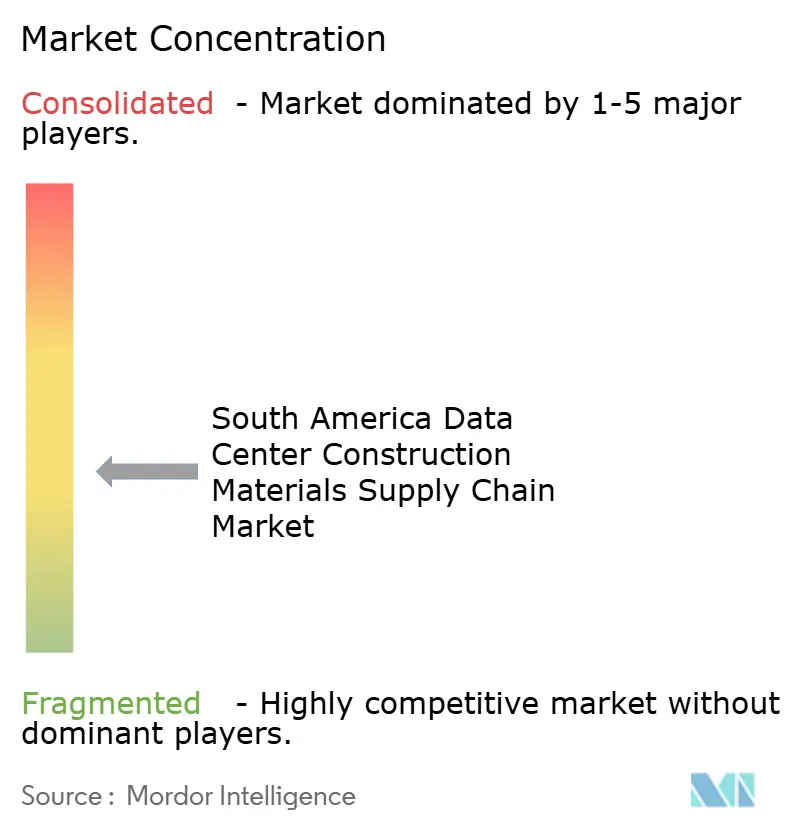
| Market Concentration | Medium |
Major Players *Disclaimer: Major Players sorted in no particular order Image © Mordor Intelligence. Reuse requires attribution under CC BY 4.0. | |
South America Data Center Construction Materials Supply Chain Market Analysis by Mordor Intelligence
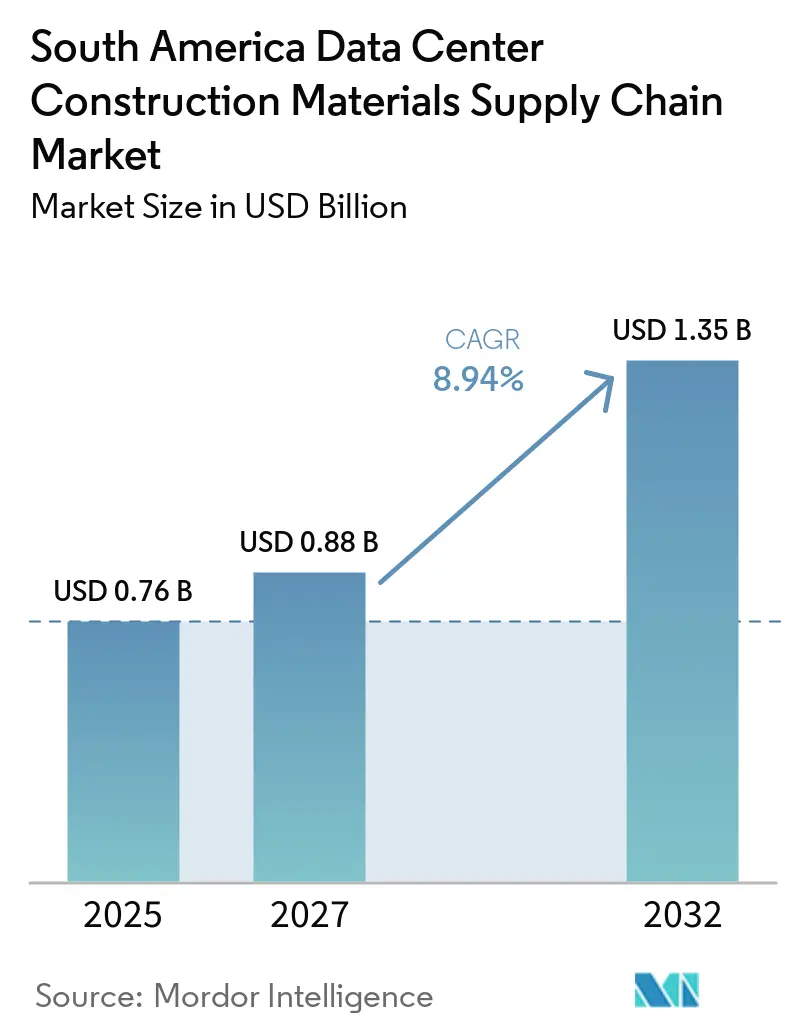
The South America data center construction materials supply chain market size was valued at USD 0.76 billion in 2026 and is estimated to grow from USD 0.88 billion in 2027 to reach USD 1.35 billion by 2032, at a CAGR of 8.94% during the forecast period (2027-2032). The South America data center construction materials supply chain market is supported by large cloud campuses, AI-ready facilities, and expanding colocation capacity. Brazil remains the main demand center because its projects combine large data halls, power infrastructure, and specialized fit-out requirements. Chile is gaining importance through renewable power availability, new transmission works, and cable-linked development along coastal and metropolitan corridors. Contractors are using prefabrication and earlier procurement to manage long equipment lead times and limit work at congested sites. Grid access, water approvals, imported input costs, and shortages of specialized construction labor continue to shape project schedules and material choices.
Key Report Takeaways
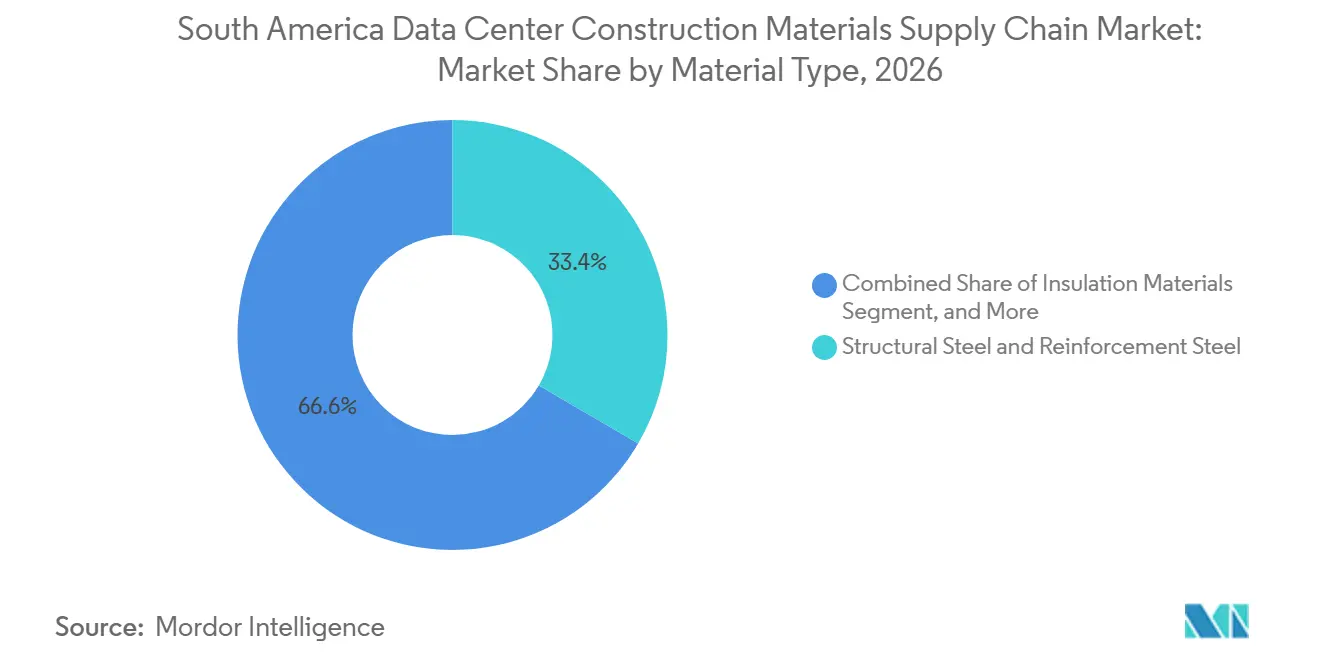
- By material type, Structural Steel and Reinforcement Steel held 33.41% of the South America data center construction materials supply chain market share in 2026, while Precast Concrete Products are projected to expand at a 9.67% CAGR through 2032.
- By construction phase, Structural Construction accounted for 43.30% of the South America data center construction materials supply chain market size in 2026, while Building Envelope and Roofing are projected to expand at a 9.53% CAGR through 2032.
- By procurement model, EPC-led procurement held a 52.63% share in 2026, while Direct Procurement by Data Center Developers and Operators is projected to expand at a 9.78% CAGR through 2032.
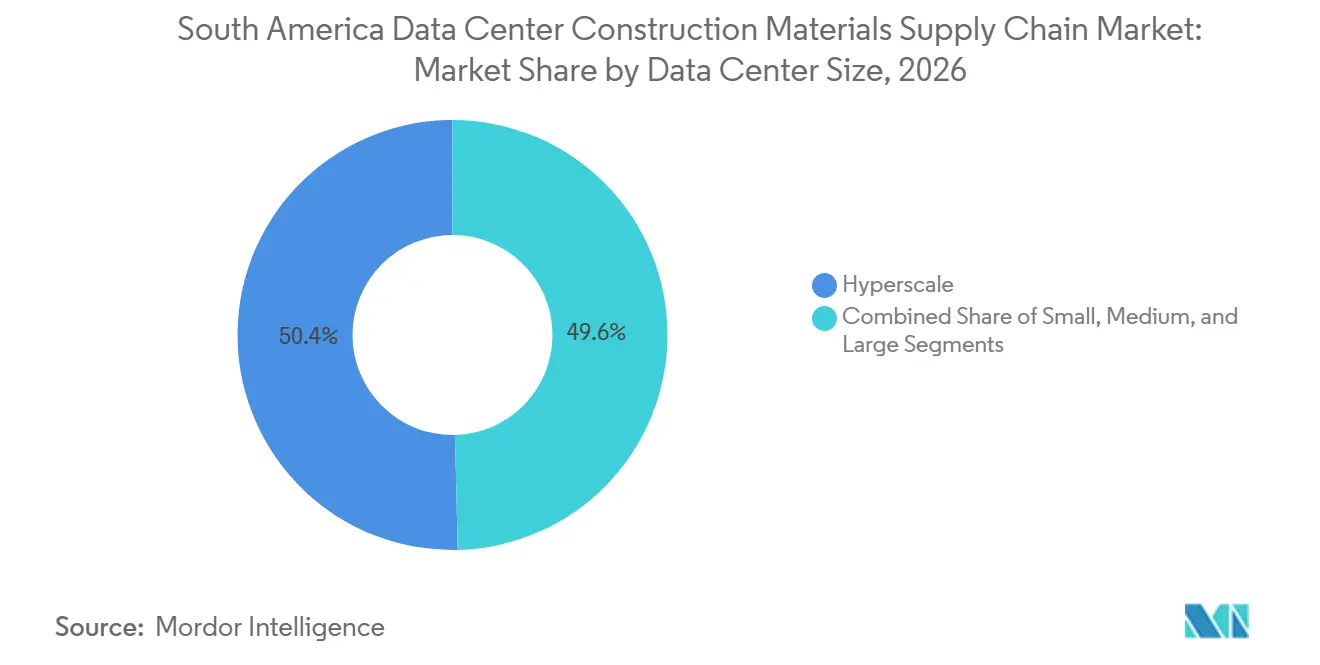
- By data center size, Hyperscale accounted for a 50.39% share in 2026 and is projected to expand at a 10.21% CAGR through 2032.
- By data center type, Colocation held 56.17% share in 2026, while Cloud Service Providers are projected to expand at a 10.40% CAGR through 2032.
- By geography, Brazil held 66.40% share in 2026, while Chile is projected to expand at a 10.71% CAGR through 2032.
Note: Market numbers in this report are based on Mordor Intelligence's proprietary estimation framework, which combines nine months of actuals with Q4 projections for base year 2026.
Market Trends and Insights
Drivers Impact Analysis of South America Data Center Construction Materials Supply Chain Market*
| Driver | (~) % Impact on CAGR Forecast | Geographic Relevance | Impact Timeline |
|---|---|---|---|
| Cloud Migration and Hyperscale Data Center Expansion | +2.0% | Brazil and Chile, with activity in São Paulo, Campinas, Rio de Janeiro, Santiago, and Lampa | Short term (≤ 2 years) |
| AI Workloads Increasing Construction Intensity | +1.9% | Brazil and Chile, especially São Paulo, Fortaleza, and Santiago | Short term (≤ 2 years) |
| Renewable-Energy and Green-Building Investment | +1.3% | Chile and Brazil, especially Chile and Brazil's southern and northeastern states | Medium term (2-4 years) |
| Data Sovereignty and Low-Latency Requirements | +1.1% | Brazil, Chile, and Argentina, with early gains in Santiago, São Paulo, and Buenos Aires | Medium term (2-4 years) |
| Prefabricated Construction Reducing Delivery Timelines | +0.9% | Brazil and Chile, including São Paulo, Santana de Parnaíba, Lampa, and Curauma | Short term (≤ 2 years) |
| Subsea Cable Concentration Creating New Regional Hubs | +0.7% | Brazil, Chile, and Argentina, including Fortaleza, Porto Alegre, Valparaíso, and Chubut | Medium term (2-4 years) |
| Source: Mordor Intelligence | |||
Cloud Migration and Hyperscale Data Center Expansion
The South America data center construction materials supply chain market is seeing larger material orders as cloud operators build campuses rather than isolated facilities. Brazil accounts for 71% of regional capacity under construction, concentrating demand for steel frames, reinforced slabs, and fit-out materials in a limited number of corridors. ODATA describes Brazilian AI data center locations with construction programs that require purpose-built facilities and supporting power systems. Large campuses reduce the number of individual projects but increase the value and complexity of each procurement package. This pattern favors contractors that can coordinate suppliers, transport, and installation across several development phases. It also makes supply availability in São Paulo and Santiago more important for contractors serving smaller projects.
AI Workloads Increasing Construction Intensity
AI workloads are changing the specifications of data halls and the materials needed to build them. Cimento Itambé reported that data center floors may be designed to support loads of up to 2,000 kg per m², which raises requirements for concrete, reinforcement, and slab design.[1] Higher rack densities also require reinforced supports for cooling systems, electrical pathways, and fire-rated partitions. Microsoft stated that its planned Brazilian facilities in Hortolândia and Sumaré would generate 13.5 million construction labor hours and more than 3,300 peak jobs. The South America data center construction materials supply chain market therefore benefits from AI projects through higher material content per facility, not only through additional floor area. Contractors also need installation crews that understand critical-environment requirements, which can limit capacity during simultaneous projects.
Renewable-Energy and Green-Building Investment
Renewable power is widening the scope of a data center project beyond the building itself. Chile's Ministry of Energy has identified data centers as part of the country's effort to combine digital infrastructure with renewable generation and transmission planning. Scala Data Centers announced USD 328 million in financing for three Chilean hyperscale facilities and the Nova Lampa power substation within the same program. This approach adds demand for civil works, foundations, cable routes, and related materials alongside data hall construction. Brazil's Redata tax regime also provides an incentive context for new data infrastructure projects. The South America data center construction materials supply chain market can benefit when developers procure energy infrastructure and facilities together. The combined scope requires early coordination between civil contractors, electrical suppliers, and utilities.
Data Sovereignty and Low-Latency Requirements
Data rules and response-time requirements support local infrastructure even when broader cloud demand changes. Brazil's LGPD framework and the national regulator's cross-border transfer rules influence how organizations handle sensitive information. Chile's Law 21.663 establishes a cybersecurity and critical information infrastructure framework that affects operators of essential services. These measures can increase the value of locally located facilities for regulated users. ANATEL's Resolution 780 extended conformity assessment requirements to data centers integrated with telecommunications networks. The South America data center construction materials supply chain market gains from this demand because compliant facilities still need the same structural, electrical, and fire-protection materials as commercially driven sites. Requirements for low-latency service also favor capacity nearer to financial and population centers.
Restraints Impact Analysis of South America Data Center Construction Materials Supply Chain Market*
| Restraint | (~) % Impact on CAGR Forecast | Geographic Relevance | Impact Timeline |
|---|---|---|---|
| Grid Interconnection Delays | -1.6% | Chile, Brazil, and Argentina, especially Santiago, São Paulo, and Fortaleza | Short term (≤ 2 years) |
| Water-Stress Restrictions on Cooling-Related Construction | -1.3% | Chile, Brazil, and Peru, especially Santiago, Cerrillos, and São Paulo | Medium term (2-4 years) |
| Imported Material and Equipment Cost Volatility | -0.8% | Argentina, Brazil, and the Rest of South America | Short term (≤ 2 years) |
| Limited Regional Availability of Data Center Construction Specialists | -0.7% | All South American markets, particularly areas outside São Paulo and Santiago | Long term (≥ 4 years) |
| Source: Mordor Intelligence | |||
Grid Interconnection Delays
Grid access can delay construction before a contractor orders major materials. Brazil's electricity system has recorded cases where large data center connection requests could not proceed because network capacity was insufficient. Chile's energy authorities have also treated transmission works for data center loads as urgent infrastructure needs. When approvals remain uncertain, developers may defer structural packages, switchgear orders, and fit-out commitments. This creates planning risk for suppliers that reserve production slots for large projects. It also increases demand for early utility engagement and staged procurement. The South America data center construction materials supply chain market is exposed because electrical infrastructure is a prerequisite for the wider civil construction schedule.
Water-Stress Restrictions on Cooling-Related Construction
Water availability is becoming a site selection and design issue for high-density facilities. Chile's Second Environmental Tribunal considered local water conditions in reviewing a large Santiago campus proposal, showing that cooling design can affect project approvals.[2] Brazil's proposed Bill 5003/2025 calls for water-impact assessment and favors closed-loop or recycled-water systems for new data center installations. These approaches can increase use of air-side systems and rooftop equipment. The heavier mechanical loads can change roofing, façade, and structural requirements. Water-related reviews may also extend permitting schedules in Chile, Brazil, and Peru. The South America data center construction materials supply chain market must therefore accommodate cooling choices that differ by local environmental conditions.
*Our forecasts treat driver/restraint impacts as directional, not additive. The impact forecasts reflect baseline growth, mix effects, and variable interactions.
South America Data Center Construction Materials Supply Chain Market Segment Analysis
By Material Type:
Steel and Precast Drive Specification DivergenceStructural Steel and Reinforcement Steel held 33.41% of the South America data center construction materials supply chain market share in 2026. The segment supplies frames, reinforcement cages, supports, and structural connections for large data halls. Hyperscale campuses require steel systems that can support multi-story layouts and large mechanical installations. ODATA's published Brazilian locations show the reliance of AI-ready campus development on purpose-built construction. Steel demand is particularly important during the structural phase, when a contractor must coordinate deliveries with concrete pours and lifting capacity. Suppliers with local fabrication and dependable transport can reduce disruption at constrained urban sites. Reinforcing steel also remains essential where soil conditions or seismic requirements call for stronger foundations. This keeps structural steel relevant even when developers select more modular building approaches.
Precast Concrete Products are projected to expand at a 9.67% CAGR through 2032. Off-site fabrication can shorten on-site schedules by 30-40%, according to Cimento Itambé's discussion of data center construction. That benefit is useful when data center developers need repeatable buildings across a campus. Precast elements also provide greater schedule certainty when rain, labor availability, or site congestion affects field work. Cement, concrete, and aggregates continue to support foundations, slabs, retaining structures, and power-related civil works. Insulation materials support thermal separation near high-density equipment, while roofing, cladding, flooring, and waterproofing protect the controlled environment. Material choices are increasingly linked to cooling equipment loads and fire performance requirements. This range of specifications creates opportunities for suppliers that can provide documented performance and compatible installation systems.

By Construction Phase:
Structural Work Anchors Material VolumeStructural Construction accounted for 43.30% of regional sector value in 2026. This phase brings the heaviest demand for concrete, reinforcement, structural steel, and precast components. It also sets the physical limits for later equipment loads, cable routes, and resilience systems. Chilean developments around Santiago must account for seismic design requirements, including the NCh 433 standard for earthquake-resistant building design. These conditions support deeper foundations and carefully engineered structural elements. Brazil's large greenfield campuses similarly require extensive foundations and civil preparation before fit-out begins. Contractors must coordinate structural work with future electrical and cooling pathways to avoid rework. The concentration of material volume in this phase makes reliable delivery timing central to project control.
Building Envelope and Roofing are projected to expand at a 9.53% CAGR through 2032. Air-cooled facilities can require larger rooftop mechanical installations and stronger support systems. Envelope design also helps control heat, moisture, dust, and external air leakage around critical equipment. Roofing and cladding materials must perform under local rain, heat, wind, and coastal exposure conditions. In Chile, seismic requirements can add detail to connections and façade restraint systems. Interior and Fit-Out Works then create demand for raised floors, cable containment, and fire-rated partitions. Uptime Institute's Tier Standard provides a widely used reference point for resilient data center design and operating requirements. The South America data center construction materials supply chain market benefits when developers specify these requirements early because procurement becomes more predictable.
By Procurement Model:
EPC Structure Concentrates Material FlowsEPC-led procurement held 52.63% of regional sector value in 2026. Developers use this model to place design, procurement, construction, and delivery accountability under one contract structure. EPC contractors can combine steel, concrete, mechanical, electrical, and specialist fit-out packages into a coordinated schedule. This is useful for hyperscale sites where a delayed component can affect several dependent workstreams. Large contractors also have greater capacity to negotiate supply arrangements and manage quality documentation. Turner Construction reported a USD 44.3 billion backlog at the end of 2025, with data centers representing 37% of the total.[3] The South America data center construction materials supply chain market is therefore influenced by a relatively small number of prime contractors on major projects. Regional builders remain important where local permits, labor relationships, and civil execution determine performance.
Direct Procurement by Data Center Developers and Operators is projected to expand at a 9.78% CAGR through 2032. Large cloud providers can use internal supply-chain teams to negotiate material orders and secure capacity over several sites. This can provide more direct control over technical standards and shipment timing. It can also shift price and availability risk from an EPC contractor to the facility owner. Distributor and supplier-led procurement remains relevant for specialty products that need local technical support. Smaller developers may prefer this approach when project scale does not justify a dedicated internal procurement function. Direct sourcing is most practical where a company has repeatable designs and a multi-country development pipeline. It may increase pressure on manufacturers to provide regional inventory, technical documentation, and field support. The procurement mix will therefore vary with developer scale, facility type, and local supply capability.
By Data Center Size:
Hyperscale Commands Share and Growth SimultaneouslyHyperscale accounted for 50.39% of regional sector value in 2026. These sites concentrate high quantities of structural, civil, electrical, and interior materials within one development program. ODATA describes projects in Brazil that are designed for AI workloads and power-intensive operations. Such campuses can be built in phases, which gives suppliers a clearer view of later demand than a single small facility. Large campuses also require extensive access roads, drainage, substations, and security infrastructure. Their scale makes logistics planning, quality assurance, and installation capacity more important. The South America data center construction materials supply chain market benefits when operators standardize designs across multiple halls. Standardization can support repeat procurement while retaining high structural and performance specifications.
Hyperscale is also projected to expand at a 10.21% CAGR through 2032. Growth reflects the move toward cloud platforms, AI compute, and wholesale capacity that serves large technology customers. Large data centers for financial and government users will continue to require resilient systems and high-specification materials. Medium facilities are also gaining activity in secondary locations such as Campinas, Barueri, Lampa, and Curauma. Small and edge facilities use more modular systems because they need shorter build times and smaller site footprints. BNDES financing for Modular supported a Brazilian manufacturer with three plants and annual production capacity of 80 MW. Modular delivery can reduce field work while keeping critical components factory tested. This makes the size mix broader even as hyperscale facilities remain the leading demand source.
By Data Center Type:
CSP Growth Reshapes Facility OwnershipColocation held 56.17% of regional sector value in 2026. Colocation operators expand in response to enterprise demand for outsourced, resilient capacity. Their projects require phased additions of data halls, cooling systems, and electrical rooms. Equinix's RJ3 development in Rio de Janeiro was supported by an initial investment of USD 45 million, creating a continuing structural and fit-out workstream. Colocation providers also need flexible space layouts because customers can have different rack densities and redundancy needs. This supports demand for modular partitions, raised floors, containment, and cable-management systems. New facilities must also integrate secure access, fire protection, and monitoring infrastructure. These requirements maintain a broad mix of materials even where the initial shell has already been completed.
Cloud Service Providers are projected to expand at a 10.40% CAGR through 2032. AWS made its Chile cloud region operational during H2 2026, adding purpose-built capacity across multiple sites in the Santiago northern corridor. CSP projects are more likely to set detailed requirements for civil works, electrical containment, and fit-out systems. They may also require materials to align with Tier III or Tier IV expectations in both design and construction. Enterprise and edge sites are growing in secondary cities where regulated users need local processing or rapid response times. These facilities often use prefabricated elements and smaller standardized blocks. The shift from enterprise-managed sites to CSP-led infrastructure raises the importance of documented construction quality. Suppliers that can meet repeated technical requirements have a stronger position in this ownership model.
Geography Analysis
Brazil
Brazil held 66.40% of regional sector value in 2026. The country also accounts for 71% of regional capacity under construction, with activity concentrated in São Paulo, Campinas, Barueri, Hortolândia, and Sumaré. Ascenty committed USD 1 billion for expansion during 2026, and its SPO05 campus in Greater São Paulo has 47 MW of IT capacity and nearly 40,000 m² of built area. Microsoft reported that its Hortolândia and Sumaré facilities would generate 13.5 million construction labor hours and more than 3,300 peak jobs. ANATEL's Resolution 780 extends conformity assessment requirements to data centers integrated into telecommunications networks. This regulatory influence raises attention to structural, electrical, and fire-safety specifications. Fortaleza is also emerging through its subsea cable connectivity and Tecto's Mega Lobster campus proposal. Coastal construction there places greater emphasis on waterproofing, drainage, and resilient façade systems.
Chile
Chile is projected to expand at a 10.71% CAGR through 2032. Chile's regional materials demand is supported by renewable electricity, cable connectivity, and a growing Santiago pipeline. Scala Data Centers secured USD 328 million for three hyperscale facilities, and the Nova Lampa power substation, combining power and data hall works in one project.[4] This structure creates parallel demand for transmission-related civil works and conventional facility materials. The government has positioned the country as a potential data center location and published guidance for project development. Chile's cybersecurity framework under Law 21.663 and the financial sector's data obligations support local infrastructure demand. The forthcoming Humboldt Connect cable adds a direct digital route between Valparaíso and Asia-Pacific. Developers must still manage grid congestion, water review, and seismic design requirements.
Rest of South America
Argentina, Paraguay, and Peru provide a mixed set of opportunities for the South America data center construction materials supply chain market. Datawaves completed a 10-module prefabricated facility for Claro Argentina in Buenos Aires in August 2025, with 650 kW of initial capacity and expansion capability without structural modifications. The project shows how modular systems can address smaller capacity needs and variable construction conditions. Chubut's Hub Digital 2030 program seeks a second international cable landing location in Argentina with ENACOM participation. Paraguay's Ministry of Information and Communication Technologies launched a tender for a modular Tier III government facility in Chaco'i, financed under a USD 130 million Inter-American Development Bank digital agenda loan. The 5 MW facility is expected to be operational by December 2027. In Peru, drought risks are raising scrutiny of cooling-water requirements and related approvals. This can favor air-side cooling systems and stronger rooftop structures. These countries offer targeted demand, although local power, logistics, financing, and permitting conditions can vary widely.
Competitive Landscape
The South America data center construction materials supply chain market is moderately fragmented. AECOM, Turner Construction, Jacobs Solutions, Fluor Corporation, and DPR Construction compete for large contracts through global purchasing capacity and experience with complex facilities. Regional firms such as Constructora Andrade Gutierrez, Racional Engenharia, and Fonseca Mercadante Constructor remain relevant in civil, structural, and fit-out packages. Turner Construction's USD 44.3 billion year-end 2025 backlog, including a 37% data center contribution, demonstrates the scale available to established prime contractors. This concentration can raise qualification requirements for regional competitors. At the same time, local firms retain an advantage in site supervision, permitting relationships, labor access, and local material logistics. These capabilities matter when delivery schedules depend on city-specific conditions.
Off-site fabrication is a major competitive strategy. Turner's xPL Offsite platform, ACECO TI's modular assembly capabilities, and Synergy Engenharia's fit-out specialization seek to cover a wider share of the path from materials to commissioning. Manufacturers and constructors also use Tier III design readiness as a commercial differentiator. Uptime Institute's Tier Standard remains a recognized reference for resilient facility design. Secondary markets in Campinas, Curauma, and Fortaleza are creating demand for firms that can combine local supervision with reliable logistics. Quark Datacenter Solutions, Soben, and Afonso Franca Engenharia can compete through speed and subcontractor depth in these areas. Smaller contractors may focus on edge facilities that use standardized modular blocks. This strategy can be effective where global EPC firms have less local delivery capacity.
Company strategies also increasingly connect construction with power and network infrastructure. Scala combined its Chile data center expansion with the Nova Lampa substation, which broadens its construction scope. Modular expanded its ability to serve scalable projects through BNDES-supported financing for an 80 MW annual production base. Telxius expanded EllaLink space and power capacity at its Fortaleza facility to support Atlantic cable traffic. The South America data center construction materials supply chain market therefore rewards firms that combine specialized facility construction with energy, cable, and logistics coordination.
South America Data Center Construction Materials Supply Chain Industry Leaders
-
AECOM
-
Turner Construction Company
-
Jacobs Solutions Inc.
-
DPR Construction
-
Fluor Corporation
- *Disclaimer: Major Players sorted in no particular order
South America Data Center Construction Materials Supply Chain Market Companies Covered in this Report
- AECOM
- Turner Construction Company
- Jacobs Solutions Inc.
- DPR Construction
- Fluor Corporation
- Constructora Andrade Gutierrez
- Techint Engenharia e Construção
- Mercury Engineering
- Hensel Phelps
- Gilbane Building Company
- McCarthy Building Companies
- Balfour Beatty US
- Rider Levett Bucknall
- Fonseca Mercadante Constructor
- GSI Ingenieria & Construcción
- Quark Datacenter Solutions
- ACECO TI
- Whiting-Turner Contracting Company
- Synergy Engenharia
- Constructora Sudamericana
- EBM Group
- Racional Engenharia
- Afonso Franca Engenharia
- Soben
Recent Industry Developments in South America Data Center Construction Materials Supply Chain Market
- October 2026: Chile's Comisión Nacional de Energía approved emergency construction of the "Nueva SE Seccionadora Punta Verde 110 kV" substation in Quilicura to supply 50 MW to the Datacenter Santiago Chile 4 project by end-2027, with a second phase targeting 150 MW by end-2028. The approval established a regulatory precedent for fast-tracked transmission civil works tied to data center load requests.
- October 2026: Hitachi Energy, a global leader in electrification, announced a new BRL 385 million (USD 77 million) investment in Brazil to expand local production of critical transformer components, as a long-term commitment to Brazil, reinforcing the country’s role in building the infrastructure needed for the electricity era. The investment includes a new facility dedicated to manufacturing bushings and tap changers, which will be co-located with the power transformer industrial complex already under construction in Pindamonhangaba, São Paulo, as well as the expansion of insulation material production in Guarulhos, São Paulo.
- August 2026: Kingspan has acquired a majority stake in Grupo LTN, a premier manufacturer of structural insulated panels in Argentina. This strategic transaction expands Kingspan’s regional platform by providing immediate access to a highly skilled workforce, well-capitalized manufacturing facilities, and an established reputation within the domestic construction sector.
- July 2026: Brazilian construction company Racional Engenharia started building the first data center in Brazil for US-based Ada Infrastructure, part of Ares Management.
South America Data Center Construction Materials Supply Chain Market Report Scope
The South America data center construction materials supply chain market encompasses the end-to-end sourcing, cross-border logistics, and distribution of structural, architectural, and specialized materials required for data center infrastructure across the continent.
The South America Data Center Construction Materials Supply Chain Market Report is Segmented by Material Type (Structural Steel and Reinforcement Steel, Cement, Concrete, and Aggregates, Precast Concrete Products, Roofing and Waterproofing Materials, Insulation Materials, Façade and Cladding Materials, Flooring and Interior Construction Materials, and Other Construction Materials), Construction Phase (Site Preparation and Civil Works, Structural Construction, Building Envelope and Roofing, and Interior and Fit-Out Works), Procurement Model (Direct Procurement by Data Center Developers and Operators, Engineering, Procurement, and Construction-Led Procurement, and Distributor and Supplier-Led Procurement), Data Center Size (Small, Medium, Large, and Hyperscale), Data Center Type (Colocation, Cloud Service Providers [CSPs], and Enterprise / Edge), and Country (Brazil, Argentina, Chile, and Rest of South America). The Market Forecasts are Provided in Terms of Value (USD).
Segmentation Overview
| Structural Steel and Reinforcement Steel |
| Cement, Concrete, and Aggregates |
| Precast Concrete Products |
| Roofing and Waterproofing Materials |
| Insulation Materials |
| Façade and Cladding Materials |
| Flooring and Interior Construction Materials |
| Other Construction Materials |
| Site Preparation and Civil Works |
| Structural Construction |
| Building Envelope and Roofing |
| Interior and Fit-Out Works |
| Direct Procurement by Data Center Developers and Operators |
| Engineering, Procurement, and Construction-Led Procurement |
| Distributor and Supplier-Led Procurement |
| Small |
| Medium |
| Large |
| Hyperscale |
| Colocation |
| Cloud Service Providers (CSPs) |
| Enterprise / Edge |
| Brazil |
| Argentina |
| Chile |
| Rest of South America |
| By Material Type | Structural Steel and Reinforcement Steel |
| Cement, Concrete, and Aggregates | |
| Precast Concrete Products | |
| Roofing and Waterproofing Materials | |
| Insulation Materials | |
| Façade and Cladding Materials | |
| Flooring and Interior Construction Materials | |
| Other Construction Materials | |
| By Construction Phase | Site Preparation and Civil Works |
| Structural Construction | |
| Building Envelope and Roofing | |
| Interior and Fit-Out Works | |
| By Procurement Model | Direct Procurement by Data Center Developers and Operators |
| Engineering, Procurement, and Construction-Led Procurement | |
| Distributor and Supplier-Led Procurement | |
| By Data Center Size | Small |
| Medium | |
| Large | |
| Hyperscale | |
| By Data Center Type | Colocation |
| Cloud Service Providers (CSPs) | |
| Enterprise / Edge | |
| By Country | Brazil |
| Argentina | |
| Chile | |
| Rest of South America |
Key Questions Answered in the Report
What is the value of the South America data center construction materials supply chain sector?
The sector was valued at USD 0.76 billion in 2026, is estimated at USD 0.88 billion in 2027, and is forecast to reach USD 1.35 billion by 2032. The forecast reflects demand for new campuses, related energy works, and the materials needed for resilient data hall construction.
What is driving demand for data center construction materials in South America?
Cloud expansion, AI-ready infrastructure, renewable-energy-linked campuses, and data localization requirements are increasing demand for structural and fit-out materials. These drivers also increase the need for concrete, steel, precast elements, electrical containment, cooling supports, and building-envelope products. The impact is strongest where developers can secure power, land, utility approvals, and skilled installation capacity at the same time.
Which material segment is expanding fastest in this sector?
Precast Concrete Products are projected to expand at a 9.67% CAGR through 2032 because off-site fabrication can shorten site delivery schedules. The approach can reduce exposure to site congestion, variable weather, and a shortage of specialized on-site labor.
Why does Brazil lead regional demand for data center construction materials?
Brazil held 66.40% share in 2026 and accounts for 71% of regional capacity under construction, led by activity in the São Paulo corridor. Large facilities in Campinas, Barueri, Hortolândia, and Sumaré support orders for structural, civil, and fit-out materials.
Which country is expected to expand fastest through 2032?
Chile is projected to expand at a 10.71% CAGR, supported by renewable power, transmission projects, cable connectivity, and local infrastructure demand. Projects that combine data halls with substations can increase requirements for civil works and related construction inputs.
What are the main risks for contractors and materials suppliers?
Grid interconnection delays, water-related approvals, cost volatility for imported inputs, and limited specialist labor can slow project execution. Contractors can reduce disruption through earlier utility engagement, documented specifications, and staged procurement of critical components.